
As a professional coach, you may already have paying clients, but if onboarding feels inconsistent, follow-ups slip, or each engagement is set up differently, your practice is running on effort, not structure. In the long run, this can be observed as no-shows, unclear boundaries, and sessions spent re-establishing context instead of moving clients forward. That is exactly where starting a coaching business checklist becomes non-negotiable.
Formalizing your practice is all about designing a setup that supports how you actually work. You need clear client pathways, consistent session structures, and reliable ways to track behavioral progress without interrupting the depth of your conversations. When these are missing, even strong coaching loses continuity.
In this article, you will build a structured, practice-ready ‘starting a coaching business checklist’ that reflects real coaching conditions, covering client onboarding, session flow, accountability, and the operational decisions that directly impact outcomes.
Key Takeaways
- A clear understanding of your target clients influences your messaging, offers, and operational focus.
- Integrated tools for scheduling, goal tracking, and client management free you to focus on coaching outcomes.
- Insurance, contracts, and legal registration safeguard both your business and client trust.
- Brand identity, online presence, and curated connections expand visibility without wasting resources.
- Ongoing professional development, time-blocking, and performance metrics ensure long-term practice sustainability.
- Simply.Coach accelerates your coaching launch, ensuring you hit the ground running by centralizing client onboarding, automating session scheduling, tracking coaching goals, and handling payments, so you can focus on growing your practice instead of handling admin tasks.
Preliminary Questions To Ask Yourself Before Starting A Coaching Business
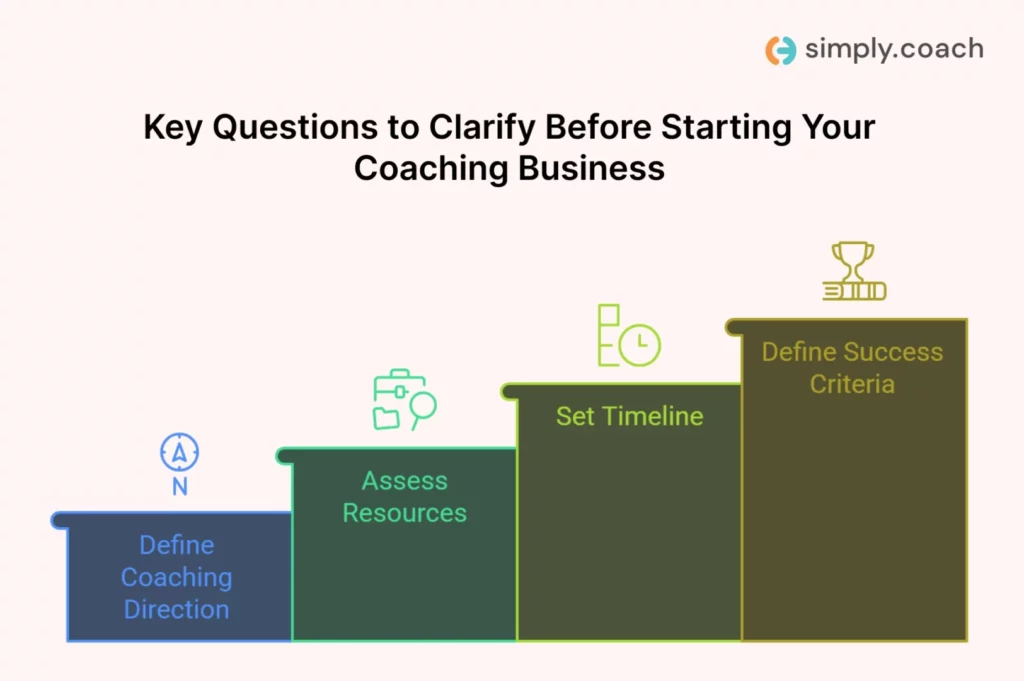
Before starting a coaching business checklist, you need clarity on how your practice will function under real client conditions. These questions help you evaluate readiness, constraints, and alignment with the kind of outcomes you want to deliver.
1. Describe your coaching direction and client profile
- What kind of client situations do you want to work with repeatedly, especially under emotional or relational complexity?
- What expectations do your ideal clients hold around pace, depth, and communication?
- How clearly can you define your ideal client’s decision-making style and emotional readiness?
- Assess your available resources and constraints
- How much financial flexibility do you realistically have to support systems, tools, and setup?
- What level of administrative complexity can you sustain without disrupting coaching quality?
- Which tools are you planning on using to support your coaching process?
- Decide on your timeline and implementation pace
- How will you prioritize changes that directly affect client engagement?
- How will you test new processes before fully integrating them into your workflow?
- How will you maintain session quality while introducing new systems?
- Reflect on success criteria and internal barriers
- Where do you tend to overcompensate instead of creating structured accountability?
- What beliefs might prevent you from introducing stronger boundaries or systems?
- What past experiences influence how you design or avoid systems in your practice?
Also read: How to Start an Online Life Coaching Business (Step-by-Step Blueprint)
With clarity on your goals and clients, organize your insights into a step-by-step checklist that forms the backbone of your launch plan.
14-Step Checklist For Starting A Coaching Business
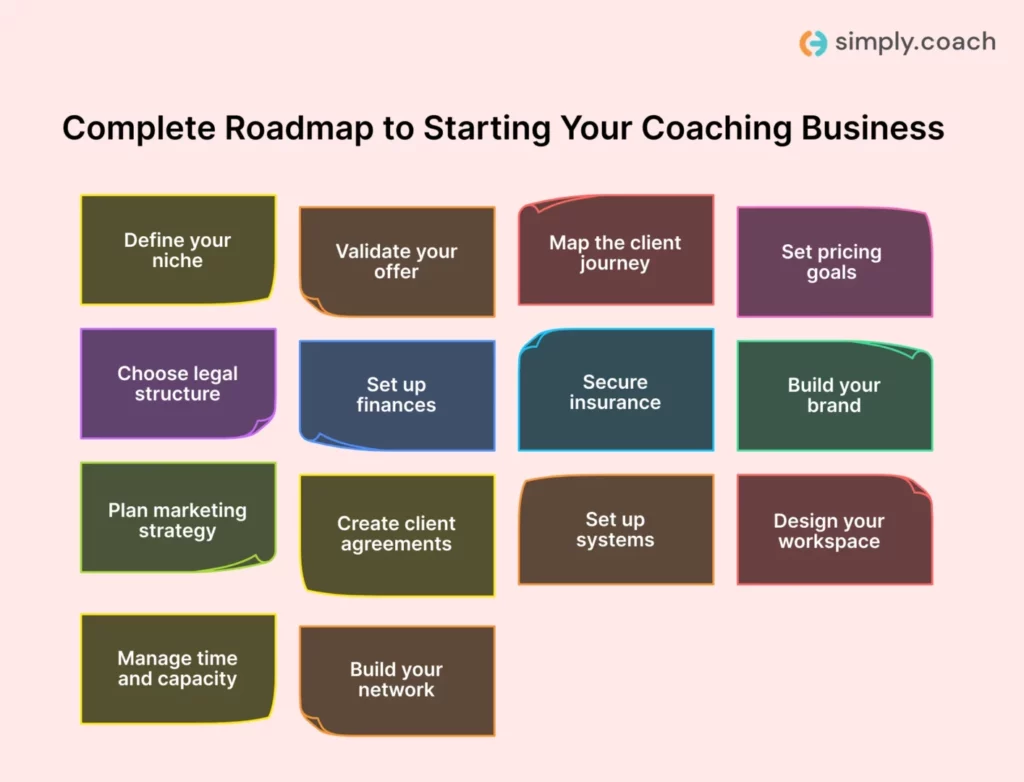
A ‘starting a coaching business checklist’ is a working structure that supports how you deliver, track, and sustain client outcomes. Without this, your practice relies on memory and improvisation, which creates inconsistency. This checklist helps you translate your coaching expertise into repeatable, reliable processes that hold under real client conditions.
1. Clarify your niche, audience, and positioning
This step defines where your coaching creates the most impact and how you operate within that scope. It combines external positioning with internal clarity, ensuring your work remains consistent, effective, and aligned in complex client situations.
Without this niche clarity, sessions become generic, boundaries blur, and decision-making becomes reactive instead of structured.
How to implement this step
- Identify recurring client patterns you handle effectively, such as burnout, conflict cycles, or decision paralysis.
- Analyze existing clients to determine who makes consistent progress and the factors driving those outcomes.
- Define your positioning based on specific problems you solve and measurable outcomes you facilitate.
- Establish your vision in terms of clear client transformations, such as improved emotional regulation or decision clarity.
- Articulate your mission by specifying who you work with and the patterns you address repeatedly.
- Identify 3–5 core values that guide boundaries, pacing, and intervention choices during sessions.
What this looks like in your practice
- Your sessions consistently focus on defined, high-impact client challenges and transformation goals.
- Clients quickly understand whether your approach aligns with their needs and expectations.
- You maintain clear boundaries and decline clients outside your defined scope of work.
- Your session structure remains stable, even when client situations become unpredictable.
- Decisions are driven by client progress, safety, and your defined values, not external pressure.
2. Validate your market and offer structure
At this stage, you are testing whether your coaching translates into a clear, relevant offer that clients can recognize and commit to. This is about the fit between client need, your method, and how you present it.
How to implement this step
- Research existing coaches working with similar patterns to understand how they structure and communicate their offers.
- Identify gaps where client needs are not being addressed with sufficient depth or clarity.
- Define your offer by outlining session structure, duration, and expected behavioral or emotional outcomes.
What this looks like in your practice
- Clients understand what your coaching involves before the first session.
- You spend less time explaining your process repeatedly.
- Your sessions follow a clear arc aligned with the offer structure.
- Clients engage with realistic expectations around depth and pace.
3. Map your audience journey and client experience
Without mapping the journey, client engagement becomes inconsistent across touchpoints. This step ensures that from first contact to ongoing sessions, the experience supports trust, clarity, and continuity.
How to implement this step
- Outline each stage from initial inquiry to ongoing coaching engagement and closure.
- Define what clients need at each stage, including information, structure, and emotional safety.
- Identify where breakdowns occur, such as no-shows, confusion, or drop-offs, and design corrections.
What this looks like in your practice
- Clients arrive prepared and understand the purpose of each session.
- Transitions between sessions feel structured, not fragmented.
- You see fewer no-shows due to clearer expectations and reminders.
- Clients stay engaged because the process feels predictable and supportive.
Also read: Top 10 Coaching Apps 2026: Streamline & Enhance Client Experience
4. Set your financial goals and pricing approach
This step is about aligning your pricing with the depth, intensity, and structure of your coaching, not market averages. Poor alignment here leads to overextension or reduced client commitment.
How to implement this step
- Define pricing based on session depth, preparation time, and the required level of between-session support.
- Create structured options that reflect different levels of engagement and intensity.
- Evaluate whether your pricing supports sustainable delivery without compromising session quality.
What this looks like in your practice
- Clients commit with clarity on what they are paying for and why.
- You avoid overextending yourself across too many engagements.
- Sessions maintain quality because your workload is controlled.
- Pricing supports consistent delivery without reactive adjustments.
5. Establish your legal and business structure
This step defines how your practice operates from a compliance and liability standpoint. It affects how you manage risk, formalize client relationships, and separate personal and professional responsibilities. Without clarity here, you expose your practice to avoidable legal and financial vulnerabilities.
How to implement this step
- Choose a structure such as sole proprietorship, LLC, or S-corporation based on liability exposure and long-term plans.
- Register your business name and obtain required identifiers like EIN or local business registration numbers.
- Ensure your structure supports clear separation between personal and coaching-related financial activity.
What this looks like in your practice
- Your coaching engagements are formally recognized under a defined business entity.
- You operate with clear boundaries between personal and professional liabilities.
- Your contracts and agreements align with your chosen structure.
- You reduce risk exposure in case of disputes or financial issues.
6. Set up financial systems and business accounts
Financial structure tracks income, supporting clarity, reducing stress, and preventing operational confusion. Without a dedicated system, you risk mixing transactions, missing obligations, and losing visibility into your practice. This step ensures your financial activity remains organized, traceable, and manageable over time.
How to implement this step
- Open a dedicated business bank account to separate coaching income and expenses.
- Set up systems for facilitating payments and tracking invoices consistently.
- Choose a method for monitoring cash flow and recording financial activity regularly.
What this looks like in your practice
- You can clearly track income, expenses, and outstanding payments.
- Financial decisions are based on accurate, up-to-date information.
- You avoid confusion between personal and business transactions.
- Payment processes feel structured and predictable for clients.
Also read: 10 Best Billing Software for Life Coaches in 2026: Streamline Payments & Invoicing
7. Secure insurance, compliance and risk coverage
Coaching involves responsibility, especially when working with sensitive client situations. This step ensures you are protected against professional risks, liability claims, and unforeseen issues. Skipping this creates exposure that can disrupt your practice significantly.
How to implement this step
- Obtain professional indemnity insurance covering coaching, training, and advisory services.
- Evaluate whether additional liability insurance is required based on your structure and context.
- Ensure compliance with local regulations, licensing, and professional standards.
What this looks like in your practice
- You operate with confidence knowing your work is protected.
- Clients recognize your practice as credible and professionally structured.
- You are prepared for unexpected situations without reactive scrambling.
- Your practice meets required legal and professional standards.
8. Build your brand identity and online presence
Your brand identity and online presence define how potential clients perceive your expertise and credibility. Thoughtful design, messaging, and content convey your coaching philosophy, niche focus, and professional standards. Every visual element, profile, and communication touchpoint should consistently reinforce your positioning.
How to implement this step
- Create a logo, tagline, and email signature reflecting your niche and professional tone.
- Purchase a domain name and set up a simple, client-friendly website with clear service descriptions.
- Optimize LinkedIn, Facebook, and professional profiles to highlight certifications, experience, and testimonials.
What this looks like in your practice
- Clients immediately recognize your professional identity and value proposition.
- Messaging across platforms is consistent, reinforcing trust and credibility.
- Online presence positions you as an authority in your field.
- Clients find relevant, clear information that encourages engagement.
9. Design your marketing and relationship strategy
A targeted marketing and relationship strategy helps you connect with ideal clients while building a strong professional network that supports long-term growth. Beyond visibility, it’s about creating meaningful relationships with peers, collaborators, and referral partners who expand your reach and credibility. When your outreach, content, and networking align with real client challenges, you create consistent, high-quality opportunities without relying on cold outreach.
How to implement this step
- Identify and engage connectors, coaches, business leaders, and influencers aligned with your niche.
- Participate in professional associations, workshops, and networking events to build relevant relationships.
- Develop a content strategy (articles, newsletters, social media) that reflects client pain points and expertise.
- Engage in peer coaching or mastermind groups to exchange insights and strengthen your network.
- Track engagement, referrals, and opportunities to refine your messaging and outreach approach.
What this looks like in your practice
- Marketing efforts attract aligned, high-value clients rather than generic leads.
- Strong relationships create consistent referral pathways and collaboration opportunities.
- Ongoing peer interaction improves your coaching quality and decision-making.
- Your presence and content reinforce credibility and authority in your niche.
- Outreach and networking translate into measurable, sustainable business growth.
Also read: Marketing for Coaches: 25 Best Strategies for 2026
10. Create your coaching agreements and engagement models
Well-structured agreements and engagement models protect both coach and client, clarify expectations, and define responsibilities. Clear agreements reduce miscommunication, enhance professional credibility, and allow you to structure flexible offerings that cater to diverse client needs. Tiered engagement models, from entry-level to premium, enable scalability and tailored services.
How to implement this step
- Draft standard coaching agreements detailing scope, session structure, cancellation policies, and responsibilities.
- Create tiered packages (platinum, gold, silver) with clearly defined deliverables and outcomes.
- Regularly review agreements to ensure alignment with legal requirements and coaching best practices.
What this looks like in your practice
- Clients understand expectations and commitments upfront.
- Coaching sessions proceed smoothly without disputes or confusion.
- Transparent agreements reinforce professionalism and trust.
- Flexible packages accommodate varying client goals and budgets.
11. Set up your operational systems and tools
Efficient operational systems allow you to manage clients, sessions, finances, and administrative tasks without disrupting your coaching practice. The right platforms enable seamless session scheduling, invoicing, progress tracking, and secure document storage.
How to implement this step
- Implement scheduling, client management, and invoicing platforms suitable for coaching services.
- Use cloud storage and secure backup systems to protect client data and maintain accessibility.
- Regularly audit tools to ensure efficiency, scalability, and alignment with your workflow.
What this looks like in your practice
- Sessions and administrative tasks flow efficiently without disruption.
- Clients experience professional, reliable engagement throughout the coaching journey.
- Tools enable tracking of goals, progress, and follow-up actions.
- Operational consistency reinforces high standards and enhances client satisfaction.
Also read: 20+ Best Coaching Platforms for 2026 to Run & Scale Your Business
12. Design your workspace and session environment
Your coaching environment, physical or virtual, directly affects client engagement, comfort, and confidentiality. A well-designed space minimizes distractions, supports clear communication, and enhances professional credibility. Equipment quality, lighting, and ergonomics impact session effectiveness, while virtual setups must ensure smooth video, audio, and privacy compliance. Tailoring the environment to client needs improves focus and strengthens the therapeutic alliance.
How to implement this step
- Ensure a quiet, distraction-free physical or home office with appropriate seating and lighting.
- Equip video sessions with a high-quality camera, microphone, and stable internet connection.
- Maintain confidentiality measures for digital and physical spaces, including soundproofing or secure storage.
What this looks like in your practice
- Clients feel comfortable, safe, and focused throughout sessions.
- Technical disruptions are minimized, allowing uninterrupted coaching conversations.
- Workspace reflects your coaching brand and standard of care.
13. Structure your time, roles, and delivery capacity
Effective time management ensures that coaching, marketing, content creation, and administrative tasks receive focused attention. Structuring roles prevents burnout and maximizes client impact, while understanding delivery capacity maintains quality across engagements. Time-blocking, delegation, and clear boundaries enable consistency in session delivery, client follow-up, and business growth without overextending yourself.
How to implement this step
- Create weekly time blocks for coaching, marketing, administration, and personal development.
- Delegate or automate tasks that do not require your direct expertise.
- Track client load to maintain high-quality delivery without overcommitment.
What this looks like in your practice
- Sessions are prepared and executed without stress or scheduling conflicts.
- Administrative and marketing work is handled efficiently.
- Clients receive consistent attention and professional engagement.
- You maintain work-life balance and sustainable business growth.
14. Develop your professional network and community
Your network and professional community are critical for referral pathways, collaborative learning, and ongoing support. Engaging with peers, mentors, and industry groups expands opportunities and knowledge. Strategic networking enhances credibility, enables partnerships, and provides access to high-quality clients.
How to implement this step
- Identify and connect with coaches, business leaders, and influencers aligned with your niche.
- Participate in professional associations, workshops, and networking events to build relationships.
- Engage in peer coaching or mastermind groups to exchange insights and strategies.
What this looks like in your practice
- You gain trusted referral sources and collaborative opportunities.
- Access to expertise helps improve coaching delivery and client outcomes.
- Professional relationships provide feedback, accountability, and career growth.
- Community engagement strengthens your reputation and credibility in the industry.
Also read: Best Tools and Workflows to Automate Your Coaching Business
As you implement your checklist, being aware of common errors ensures you avoid setbacks that can derail your progress.
4 Critical Mistakes That Can Sabotage Your Coaching Launch
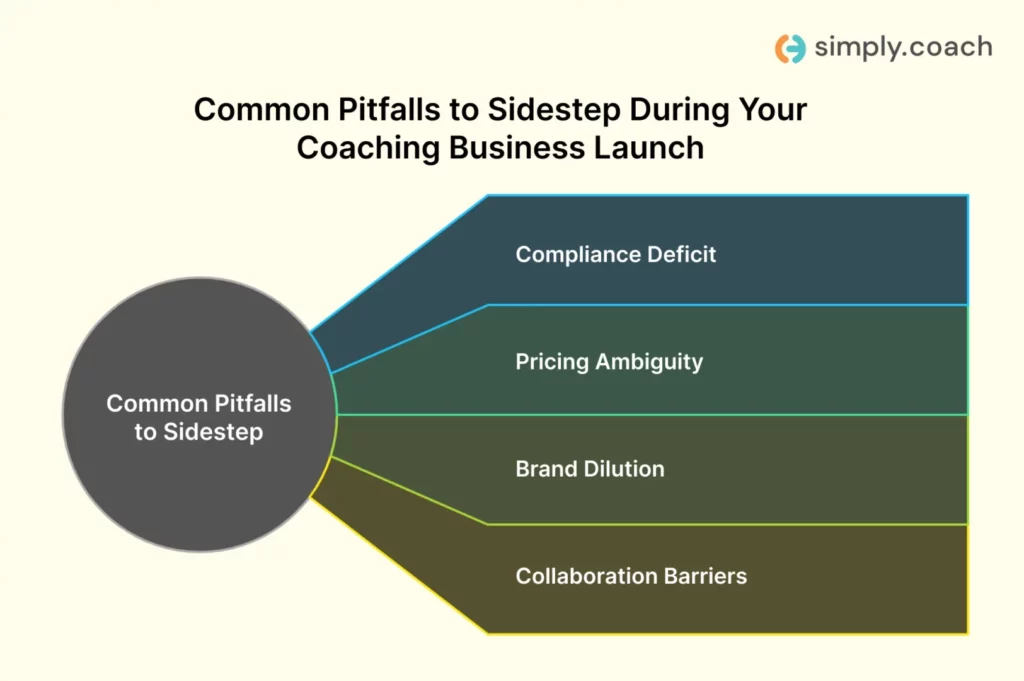
Even experienced coaches risk undermining their business if foundational elements aren’t properly established. Each misstep can create operational inefficiencies, compromise client trust, and limit long-term growth. Recognizing these challenges upfront ensures your practice is professional, compliant, and client-centered.
- Insufficient legal and insurance safeguards – Failing to secure professional indemnity, liability, or local business licensing exposes your coaching practice to legal disputes and regulatory penalties.
- Inconsistent pricing and service packages – Offering ad-hoc rates or poorly differentiated service tiers diminishes perceived value, complicates revenue tracking, and hinders scalability of coaching programs.
- Weak brand architecture and digital presence – Incoherent website messaging, absent email systems, or inconsistent social media branding can undermine credibility and reduce your visibility to high-value clients.
- Limited professional network and peer community – Avoiding strategic relationships with connectors, associations, or other coaches limits referral pathways, mentorship opportunities, and collaborative growth initiatives.
Also read: How to Start and Grow a Successful Creativity Coaching Business
Once risks are mitigated, Simply.Coach can help streamline operations, client management, and workflow, letting you focus on delivering high-impact coaching.
Launch Your Coaching Practice Confidently With Simply.Coach
Starting a coaching business comes with endless moving parts, client management, scheduling, compliance, and marketing. Simply.Coach streamlines all of these, giving you a single platform to manage sessions, track goals, automate reminders, and engage clients professionally. Focus on delivering transformative coaching while the platform handles the operational complexity.
- Streamlined goal & development planning – Define clear client goals from day one, align them with your niche, and track behavioral progress without relying on scattered notes.
- Integrated reports – Monitor session consistency, client engagement, and adherence patterns early, so you can refine your process before scaling your practice.
- Stakeholder integration – Set up structured input loops for corporate or sponsored clients, ensuring clarity and alignment from the start of your engagements.
- Action plans with automated reminders – Build accountability into your practice by ensuring clients follow through between sessions, reducing no-shows and drop-offs.
- Client workspaces – Create a consistent onboarding and engagement experience where clients can access goals, session notes, and resources in one place.
- Shared resources – Deliver structured materials aligned with your coaching niche, reinforcing your positioning and improving session continuity.
- Team engagements and journeys – Organize multi-client programs or group coaching workflows early, so your practice can scale without losing structure.
Simply.Coach transforms your process of starting a coaching business checklist into a fully operational, professional, and client-ready system, eliminating common pitfalls while enhancing credibility and efficiency.
Conclusion
Building a coaching business is a challenging arrangement of vision, client strategy, operational systems, and legal compliance. Defining your niche, mapping your client journey, setting up financial structures, and designing marketing workflows are not just administrative tasks; they directly influence your ability to deliver consistent, high-quality coaching outcomes.
Clear pricing models, structured engagement agreements, and automated workflows allow you to spend more time facilitating client breakthroughs and less on chasing logistics. Strategic planning also safeguards your practice against gaps in compliance, risk coverage, and operational inefficiency, which can compromise both your reputation and coaching results.
Simply.Coach equips you to implement these steps with precision. Contact management, scheduling, and action plans provide a single, cohesive framework for managing client data, tracking progress, and automating administrative processes. This ensures you maintain professional rigor, deepen client engagement, and scale your business while preserving your focus on delivering transformative coaching.
FAQs
1. What is the first step in starting a coaching business?
Clarify your vision, define your niche, and identify your target client before investing in branding or operational tools for your coaching business.
2. How do I determine my pricing as a coach?
Assess your target client’s capacity, market standards, and your expertise level to set fees that reflect value and sustainability.
3. Do I need a business license to coach professionally?
Yes, depending on your country or state. Verify local requirements, register your entity, and obtain any professional permits needed.
4. How important is it to have a coaching agreement?
Essential. A clear coaching agreement outlines scope, responsibilities, confidentiality, and session structure, protecting both you and your clients.
5. Should I offer pro bono sessions when starting out?
Limited pro bono work builds experience and referrals, but cap hours to avoid operational strain or undervaluing your services.
6. What tools should I use to manage clients and sessions?
Use an integrated platform with scheduling, automated reminders, session tracking, and goal management to maintain efficiency and client engagement.
7. How do I ensure compliance and risk coverage?
Secure professional indemnity and liability insurance, and adhere to local legal and ethical requirements to protect your practice and clients.
8. How do I balance client work and business operations?
Block time for marketing, administration, professional development, and coaching delivery; delegate tasks outside your core expertise to stay focused.