
Setting the right group coaching pricing for your coaching sessions in 2026 can feel complex, with many factors shaping the final decision. As an experienced coach, you already know your expertise, location, and client needs directly influence how your services are valued. You may plan to expand your group programs or introduce them for the first time. Finding prices that reflect your value without discouraging potential clients remains essential for sustainable growth.
This guide helps you understand group coaching pricing models, rate structures, and fee models used by successful coaches. You will learn how pricing strategy affects coaching business profitability, client commitment, and long-term stability. The guide answers a common question coaches ask: how much should you charge for group coaching? Each section breaks down pricing decisions using clear benchmarks, practical examples, and value-based considerations, helping you make confident decisions for your coaching business.
Key Takeaways
- Group coaching pricing should reflect outcomes, group dynamics, and realistic enrollment, not just session length.
- Using your 1:1 coaching rate as a baseline helps anchor value and maintain pricing consistency.
- Smaller groups support higher per-client pricing, while larger groups require strong structure and engagement.
- Cohort-based and program pricing increase commitment, predictability, and long-term coaching revenue.
- Clear pricing communication improves conversions by showing results, structure, and return on investment.
- Avoid underpricing expertise, overcrowding groups, or misaligning rates with your ideal client profile.
- An all-in-one coaching platform like Simply.Coach helps manage group pricing, scheduling, and client progress in one place, making scalable group coaching easier to run.
What is Group Coaching?
Group coaching is a structured format where you coach multiple clients together in live sessions. It creates a collaborative learning environment that accelerates growth, accountability, and skill development for your clients while allowing you to manage more participants efficiently.
How group coaching differs from other formats
- Group coaching vs 1:1 coaching: Clients learn from each other’s experiences, gain diverse perspectives, and stay motivated through peer accountability, which is hard to achieve in one-on-one sessions.
- Group coaching vs courses or workshops: Unlike static courses, group coaching adapts to individual needs while maintaining structured guidance. Clients receive actionable feedback and practical support, not just content.
Types of group coaching
- Open groups: Flexible enrollment allows you to attract new clients and introduce them to your coaching style.
- Cohort-based programs: Structured start and end dates ensure accountability and measurable progress.
- Corporate / team coaching: Customized sessions improve team performance, communication, and leadership skills while generating higher revenue per client.
Also read: How To Structure A Group Coaching Program (Step-By-Step)
Why Group Coaching is a Scalable Revenue Model for Coaches
Group coaching allows you to coach multiple clients simultaneously while increasing both revenue and client impact. It is a powerful way to grow your business efficiently without overextending your time.
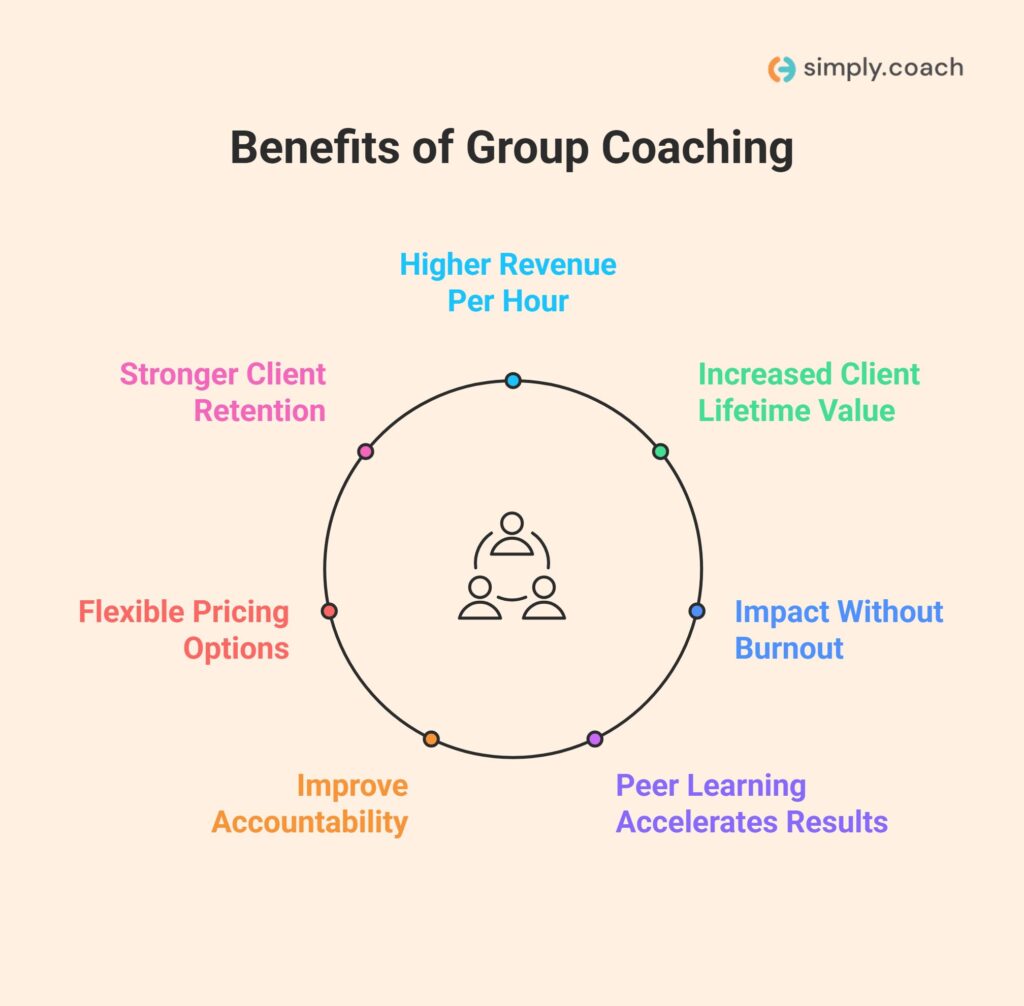
- Higher revenue per hour: You can charge multiple clients for a single session, often earning two to five times more than a one-on-one session.
- Increased client lifetime value: Clients engaged in groups are more likely to continue with additional programs, follow-up coaching, or longer-term packages.
- Impact without burnout: Coaching in a group allows you to deliver results for more clients without extending your weekly hours or compromising session quality.
- Peer learning accelerates results: Participants share strategies, insights, and feedback, enabling faster skill development and real-world problem solving.
- Built-in accountability improves engagement: Group check-ins and shared progress tracking keep clients on track, reducing no-shows and dropouts.
- Flexible pricing options: You can offer tiered group sizes or advanced programs, adjusting fees to maximize income per session while maintaining client satisfaction.
- Stronger client retention: The sense of community encourages clients to remain in programs longer, refer others, and invest in higher-value coaching opportunities.
Group coaching creates a sustainable model that maximizes your earning potential while enhancing outcomes and satisfaction for your clients.
Key Factors That Influence Group Coaching Pricing
Several key factors determine how you should price your group coaching programs. Paying attention to these ensures your rates are profitable, fair, and aligned with client expectations.
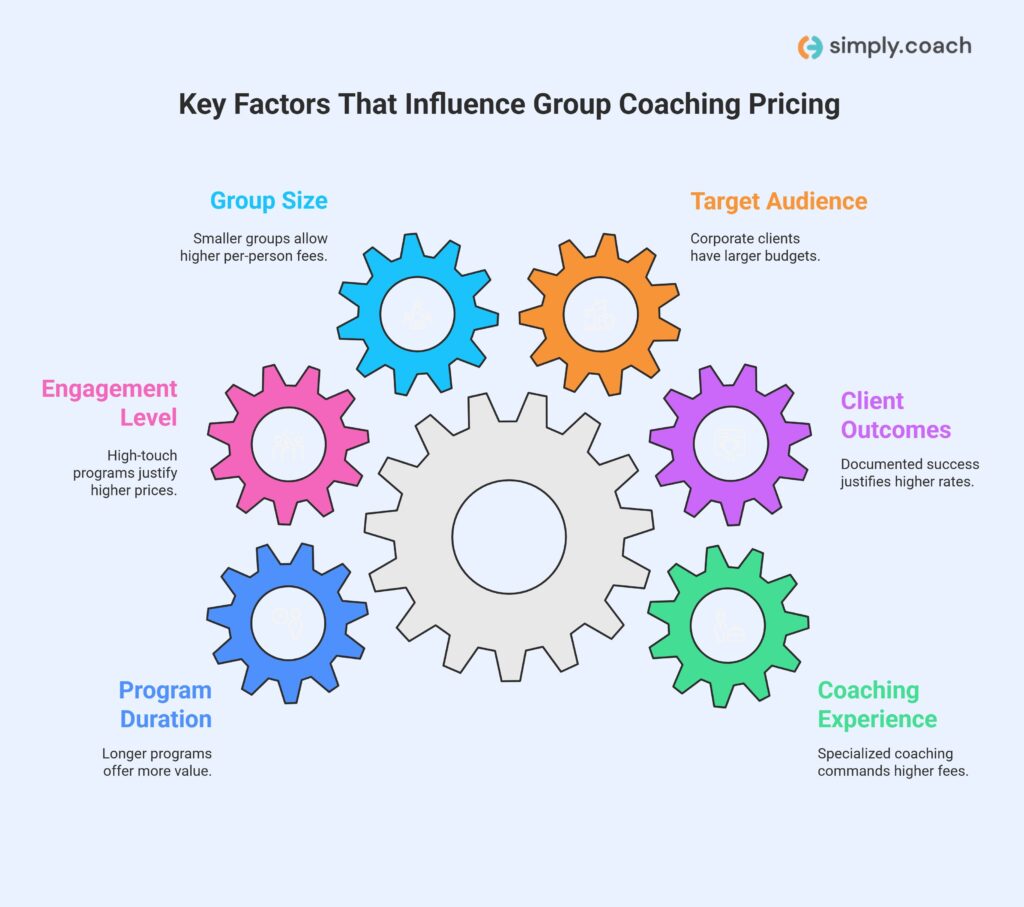
- Your coaching experience and niche: Specialized coaching like executive or leadership programs allows higher pricing, while beginner or general life coaching may require lower rates.
- Client outcomes and proof of success: Documented results, testimonials, and case studies increase perceived value and justify higher fees.
- Target audience and willingness to pay: Corporate clients often have larger budgets than individual clients; industry and regional norms also influence acceptable pricing.
- Group size: Smaller groups allow more personalized attention, enabling higher per-person fees; larger groups may require lower rates to maintain accessibility.
- Engagement level: High-touch programs with frequent check-ins justify higher prices than light-touch or self-paced groups.
- Program duration and format: Longer programs or live sessions offer more value and can be priced higher than shorter or asynchronous formats.
Considering these factors helps you set group coaching prices that reflect your expertise, maximize revenue, and deliver meaningful results for your clients.
How to Set Group Coaching Prices (Step-by-Step Framework)
Setting the right price for your group coaching ensures fair compensation while delivering measurable value to clients. Use this framework to create rates that are competitive, profitable, and aligned with your program structure.
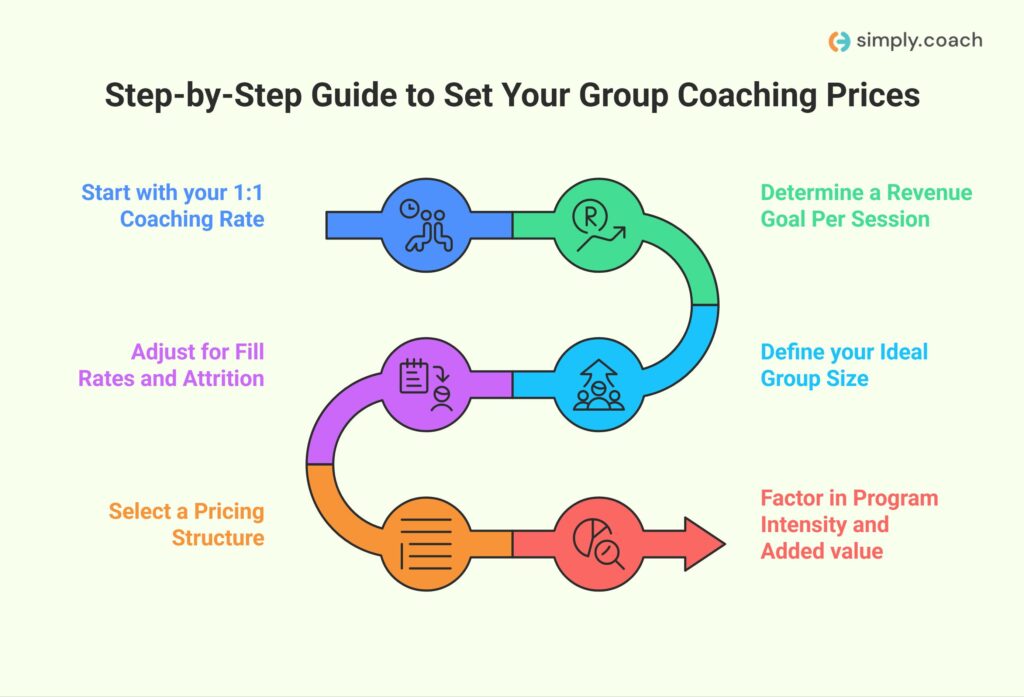
Step 1: Start with your 1:1 coaching rate
Begin with your individual session rate as a baseline. This anchors perceived value and communicates your expertise to potential clients.
- Anchor perceived value: Your 1:1 session rate signals credibility.
Example: $150 per session sets a clear starting point for group pricing.
- Client comparison matters: Clients often compare your group program to private coaching. Pricing too low may reduce perceived value.
- Maintain consistency: Your group program should reflect the same expertise and quality as your one-on-one coaching.
Step 2: Determine a revenue goal per session
Decide how much you want to earn for each group session, considering preparation time, facilitation, and added value from peer learning.
- Outperform 1:1 income: Multiply your 1:1 rate by 1.5 or 2 depending on group size and program intensity.
Example: $150 x 1.5 = $225 per session.
- Include preparation time: Factor in planning, materials, and follow-up to ensure your hourly earnings remain fair.
- Set realistic targets: Your revenue goal helps you determine the minimum per-client rate for sustainable profitability.
Step 3: Define your ideal group size
Choose a group size that balances personal attention with revenue potential. Your group size affects client experience and pricing strategy.
- Small groups (4–6 clients): Allow personalized guidance and higher per-person rates.
- Medium groups (7–10 clients): Balance scale and individual attention, suitable for mid-tier pricing.
- Large groups (10–15 clients): Maximize total session revenue; consider slightly lower per-person rates.
Example calculation: $225 ÷ 5 clients = $45 per client per session. A 6-client group = $37.50 per client, adjusting based on fill rates.
Step 4: Adjust for fill rates and attrition
Not all clients attend every session. Planning for realistic attendance ensures your pricing protects revenue while remaining fair.
- Anticipate attendance: If you expect 85% participation, divide your session revenue by expected participants.
Example: $225 ÷ 5 attendees = $45 per client.
- Maintain consistent revenue: This ensures your hourly earnings are stable even if a few clients miss a session.
- Plan for cancellations: Consider offering a slightly higher rate or optional makeup sessions to cover gaps.
Step 5: Select a pricing structure
Choose a pricing structure that matches program length, delivery style, and client expectations. Your pricing format impacts both revenue and commitment.
- Per session: Simple and easy for short-term or trial programs.
- Weekly rate: Useful for ongoing programs.
Example: 2-hour weekly sessions x $150/hour = $300 per week. 5 clients = $60 per person per week.
- Monthly or program-based pricing: Best for multi-week cohorts.
Example: 8-week leadership program, 2-hour sessions per week, 5 clients, $30/hour per client:
- Hourly rate per client: $30
- Session length: 2 hours → $30 × 2 = $60 per client per session
- Number of sessions: 8 weeks → $60 × 8 = $480 per client
This ensures predictable revenue for you while clearly showing clients how the program pricing is calculated.
- Tiered pricing: Offer premium options with extra support, templates, or private check-ins for higher-paying clients.
Step 6: Factor in program intensity and added value
Consider the extra value clients receive through coaching support, resources, and guidance. Higher value justifies higher rates and client satisfaction.
- High-touch programs: Frequent check-ins or homework reviews allow you to charge more per client.
- Bonus materials: Templates, assessments, or recordings increase perceived value without adding hours.
Example: Including a 30-minute one-on-one check-in per client could raise your fee by $20–$30 per participant while keeping group facilitation efficient.
- Highlight outcomes: Emphasize measurable results like skill growth, accountability, or goal achievement to justify pricing.
Following this framework ensures your group coaching prices reflect your expertise, scale your revenue efficiently, and deliver tangible results that clients perceive as highly valuable.
Want a clearer approach to group coaching pricing?
Setting prices that balance client commitment and sustainable revenue takes more than guesswork. Simply.Coach’s “Complete Guide to Pricing Strategies for Your Coaching Business” walks you through practical pricing models, real examples, and decision frameworks tailored for professional coaches

Group Coaching Pricing Models with Examples
Choosing the right pricing model is key to aligning your group coaching program with client expectations, program structure, and revenue goals. Each model offers unique advantages depending on your audience, session format, and desired outcomes.
| Pricing Model | Example Price Range | Best Use Case | Pros | Cons |
| Per-session | $30–$100 per participant per session | Short-term programs, workshops, or trial sessions | Simple, flexible, easy to understand | Revenue may fluctuate, less predictable income |
| Monthly subscription | $100–$300 per participant per month | Ongoing coaching, accountability groups | Predictable recurring income, encourages client retention | Clients may cancel anytime, requires continuous value |
| Cohort-based program | $300–$1,000 per participant per 6–12 weeks | Structured multi-week programs, skill-building | Clear start and end, higher commitment, measurable results | Less flexible for clients, requires upfront planning |
| Tiered pricing (Basic/Premium/VIP) | Basic $100 / Premium $200 / VIP $400 per cohort | Programs with varying support levels | Attracts multiple client segments, increases revenue | Can be complex to manage, requires clear value for each tier |
| Corporate group coaching | $1,000–$5,000 per team per program | Teams, organizations, high-value clients | Higher revenue per client, measurable ROI for companies | Requires customization, longer sales cycle |
Including pricing examples helps you quickly compare models, test your rates, and decide which approach best fits your program, audience, and revenue goals. Choosing the right model ensures you deliver value to clients while maximizing your group coaching profitability.
Common Group Coaching Pricing Mistakes (And How to Avoid Them)
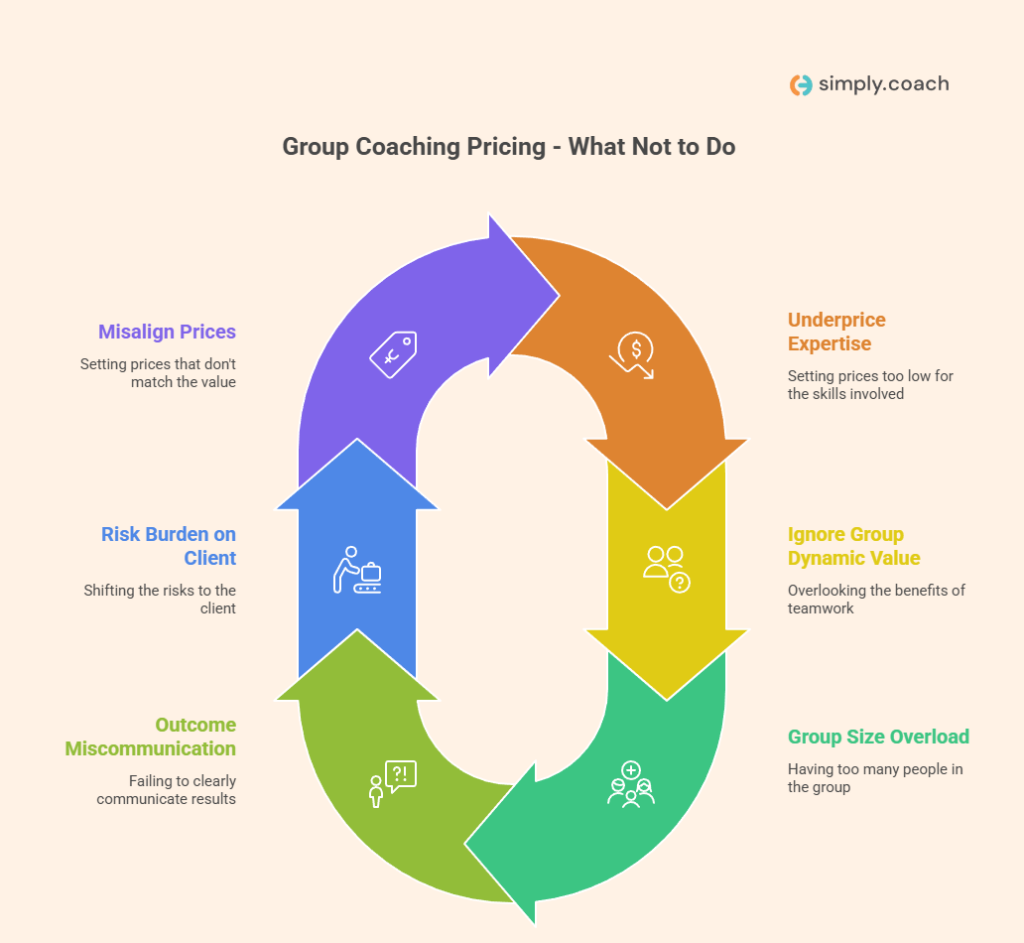
Pricing mistakes often limit your revenue and reduce client commitment before your program even begins. Avoiding these common errors helps you protect your time, improve outcomes, and attract the right clients.
- Underpricing your expertise: Charging too low signals low value and attracts clients who are less committed to the work. Price your group coaching based on your experience, proven outcomes, and facilitation effort, not just session time.
- Ignoring the value of group dynamics: Group coaching delivers added value through peer accountability, shared learning, and real-world problem solving. Failing to include this in your pricing leads to undervaluation of the overall experience.
- Overloading groups to increase revenue: Adding too many participants reduces interaction, limits feedback, and weakens results. Set a group size that allows meaningful discussion, participation, and visible progress for every client.
- Failing to communicate outcomes and ROI: Clients do not buy sessions; they invest in outcomes. If pricing is not tied to clear results, milestones, or transformation, prospects struggle to justify the cost.
- Making clients absorb all the risk: High upfront pricing without reassurance can slow conversions. Offering structured onboarding, limited trials, or clear refund terms reduces hesitation and builds trust.
- Misaligning prices with your ideal client profile: Pricing that ignores your audience’s industry, income level, or expectations attracts the wrong clients. Align your rates with what your ideal clients are willing and prepared to invest.
Avoiding these mistakes helps you position your group coaching as a premium, outcome-driven experience that respects both your expertise and your clients’ commitment.
Also read: Running Successful Online Group Coaching Programs with Simply.Coach
Conclusion
Setting the right group coaching prices allows you to protect your time, attract committed clients, and deliver consistent outcomes at scale. When pricing reflects your expertise, group dynamics, and realistic enrollment, your programs become easier to manage and more sustainable. Clear pricing decisions reduce burnout, improve engagement, and help you build predictable revenue across your coaching offers. With the right structure in place, group coaching supports long-term business growth without compromising client experience.
Simply.Coach is an all-in-one coaching platform designed to support professional coaches who run both group and one-on-one programs. It helps you manage pricing, scheduling, client communication, and progress tracking from a single, organized workspace. With tools built specifically for coaching businesses, Simply.Coach makes it easier to deliver high-quality group programs while staying focused on client outcomes.
FAQs
1. What is the average cost of group coaching programs?
Group coaching programs often range from $30 to $200 per participant per session. Multi-week programs may cost $300 to $1,000 or more. Pricing depends on experience, niche, and program depth.
2. Is group coaching more profitable than one-on-one coaching?
Group coaching can generate higher revenue per hour when groups are filled consistently. It allows serving multiple clients without increasing session time. Profitability depends on pricing, retention, and delivery efficiency.
3. Should group coaching prices be listed on a coaching website?
Listing prices can build trust and pre-qualify leads before discovery calls. Some coaches prefer sharing pricing after discussing client goals. The approach depends on audience expectations and sales strategy.
4. How often should group coaching prices be reviewed or adjusted?
Prices are typically reviewed once or twice a year. Adjustments often follow improved outcomes, stronger demand, or expanded program scope. Regular reviews help keep pricing aligned with value delivered.
5. Are payment plans common for group coaching programs?
Many coaches offer installment plans for higher-priced programs. Payment options reduce friction while maintaining perceived value. Clear terms help set expectations and reduce dropouts.
6. Does group coaching pricing vary by coaching niche?
Pricing often varies across niches such as executive, leadership, or wellness coaching. Specialized or corporate-focused programs usually command higher rates. Expected outcomes influence willingness to pay.
7. When does discounting group coaching prices make sense?
Discounts may work for early cohorts, limited launches, or beta programs. Frequent discounting can weaken perceived value. Pricing should still reflect outcomes and facilitator effort.