
In leadership programs, you often see teams struggle to communicate despite shared goals, because work styles clash and people make decisions in different ways. On Big Five vs MBTI, the short answer is this: the Big Five scores behavior on trait scales and is better at predicting performance, while the MBTI sorts people into types that are easy to talk about.
Below, you will see what each model measures, where they differ in organizational coaching, how to use them together and the pros and cons of each. If you need to choose now, go straight to Key Differences Between Big Five and Myers-Briggs Personality Indicators.
TL;DR
The Big Five and the MBTI answer different coaching questions. The Big Five scores openness, conscientiousness, extraversion, agreeableness and neuroticism on continuous scales, has strong research support and helps predict job performance, so it suits leadership assessment, succession planning and programs with measurable goals. The MBTI sorts people into 16 types from four preference pairs, is easy to introduce in a workshop and suits self-awareness and decision-style conversations, but its results can change on a retest. Neither covers everything: the MBTI has no emotional stability scale, and the Big Five says less about how a leader prefers to think. Use the Big Five when you need evidence, the MBTI when you need a shared language, and both when a program moves from awareness to behavior change.
What is the Big Five Personality Model?
The Big Five Personality Model is a research-based framework that describes the core personality traits in people. It is widely used in organizational coaching to understand leadership behavior, team dynamics and workplace interactions. With it, you can see how individual differences shape collaboration, decision-making and engagement.
The Big Five dimensions and their relevance in organizational settings are:
- Openness: Creativity, curiosity and willingness to embrace new ideas. Leaders high in openness explore new strategies but may challenge traditional workflows.
- Conscientiousness: Organization, reliability and focus on goals. Highly conscientious people drive performance, meet deadlines and keep standards consistent.
- Extraversion: Energy in social interactions, assertiveness and engagement in teams. Extraverted leaders energize meetings, draw people in and strengthen cross-functional collaboration.
- Agreeableness: Cooperation, supportiveness and the ability to resolve conflict. Teams high in agreeableness tend to manage conflict more smoothly and build stronger trust.
- Neuroticism: Emotional stability, stress response and resilience under pressure. High neuroticism can raise stress under tight deadlines, affecting morale and clear decision-making.
Understanding these traits lets you anticipate behavior, guide leadership development and tailor your work for both individuals and teams. When a client wants to go deeper into one trait, these OCEAN personality model questions give you prompts to explore it in a session.
When coaches should use big five assessments in organizational coaching
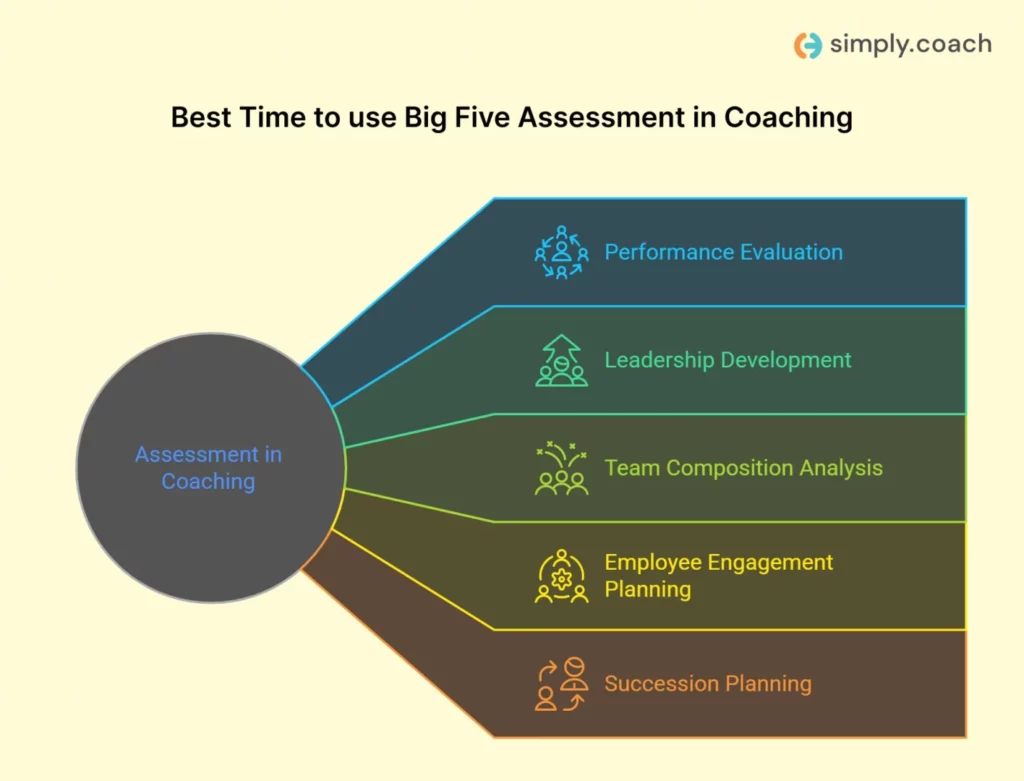
Big Five assessments are not just diagnostic; they are practical tools for organizational development. You can build them into leadership and team programs to target specific outcomes.
- Performance evaluation: Align traits with key competencies and role requirements.
- Leadership development: Identify leaders’ natural tendencies and potential areas for growth.
- Team composition analysis: Understand how trait combinations influence collaboration, communication and conflict.
- Employee engagement planning: Tailor your work to each person’s profile for better motivation and retention.
- Succession planning: Highlight traits that point to readiness for future leadership roles.
Bringing Big Five insights into coaching lets you design targeted, measurable work that improves both individual and team performance. For whole-team engagements, the five disciplines of systemic team coaching give you a structure for working with the team’s mix of traits.
What is the Myers-Briggs Type Indicator (MBTI)?
The Myers-Briggs Type Indicator (MBTI) is a psychological framework that explains how people take in information, make decisions and interact with others. In organizational and leadership coaching, the MBTI helps you understand leaders’ thinking patterns, decision-making preferences and working relationships. With it, you can guide leaders to improve collaboration, self-awareness and team effectiveness.
The MBTI sorts personality into 16 types using four preference pairs:
- Extraversion vs Introversion: Where leaders focus their energy, outward with teams or inward through reflection.
- Sensing vs Intuition: How leaders process information, through concrete facts or through patterns and possibilities.
- Thinking vs Feeling: How leaders make decisions, using logic and analysis or values and people considerations.
- Judging vs Perceiving: How leaders approach structure, preferring organization and planning or flexibility and adaptability.
Each pair adds one letter to a four-letter code such as ENTJ, and these combinations produce 16 distinct personality types, each linked to a leadership style, way of working with a team and pattern of workplace behavior. Understanding MBTI types lets you tailor coaching to a leader’s decision-making style, communication preferences and approach to problems. If a client already knows their Enneagram type, the differences between Myers-Briggs and the Enneagram help you explain how the two fit together.
When coaches should use MBTI in organizational coaching
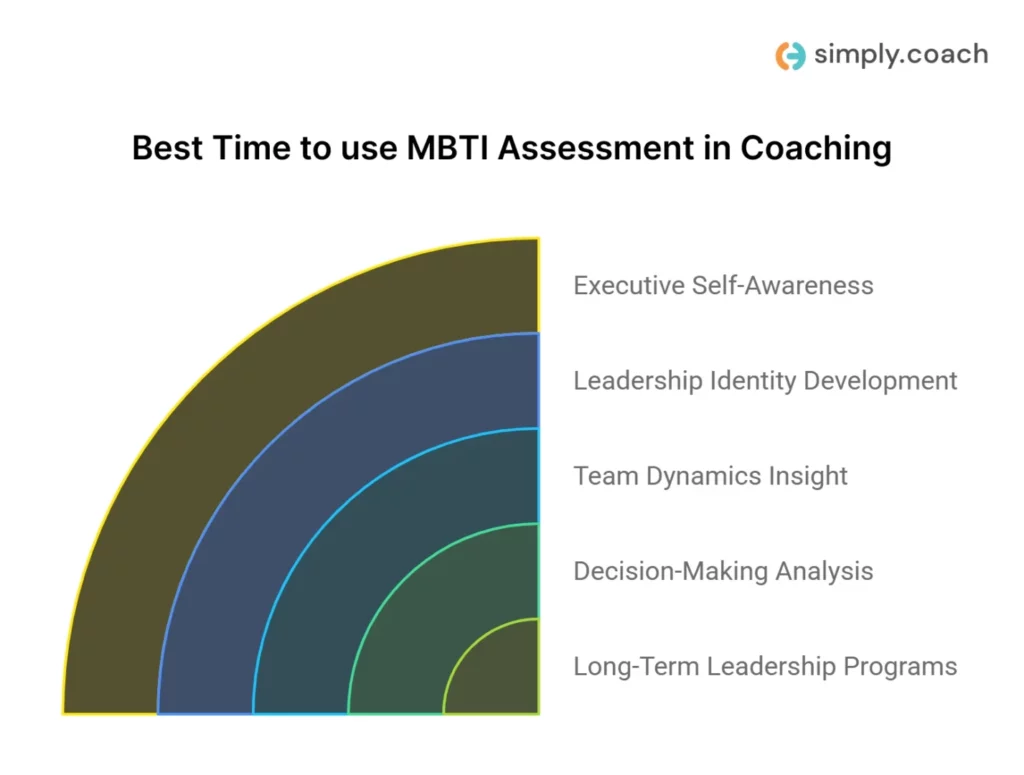
Myers-Briggs assessments work best when coaching focuses on self-awareness, leadership mindset and team collaboration rather than immediate behavior change. Typical uses include:
- Executive self-awareness: Help leaders understand how their preferences shape communication, decision-making and influence on the team.
- Leadership identity development: Explore how values, motivations and thinking preferences drive leadership style.
- Team dynamics insight: Identify how different personality types interact, anticipate conflict and improve collaboration.
- Decision-making analysis: Guide leaders in understanding their natural approach and how to adapt it for strategic outcomes.
- Long-term leadership programs: Use MBTI insights across several sessions to track growth and changes in mindset.
Bringing the MBTI into coaching programs strengthens leaders’ psychological insight, improves team cohesion and supports lasting leadership development. When a client needs more than a type, other personality tests like Myers-Briggs cover the traits, motivation and behavior the MBTI leaves out.
Key Differences Between Big Five and Myers-Briggs Personality Indicators
As a coach working with leadership teams, the difference between these frameworks shapes how you assess leaders, design your sessions and measure outcomes. The Big Five gives you behavioral data that predicts performance, while the MBTI helps you interpret how leaders think and make decisions.
1. Trait vs Type
When you assess leaders in organizational settings, the precision of the personality measure directly affects your coaching recommendations.
The Big Five works on continuous scales:
- Leaders score along a range, such as moderately high conscientiousness or low agreeableness.
- It helps you spot small differences between high performers and average performers.
- It is useful when coaching calls for fine adjustments in leadership behavior.
The MBTI assigns fixed personality types:
- Leaders are grouped into one of 16 categories, for example ENTJ or ISFP.
- It simplifies communication in workshops but loses behavioral nuance.
- Two leaders with the same type may still perform very differently under pressure.
Coaching insight: Use the Big Five when you need precision in leadership assessment. Use the MBTI when you want a shared language for discussing personality in teams.
2. Scientific Credibility
If your coaching outcomes are tied to performance, promotion or leadership readiness, the reliability of the assessment becomes a critical factor.
The Big Five is strongly supported by research:
- Organizational psychologist Adam Grant notes that the Big Five traits have high reliability.
- The same five traits show up across many cultures around the world.
- The traits help predict job performance and team effectiveness.
The MBTI shows weaker results in research:
- Grant cites an estimate that people who retake the test after five weeks have around a 50% chance of getting a different type.
- Its either-or letters hide the fact that most people sit near the middle of introversion and extraversion.
- It has limited ability to predict measurable outcomes like performance.
Coaching insight: Use the Big Five when your program needs data-backed decisions and measurable outcomes. Use the MBTI when your goal is reflection, awareness and discussion.
3. Behavior vs Cognition
In leadership coaching, you often need to decide whether to focus on changing behavior or on understanding the thinking behind it.
The Big Five focuses on observable workplace behavior:
- How leaders communicate in meetings and feedback sessions.
- How they respond to pressure, deadlines and conflict.
- How they collaborate, delegate and carry out tasks.
- It connects directly to performance and team outcomes.
The MBTI focuses on thinking preferences and decision-making style:
- How leaders interpret information and assess situations.
- How they balance logic with people considerations.
- How they approach planning, structure and flexibility.
- It explains the reasoning behind leadership behavior.
Coaching insight: Use the Big Five when you need to improve visible leadership behavior quickly. Use the MBTI when you want leaders to understand the thinking patterns behind that behavior.
4. Simplicity vs Depth
How useful an assessment is often depends on how easily leaders can understand and apply the insights during coaching programs. The two models differ sharply here.
The Big Five is easier to apply in organizational programs:
- Trait scores map directly to competencies like accountability or collaboration.
- It works well in large-scale HR and L&D programs.
- Leaders can apply the insights without much interpretation.
The MBTI needs guided interpretation:
- Sixteen personality types need explaining before leaders can apply them.
- Insights come out of guided discussions and coaching sessions.
- It suits smaller groups or executive coaching engagements better.
Coaching insight: Use the Big Five for programs at scale with clear outcomes. Use the MBTI for deeper coaching conversations and leadership reflection.
5. Use Case Alignment in Organizations
Selecting the right framework depends on the specific coaching objective and the outcomes your organization expects from the program.
| Coaching Objective | Big Five Application | MBTI Application |
|---|---|---|
| Leadership assessment | Identify traits linked to performance and readiness | Understand leadership style and preferences |
| Team development | Analyze the trait mix affecting collaboration and conflict | Explore communication and thinking differences |
| Performance improvement | Link traits to measurable behavior gaps | Reflect on decision-making and interpersonal style |
| Succession planning | Predict leadership potential using trait patterns | Support leadership identity development |
| L&D programs | Standardize assessments across large groups | Run interactive workshops and discussions |
The Big Five helps you predict and measure leadership behavior in real work settings, while the MBTI helps you interpret how leaders think, decide and interact. Used together, they let you design programs that move from awareness to measurable improvement, alongside the other coaching techniques and tools you use in sessions.
Big Five vs MBTI Core Comparison for Organizational Coaching
Before selecting an assessment, you need to be clear on what each framework actually measures and how it applies in real coaching situations. This comparison helps you match the right tool to your coaching objectives.
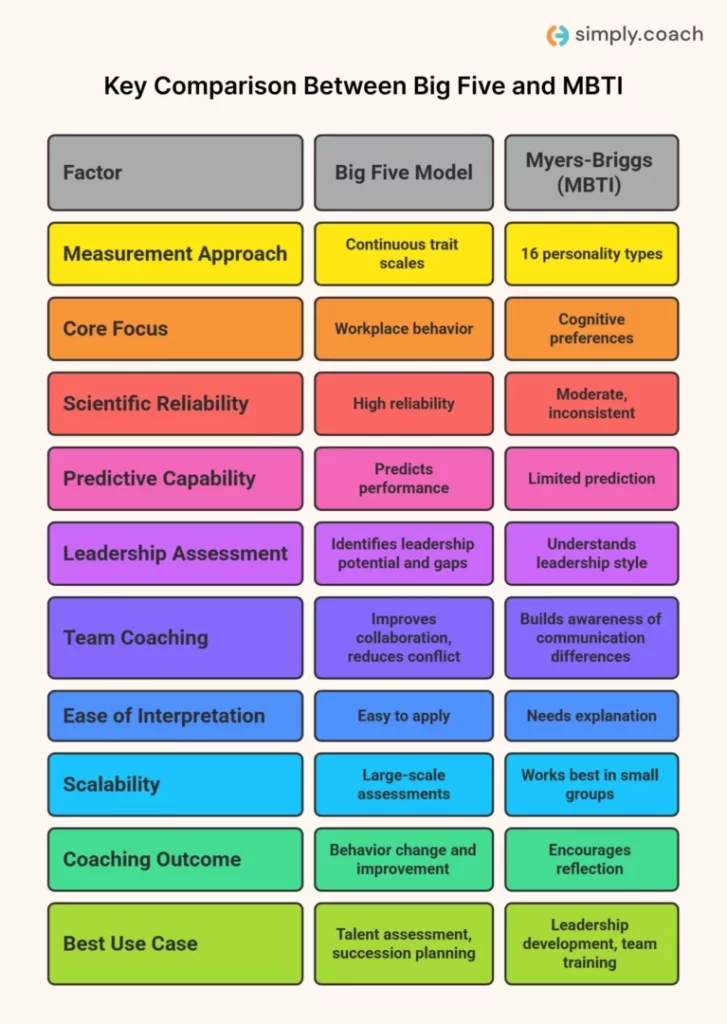
| Factor | Big Five Personality Model | Myers-Briggs (MBTI) |
|---|---|---|
| Measurement approach | Measures personality on continuous trait scales (low to high) | Places people into 16 fixed personality types |
| Core focus | Observable workplace behavior and consistent patterns | Thinking preferences and decision-making styles |
| Scientific reliability | High reliability and strong research support | Weaker reliability, with results that can change on a retest |
| Predictive capability | Helps predict job performance and team behavior | Limited ability to predict performance outcomes |
| Use in leadership assessment | Identifies leadership potential, risk areas and performance gaps | Helps leaders understand their leadership style and preferences |
| Application in team coaching | Analyzes the trait mix to improve collaboration and reduce conflict | Builds awareness of communication and thinking differences |
| Ease of interpretation | Easy to interpret and apply in HR and L&D programs | Needs guided explanation and discussion |
| Scalability in organizations | Suits large-scale assessments and standardized programs | Works best in workshops and smaller groups |
| Coaching outcome | Drives measurable behavior change and performance improvement | Encourages self-awareness and reflection |
| Best use case | Talent assessment, succession planning, performance coaching | Leadership development, team workshops, communication training |
If your program needs data-driven decisions and measurable outcomes, the Big Five gives you stronger direction. If your focus is team understanding and leadership awareness, the MBTI supports better conversations, and the same behavior-versus-thinking split runs through the differences between the DISC assessment and Myers-Briggs.
Can coaches use both Big Five and MBTI together?
Many organizational coaches combine the Big Five and MBTI in leadership development programs to get a fuller view of leaders and teams. Each framework explains a different side of personality. The Big Five focuses on observable workplace behavior, while the MBTI explains the thinking patterns behind decisions and interactions.
Using both lets you connect what leaders do at work with how they think behind those actions. That makes coaching conversations more focused and development outcomes stronger.
The Big Five gives clear insight into behavior patterns that affect leadership performance and team dynamics. You can use it to see how leaders operate in real work situations and where adjustments are needed.
The Big Five helps you understand:
- How consistently a leader delivers on goals and commitments.
- How they respond to pressure, deadlines and uncertainty.
- How they collaborate and manage working relationships.
- How their behavior affects team engagement and performance.
These insights let you address visible gaps in leadership behavior that affect outcomes in organizational programs.
The MBTI complements this by explaining the thinking preferences behind those behaviors. It helps you understand how leaders read situations, process information and approach decisions.
The MBTI helps you explore:
- How leaders gather and interpret information in complex situations.
- How they weigh decisions using logic or people considerations.
- How they approach structure, planning and adaptability.
- How their thinking style shapes communication and leadership approach.
When you combine these frameworks, you move beyond surface observations. You can explain what needs to change in leadership behavior and why those patterns exist.
This combined view helps you design coaching that improves communication, strengthens awareness of how decisions get made and builds lasting leadership development across teams. Personality data is one input among the leadership coaching tools a program can draw on.

Pros and Cons of Big Five and MBTI
Knowing the strengths and limits of both frameworks helps you choose the right tool for a specific leadership coaching objective. The table below sets out the main advantages and drawbacks of each assessment in organizational settings:
| Aspect | Big Five | MBTI |
|---|---|---|
| Pros | Strong research support and reliability; continuous traits give a more detailed view of leaders and teams; applies across cultures and industries; helps predict job performance | Popular and widely recognized in organizations; easy to introduce and discuss with leaders; encourages self-reflection and awareness of thinking styles; supports team communication and leadership workshops |
| Cons | Less intuitive for leaders unfamiliar with psychological research; may need expert interpretation for deeper insights; focuses on behavior, less on inner motivation or decision-making preferences | Fixed types can oversimplify complex personalities; results can change when leaders retake the test; limited power to predict performance; needs coaching to turn insights into action |
The Big Five is strongest at predicting observable behavior and leadership potential, while the MBTI adds value in exploring thinking patterns and working relationships. To see whether either one changes behavior over time, coaching tracking tools help you measure progress between sessions.
How Simply.Coach Helps Implement Big Five and MBTI Assessments in Coaching
In leadership and organizational coaching, personality insights are only useful when they are captured, tracked and tied to outcomes. Simply.Coach gives you digital tools to bring assessments into your coaching process, turn results into development goals and share progress with clients and stakeholders, all on one secure platform.
- Digital tools for assessment delivery: Create custom forms and surveys on the platform, send them to clients and keep every response in one place.
- Client workspace: Clients get their own space to view their goals, track their progress, make notes and share content with you.
- Goal and development planning based on traits or types: Connect Big Five scores or MBTI insights to specific goals and actions, and track progress over time.
- Action plans and session nudges: Turn assessment insights into actions, and set reminders before or after sessions that keep leaders accountable between them.
- Stakeholder integration for 360-degree perspectives: Bring in a client’s peers, managers and direct reports to give feedback on progress, including through 360-degree feedback surveys.
- Progress and impact reporting: Generate reports on each client’s progress, the impact of your coaching and the return on investment for the client.
- Reusable program templates: Build a reusable program template with stages and sessions, then adjust it for each leader you coach.
Keeping assessments inside the coaching workflow, rather than in separate documents, helps you turn Big Five and MBTI insights into development plans that fit an organization’s leadership goals.
Conclusion
The Big Five and the MBTI both help you understand leaders, but they do different jobs. The Big Five gives you trait scores that hold up in research and help predict how a leader will perform. The MBTI gives leaders an easy way to talk about how they think and decide.
Choose by the outcome your program has to show. Reach for the Big Five when you need evidence, the MBTI when you need reflection and a shared language, and combine them when you want to explain both what a leader does and why.
Key Takeaways
- Traits versus types. The Big Five places each leader on a range for every trait, while the MBTI assigns one of 16 categories.
- Evidence favors the Big Five. Its traits are reliable across cultures and help predict job performance.
- The MBTI opens conversations. Its four letters make self-awareness and communication sessions easy to start.
- Behavior and thinking differ. The Big Five explains what leaders do at work; the MBTI explains how they think and decide.
- Watch the retest problem. A leader’s MBTI type can change, so keep it out of hiring and promotion decisions.
- Combine them deliberately. Use each test for the question it answers best, and keep the language consistent across sessions.
- Track what changes. Tie each insight to a goal and review progress so the assessment leads to action.
If your Big Five and MBTI results sit in separate PDFs, leaders rarely look at them again after the debrief. Simply.Coach lets you send assessment forms and surveys to clients on the platform, with email nudges before or after sessions, and see every response in one place.
Frequently Asked Questions (FAQs)
Can the Big Five and MBTI results contradict each other?
Yes. The Big Five measures traits on a continuum, while the MBTI assigns fixed types. A leader may score in the middle on a Big Five trait yet still be placed on one side of the matching MBTI preference, so the two profiles can seem to conflict.
Is one assessment better for hiring decisions than the other?
The Big Five is generally considered the better fit for hiring and performance prediction because of its research support and predictive validity. The MBTI is less reliable for selection decisions and is better suited to self-awareness and team discussion.
Can organizational teams take both Big Five and MBTI simultaneously?
Yes. Some organizations have teams complete both to get complementary insights, the Big Five for predicting behavior and the MBTI for understanding thinking styles. Together, the results give a fuller picture of how the team works.
Do Big Five traits change over time like MBTI types?
Big Five traits are relatively stable across adult life, which is part of why researchers trust them. MBTI types can shift more easily: Adam Grant cites an estimate that around half of people get a different type when they retake the test after five weeks.
Can Big Five and MBTI results be used together in leadership development?
Yes. Using both lets you connect observable behavior, from the Big Five traits, with the decision-making preferences behind it, from the MBTI. That helps you shape your coaching around both what a leader does and how they think.
Are Big Five or MBTI assessments more scientifically accepted?
The Big Five has broader scientific acceptance because of extensive research, replication across cultures and its ability to predict job performance. The MBTI remains popular in applied and coaching settings but has weaker research support.
Does MBTI measure emotional stability like the Big Five?
No. The MBTI does not measure emotional stability. The Big Five includes neuroticism, the trait linked to stress responses and resilience, and Adam Grant calls emotional stability one of the most important predictors of how people think, feel and act.
Is Big 5 more accurate than MBTI?
For coaching decisions, yes in the ways that matter most. The research Adam Grant summarizes finds the Big Five traits reliable and useful for predicting job performance, while an MBTI type can change when people retake the test. The MBTI is still easier to discuss.