
Leadership workshops often reveal the same problem. Senior leaders share goals but still describe colleagues as “too direct”, “too cautious” or “hard to read”, and meetings slow down as a result. On the DISC assessment vs Myers Briggs question, the short answer is that DISC shows how leaders behave and communicate, while the Myers-Briggs shows how they think and decide.
Below, you will see what each assessment measures, when coaches use each one, how they differ and where both fit in organizational coaching. If you need to choose now, go straight to Key Differences Between the DISC Assessment and Myers-Briggs Personality Framework.
TL;DR
DISC and the Myers-Briggs Type Indicator (MBTI) both help leaders understand personality, but they measure different things. DISC describes observable behavior at work in four styles, Dominance, Influence, Steadiness and Conscientiousness, so teams can learn it quickly and use it to improve communication and handle conflict. The MBTI describes thinking preferences through four pairs that combine into 16 types, so it suits deeper reflection on how a leader takes in information and makes decisions, and it usually needs a guided debrief. Use DISC when the goal is visible behavior change inside a team, the MBTI when the goal is self-awareness and decision style, and both when you want to connect what a leader does with why they do it.
What is the DISC Assessment?
The DISC assessment is a behavioral personality assessment that helps you understand how individuals communicate, respond to challenges, and interact within professional environments. The framework sorts workplace behavior into four primary styles: Dominance, Influence, Steadiness and Conscientiousness.
These styles reveal how leaders approach decision-making, collaboration, and conflict within teams. Executive coaches often use the DISC assessment to identify communication gaps and improve leadership effectiveness across organizational settings.
1. The four DISC personality styles
DISC organizes workplace behavior into four distinct personality styles that describe how individuals approach tasks, decisions, and relationships.
- Dominance: Leaders with a Dominance style prioritize results, direct communication, and quick decision-making. They often take charge during challenges and focus on achieving measurable outcomes.
- Influence: Professionals with an Influence style emphasize persuasion, enthusiasm, and relationship-building. They energize teams, encourage collaboration, and communicate ideas with strong emotional engagement.
- Steadiness: Individuals with a Steadiness style value stability, patience, and supportive teamwork. They prefer consistent processes and often help maintain trust and harmony within teams.
- Conscientiousness: Leaders with a Conscientiousness style prioritize accuracy, structure, and careful analysis. They rely on data, maintain high standards, and often focus on quality and process improvement.
Together, these four styles give you a practical way to understand leadership behavior and communication patterns in organizations. Each of the DiSC personality types also has its own strengths and blind spots, which matter when you plan how a leader works with others.
2. What DISC measures
The DISC assessment evaluates observable behavioral tendencies that shape how professionals operate within teams and leadership structures.
- Communication approach: DISC identifies how individuals express ideas, give feedback, and respond to conversations within professional settings.
- Response to challenges: The framework shows how leaders react to pressure, competition, and high-stakes decisions.
- Pace of work and decision-making: DISC reveals whether individuals prefer rapid action, collaborative discussion, or careful analysis before making decisions.
- Interaction with people and tasks: The assessment highlights how professionals balance relationship-building with task completion.
- Comfort with structure and change: DISC indicates how individuals respond to rules, processes, and evolving organizational priorities.
These insights help you understand how leadership behavior affects collaboration, performance and workplace dynamics. When a leader’s report arrives, knowing how to read DISC test results keeps the debrief focused on what the scores mean for their team.
3. When should coaches use the DISC assessment in organizational coaching?
The DISC assessment works best when coaching focuses on improving visible workplace behavior and communication patterns. Executive coaches often introduce DISC when leadership effectiveness depends on clearer communication, stronger collaboration and faster behavioral adjustments within teams.
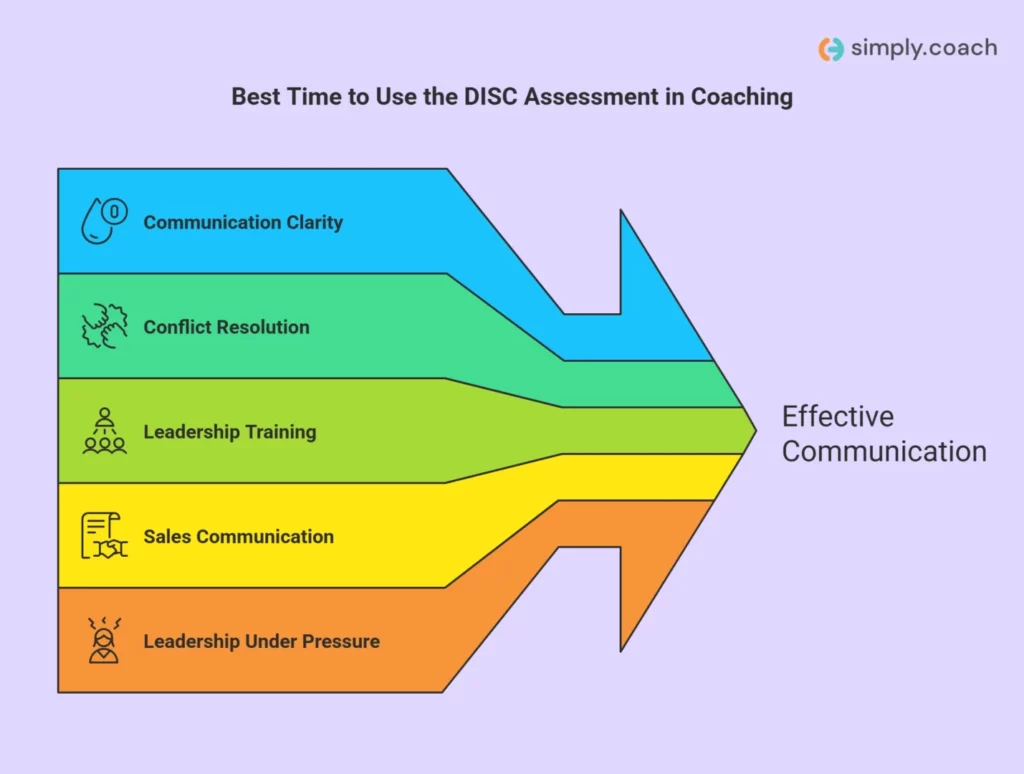
The framework is particularly valuable in the following coaching situations:
- Improving team communication clarity: Leaders learn how different personality styles interpret instructions, feedback, and expectations during daily workplace interactions.
- Resolving interpersonal conflict within teams: DISC reveals how individuals react to pressure, disagreement, and authority, which helps coaches address team conflict patterns.
- Leadership communication training programs: Leaders develop the ability to adjust communication when working with direct, analytical, supportive, or relationship-driven personalities.
- Developing sales and client-facing teams: Behavioral insights help professionals recognize client communication styles and adapt their approach during conversations.
- Coaching leaders in fast-paced organizational environments: DISC helps leaders understand how behavior changes under pressure, tight deadlines, and high-stakes decision-making.
These situations show why executive coaches introduce the DISC assessment when leadership development calls for practical behavior change and better team communication.
What is the Myers-Briggs Type Indicator (MBTI)?
The Myers-Briggs Type Indicator (MBTI) is a psychological personality assessment that explains how individuals perceive information and make decisions. The framework organizes personality into sixteen types using four psychological preference pairs, which reveal patterns in thinking, communication and leadership behavior. As an executive coach working with organizations, you can use MBTI to help leaders understand internal motivations that shape workplace decisions and collaboration.
1. The 4 psychological preference pairs in the Myers-Briggs
The Myers-Briggs framework defines personality using four preference pairs that explain how leaders gather information, make decisions, and interact with people.
- Extraversion vs Introversion: This dimension explains where individuals focus attention and gain energy. Extraverted leaders engage actively with teams, while introverted leaders prefer reflection before responding.
- Sensing vs Intuition: This dimension describes how individuals interpret information. Sensing types focus on facts and current realities, while intuitive types explore patterns, possibilities, and strategic ideas.
- Thinking vs Feeling: This dimension highlights decision-making preferences. Thinking types rely on logical evaluation, while feeling types consider relationships and emotional consequences.
- Judging vs Perceiving: This dimension explains how individuals approach structure and planning. Judging types prefer organized decisions, while perceiving types remain flexible during evolving situations.
Each pair adds one letter to a four-letter type code such as ENTJ. Together, the pairs help you interpret the thinking patterns behind a leader’s collaboration and decisions.
2. What the Myers-Briggs personality assessment measures
The Myers-Briggs assessment focuses on psychological preferences that influence how professionals interpret information and make leadership decisions.
- Cognitive preferences in leadership thinking: MBTI explains how individuals naturally direct attention and interpret information during problem-solving.
- Decision-making style in complex leadership situations: The framework shows how leaders evaluate options using logic, values, structure, or flexibility.
- Information processing and strategic interpretation: MBTI highlights how leaders analyze data, recognize patterns, and generate insights during planning.
- Psychological orientation toward structure and relationships: The assessment reveals how leaders balance analytical thinking, interpersonal values, and organizational priorities.
These insights help you understand the thinking patterns behind leadership decisions and team interactions. If a leader’s question is about what they do best rather than how they think, the CliftonStrengths assessment answers it more directly.
3. When should you use the Myers-Briggs personality assessment?
The Myers-Briggs Type Indicator (MBTI) works best when your coaching focuses on deeper psychological awareness rather than immediate behavior change. You will often introduce MBTI when leaders want to understand how their thinking patterns influence decisions, communication style, and leadership identity.
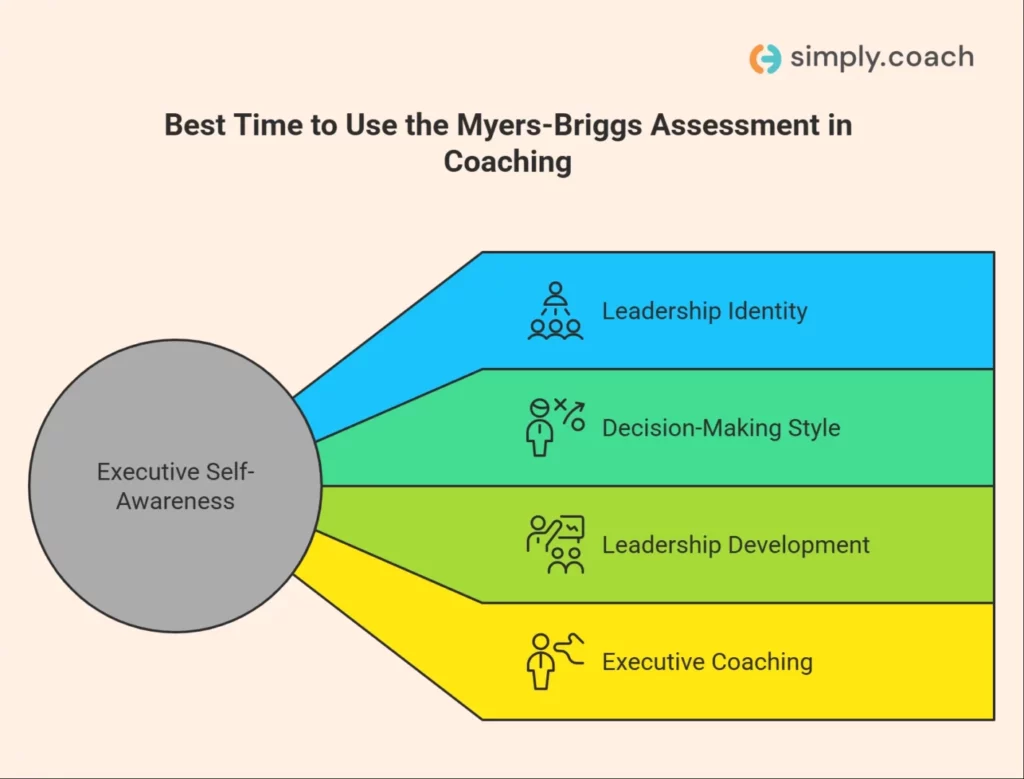
The framework is especially useful when coaching conversations call for reflection, personal insight and long-term leadership development. It works well in the following coaching scenarios:
- Develop executive self-awareness: You help leaders understand how their personality preferences influence communication, relationships, and leadership behavior.
- Explore leadership identity: Coaching conversations focus on how personal values, motivations, and thinking patterns shape leadership approach.
- Analyze decision-making style: Leaders gain clarity on how they process information, evaluate options, and balance logic with people considerations.
- Support personal leadership development: Personality insights help leaders identify strengths, blind spots, and preferred leadership approaches.
- Guide long-term executive coaching engagements: MBTI supports deeper reflection across multiple coaching sessions focused on leadership mindset and growth.
These scenarios explain why executive coaches introduce the Myers-Briggs when leadership development calls for deeper psychological insight and reflective conversations. Personality assessments are one part of a wider set of leadership coaching tools, so plan where the MBTI fits among them.
Key Differences Between the DISC Assessment and Myers-Briggs Personality Framework
Both the DISC assessment and the Myers-Briggs personality test help leaders understand personality patterns that influence communication, collaboration, and workplace behavior. However, the two frameworks are built on very different psychological foundations. As an executive coach working with organizations, this distinction affects how you select and apply each assessment in leadership development and team coaching.
The DISC assessment focuses on observable workplace behavior, while Myers-Briggs focuses on internal psychological preferences that shape thinking and decision-making. Understanding these differences helps you choose the right assessment for specific leadership challenges, team dynamics and organizational coaching goals.
1. DISC Behavioral Model Vs Myers-Briggs Psychological Type Theory
The DISC assessment explains how people behave and communicate in professional environments. The framework highlights visible leadership behaviors that affect collaboration, communication, and team performance. These insights help you identify patterns quickly during leadership coaching or team workshops.
DISC typically examines:
- Communication style during professional conversations
- Response patterns during pressure or conflict situations
- Decision pace in workplace environments
- Approach to authority, rules, and responsibilities
These insights help you guide leaders toward practical behavior adjustments that improve collaboration and communication across teams.
The Myers-Briggs Type Indicator (MBTI) focuses on psychological thinking preferences. Instead of measuring behavior directly, MBTI explains how leaders interpret information, evaluate options, and form decisions.
MBTI typically explores:
- How leaders gather and interpret information
- How they evaluate choices during decision-making
- How they process ideas, possibilities, and future scenarios
DISC helps you understand how leaders behave, while Myers-Briggs helps you understand how leaders think.
2. Four DISC Personality Styles Vs Sixteen Myers-Briggs Personality Types
The DISC framework organizes personality into four behavioral styles that describe how individuals approach tasks, communication, and collaboration.
The four DISC styles include:
- Dominance: Results-focused leaders who prioritize action, control, and decisive problem-solving.
- Influence: Relationship-oriented leaders who motivate teams through enthusiasm, persuasion, and social engagement.
- Steadiness: Supportive professionals who value stability, cooperation, and consistent team relationships.
- Conscientiousness: Analytical thinkers who emphasize accuracy, structure and careful decision-making.
This simple structure helps teams quickly recognize behavioral differences and adjust communication during collaboration.
The Myers-Briggs framework, in contrast, identifies sixteen personality types created from four psychological preference pairs. The table groups the sixteen four-letter codes.
| Orientation | Sensing + Judging | Sensing + Perceiving | Intuition + Feeling | Intuition + Thinking |
|---|---|---|---|---|
| Introverted | ISTJ, ISFJ | ISTP, ISFP | INFJ, INFP | INTJ, INTP |
| Extraverted | ESTJ, ESFJ | ESTP, ESFP | ENFJ, ENFP | ENTJ, ENTP |
These personality types offer deeper insight into leadership psychology but require more explanation during coaching sessions. DISC simplifies behavioral understanding, while Myers-Briggs explores deeper personality structure.
3. Simplicity of the DISC Framework Vs Complexity of the Myers-Briggs Model
The DISC assessment is widely used in organizations because leaders understand the framework quickly. Four behavioral styles create a clear structure that teams can apply immediately during leadership workshops or coaching conversations.
DISC works particularly well for:
- Leadership communication training
- Team collaboration workshops
- Conflict resolution coaching
Leaders often begin applying DISC insights straight after the assessment. The assessment itself is short, and the publisher of DiSC says its Everything DiSC Workplace questionnaire takes about 15 to 20 minutes.
The Myers-Briggs framework requires deeper reflection. Sixteen personality types create a more detailed psychological model that explains internal thinking patterns.
Leaders often need guided coaching conversations to interpret their personality type and translate insights into leadership behavior.
4. DISC Insights on Workplace Behavior Vs MBTI Insights on Internal Motivations
The DISC assessment focuses on how professionals behave during workplace interactions. This focus makes DISC particularly valuable when you address communication challenges and team collaboration.
DISC insights often explain:
- How leaders communicate with colleagues and team members
- How they influence discussions and group decisions
- How they respond during conflict or disagreement
- How they manage pace, pressure, and deadlines
These insights allow you to adjust visible leadership behaviors that affect team performance.
The Myers-Briggs assessment explores internal motivations and thinking patterns. Instead of focusing only on behavior, MBTI explains why leaders approach problems and decisions in specific ways.
MBTI insights often reveal:
- How leaders process and interpret information
- How they balance logic and values during decisions
- How they interpret opportunities, risks, and future possibilities
DISC helps you improve behavior within teams, while Myers-Briggs helps leaders understand the thinking behind their behavior.
5. Practical Leadership Coaching with DISC Vs Psychological Self-Awareness through MBTI
Executive coaches often choose the DISC assessment when coaching conversations focus on behavior change. DISC is effective when leaders need to improve communication, collaboration, and influence inside teams.
DISC works well when leaders need to:
- Improve communication with team members
- Adjust leadership style across different personalities
- Manage conflict and collaboration challenges
Leaders can apply DISC insights immediately during meetings, feedback sessions, and leadership discussions.
The Myers-Briggs assessment supports coaching conversations focused on leadership identity and thinking patterns. MBTI is particularly useful when leaders want deeper understanding of motivations and decision-making approaches.
MBTI works well when leaders want to:
- Understand personal motivations and leadership values
- Look at how their leadership mindset and thinking patterns shape their choices
- Reflect on long-term decision-making habits
Both frameworks support leadership development, yet they serve different coaching objectives. DISC helps you drive visible behavior change, while Myers-Briggs helps leaders build deeper psychological awareness.
DISC Assessment vs Myers-Briggs Personality Test, Key Comparisons
Executive coaches often compare the DISC assessment vs Myers Briggs when selecting personality frameworks for leadership development programs. Both tools explain personality patterns, yet they measure different sides of behavior and thinking.
The table below summarizes the differences that most affect how you apply each assessment in organizational coaching.
| Factor | DISC Assessment | Myers-Briggs Type Indicator (MBTI) |
|---|---|---|
| Core purpose | Understand observable workplace behavior | Understand psychological thinking preferences |
| Psychological foundation | William Marston’s behavioral theory | Carl Jung’s psychological type theory |
| Personality structure | Four behavioral styles | 16 personality types |
| Primary insight | How people communicate and act | How people think and interpret information |
| Workplace focus | Behavior during collaboration and conflict | Cognitive preferences behind decisions |
| Learning curve | Easy for teams to grasp quickly | Requires deeper explanation and reflection |
| Coaching outcome | Immediate behavior adjustments | Deeper personal insight and self-awareness |
| Best team application | Communication and collaboration training | Understanding thinking differences |
| Leadership coaching focus | Influence, communication, and conflict style | Decision-making and leadership mindset |
| Training environment | Team workshops and leadership programs | Executive reflection and development coaching |
Both frameworks support leadership development, yet they address different coaching needs. The DISC assessment helps you improve communication and collaboration inside teams by revealing observable workplace behavior. The Myers-Briggs framework helps leaders understand the thinking patterns that shape how they interpret information and make decisions.
Applications of DISC and Myers-Briggs in organizational coaching and leadership development
Executive coaches often choose between the DISC assessment and Myers-Briggs personality framework depending on the coaching objective. DISC helps address visible workplace behavior and communication patterns. Myers-Briggs helps leaders understand the thinking preferences that influence leadership decisions and interactions.
The table below shows how both frameworks apply across common organizational coaching scenarios.
| Type of Coaching Context | DISC Assessment Application | Myers-Briggs (MBTI) Application |
|---|---|---|
| Leadership coaching | Helps leaders adapt communication style across different personalities; Reveals behavioral patterns affecting influence and collaboration; Improves clarity during feedback and leadership conversations | Helps leaders understand decision-making patterns; Explains how personality preferences influence leadership judgment; Encourages reflection on thinking and leadership approach |
| Team development workshops | Improves team communication and collaboration; Helps teams recognize behavioral differences during interactions; Reduces conflict caused by communication style gaps | Helps teams understand different thinking and information-processing styles; Encourages respect for diverse problem-solving approaches; Supports deeper discussions about team dynamics |
| Organizational culture development | Encourages behavioral awareness across teams; Promotes clear communication and constructive feedback; Helps leaders recognize how behavior affects workplace relationships | Builds psychological awareness across leadership teams; Helps leaders appreciate diverse cognitive styles; Supports a culture that values different perspectives |
| Executive coaching programs | Helps leaders adjust behavior in real workplace situations; Supports communication improvement across leadership teams; Helps address collaboration and influence challenges | Encourages deeper reflection on leadership identity; Explores personal motivations and leadership mindset; Helps leaders understand decision-making habits |
Both frameworks support leadership development, but toward different outcomes. The DISC assessment helps improve visible leadership behavior and team communication, while the Myers-Briggs helps leaders understand the preferences behind their thinking. Either way, coaching tracking tools show you whether the insight turns into change.
Can Coaches Use DISC and Myers-Briggs Together?
Many executive coaches combine the DISC assessment and Myers-Briggs personality framework during leadership development programs. Each tool explains a different dimension of leadership behavior. DISC focuses on observable workplace communication, while Myers-Briggs explains the thinking preferences that shape decisions and problem-solving.
Using both frameworks together creates a more complete understanding of how leaders think, communicate, and interact with teams.
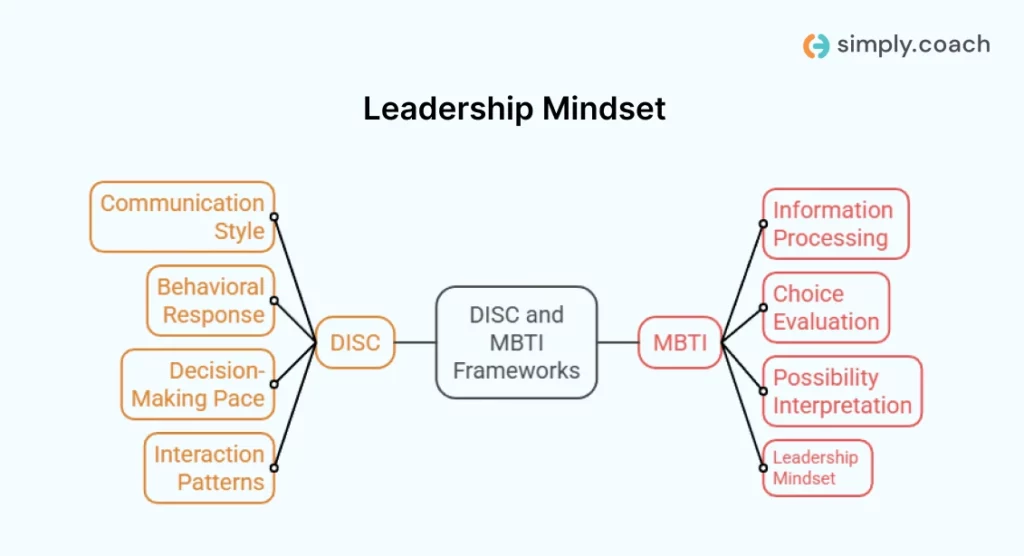
DISC provides insight into communication behavior and interaction patterns. Coaches use it to identify how leaders express ideas, respond to pressure, and influence colleagues during daily workplace situations.
DISC helps you understand:
- Communication style during leadership conversations
- Behavioral response during conflict or pressure
- Pace and approach to decision-making in meetings
- Interaction patterns with different personality styles
These insights make DISC useful when coaching focuses on practical leadership behavior and team communication.
Myers-Briggs complements these insights by explaining cognitive preferences and psychological orientation. The framework reveals how leaders interpret information and approach complex decisions.
MBTI helps you explore:
- How leaders process information and ideas
- How they evaluate choices during decision-making
- How they interpret possibilities, risks, and future opportunities
- How personality preferences influence leadership mindset
When used together, these frameworks allow coaches to address both visible leadership behavior and internal thinking patterns.
DISC explains how leaders act in workplace situations, while the Myers-Briggs explains why they think and decide the way they do. Combined, they help you design coaching conversations that improve communication, sharpen awareness of decision-making and support long-term leadership growth, and other personality tests like Myers-Briggs can fill gaps neither one covers.

Implement Leadership Assessments Effectively With Simply.Coach
Applying assessments like DISC and the MBTI is easier when your coaching workflow is structured and kept in one place. Simply.Coach helps you organize coaching engagements, track leadership development goals and manage assessment-based coaching programs. The platform lets you:
- Manage goal setting, action plans and each leader’s development progress from the client dashboard.
- Share assessments, surveys and coaching tools digitally, and collect every response in one place.
- Track client progress and create coaching impact reports that show the return on investment for the client.
- Structure multi-session executive coaching as reusable program templates with stages, sessions and actions.
This structure helps you move from assessment insights to measurable leadership development, and keeps your programs consistent as they grow. If you are building a program around these assessments, follow the steps for designing a signature coaching program and launching it.
Conclusion
Choosing between the DISC assessment and the Myers-Briggs depends on the leadership challenge in front of you. DISC helps leaders change how they communicate, collaborate and handle conflict at work. The Myers-Briggs helps them understand the thinking preferences behind their decisions.
Start with the outcome the engagement has to deliver. Choose DISC for visible behavior change inside a team, the Myers-Briggs for self-awareness and decision style, and both when you need to connect what a leader does with why they do it.
Key Takeaways
- Different things measured. DISC reads observable behavior; the Myers-Briggs reads thinking preferences.
- Four styles or sixteen types. DISC’s simpler structure is easier for a whole team to learn.
- DISC for team friction. Use it when communication gaps and conflict are slowing a team down.
- The MBTI for reflection. Use it when a leader wants to understand their own decisions and identity.
- Expect a debrief. Sixteen types need guided interpretation before leaders can act on them.
- Combine with care. Pair the two to link what a leader does with why, and keep the language consistent.
- Track the change. Tie each insight to a goal so the assessment leads to behavior you can see.
If your DISC or MBTI debriefs end with a PDF the leader never opens again, the insight fades. Simply.Coach lets you set action plans for each goal a leader is working on, so every insight from the assessment becomes a step they take and you can track.
Frequently Asked Questions (FAQs)
Is the DISC assessment better than Myers-Briggs for workplace coaching?
DISC is often easier to apply in workplace coaching because it focuses on observable communication and behavior, so leaders can recognize styles quickly and adjust in meetings. The Myers-Briggs offers deeper insight into thinking preferences but usually needs more interpretation.
What does the DISC assessment measure?
It measures behavioral tendencies that shape communication, the pace of decisions and responses to challenges. Results group behavior into four styles, Dominance, Influence, Steadiness and Conscientiousness, which explain how a person works with colleagues and approaches tasks.
What does the Myers-Briggs personality test measure?
It measures preferences that shape how people take in information and make decisions, across four pairs: where they focus energy, how they process information, how they decide and how they approach structure. The combinations create sixteen personality types.
Can DISC and Myers-Briggs be used together in leadership coaching?
Yes. DISC explains a leader's communication style and interaction patterns at work, while the Myers-Briggs explains the preferences behind their decisions. Used together, they let you connect what a leader does with why, as long as you keep the language consistent.
Why do organizations use DISC for team development?
DISC builds awareness of how different behavioral styles affect discussions and conflict. Because the four styles are quick to learn, a whole team can use the same language to understand each other, which reduces misunderstandings and helps people work together.
How long do DISC and Myers-Briggs assessments take to complete?
The publisher of DiSC says the Everything DiSC Workplace questionnaire takes about 15 to 20 minutes, and its Catalyst version about 20 to 30 minutes. Timing for the Myers-Briggs depends on the version and provider, so check the publisher's guidance for the one you use.
Which assessment is easier for teams to understand?
DISC is easier for teams to understand because it uses four clear behavioral styles that people can recognize and apply during collaboration. The Myers-Briggs includes sixteen personality types and usually needs more explanation before a team can use it.
How do personality assessments improve executive coaching outcomes?
They help you identify a leader's behavior and decision-making patterns, so development work targets what matters for that person. Structured feedback on the results also builds self-awareness, and tying each insight to a goal turns it into progress you can track.