
As a coach, you often face the same challenge: there are only so many hours in a day, yet your clients’ needs keep growing. Managing one-on-one sessions, handling no-shows, scheduling, and maintaining consistency can stretch you thin. Many coaches in the U.S. report that the biggest barrier to growth is time, not skill or demand.
Group coaching changes that. It allows you to serve more clients in less time without compromising the quality of your coaching. Beyond efficiency, it creates an environment where clients learn from both you and each other, which often leads to stronger accountability, fresh perspectives, and deeper engagement.
In this blog, we will explore what group coaching is, why it matters for your practice, how it compares with one-on-one coaching, the different models you can run, and a step-by-step guide to structuring an effective program. By the end, you’ll know exactly how to design and deliver a group coaching program that saves time, scales your impact, and supports better outcomes for your clients.
What is Group Coaching?
Group coaching is a dynamic process where you, as the coach, work with a group of individuals who share common goals, personal or professional (such as leadership skills, work-life balance, career transition etc.). It’s a facilitated environment designed to leverage the collective wisdom, shared experiences, and mutual support of all the participants to achieve personal and collective growth.
As a coach, group coaching allows you to impact more clients without doubling your time commitment. Instead of repeating the same material in multiple one-on-one sessions, you guide a group through a structured process where they learn from your expertise and also from one another. This not only helps you scale but also builds a dynamic community where accountability and peer support become part of the coaching experience.
1. Total number of people in group coaching
Finding the right group size ensures that every client feels heard while still benefiting from diverse perspectives.
- The ideal size is 8 –20 participants.
- Fewer than 8 clients reduces the variety of viewpoints and energy in the room.
- More than 20 can feel overwhelming and make it hard for you to give each person attention. But the group size also depends on the coaching niche.
- For instance, if you are a fitness or wellness coach, 6–8 clients keep sessions interactive and hands-on. Wellness clients often discuss personal, sensitive topics like emotional eating, stress, or chronic condition management, which thrives in a more intimate setting.
- On the other hand, if you are a business or strategy coach, you can comfortably work with 20–25 clients since varied experiences enrich discussions.
2. Time and length
Choosing the right session length and program duration keeps your clients engaged and gives them space to apply what they learn.
- Most sessions run for 60–90 minutes.
- 60 minutes works well when you want to focus on teaching and handle quick Q&A.
- 90 minutes is better for deeper discussions, spotlight coaching, or group exercises.
- Programs usually last 8–12 weeks depending on the transformation you promise.
- Shorter formats suit focused goals like interview prep, while longer ones work better for leadership, business growth, or personal transformation.
3. How the pricing works
Pricing your program correctly ensures that you offer value to clients while making the model profitable for you.
- Group coaching is usually priced 30–50% lower than one-on-one coaching.
- Most coaches ask for upfront payment or allow 2–3 installments.
- Example: If your one-on-one package is $2,000 for eight sessions, your group fee could be $800–$1,200 per client.
- With 15 participants, this translates to $12,000–$18,000 in the same timeframe.
- Offering early bird discounts or referral bonuses helps you fill your groups faster and build early momentum.
Also read: How to Set Your Group Coaching Pricing
Benefits of Group Coaching
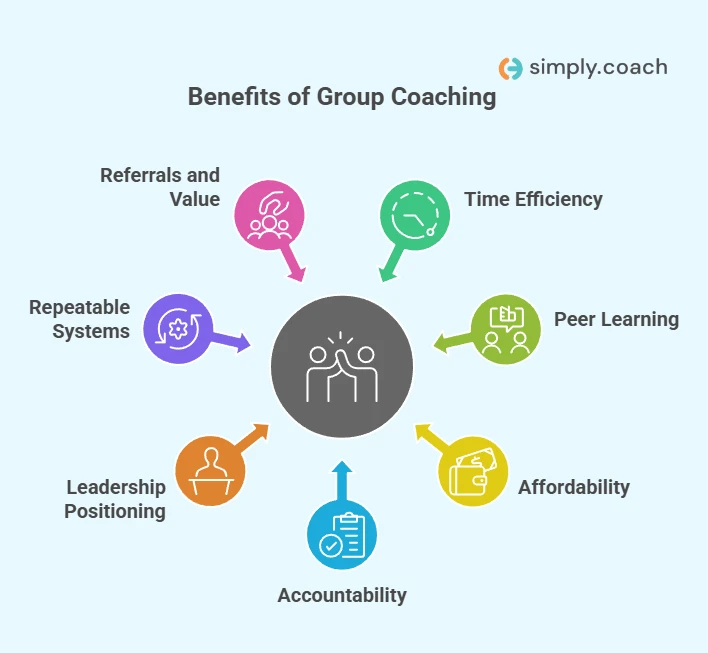
When you run group coaching, you do more than fill multiple seats in a session. You create a structured space that multiplies your impact while strengthening the value you deliver. Here are the specific benefits you gain when you add group coaching to your practice:
- Serve more clients without extending your calendar: Instead of delivering the same session five times to five individuals, you deliver it once to a group. This frees up hours each week that you can use for business development, content creation, or higher-touch clients.
- Give your clients the power of peer learning: In a group setting, clients hear how others handle challenges similar to their own. For example, a leadership client struggling with delegation learns not only from you but also from peers who share practical tips from their workplaces.
- Reach clients who cannot afford private coaching: Not every potential client has the budget for one-on-one coaching. By offering a group program at 30–50% lower cost, you attract a new segment of clients while still earning more per hour than individual sessions.
- Strengthen accountability through shared progress: Clients are less likely to miss sessions or abandon goals when they know peers are expecting updates. A simple weekly check-in round keeps everyone engaged and reduces no-shows.
- Position yourself as a leader in your niche: Running groups allows you to showcase your expertise to multiple clients at once. This builds authority faster, as word-of-mouth spreads among professionals who experience your coaching together.
- Build repeatable systems that save you time: Once you create a group curriculum with exercises, templates, and resources, you can reuse it for new cohorts. This lowers prep time for future programs and helps you scale without increasing workload.
- Increase referrals and client lifetime value: Clients who succeed in group programs often invite colleagues or friends to join the next round. Many later upgrade to one-on-one packages, giving you a steady stream of referrals and long-term revenue.
With these benefits in place, the next step is to see how group coaching compares to one-on-one coaching, so you can decide when each model works best for your clients.
Also read: The 10 Best Enterprise Coaching Tools 2025 to Streamline Your Group Coaching Programs
Group Coaching vs One-on-One Coaching
As a coach, you may wonder whether to run group programs or continue with one-on-one sessions. Both formats have clear value, but the impact on your time, pricing, and client outcomes can be very different. Understanding these differences helps you choose the right model for each situation.
| Aspect | Group Coaching | One-on-one Coaching |
| Personalization | Moderate – enough structure to guide many, but less tailored to each client | High – every session is customized to the individual |
| Peer support | Strong – clients learn from each other and gain accountability | None – progress depends solely on coach–client interaction |
| Pricing | Lower – usually 30–50% less than one-on-one | Higher – premium investment for personalized coaching |
| Time commitment | Medium – you deliver once to many clients at the same time | High – you repeat sessions with each client individually |
| Accountability | Shared – clients motivate one another and track progress together | Individual – accountability rests on you and the client only |
| Pros | Efficient use of your time, affordable for clients, builds community, scalable systems | High customization, flexible pacing, deeper privacy and trust |
| Cons | Less tailored attention, scheduling challenges, risk of drop-outs if engagement drops | Time-intensive for you, higher cost barrier for clients, limited scalability |
Both models serve different needs. Group coaching works best when your goal is to reach more clients at once and build shared accountability, while one-on-one coaching is ideal for deeper personalization and sensitive issues. Next, let’s look at the different types of group coaching models you can use to structure your programs.
Different Types of Group Coaching Models
As a coach, you can structure your group program in more than one way. The model you choose will depend on your coaching style, your clients’ needs, and the kind of results you want to deliver. Let’s look at some proven approaches and how each one works.
1. Cohort-based coaching model
In a cohort-based program, every client starts and finishes together. You take them through a structured curriculum, much like a guided classroom experience. For example, as a business coach, you might run a 12-week “Scale Your Startup” program where 20 entrepreneurs meet weekly for 90 minutes. Between sessions, they complete assignments and continue discussions in a private online community.
Key features
- Clear start and end dates that help you and your clients stay organized
- A structured curriculum designed to deliver measurable results
- Strong peer support that creates accountability within the group
- A targeted program that highlights your coaching expertise
How to set the pricing
Cohort programs often command higher fees because they’re structured and results-driven. A simple formula is:
(Your 1:1 hourly rate) × (number of sessions) × 50–70%
So if you charge $200 per hour and run 12 sessions, you can price your program at $1,200–$1,680 per client. With 15 participants at $1,500 each, you generate $22,500 from a single cohort.
Pros and cons
- Pros: High engagement and completion rates, scalable revenue, strong authority building, strong community dynamic
- Cons: Requires detailed upfront planning, less flexible for varied schedules, may not fit clients with unique individual needs
Who is it best for
This model is best for you if you already have a proven system, enjoy working with structured groups, and can commit to a fixed schedule.
Also read: Best Group Coaching Software for Business Coaches to Scale in 2025
2. Standard program model
The standard program combines recorded lessons with live coaching. You build the core content once and use it for every new group that joins. For example, you might design an 8-week “Healthy Habits Bootcamp.” Clients receive pre-recorded weekly lessons on nutrition, exercise, and stress management while you host a monthly Q&A session to answer questions and keep them engaged.
Key features
- Evergreen content that can be reused across different client groups
- A balance of recorded lessons and live support
- Flexibility for clients to learn at their own pace
- A semi-passive format that frees up more of your time
How to set the pricing
Standard programs usually sit between DIY courses and cohort models. A simple formula is:
(Hourly rate) × (content hours + live call hours) × 10–20%
So if your rate is $100 and the program includes 8 hours of content and 4 hours of calls, you could charge $1,200–$2,400 per client. With 25 participants paying $1,500 each, you earn $37,500 in one round.
Pros and cons
- Pros: Scalable, recurring revenue, more flexible for clients, requires less live time from you
- Cons: Weaker personal connection, higher drop-off rates, requires strong marketing to stay filled
Who is it best for
This model is best for you if you like building communities and want a predictable monthly revenue stream.
Also read: Top 8 Group Coaching Platforms Every Wellness Coach Should Know
3. Membership model
Membership programs give clients ongoing access to your resources, coaching calls, and community in exchange for a monthly fee. For example, as a financial coach, you could run a “Wealth Builders Club” where members pay $49 per month for budgeting templates, investing tutorials, and weekly live coaching calls.
Key features
- Predictable recurring income that stabilizes your cash flow
- A community space where clients connect and support each other
- Ongoing value delivery that keeps clients subscribed long term
- Flexibility to add new resources or events over time
How to set the pricing
Memberships are priced lower than full programs, usually 10–20% of your one-on-one monthly rate. If you charge $500/month privately, you can set your membership between $50–$100. Offering tiers with different levels of access helps you attract a broader audience.
Pros and cons
- Pros: Steady income, strong community building, long-term client relationships, scalable
- Cons: Requires consistent content creation, member churn risk, may attract lower-budget clients
Who is it best for
This model is best for you if you like building communities and want a predictable monthly revenue stream.
Read: 10 Best Group Coaching Platforms Life Coaches Should Try in 2025
4. Course-based program model
The course-based program blends self-paced learning with group coaching calls. You design an in-depth course with lessons, worksheets, and videos, then support clients through regular group sessions. For example, as a marketing coach, you might create a 6-week “Perfect Your Branding” program with 12 video lessons and weekly live calls.
Key features
- Structured course content that clients can complete at their own pace
- Group coaching calls that provide accountability and feedback
- Multimedia resources that make the program engaging and practical
- A strong mix of flexibility and personal support
How to set the pricing
Pricing usually falls between a pure course and a high-end cohort program. A simple formula is:
(Hourly rate) × (course hours + coaching hours)
If you charge $150/hour and the program includes 12 hours of content plus 6 hours of calls, you can price it at $2,700 per client. You can also break it down into three payments of $900.
Pros and cons
- Pros: High perceived value, premium pricing, scalable, positions you as an authority
- Cons: More effort upfront to build, requires ongoing promotion, some clients may not complete the course
Who is it best for
This model is best for you if you enjoy creating detailed content and want to offer a high-value program at a premium price.
5. Weekly matchup program model
In this setup, you pair small groups of clients weekly. Each pair supports each other with feedback, skill practice, and progress sharing. You step in to guide the structure, provide prompts, and facilitate discussions. For example, in a fitness program, you might match clients each week to share workout logs, track nutrition, and check in on progress. This creates momentum and reduces the risk of clients falling off track.
Key features
- Weekly peer pairings that drive accountability and motivation
- Small group interactions that keep everyone engaged without overwhelming them
- Regular feedback loops that reinforce consistency and habit formation
- Coach-guided structure to ensure sessions stay productive
How to set the pricing
Weekly matchup programs are usually priced lower than intensive cohort models but higher than self-paced memberships. A good starting point is 30–40% of your one-on-one monthly rate. If you charge $600 per month privately, pricing at $200–$250 per client for a 6–8 week program works well.
Pros and cons
- Pros: Strong accountability, easy to manage small groups, keeps clients consistent, scalable with multiple pairings
- Cons: Limited depth per client, requires active management of pairings, may not suit clients who prefer more privacy
Who is it best for
This model is best for you if your coaching focuses on lifestyle, fitness, or habit-building and you want to keep clients engaged through peer accountability.
How To Choose The Perfect Group Coaching Model
Cohort-based or course-based model: If you’re great at building step-by-step systems and love guiding clients toward measurable results, a cohort-based or course-based model could be the right fit. These models are structured, outcome-driven, and allow you to charge premium rates. But they do require upfront work to design the curriculum and keep clients engaged.
Standard program model: If you prefer flexibility and enjoy a balance of recorded content with live touchpoints, the standard program model may suit you better. It’s easier to manage once built, though it often needs strong marketing to stay full.
Membership model: If your strength lies in community building and ongoing support, a membership model is ideal. It gives you steady recurring income and long-term relationships with your clients, but it does demand consistent new content to keep members engaged.
Weekly matchup program model: If you specialize in helping clients stay consistent with habits, the weekly matchup program model is a natural choice. It’s built on accountability, peer-to-peer check-ins, and small group dynamics that keep clients motivated.
So, how do you choose? Start by asking yourself:
- What are my strongest coaching skills?
- What transformation do my clients really want?
- How much time and energy can I invest each week?
For example, if you’re a career coach who thrives on structure and your clients want fast, measurable progress, a cohort-based 10-week career accelerator could be the winning option. If you’re a wellness coach who loves community-driven growth, a weekly matchup or membership model will deliver more accountability and long-term engagement.
The best model is the one that fits your coaching style, aligns with your clients’ needs, and supports the kind of business you want to build.
Also read: The Best Group Coaching Tools for Career Coaches to Streamline Your Practice in 2025
Step-By-Step Guide to Structure an Effective Group Coaching Program
Designing a group coaching program takes more than putting people together on a call. You need a framework that balances structure, interaction, and support. Here’s a step-by-step approach to help you build a program that delivers consistent results.
1. Define program goals & outcomes
- Decide the exact transformation you want your clients to achieve.
- Example outcomes: build a 6-month career plan, design a startup launch strategy, or adopt sustainable fitness habits.
- Keep your goals measurable so you and your clients can track progress.
2. Identify your ideal client
- Be selective about who joins your program. The right mix creates strong group energy.
- Define their shared struggles and aspirations. For instance, mid-career professionals seeking leadership roles.
- Use an application process or discovery call to ensure alignment.
Also read: Benefits of Choosing a Coaching Niche for Yourself
3. Decide on length & format
- Most programs work well at 8–12 weeks with weekly or bi-weekly sessions.
- Keep sessions between 60–90 minutes to balance teaching, discussion, and Q&A.
- Choose the group size wisely: 10–20 participants keep the sessions engaging without feeling crowded.
4. Create your curriculum
- Break down the journey into weekly milestones or modules.
- Include teaching points, peer activities, and exercises for real application.
- Add resources like worksheets, journaling prompts, or trackers to keep clients consistent between sessions.
5. Develop session flow
- Start each session with quick wins or check-ins to build energy.
- Move into your main teaching or guided activity.
- Use breakout groups for peer accountability and collaboration.
- Close with spotlight coaching or a Q&A so clients walk away with clarity.
6. Use group coaching software like Simply.Coach
Running a group program is much smoother when you rely on an all-in-one platform. Simply.Coach gives you every tool you need to manage clients, track progress, and keep your sessions organized.
- Client workspaces: Share resources, notes, and recordings in one central hub.
- Goal planning: Set clear goals with clients, break them into action steps, and track progress in real time.
- Scheduling & reminders: Let clients self-schedule sessions, with email/text reminders to reduce no-shows.
- Integrated video conferencing: Host live coaching directly through Zoom, Google Meet, or Teams inside the platform.
- Progress reports: Generate insights and share reports that showcase real ROI for your clients.
- Stakeholder feedback: In corporate coaching, gather input from managers or peers to measure progress holistically.
7. Set pricing & enrollment strategy
- Price your program 30–50% lower than one-on-one coaching but multiply by group size to scale income.
- Offer early-bird discounts or referral bonuses to fill spots quickly.
- Use webinars, content marketing, or email campaigns to attract the right clients.
Want to master pricing strategies?
Finding the right price point can be tough, too high and you lose sign-ups, too low and you undercut your value. Simply.Coach’s “Complete Guide to Pricing Strategies for Your Coaching Business” breaks it down with formulas, examples, and frameworks you can apply right away.

Common Mistakes to Avoid in Group Coaching
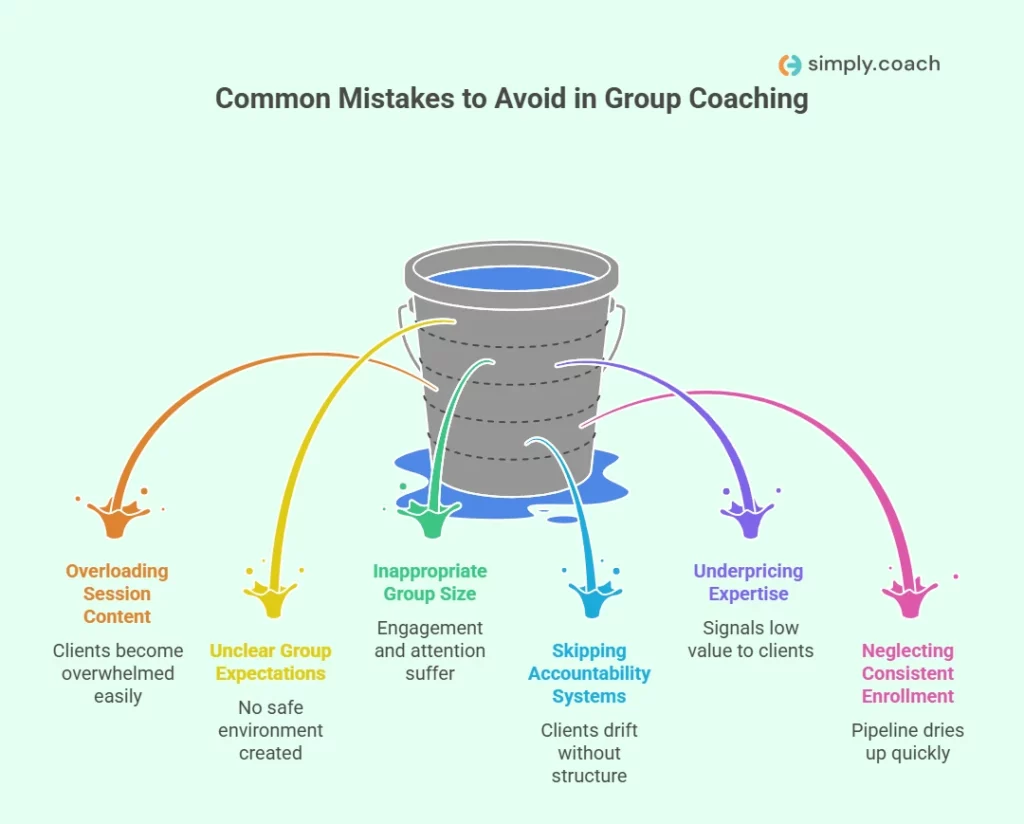
Running group programs can be incredibly rewarding, but a few missteps can undermine the entire experience for you and your clients. Knowing what to watch out for will help you deliver more consistent results and build lasting trust.
- Overloading sessions with too much content: Clients don’t need everything at once. Focus on one core outcome per session, or you risk overwhelming them and reducing retention.
- Not setting clear group expectations: Define boundaries around participation, communication, and confidentiality from day one. Clear rules create a safe environment where clients feel respected and engaged.
- Allowing groups to grow too large or too small: Aim for a sweet spot of 8–20 participants to balance engagement and profitability. Too few limits the group dynamic, while too many dilutes your personal attention.
- Skipping accountability systems: Without check-ins or action tracking, clients can drift. Structured accountability ensures steady progress and reinforces the value of your coaching.
- Underpricing or undervaluing your expertise: Charging too little signals low value. Confident pricing positions you as a professional and helps you attract clients who are truly committed.
- Neglecting marketing and consistent enrollment: Even the best program fails if no one knows about it. Consistent marketing keeps your pipeline full and prevents revenue gaps between cohorts.
Also read: 9 Best Group Coaching Tools for Coaching Businesses in 2025
Conclusion
Group coaching gives you the chance to serve more clients, save time, and create a collaborative learning space where accountability thrives. Whether you run a cohort, a membership, or a weekly matchup model, the key is to align your structure with your strengths and your clients’ needs. By following a clear step-by-step approach, you can design programs that deliver measurable results and scalable income. Done right, group coaching not only grows your business—it deepens the impact you have on every client you serve.
Running group programs means juggling sign-ups, schedules, accountability, and progress reports all at once. Simply.Coach simplifies it with client workspaces, goal tracking, automated reminders, and integrated video sessions, all in one platform. It’s built for coaches like you who want to scale group programs without losing quality or time.