
Ask ten project management consultants what they charge, and you’ll get ten different answers, many shaped by self-doubt. Pricing is where even experienced consultants hesitate. Hourly, project-based, retainer – what’s right? And what if you’re undercharging without realizing it?
Unlike a salaried role, consulting puts pricing entirely on you. Most default to hourly rates because they’re simple. But hourly billing caps income by design: the faster and better you deliver, the less you earn. Expertise gets penalized.
To avoid such shortfalls, in this article, you’ll learn:
- 2026 salary and project management consultant hourly ratebenchmarks.
- How to calculate your baseline rate.
- When to use hourly, project, retainer, or value-based pricing.
- How to raise rates confidently and handle pushback.
From setting your first rate to scaling up for $500K projects, this guide provides the clarity and confidence you need to price your work effectively.
Key Takeaways
- Benchmarks are wide for a reason. In 2026, U.S. project management consultant rates range from ~$40/hour to $95+/hour. Positioning and specialization determine where you land.
- Hourly is a starting point, not a strategy. It’s simple but caps income. As you gain experience, shift toward project-based and value-based pricing.
- Your baseline rate must cover real costs. Multiply your equivalent employee rate by 2.5–3x to account for taxes, benefits, downtime, and business expenses.
- Specialization drives premium pricing. Niche expertise in high-stakes industries supports $125–$250+/hour and higher-value engagements.
- Structure increases revenue. Tiered offers and retainers create predictable income and elevate you from vendor to strategic advisor.
- Operations must match your rates. Platforms like Simply.Coach help consultants manage retainers, contracts, and client workflows so pricing growth translates into scalable income.
What is the Average Project Management Consultant Hourly Rate?
Before setting your rate, you need to understand what the market actually pays. The numbers are not shocking because they are low, but because of how wide the range is. That spread shows how much room there is to move up.
National Benchmarks (U.S., 2026)
Research data shows, the average annual pay for a Project Management Consultant in the United States is $134,079, which works out to approximately $64.46 per hour (equivalent to $2,578/week or $11,173/month).
| Percentile | Annual salary | Hourly rate |
| Top Earners (90th) | $187,500 | $90.24 |
| 75th Percentile | $160,000 | $77.19 |
| Average | $134,079 | $64.46 |
| 25th Percentile | $111,500 | $53.54 |
| Lowest | $61,500 | $29.55 |
The wide range highlights the impact of specialization, experience, and client market. For Project Management Consultants, the gap between the 25th and 90th percentile exceeds $75,000 per year, separating modest freelance earnings from highly profitable consulting practices.
A Project Management Consultant typically advises at a strategic level on PM frameworks, portfolio oversight, and organizational delivery systems. Your positioning, skillset, and niche expertise will determine where you fall within this range.
Also read:Top 10 Essential Certificates for Management Consultants
What Influences Project Management Consultant Rates in 2026
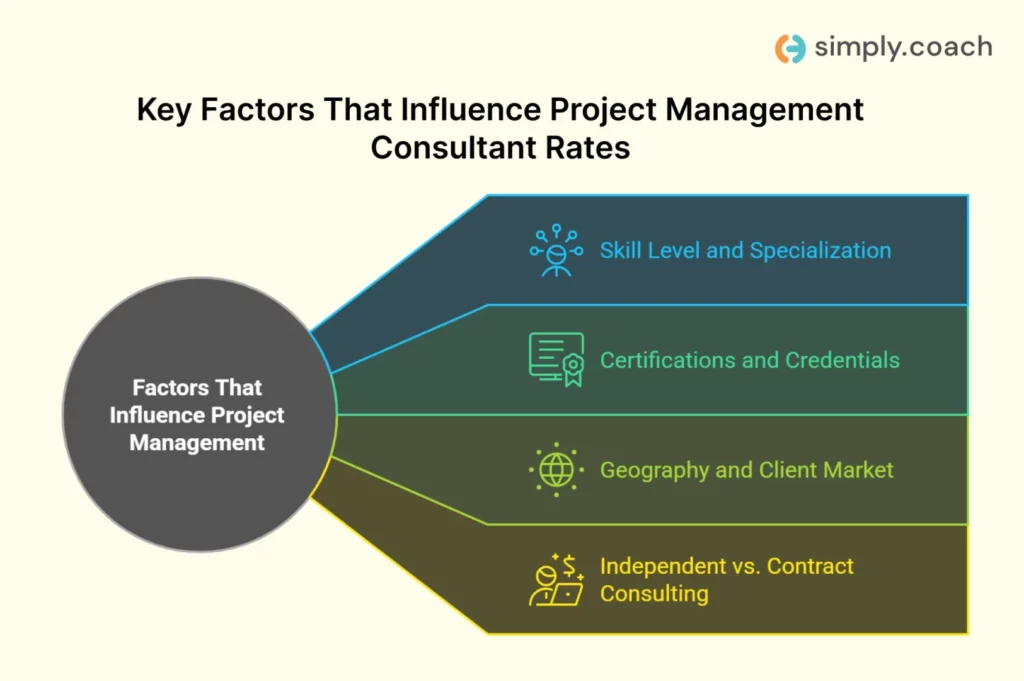
Your earning potential as a Project Management Consultant is not random. It is shaped by several key factors. Understanding these influences helps you position yourself strategically and command higher rates.
1. Skill Level and Specialization
If you offer general project management services, you may find yourself competing mainly on price. By specializing in high-demand areas such as enterprise ERP migrations, healthcare, or defense projects, you can justify premium rates. Your niche expertise directly increases your billable value.
2. Certifications and Credentials
Certifications such as PMP, PgMP, PMI-ACP, or PRINCE2 validate your expertise and make it easier for you to command top-tier pricing. They signal competence and reliability to your clients.
3. Geography and Client Market
Where you operate and the clients you target significantly affects your rates. Even if you work remotely, serving clients in high-cost markets or with larger budgets can increase your earning potential. For example, Project Management Consultants in the top-paying U.S. cities earn considerably more:
| City | Annual Salary | Monthly Pay | Weekly Pay | Hourly Rate |
| Nome, AK | $166,325 | $13,860 | $3,198 | $79.96 |
| Berkeley, CA | $164,172 | $13,681 | $3,157 | $78.93 |
| Sitka, AK | $161,523 | $13,460 | $3,106 | $77.66 |
| Sunnyvale, CA | $159,516 | $13,293 | $3,067 | $76.69 |
| San Francisco, CA | $157,969 | $13,164 | $3,037 | $75.95 |
| Livermore, CA | $157,273 | $13,106 | $3,024 | $75.61 |
| San Jose, CA | $157,140 | $13,095 | $3,021 | $75.55 |
| Santa Clara, CA | $156,245 | $13,020 | $3,004 | $75.12 |
| Alameda, CA | $155,491 | $12,957 | $2,990 | $74.76 |
| Daly City, CA | $155,357 | $12,946 | $2,987 | $74.69 |
4. Independent vs. Contract Consulting
When you work as an independent consultant, you control your rates and client relationships. This gives you more flexibility and higher earning potential. Agency or contract roles often have capped rates, which limits your income.
Consultants earning $75 to $80 per hour are not necessarily working harder than their peers. They are making intentional choices about specialization, location, and positioning to command premium rates.
Also read: 12 Main Types of Consulting Services & How to Find Your Niche
Project Manager Consulting Rates by Experience Level
Market benchmarks show averages. Experience level shows where you fit and how to move up. As consultants advance, rates increase due to tenure, stronger positioning, clearer value, and better pricing models.
| Experience level | Typical hourly rate | Years of experience |
| Entry-Level / Transitioning PM | $40–$65/hour | 1–3 years |
| Mid-Level Consultant | $70–$120/hour | 3–8 years |
| Senior / Specialist PM Consultant | $125–$250+/hour | 8+ years |
1. Entry-Level / Transitioning PM – $40–$65/hour
At this level, most professionals come from corporate PM roles with solid skills but limited consulting proof. Without a portfolio, niche, or testimonials, clients perceive a higher risk, and price becomes the negotiating lever.
Early-stage consultants are still refining their positioning and identifying which industries value them most. Competing on price may be necessary in the short term, but the goal is to build evidence quickly and move up.
2. Mid-level consultant – $70–$120/hour
Here, specialization starts to drive pricing power. Consultants typically identify a clear pattern, such as IT delivery, construction oversight, change management, or product launches. That positioning supports higher fees.
At this level, many consultants begin shifting away from pure hourly billing toward project-based pricing. Clients pay for defined outcomes. This protects income as efficiency improves and reduces dependence on hours worked.
3. Senior / specialist PM consultant – $125–$250+/hour
Senior consultants operate at a different level. They advise executives, rescue troubled programs, and provide strategic oversight. Clients are buying certainty and judgment.
Hourly billing becomes rare. Retainers, advisory packages, and value-based pricing dominate because clients want ongoing access to expertise.
| Experience tier | Typical pricing model | What clients are buying |
| Entry-Level | Hourly, reduced fee | Availability and effort |
| Mid-Level | Hourly or project-based | Expertise and outputs |
| Senior / Specialist | Retainer or value-based | Judgment and outcomes |
As you move up each level, your goal is not just to increase your rate, but to change what you are being paid for. The transition from effort to expertise to outcomes is what ultimately drives sustainable, premium pricing in project management consulting.
Also read: 23 Consulting Niches That Actually Make Money (And How to Choose Yours)
Hourly vs. Project-Based vs. Value-Based Pricing
Your rate is only half the equation. The pricing model you choose determines how that rate translates into actual income and how clients perceive your value before you’ve even started the work. Each model suits a different stage of your consulting career and a different type of engagement. Understanding when to use each one is what separates consultants who earn well from those who stay stuck.
1 . Hourly pricing
Hourly billing is where most consultants start, and for good reason. It’s straightforward, easy to explain, and works well for short-term or loosely defined engagements where scope can shift week to week.
Formula:
Desired Annual Income ÷ Billable Hours = Hourly Rate
Example: A consultant targeting $150,000 per year, working 1,200 billable hours annually, should charge:
$150,000 ÷ 1,200 = $125/hour
Note that billable hours are not the same as working hours. Admin, business development, proposal writing, and professional development all consume time without generating direct income. Most full-time consultants realistically bill between 1,000 and 1,400 hours per year.
| Pros | Cons |
| Simple to calculate and communicate | Caps your income by the hour |
| Low friction for short engagements | Clients scrutinize every logged hour |
| Easy to adjust as you build experience | Rewards slow delivery, penalizes efficiency |
| Familiar to most clients | Positions you as a vendor, not a strategist |
The biggest structural problem with hourly billing is that it works against you as you improve. The more experienced you become, the faster you deliver results, and under an hourly model, that speed reduces your earnings. At the entry level, hourly pricing is a practical starting point. As a long-term strategy, it has a ceiling.
2 . Project-based pricing
Once you’ve completed enough engagements to estimate your work accurately, project-based pricing becomes a more powerful model. Instead of billing for time, you quote a flat fee for a defined deliverable. The client gets cost certainty; you get protected income regardless of how efficiently you work.
Formula:
(Estimated Hours × Hourly Rate) × 1.5 safety buffer = Project Fee
Example: A PM consultant estimates a project will take 40 hours at their $100/hour rate:
(40 × $100) × 1.5 = $6,000 project fee
The 1.5 multiplier is a professional risk management approach. Scope creep, client delays, revision cycles, and coordination overhead are almost always underestimated. Building that buffer in protects your margins without requiring an awkward mid-project conversation about additional costs.
When project-based pricing works best:
- Clearly defined scopes with fixed deliverables.
- Implementation-heavy engagements with a defined start and end.
- Repeat work you’ve done enough times to estimate confidently.
- Clients who need internal budget approval before proceeding.
Clients often prefer project fees for the same reason: budget predictability makes approvals faster and reduces friction at the contracting stage. A well-scoped project proposal also signals competence in a way that an open-ended hourly quote simply doesn’t.
3 . Value-based pricing
Value-based pricing requires a fundamental shift in how you frame your work. Instead of asking “How many hours will this take?”, you ask “What is this project worth to the business?”
The answer, in many PM consulting engagements, is far more than an hourly rate would ever capture.
Consider what’s actually at stake in a typical engagement:
- Preventing a $500K ERP implementation failure.
- Accelerating a product launch by three months, recovering lost revenue.
- Reducing cost overruns on a capital project by 20%.
- Rescuing a program that’s months behind schedule.
These aren’t $120/hour problems. They’re high-value results worth six figures or more. If you help deliver or protect that kind of value, charging only by the hour undervalues your impact.
How to approach value-based pricing:
Start the client conversation before you quote anything. Understand the scope of what’s at risk, what a successful outcome is worth in revenue, cost savings, or time recovered, and what the cost of not solving the problem looks like. From there, you set a fee as a percentage of the value you’re delivering, typically between 5% and 15% for project-based engagements.
| Value Created | Fee at 5% | Fee at 10% | Fee at 15% |
| $100,000 outcome | $5,000 | $10,000 | $15,000 |
| $300,000 outcome | $15,000 | $30,000 | $45,000 |
| $500,000 outcome | $25,000 | $50,000 | $75,000 |
Value pricing unlocks engagement sizes that hourly billing structurally cannot. It also repositions you in the client’s mind from a billable resource managing a timeline to a strategic partner with a stake in their outcomes. That perception shift opens the door to $10,000–$50,000+ project fees, executive-level relationships, and long-term advisory retainers.
Choosing the right model
No single pricing model is universally correct. The right choice depends on where you are in your career, how well-defined the engagement is, and how clearly you can articulate your impact.
| Pricing model | Best for | Income potential | Client relationship |
| Hourly | Early-stage consultants, undefined scopes | Moderate, capped by hours | Transactional |
| Project-based | Defined deliverables, repeat work | Strong, protected by buffer | Vendor/partner |
| Value-based | Senior consultants, high-stakes engagements | Highest, uncapped | Strategic advisor |
Most experienced consultants don’t commit to a single model indefinitely. They use hourly for exploratory or short-term work, project-based for implementation engagements, and value-based pricing for high-impact strategic work. The goal is to move as much of your revenue as possible toward the right side of that table.
Also read:How to Set and Raise Your Consulting Rates Successfully
Why Many Project Management Consultants Undercharge
The benchmarks exist. The formulas are straightforward. And yet, the majority of project management consultants are billing below what their experience and impact genuinely provide.
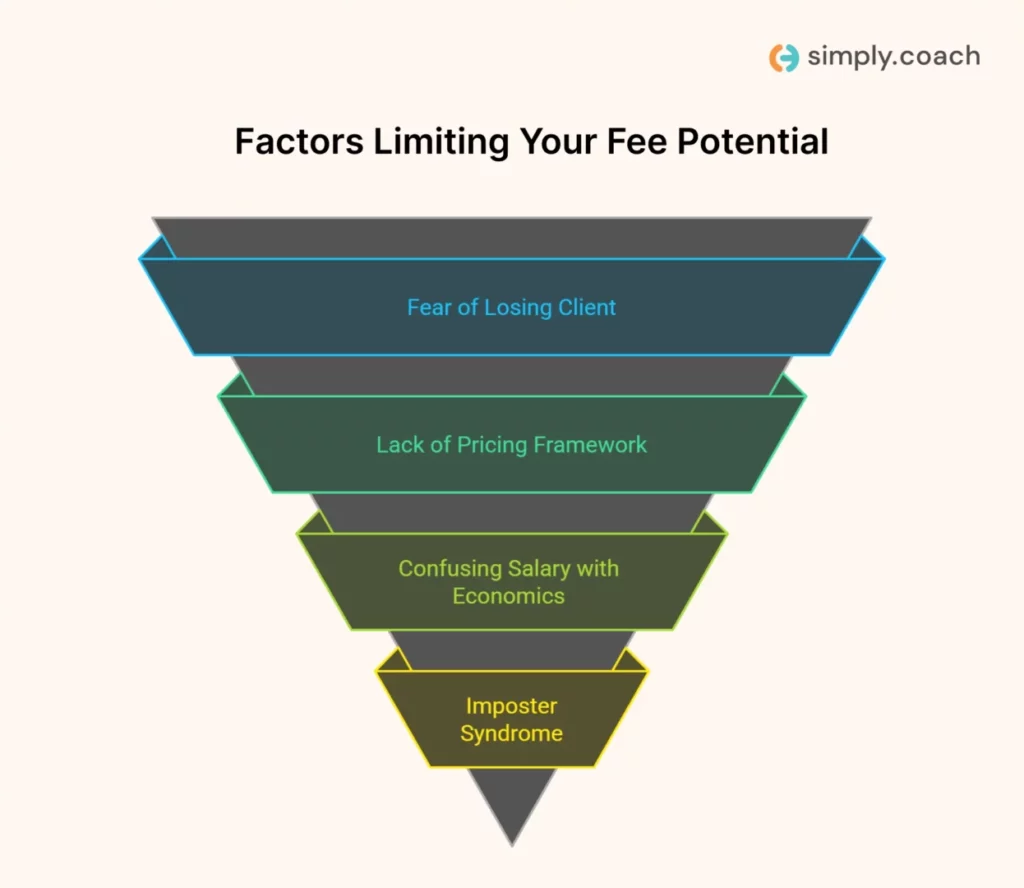
The problem is a set of deeply ingrained barriers that quietly suppress rates before a client ever enters the conversation.
The barriers that keep rates low
- Fear of losing the client. This is the most common culprit, and it operates almost entirely on assumption. Most consultants who underprice do so not because a client demanded a lower rate, but because they preemptively discounted themselves to avoid a rejection that never came. The fear of hearing “that’s too expensive” keeps rates anchored at comfortable rather than competitive. In reality, clients who walk away at your true rate were rarely the right clients to begin with.
- No pricing framework. Without a systematic approach to setting rates, pricing becomes an emotional decision made under pressure, usually right before a proposal goes out. Consultants without a clear framework default to guessing, anchoring off what they charged last time, or matching what they think a competitor charges. All three methods trend downward over time.
- Confusing salary with consulting economics. This is arguably the most damaging mental model a new consultant carries out of corporate life. If you earned $90,000 as a salaried PM, quoting $45–$50/hour can feel like a raise. It isn’t. That calculation ignores the entire financial infrastructure your employer was quietly providing and continues to ignore it every single time you send an invoice.
- Imposter syndrome. Particularly common among consultants transitioning from in-house roles, imposter syndrome creates a persistent internal narrative that says the rate isn’t earned yet. It mistakes the absence of a formal title or employer brand for an absence of value. Clients aren’t hiring your job title. They’re hiring the judgment, experience, and results you’ve built over an entire career.
The math your salary never showed you
When a company employs a full-time PM, the salary on the offer letter is only part of what the employment relationship costs them and only part of what it was worth to you. As a consultant, every item that was once invisible is now your responsibility.
| Cost Category | Employee | Consultant |
| Self-employment tax | Employer pays half | You pay the full 15.3% |
| Health insurance | Employer-subsidized | Fully out-of-pocket |
| Paid time off | Included in salary | Unpaid; lost income |
| Retirement contributions | Often employer-matched | Entirely self-funded |
| Tools & software | Company-provided | Your expense |
| Professional development | Often covered | Your investment |
| Business insurance | Not applicable | Your liability |
| Slow periods & downtime | Paid regardless | Uncompensated |
| Business development time | Not applicable | Uncompensated hours |
None of these costs disappear because you went independent. They shifted from your employer’s budget to yours. A consultant charging $60/hour on a $90,000 salary equivalent isn’t breaking even on paper; they’re operating at a loss once the full cost of self-employment is factored in.
A commonly used rule of thumb addresses this directly: multiply your equivalent employee hourly rate by at least 2.5 to 3x to arrive at a rate that actually sustains a consulting business. On a $90,000 salary basis, that’s not $43/hour; it’s $108–$130/hour before you’ve accounted for specialization, market demand, or the value of your outcomes.
Related:IT Consulting Hourly Rates in the USA (2026) | By Industry, Experience & Company Size
How to Increase Your Project Management Consulting Rates
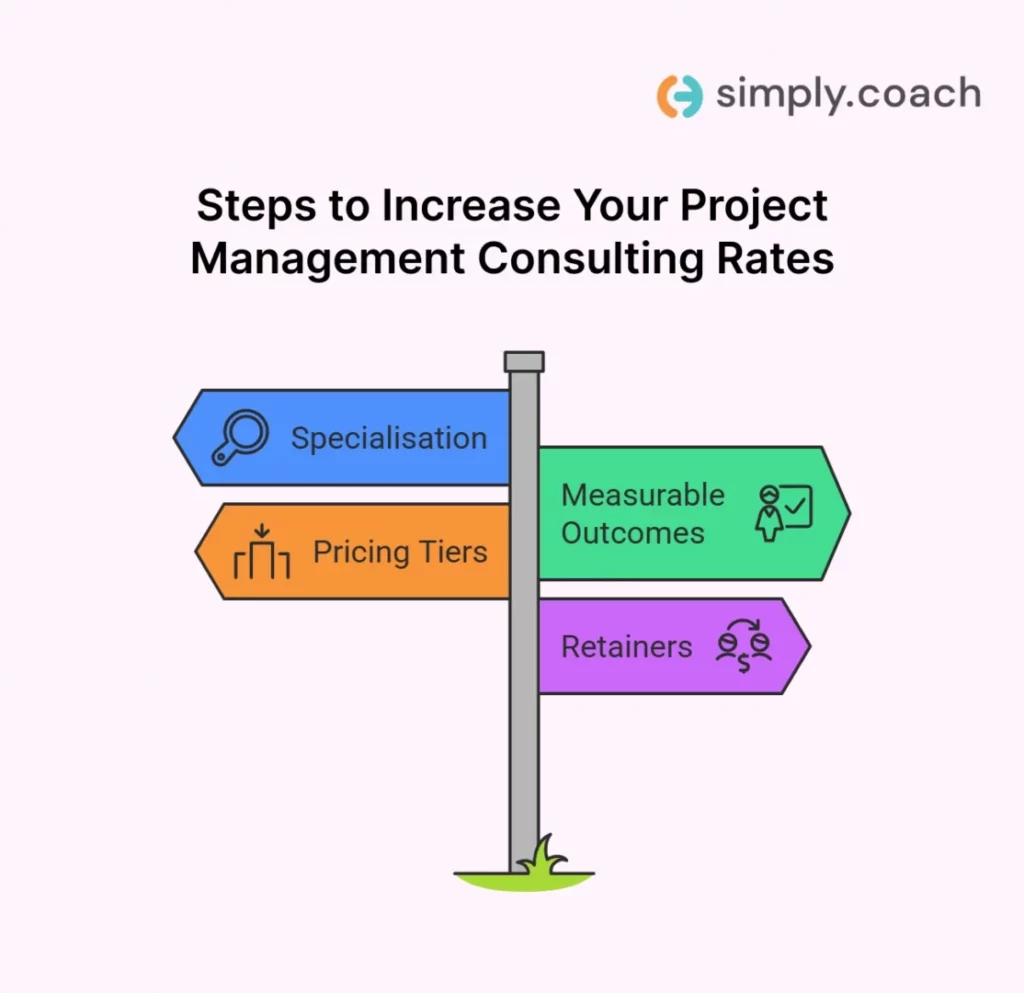
These four steps move you up the rate curve without losing clients.
Step 1: Specialize
Generalists compete on price. Specialists compete on expertise. Narrow your positioning so it speaks to a specific problem and industry.
Instead of:
- Project Manager Consultant
- PM Consultant
- Agile Consultant
Position as:
- Healthcare ERP Rollout Specialist
- Fintech Digital Transformation Consultant
- Capital Infrastructure Program Recovery Advisor
- SaaS Product Launch Delivery Consultant
When a company faces a delayed $2M ERP project, they look for proven experience, not a generalist. Specialization shortens sales cycles and supports premium pricing.
Step 2: Document measurable outcomes
Higher rates require proof. Track quantified results on every engagement:
| Outcome type | What to measure | Example |
| Schedule recovery | Time saved | Delivered delayed program on original go live date |
| Cost savings | Budget variance | Prevented $340K overrun |
| Revenue acceleration | Revenue timing | Generated $1.2M one quarter earlier |
| Risk mitigation | Issues avoided | Identified vendor risk before critical path impact |
| Efficiency gains | Time saved | Freed 12 executive hours per week |
Documented results strengthen proposals and make value-based pricing credible.
Step 3: Offer three pricing tiers
Present structured options instead of a single hourly quote.
| Tier | Included | Typical fee |
| Core | Standard PM delivery and reporting | $5,000 to $15,000 |
| Enhanced | Core plus risk oversight and advisory calls | $15,000 to $35,000 |
| Premium | Governance, executive advisory access, priority support | $35,000 to $75,000+ |
It increases average engagement value and signals a structured practice.
Step 4: Introduce retainers
Retainers create recurring revenue and elevate your role to strategic advisor.
| Retainer type | scope | Monthly rate |
| Governance Oversight | PMO advisory and portfolio reviews | $3,000 to $6,000 |
| Program Advisory | Active oversight and reporting | $5,000 to $8,000 |
| Strategic PM Partnership | Embedded advisory and hiring input | $8,000 to $10,000+ |
One $5,000 per month retainer generates $60,000 annually from a single client. Two can cover baseline income.
Also read:A 12-Step Guide to Become a Successful Consultant in 2026
Build a Consulting Practice That Reflects Your True Value With Simply.Coach
Raising your rates is only half the battle. The other half is running a business that can actually support the level you’re charging at. For most consultants, that’s where things quietly fall apart. Client onboarding is manual, contracts are scattered, retainers are tracked in spreadsheets, and follow-ups get missed. The operational gaps don’t just create friction; they undermine the credibility that premium pricing depends on.
Simply.Coach is built to close that gap. Designed specifically for consultants, coaches, and service professionals, it gives you the infrastructure to run your practice with the same standard your clients expect from your work.
- Automated client workflows: Eliminate repetitive admin with structured onboarding, session cadences, and follow-up sequences built directly into your programs.
- Integrated contracts & invoicing: Create, send, and manage contracts and invoices from one place, with no third-party tools required.
- Retainer & subscription management: Set up and manage recurring engagements with built-in payment processing, so your revenue is predictable and organized.
- Professional showcase page: Build a credible online presence that displays your credentials, testimonials, and services, and converts prospects into paying clients.
- Scheduling &video conferencing: Let clients self-book sessions synced to your calendar, with integrated Zoom, Google Meet, and Microsoft Teams support.
- Client workspaces &progress tracking: Keep all goals, actions, notes, and shared resources in one centralized space for every client engagement.
When your operations run as professionally as your consulting does, premium pricing becomes the expectation, not the exception.
Conclusion
Pricing your project management consulting services well is not about luck or guesswork. It is about understanding the benchmarks, knowing what your experience is genuinely worth, choosing the right pricing model for each engagement, and building the systems that support sustainable growth. The path forward is the same: specialize, document your outcomes, move toward project-based and value-based pricing, and create predictable recurring revenue through retainers.
Simply.Coach is the platform built for consultants who are ready to operate at that level. From automated client workflows and integrated contracts to retainer management and professional client workspaces, it gives you the infrastructure to run a practice that matches the rates you charge and the results you deliver. Consultants who invest in the right tools show up with the credibility and structure that converts premium clients.
FAQs
1. How much do project management consultants charge per hour?
In 2026, U.S. project management consultants typically charge between $40 and $95 per hour. The national average falls around $60 to $65 per hour. Senior specialists and strategic advisors often charge $125 to $250 or more per hour, depending on expertise, industry, and project complexity.
2. Is $100 an hour good for consulting?
Yes, $100 per hour is a solid rate for many mid-level project management consultants. It generally reflects established experience and some specialization. For senior consultants working on high-risk or high-value programs, $100 per hour may still be conservative.
3. How much should I charge per hour as a project manager?
Start by calculating your income target and realistic billable hours. Many independent consultants bill 1,000 to 1,400 hours per year. Multiply your former employee’s hourly equivalent by 2.5 to 3 times to account for taxes, insurance, downtime, and business expenses. For many consultants, this results in a rate between $90 and $150 per hour.
4.What is an hourly rate for a project manager?
Employee project managers in the U.S. typically earn the equivalent of $45 to $75 per hour in salary terms. Independent project management consultants usually charge more because they cover their own benefits, taxes, tools, and business risk. Rates commonly range from $60 to $120 per hour, with higher fees for specialized or strategic roles.