
A prospect asks what makes you qualified to fix their operations, and a résumé alone may not settle it. The right certification for management consultants depends on the work you sell, because general practice, project delivery, finance and IT audit each point to a different credential. A good choice gives clients a clear reason to trust you and gives you a reason to keep learning.
No credential suits every consultant, and each one asks for a different mix of experience, exams and renewal. Below, you will see why certificates matter, how the credentials were chosen, what each one requires and how to pick between them for the practice you want to build.
TL;DR
Pick the credential that matches the work you sell. The Certified Management Consultant (CMC) is the broadest and is built for consulting itself, and the Chartered Management Consultant (ChMC) suits consultants with five or more years behind them. Project, change, quality and analysis work each have a dedicated credential, finance advice has the Certified Management Accountant (CMA), and ISACA covers IT audit and governance. Most credentials ask for years of experience before you can apply, then an exam and renewal every few years. Plan the experience first, then check the issuer’s page for the current fee.
Why Do Consulting Certificates Matter?
The US management consulting services market reached USD 132.34 billion in 2026 and is projected to reach USD 168.46 billion by 2031, growing at a 4.94% annual rate, according to Mordor Intelligence. More demand brings more competition, and a recognized credential is one clear way to stand out. If you are still working out the first steps, the path to become a successful consultant comes before any exam.

- Build trust with clients faster: Getting certified shows clients that you know what you are doing. It proves you have the skills and training to back up your advice. That credibility helps you stand out when clients are weighing their options.
- Create more professional opportunities: A credential opens doors to larger clients and steadier projects, and it often makes the decision easier for the people hiring you. Many issuers also run member groups, events and forums, which are good places to find referrals and hear about new projects.
- Stay sharp and current: Most certification programs require ongoing learning. That keeps you in the loop on industry practices, tools and frameworks without having to work it all out alone.
- Earn more: Some issuers report a pay gap. The Institute of Management Accountants says CMAs report a 21% higher median annual compensation than noncertified peers, and the International Institute of Business Analysis reports 19% higher earnings for certification holders. Those are issuer figures, so treat them as a signal, not a promise.
How We Chose These Certifications
What we compared: Ten certifications that management consultants hold, from consulting credentials such as the CMC and ChMC to project, change, quality, finance and IT credentials.
How we chose them: Each is issued by a professional body or standards organization, is recognized across industries and is earned through an exam, an assessment or both.
Where the details come from: Each issuer’s own certification page, including its fee and renewal information.
What we left out: Degrees such as an MBA, entry-level credentials and certificates tied to one software product, because they follow different routes.
Limits of the method: Fees and requirements change, so confirm them on the issuer’s page before you apply.
Top 10 Certifications for Management Consultants
A certification for management consultants works best when it matches the clients you serve and the experience you already have. The table shows what each credential asks for and how it renews, with figures checked on November 19, 2026. The entries below add the focus, eligibility and best fit for each one.
| Certification | Issuer | Experience asked | Renewal |
|---|---|---|---|
| CMC | Institute of Management Consultants USA | 3 to 9 years in management consulting for the Basic stream | Every 3 years |
| PMP | Project Management Institute | 3 years leading projects with a bachelor’s degree | 60 PDUs every 3 years |
| CMA | Institute of Management Accountants | 2 years in management accounting or financial management | 30 CPE hours a year |
| CBAP | International Institute of Business Analysis | 7,500 hours of business analysis in the last 10 years | 60 CDUs every 3 years |
| CCMP | Association of Change Management Professionals | 3 years of professional change management experience | Every 3 years |
| CSSBB | American Society for Quality | 3 years of on-the-job experience plus 1 or 2 projects | 18 recertification units every 3 years |
| CSM | Scrum Alliance | A course led by a Certified Scrum Trainer | 20 SEUs every 2 years |
| ChMC | Chartered Management Institute and MCA | 5 or more years as a management consultant | Kept while CMI membership renews each year |
| CISA | ISACA | 5 years in information systems audit, control or security | 120 CPE hours every 3 years |
| CGEIT | ISACA | 5 years in an IT governance advisory or oversight role | 120 CPE hours every 3 years |
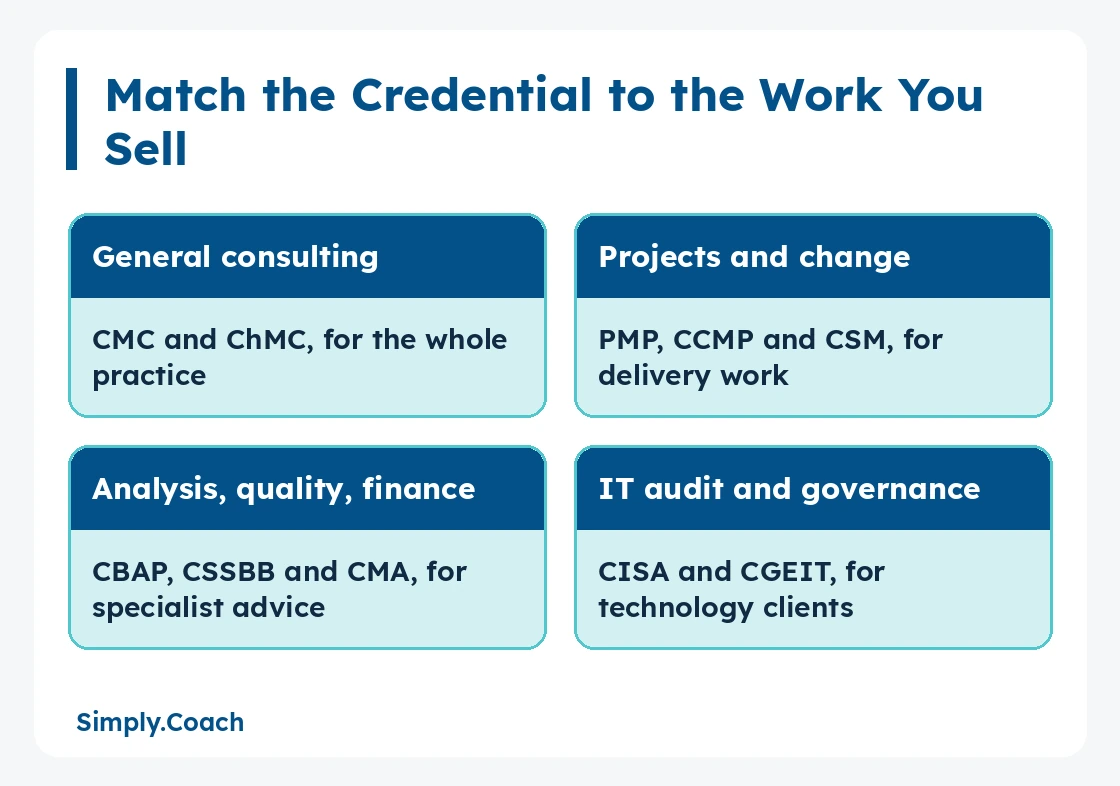
The figure groups the ten credentials by the kind of work each one supports.
1. Certified Management Consultant (CMC) Certification
If you want to be taken seriously as a management consultant, the CMC certification gives you that edge. It is a recognized professional designation for management consulting, and the national institutes that award it operate in more than 49 countries. It shows that you work with professionalism, integrity and a high level of skill.
Issued by: Institute of Management Consultants USA (IMC USA)
Focus:
- Ethical consulting practices
- Structured problem-solving
- Client relationship building
- Professional growth in management consulting
Eligibility:
- Experience: 3 to 9 years in management consulting for the Basic stream, with five satisfactory client evaluations
- Education: A bachelor’s degree, or at least 5 years of work experience including 3 years of full-time consulting plus professional education in management consulting
- Assessment: A written application, an online exam on ethics and consulting competency, and an oral exam
Renewability: Yes, every three years
Price: The application and assessment fee is $350 for IMC USA members and $550 for non-members
Who it’s for: You, if you work independently or at a firm and want clients in both corporate and nonprofit settings to see you as a trusted, credible consultant.
Not for: Skip it if you have less than three years of full-time consulting, because the application needs client evaluations from real engagements.
2. Project Management Professional (PMP) Certification
Planning to manage big projects as a consultant? The PMP certification helps you prove you can deliver results on time, within scope and on budget, in any industry. The Project Management Institute (PMI) says PMP holders in the United States report a median salary of $135,000.
Issued by: Project Management Institute (PMI)
Focus:
- Project planning and scheduling
- Leading project teams
- Risk and quality control
- Stakeholder communication
Eligibility:
- A bachelor’s degree or higher with 3 years of experience managing projects
- Or an associate’s degree with 4 years, or a high school diploma with 5 years
Training: 35 hours of project management training, or an active CAPM certification
Renewability: Every three years with 60 professional development units (PDUs)
Price: PMI sets the exam fee by region and membership, so check its page for your price
Who it’s for: Ideal if you handle complex client projects or want to specialize in structured, timeline-driven work.
Not for: Skip it if you rarely lead projects, because the application asks you to list each project you managed.
3. Certified Management Accountant (CMA) Certification
If you want to consult on financial strategy, the CMA certification gives you the credentials to do it. It sharpens your financial analysis skills and shows that you can advise businesses on money decisions.
Issued by: Institute of Management Accountants (IMA)
Focus:
- Financial planning and reporting
- Cost management and budgeting
- Internal controls and performance tracking
- Strategic financial decision-making
Eligibility:
- Education: A bachelor’s degree from an accredited institution, or a related professional certification
- Experience: Two continuous years in management accounting or financial management, completed before the exam or within seven years of passing it
- Exam: Two parts, which you can take in any order
Renewability: Every year, with 30 hours of continuing professional education (CPE), including 2 hours in ethics
Price: IMA membership is required, and its fees are listed on the IMA join page
Who it’s for: A smart choice if you want to advise on budgeting, forecasting or financial systems, especially for mid-size to large businesses.
Not for: Skip it if your clients do not need financial advice, since the exam and renewal focus on accounting and finance.
4. Certified Business Analysis Professional (CBAP) Certification
If you are drawn to solving business problems and finding what clients really need, the CBAP certification positions you as an expert in business analysis. It is designed for experienced professionals who want to go deeper into strategy and solutions.
Issued by: International Institute of Business Analysis (IIBA)
Focus:
- Business needs assessment
- Requirements planning and monitoring
- Strategic analysis and solution evaluation
- Stakeholder engagement
Eligibility:
- Experience: 7,500 hours of business analysis work in the last 10 years
- Education: 35 hours of professional development in the last 4 years
- References: Two professional references
- Exam: Pass the CBAP exam
Renewability: Every three years with 60 continuing development units (CDUs)
Price: A $145 application fee, then an exam package listed at $505 ($350 for IIBA members)
Who it’s for: This is for you if you already have hands-on business analysis experience and want to build authority in that space.
Not for: Skip it if you are early in your career, because 7,500 hours of business analysis work is required first.
5. Certified Change Management Professional (CCMP) Certification
Planning to help clients lead change without the chaos? The CCMP certification shows you understand how to manage transitions, guide stakeholders and make change stick, which every great consultant needs.
Issued by: Association of Change Management Professionals (ACMP)
Focus:
- Change strategy and planning
- Stakeholder alignment
- Communication during change
- Measuring and sustaining change
Eligibility:
- Experience: At least 3 years of professional change management experience, counted in hours
- Education: 21 hours of change management education
- Exam: Pass the CCMP exam
Renewability: Every three years with continuing professional development
Price: ACMP lists the current fees with the application, so check its page before you apply
Who it’s for: Perfect if you want to specialize in organizational change, help teams adopt new systems or advise on leadership alignment.
Not for: Skip it if change management is a side topic for you, because the application counts hours of change work and education.
6. Certified Six Sigma Black Belt (CSSBB) Certification
If you focus on improving processes and cutting waste for your clients, the CSSBB certification is one of the best ways to prove it. It shows you can lead high-impact improvement projects with measurable results.
Issued by: American Society for Quality (ASQ)
Focus:
- Advanced statistical analysis
- Six Sigma methodology
- Project planning and team leadership
- Root cause analysis and process control
Eligibility:
- Experience: Three years of on-the-job experience in the Body of Knowledge areas, plus one or two completed projects with signed affidavits
- Work status: A full-time, paid role
- Exam: Pass the CSSBB exam
Renewability: Every three years with 18 recertification units, or by retaking the exam
Price: The exam fee is $585, and ASQ members save $100
Who it’s for: Best suited to you if you aim to consult on operational efficiency, quality improvement or data-driven decisions.
Not for: Skip it if you do not run improvement projects, because the application needs completed projects with signed affidavits.
7. Certified ScrumMaster (CSM) Certification
If you want to lead agile teams and speed up project delivery, the Certified ScrumMaster (CSM) certification gives you the skills to do it. It shows that you understand Scrum principles and can guide agile practices with a team.
Issued by: Scrum Alliance, through its Certified Scrum Trainers
Focus:
- Scrum framework and principles
- Team roles and responsibilities
- Agile team guidance
- Sprint planning and execution
Eligibility:
- Training: A course taught by a Certified Scrum Trainer
- Exam: Pass the CSM exam after the course
Renewability: Every two years with 20 Scrum Education Units (SEUs)
Price: Course fees vary by training provider, so compare the course listings before you book
Who it’s for: Ideal if you are moving into agile project roles or want to improve team collaboration and efficiency.
Not for: Skip it if you advise on strategy rather than delivery teams, since Scrum covers how a team plans and runs its work.
8. Chartered Management Consultant (ChMC) Certification
Aspiring to be recognized at the top of the consulting profession? The Chartered Management Consultant (ChMC) accreditation is a professional standard of career excellence for management consultants, and the Chartered Management Institute (CMI) reports more than 3,000 consultants have achieved Chartered status.
Issued by: Chartered Management Institute (CMI) and Management Consultancies Association (MCA)
Focus:
- Strategic management consulting
- Ethical and professional standards
- Client relationship management
- Continuous professional development
Eligibility:
- Experience: 5 or more years of experience in your role as a management consultant, for the Experienced Professional route
- Assessment: A written submission within 3 months of applying, followed by a professional discussion with an assessor
Renewability: You can use the designation while your CMI membership stays current, and you keep a record of continuing professional development
Price: CMI sets the assessment fee, so check its page for the current amount
Who it’s for: Suited to experienced consultants who want to validate their expertise and commitment to the profession.
Not for: Skip it if you have under five years as a consultant, because the Experienced Professional route needs 5 or more.
9. Certified Information Systems Auditor (CISA) Certification
If you are interested in auditing, controlling and assuring information systems, the CISA certification validates your expertise in those areas. It is recognized globally and suits consultants focused on IT governance and risk management. ISACA lists US$149K or more as the average annual salary for CISA holders.

Issued by: ISACA, which also issues the CGEIT
Focus:
- Information systems auditing processes
- IT governance and management
- Information systems acquisition and implementation
- Information systems operations and business resilience
- Protection of information assets
Eligibility:
- Experience: Five years of professional experience in information systems auditing, control or security, within the 10 years before you apply
- Exam: Pass the CISA exam
Renewability: Every three years with 120 continuing professional education (CPE) hours, at least 20 a year
Price: The exam costs $575 for ISACA members and $760 for non-members, plus a one-time $50 application processing fee
Who it’s for: Ideal if you focus on IT audit, control and security consulting.
Not for: Skip it if you do not work in audit or security, because it needs five years in information systems auditing, control or security.
10. Certified in the Governance of Enterprise IT (CGEIT) Certification
For consultants who want to specialize in enterprise IT governance, the CGEIT certification shows you can manage and advise on IT governance frameworks and align IT strategy with business goals. ISACA lists US$141K or more as the average annual salary for CGEIT holders.
Issued by: ISACA, which also issues the CISA
Focus:
- Enterprise IT governance frameworks
- Strategic alignment of IT and business
- Benefits realization and risk optimization
- Resource optimization
Eligibility:
- Experience: At least five years in an advisory or oversight role supporting IT governance, across at least three of the four CGEIT domains, within the 10 years before you apply
- Exam: Pass the CGEIT exam
Renewability: Every three years with 120 CPE hours
Price: The application processing fee is $50 and ISACA lists the exam fee with registration
Who it’s for: Best suited if you advise organizations on IT governance and want to align IT initiatives with business objectives.
Not for: Skip it if you do not advise on IT governance, because it needs five years in an advisory or oversight role.
Tips for Management Consultants to Choose the Right Certification
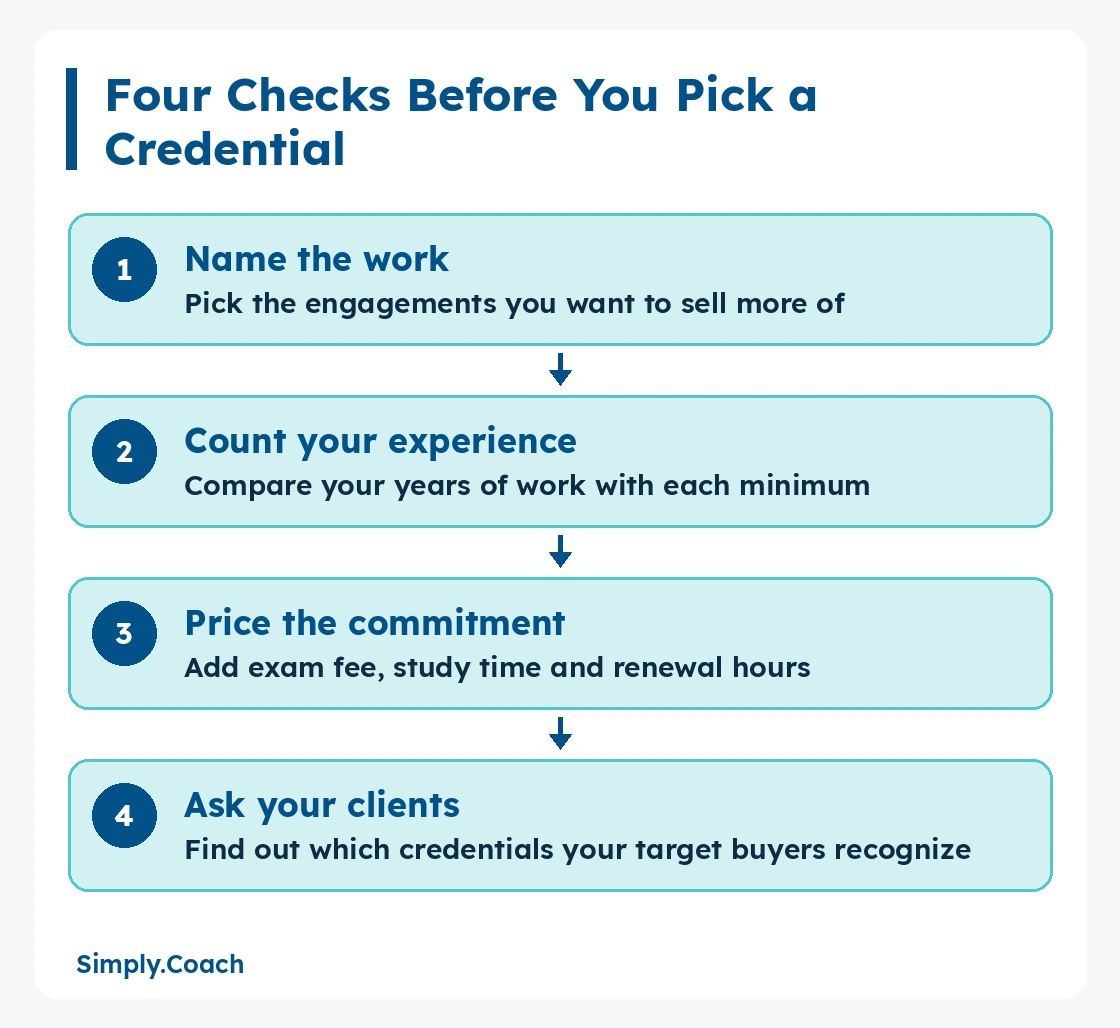
Choosing the right certificate means matching it to the career you want and the time you can give it. These four checks help you make an informed choice.
- Assess your career goals: Reflect on your long-term aims. You may want to specialize in one niche, such as business strategy, organizational structure, change management or operational efficiency, or to broaden across strategy, financial advisory and operations consulting. The most profitable consulting niches can show you which specialty clients pay for, and that points to a credential.
- Consider industry demand: Research which certifications are well regarded in your target market, such as financial services, manufacturing, technology, healthcare or consumer goods and retail. Talking with industry professionals and attending events shows you which credentials clients and employers value most. The types of consulting services you plan to sell are a good starting point.
- Evaluate time and investment: Understand the commitment each certification needs, including study time, fees and the return in career growth and client work. If you plan IT-focused work, compare the cost against current IT consulting hourly rates to see how soon a credential could pay for itself.
- Check the issuing body: Research how credible and recognized the organization behind the certification is. A credential from a reputable body adds to your professional standing and builds trust with clients and employers.
A credential also matters if you are becoming a personal consultant, because trust in one person often carries the sale. The figure below puts the four checks in order.
Conclusion
Start with the work you want to be known for, then pick the credential that proves it. General consulting points to the CMC, or the ChMC once you have five years behind you. A single kind of engagement points to its own credential: PMP for projects, CBAP for analysis, CCMP for change, CSSBB for process, CISA or CGEIT for IT.
Check the experience rules before you pay for anything, because several credentials need years of work that no exam replaces. Then plan the renewal, since each one asks you to keep learning.
Key Takeaways
- Match the work: Choose the credential that fits the engagements you sell, not the one with the biggest name.
- Start with the CMC: It is built for consulting itself and fits most general practices.
- Check experience first: Most credentials ask for three to five years of work before you can apply.
- Plan renewal: Every credential here needs ongoing learning, so count the hours and the cycle.
- Read the issuer’s page: Fees and requirements change, and some issuers set them by region or membership.
- Treat pay figures as signals: Issuer salary numbers come from their own members and are not guarantees.
- Pair it with a niche: A credential works hardest when it backs a clear specialty.
Once you are certified, the next job is running client work well. Simply.Coach’s consulting software for business growth brings client management, scheduling, notes, contracts and invoicing into one place, so you spend your time on advice and on the clients your credential helps you win, instead of on admin.
Frequently Asked Questions (FAQs)
Which certification is best for management consulting?
The CMC is the broadest, because it is built for consulting itself and covers ethics, problem-solving and client work. The best fit still depends on your engagements: PMP for projects, CBAP for analysis, CCMP for change, CSSBB for process improvement, and CISA or CGEIT for IT audit and governance.
How much does a CMC certification cost?
IMC USA lists an application and assessment fee of $350 for members and $550 for non-members. The CMC renews every three years, and IMC USA also charges membership dues. Check its fee page for current amounts before you apply, because fees change.
How do you become a management consultant?
Most consultants build several years of experience in a field such as strategy, operations, finance or IT, then add a credential that proves it. The CMC route accepts a bachelor's degree, or at least five years of work experience that includes three years of full-time consulting.
What certifications should I get for consulting?
Start from your clients' problems. Choose a consulting credential such as the CMC or ChMC for general work, then add one specialty credential that matches the engagements you sell, such as PMP, CBAP, CCMP, CSSBB or CISA. One or two well-chosen credentials beat a long list.
Do you need a certification to be a management consultant?
No credential is required to start consulting. A certification gives clients a way to judge your skills, and it can open larger projects. It works best alongside real engagements and clear results you can point to.
Which consulting certification asks for the least experience?
The CSM asks for a course and an exam rather than years of work. The other credentials here ask for two years or more of related experience, and the ChMC, CISA and CGEIT ask for five years or more.
How often do consulting certifications need renewal?
Most renew every three years, including the CMC, PMP, CBAP, CCMP, CSSBB, CISA and CGEIT. The CSM renews every two years, the CMA asks for 30 hours of continuing education each year, and the ChMC stays active while your CMI membership renews.
Can a certification raise what you earn?
Some issuers report a pay gap, such as 21% higher median pay for CMAs and 19% higher earnings for CBAP holders. Those figures come from the issuers' own members, so they show a link between certification and pay, not proof that the credential causes the raise.