
Most coaches do not need more apps. They need fewer, and the right coaching app is the one that lets you drop the calendar tool, the payment link, the spreadsheet and the chat group you juggle today. The best coaching apps put scheduling, client management, programs and payments in one place, and which one fits depends on how you coach: individually, in groups, through courses or inside companies.
The apps below are compared on what they do, what they cost and where each one falls short. The table under “Coaching Apps at a Glance” gives the short version, and “How to Choose and Integrate the Right Coaching App for Your Business” helps you test the shortlist against your own practice.
TL;DR
The right coaching app depends on your coaching model. For one-to-one coaching with programs, notes and payments, coaching-specific apps such as Delenta, Satori and Upcoach cover the essentials. Quenza is strongest for exercises and homework between sessions but leaves scheduling and billing to other tools. Mighty Networks and Kajabi suit coaches who sell communities, courses or memberships alongside coaching, at a higher price. HoneyBook and vCita handle the business side well but were not built around coaching programs. CoachHub is a corporate coaching network rather than an app for running your own practice. Entry prices run from $9 to $179 a month, and almost every app offers a free trial, so shortlist two or three and run a real client through each before you move your practice.
Why Digital Coaching Apps Are Essential for Modern Coaches in 2026
Digital coaching apps matter in 2026 because coaching has moved well beyond pen, paper and scattered spreadsheets. They combine scheduling, client management, payments, program delivery and progress tracking in one system that works on a phone. You deliver a personal experience to each client while the business side runs with less effort.

With these apps, you can:
- Save time and reduce admin work: Automate reminders, billing, and session tracking so you can focus on coaching instead of repetitive tasks.
- Deliver structured, results-driven programs: Create pathways, exercises, and goals that clients can follow between sessions, keeping them accountable and engaged.
- Improve the client experience: Provide clients with a professional portal where they can view sessions, access resources, complete assignments, and track progress.
- Scale your practice efficiently: Manage several clients, group programs and recurring sessions without juggling separate tools.
- Maintain security and compliance: Look for encrypted communication and data storage aligned with GDPR, the EU data protection rules, and with HIPAA, so client information stays private.
A coaching app simplifies your workflow and gives clients a more professional, engaging experience. For coaches who want to grow and show measurable results, it has become part of the job, in the same way that new-age coaching tools and techniques have changed how sessions themselves are run.

How We Chose These Coaching Apps
Every app below was judged on the same criteria, so you can compare the entries on equal terms.
- What we compared: ten apps that coaches use to run a practice, from coaching-specific platforms to course, community and business management tools.
- Where the details come from: each vendor’s own product and pricing pages, with every price re-read for this update; where a vendor shows prices only after its page loads in a browser, the entry says what the page does state.
- How we judged them: scheduling, client management, program delivery, payments, mobile access and what the entry plan costs, plus the kind of practice each one suits.
- What we left out: fitness and sports coaching apps, such as personal training platforms, which serve a different reader.
- How to read it: nobody used these apps with real clients for this comparison, so it is not a hands-on review.
Coaching Apps at a Glance
The coaching apps in this list differ most in the kind of practice they serve and in what the entry plan costs, so the table below sets those two side by side before the detail.
| App | Best for | Entry price (October 2026) |
|---|---|---|
| Mighty Networks | Communities, courses and memberships | $79 per month |
| Delenta | Solo coaches who want simple workflows | $29 per month |
| Quenza | Exercises and homework between sessions | $25 per month, or $20 billed yearly |
| HoneyBook | The business side: proposals, contracts, invoices | $29 per month billed yearly |
| Satori | Coaching businesses that want automation | Shown on its pricing page |
| Kajabi | Coaching sold with courses and marketing | $143 per month billed yearly |
| Upcoach | Programs, cohorts and group coaching | $49 per month billed yearly |
| vCita | Booking, invoicing and client management | $35 per month billed yearly |
| CoachHub | Corporate coaching programs | Enterprise quotes only |
| Simply.Coach | Running a coaching practice end to end | $9 per month |
Top 10 Coaching Apps for 2026
Every coaching app in this list handles some mix of scheduling, payments, client communication and program delivery, and the entries below show where each one is strong and where it stops. Prices were read on each vendor’s own page on October 8, 2026.
1. Mighty Networks
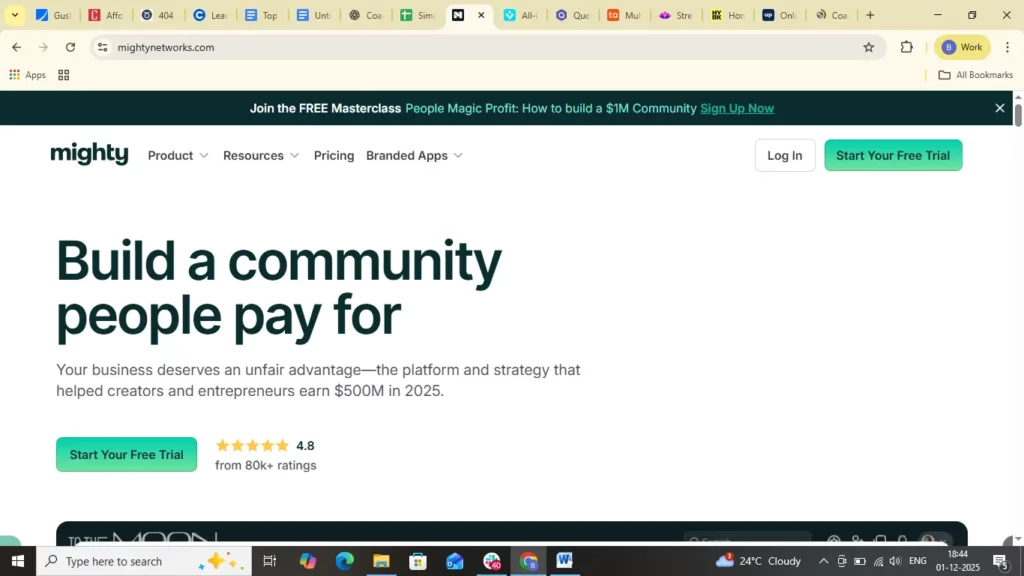
Mighty Networks is a community-first coaching and membership app that combines group coaching, courses, memberships and community interaction in one platform that works on mobile. As a coach, you can build a branded space where clients learn, connect, and support each other. That matters most if your business includes group programs, ongoing memberships or community-based learning rather than only one-to-one coaching.
The key features to know:
- Community and groups: Create private or public spaces for clients to interact, discuss, and support each other.
- Course and content delivery: Build and deliver online courses, challenges, and resource libraries with videos, text, audio, and PDFs.
- Events and live sessions: Host live sessions, webinars, or group calls within the app and run events for your community.
- Payments and monetization: Sell memberships, paid access, courses, or subscriptions directly so clients can pay and access content in one place.
- Unlimited members and spaces: Every plan includes unlimited members, spaces and hosts.
- Mobile apps for iOS and Android: Clients and coaches can access the community, courses, and interactions on the mobile app.
Pricing: Mighty Networks lists three plans: Launch at $79 per month, Scale at $179 and Growth at $354, with two months free on annual billing and a free trial.
| Pros | Cons |
|---|---|
| Combines community, courses, events, and monetization which reduces the need for multiple tools | Lower tier plans offer limited customization and fewer automation features |
| Scales with unlimited members and spaces which suits group coaching or memberships | Advanced analytics or course control requires higher tier plans |
| Clients get mobile ready access to content, community, and events which increases engagement | Integrations and workflow automations are limited compared to dedicated LMS or coaching tools |
| Built in payments and subscription tools make monetization simple | If your coaching is mainly one to one, it may feel more complex than needed |
Not ideal for: one-to-one coaches who need scheduling, notes and invoices, because the platform is built around communities and courses.
2. Delenta

Delenta is a coaching app designed for solo coaches and small coaching businesses that want one easy-to-use system. It gives you scheduling, client management, portals, billing, and session tracking in one place. If you prefer simplicity, clean workflows, and essential coaching features without unnecessary complexity, Delenta fits that need well.
The key features to know:
- Booking and scheduling: Sync your calendar, allow clients to book sessions, and manage appointments in one platform.
- Client management and CRM: Store client data, session notes, goals, tasks, and history in a central system.
- Client portals and resources: Give each client a portal to access notes, files, resources, and assignments to support continuity.
- Payments, contracts, and billing: Send contracts, accept payments, create invoices, and manage subscriptions.
- Group coaching and package management: Create packages, manage group coaching, and handle multiple clients in structured programs.
- Integration support: Connect Zoom, Google Meet, calendars, PayPal, Stripe, and other tools for smoother workflows.
Pricing: Delenta’s Starter plan is $29 per month, Pro is $49 and Premium is $79, with team plans priced separately and a free trial on each.
| Pros | Cons |
|---|---|
| Designed specifically for coaches with CRM, scheduling, billing, portals, and sessions in one place | Starter plan has limited client portals and file storage |
| Supports group coaching and program management | Larger teams may require costlier plans with more features |
| Easy onboarding and straightforward workflows for solo and small coaching businesses | Limited community or course building features compared to LMS tools |
| Integrates with Zoom, Stripe, calendars, and more which reduces tool overload | Coaches needing advanced marketing automations may find it basic |
Not ideal for: coaches who sell courses or run a community, because course and community features are limited.
3. Quenza
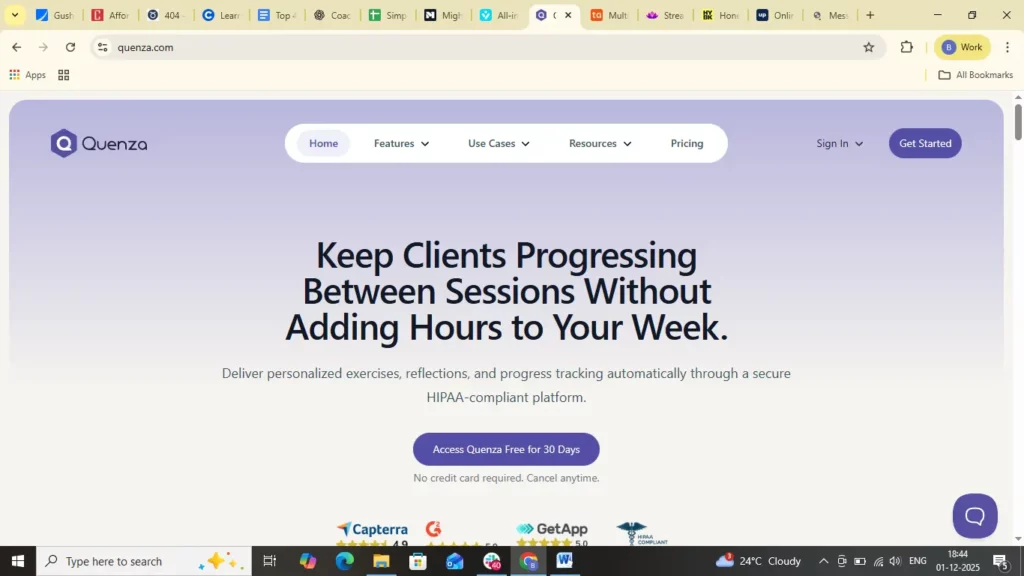
Quenza is a coaching app focused on delivering structured programs and client engagement between sessions. With Quenza you can send exercises, track completion, and maintain client momentum outside of live calls. If you aim to offer homework, reflections, assessments or guided change, Quenza helps you deliver that in an automated, secure, digital way.
The key features to know:
- Activities and exercises: Choose from 200+ ready-made activities or build your own; send them to clients for self-paced work.
- Client progress tracking: See real time completion status of client tasks so you know who is on track and who needs follow up.
- Automated programs and pathways: Create multi-week programs or sequences of tasks that run automatically once you enroll a client.
- Secure communication and data: Use encrypted messaging and HIPAA and GDPR compliant storage which is useful if you coach on sensitive personal or health related topics.
- Client portal and file sharing: Clients get a portal to access resources, submit assignments, and review their progress.
Pricing: Quenza’s Spark plan is $25 per month, or $20 per month billed yearly, for up to 10 clients, and Growth is $50, or $40 billed yearly. A 30-day free trial needs no credit card.
| Pros | Cons |
|---|---|
| Excellent for delivering structured programs, assignments and engagement outside sessions | It does not include scheduling, billing or calendar management so you need separate tools |
| Good for coaching or mental health work where assignments, tracking and secure communication matter | Not ideal if your model depends on payment processing plus scheduling plus program delivery in one place |
| Secure and compliant platform (HIPAA, GDPR) which is helpful for sensitive data | As you scale clients, cost rises and you still need external tools for business management |
| Flexible activity library and custom program builder | No built in invoicing, contracts or automated scheduling which adds manual work |
Not ideal for: coaches who want scheduling and billing in the same tool, because Quenza leaves both to other apps.
4. HoneyBook

HoneyBook is a client management and business operations app that coaches often use to manage clients, contracts, invoices, scheduling and basic workflows. If you want to simplify payments, proposals, scheduling and client interactions without needing coaching specific tools, HoneyBook is a strong option.
The key features to know:
- Client management and projects: Manage clients, proposals, projects and contracts in one system to simplify admin.
- Scheduling and calendar tools: Create booking links, set appointments and manage your availability easily.
- Invoicing, payments and billing: Send contracts, create invoices and accept client payments directly.
- Client portal and communication tracking: Keep records of all messages, contracts and files for each client.
- Templates and workflow automation: Use templates and automate repeated tasks such as emails or invoices.
Pricing: HoneyBook’s Starter plan is $29 per month, Essentials $49 and Premium $109, all billed yearly, and a free trial is available.
| Pros | Cons |
|---|---|
| Great for managing the business side of coaching including payments, scheduling and proposals | Not suited for structured coaching programs, assignments or progress tracking |
| Unlimited clients and projects even on the Starter plan | Does not offer habit tracking, resource delivery or detailed client engagement tools |
| Strong choice for coaches shifting from freelancing or consulting to structured coaching | More generic than specialized coaching apps which may require extra tools |
| Templates and automations reduce admin work significantly | No built in course delivery or interactive coaching modules |
Not ideal for: coaches who deliver structured programs and track client progress, because it is a general business tool.
5. Satori
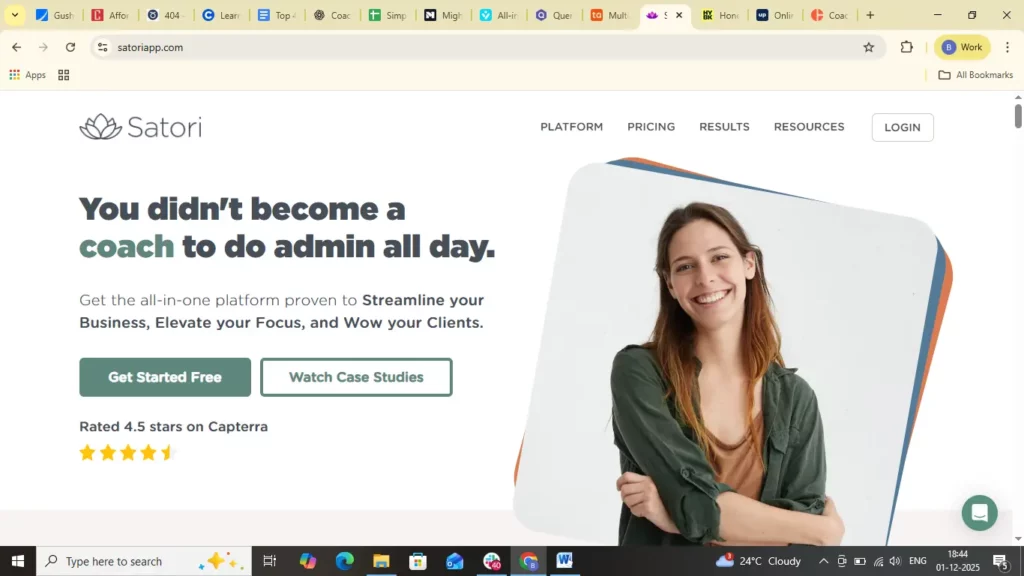
Satori is a complete coaching platform that supports client onboarding, scheduling, billing, program management and client tracking. If you want one system for both the operational and the delivery side of coaching, Satori is a dependable option as your practice grows.
The key features to know:
- Appointment booking and calendar sync: Let clients book sessions and sync with Google or other calendars.
- Client onboarding and agreements: Create proposals, send contracts and handle intake forms with built in templates.
- Coaching programs and session tracking: Build multi session packages, track session notes, and manage recurring check ins.
- Billing, invoicing and payments: Accept payments, manage invoices and offer subscription billing.
- Client portal and resources: Give clients access to their programs, history and shared materials.
- Business dashboard and analytics: Track revenue, bookings and workload to monitor your business performance.
Pricing: Satori offers a 15-day free trial with access to the whole system, then monthly or annual plans, with two months free on annual billing. Its plan prices appear only once the pricing page loads in a browser, so check the current figure there.
| Pros | Cons |
|---|---|
| Built specifically for coaching businesses and covers scheduling, billing, programs and client management | Lower tier plans may limit the number of programs or clients depending on usage |
| Helps automate admin tasks to reduce tool switching | Limited advanced integrations if you want complex workflows |
| Useful analytics and dashboards for growing practices | Not specialized for mental health style modules or therapy style assignments |
| Flexible program, booking and billing capabilities | Higher plans may be needed as you scale which increases cost |
Not ideal for: coaches who only need a light tool, because much of its value sits in automation across the whole business.
6. Kajabi
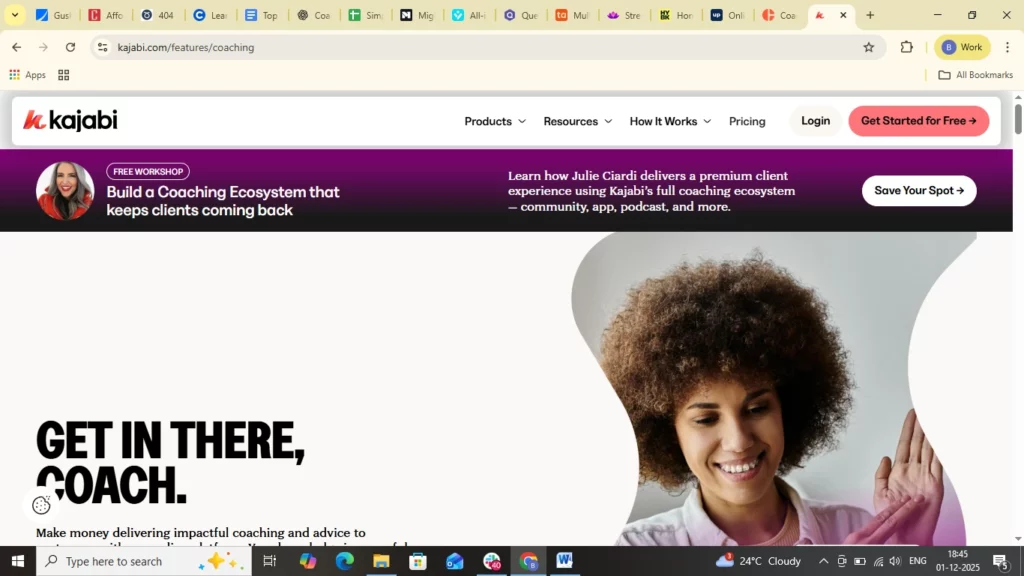
Kajabi is an app for building, delivering and scaling coaching, courses and digital products from a single dashboard. You can manage coaching packages, run live or recorded sessions, deliver resources, handle payments, marketing and course content through one app. If you want to package coaching, courses, and business marketing under one roof, Kajabi makes it easier and cleaner.
The key features to know:
- Coaching packages and live video sessions: Run one on one or group coaching, host live sessions with built in video and deliver coaching through the same app.
- Course and content creation: Build courses, membership sites, or digital products with video, text, downloads and drip content which is great if you combine coaching with courses.
- Landing pages, funnels, email marketing and automation: Use Kajabi’s built-in marketing tools like landing pages, sales funnels, and email sequences to attract and convert clients.
- Client management and CRM for contacts, billing, and payments: Manage contacts, payments, subscriptions, and checkout inside Kajabi.
- Client portal and resource delivery: Clients get access to course materials, coaching sessions, downloadable resources, and memberships in one place.
- Mobile and web access: Manage your coaching and content from any device.
Pricing: Kajabi’s Basic plan is $143 per month billed yearly ($179 month to month), Growth is $199 ($249) and Pro is $399 ($499).
| Pros | Cons |
|---|---|
| Everything in one app for coaching, courses, marketing and payments which reduces the need for multiple tools | More expensive compared to simpler coaching only apps |
| Built in video, course hosting, funnels and email marketing which supports full program delivery | Can feel like too much if you only need simple coaching features |
| Helps you market, sell, deliver and manage clients from the same dashboard which boosts efficiency | Has a learning curve when setting up everything |
| Suits premium coaching programs, courses, memberships and scale | Not ideal for coaches who want only basic one on one or group coaching features |
Not ideal for: coaches who only run one-to-one sessions, because most of the price pays for course and marketing tools.
7. Upcoach
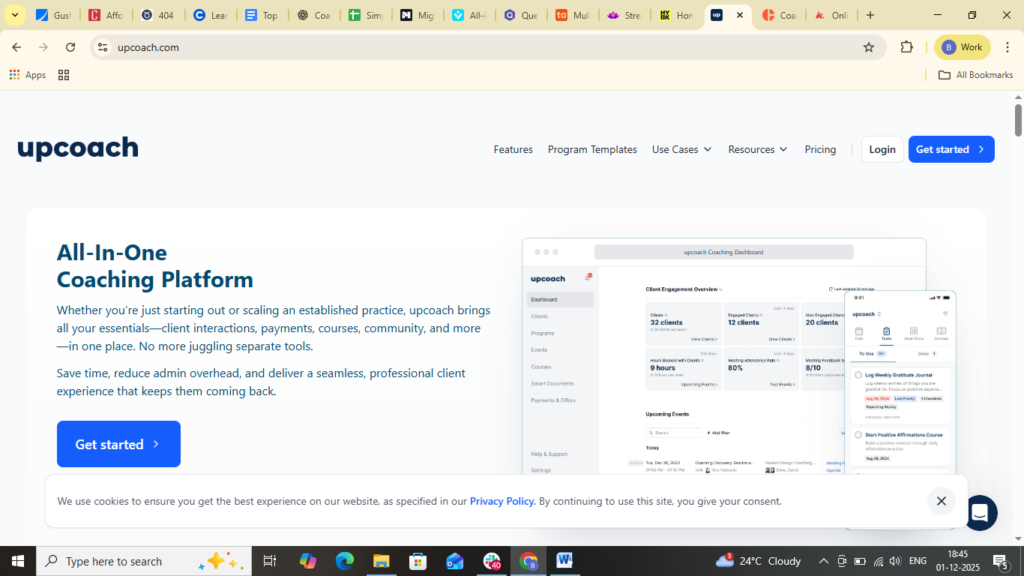
Upcoach is a coaching-first app that helps you run one on one coaching, group coaching, programs, courses and client management from one place. If you want structure, automation and clear client tracking, Upcoach reduces the need to juggle several tools.
The key features to know:
- Coaching program builder and course management: Create coaching programs, courses and group pathways with lessons, assignments and milestones.
- Client management and CRM: Store client data, track progress, sessions and maintain coaching history in one dashboard.
- Habit tracking, tasks and smart documents: Assign tasks, habits, forms or documents and track client completion.
- Group coaching and cohort capabilities: Manage groups and cohorts easily which is great for group coaching models.
- Payment processing and offer pages: Sell coaching offers, accept payments and manage subscriptions smoothly.
- Mobile friendly client dashboard: Clients can access their tasks, programs and resources on any device.
Pricing: Upcoach’s Starter plan is $49 per month billed yearly for up to 25 active participants, Pro is $99 for 100 and Business+ is $199 for 250, with a free trial that needs no credit card.
| Pros | Cons |
|---|---|
| Built specifically for coaching which makes client tracking and program delivery smooth | Basic plan limits number of clients which means you may need to upgrade |
| Strong balance between features and price which is great for solo coaches | Some users feel the interface is less polished |
| Supports structured programs, group coaching and habit tracking which enhances client results | Some advanced features require higher tier plans |
| Built in payments, CRM, and program delivery reduce admin time | May feel too feature heavy for very low volume coaching |
Not ideal for: coaches on a tight budget with many clients, because pricing steps up with active participants.
8. vCita
vCita is a business management and CRM app designed for coaches, consultants and service professionals. If you want simple scheduling, payments, invoicing, communication and client management in one app, vCita helps you run your coaching business with less admin work.
The key features to know:
- Client management and CRM: Store client profiles, communication history, bookings, invoices and documents in one place.
- Online scheduling and bookings: Allow clients to book sessions online and sync your calendar to avoid double booking.
- Payments, invoicing and billing: Accept payments, send invoices, manage recurring payments or packages.
- Client portal and communication: Clients can access documents, invoices, communication and reminders from their portal.
- AI powered admin assistance: Automate tasks such as reminders and scheduling to reduce admin load.
- Mobile app: Manage clients, appointments and payments on the go.
Pricing: vCita’s Kickstart plan is $35 per month, Manage is $54 and Manage + Grow is $93, all billed yearly, and a free trial is available.
| Pros | Cons |
|---|---|
| All in one app for CRM, scheduling, billing, payments and communication which simplifies your operations | Not built specifically for coaching programs or progress tracking |
| Easy bookings and payments that reduce admin work and ensure you get paid on time | If you need course delivery or structured programs you may need another app |
| Built in client portal with automated reminders which keeps clients accountable | Per seat pricing can get costly for larger teams |
| Mobile ready and suited to coaches who travel or manage clients remotely | Generic CRM features rather than specialized coaching tooling |
Not ideal for: coaches who deliver structured programs or courses, because it was built for service businesses in general.
9. CoachHub
CoachHub is a global coaching app built for corporate level coaching and organizational talent development. If you work with companies or large teams rather than individual clients, CoachHub gives you access to a broad network of certified business coaches and tools to deliver scalable, science-backed coaching across organizations worldwide.
The key features to know:
- AI coach matching and global coach network: Get matched with certified coaches from a pool of over 3,500 coaches across 90 plus countries, based on your clients’ preferences, background and needs.
- Digital coaching sessions anytime, anywhere: Offer live video coaching sessions and asynchronous communication through mobile or desktop which is helpful if your clients are distributed globally.
- Personalized content and learning resources: Use the built in content library (CoachHub Academy) to provide clients with curated articles, exercises, podcasts and learning modules based on their goals.
- Analytics and impact tracking: Track client progress and, if working with organizations, measure coaching outcomes and behavior changes across populations with real time dashboards.
- Enterprise scale system and HR integration: Integrates with company HR or HRMS systems which makes it suitable for large scale employee development programs rather than one on one coaching businesses.
Pricing: CoachHub does not publish public pricing for individual coaches or small coaching businesses. Pricing is negotiated at enterprise level and depends on the volume of clients, organizational requirements and scope of services.
| Pros | Cons |
|---|---|
| Access to a global, vetted pool of 3,500 plus certified coaches and large organizational clients which can provide scale and consistent work | Not suitable if you run a small independent practice targeting retail clients or individuals |
| Built in matching, content library, session tools and analytics which reduces the need for separate tools | No public pricing or clear plan structure for solo or small coach use cases which means onboarding may require corporate contracts |
| Great for corporate coaching, talent development and team level coaching engagements | Less flexibility for small scale one on one or group coaching because it is optimized for enterprise workflows |
| Offers structured approach, scalability and data driven coaching outcomes which appeal to business clients | As a solo coach targeting individual clients, the model may not be a fit unless you partner with an organization |
Not ideal for: independent coaches running their own practice, because it is a corporate coaching network, not an app you run clients on.
10. Simply.Coach
Simply.Coach is the platform we build, so it is the one we know best, and it sits in this list on the same terms as the others. It is coaching and mentoring software for running a practice end to end, from anywhere. Whether you coach individuals, teams or groups, it gives you one mobile-ready system to manage sessions, track progress, deliver programs and engage clients, with the business tools in the same app.
The key features to know:
- Session scheduling: Sync calendars, manage availability, and automate reminders so you never miss or manually track sessions again.
- Client portal: Give clients a private space to view sessions, access resources, complete assignments, and track their progress.
- Programs and pathways: Build structured program pathways for 1:1 or group coaching with activities, milestones, and automated steps.
- Goal and tracking: Set goals, assign habits, track progress, and keep clients accountable with nudges and check-ins.
- Payments and contracts: Create proposals, send contracts, accept payments and manage subscriptions inside the app.
- Notes and documentation: Store session notes, worksheets, forms, and shared files securely in one central location.
- Mobile app (iOS and Android): Manage your entire coaching workflow conveniently from your phone, anywhere, anytime.
- Security and compliance: Work with enterprise-grade standards including SOC2, HIPAA alignment, and GDPR compliance.
Pricing: Simply.Coach pricing starts at $9 per month and rises gradually, so plans fit an individual coach as well as a team, and a 14-day free trial lets you test it first.
| Pros | Cons |
|---|---|
| Full mobile app that covers coaching delivery, programs, and client accountability tools | Advanced automation and team features are available only in higher tiers |
| Strong security standards suitable for sensitive coaching data | Client limits on lower-tier plans may require upgrading as you scale |
| Integrated workflows reduce reliance on multiple external tools | Integrations library is expanding, but some niche tools still require Zapier |
Not ideal for: coaches who mainly sell self-paced courses or run a large community, because it is built around coaching engagements.
How to Choose and Integrate the Right Coaching App for Your Business
Choosing the right coaching app starts with your coaching style: the app should fit how you deliver coaching, cut manual tasks and improve the client experience. Most apps in this list belong to the wider category of coaching platforms, and the questions below help you narrow it down. If you coach in one niche, a focused list such as the best life coach apps can shorten the search.
1. Key features to look for in a coaching app

- Client management: Keep all client details organized, track progress easily, and maintain consistent communication.
- Scheduling tools: Simplify appointment management with calendar sync, automated reminders, and hassle-free booking options.
- Payment processing: Accept secure payments, manage invoices, and automate billing to save time.
- User interface: Choose an intuitive app that is easy for both you and your clients to use.
- Customization and scalability: Pick software that adapts to your coaching style and grows as your practice expands.
- Support and training: Ensure responsive support and clear onboarding resources to get started quickly.
- Affordable pricing: Find an app that covers the essentials without going over your budget.
2. Steps to integrate a coaching app into your practice
- Ensure compatibility: Check that the app integrates smoothly with tools you already use, such as email, calendars, or payment systems.
- Invest in training: Learn the app with your team so you use the features you are paying for.
- Implement in phases: Start with key processes, then gradually expand its use as you gain confidence.
- Monitor performance: Regularly assess how the app improves efficiency, client experience, and program delivery, and make adjustments as needed.
The right coaching app should simplify your operations, not complicate them. Matching the app to your setup is the core decision in choosing software for coaches, and with the right one in place you can deliver more to clients and run the business from one system on your phone.
Conclusion
Managing a coaching business does not have to be complicated. The right coaching app brings scheduling, client management, program delivery and payments into one place, so your time goes to helping clients reach their goals.
Pick by your coaching model first and price second, and test your shortlist with a real client before you move everything. Simply.Coach is built for coaches who want to run the whole practice in one app, from session scheduling and client portals to programs and payments, at a price that suits a solo coach.
Key Takeaways
- Fewer apps, not more. A good coaching app replaces the calendar, payment, spreadsheet and chat tools you juggle today.
- Model before features. One-to-one, group, course and corporate coaching each point to a different kind of app.
- Know where each stops. Some apps skip scheduling and billing, others skip programs, so check the gaps as well as the features.
- Prices move. Several vendors changed plans this year, so confirm the current price on the vendor’s page before you buy.
- Trial with a real client. A week with one real client shows more than a feature list or a demo.
- Roll out in phases. Move booking and payments first, then programs and notes, so clients are not hit with everything at once.
If you run your practice across four or five apps, the time you lose to switching adds up every week. Simply.Coach is a client management platform for coaches that keeps sessions, programs, notes and payments in one app. See how your practice would look in it.
Frequently Asked Questions (FAQs)
Can I use a coaching app even if I only coach a few clients at a time?
Yes. Even with a small client base, a coaching app keeps you organized and consistent. Scheduling, secure records and a client portal give your current clients a professional experience, and the same setup grows with your practice.
Do coaching apps support video calls and live sessions, or do I still need Zoom or Google Meet separately?
It depends on the app. Some include built-in video, and most connect to Zoom or Google Meet so the call link sits with the booking. Either way, sessions, resources and follow-ups stay in one app even when the call runs elsewhere.
How can coaching apps help improve client engagement between sessions?
Coaching apps keep clients engaged with homework tasks, goal and habit tracking, resource libraries, progress dashboards and push notifications. Coaching becomes continuous rather than limited to scheduled sessions, which helps clients stay accountable.
Will I lose flexibility if I move from separate tools to a single coaching app?
Usually not. Most coaching apps let you choose which features to use, from scheduling and payments to programs and messaging, and connect to the calendar and payment tools you keep. Check the integrations list before you switch.
Can I integrate a coaching app with my existing tools like calendars, email, or payment gateways?
Yes. Most coaching apps connect to popular calendars, email clients and payment systems such as Stripe or PayPal. Check that the specific tools you rely on are supported, because some apps need Zapier for less common ones.
How do coaching apps help when I scale up, such as adding more clients or offering group coaching?
Coaching apps bring bookings, payments, client data, messages and programs into one system, so adding clients does not add admin at the same rate. Apps with group or cohort features let you run group programs alongside one-to-one work.
What is the best coaching app?
The best coaching app depends on how you coach. Coaching-specific apps suit one-to-one programs, community and course apps suit coaches who sell memberships, and business tools suit coaches who mainly need booking and billing. Shortlist by your model, then trial two or three.
Is there a free coaching app available?
A few apps offer free plans with limits, and almost every paid coaching app has a free trial of one to four weeks. A free plan suits a coach with one or two clients; once you take payments and run programs, a paid plan usually pays for itself in time saved.