
Many life coaches struggle with no-shows, heavy paperwork, and scattered tools that take time away from actual coaching. You know the frustration of spending more hours chasing schedules than guiding your clients toward meaningful change. This pain is real for most established coaches trying to balance growth with client care.
The coaching industry, however, is expanding at a record speed and is projected to generate around $7.21 billion in 2025, with demand for online life coaching rising rapidly . The online coaching market is projected to reach $4.5 billion by 2028 and rise up to $11.7 billion by 2032! The North American sector, which accounts for the largest market share, is expected to grow at 11.92% during the period 2021-2028. This shift shows how important it is for you to take your practice online if you want to stay relevant and competitive.
In this blog, you’ll learn how to start an online life coaching business in 10 straightforward steps. Each step is practical, specific, and focused on helping you reduce admin, keep clients accountable, and grow your practice with confidence. By the end, you’ll know exactly how to set up, run, and scale your online coaching business.
What is Online Coaching & Why is it Necessary
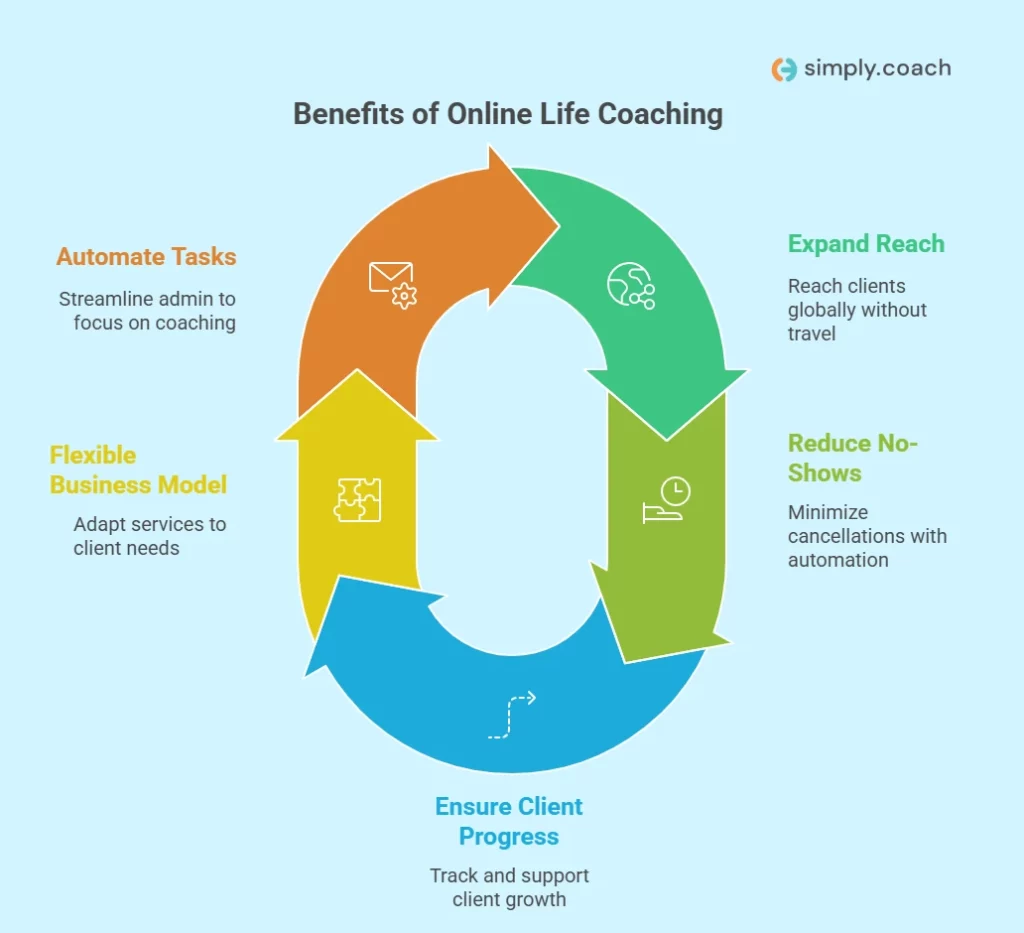
Online coaching means guiding your clients through structured sessions using video conferencing integration, automated reminders, pre-session forms, and digital accountability tools. You manage every part of the journey including goal-setting, progress tracking, and action plans without needing in-person meetings.
Here is why moving your practice online is important for you as a life coach:
- Expand beyond local boundaries: You are no longer tied to your city or region. You can work with clients across the U.S. or even worldwide, opening new opportunities without extra travel or office costs.
- Reduce time lost to no-shows: Automated reminders and pre-session forms help you cut down on last-minute cancellations. This means fewer wasted hours and more productive coaching sessions.
- Create consistent client progress: With shared dashboards, action plans, and nudges, you keep every client accountable between sessions. This structured approach ensures clients see measurable growth and you build stronger credibility.
- Run a flexible business model: You choose how you want to work including one-on-one sessions, group programs, or subscription packages. Online coaching gives you the freedom to adapt your services as your practice grows.
- Save hours through automation: By automating scheduling, facilitating payments, and follow-ups, you spend less time on admin and more time on coaching. This balance allows you to grow without burning out.
Life Coaching Track for Growth
If you are starting your life coaching journey from scratch, Simply.Coach’s Life Coaching Track gives you a complete roadmap to build your practice with confidence. It helps you fully understand the profession, choose the right certification, and start your business without confusion. The track equips you with the tools and technology you need to manage your practice efficiently and move from interest to execution with clarity.

10 Simple Steps to Start an Online Life Coaching Business
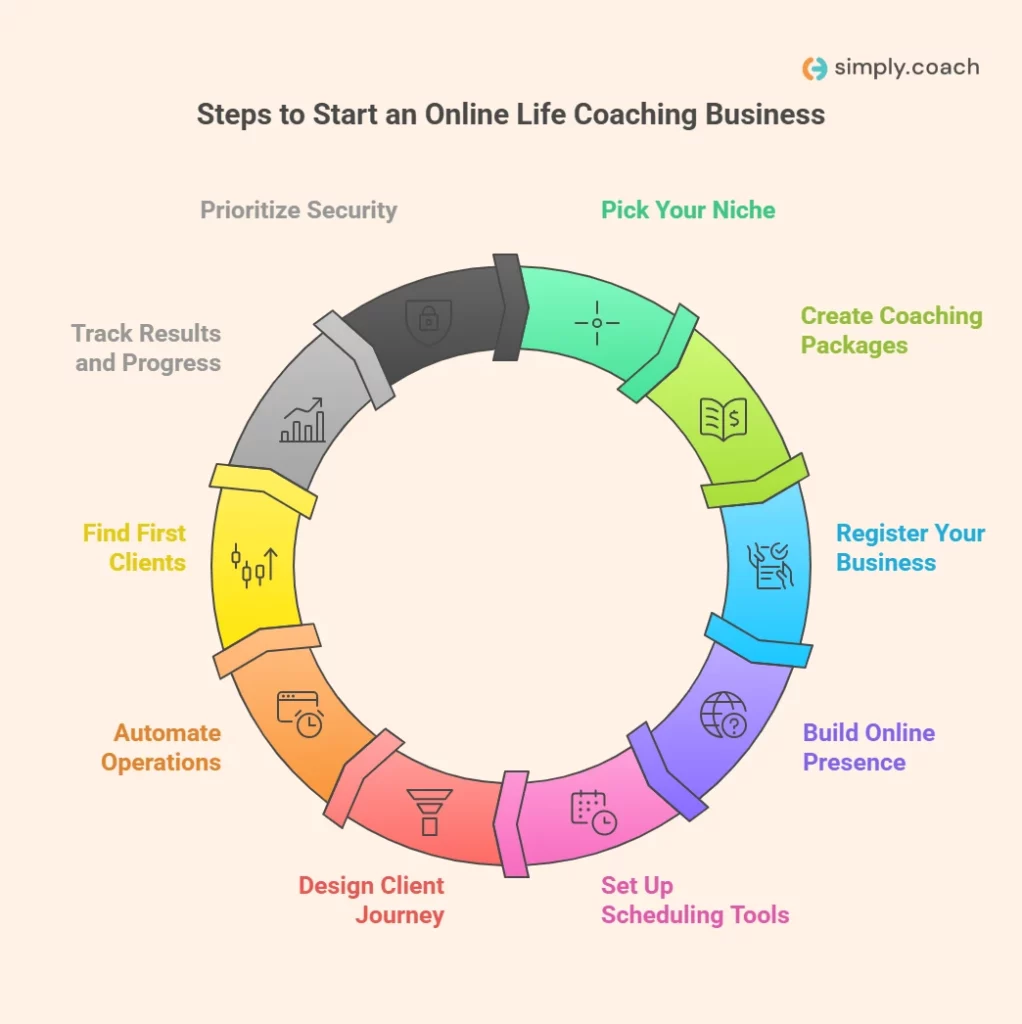
Launching your coaching practice online doesn’t have to be confusing. By following these 10 simple steps, you move from having an idea to building a structured, professional business that attracts the right clients, delivers measurable results, and grows with confidence. Each step is designed to remove guesswork and give you a clear path toward running a sustainable online life coaching business.
Step 1: Choose your niche and who you’ll work with
Life coaching is a growing field, but competition is high. Picking a niche makes it easier for you to stand out and attract the right clients.
It’s possible to start your business without narrowing your focus, but casting your net too wide usually leaves you overlooked. Clients want to know that you understand their exact situation and can guide them through it. When you define a clear niche, you position yourself as the expert they need instead of just another general life coach.
To find your niche:
- Identify the areas where you already have strengths or personal experience
- Understand who needs your guidance and is willing to invest in it
- Talk to potential clients to validate that your chosen focus is relevant and in demand
Here are some examples of life coaching niches:
- Career transition coaching
- Relationship coaching
- Leadership coaching
- Financial life coaching
- Wellness and balance coaching
- Workforce re-entry coaching
Your niche does not have to be groundbreaking. What matters is solving a specific problem clearly and effectively. By doing that, you make it easier for clients to see your value and choose you over a general coach.
Read more: How to Find Your Niche as a Life Coach : Tips for Attracting Your Ideal Clients
Step 2: Create your coaching packages and set your prices
One of the quickest ways to lose momentum as a life coach is by offering only single sessions. Clients often drop out before they see results, and you are left chasing inconsistent income. A better approach is to design packages that set clear expectations, create accountability, and give you stable revenue.
Here are proven pricing models you can use:
- Coaching packages: Structure a set number of sessions within a clear timeframe. For example, you might offer six sessions over three months with progress tracking between calls. This commitment makes clients more invested in the outcome while giving you predictable income.
- Subscriptions: Give clients ongoing access to you through a monthly plan that includes sessions, accountability check-ins, or resources. Subscriptions build long-term relationships and recurring revenue. You can manage these seamlessly with Simply.Coach’s subscription and session package tools, which automate renewals, payments, and scheduling.
- Group coaching: Create small group programs where multiple clients work together on similar goals. For example, a six-week confidence program or a leadership skills bootcamp. This model helps you scale your impact, serve more clients at once, and make your pricing accessible.
When you design packages, think beyond “hours on a call.” Clients pay for transformation, structure, and accountability. By combining packages, subscriptions, and group sessions, you set up a business model that supports both client success and your financial stability.
Ready to create a signature offer that sells?
Download our free guide: “How to Design & Launch Your Signature Coaching Program” and learn how to package your expertise into a coaching program that attracts the right clients.
Step 3: Register your business and cover the basics
Your coaching practice becomes more credible when you treat it like a proper business from the start. Clients feel more confident investing in you when they see that your operations are structured and professional. Legal registration and clear agreements protect you while setting expectations for your clients.
Before you get started, make sure you:
- Decide on your legal structure (many coaches choose an LLC in the U.S. for liability protection)
- Draft a coaching contract that outlines scope of work, confidentiality, payments, and what happens with reschedules or no-shows
- Put your business policies in writing to cover cancellations, refunds, and communication expectations
Taking these steps removes confusion and gives your practice a strong foundation. Need a simple way to manage contracts? With Simply.Coach’s Contracts feature, you can create customized agreements and get them digitally signed during onboarding, saving time and protecting your business.
Step 4: Build your online presence (website or showcase page)
A strong online presence makes it easier for potential clients to see your credibility and connect with you. Instead of relying only on word of mouth, you give people a clear way to learn about your coaching, check your expertise, and reach out. Your online home is where trust begins, so it needs to look professional and guide visitors to take the next step.
Before you set it live, make sure your site or page clearly shows:
- Who you help and what problems you solve within your niche
- Your coaching packages, pricing, or subscription options
- Testimonials or success stories that build trust
- A clear call-to-action, like booking a discovery call or signing up for a session
- Easy ways to contact you without extra clicks or confusion
If you want a quick, professional option, you don’t need to invest heavily in a full website right away. With Simply.Coach’s Showcase Page, you can create a branded page that highlights your offers, credentials, and testimonials while capturing leads directly. It even integrates with scheduling, making it easier to convert visitors into paying clients.
Step 5: Set up easy scheduling and session tools
Nothing frustrates clients more than back-and-forth emails or missed sessions. If booking a call feels complicated, you risk losing momentum before coaching even begins. A reliable scheduling system ensures clients can book easily, attend on time, and stay consistent, while you save hours every week.
When setting up your scheduling process, focus on:
- Syncing your Google or Microsoft calendar to avoid double-bookings
- Offering self-scheduling so clients can select their own time slots
- Using built-in video conferencing integration for Zoom, Google Meet, or Microsoft Teams
- Sending automated reminders to cut down on no-shows
- Collecting pre-session forms so clients arrive prepared and engaged
Instead of piecing together multiple tools, you can manage everything in one platform. With Simply.Coach’s scheduling and video conferencing features, your calendar, client bookings, reminders, and live sessions all work together. This creates a seamless client experience and lets you focus entirely on coaching.
Step 6: Design a coaching journey for every client
Clients don’t just invest in your time, they invest in outcomes. If your coaching ends once the session does, clients may lose focus and motivation between meetings. A structured journey helps them stay engaged, accountable, and clear about their next steps until they reach their goals.
When designing these journeys, make sure you:
- Set SMART goals so clients know exactly what they’re working toward
- Build action plans with tasks linked to those goals
- Schedule regular check-ins to measure progress and adjust when needed
- Use nudges to remind clients of commitments and keep them consistent
- Share progress updates so they can see measurable results over time
With Simply.Coach’s client management tools, you get everything in one place, goal planning, action plans, nudges, check-ins, and progress dashboards. This makes your coaching more organized, keeps clients accountable between sessions, and helps you deliver real, lasting results.
Step 7: Automate your business operations
Manually managing every detail of your coaching practice can quickly drain your time and energy. Without automation, you spend more hours on admin than on actual coaching. Automating key parts of your business gives you freedom to focus on clients while keeping operations consistent and professional.
When setting up automation, focus on:
- Creating reusable program templates so you don’t have to rebuild sessions and workflows from scratch
- Facilitating payments through integrated billing and subscriptions to make transactions smooth for clients
- Using invoicing tools that track payments automatically and reduce manual follow-ups
- Setting up client workspaces where clients can access notes, resources, and action plans in one place
With Simply.Coach’s business management tools, you can build program templates, manage invoicing, enable seamless payments, and create collaborative client spaces all in a single platform. These automations save you hours every week and give your practice the structure it needs to grow without extra stress.
Step 8: Find your first clients and start marketing
Getting your first paying clients validates your coaching offer and gives you traction. Start with short-term strategies that bring quick results before investing in long-term marketing.
Here are some ways to find your first clients:
- Use your existing network for referrals from friends, family, or colleagues
- Write a guest post for blogs your ideal clients already read
- Pitch yourself as a guest on relevant podcasts
- Engage in Facebook or LinkedIn groups related to your coaching niche
- Attend local or virtual networking events where potential clients show up
- Optimize your LinkedIn profile and reach out to prospects directly
Your first few clients may take more effort to secure, but their results and testimonials will build momentum. Go above and beyond to create a positive experience and then ask for referrals. Offering a discounted package or introductory rate can also help prospects take the first step.
Want to make LinkedIn your client-attraction tool?
Grab our free guide: “How to Optimize Your LinkedIn Profile: A Guide for Coaches.” This step-by-step guide shows you how to polish your profile, stand out in your niche, and attract the right clients.
Step 9: Track results and show client progress
Clients stay motivated when they can see the progress they are making. Tracking results also helps you demonstrate the value of your coaching, which is key for renewals and referrals.
Here’s how to make progress tracking part of your coaching process:
- Use reports to capture milestones and highlight growth areas
- Track ROI to show clients the tangible impact of your sessions
- Share wins regularly to keep clients motivated and engaged
- Use data to refine your coaching approach and improve outcomes
With Simply.Coach’s reporting tools, you can generate detailed insights, measure ROI, and share progress dashboards directly with clients or sponsors. This transparency builds trust and makes clients more likely to continue working with you long term.
Also read: Tracking Life Coaching Client Progress: Methods to Ensure Success
Step 10: Make security and privacy part of your foundation
Coaching often involves sensitive client information, and protecting that data is non-negotiable. When clients know their personal details are safe, they trust you more and are confident about opening up. Strong security practices also make your business look more professional.
Here’s why compliance matters:
- SOC2 compliance shows your systems meet high standards for security and confidentiality
- HIPAA compliance protects health-related information for clients who share personal or medical details
- GDPR compliance ensures that clients in the U.K. and Europe know their data rights are respected
With Simply.Coach’s security framework, your coaching business is protected by SOC2, HIPAA, and GDPR standards. This foundation of trust allows you to focus on client growth while reassuring clients that their information is safe.
Building your online life coaching business doesn’t stop at the basics. Once your foundation is set, you’ll need proven strategies to keep attracting clients and expanding your reach. To help with that, check out this guide: 18 Proven Strategies to Find Clients and Grow Your Coaching Business
Conclusion
If you’ve been wondering how to start online life coaching business, the process becomes much clearer when broken into simple steps. By narrowing your niche, creating structured packages, setting up systems, and building client trust, you create a business that’s both professional and sustainable. Each of the 10 steps in this guide is designed to help you reduce admin, deliver results, and focus on what matters most—coaching clients toward real change.
Simply.Coach is the all-in-one life coaching platform designed to make this journey smoother. From client management and scheduling to contracts, payments, and progress tracking, it brings everything into one secure platform. This means you spend less time juggling tools and more time guiding clients with confidence.
FAQs
1. Are life coaching businesses profitable?
Yes, life coaching can be very profitable when structured well. Many coaches earn six figures by building a clear niche, offering packages, and scaling with online tools as demand continues to grow.
2. Do I need training to build a successful coaching business?
Formal training isn’t required since coaching is unregulated, but certification or specialized programs can boost your credibility and help you attract higher-paying clients.
3. Can I start a life coaching business online?
Absolutely. You can run your entire practice online using video conferencing, digital tools, and automation features, allowing you to serve clients anywhere in the world.
4. Do I need a website to start a coaching business?
A website builds trust and positions you as an expert, but you don’t need one immediately. Many coaches start by using social media or a platform like Simply.Coach’s Showcase Page to promote services.
5. How much should I charge as a life coach?
Hourly rates often range from $50 to $300 depending on experience, but packages bring more stability. Many new coaches begin with $1,500 for a 3-month package and scale from there.
6. Is online coaching profitable?
Yes, online coaching is highly profitable if you target the right audience. By focusing on clients willing to invest in transformation, you can build long-term income streams.