
You know the moment when a client finally opens up and shares something deeply personal that they have never voiced before. That moment happens because they believe their story is safe with you. But today, clients are more cautious than ever about how their information is handled. A 2025 Acronis Data Privacy Survey found that 64% of consumers list data breaches as their top privacy concern, which shows how easily trust can be shaken in today’s digital world.
For you as a coach, this goes far beyond technology. Your sessions often involve sensitive career choices, emotional triggers, workplace conflicts and personal struggles. When clients worry about confidentiality, they hold back. And when they hold back, your coaching impact weakens and their progress slows.
In this blog, you will learn what client confidentiality really means in coaching, why it is essential in 2025 and the best practices you can apply to protect your clients’ information with confidence. You will also find a practical checklist and clear answers to common questions so you can strengthen trust, reduce risk and create a safer coaching environment for every client you support.
Key Takeaways
- Why confidentiality matters: Confidentiality builds trust, encourages honest sharing, and strengthens coaching outcomes.
- Core definitions: Privacy, confidentiality, and data protection each protect client information in different ways.
- Ethical duties: You are responsible for informed consent, transparency, integrity, and safeguarding all client information.
- Legal duties: Coaching confidentiality depends on contracts and compliance with data protection laws such as GDPR.
- Best practices: Use secure tools, set clear expectations, maintain boundaries, protect group coaching conversations, and review policies regularly.
- Third-party involvement: Sponsors and support teams should only receive non-identifiable information with clear consent.
- Consequences of breaches: Violations can damage trust, harm reputation, trigger legal issues, and result in financial or contractual penalties.
- When confidentiality applies: It protects all client disclosures across one-to-one, group, and organizational coaching contexts.
- When it can be broken: Only in cases of imminent harm, legal obligations, or explicit client permission.
- Checklist summary: Use secure systems, private spaces, consent forms, documentation routines, and updated confidentiality policies.
What Is Client Confidentiality in Coaching?
Client confidentiality in coaching means protecting everything a client shares with you, whether spoken, written or stored digitally. It ensures that their personal experiences and challenges remain strictly between you and the coaching relationship. This commitment creates a safe environment where clients feel free to express themselves honestly. It is one of the most essential foundations of responsible and ethical coaching.
Why confidentiality matters in coaching
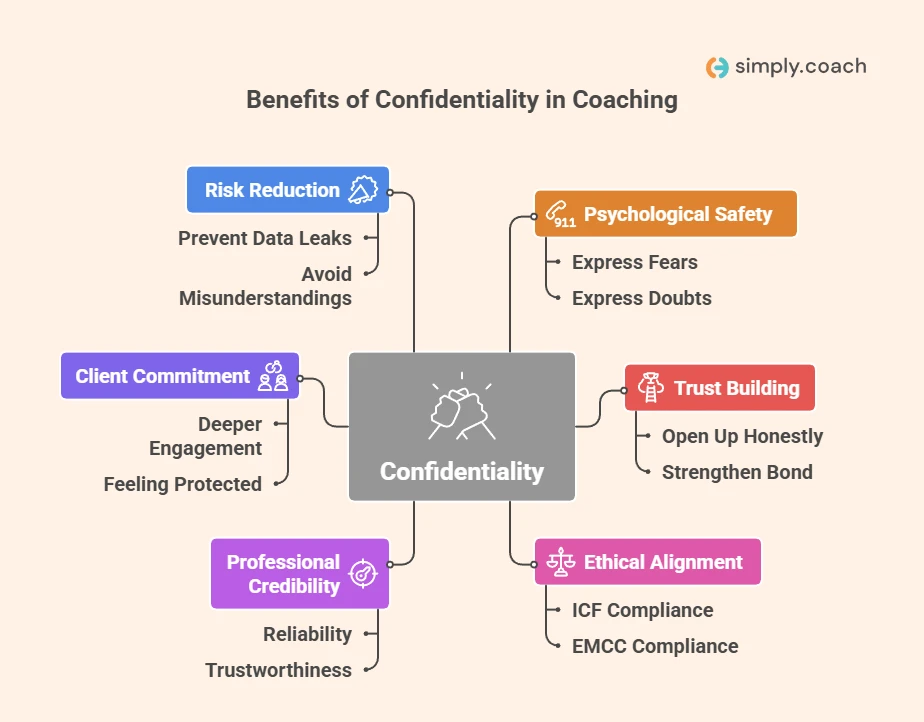
Coaching relies on openness, vulnerability and trust. Clients can only explore deeper issues when they know their information is safe with you.
- Psychological safety: Clients feel free to express fears, doubts and concerns without hesitation.
- Trust building: Confidentiality strengthens the bond that allows clients to open up more honestly.
- Ethical alignment: It keeps your practice compliant with ICF, EMCC and other ethical frameworks.
- Professional credibility: Maintaining confidentiality reinforces your reliability as a coach.
- Client commitment: Clients engage more deeply in sessions when they feel protected.
- Risk reduction: Prevents reputational damage and misunderstandings related to data leaks.
Ethical and legal obligations of coaches
As a coach, you have both ethical and legal responsibilities to protect client information. Following professional guidelines from bodies like ICF and EMCC, obtaining informed consent, and understanding organizational and legal requirements ensures you maintain trust, safeguard your clients, and preserve your professional reputation. Even in situations requiring disclosure, your goal is always to balance safety with confidentiality.
Privacy vs Confidentiality vs Data protection
Understanding these concepts helps you manage client information responsibly and align your coaching practice with ethical and secure standards.
| Aspect | Privacy | Confidentiality | Data Protection |
| Core meaning | Client’s right to decide what personal information they share. | Your obligation to keep shared information private. | Systems and processes used to secure stored information. |
| Focus area | Personal choice and boundaries. | Ethical responsibility and trust. | Technology, tools and security measures. |
| Your responsibility | Avoid requesting unnecessary details. | Never disclose client information without consent. | Use secure platforms, encrypted tools and safe storage. |
| Examples | Choosing what to tell you in sessions. | Not sharing session content with others. | Encrypting notes, protecting devices and using secure apps. |
Together, these three elements help you maintain a strong ethical foundation and create a safe, secure coaching environment where clients can grow with confidence.
Also read: A Guide to ICF Coaching Definition and Ethics Code
Top 8 Best Practices to Maintain Client Confidentiality
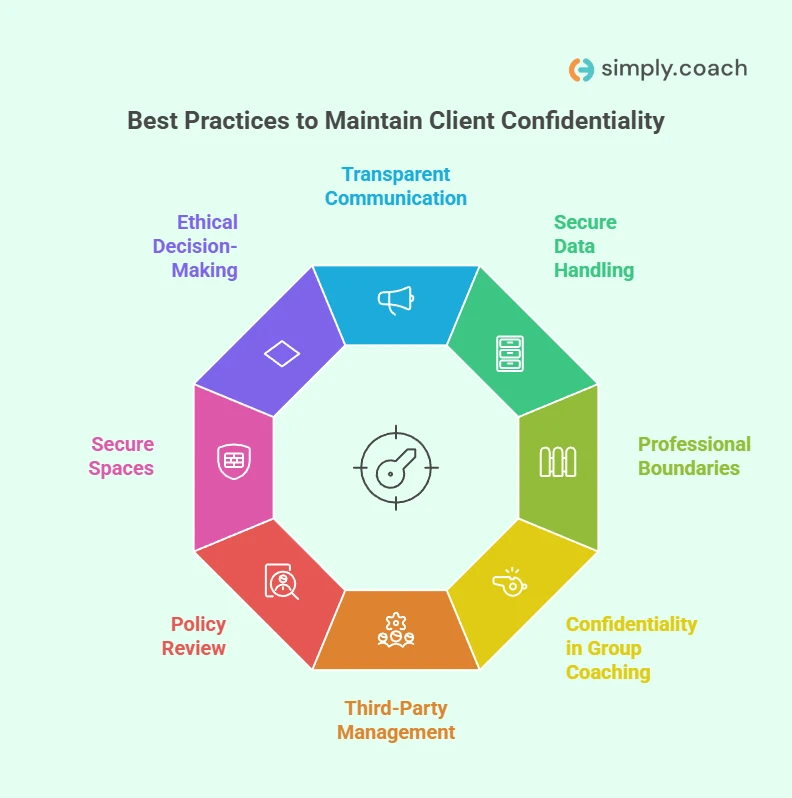
As a coach, confidentiality is the foundation of trust in every coaching relationship. Your clients open up only when they feel genuinely safe with you. That safety is not just emotional; it is also operational, legal, and procedural. Below are eight deeply practical best practices presented in a detailed, structured way so you can apply them immediately in your coaching practice.
1. Start with clear, transparent communication
Your confidentiality protection begins long before the first session. Clients deserve to know exactly how their information will be handled, protected, and stored.
What you should cover during onboarding
- Explain confidentiality in simple language and avoid legal jargon.
- Tell clients what is confidential (sessions, notes, worksheets, assignments).
- Tell clients what is not confidential (attendance, invoicing, scheduling).
- State the mandatory disclosure exceptions such as:
- Risk of harm to self or others
- Abuse of minors or vulnerable individuals
- Legal or court-ordered disclosures
How to set expectations
- Share how you take notes, how long you keep them, and how they are protected.
- Clarify whether you use recordings, transcriptions, or any digital tools.
- Ask clients if they have questions; encourage them to clarify doubts.
Pro tip: Add a “Confidentiality Summary” to your welcome packet that clients can revisit anytime.
2. Use secure and compliant tools for data handling
Every coaching business, regardless of size, must treat client data with the same seriousness as a medical or legal practice.
Core security essentials
- Use encrypted platforms for notes, client profiles, documents, and communication.
- Enable multi-factor authentication for all accounts.
- Store files in GDPR/HIPAA-compliant systems where applicable.
- Avoid:
- Personal email
- WhatsApp or unencrypted messengers
- Open Google Docs without access control
- Screenshots saved on personal devices
If you use coaching platforms
Consider Simply.Coach, an all-in-one, HIPAA-compliant software built specifically for coaches. It provides secure client profiles, encrypted storage, role-based access, and dedicated coaching tools, allowing you to manage sessions, notes, and recordings safely while keeping client information confidential.
Pro tip: Create a simple “Data Map” a one-page document showing where client data enters, lives, and gets deleted. This keeps your systems clean and auditable.
Also read: Simply.Coach: A Comprehensive Online Coaching Software to Grow your Business
3. Maintain professional boundaries
Boundaries are what protect you, your clients, and the integrity of the coaching relationship, ensuring that personal familiarity never compromises confidentiality or professionalism.
Protective actions you should take
- Use separate communication channels for work (business email, business number).
- Keep sensitive discussions within official coaching platforms, not social media DMs.
- Be neutral and non-judgmental when clients share vulnerable details.
- Do not share client stories even anonymously without explicit permission.
Preventing boundary drift
Long-term clients may treat you like a friend. That is natural but dangerous.
- Reinforce boundaries kindly when you observe overfamiliarity.
- Remind clients that all conversations stay within coaching sessions, not casual chats.
Pro tip: Create a “Communication Policy” that tells clients what topics belong where and how you handle messages outside session hours.
4. Protect confidentiality during group or team coaching
Group settings introduce additional layers of complexity because multiple people share the same space, making it essential for you to create structure and agreements that protect everyone involved.
Set group-wide confidentiality norms
- Start the first session with a group confidentiality declaration.
- Ask every participant to agree to:
- No recording
- No screenshots
- No sharing outside the group
Handling sensitive disclosures
- If someone overshares or becomes emotional, offer a private follow-up after the session.
- Model how to keep details private when summarizing group reflections.
Managing breaches
- Have a procedure for:
- Identifying a breach
- Addressing it with the individual
- Documenting actions
- Reinforcing group norms without shame
Pro tip: Include a “Group Confidentiality Contract” in your intake process before the first session begins.
5. Manage third-party involvement carefully
Whenever someone other than you has even partial access to client information, you must define, limit, and document that access to maintain complete confidentiality and accountability.
Define who gets access to what
- Assistants should see scheduling details only, not session notes.
- Co-coaches should sign NDAs and receive only necessary information.
- Supervisors should receive anonymized material unless the client consents.
For corporate coaching
- Clarify what will be shared with sponsors:
- Themes
- Progress
- Attendance
- High-level outcomes
- Never share personal details unless the client permits it explicitly.
Pro tip: Keep a “Third-Party Register” listing every person or vendor with access to data and their purpose.
6. Regularly review and update confidentiality policies
Confidentiality is not a one-time setup; it is an evolving commitment that requires continuous review as laws change, tools update, and security risks shift.
Your review checklist
- Audit your tools annually.
- Update privacy statements when you change a system or workflow.
- Refresh your data retention timelines.
- Review your consent processes.
- Inform clients when you make any major policy change.
Pro tip: Create a “Confidentiality Health Check” you run every 6 or 12 months to stay compliant and organized.
7. Secure physical and digital coaching spaces
Every coaching conversation depends on the safety of the environment you create, both offline and online, and it is your responsibility to ensure that no unauthorized person can overhear or access client information.
Physical security
- Conduct sessions in a private room.
- Keep paper notes locked away when not in use.
- Shred outdated documents.
Digital session safety
- Use headphones.
- Secure meeting links with passwords and waiting rooms.
- Store recordings only inside controlled systems.
- Keep devices encrypted and auto-locked.
Pro tip: Remind clients to join sessions from a private, interruption-free space. This protects their confidentiality too.
8. Practice ethical decision-making in grey areas
There will be moments where confidentiality collides with safety, risk, or legal duty, and your ability to navigate these grey areas ethically defines your professionalism as a coach.
How to navigate them
- Use a structured decision framework:
- Identify the dilemma
- Consult your code of ethics
- Seek supervision (with anonymity)
- Evaluate risk vs. confidentiality
- Document every step
- If a client expresses intent to harm:
- Prioritize safety
- Follow your jurisdiction’s legal requirements
- Communicate actions transparently
Pro tip: Keep an “Ethical Escalation Protocol” document that outlines exactly what steps you follow during sensitive disclosures.
By applying these eight practices with consistency, you create a safe, trustworthy, and deeply professional coaching environment where your clients can open up without fear.
Consequences of Breaching Confidentiality
Maintaining client confidentiality is one of the most important responsibilities you have as a coach. When confidentiality is broken, intentionally or accidentally, it can have serious repercussions for both your clients and your coaching practice. Understanding these consequences helps you remain vigilant and uphold the trust that is critical to effective coaching.
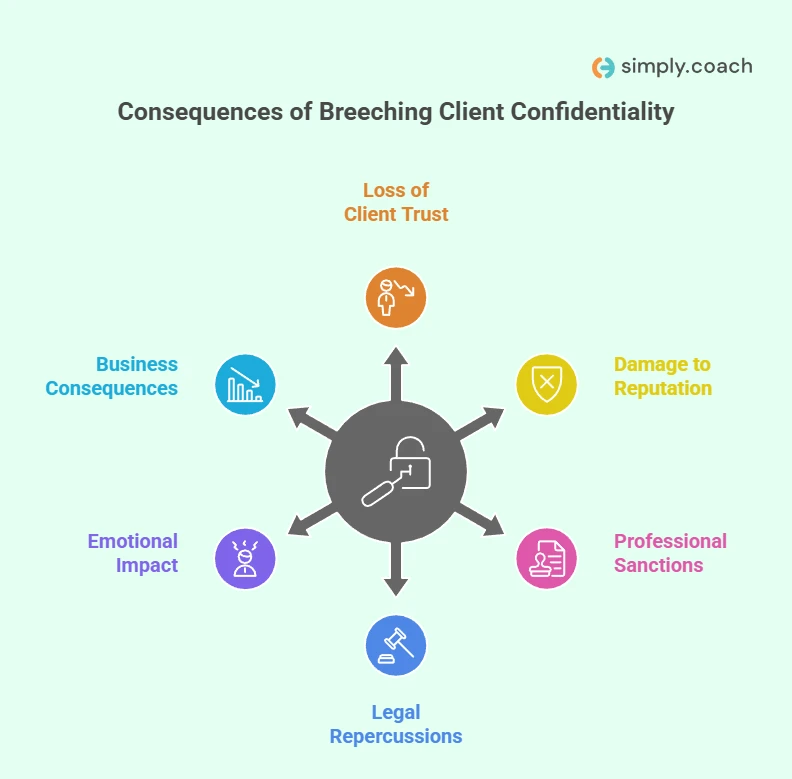
Potential consequences you may face as a coach
- Loss of client trust: Clients may feel unsafe sharing openly, which can weaken the coaching relationship or cause them to terminate sessions.
- Damage to professional reputation: Word of a confidentiality breach spreads quickly and can harm your credibility in the coaching community and among potential clients.
- Professional sanctions: Certification bodies like ICF or EMCC may suspend or revoke credentials if ethical guidelines are violated.
- Legal repercussions: Violating confidentiality agreements, contracts, or applicable laws could result in fines, lawsuits, or other legal penalties.
- Emotional and personal impact: Experiencing a breach can cause guilt, stress, and reduced confidence in your coaching abilities.
- Business consequences: Loss of referrals, decreased client engagement, and difficulty acquiring new clients due to reputational damage.
When can confidentiality be broken or cannot be broken
Knowing when confidentiality can and cannot be broken is essential for making informed and ethical decisions. While you must always protect client information, there are specific situations where disclosure is required or permissible.
| Scenario | Confidentiality can be broken | Confidentiality cannot be broken |
| Risk of harm | If a client poses an imminent risk to themselves or others, disclosure is required to prevent harm. | Routine coaching disclosures, like career reflections or personal goals, remain confidential. |
| Abuse or neglect | Suspected abuse of minors, vulnerable adults, or dependent individuals must be reported according to law. | Discussions of workplace stress, personal frustrations, or family matters without abuse indicators remain confidential. |
| Legal requirements | Court orders, subpoenas, or government investigations may require disclosure of specific information. | You cannot voluntarily share client details with third parties outside legal obligations or without client consent. |
| Corporate reporting | Aggregate, anonymized data may be shared with sponsors if clients consent. | Identifiable client information cannot be disclosed without explicit written consent. |
| Ethical supervision | Limited anonymized case information may be shared with a supervisor or mentor for guidance. | Identifiable client information cannot be shared during supervision unless clients provide consent. |
By understanding the consequences of breaches and knowing exactly when confidentiality can and cannot be broken, you protect your clients, safeguard your reputation, and maintain the integrity of your coaching practice.
Confidentiality Checklist for Coaches
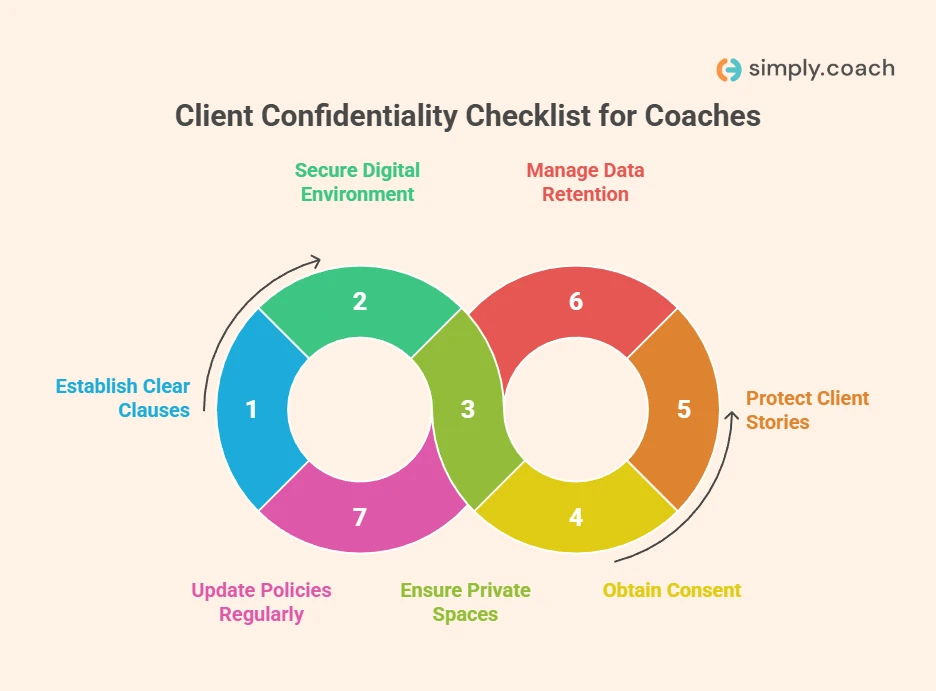
Protecting client confidentiality requires clear, consistent practices. Use this checklist to ensure you cover all essential areas and maintain a professional, secure coaching environment.
- Clear confidentiality clauses in contracts: Include explicit statements in your coaching agreement that define what is confidential, what exceptions exist, and how client data is handled. This creates transparency and legal protection.
- Secure digital environment: Protect client information with strong passwords, multi-factor authentication (MFA), and encrypted storage. Avoid storing sensitive data in personal email, messaging apps, or unprotected documents.
- Private coaching spaces: Conduct sessions in environments where conversations cannot be overheard. For virtual coaching, ensure both you and your client use private rooms and headphones.
- Consent for all data usage: Obtain explicit consent whenever you record sessions, share progress with third parties, or use digital tools that process client data. Document this consent clearly in intake forms or contracts.
- No sharing of client stories without written permission: Never discuss client cases publicly or with peers unless identities are fully anonymized and clients have granted written permission. This includes social media, blogs, or workshops.
- Document retention and disposal plan: Define how long you retain client notes, recordings, and communications. Establish a secure disposal method, such as shredding physical notes and permanently deleting digital files, once retention periods expire.
- Updated policies every 6–12 months: Regularly review your confidentiality policies to reflect new laws, updated tools, and evolving best practices. Inform clients of major changes and obtain updated consent when necessary.
Use this checklist to audit your processes and ensure you never miss a critical step in protecting client confidentiality.
Also read: How to Handle Difficult Clients: 10 Key Strategies for Coaches
Conclusion
Client confidentiality is the foundation of trust in coaching. By understanding what it means, recognizing your ethical and legal responsibilities, and applying best practices consistently, you create a safe environment where clients can share openly and achieve meaningful results. Following these practices strengthens your credibility, reduces risk, and ensures every coaching session is professional and secure. Confidentiality is the key to building lasting client relationships and real transformation.
Simply.Coach makes protecting client information simple and reliable. Its encrypted storage, secure session management, and role-based access controls are designed specifically for coaches. Every note, recording, and communication is safe, giving you peace of mind while focusing on delivering impactful coaching. With Simply.Coach, you can ensure client confidentiality is always maintained and never compromised.
FAQs
1. Is coaching confidentiality legally the same as therapist-client confidentiality?
No. Coaching normally does not carry the same legal privilege as therapy. Confidentiality depends on your agreement with the client and your ethical code, not on legal privilege.
2. Can I record coaching sessions and still guarantee confidentiality?
Yes, but only if you obtain explicit written consent from the client before recording. You must also secure storage and restrict access to recordings to maintain confidentiality.
3. Is sharing anonymized client stories or testimonials safe?
Only if you remove all identifying details and have written permission from the client. Even anonymized stories can reveal identity if details are too specific.
4. How long should I keep client notes or records?
There is no universal rule. Best practice is to keep records only as long as needed and delete or securely archive them once the coaching engagement ends or retention period lapses.
5. What happens if a client’s data is exposed through a hack or breach?
If data is exposed because of poor security, confidentiality is compromised. You must inform the client, take corrective actions, and implement stronger security measures immediately.
6. Can organizational sponsors demand access to private coaching session content?
Only with the client’s explicit written consent. Otherwise, you should refuse to share personal session content. At most, you may share aggregated or anonymized summary data if agreed upon.
7. Does confidentiality also cover emails, messages or online communications between sessions?
Yes. Any information exchanged outside sessions, emails, texts or platform messages counts as part of the coaching relationship and must be treated with the same confidentiality as session content.