
As a coach you often meet clients who are highly capable but unaware of how they’re perceived by others. That’s where the Johari Window Model earns its place, it helps turn self-reflection into actionable insight. Developed by psychologists Joseph Luft and Harrington Ingham in 1955, the model is designed to increase self-awareness, improve communication, and strengthen relationships through structured feedback.
The Johari Window enables clients to explore how their thoughts, behaviors, and intentions are seen by others, uncover hidden patterns, and reduce blind spots. Over time, it helps teams and individuals build trust, align on shared goals, and navigate professional interactions more effectively. Whether used in leadership coaching, team development, or personal growth, it provides a practical, reflective framework for meaningful change.
Also read: OCEAN Personality Model: Key Questions and Practical Insights for Coaches
When & Why the Johari Window Model Works
In many coaching engagements, clients struggle to understand how their behavior is perceived by others. Miscommunication, repeated misunderstandings, or unclear feedback can create frustration and limit growth. Without a structured approach, conversations often stay surface-level, and clients leave without actionable insights.
The Johari Window addresses this by creating a clear framework for comparing self-perception with external feedback. It helps clients uncover blind spots, explore hidden strengths, and expand self-awareness in a safe and structured way. Using the Johari Window model works best when the coaching environment encourages trust and openness.
As a coach you can rely on the Johari Window in situations like these:
- When clients need to understand how their intentions align or misalign with how others experience them.
- When leaders or team members face recurring communication challenges or interpersonal friction.
- When there is a need to uncover blind spots that limit influence or effectiveness.
- When clients are ready for structured reflection and feedback that can guide measurable behavior change.
- When personal growth or leadership development requires both insight and actionable steps for improvement.
What makes the Johari Window effective is its ability to combine depth with clarity. It gives clients a safe way to explore perceptions, reduces assumptions, and translates reflection into concrete actions that improve relationships, performance, and trust over time.
Also read: How Coaches Can Use the Kirkpatrick Model to Demonstrate Leadership Results
Johari Window Breakdown: The Complete Framework Analysis
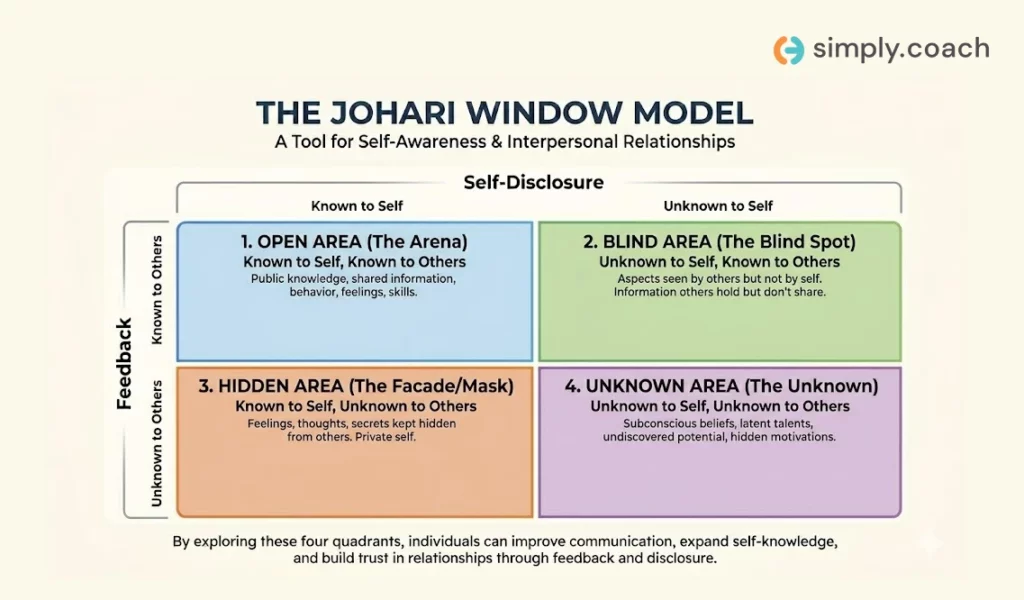
The Johari Window works best when each quadrant is treated as a lens rather than a checklist. Each area shows something different about what a client knows, hides, or has yet to discover. Exploring them intentionally helps reflection turn into actionable insight and keeps coaching grounded in real behaviors.
1. Open Area (Arena)
The open area is what both your client and others clearly see. It usually includes strengths, habits, and communication patterns that show up consistently. Helping clients recognise this shared space reinforces confidence and clarity.
Questions to ask:
- Which of your strengths do you think are most visible to others?
- Can you recall moments when your intentions were understood exactly as you meant?
- What patterns in your behavior do people often compliment?
- How do you feel when others acknowledge your contributions?
- Are there habits you rely on that you think others notice too?
Prompts:
- Ask clients to describe times they felt fully aligned with colleagues.
- Invite peers to highlight moments when the client’s behavior made a positive difference.
- Encourage reflection on patterns that show up reliably in teams.
- Suggest keeping a journal of visible strengths over a week.
- Explore ways to deliberately showcase strengths in new situations.
2. Blind Area (Blind Spot)
This quadrant includes behaviors that others notice but the client does not. This area often sparks the most insight. Small, unnoticed habits can affect relationships, and bringing them into awareness can be transformative.
Questions to ask:
- Are there reactions from others that surprise you?
- Which behaviors might be visible but unnoticed by you?
- Have you ever been told something about yourself that didn’t match your perception?
- How do you think others experience your tone, gestures, or body language?
- Are there repeated misunderstandings that might point to blind spots?
Prompts:
- Gather feedback from colleagues on specific behaviors.
- Explore situations where intent didn’t match impact.
- Ask clients to notice patterns in how people respond to them.
- Encourage reflection on feedback they initially dismissed.
- Highlight small changes that can reduce friction or confusion.
3. Hidden Area (Facade)
The hidden area contains what clients know about themselves but choose not to share. Reducing this space can improve trust, collaboration, and team connection. Clients often hold back due to fear of judgment or uncertainty.
Questions to ask:
- What ideas or concerns do you usually keep to yourself, and why?
- Are there strengths you don’t share out of caution?
- How do you decide what to reveal and what to hold back?
- When has staying silent affected your outcomes?
- What would happen if you shared more selectively with trusted colleagues?
Prompts:
- Reflect on moments where holding back limited impact or connection.
- Explore safe ways to reveal thoughts gradually.
- Encourage selective sharing in meetings or team discussions.
- Use storytelling to build comfort with disclosure.
- Practice role-play to test revealing ideas in a supportive setting.
4. Unknown Area (Unknown)
The unknown area contains traits and potential that neither the client nor others have discovered yet. It usually emerges through challenges, experiments, or new roles. Guide clients to explore this area cautiously but with curiosity.
Questions to ask:
- What strengths might appear if you took on a completely new role?
- Are there reactions in yourself you haven’t yet noticed?
- What challenges could reveal untapped potential?
- Which tasks push you outside your comfort zone?
- How do you usually respond in unfamiliar situations?
Prompts:
- Encourage taking on stretch assignments to reveal hidden abilities.
- Explore reflection exercises after new experiences.
- Suggest experimenting with unfamiliar tasks or responsibilities.
- Observe responses to challenges to identify emerging strengths.
- Ask clients to note surprises about their own behavior or capabilities.
When the Johari Window is used in this way, each quadrant becomes a practical coaching tool rather than an abstract concept. Expanding the open area, exploring blind spots, sharing hidden aspects, and uncovering unknown potential often leads to measurable behavioral change and deeper self-awareness.
Also read: How Coaches Use the GROW Model for Effective Training in 2026
Applications & Adaptations of the Johari Window Model
The Johari Window works best when the goal is to turn self-awareness into actionable insight. It helps clients see the difference between intention and impact, strengthens communication, and accelerates development across multiple coaching contexts. The model becomes practical when feedback is structured, and reflection leads to measurable behavioral change.
- Leadership Development and Executive Presence
Use the Johari Window with leaders to align intention with impact. Many assume their actions are understood but blind spots distort perception. By mapping feedback, leaders can see how behaviors such as tone, meeting style, or decision-making are experienced. This helps create intentional actions that improve influence, team engagement, and professional presence.
Also read: How to Provide Feedback as a Coach to Develop Better Leaders
- Team Alignment and Collaboration
Teams often get stuck in miscommunication or repeated conflicts. The Johari Window provides a shared framework to surface hidden dynamics and differences in perception. By mapping self and peer perceptions in your sessions, you uncover blind spots that pave the way for more honest dialogue, stronger trust, and improved team collaboration.
Also read: Systemic Team Coaching: Five Disciplines Model for High-Performing and Adaptive Teams
- Personal Growth and Behavior Change
Individually, the model highlights blind spots and hidden potential. Guide clients to reflect on feedback and experiment with small behavioral adjustments. For example, noticing how interrupting or rushing decisions affects others allows clients to practice more mindful communication. This turns vague aspirations into clear, observable actions that can be tracked over time.
Also read: How to Build an Effective Personal Development Coaching Program (2026)
- Remote and Hybrid Work Environments
Remote work often hides subtle interpersonal cues. By combining the Johari Window with digital feedback and reflection exercises, you help teams and individuals uncover blind spots even without in-person interactions. This supports clearer expectations, reduces misunderstandings, and guides behavior adjustments that maintain team cohesion across locations.
Also read: Why is Remote Coaching Thriving in 2026?
- Talent Development and Career Progression
For career coaching, the model identifies strengths and blind spots that impact advancement. Emerging leaders can see how their reputation and behavior intersect. By using structured feedback, clients recognize untapped abilities, adjust behaviors, and align development efforts with real-world impact. Progress can then be tracked session by session to ensure growth.
Finally, integrating the Johari Window with Simply.Coach strengthens its effectiveness. As a coach, you can collect structured self and peer feedback, document quadrants, and track behavior changes over time. This transforms one-off insights into measurable, long-term growth across leadership, teams, and individual development.
Also read: Hogan Assessment System: A Complete Guide for Coaches in the Workplace
Challenges and Limitations of the Johari Window Model
The Johari Window works best when trust and openness are present. Its framework is solid, but in sessions where clients feel vulnerable or defensive, the exercise can feel exposing.
The key is to hold it lightly, using it as a guide rather than a script. When curiosity and presence are part of the process, the model helps move reflection into meaningful action instead of just filling quadrants. Like any framework, its true value is unlocked when you bring your own perspective to the process, going beyond just following the steps.
Common Pitfalls to Watch For
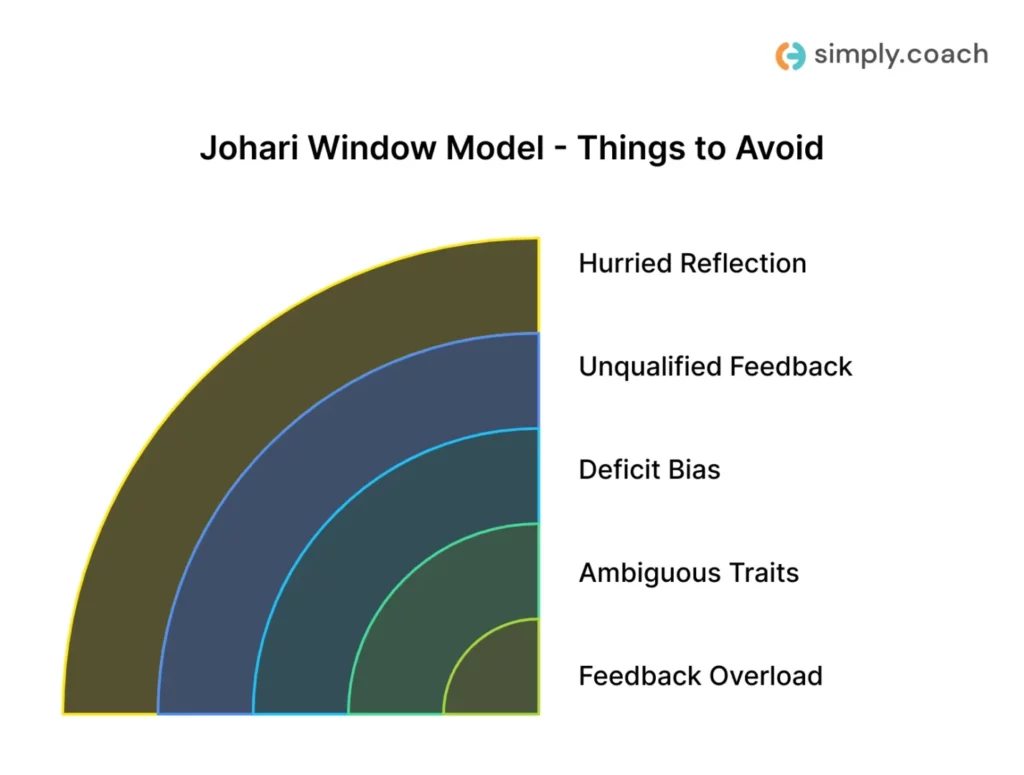
- Hurried Reflection: Rushing through the quadrants without giving clients time to reflect on each area.
- Unqualified Feedback: Using feedback from people who don’t have enough context, which leads to inaccurate insights.
- Deficit Bias: Focusing only on blind spots while ignoring strengths, creating defensiveness or discouragement.
- Ambiguous Traits: Selecting vague traits like “confident” or “difficult” without tying them to real behaviors.
- Feedback Overload: Overloading clients with too much feedback at once, making the process feel overwhelming instead of actionable.
When the Model Might Not Work
The Johari Window isn’t effective in every coaching moment.
- It can lose traction when clients are highly defensive, emotionally unsettled, or distrustful of the process.
- In crisis situations or where immediate action is required, reflective exercises may feel out of sync.
- In highly hierarchical, multi-stakeholder, or emotionally charged environments, a more dynamic or therapeutic approach may be better.
The Johari Window complements those methods but doesn’t replace them.
Adapting Across Cultures and Contexts
Culture shapes how the model is received and how feedback is interpreted. In individualistic contexts, clients may respond well to direct feedback; in collectivist or high-context cultures, indirect questions and reassurance are often needed. Hierarchical dynamics, communication norms, and social expectations all influence how open someone is willing to be.
The structure of the Johari Window stays the same; what changes is how it’s held. Adjusting the pace, language, and framing makes it feel less like a tool and more like a meaningful conversation about awareness and growth.
Also read: Enneagram Can Help You Become a Better Coach in 2026
Comparative Analysis
Every coaching model has a unique rhythm and purpose. Some, like GROW or CLEAR, guide structured reflection and dialogue. Others, like the Johari Window, focus on self-awareness, feedback, and uncovering blind spots that often go unnoticed.
It’s never about which model is universally “best.” The choice depends on the client’s readiness, the context, and the kind of growth or insight you’re aiming for. The table below highlights how these models differ in focus, practical strengths, and limitations, giving a clear view of when each framework can be most effective.
| Model | Core Components | Best For | Strengths | Limitations |
| Johari Window | Open, Blind, Hidden, Unknown | Self-awareness, team dynamics, leadership development | Reveals blind spots and hidden potential, fosters trust and feedback culture, practical for one-on-one or group coaching | Requires psychological safety and honest feedback; less effective in crisis or highly defensive contexts |
| GROW | Goal, Reality, Options, Will | Goal setting, problem solving, structured coaching sessions | Simple, flexible, widely recognized, works across industries | Lacks deep insight into hidden behaviors; doesn’t explicitly address blind spots |
| OSKAR | Outcome, Scaling, Know-how, Affirm/Action, Review | Solution-focused coaching, incremental progress, complex challenges | Strengths-based, encourages sustainable development, built-in review | Can feel slow for short-term goals; less structured for exploring unknown potential |
| CLEAR | Contract, Listen, Explore, Action, Review | Relationship-building, executive coaching, team alignment | Builds rapport, clarifies expectations, supports trust-based conversations | Requires skilled facilitation; may slow momentum if overemphasized |
| FUEL | Frame, Understand, Explore, Lay Out, Execute | Performance coaching, leadership action planning | Action-oriented, time-efficient, structured for measurable results | Less reflective focus; may miss unconscious patterns or hidden traits |
Choosing the right model is about creating a space where the client’s awareness, insight, and action can meet, so that feedback becomes clarity, and reflection becomes tangible growth.
Also read: Competency Models for Coaches: How to Align, Measure, and Drive Impact
What Research Shows About the Johari Window’s Effectiveness
The research behind the Johari Window demonstrates its value in helping clients bridge the gap between self-perception and external feedback. By making perceptual differences visible, the model fosters awareness, communication, and actionable insight in professional and coaching contexts. Below are two key studies that highlight its effectiveness and practical application in coaching practice.
1. Awareness and Insight in Coaching Contexts
Swart, J. (2022). The Johari Window as a Coaching Tool to Create Awareness
Sample: 210 coaching participants across organizational and leadership programs
Key Finding:
The Johari Window consistently increased self-awareness by combining self-reflection with structured feedback from peers and colleagues. Participants were able to identify perception gaps that would have otherwise remained hidden, which enhanced interpersonal understanding and communication within teams.
Why this matters:
Awareness is the foundation for behavioral change. By making blind spots and hidden traits visible, coaches can guide clients toward concrete actions rather than abstract reflection. The model transforms perception into practical insight, strengthening relational dynamics and clarity in professional contexts.
In practice:
Use Johari Window exercises in workshops or one-on-one coaching sessions with structured feedback. Encourage clients to compare their self-perceptions with input from trusted peers, highlighting specific behaviors that are impacting relationships or outcomes.
2. Blind Spots and Perception Gaps
Mukherjee, Pahwa, Moza et al. (2023). Influence of Personality Traits on Johari Window Perception in the Workplace.
Sample: 420 employees across multiple organizational teams
Key Finding:
Structured use of the Johari Window revealed blind spots — behaviors that others observe but individuals do not recognize. When these gaps were addressed through guided feedback, teams reported improved collaboration, reduced misunderstandings, and more effective communication.
Why this matters:
Blind spots often block growth and create friction in relationships. The Johari Window provides a systematic approach for uncovering these areas safely, allowing clients to take actionable steps toward alignment and personal development.
In practice:
Incorporate Johari exercises as part of leadership or team coaching, collecting feedback from colleagues or stakeholders who regularly observe the client’s behavior. Facilitate reflection on patterns and coach actionable steps to reduce blind spots, improving both individual and team performance.
Neuroscience of the Johari Window: How it Aligns with Cognitive Learning and Behaviour
The Johari Window works because it mirrors how the brain processes self-perception, social feedback, and behavior change. It combines reflective thinking with external input, activating neural pathways that support awareness, learning, and adaptive action. By making hidden traits and blind spots visible, clients engage both cognitive and emotional systems to translate insight into action.
| Johari Window Step | Brain Mechanisms | Psychological Principles | Why It Works |
| Open Area | Activates prefrontal cortex (self-monitoring) and mirror neuron networks | Social Feedback Integration – Shared awareness reinforces recognition of patterns | Seeing oneself accurately in social context strengthens understanding and predicts adaptive responses |
| Blind Spot | Engages anterior cingulate cortex (conflict detection) and temporoparietal junction (perspective-taking) | Feedback Processing – Awareness of discrepancies drives reflection | Receiving feedback triggers learning and reduces unconscious behavioral blind spots |
| Hidden Area | Activates default mode network (self-referential thought) and amygdala (emotional processing) | Self-Disclosure Theory – Expressing internal thoughts fosters trust and cognitive alignment | Sharing internal experiences reduces tension and supports alignment with team or relational dynamics |
| Unknown Area | Stimulates hippocampus (memory consolidation) and prefrontal planning circuits | Experiential Learning – New challenges reveal latent abilities | Exploration uncovers untapped potential, creating opportunities for growth and confidence building |
Best Practices for Coaches While Applying the Johari Window
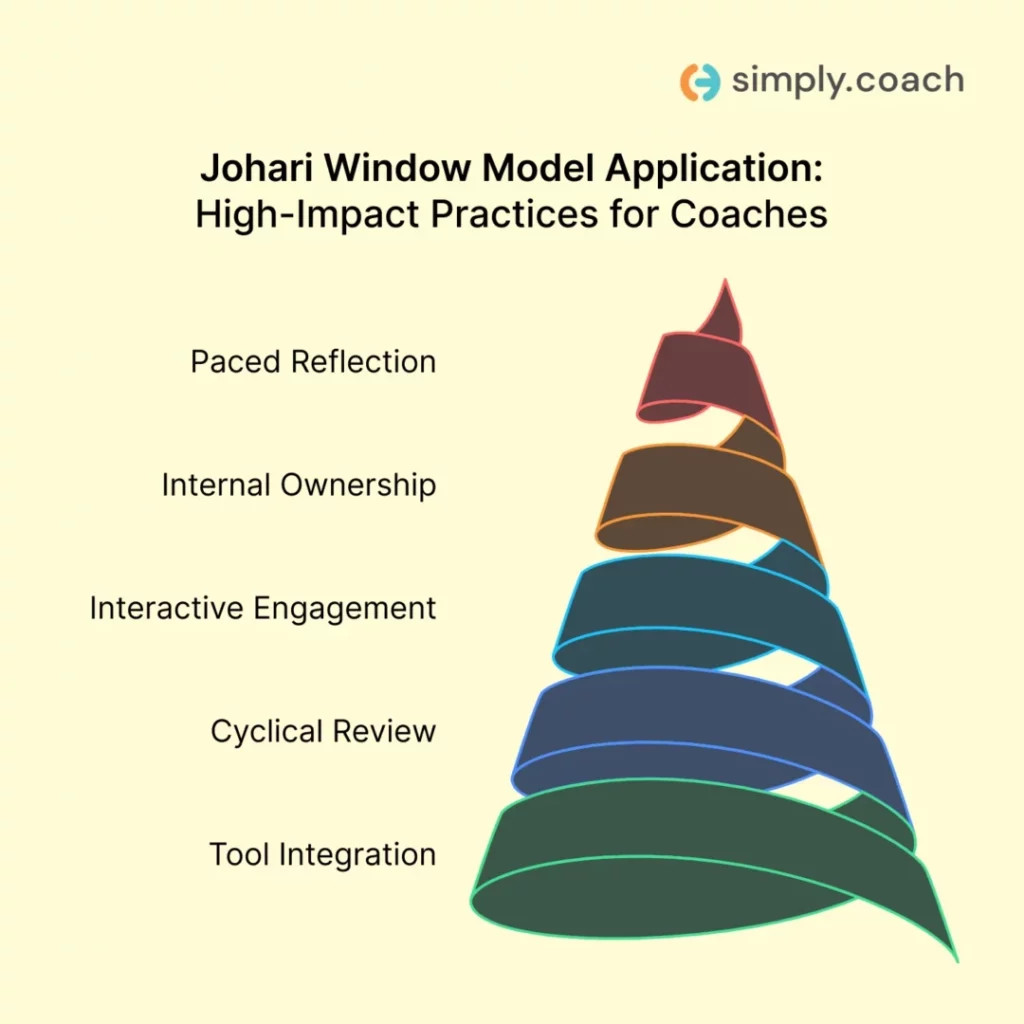
The Johari Window works best when reflection and feedback are guided carefully. A few principles make the process effective in real-world coaching:
- Guide reflection without rushing: Give clients space to process feedback and uncover hidden patterns. Silence can support deeper insight.
- Focus on internal ownership: Encourage clients to connect observed behaviors with their own intentions rather than blaming external factors.
- Use it interactively: Feedback is most powerful when clients discuss and interpret it, rather than just receiving it passively.
- Revisit insights regularly: Awareness evolves. Check in periodically to track changes in blind spots and growth in open areas.
- Integrate with other tools: Combine Johari insights with journaling, goal-setting, or leadership exercises to reinforce learning and action.
Coaching Skills That Bring the Johari Window to Life
Effective use of the Johari Window depends as much on the coach as the model itself. Key competencies include:
- Active Listening and Powerful Questioning: Helps clients uncover blind spots and hidden patterns.
- Facilitating Feedback Discussions: Guides clients to interpret feedback constructively.
- Goal-Setting and Action Planning: Converts awareness into specific, measurable behaviors.
- Understanding Behavior Change and Cognitive Science: Explains why self-awareness drives action, building client trust.
- Distinguishing Internal vs. External Factors: Keeps focus on behaviors clients can influence.
- Cultural Sensitivity: Adapts exercises to context, whether individualistic or collectivist.
- Coach Presence and Non-Attachment: Holds space for authentic reflection without imposing solutions.
- Progress Tracking and Accountability: Ensures that insights lead to consistent behavioral change over time.
Also read: Top 10 Training Evaluation Models in 2026
Conclusion
The Johari Window model works best when used as a living tool, not just an exercise on paper. It gives clients a clear mirror of how they are perceived versus how they perceive themselves, turning abstract self-reflection into actionable insight.
The model’s strength lies in its simplicity and precision. By guiding clients through the four quadrants, you can uncover blind spots that hinder collaboration, highlight hidden strengths that often go unrecognized, and explore unknown potential that only emerges in new situations.
Using this approach clients shift from defensive or reactive patterns to intentional, aware behavior. It strengthens communication, builds trust, and creates a foundation for measurable change.
Whether applied in leadership coaching, team alignment sessions, or individual development work, the Johari Window keeps the focus on tangible outcomes. It allows you as a coach to translate reflection into practical strategies that improve both performance and interpersonal effectiveness.
How Simply.Coach helps integrate Johari Window Model insights into coaching workflows
Simply.Coach bridges the gap between Johari Window insights and actionable coaching workflows. By centralizing assessment data, session reflections, and goal setting in one secure hub, the platform allows you to map personality traits to measurable outcomes. This integration makes it seamless to document behavioral patterns and capture stakeholder feedback, enabling you to design high-impact, trait-based interventions while maintaining organized, professional records.
FAQs
1. What is the main purpose of the Johari Window?
The Johari window helps you understand how your behavior is perceived by others in real situations. It reduces gaps between self-perception and external perception through structured feedback. This creates clearer alignment, stronger trust, and more effective communication in professional environments.
2. How many adjectives should I choose in the Johari Window exercise?
Participants usually select five to six adjectives that best reflect their personality and behavior in real work situations. This limitation forces you to prioritize traits instead of selecting everything that feels relevant. It keeps the exercise focused, making insights easier to interpret and apply.
3. Is the Johari Window used only for teams?
The Johari window is widely used in team settings, but it also works effectively in one-on-one coaching contexts. You can collect feedback from colleagues, managers, or stakeholders who regularly interact with your client. This makes the model flexible across both individual and group coaching environments.
4. How does the Johari Window improve communication?
The model highlights gaps between what you intend to communicate and how others actually interpret your behavior. This allows you to adjust your tone, actions, and responses based on real feedback. Over time, it reduces misunderstandings and improves clarity in everyday professional interactions.
5. What makes the Johari Window effective for personal development?
The Johari window combines self-reflection with external feedback, which most self-assessment tools fail to provide consistently. This dual perspective helps you identify patterns that are difficult to recognize on your own. It ensures that development efforts focus on real behaviors instead of assumptions.
6. Can the Johari Window reveal hidden strengths?
The model can uncover strengths that others clearly see but you may underestimate or ignore in your daily work. These traits often appear through feedback and become visible when compared with your self-perception. Recognizing them helps you use your strengths more intentionally and consistently.
7. How often should you use the Johari window?
You should use the Johari window regularly instead of treating it as a one-time exercise in your coaching process. Repeating the exercise helps you track how perceptions and behaviors change over time. This makes it more effective for long-term development and sustained improvement.