
Competency models have long guided HR and L&D teams in defining the skills, behaviors, and performance expected from employees. For coaches, these models offer more than theory; they provide a structured approach to connect your coaching sessions directly with organizational goals. Using competency models helps you align your work with leadership priorities, while demonstrating measurable outcomes and real impact to HR and stakeholders.
Applying these models strengthens your credibility as a coach and positions you as a strategic partner within corporate and L&D initiatives. They allow you to track progress clearly, show tangible results, and ensure that every coaching session contributes to meaningful development. When used thoughtfully, competency models transform coaching from insight-driven conversations into structured, outcome-focused development.
In this blog, you will learn how competency models benefit your coaching, explore practical examples, and see how to apply them effectively with corporate clients. This guide will help you deliver measurable results and align your sessions with organizational priorities.
Key Takeaways
- Competency models guide coaching with clear behaviors and measurable outcomes.
- Align coaching sessions with organizational goals to show impact to HR and leadership.
- Use the right model: core, leadership, functional, behavioral, team, or innovation.
- Adapt existing competencies to coaching goals and observable behaviors; don’t reinvent.
- Avoid treating competencies as checklists or overloading models with too many items.
- Digital platforms like Simply.Coach track progress, goals, reflections, and stakeholder insights.
- Structured, competency-based coaching makes development measurable, credible, and impactful.
What is a Competency Model?
Most competency model definitions originate in HR, where they outline skills, behaviors, and capabilities required for job performance. As a professional coach, your lens is different. You do not focus on roles alone; you focus on capabilities and behaviors that can be developed through coaching to achieve measurable outcomes. A competency model gives you a structured framework to identify what your clients need to develop and how your coaching interventions contribute to that growth.
Simple definition of a competency model
At its core, a competency model is a systematic map of behaviors, skills, and capabilities required to achieve specific outcomes. For coaches, it:
- Defines observable actions your client must demonstrate to succeed in a role or context.
- Focuses on behaviors you can influence rather than personality traits, which are harder to change.
- Differentiates from a job description, which lists tasks rather than the underlying skills or behaviors enabling success.
- Provides a measurement framework for tracking client progress over time.
How a competency model differs from coaching goals
Coaching goals define the end outcomes your client wants to achieve, such as improving leadership presence or team influence. Competencies, in contrast, define the capabilities and behaviors required to reach those goals. Understanding this distinction allows you to:
- Translate abstract objectives into concrete behaviors to focus on during sessions.
- Identify skill gaps that may block goal achievement.
- Design structured coaching interventions that are evidence-based and measurable.
- Communicate your impact clearly to HR or L&D teams, showing the link between coaching and organizational outcomes.
Competency models empower you to move beyond intuition and anecdotal feedback. They give structure to your interventions, clarify the behaviors to target, and provide a shared language with HR, L&D, and leadership. For coaches, this means every session can be strategically aligned and outcome-driven, making your work measurable, credible, and scalable across multiple clients or teams.
Why Competency Models Matter in Coaching Engagements
When you work with professional teams, coaching impact is only visible when behaviors, skills, and capabilities are clearly defined and aligned with organizational goals. Competency models give you a structured framework to target interventions, track progress, and demonstrate measurable results.
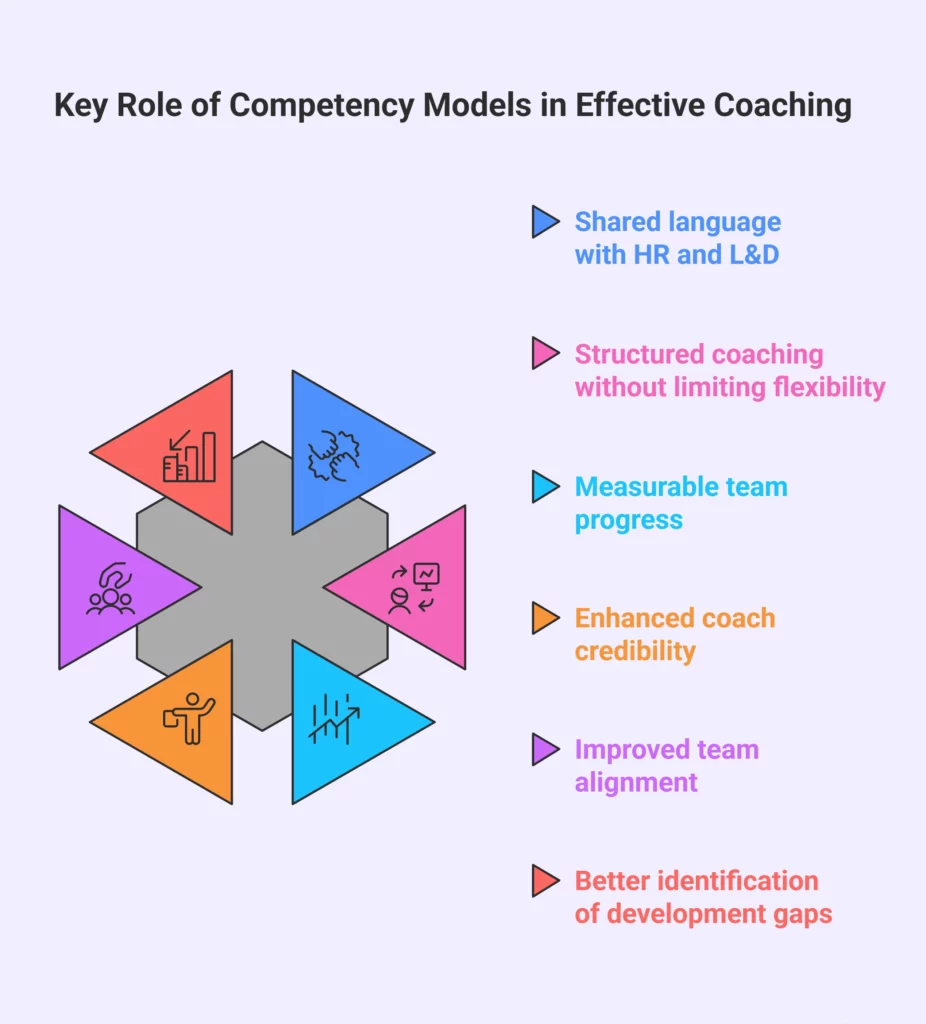
- Shared language with HR and L&D: Reduces ambiguity by clarifying which team behaviors drive performance. Aligns coaching objectives with leadership frameworks and ensures all stakeholders share a common understanding.
- Structured coaching without limiting flexibility: Allows you to focus on specific skills and behaviors for both individuals and teams. Supports tailored interventions while maintaining a consistent framework for team development.
- Measurable team progress: Defines observable behaviors and capabilities to track over time. Provides clear data for reviews with HR, L&D, and leadership, demonstrating tangible coaching impact.
- Enhanced coach credibility: Positions you as a strategic partner rather than a soft-skills facilitator. Builds trust with HR and leadership and shows how coaching drives real team outcomes.
- Improved team alignment: Helps unify individual and collective efforts toward shared organizational objectives. Ensures team development complements business priorities.
- Better identification of development gaps: Highlights areas where team members need targeted coaching. Supports proactive planning for skill-building and behavioral improvement.
Competency models transform team coaching from intuition-driven guidance into structured, outcome-focused interventions, making your impact visible and strategic.
Also read: Systemic Team Coaching: Five Disciplines Model for High-Performing and Adaptive Teams
Types of Competency Models Coaches Commonly Work With
Coaches rarely need to build competency models from scratch, but understanding the different types ensures you apply the right framework to your clients and teams. Each model provides a specific lens to observe behaviors, guide development, and measure impact. Selecting the appropriate model allows you to deliver structured, outcome-driven coaching while addressing both individual and team needs.

1. Core competency models
Core competency models define the values, behaviors, and mindsets expected across an organization. They provide a consistent framework for all employees, ensuring alignment with organizational culture.
The ICF categorizes core competencies into 4 key areas – foundation, co-creating the relationship, communicating effectively and cultivating learning and growth in clients.
As a coach, using core models helps you:
- Establish a shared language with HR and leadership about expected behaviors.
- Align team coaching with organizational priorities and values.
- Identify gaps where team members may struggle to embody expected behaviors.
These models are particularly useful when coaching teams that need to internalize culture or reinforce organizational standards, helping you focus on behaviors that matter most for collective success.
Also read: Guide to ICF Core Competencies for Coaching Leadership
2. Leadership competency models
Leadership competency models focus on decision-making, emotional intelligence, influence, and accountability. They are designed for executives and emerging leaders who must drive performance while guiding teams effectively.
As a coach, applying leadership models allows you to:
- Map coaching sessions to specific leadership behaviors that improve team outcomes.
- Track progress in areas like strategic thinking, conflict management, and team influence.
- Demonstrate measurable growth to HR and organizational stakeholders.
Using leadership models ensures your coaching contributes to both individual development and broader team effectiveness, making your interventions highly credible in corporate contexts.
3. Functional or role-based competency models
Functional or role-based models focus on skills and behaviors required for specific roles or transitions. They are ideal for coaching employees in new positions or those aiming to enhance performance in their current roles.
With these models, you can:
- Identify role-specific skill gaps that coaching can address.
- Align coaching interventions with performance expectations and career progression.
- Provide structured development plans that are tied to measurable outcomes.
These models are highly valuable when coaching high-performing teams, ensuring each member develops capabilities essential for their responsibilities while contributing to collective goals.
4. Behavioral and capability-based models in coaching
Behavioral and capability-based models emphasize observable actions and measurable skills. They focus on behaviors that can be developed through coaching to improve performance and collaboration.
Using these models allows you to:
- Track behavioral changes in real time during coaching engagements.
- Focus interventions on specific, actionable skills rather than abstract concepts.
- Provide clear evidence of impact to stakeholders, HR, and leadership.
This type is particularly effective for executive and team coaching where behavior drives results, helping you make coaching progress transparent and actionable.
Also read: Mastering Behavioral Coaching: 4 Key Modalities to Transform Client Outcomes
5. Team dynamics competency models
Team dynamics models highlight competencies necessary for effective collaboration, communication, and conflict resolution. They help coaches address challenges that affect group performance and cohesion.
As a coach, you can:
- Identify team-level behavioral gaps that limit productivity or alignment.
- Design interventions to improve communication, trust, and collaboration.
- Track collective progress to demonstrate team development impact.
These models are essential when coaching cross-functional or high-performing teams where individual growth must align with group effectiveness.
Also read: How to Scale a Coaching Program Across Global Teams
6. Innovation and problem-solving competency models
Innovation and problem-solving models focus on creative thinking, adaptability, and strategic problem-solving capabilities. They are especially relevant for teams tackling complex projects or undergoing change.
Using these models allows you to:
- Strengthen team capacity to respond to challenges and generate new solutions.
- Guide coaching sessions that build both critical and creative thinking skills.
- Measure improvement in decision-making, collaboration, and solution implementation.
These models help you position coaching as a strategic enabler of organizational agility, showing tangible value to leadership and HR.
Understanding these models allows you to choose the most effective framework for your coaching engagements, measure team progress, and provide interventions that produce meaningful, measurable outcomes for both individuals and the team.
How Coaches Can Create or Adapt a Competency Model
You don’t need to design a competency model from scratch. Your role is to adapt existing models to your coaching context, ensuring they focus on behaviors your coaching can influence and outcomes your teams or executives need to achieve.
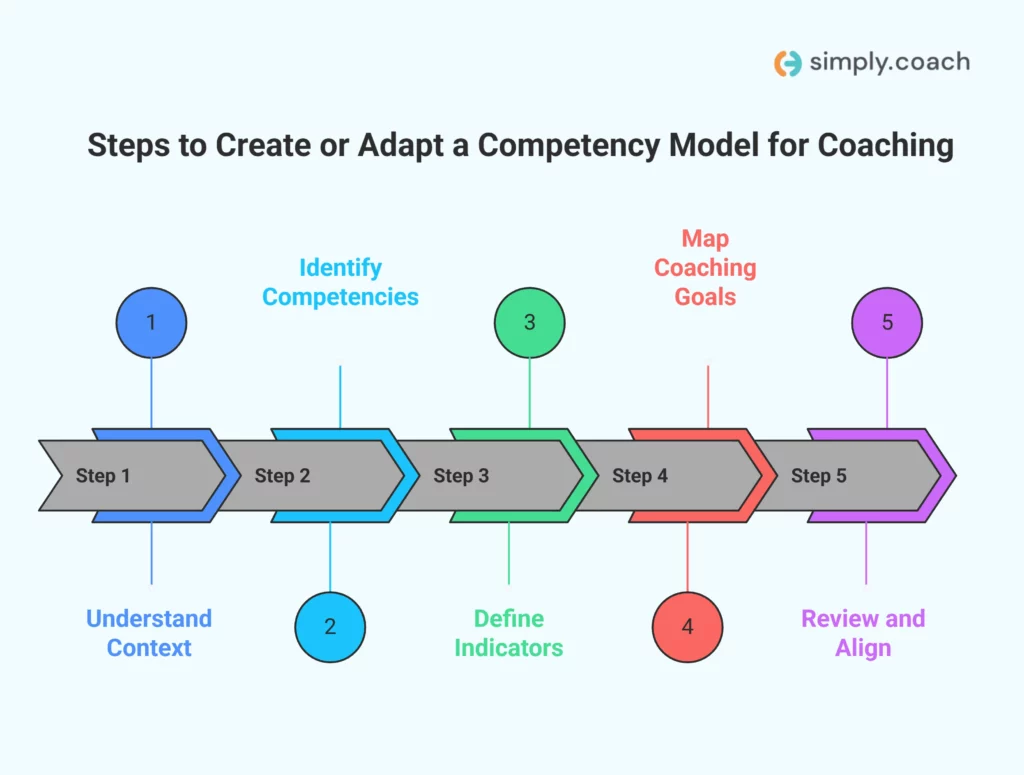
Step 1: Understand the organizational context
Start by mapping business priorities, leadership expectations, and team culture. Without this, competencies risk being irrelevant or misaligned.
Actionable approach:
- Review organizational strategy documents and team charters.
- Meet with HR or L&D to clarify leadership expectations for the team.
- Observe team interactions to understand real behaviors versus stated expectations.
Example: A senior leadership team is struggling with cross-functional collaboration. Focus on competencies like “proactive communication,” “shared accountability,” and “decision alignment” rather than abstract leadership traits.
Read more: 3 Proven Strategies for Scaling Coaching in Large Organizations
Step 2: Identify coaching-relevant competencies
Select competencies that are directly observable and coachable, avoiding technical skills or certifications outside your scope.
Actionable approach:
- List behaviors that influence team performance, collaboration, or leadership effectiveness.
- Cross-check with organizational priorities to ensure relevance.
- Prioritize competencies that can be developed and measured through coaching.
Example: For a high-performing product team, focus on competencies such as “feedback delivery,” “stakeholder influence,” and “conflict resolution” rather than product knowledge.
Step 3: Define observable behavior indicators
Break each competency into specific actions you can see and measure. This removes ambiguity and lets you track progress concretely.
Actionable approach:
- Ask, “What would I see this person doing if they were demonstrating this competency well?”
- Write 2–3 clear behaviors per competency that can be observed in meetings, emails, or team interactions.
Example: For “decision-making under ambiguity”:
- Seeks input from relevant team members before deciding.
- Explains rationale to peers and stakeholders.
- Adjusts decisions when new information emerges.
Step 4: Map coaching goals to competencies
Directly link each coaching goal to one or more competencies. This ensures that coaching sessions are structured, measurable, and aligned with outcomes HR or leadership cares about.
Actionable approach:
- Align goals like “improve team collaboration” to competencies such as “active listening” and “constructive feedback.”
- Create a session plan showing which competencies are targeted each week.
- Track progress by observing behaviors in real work contexts, not just in sessions.
Example: Coaching a leadership team on “executive influence” maps to competencies like “stakeholder engagement,” “persuasive communication,” and “strategic thinking.”
Step 5: Review and align with HR or L&D stakeholders
Validate your adapted model with HR or L&D to ensure consistency, buy-in, and strategic alignment. This step strengthens your credibility and demonstrates your role as a strategic partner.
Actionable approach:
- Present the selected competencies, behavior indicators, and coaching plan.
- Adjust based on HR feedback to ensure alignment with performance frameworks.
- Agree on metrics to track behavioral change over the coaching period.
Example: Before coaching a senior management team, review the competency map with HR. Confirm which behaviors will be tracked and reported during performance reviews.
Adapting a competency model for coaching allows you to focus on behaviors that matter, measure team progress, and demonstrate clear impact to leadership and HR. Each step ensures coaching is structured, targeted, and outcome-driven.
Related: The 6-Question Coaching Tool That Will Improve Your Coaching Outcomes
Common Mistakes Coaches Make with Competency Models
Competency models are meant to support coaching, not box it in. When they are applied without enough thought or flexibility, they can start to feel heavy, rigid, or disconnected from real coaching work.
Most problems do not come from the model itself, but from how it is introduced, interpreted, and used during coaching conversations with professionals and teams.
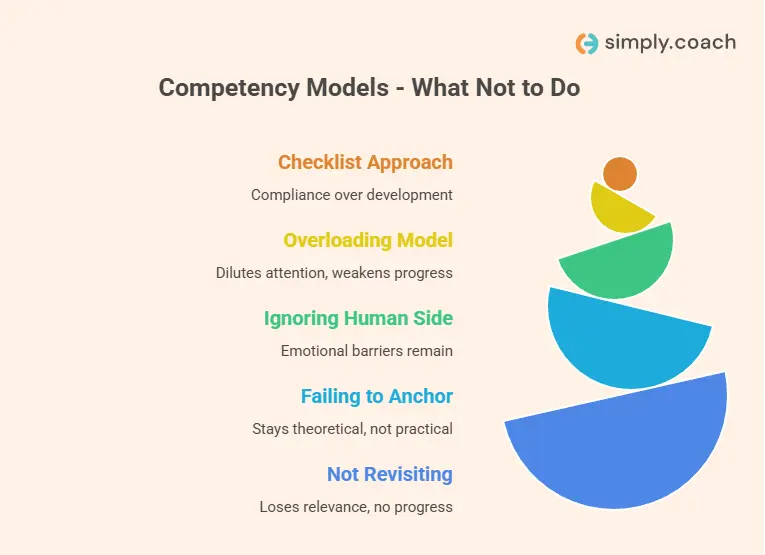
- Treating competencies as a checklist: You risk turning coaching into compliance when competencies are treated as items to complete rather than behaviors to develop. This shifts focus away from reflection, choice, and sustained behavior change within real work situations.
- Overloading the model with too many competencies: Including too many competencies dilutes attention and weakens progress. Teams struggle to focus when everything feels equally important, and coaching conversations lose depth and direction.
- Ignoring the human side of behavior change: Competencies describe behaviors, not the emotional, relational, or contextual barriers behind them. When fear, identity, or team dynamics are ignored, behavior change rarely sticks beyond the coaching engagement.
- Failing to anchor competencies in real work moments: Competencies stay theoretical when they are not tied to meetings, decisions, conflicts, or stakeholder interactions. Coaching impact increases when behaviors are examined inside actual work scenarios.
- Not revisiting and reflecting on progress: Competency models lose relevance when they are set once and never reviewed. Regular reflection helps you track behavior shifts, recalibrate focus, and demonstrate progress to stakeholders.
Used thoughtfully, competency models support clarity and growth. Used mechanically, they limit insight and reduce coaching effectiveness for professional teams.
How Simply.Coach Helps Coaches Work With Competency Models
Working with competency models becomes far more effective when structure supports, rather than distracts from, your coaching work. Simply.Coach is designed to help you apply competency models in real coaching engagements, without adding operational complexity.
- Progress tracking tied to observable behaviors: Track development against specific competencies over time, based on real work behaviors rather than subjective impressions.
- Goal setting aligned with competencies: Map coaching goals directly to targeted competencies, keeping every engagement focused and outcome-driven.
- Session structure that reinforces development: Link each session to the competencies being developed, creating continuity across leadership and team coaching programs.
- Self-reflection grounded in real work moments: Capture reflections on meetings, decisions, and challenges, and connect them to specific competencies.
- Action planning linked to behavior change: Create action plans around concrete behaviors so learning is applied immediately at work.
- Clear, structured insights for stakeholders: Share progress updates with HR, L&D, or leadership without compromising coaching confidentiality.
Simply.Coach keeps competency models practical, visible, and integrated into everyday coaching work. You spend less time managing frameworks and more time supporting meaningful, sustained behavior change for professionals and teams.
Conclusion
Competency models give your coaching clarity, focus, and direction when working with professionals and teams. They help you move from insight-led conversations to behavior-driven development aligned with organizational goals. When applied thoughtfully, they make progress visible, outcomes measurable, and your coaching easier for stakeholders to trust. This is how coaching becomes a strategic driver of real performance change.
Simply.Coach supports this approach as an all-in-one coaching platform built for professional and team coaching. It brings goals, competencies, sessions, reflections, action plans, and progress tracking into one structured space. You can clearly link behavior change to outcomes without added administrative effort. This allows you to focus fully on development work while confidently demonstrating impact to HR, L&D, and leadership.
FAQs
1. What challenges do organizations face when building a competency model?
Organizations often struggle with unclear scope, lack of stakeholder alignment, and over-engineering the model. This can result in frameworks that look good on paper but fail in practice. Simplicity and relevance are common gaps.
2. How often should a competency model be updated?
Competency models should be reviewed annually or when business priorities change. Regular updates keep behaviors aligned with strategy, roles, and team realities. Static models lose relevance quickly.
3. How is a competency model different from a skills framework?
A skills framework focuses on what someone can do. A competency model includes how they behave while doing it. Competencies connect performance, behavior, and outcomes.
4. Can competency models be used beyond HR and performance reviews?
Yes. They are widely used in leadership development, coaching, succession planning, and team effectiveness initiatives. They help align development efforts across functions.
5. What is the difference between competency and capability?
Competency reflects current, observable behavior. Capability reflects the potential to develop new behaviors over time. Both are important for long-term growth planning.