
As a coach, you know how challenging it can be to keep sessions focused and ensure your clients make real progress. Many coaches struggle with planning, tracking outcomes, and adjusting strategies for different clients. Without a clear method, your sessions can feel inconsistent, and your clients may miss key growth opportunities.
The ADDIE Training Model gives you a clear, step-by-step framework to structure every coaching engagement. Each phase helps you understand your clients, plan effective sessions, deliver meaningful guidance, and measure results. In this guide, you will learn how to apply ADDIE in coaching, who benefits most, and the advantages it brings to your practice.
Key Takeaways
- ADDIE model is a structured coaching framework guiding Analysis, Design, Development, Implementation, and Evaluation.
- Use ADDIE when creating new programs, revising sessions, running workshops, or tracking client progress.
- Structured sessions, clear goals, improved engagement, measurable outcomes, and adaptability make ADDIE valuable for coaches.
- Analyze client needs, design session plans, develop materials, implement coaching, and evaluate impact for effectiveness.
- Use digital tools like Simply.Coach for goal setting, progress tracking, action plans, feedback, and 360-degree assessments.
What is the ADDIE Training Model
The ADDIE Training Model is a step-by-step framework coaches use to plan, structure, and deliver effective coaching sessions. It ensures that every session is focused, measurable, and aligned with the client’s goals.
The model organizes coaching into five phases: Analysis, Design, Development, Implementation, and Evaluation. Each phase guides you through understanding your clients, creating structured sessions, and tracking progress for meaningful outcomes.
ADDIE was first developed in the 1970s for instructional design in corporate and military training. Coaches later adopted it because it provides a systematic approach, helping you maintain consistency and improve results across all coaching engagements.
Related: GROW Coaching Model: Steps, Questions, Uses, and Examples
When Coaches can Use the ADDIE Training Model
You can apply the ADDIE Training Model whenever you need a structured approach to design and deliver coaching programs. It is especially useful in situations where clarity, consistency, and measurable outcomes are important. Key scenarios include:
- Designing new programs: When you are creating coaching programs from scratch for individuals or teams.
- Revising existing sessions: When current sessions feel scattered or fail to deliver measurable results.
- Running workshops or group sessions: When you manage multiple participants in one coaching program.
- Implementing hybrid or corporate formats: When coaching programs involve online, in-person, or blended delivery.
- Tracking progress consistently: When you want to measure outcomes and ensure continuous client growth.
Using ADDIE in these situations helps you stay organized, save time, and focus on actions that deliver real results.
To whom can coaches apply this model
The ADDIE model can be applied across various client types. It allows you to tailor coaching sessions according to role, goals, and learning needs. Key clients include:
- Learning and Development (L&D) professionals: To design structured training programs and improve employee learning outcomes.
- HR teams: To align coaching with organizational goals and workforce development strategies.
- Executives and leadership teams: To support leadership growth, performance improvement, and strategic decision-making skills.
- Teams with skill gaps: To guide learning and bridge competency gaps in a structured manner.
- Groups adopting new systems or processes: To simplify complex learning into clear, actionable steps.
- Career-focused individuals: To provide structured development plans for personal growth and career advancement.
This format makes it easy for coaches to scan and understand when and with whom to apply the ADDIE model.
Benefits of Using the ADDIE Model in Coaching
Using the ADDIE model in your coaching practice provides clear advantages that improve session effectiveness, client engagement, and measurable outcomes. Key benefits include:
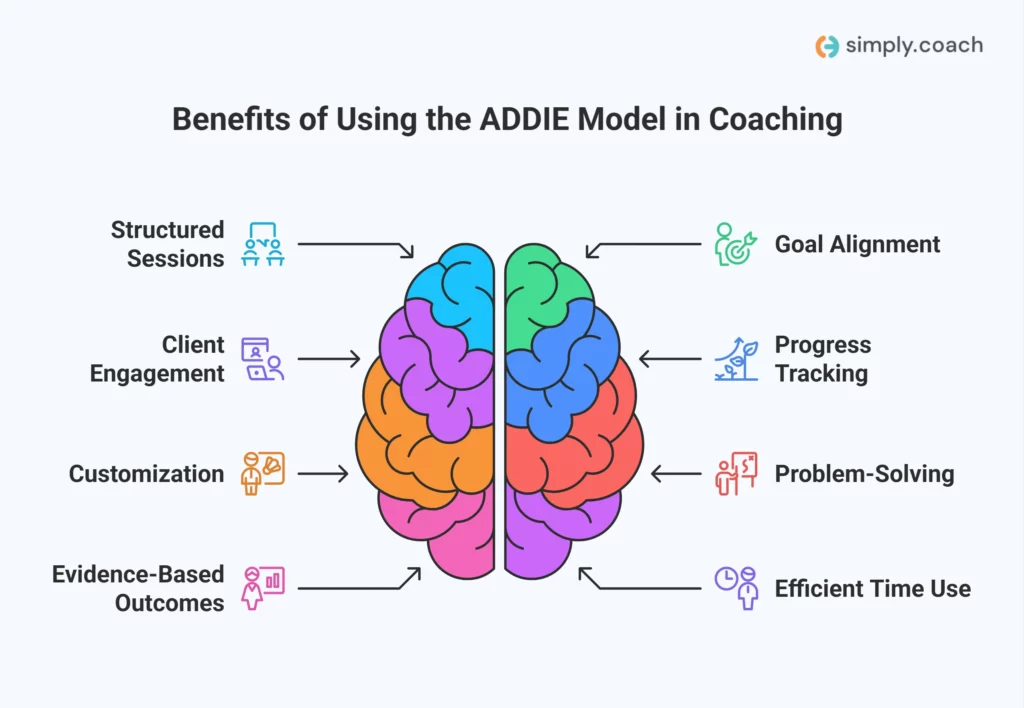
- Structured coaching sessions: Ensures each session has a clear purpose and follows a logical flow for maximum client impact.
- Clear goal alignment: Helps you connect every activity to the client’s specific objectives and long-term development plans.
- Improved client engagement: Guides you to design exercises and discussions that actively involve clients in their learning.
- Consistent progress tracking: Provides a framework to monitor development and adjust coaching strategies based on measurable results.
- Customizable for different clients: Allows you to adapt the approach for executives, teams, L&D professionals, or individuals with unique needs.
- Enhanced problem-solving: Helps identify gaps in skills or knowledge early, so you can focus coaching efforts where they matter most.
- Evidence-based outcomes: Encourages documentation and evaluation, making it easier to demonstrate the value of your coaching programs.
- Efficient use of time: Reduces wasted effort by planning sessions around structured phases, keeping both you and your clients focused.
Using these benefits, coaches can deliver more impactful sessions, increase client satisfaction, and achieve measurable growth consistently.
The 5 Phases of ADDIE Model
The ADDIE model is a step-by-step framework that helps coaches design and deliver highly effective coaching programs. Each phase ensures your sessions are purposeful, measurable, and aligned with client goals.
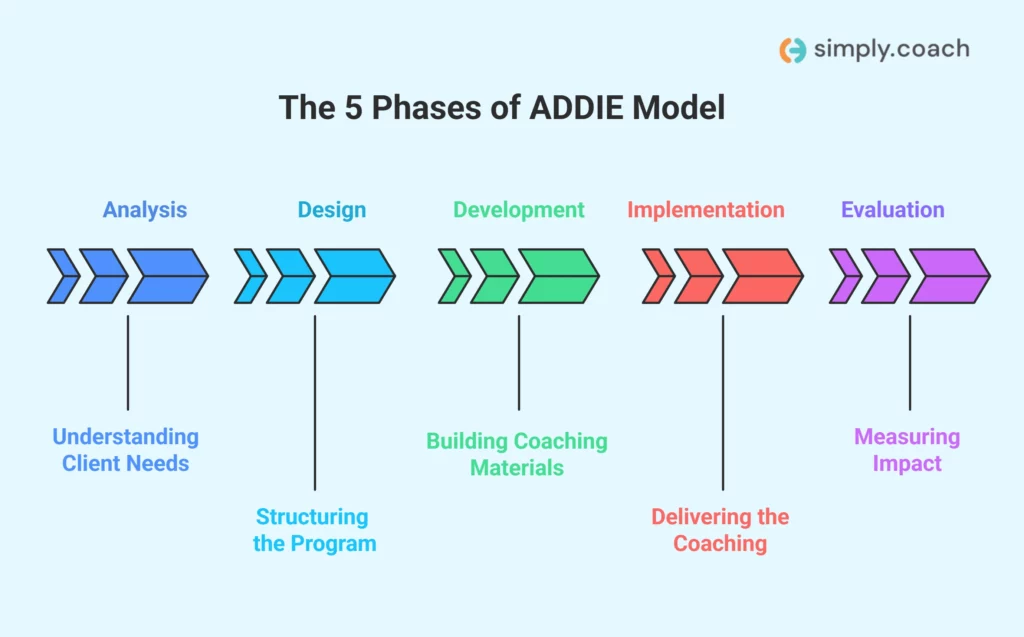
1. Analysis: Understanding your client and their coaching needs
The Analysis phase is the foundation of your coaching program. This is where you identify your client’s goals, skill gaps, and development needs. Without this step, coaching sessions risk being unfocused or irrelevant.
What coaches must do:
- Assess current client performance, behaviors, and challenges.
- Identify skill gaps and areas for growth.
- Define learner personas capturing experience, role, responsibilities, and learning preferences.
- Understand organizational context for corporate clients, including team dynamics and company culture.
Questions to ask clients:
- What are your short-term and long-term coaching goals?
- Which skills or behaviors do you want to strengthen first?
- What obstacles have slowed your progress in the past?
- How do you prefer feedback and support during coaching?
- Are there organizational expectations or KPIs guiding coaching?
Tips for coaches:
- Use surveys, interviews, or observations for team analysis.
- Document insights carefully to guide the design phase.
- Align analysis outcomes with client priorities to ensure relevance and impact.
Example: If working with an HR team, you might identify gaps in leadership communication. The sessions then focus on practical techniques like conflict resolution and feedback delivery.
Also read: Effective Coaching Check-In Questions: Unlock Deeper Client Insights and Growth
2. Design: Structuring your coaching program
In the Design phase of the ADDIE model, you transform all insights from the Analysis phase into a clear coaching plan. This involves creating a structured outline that defines objectives, session flow, and engagement strategies for each workshop or coaching session.
Key steps for coaches:
- Define learning objectives: Specify what clients should achieve after each session.
- Plan session structure: Decide on topics, exercises, duration, and sequence.
- Select delivery methods: Choose in-person, virtual, or blended approaches that best fit your client.
- Include assessments and feedback: Decide how you will measure client progress during and after sessions.
Evaluating coaching effectiveness:
Not every session requires full-scale evaluation. Simple feedback may be sufficient for smaller or low-investment programs. High-impact coaching programs, especially for executives or teams tackling critical business challenges, may require deeper measurement. Consider using Kirkpatrick’s evaluation model to assess:
- Reaction: How did the client respond to the session?
- Learning: What knowledge or skills were gained?
- Behavior: Is the client applying the learning in real situations?
- Results: What measurable impact did the coaching have on performance or outcomes?
Storyboards and prototypes:
Creating a storyboard or prototype can help you visualize the coaching flow and communicate value to stakeholders or clients. Briefing stakeholders on objectives, session design, and planned outcomes ensures alignment before you move to development.
Example: When coaching a corporate leadership team, you might design a session blueprint showing each activity, discussion topic, and assessment method, then review it with HR or L&D stakeholders for approval.
3. Development: Bringing your coaching program to life
In the Development phase, you take the storyboards or prototypes from the Design phase and start creating the actual coaching materials. By this stage, your objectives are clear, and it’s time to build content that is engaging, practical, and ready for delivery.
Key steps for coaches:
- Decide delivery methods: Determine whether coaching will be in-person, virtual, or blended, and choose strategies that suit your client’s learning style.
- Create coaching materials: Develop slides, exercises, workbooks, discussion prompts, or digital modules aligned with your learning objectives.
- Choose tools and platforms: Identify the software or platforms you’ll use, such as Simply.Coach, for your all in one coaching needs.
- Determine in-house or external resources: Decide if you will create materials yourself or collaborate with subject matter experts or training providers.
Tips for coaches:
- Ensure materials are aligned with the session design and the client’s needs identified during Analysis.
- Conduct pilot sessions to test content accuracy, engagement, and flow.
- Check for clarity, grammar, and usability; your client should navigate content naturally without confusion.
- Collect early feedback using online tools like Survey Monkey or Qualtrics to refine exercises and materials.
Example: For a corporate leadership program, you might develop scenario-based exercises where managers practice giving feedback. Conduct a pilot with a small group to ensure the activity aligns with objectives and produces meaningful discussion.
4. Implementation: Delivering your coaching program
The Implementation phase is where your coaching plan comes to life. This stage focuses on delivering sessions effectively, managing logistics, and ensuring clients are fully supported throughout the process.
Key steps for coaches:
- Prepare clients for coaching: Share schedules, session guidelines, and any supplementary materials like guides or manuals.
- Set up support systems: Anticipate FAQs, technical issues, or challenges, and let clients know who to contact for assistance.
- Offer additional support programs: Consider one-to-one sessions, group coaching, or webinars to reinforce learning and address questions.
- Adjust the learning environment: Use props, posters, or reminders to reinforce key messages during sessions.
Tips for coaches:
- Upload session materials to a central platform (like an LMS) to track participation, completion, and feedback.
- Communicate start and end dates clearly, creating excitement and motivating clients to engage fully.
- Begin informal evaluation during this phase by observing engagement, participation, and client reactions.
Evaluation during implementation:
While formal evaluation comes next, you can start collecting data now using:
- Pre-and post-session assessments.
- Questionnaires or feedback forms.
- Observations of client behavior during sessions.
- Knowledge checks or practical exercises.
Example: Coaching a leadership team might involve rolling out interactive sessions via an LMS, conducting weekly check-ins, and providing additional one-on-one guidance for executives struggling with specific challenges.
Also read: Best Group Coaching Platforms & Frameworks for L&D Professionals in 2026
5. Evaluation: Measuring the impact of your coaching program
The Evaluation phase ensures that your coaching program achieves its objectives and provides insights for continuous improvement. Evaluation is both continuous during delivery and formal after sessions are completed.
Key steps for coaches:
- Gather immediate feedback: Collect reactions from clients after each session through surveys, polls, or short reflection exercises.
- Observe client behavior: Monitor how clients apply new skills or strategies in real situations.
- Use formal assessment tools: Implement pre- and post-coaching assessments, knowledge checks, or skill demonstrations to measure learning outcomes.
- Analyze results: Compare client performance against objectives set in the Analysis phase. Identify gaps, successes, and areas needing refinement.
Tips for coaches:
- Use multiple evaluation methods to get a complete picture:
- Questionnaires and surveys.
- Interviews or one-on-one discussions.
- Observations during work or practice scenarios.
- 360-degree feedback from peers, managers, or stakeholders.
- Work output or measurable performance indicators.
- Document lessons learned and recommendations for future sessions.
Provide feedback to clients and, where relevant, to stakeholders or HR teams to demonstrate the impact of coaching.
Example: After coaching an L&D team on feedback delivery, a coach might track changes in managers’ communication behavior, gather peer feedback, and measure improvements in employee engagement scores. This helps refine future coaching programs.
Evaluation is not a one-time step. By continuously measuring impact, you can improve content, delivery, and client results, ensuring your coaching program delivers real, measurable value.
Elevate your ADDIE Model to the next level
If you are planning to implement theADDIE model – providing a clear, structured, well designed and an impactful program which will deliver measurable results for your clients – the right framework is essential. Our practical guide, “How to Design u0026amp; Launch Your Signature Coaching Program,” outlines proven program structures, pricing models, and delivery approaches used by experienced coaches.

ADDIE Model Coaching Examples
To help you visualize how the ADDIE model works in a coaching context, here are practical examples showing how coaches can apply each phase with real clients.
Example 1: Coaching for leadership development
Focus: Enhancing leadership skills for mid-level managers, including decision-making, delegation, conflict resolution, and team motivation. Sessions include role-plays, reflection exercises, and 1:1 coaching discussions.
| ADDIE Phase | Coaching Activities |
| Analysis | – Identify leadership gaps based on performance reviews or 360-degree feedback.- Determine objectives: improving decision-making, delegation, and team engagement.- Identify the target audience: mid-level managers or emerging leaders.- Assess existing skills and behaviors using surveys, interviews, or observation. |
| Design | – Develop a coaching plan outlining session topics, exercises, and discussion points.- Create session guides, reflection prompts, and assessment tools.- Define evaluation methods (e.g., 360 feedback, self-assessment).- Schedule sessions, including 1:1 and group workshops. |
| Development | – Prepare coaching materials: leadership frameworks, case studies, exercises.- Design interactive activities like scenario-based role-plays.- Review content with stakeholders or HR to ensure alignment.- Pilot a session with a small group of managers. |
| Implementation | – Deliver coaching sessions as scheduled (virtual, in-person, or blended).- Provide continuous support and feedback during exercises.- Monitor engagement and address challenges in real-time.- Offer supplemental resources or follow-up exercises. |
| Evaluation | – Collect feedback from participants and stakeholders.- Assess changes in leadership behavior through 360-degree feedback and direct observation.- Compare performance metrics or team engagement scores before and after coaching.- Adjust future coaching sessions based on results. |
Example 2: Coaching for time management and productivity
Focus: Improving personal productivity and time management skills for employees struggling with workload management or prioritization. Coaching includes goal-setting exercises, accountability sessions, and habit tracking.
| ADDIE Phase | Coaching Activities |
| Analysis | – Identify productivity challenges using surveys, time audits, or interviews.- Determine objectives: prioritization, scheduling, minimizing distractions, and work-life balance.- Target audience: employees at all levels who need to improve productivity.- Assess current habits, tools used, and time management behaviors. |
| Design | – Create a coaching plan with session topics: goal-setting, scheduling, and focus techniques.- Develop exercises: time logs, prioritization matrices, reflection prompts.- Decide evaluation tools: self-assessments, progress tracking sheets.- Schedule regular coaching sessions and check-ins. |
| Development | – Develop worksheets, guides, and templates for tracking tasks and goals.- Prepare examples and case studies to demonstrate effective time management.- Test materials with a pilot group to refine exercises.- Incorporate digital tools like calendars, task managers, or habit trackers. |
| Implementation | – Conduct coaching sessions, guiding clients through exercises and goal-setting.- Provide feedback on progress, offer accountability, and adjust plans as needed.- Monitor adoption of new strategies and tools.- Encourage reflection and adjustments in real-world scenarios. |
| Evaluation | – Collect feedback on the usefulness of coaching sessions.- Track improvements in task completion, goal achievement, and stress levels.- Assess behavior changes through follow-up discussions and self-reporting.- Revise coaching methods and materials for future clients. |
These examples demonstrate how a structured ADDIE approach ensures coaching programs are purposeful, measurable, and deliver meaningful results for clients.
Best Practices for Using the ADDIE Model in Coaching
Implementing the ADDIE model effectively requires more than following its phases, it involves adopting proven best practices that ensure your coaching delivers measurable impact.
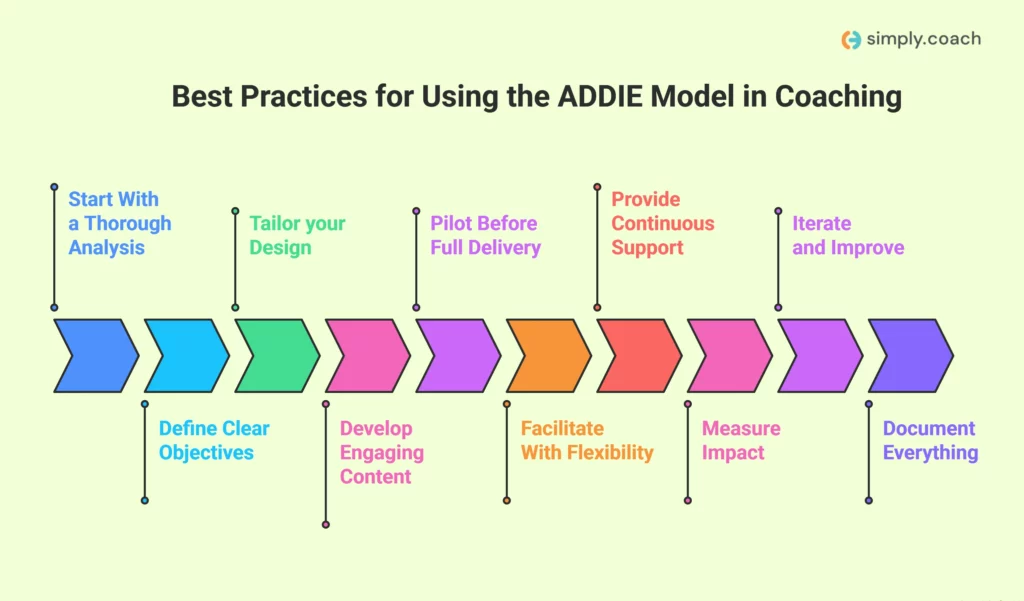
- Start with a thorough analysis: Ask targeted questions, observe client behavior, and gather data to understand real needs.
- Define clear objectives: Each coaching session should have measurable outcomes linked to client goals.
- Tailor your design: Customize exercises, discussions, and delivery methods to suit your client’s learning style and context.
- Develop engaging content: Use practical exercises, role-plays, multimedia, or digital tools that make learning interactive.
- Pilot before full delivery: Test materials or exercises with a small group or trial session to refine content and flow.
- Facilitate with flexibility: Adapt your approach during sessions based on client engagement and feedback.
- Provide continuous support: Offer follow-up exercises, resources, or accountability sessions to reinforce learning.
- Measure impact: Collect feedback, track skill application, and evaluate behavior changes to ensure results.
- Iterate and improve: Use evaluation insights to refine future coaching programs and maintain program relevance.
- Document everything: Keep records of objectives, activities, assessments, and feedback to guide future sessions.
By following these best practices, you can create structured, client-focused coaching programs that drive real skill development and lasting behavioral change.
Conclusion
The ADDIE model provides a clear, structured approach for coaches to design and deliver impactful programs. By following its five phases you can tailor coaching to client needs and ensure measurable results. Applying ADDIE in coaching enhances engagement, accountability, and skill development across clients or teams. With practical examples and best practices, you now have a roadmap to implement ADDIE effectively in your coaching sessions.
Simply.Coach is an all-in-one digital coaching platform that simplifies ADDIE-based coaching programs for coaches and clients. It offers tools that streamline program design, delivery, and evaluation, ensuring your coaching is structured and results-driven. Key features include:
- Goal setting: Define clear, measurable objectives for each coaching session.
- Progress tracking: Monitor client development and skill acquisition over time.
- Action plans: Create step-by-step plans to help clients implement learning.
- 360 degree feedback forms: Gather insights from peers, managers, and stakeholders.
- Session scheduling and reminders: Ensure timely, organized coaching sessions for clients.
With Simply.Coach, you can implement ADDIE coaching efficiently while enhancing client outcomes and maintaining seamless program management.
FAQs
1. What makes the ADDIE model still relevant in coaching today?
Despite newer approaches, ADDIE remains useful because it offers a structured roadmap coaches can adapt for individual and group programs. Its flexibility lets you revisit phases as needed to improve outcomes.
2.Can coaches use ADDIE in agile or adaptive coaching programs?
Yes. You can use ADDIE iteratively rather than strictly linear, allowing you to adjust coaching content and methods as client needs evolve throughout the engagement.
3. Is the ADDIE model suitable for small coaching engagements?
Absolutely. You can scale ADDIE by focusing on core steps and outcomes, making it effective even for short‑term or one‑on‑one coaching without formal project infrastructure.
4. How does continuous evaluation work within the ADDIE process?
Evaluation is ongoing and not just at the end. You can collect feedback and performance data throughout coaching to refine objectives and improve subsequent phases.
5. Can ADDIE help coaches align their programs with business goals?
Yes. Through thorough analysis, you ensure coaching outcomes connect with business priorities and performance indicators, making your coaching more strategic and measurable.
6. What is the main difference between ADDIE and other coaching models like GROW?
ADDIE focuses on program design and delivery across multiple phases, whereas models like GROW focus on session‑to‑session client conversation flow. ADDIE gives a broader framework for structured programs.