
Clients often struggle to name what they feel during coaching conversations. Many use broad words like stressed, confused, or overwhelmed that hide the real emotion underneath. This lack of clarity can slow progress and make meaningful reflection harder during your sessions.
When emotions remain unclear, clients often understand the situation logically but still feel stuck emotionally. You need a structured way to help them recognize and articulate what they actually feel. Clear emotional language allows clients to reflect deeper, connect patterns, and move forward with intention.
The Plutchik wheel of emotions offers a practical framework for this challenge. It organizes core emotions and shows how feelings relate, intensify, and combine. This guide explains how the Plutchik wheel of emotions works and how you can use it to support emotional awareness in coaching sessions.
Key Takeaways
- The Plutchik wheel of emotions is a visual framework that explains how eight primary human emotions are structured and connected. It shows emotional relationships, opposites, and intensity levels.
- The model includes eight core emotions: joy, sadness, trust, disgust, fear, anger, surprise, and anticipation. These universal emotions form the basis of most emotional experiences.
- Emotions vary in intensity and evolve based on context. The wheel illustrates how mild emotions can intensify into stronger states depending on triggers and situations.
- Primary emotions can combine to form complex emotions. Examples include joy + trust = love and anticipation + joy = optimism, helping explain nuanced emotional experiences.
- Coaches use the Plutchik wheel to analyze emotional patterns and improve client self-awareness. Emotional mapping helps clients understand triggers, reactions, and behavioral responses.
- Digital coaching platforms like Simply.Coach help implement emotional frameworks effectively. Tools for goal setting, action plans, progress tracking, and reflection support structured emotional development in coaching programs.
What is the Plutchik Emotion Wheel (or Feelings Wheel)?
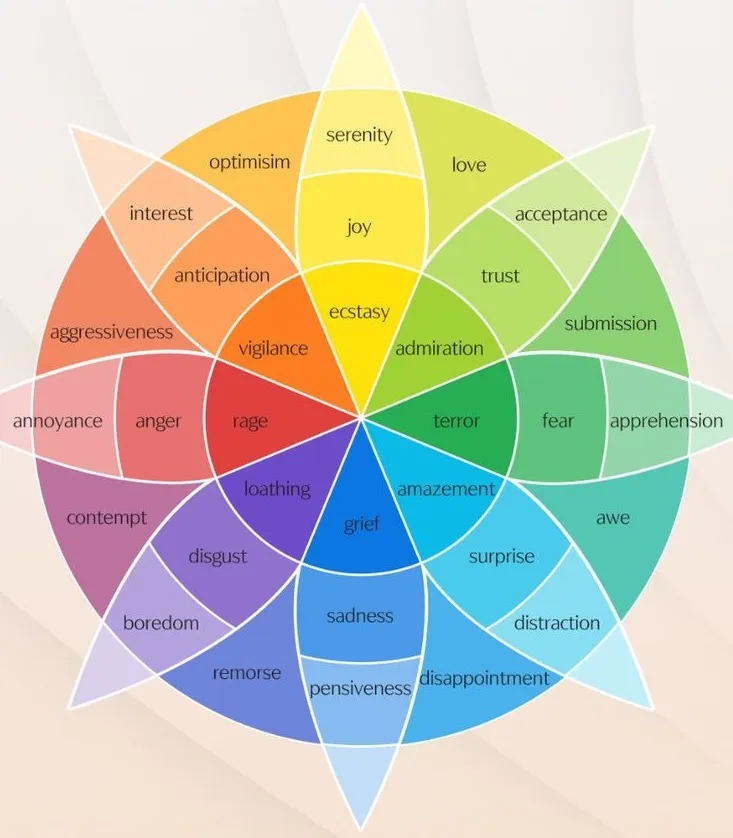
The Plutchik emotions wheel is a visual model that explains how core human emotions relate, contrast, and change in intensity. The model organizes emotions in a circular structure to show emotional relationships and interactions.
The framework helps people understand how basic emotions connect and sometimes combine to create more complex emotional experiences. It also shows how emotions can appear in different intensity levels depending on the situation.
For coaches, the model works as a practical tool to help clients identify emotions clearly and explore how those emotions influence behavior and decisions.
Origin of the model
Psychologist Robert Plutchik introduced the model in 1980 while researching emotional patterns in psychology and evolutionary biology. His work focused on understanding how emotions support survival and influence human behavior.
Plutchik proposed the psycho-evolutionary theory of emotions, which explains that emotions developed as biological responses that help humans adapt to challenges and opportunities.
For example, fear prepares the body for protection and quick reaction, while trust supports cooperation and relationship building.
To represent these emotional relationships clearly, Plutchik designed a circular wheel structure. The format helped him show emotional contrasts, intensity changes, and emotional combinations within one visual framework.
How the Plutchik wheel of emotions helps coaches
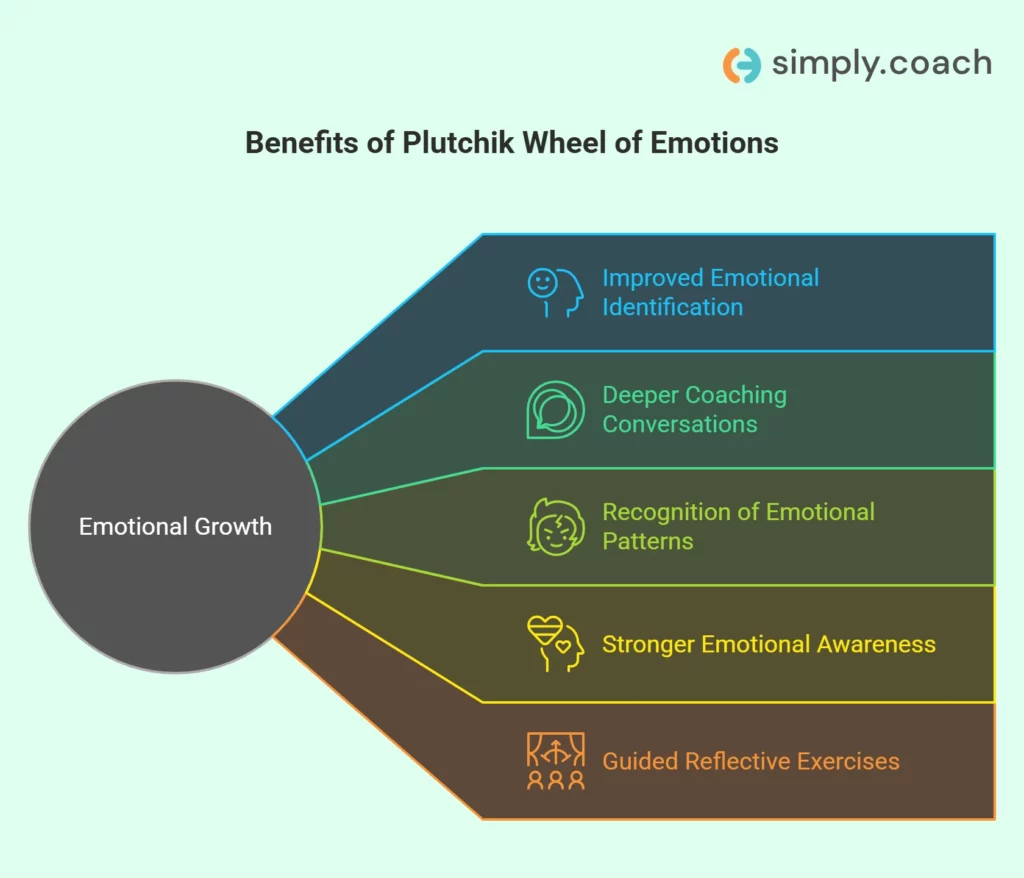
Coaching conversations often involve emotions that clients struggle to describe clearly. The Plutchik wheel of emotions gives you a structured way to explore those emotions and guide clients toward deeper awareness.
- Improves emotional clarity: Clients move from vague descriptors like “stressed” or “upset” to precise emotions such as fear, frustration, or disappointment. This clarity helps both coach and client explore feelings more deeply.
- Strengthens self-awareness: By mapping emotions and noticing patterns, clients gain insight into how specific feelings influence their thoughts, decisions, and behaviours over time.
- Supports actionable reflection: The wheel encourages clients to connect emotions to real-life situations, uncover triggers, and identify potential responses rather than just naming feelings.
- Encourages exploration of complex emotions: Primary emotions often combine to form nuanced states (e.g., joy + trust = love). Recognizing these blends helps clients understand subtle dynamics in relationships and personal choices.
- Guides session flow and intervention design: Coaches can use the wheel to structure questions, exercises, and interventions, linking emotional awareness to goal-setting, conflict resolution, or mindset shifts.
The tool is used as a guide, not a rigid checklist. Clients lead the process by self-labeling, while coaches facilitate reflection and insight. When clients understand their emotions more clearly, coaching discussions become more focused. The Plutchik wheel of emotions helps you create conversations that lead to insight, reflection, and meaningful behavioral change.
Also read: Behavioral Coaching: 4 Modalities to Transform Client Outcomes (2026)
The 8 Fundamental Sentiments in the Plutchik Wheel
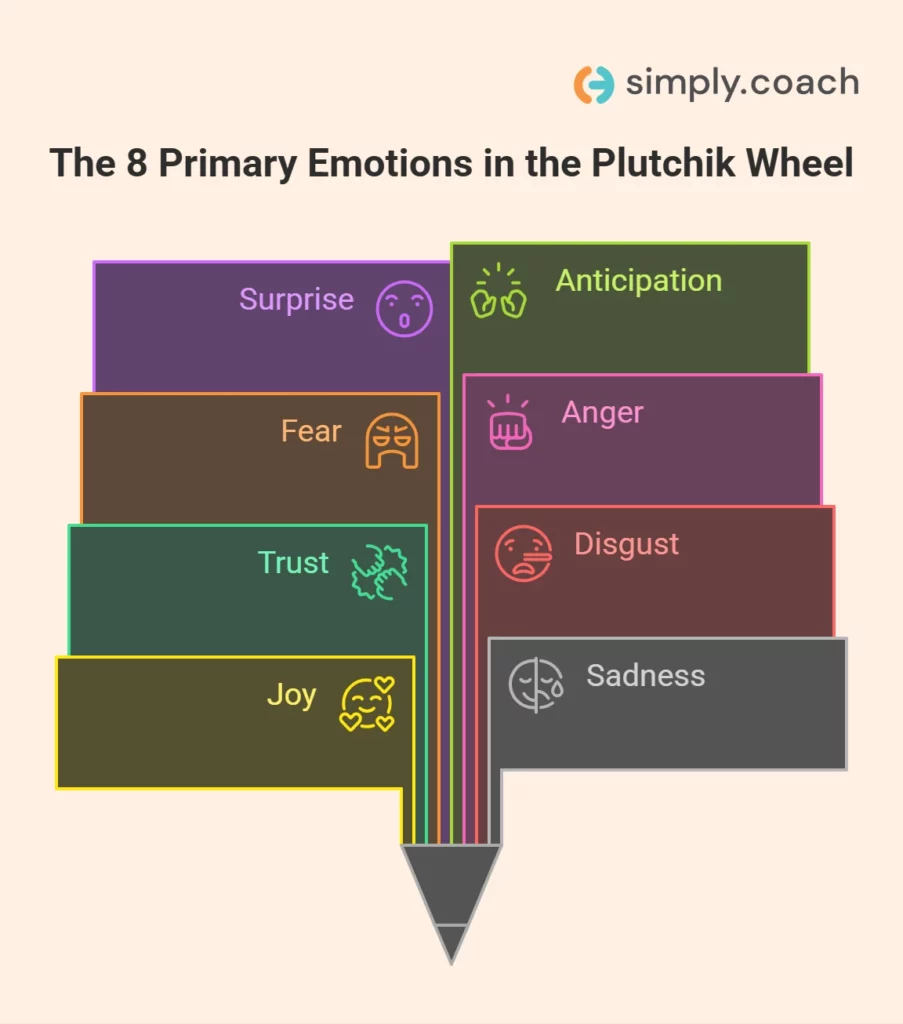
The Plutchik wheel of emotions identifies eight primary emotions that form the foundation of human emotional experience. These emotions are universal, appear consistently across cultures, and influence how your clients think, react, and make decisions. Understanding these emotions helps you interpret subtle emotional signals and design coaching conversations that create meaningful insights.
1. Joy
Joy is a positive emotional state characterized by pleasure, satisfaction, and connection. It often arises from personal achievement, meaningful experiences, or progress.
Client cues: You might notice smiling, relaxed posture, lively tone, or excitement in their storytelling. They often recall achievements enthusiastically.
Situational example: A client celebrates completing a challenging project or successfully implementing a new habit.
Coaching action prompts:
- Ask: “What specifically about this moment brings you the most satisfaction?”
- Encourage reflection or journaling on recent wins and the emotions tied to them.
- Explore patterns of actions, people, or circumstances that consistently bring joy.
Recognizing joy helps reinforce positive behaviors and uncover motivating factors that sustain client progress.
2. Sadness
Sadness is a response to loss, disappointment, or unmet expectations. It encourages reflection and emotional processing, allowing clients to understand their reactions.
Client cues: Look for downcast eyes, slow speech, withdrawn posture, quieter tone, or hesitant gestures.
Situational example: A client talks about a career setback, a broken relationship, or missing a personal goal.
Coaching action prompts:
- Ask: “What does this experience mean to you personally?”
- Explore coping strategies and sources of support.
- Guide the client to reflect on insights or lessons from the situation.
Understanding sadness enables you to create a safe space for emotional expression and guide clients toward resilience.
3. Trust
Trust reflects confidence and safety in relationships, people, or situations. It fosters openness, collaboration, and a willingness to take emotional risks.
Client cues: You may notice open posture, sustained eye contact, honest disclosure, and willingness to share personal challenges.
Situational example: A client confides in you about a sensitive career decision or a personal fear without hesitation.
Coaching action prompts:
- Ask: “What makes you feel safe discussing this now?”
- Identify areas where trust may be lacking and explore their impact.
- Discuss ways to strengthen trust in personal or professional relationships.
Recognizing trust allows you to deepen your coaching relationship and facilitate meaningful exploration.
4. Disgust
Disgust signals aversion or avoidance toward experiences, behaviors, or environments perceived as harmful, unpleasant, or conflicting with values.
Client cues: Clients may frown, pause, or verbally reject certain situations or options. They might display subtle tension or avoidance.
Situational example: A client reacts strongly to unethical practices at work or encounters personal value conflicts.
Coaching action prompts:
- Ask: “What specifically feels off or unacceptable in this situation?”
- Explore the boundaries and values that the client wants to protect.
- Identify ways to address or navigate situations that trigger disgust.
Awareness of disgust helps you understand client boundaries and guide ethical or values-based decision-making.
5. Fear
Fear is a response to perceived threats, uncertainty, or potential harm. It activates protective instincts and prepares clients to respond effectively.
Client cues: Notice tense posture, hesitation, fidgeting, avoidance language, or anxious facial expressions.
Situational example: A client experiences fear when facing a career transition, public speaking, or an important personal decision.
Coaching action prompts:
- Ask: “What feels risky or unsafe in this situation?”
- Explore potential consequences and coping strategies.
- Break the situation into manageable steps to reduce fear and increase confidence.
Identifying fear allows you to guide clients in confronting challenges safely and building resilience.
6. Anger
Anger arises when boundaries are threatened, goals are blocked, or injustice occurs. It signals a need to assert oneself or take action.
Client cues: Clients may raise their voice, clench fists, tense their body, or express frustration verbally.
Situational example: A client expresses anger about being overlooked for a promotion or dealing with unfair treatment.
Coaching action prompts:
- Ask: “What specifically triggered this reaction?”
- Explore how anger impacts decisions or communication.
- Help clients channel anger into constructive action rather than reactive behavior.
Recognizing anger helps you teach emotional regulation and guide clients toward empowered decision-making.
7. Surprise
Surprise occurs when unexpected events disrupt expectations. It increases attention, awareness, and cognitive processing of new information.
Client cues: Clients may widen their eyes, pause speech, change tone, or display sudden shifts in posture.
Situational example: A client receives unexpected feedback, an unforeseen opportunity, or a sudden challenge.
Coaching action prompts:
- Ask: “What about this situation caught you off guard?”
- Explore immediate reactions and how the client interprets unexpected events.
- Discuss strategies to adapt and respond constructively to surprises.
Recognizing surprise helps you guide clients in processing change and building adaptability skills.
8. Anticipation
Anticipation is an emotional state linked to expectation, preparation, and looking forward to future outcomes.
Client cues: Clients may display curiosity, planning behavior, excitement, or goal-oriented discussion.
Situational example: A client sets new goals, prepares for an upcoming presentation, or visualizes a personal milestone.
Coaching action prompts:
- Ask: “What outcomes are you expecting or hoping for in this situation?”
- Explore motivation, preparation, and potential obstacles.
- Encourage forward planning to convert anticipation into actionable steps.
Understanding anticipation allows you to help clients plan effectively, maintain motivation, and prepare for challenges.
When you recognize these eight primary emotions and their subtle cues, you can interpret what clients truly feel beneath surface-level reactions. Applying this understanding makes your coaching sessions more precise, insightful, and transformative for the clients you serve.
Also read: 80 Wheel of Life Coaching Questions to Ask in Your Sessions for Deeper Client Insights
Understanding Composite Emotions in the Plutchik Wheel: Emotion Combinations for Coaching
Primary emotions rarely exist in isolation. The Plutchik wheel of emotions shows how two primary emotions can blend to form composite or secondary emotions, which often reflect more nuanced client experiences. Recognizing these combinations allows you to decode subtle emotional signals and design coaching interventions that are highly targeted.
Below is a table of common emotion combinations with practical examples and coaching applications:
| Primary Emotions Combination | Resulting Composite Emotion | Coaching Use Case | Practical Application |
| Joy + Trust | Love | Relationship coaching | Helps clients explore meaningful connections and bond-building behaviors. |
| Fear + Surprise | Alarm | Stress management sessions | Enables clients to identify sudden stress triggers and practice coping strategies. |
| Anticipation + Joy | Optimism | Goal-setting exercises | Encourages clients to visualize outcomes, maintain motivation, and plan actionable steps. |
| Sadness + Disgust | Remorse | Reflective coaching | Helps clients analyze past decisions and understand ethical or emotional misalignments. |
| Anger + Anticipation | Aggressiveness | Conflict resolution | Guides clients in channeling frustration into constructive negotiation or assertive communication. |
| Trust + Fear | Submission | Leadership coaching | Helps clients explore dependency, boundaries, and building healthy trust dynamics. |
| Surprise + Joy | Delight | Motivation coaching | Encourages recognizing positive surprises and leveraging them for engagement and growth. |
| Sadness + Surprise | Disappointment | Transition coaching | Supports clients in processing unexpected losses or unmet expectations. |
How coaches can use emotion combinations
- Analyze nuanced emotions: Composite emotions reveal what clients feel beyond basic labels like “happy” or “stressed.”
- Design tailored interventions: Use combinations to structure exercises such as reflection prompts, visualization, or scenario planning.
- Identify emotional triggers: Recognizing blends helps pinpoint triggers in relationships, work, or personal development.
- Track client progress: Observe changes in primary and composite emotions across sessions to measure emotional growth.
- Enhance client self-awareness: Teaching clients about combinations helps them label emotions accurately and respond intentionally.
These composite emotions equip you with a deeper understanding of client experiences. This approach allows coaching sessions to move beyond surface feelings and build meaningful insights and behavioural change.
How Coaches Can Incorporate Plutchik’s Wheel of Emotions in Practice
The Plutchik wheel of emotions is more than a theoretical model. It is a dynamic coaching tool for deepening emotional insight, guiding client growth, and supporting intentional action. When used skillfully, it allows your clients to map feelings, explore patterns, and respond thoughtfully to complex emotional experiences. Experienced coaches focus not just on exercises, but also on timing, client readiness, and context to maintain the richness of emotional exploration.
1. Assessing client emotions with nuance
As a coach, you need to know when and how to help your clients identify and articulate their emotions. Mapping emotions accurately is foundational, but consider timing and readiness carefully.
- Session timing: Introduce the wheel when clients express vague feelings such as “I feel off” or “I’m stressed” or when emotional clarity is needed for decision-making. Avoid using it too early if trust or self-reflection habits are not yet established.
- Client readiness: Some clients may resist labeling or over-intellectualize their emotions. In these cases, start with simple identification and reflection prompts before layering intensity or composite emotions.
- Techniques: Observe verbal and non-verbal cues. Invite clients to map feelings on the wheel and validate their interpretations without judgment.
- Reflection prompts:
- “Which emotion here most closely reflects what you are feeling right now?”
- “How does this emotion show up in your body, thoughts, or actions?”
- Journaling exercises: Encourage clients to track situations, triggers, and intensity to notice patterns over time.
2. Designing emotionally rich exercises
You can design exercises that help your clients explore emotions beyond surface-level reactions and develop self-awareness.
- Self-awareness mapping: Guide clients to chart emotions during key experiences and discuss triggers, intensity, and patterns.
- Composite emotion exploration: Introduce blended emotions such as joy + trust = love to illustrate nuanced experiences without reducing them to labels.
- Avoid over-intellectualization: Encourage clients to describe emotional stories and bodily sensations, not just tick boxes. This keeps the wheel from becoming a sterile labeling exercise.
- Adaptive questioning: Adjust prompts depending on the context of your session. Leadership coaching may focus on decision-making under stress, relationship coaching may examine emotional triggers in interpersonal dynamics, and life coaching may explore motivation, self-regulation, and personal values.
3. Integrating the wheel across coaching programs
You can embed emotional awareness into your broader coaching goals to make sessions more actionable and insightful.
- Goal-setting and mindset work: Use emotional maps to identify blocks, motivators, and readiness for change.
- Conflict resolution and leadership coaching: Analyze patterns of anger, fear, or trust to support negotiation, collaboration, or team influence.
- Relationship coaching: Map primary and composite emotions to help clients understand triggers, attachment styles, and interpersonal responses.
- Emotional self-regulation exercises: Teach clients to notice intensity shifts and apply coping or reflective strategies proactively.
- Tracking progress: Use session notes, visual wheels, or digital tools to monitor shifts in emotional awareness, intensity, and behavioral responses over time.
4. Handling challenges in-session
As a coach, you need to be prepared for resistance and complexity to maintain a meaningful coaching experience.
- Resistance: Some clients may feel uncomfortable or guarded when labeling emotions. Slow the process, normalize discomfort, and use narrative prompts instead of pushing labels.
- Flattening complexity: Avoid oversimplifying nuanced emotional states. Highlight blended emotions, intensity variations, and evolving patterns.
- Context adaptation: Tailor the wheel to session goals. Leadership sessions may emphasise decision-linked emotions, while life coaching may focus on motivation and values alignment.
By combining timing, readiness assessment, adaptive exercises, and context-specific application, you can use the Plutchik wheel not just as a tool, but as a lens for nuanced understanding. Your clients move from vague feelings to precise insight while you maintain flexibility, empathy, and judgment, preserving emotional depth and creating transformative outcomes.
Also read: Life Map for Coaches: How to Create One, Benefits, Techniques, and Templates
How to Design a Plutchik Emotion Wheel Diagram for Coaching
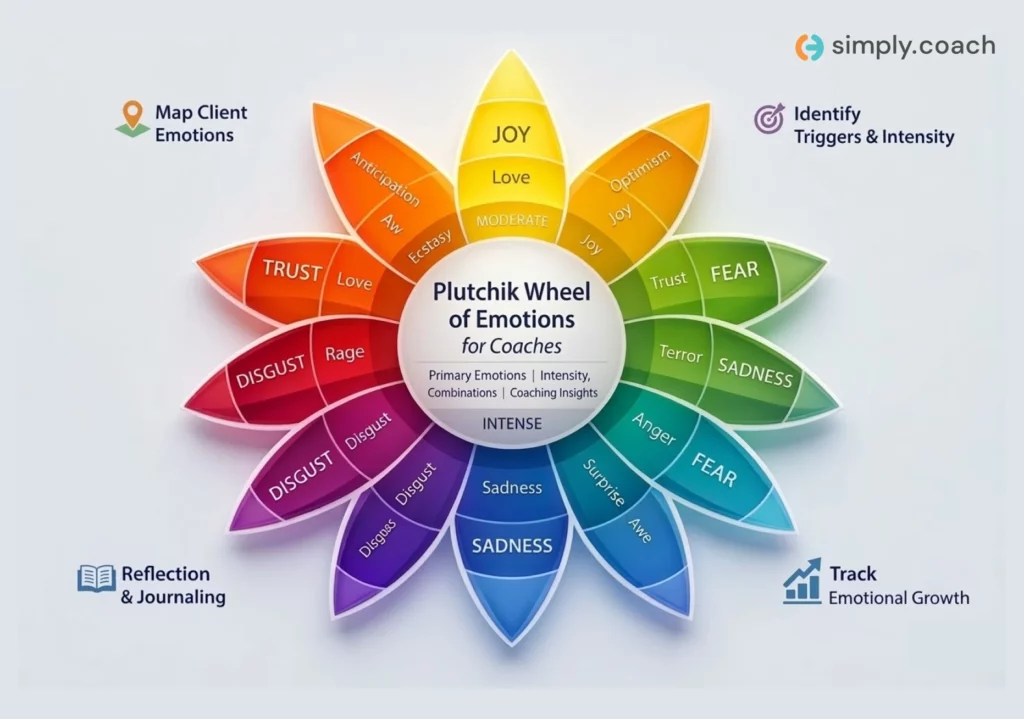
Creating a Plutchik emotion wheel diagram is a practical way to help clients visualize their emotions, recognize patterns, and track emotional growth. A well-designed wheel turns abstract feelings into tangible insights, making coaching sessions more interactive and impactful.
When clients can see emotions, intensity, and combinations, they develop stronger self-awareness and can respond intentionally rather than reactively. As a coach, designing the wheel yourself allows you to tailor it to your clients’ needs and session goals.
1. Draw the 8 primary emotions as a circle
- Place Joy, Sadness, Trust, Disgust, Fear, Anger, Surprise, and Anticipation evenly around the circle.
- Arrange opposite emotions across from each other to show contrasting feelings visually.
- Use clear labels so clients can quickly identify each emotion during sessions.
2. Add intensity layers
- Divide each emotion into inner, middle, and outer layers, representing intensity (inner = mild, outer = strong).
- Example: Joy → contentment (inner), happiness (middle), ecstasy (outer).
- This helps clients recognize subtle differences in how emotions manifest.
3. Include secondary/composite emotions
- Add blended emotions in between primary emotions (e.g., Joy + Trust = Love, Fear + Surprise = Alarm).
- Highlight these combinations so clients can see how emotions interact and create nuanced experiences.
4. Use color coding to indicate emotion families
- Assign distinct colors to each primary emotion family (warm colors for Joy, cool colors for Sadness, etc.).
- Color coding makes the diagram visually intuitive and helps clients associate emotions quickly.
- Optional: Use shades to reflect intensity, with lighter tones for mild and darker for intense emotions.
Practical tips for coaching sessions
- Encourage clients to mark current emotions on the wheel during reflections or journaling exercises.
- Use the wheel to track emotional shifts over multiple sessions and highlight progress.
- Let clients customize the diagram with their own labels or colors to increase engagement and ownership.
- Pair the visual with discussion prompts: “Which emotion dominates your week?” or “Where do you notice intensity changes?”
Designing a personalized Plutchik emotion wheel diagram transforms coaching sessions into interactive explorations of emotional patterns, making abstract emotions actionable for clients.
Plutchik Wheel of Emotions vs Other Models
Understanding how Plutchik’s wheel of emotions differs from other models can help you choose the most effective tool for coaching sessions. While multiple emotion frameworks exist, Plutchik’s model is uniquely structured to show intensity, primary – secondary emotion combinations, and dynamic relationships – making it especially valuable for coaches.
| Model | Focus | Key Difference for Coaching | Practical Application |
| Ekman’s Basic Emotions | Six universal emotions (happiness, sadness, fear, disgust, anger, surprise) | Focuses on facial expressions and universal recognition, but lacks intensity layers and dyads | Useful for clients learning to read emotions in themselves or others, but less effective for mapping emotional complexity |
| Geneva Emotion Wheel | 20+ emotion categories arranged in a circular wheel | Shows relationships and intensity but doesn’t emphasize primary emotion combinations | Good for detailed exploration, but can be overwhelming for clients without guidance |
| Mood Wheels | Broad mood categories (positive/negative) | Tracks general mood states rather than specific emotion interactions | Helpful for quick mood tracking but limited for deep emotional insight or intervention planning |
| Plutchik Wheel of Emotions | 8 primary emotions with intensity layers and secondary/composite emotions | Combines intensity, opposites, and dyads in one model | Ideal for coaching: allows you to analyze emotional intensity, track patterns, and guide interventions based on nuanced client experiences |
Using Plutchik’s wheel in coaching sessions gives you a practical framework to understand both the depth and complexity of client emotions. Compared to simpler or broader models, it provides actionable insights that drive meaningful change and growth.
Also read: The Wheel of Change Model: A Guide to a Great Client Transformation
Common Mistakes Coaches Make When Using the Plutchik Wheel
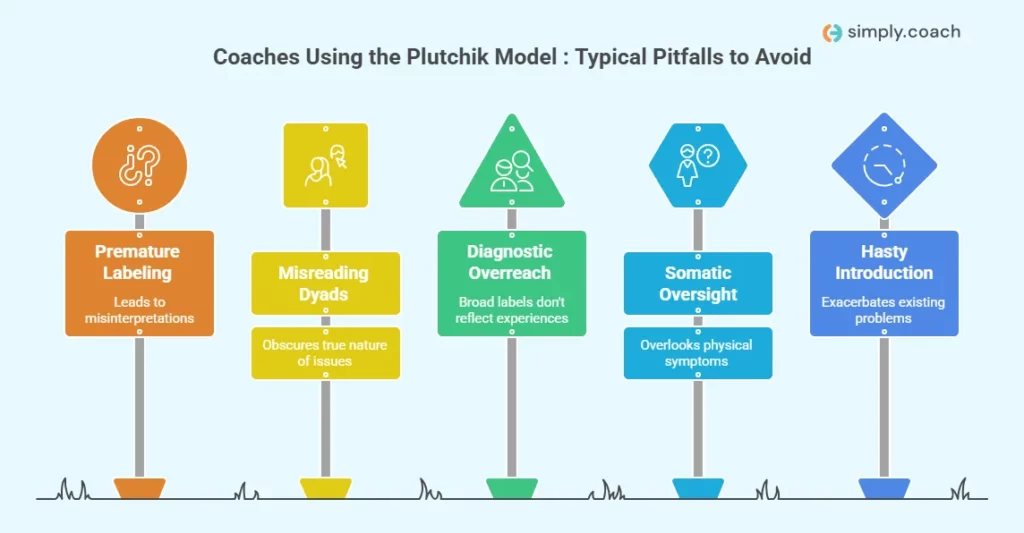
As a coach, being aware of common pitfalls ensures you use the wheel effectively and preserve the depth and accuracy of your clients’ emotional exploration.
- Forcing emotional labels too early: Pushing clients to name emotions before trust or self-reflection is established can create resistance or superficial labeling.
- Over-interpreting composite emotions: Assigning blended emotions without exploring client experience may oversimplify or misrepresent what the client actually feels.
- Treating the wheel as diagnostic truth: The tool is a guide, not a psychological test. Avoid assuming the wheel captures all of a client’s emotional complexity.
- Ignoring body-based cues: Emotions manifest physically. Focusing only on verbal labeling can miss critical signals such as posture, tone, or facial expression.
- Using the tool with unready clients: Clients who are not prepared for detailed introspection may feel overwhelmed or disconnected. Gauge readiness before introducing intensity layers or composite emotions.
These cautions help you maintain flexibility, empathy, and coaching judgment, showing clients the wheel is a guide for insight rather than a rigid framework.
How Simply.Coach Helps You Implement the Plutchik Wheel of Emotions
Simply.Coachprovides tools that make it easy to apply the Plutchik wheel of emotions directly in your coaching practice. These features help you turn emotional theory into structured client interventions and measurable progress.
- Goal setting and action plans: Align emotional insights from the Plutchik wheel with client goals. Track steps to apply emotional awareness in real-life situations.
- Progress tracking: Monitor how clients’ emotional patterns and self-awareness evolve over time, creating a clear picture of growth
- Journeys for emotional frameworks: Build structured coaching paths that include exercises using the Plutchik wheel, reflection prompts, and check-ins to guide clients consistently.
- Digital forms for self-reflection: Use customizable forms to let clients log emotions, map intensity, and explore composite emotions between sessions.
- Client workspaces: Share emotion wheels, diagrams, or notes in a dedicated space where clients can interact, reflect, and engage actively.
Using these tools, you can turn emotional mapping into actionable coaching interventions, making client sessions interactive, reflective, and results-driven.
Conclusion
The Plutchik wheel of emotions offers a powerful framework to understand, map, and analyze client feelings. By exploring primary, secondary, and composite emotions, coaches can uncover patterns and design precise interventions. Incorporating emotional intensity and combinations allows for deeper client self-awareness and growth. Using this model consistently transforms abstract emotions into actionable insights for meaningful coaching outcomes.
With Simply.Coach’s all-in-one digital platform, applying the Plutchik wheel becomes seamless and practical. You can track emotional patterns, build structured journeys, and guide clients through reflection exercises easily. Goal-setting, progress tracking, and client workspaces keep sessions focused and results-driven. Simply.Coach ensures that emotional insights translate into measurable growth and lasting transformation.
FAQs
1. Why are emotions placed opposite each other in the Plutchik wheel?
Opposite emotions highlight contrasting emotional states and behavioral responses. For example, joy contrasts with sadness, while anger contrasts with fear. These opposites help explain how emotional reactions can shift depending on context.
2. Can multiple emotions occur at the same time in Plutchik’s model?
Yes, the model suggests that people can experience several emotions simultaneously. Primary emotions often blend to create complex feelings such as love, remorse, or optimism. These combinations illustrate how emotional experiences are layered rather than isolated.
3. How does the Plutchik wheel represent emotional intensity?
The wheel uses layered circles to represent emotional strength. Emotions become more intense toward the center and milder toward the outer edges. For example, anger may intensify into rage or soften into annoyance.
4. How many emotions can be derived from the Plutchik model?
Plutchik proposed that thousands of emotional variations can emerge from combinations of the eight primary emotions. Some interpretations estimate more than 30,000 emotional states when intensity and combinations are considered.
5. Is the Plutchik wheel used in psychology or therapy?
Yes, the model is widely used in psychology, emotional intelligence training, and therapy. Professionals use it to help individuals identify emotions, understand triggers, and develop emotional awareness. It is especially helpful when people struggle to describe how they feel.