
If you’re exploring how to become a relationship coach, you already know you want to help people strengthen their connections and navigate challenges in love, communication, and trust. At the same time, you may feel unsure which training truly prepares you, how to practice safely without losing money, and how to handle situations that require therapy instead of coaching. These concerns are common and entirely manageable.
The key is to focus on practical skills, guided supervision, and creating repeatable sessions that deliver real results for clients. By choosing the right training, practicing with real people, and structuring clear packages, you can start building a credible, results-driven coaching practice.
In this blog, we’ll break down the work of a relationship coach, the skills you need, how to choose training and certification, and actionable steps to start helping clients confidently.
A relationship coach helps people improve connection through small, practical steps.
- The focus is on better communication, clear goals, and future progress, not diagnosing or treating mental health issues.
- Choosing a specific niche makes your coaching clearer and easier to sell. You can specialize in couples, dating, divorce recovery, families, or workplace relationships, which helps attract the right clients.
- Strong coaching skills matter more than just good advice. Listening deeply, asking thoughtful questions, managing emotions, setting boundaries, and tracking goals are core abilities every coach needs.
- Certification builds trust and opens more opportunities. Training programs provide structure, supervision, and credentials that help clients feel more confident in hiring you and can lead to higher rates.
- Becoming a certified relationship coach is a step-by-step process. Pick a niche, complete training hours, practice with real clients, get mentor feedback, track your hours, then apply for credentials and start offering services.
- Using Simply.Coach can streamline your practice by managing clients, tracking goals, planning sessions, collecting feedback, and delivering structured coaching that maximizes client results.
What a Relationship Coach Actually Does
As a relationship coach, you help people change how they connect with one another. That usually means you work with individuals or couples to set clear goals, improve communication, and take small, doable actions that move the relationship forward. Your job focuses on present-day patterns and future steps rather than diagnosing mental health conditions. This role requires listening closely, asking the right questions, tracking progress, and referring out when a client needs clinical care.
You’re the guide for clear, achievable steps, not the person who treats serious trauma or mental illness. When needed, you connect clients with licensed professionals.
Types of relationship coaching
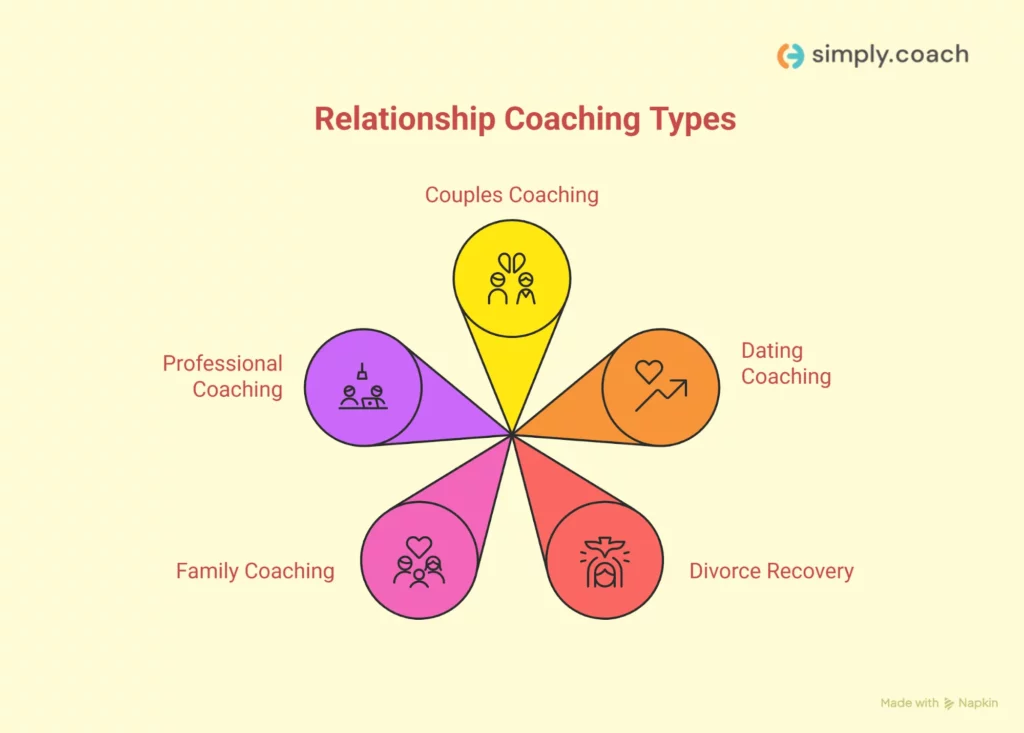
There are multiple niches you can specialize in as a relationship coach . Each one targets a different client need and uses similar coaching skills but in slightly different ways:
- Couples / marriage coaching: Work with two partners to improve communication, rebuild trust, or set shared goals.
- Dating & singles coaching: Help individuals clarify their values, find better matches, and build dating skills.
- Divorce recovery & transition coaching: Support clients through separation, helping them plan next steps and rebuild confidence.
- Family & parenting relationship coaching: Coach on co-parenting, blended family dynamics, or sibling conflict.
- Professional relationship coaching: Focus on workplace relationships, leadership communication, or team dynamics.
These niches appear repeatedly in current training and industry guides; choosing one makes your offers clearer and helps you attract the right clients.
Also Read:How Coaches Can Improve Coachability and Drive Better Client Results
Skills You Must Build to Be an Effective Relationship Coach
Relationship coaching is not just about asking good questions. You are often sitting with two people who feel unheard, misunderstood, or emotionally triggered. Your role is to manage the dynamic between them while helping them build new relational habits.
Below are the core skills that specifically define strong relationship coaches.
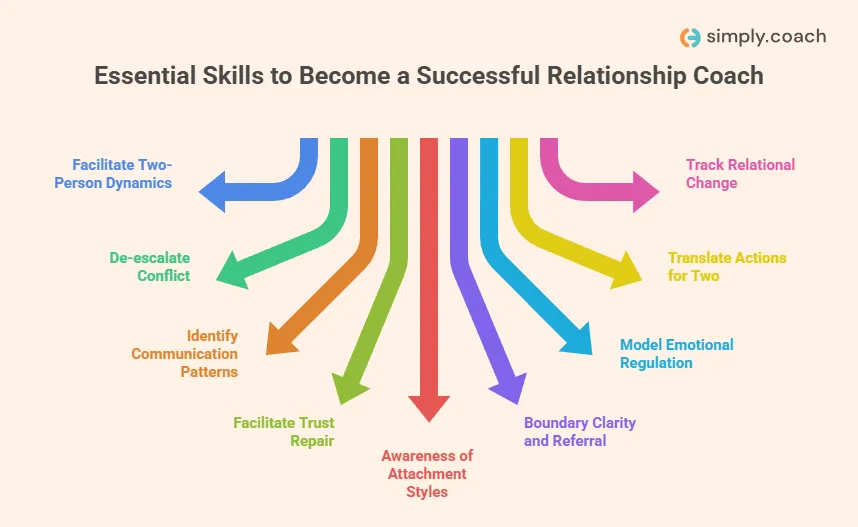
- Facilitating two-person dynamics (dyadic coaching): Coaching couples requires managing airtime, preventing one partner from dominating, and ensuring both feel heard. You must track emotional shifts in real time and redirect conversations when blame or defensiveness escalates.
- Conflict de-escalation in live conversations: Relationship sessions can heat up quickly. You need tools to slow arguments safely without shutting down emotional expression. This includes pausing the conversation, reframing accusatory language, and shifting from “you always” to specific behaviors.
- Communication pattern identification: Effective relationship coaches recognize recurring patterns such as pursue-withdraw cycles, criticism-defensiveness loops, or stonewalling. Your job is to help clients see the pattern as the problem, not each other.
- Trust repair facilitation: Many couples seek help after betrayal, broken promises, or emotional disconnection. You must know how to guide structured repair conversations without forcing forgiveness or bypassing accountability.
- Attachment and emotional safety awareness: Relationship coaching often intersects with attachment styles. While you are not diagnosing, you should understand how anxious, avoidant, or secure behaviors show up in conflict and intimacy.
- Boundary clarity and referral judgment:: Relationship coaching must stop where therapy begins. You must recognize signs of abuse, severe trauma, untreated mental illness, or domestic violence and refer immediately to licensed professionals.
- Emotional regulation modeling: Couples unconsciously mirror the coach’s emotional tone. Your nervous system becomes part of the session. Staying grounded, calm, and steady allows clients to regulate themselves.
- Action translation for two people: In individual coaching, you assign one person homework. In relationship coaching, you must create coordinated action steps that both partners agree to and commit to.
- Outcome tracking for relational change: Relationship progress is often subtle. Strong coaches track measurable shifts such as frequency of arguments, quality of check-ins, or follow-through on commitments. Without tracking, couples may overlook progress.
Also Read: 9 Sources for Excellent Relationship Advice to Send to Your Relationship Coaching Clients
What Are the Benefits of Becoming a Certified Relationship Coach?
Relationship coaching involves managing conflict, emotional triggers, trust breakdowns, and two-person dynamics. Certification ensures you are trained to handle these responsibly and professionally.
Here are the specific benefits in the context of relationship coaching:
- Credibility with couples: Certification reassures both partners that you are trained in structured communication, conflict management, and ethical practice, not simply offering advice.
- Skill in managing two-person dynamics: Accredited programs teach how to balance airtime, interrupt blame cycles, prevent escalation, and guide productive repair conversations.
- Clear ethical and referral boundaries: You learn to identify when issues such as trauma, abuse, or severe mental health concerns require referral rather than coaching.
- Structured communication and trust repair frameworks: Certification equips you with repeatable models for improving communication, rebuilding trust, and creating shared relationship goals.
- Supervised practicum with real couples: Mentor feedback on live or recorded sessions strengthens your ability to manage defensiveness, shutdown, and emotional flooding.
- Stronger market positioning: Recognized credentials, including pathways aligned with the International Coaching Federation, differentiate you from untrained relationship advisors and support premium pricing.
Most accredited pathways require training hours, documented client hours, and mentor coaching. This ensures you meet professional standards before positioning yourself as a certified relationship coach.
Also Read: Top 10 Relationship Coach Certification Programs in 2026
Step-by-Step Path to Becoming a Certified Relationship Coach
If you want to build a serious career in relationship coaching, you need more than a certificate. You need competence in managing couples, conflict, and emotional intensity. Below is a relationship-specific roadmap that ties every step directly to working with partners, not just individuals.
Step 1: Define the exact relationship problem you solve
Relationship coaching is broad. Narrow it.
Decide whether you help:
- Couples stuck in repetitive conflict
- Partners rebuilding trust after infidelity
- Engaged couples preparing for marriage
- High-achieving couples struggling with work–life imbalance
- Long-term partners experiencing emotional disconnection
Write a 20-word positioning statement focused on a relationship outcome, not a personal transformation.
Example: “I help long-term couples break destructive conflict cycles and rebuild emotional safety in 12 weeks.”
Clarity here determines your training, frameworks, and marketing language.
Step 2: Understand relationship coaching standards and ethical scope
Relationship coaching often overlaps with therapy. You must clearly understand the boundary.
If you pursue credentials aligned with the International Coaching Federation, you will need:
- Coach-specific training hours
- Documented coaching hours
- Mentor coaching
- Demonstration of ethical competence
For relationship coaching specifically, you must also understand:
- When conflict becomes emotional abuse
- When trauma requires licensed therapy referral
- How to avoid taking sides in couple sessions
- How to manage confidentiality between two partners
This step protects both you and your clients.
Step 3: Choose relationship-focused training, not generic coaching
Do not choose a program that only teaches one-to-one life coaching if you plan to work with couples.
Look for programs that include:
- Live couples session demonstrations
- Structured communication frameworks
- Conflict de-escalation models
- Trust-repair and accountability processes
- Supervised couple practicum
- Recorded session feedback
Relationship coaching requires managing two nervous systems at once. Your training must reflect that reality.
Step 4: Practice facilitating real couple dynamics early
Relationship coaching skill develops through live interaction.
Start logging sessions with:
- Volunteer couples
- Peer coaching exchanges focused on conflict simulation
- Discounted pilot clients
Track patterns such as:
- Pursue-withdraw cycles
- Criticism and defensiveness
- Emotional flooding
- Shutdown or avoidance
The goal is not just accumulating hours. It is building confidence in managing escalation without losing structure.
Step 5: Get mentor feedback on couple sessions
Mentor coaching is critical in relationship work.
Have a qualified mentor review:
- How you interrupt blame respectfully
- Whether you balance airtime fairly
- How you reframe accusatory language
- How you guide repair conversations
- Whether you remain neutral under pressure
In relationship coaching, your tone, pacing, and emotional regulation directly influence outcomes. Structured feedback accelerates mastery.
Step 6: Develop structured relationship frameworks
Before launching publicly, design clear processes such as:
- A 6-session communication reset program
- An 8-week trust rebuilding roadmap
- A premarital alignment structure
- A conflict pattern mapping tool
Couples need structure. Without frameworks, sessions become repetitive discussions instead of measurable progress.
Step 7: Complete certification and demonstrate competence
Finish your required:
- Training hours
- Logged relationship coaching hours
- Mentor coaching
- Session assessments or recordings
If applying for credentials such as ACC through the International Coaching Federation, ensure your logged hours include real coaching conversations, not consulting or advice-giving.
Certification validates that you can manage relational complexity professionally.
Step 8: Launch with a clear relationship-specific offer
Do not market yourself broadly as a “relationship expert.”
Instead, offer:
- A defined transformation timeline
- A structured couple package
- Clear outcomes such as reduced conflict frequency or improved weekly check-ins
- A transparent intake process for both partners
Run small group workshops or webinars on topics like conflict cycles or rebuilding trust to attract aligned couples.
Step 9: Continue advanced relationship skill development
Relationship coaching evolves as you gain experience.
Invest in advanced learning such as:
- Attachment-informed coaching
- High-conflict couple facilitation
- Emotional regulation techniques
- Power imbalance and boundary navigation
Track measurable outcomes such as reduced argument frequency, improved communication ratings, or follow-through on shared agreements.
By following these steps with a relationship-specific focus, you are not just earning a certification. You are building the skills required to guide two people through emotionally complex conversations safely, neutrally, and effectively.
Top 4 Relationship Coach Certification Programs
If you want clear training, real skills, and a credential you can stand behind, choosing the right certification is a smart first step. Below you’ll find four well-known relationship coach certification programs that aspiring coaches across the U.S. consider when starting or growing their coaching work. Each offers a different learning style, level of support, and investment, so you can find out what fits your life as well as coaching practice goals.
1. Relationship Coaching Institute (RCI)
RCI is a long-running training organization focused only on relationship coaching. It offers multiple certification tracks for working with singles, couples, or both.
- Price: RCI uses a membership model rather than a single, fixed tuition figure on its public page. For current pricing, you will need to contact their admissions team or view their cost page.
- Accreditation: RCI’s curriculum is so designed that its training hours apply toward ICF credentialing via the ICF portfolio route. That means the program maps to ICF core competencies and coach education hour requirements.
- Delivery: Live online classes plus self-study resources, practicum groups, and ongoing community membership. You’ll work in lab teams and get mentor feedback.
- Length: The full relationship coach training is commonly listed as an 18-month pathway, with 144 hours of coach training available that can be applied to ICF requirements.
Key benefits:
- Large, relationship-specific curriculum that maps to ICF competencies.
- Ongoing business and marketing support inside the membership.
- Lots of practice hours, peer groups, and mentor feedback to build confidence.
2. Fisher Relationship Coach Academy (FRCA) – Dr. Wyatt Fisher
A focused, ICF-accredited relationship coach certification run by Dr. Wyatt Fisher. The program emphasizes real client practicum and applied coaching skills.
- Price: The publicly stated price for the core program is $2,997. Confirm current pricing on the program page when you enroll.
- Accreditation: Listed as ICF-accredited education, which helps if you plan to pursue ICF credentials (ACC or portfolio path).
- Delivery: Live weekly classes with scheduled practicum sessions where you coach real couples under supervision. The program mixes teaching, practice, and feedback.
- Length: Promoted as a roughly 90-day cohort for the core certification, with scheduled weekly session blocks and practicum commitments. Check cohort dates when you apply.
Key benefits:
- Strong hands-on practicum with real clients and feedback.
- Taught by a licensed psychologist and experienced clinician.
- Includes a post-program directory listing for certified graduates (referral visibility).
3. IAP Career College: Relationship Coach Certificate Course
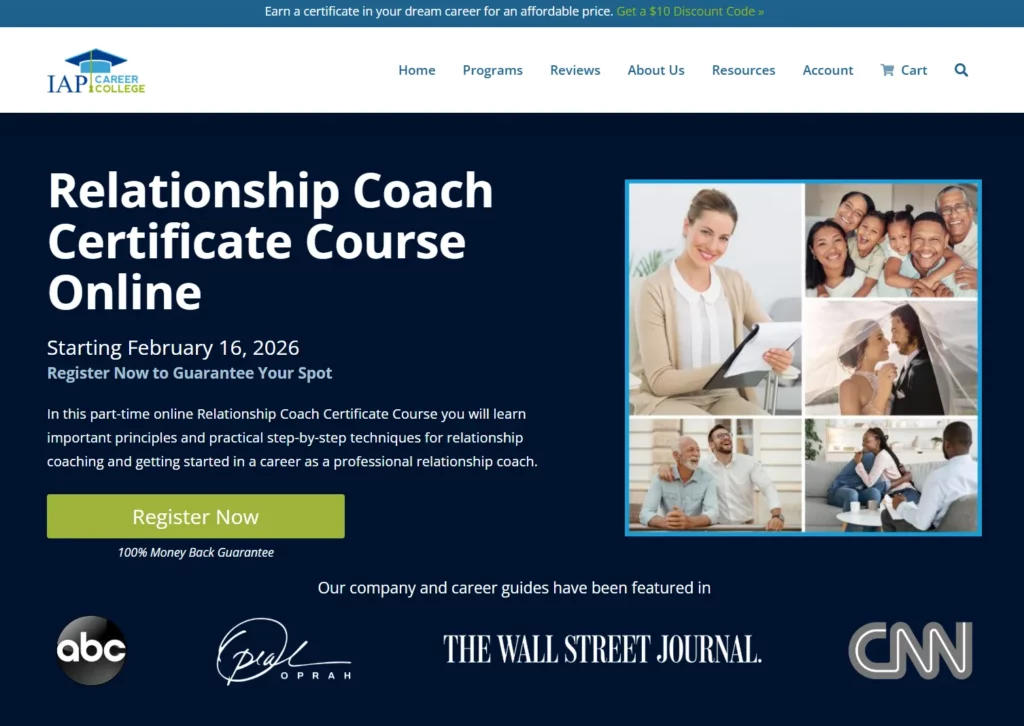
A low-cost, entry-level certification offered by IAP Career College that covers relationship coaching basics and practical tools for client work.
- Price: IAP runs frequent promotions. For example, a February 2026 special listed the course price at US$169 (all-inclusive registration package for that run). Regular prices vary, so check the current course page.
- Accreditation: This is a career certificate from IAP (a private provider). It is not the same as an ICF accreditation, but it provides a practical, low-risk entry point into the field. If you plan to pursue ICF credentialing later, confirm how these hours will or will not apply.
- Delivery: Fully online, self-paced options exist. Some runs include instructor support and graded assignments.
- Length: Basic versions can be 4 – 6 weeks; more advanced master professional tracks are available after the basic certificate.
Key benefits:
- Very low financial barrier to commence practicing core coaching skills.
- Good choice if you want to test the work before investing heavily.
- Options to upgrade into longer certificate or master professional tracks.
4. Laura Doyle: Relationship Coach Certification
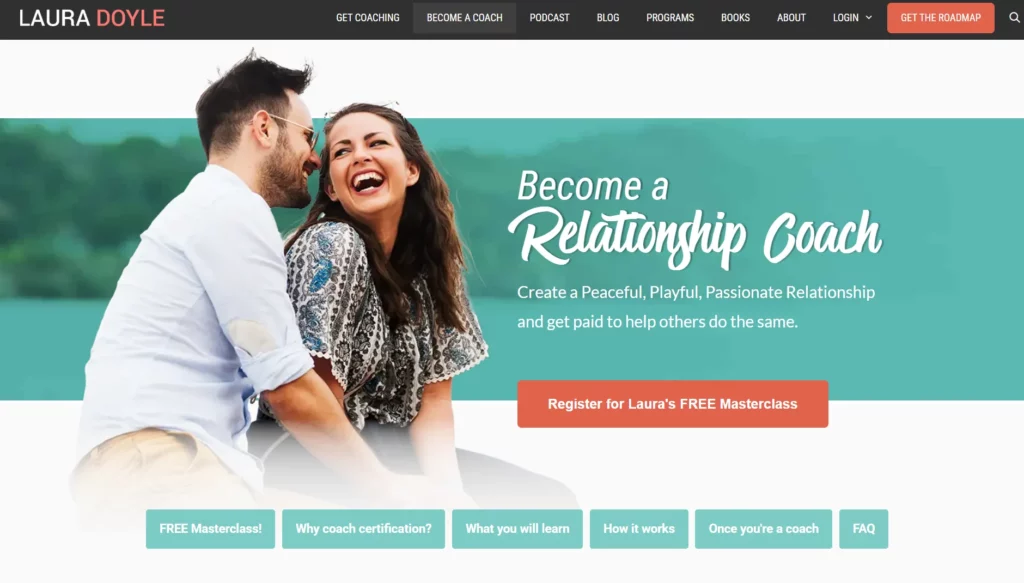
A brand-specific certification built on Laura Doyle’s Six Intimacy Skills™ and the Connecting Coaching Method. The program trains coaches to use that framework with clients.
- Price: A fairly higher-investment option, the pricing for the twelve-month training program is $27,950 for a one-time payment or 4 monthly payments of $8,325 each. The site emphasizes that certification includes coaching tuition and notes that the program requires a major time and money commitment. Confirm current tuition with the program directly.
- Accreditation: The certification is program-based and proprietary; it does not claim standard ICF accreditation. The program focuses on licensing the Six Intimacy Skills™ and deep coaching skills within that framework.
- Delivery: Live classes, cohort work, personal development components, and community support. Certification usually spans a multi-month program with checkpoints and assessments.
- Length: Public materials describe at least six months of live classes and often recommend a full year of training and practical application before completing certification.
Key benefits:
- Deep, framework-driven training that includes personal growth as part of coach education.
- Strong ongoing community and marketing support for certified graduates.
- Well-suited if you want a specific, well-defined coaching method to use with clients.
Now that you’ve seen how these programs compare, you have a stronger sense of what’s possible for your training path as a relationship coach. The next step is figuring out which program matches your schedule, budget, and the type of clients you want to help.
How to Compare and Choose the Right Relationship Coach Certification Program
Not all certifications prepare you for the realities of relationship coaching. Working with couples, managing emotional intensity, and guiding conflict conversations require specialized training. Use this focused checklist to evaluate programs side by side.
- Relationship-specific curriculum: Make sure the program teaches communication breakdown patterns, conflict de-escalation, trust rebuilding, attachment dynamics, and how to coach two people in the same session. Generic life coaching content is not enough if you plan to work with couples.
- Alignment with recognized credentials: If you want to pursue credentials through the International Coaching Federation, confirm the program provides documented coach-specific training hours, mentor coaching, and support for logging client hours toward ACC requirements.
- Supervised couples practicum: Relationship coaching is more complex than one-to-one coaching. Look for live practicum sessions with real couples, recorded session reviews, and structured feedback on how you manage conflict dynamics.
- Ethics and referral training: A strong program should clearly teach the difference between coaching and therapy, identify red flags such as domestic violence or severe trauma, and train you on when and how to refer clients to licensed professionals.
- Relationship-focused business training: Choose a program that teaches how to package couples programs, price 8–12 week transformations, run communication workshops, and build referral partnerships with therapists or mediators.
- Graduate outcomes and community: Check whether alumni are actively coaching couples, earning income in this niche, and receiving ongoing mentorship or referral support.
- Personal development and emotional readiness: Relationship coaching often triggers your own relational patterns. Look for programs that include reflection work, communication drills, and feedback on your blind spots.
Once you review these points, you’ll be able to choose a program that does more than certify you, it prepares you to confidently guide real couples through real challenges and deliver measurable change.
Final Thoughts
Becoming a relationship coach is about more than certificates or logged hours. It’s about guiding real couples through communication challenges, conflict resolution, and emotional patterns. By mastering dyadic communication, goal-setting, and ethical boundaries, you create measurable, positive change. Structured sessions and repeatable, outcome-focused offers help clients see real progress. This approach positions you as a trusted partner in improving relationships.
Simply.Coach helps relationship coaches deliver results efficiently and professionally. Track client goals, monitor progress, and run secure, video-enabled sessions all in one platform. Create tailored intake forms, session templates, and progress reports for couples. Automate scheduling, invoicing, and feedback collection to save time. Focus on deepening connection and measurable relational growth while Simply.Coach handles the logistics.
FAQ’s
1. Do I need certification to become a relationship coach?
No, you can start coaching without a formal certificate, but a recognized credential (for example, from bodies that align with the International Coaching Federation requirements) makes it easier to win clients, charge higher rates, and adhere to standard ethics.
2. How do I get my first paying clients as a relationship coach?
Start small: run a free 60–90-minute workshop or Q&A, offer a low-cost intro package, ask for referrals from your network (including therapists who can refer non-clinical clients), and collect short testimonials to show results. These tactics convert quickly without expensive ads.
3. How should I set prices and package my services as a new relationship coach?
Rather than one-off hourly rates, sell result-focused packages (e.g., 6-week communication reboot) with a clear outcome and tiered options; research local competitors, start modestly, then raise rates as you collect client outcomes and testimonials.
4. What’s the difference between a relationship coach and a therapist, and when should I refer out?
A coach focuses on present patterns, goal-setting, and action steps; therapists treat mental health, trauma, and clinical conditions. Refer a client to licensed clinicians whenever they shows signs of serious mental illness, severe trauma, or crisis.