
You can deliver great sessions, yet clients often stall when they resist feedback or repeat the same patterns. This challenge can leave you frustrated, questioning whether your efforts are truly making an impact. Coachability goes beyond listening; it means receiving feedback, processing it honestly, and applying it through consistent behavior change. When you struggle to model these behaviors, it can affect how clients respond and the overall momentum of your coaching sessions.
As a coach, your coachability directly affects client trust, session outcomes, and the learning culture you create. When you model coachability, clients engage more deeply, act on insights faster, and stay committed longer. Developing this skill also strengthens your professional reputation and helps create a positive, growth-oriented environment for every client you work with. In this guide, you will learn nine practical ways to strengthen coachability, plus a simple self-assessment to track your progress.
Key Takeaways
- Coachability is the ability to receive, process, and apply feedback to improve your coaching impact.
- Your coachability directly affects client trust, engagement, retention, and session outcomes.
- Strong coachability combines a growth mindset, structured reflection, and consistent action.
- Recognize low coachability through defensive responses, excuse-making, and lack of follow-through.
- Improve coachability with strategies like active listening, seeking feedback, goal setting, and accountability.
- Simply.Coach, an all-in-one coaching platform, helps you track goals, implement action plans, and measure progress.
- Embedding these practices creates measurable growth, stronger client outcomes, and a culture of continuous learning.
What is Coachability?
Coachability is the ability to receive guidance, reflect on it objectively, and apply it effectively to improve your skills. For coaches, it is not simply listening to advice; it requires translating insights into deliberate actions that enhance your sessions and client outcomes. This skill allows you to recognize areas for improvement without defensiveness and respond in ways that consistently elevate your coaching practice.
Coachability is closely tied to a growth mindset, which encourages you to view challenges and feedback as opportunities to develop rather than threats to your competence. It also relies on a continuous feedback loop, where reflection, adjustment, and experimentation become part of your routine. By combining mindset with action, you create a system that not only improves your performance but also models effective learning for your clients.
Why Coachability Matters for Coaches and Clients
Understanding coachability changes how you interpret feedback and shape your practice. It improves the precision of your adjustments and deepens client relationships.
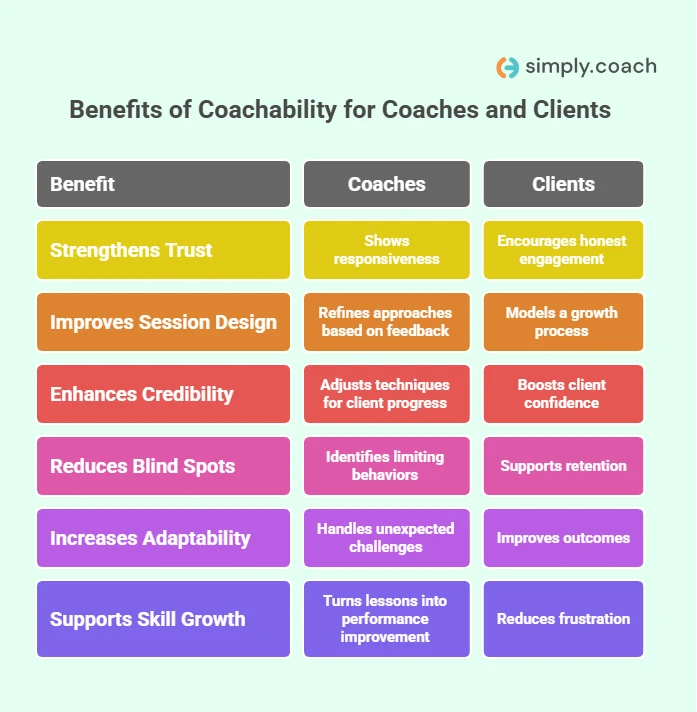
Benefits for coaches
- Strengthens trust by showing responsiveness rather than defensiveness to observations and input.
- Improves session design when you iteratively refine approaches based on real feedback patterns.
- Enhances your credibility when clients see you adjust techniques that improve their progress.
- Reduces blind spots by helping you identify recurring behaviors that limit coaching effectiveness.
- Increases adaptability when unexpected challenges arise in a session or client context.
- Supports long‑term skill growth by turning daily lessons into measurable performance improvement.
Benefits for clients
- Encourages clients to engage honestly, knowing you value and act on meaningful feedback.
- Models a growth process that clients can adopt in their personal and professional spheres.
- Boosts client confidence when they see consistent alignment between insight and change.
- Supports retention by creating a coaching environment that values progress and refinement.
- Improves outcomes when clients mirror your coachability in their implementation cycles.
- Reduces frustration by creating a shared commitment to measurable, observable progress.
Coachability matters because it aligns your professional development with stronger client outcomes and sustained engagement.
Also read: Cognitive Coaching: Transform Client Thinking and Achieve Lasting Growth
Coachability Levels: From Resistant to Proactive
As a coach, understanding how you and your clients respond to feedback can significantly improve session outcomes and progress. Recognizing these levels helps you tailor strategies that foster real growth and stronger engagement.
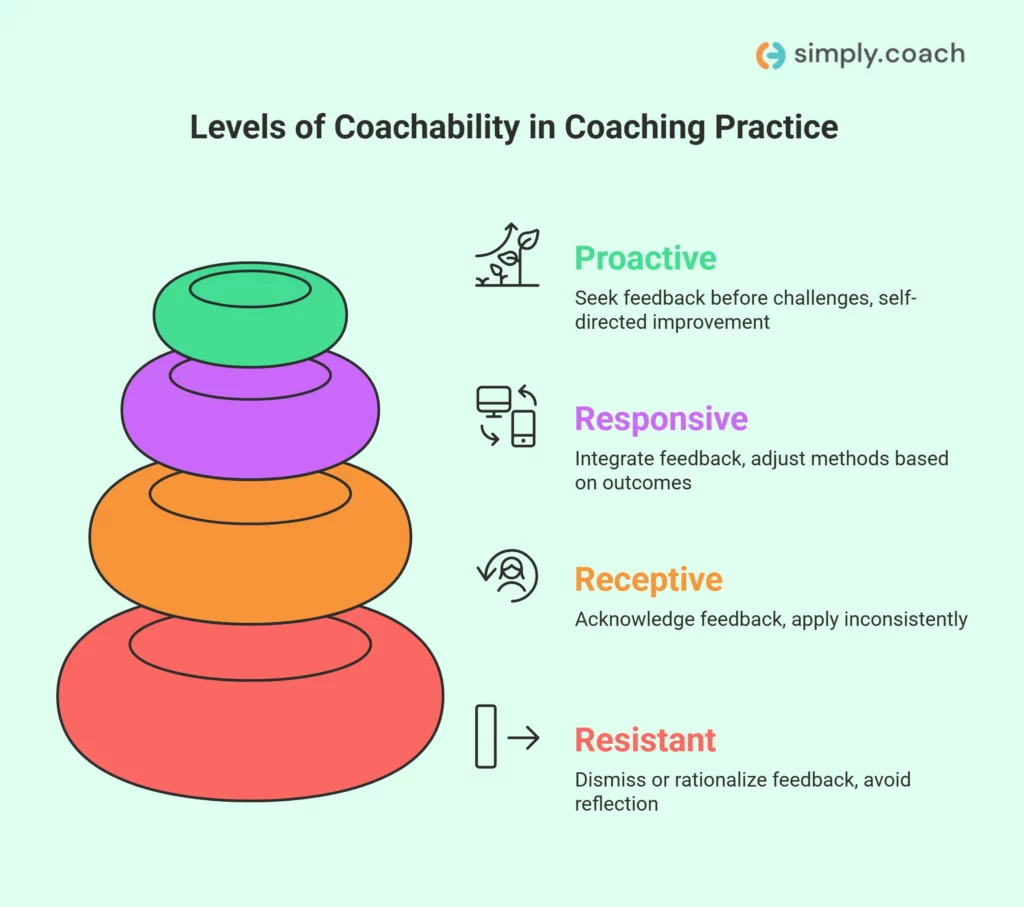
1. Resistant
At this stage, you or your client may dismiss or rationalize feedback, defending existing methods and avoiding reflection. This limits learning opportunities and can create stagnation in your practice. Identifying resistance early allows you to approach feedback delivery more strategically and reduce defensiveness.
2. Receptive
You acknowledge feedback and attempt to apply it but may do so inconsistently, which can slow measurable improvement. Building routines for reflection and structured follow-through at this stage helps ensure small changes translate into lasting impact.
3. Responsive
You actively integrate feedback into your coaching practice and adjust methods based on observed outcomes. Tracking these changes allows you to see clear progress and strengthens credibility with clients who notice your adaptability.
4. Proactive
You anticipate areas for growth and seek feedback before challenges arise, creating a self-directed improvement cycle. Modeling this behavior sets an example for clients, encouraging them to adopt the same mindset and approach.
Understanding these levels allows you to pinpoint your current approach, refine your behaviors, and move systematically toward higher coachability.
Also read: Master the Levels of Coaching: A Structured Approach to Client Retention & Growth
9 Actionable Coachability Tips Every Coach Should Apply
Improving your coachability isn’t just about receiving feedback, it’s about consistently translating insights into tangible changes that elevate your coaching and client outcomes. These nine strategies provide practical steps to strengthen your ability to receive, process, and act on feedback effectively.
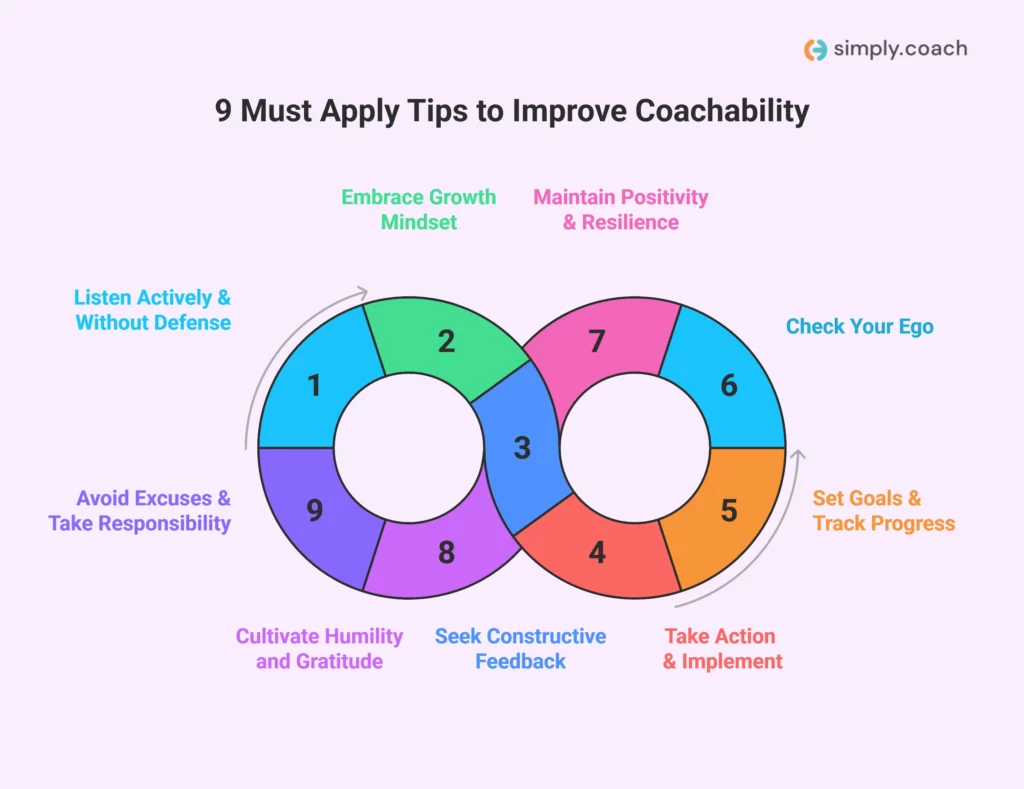
1. Listen actively and without defense
To fully benefit from feedback, you must engage completely with what’s being shared without preparing defenses. Active listening allows you to capture insights that might otherwise be lost and strengthens trust in every session.
- Echo and confirm: Restate what the client or mentor said in your own words to ensure accurate understanding.
- Summarize key insights: Capture the main points and create actionable takeaways you can implement immediately.
- Pause before responding: Resist the urge to reply instantly; processing first reduces defensiveness and misinterpretation.
- Observe non-verbal cues: Pay attention to tone, body language, and energy, which often reveal deeper insights.
By mastering this, you reduce errors, demonstrate attentiveness, and signal to clients that their input directly shapes your approach.
2. Embrace a growth mindset (beginner’s mind)
To strengthen your coachability, approach every session with curiosity and a willingness to learn, no matter your experience. This mindset turns challenges into opportunities for improvement and encourages continuous refinement of your techniques.
- Suspend judgment: Approach every piece of feedback as valuable data rather than criticism.
- Explore alternative methods: Test new techniques suggested by peers or clients without preconceptions.
- Reflect on assumptions: Examine whether habitual strategies limit effectiveness and adjust them intentionally.
- Welcome discomfort: Use challenging sessions to practice new approaches and strengthen your adaptability.
This mindset allows you to continually refine your coaching practice and model lifelong learning for your clients.
Also read: Top 12 Mindset Coaching Tools to Transform Your Clients’ Thinking
3. Seek and welcome constructive feedback
Your growth depends on actively seeking guidance instead of waiting for it to come to you. Welcoming feedback ensures you uncover blind spots and continuously improve your approach in measurable ways.
- Ask for specifics: Request concrete examples to understand exactly what behaviors need adjustment.
- Schedule regular input: Incorporate feedback sessions after every milestone or significant client interaction.
- Request different perspectives: Gather insights from peers, clients, and mentors to get a well-rounded view.
- Document feedback: Track patterns to identify recurring strengths and weaknesses over time.
By seeking feedback deliberately, you make it part of your coaching rhythm rather than leaving improvement to chance.
4. Take action and implement feedback
Feedback only becomes valuable when you deliberately turn it into actionable steps that improve sessions and outcomes. Taking immediate and targeted action reinforces your coachability and demonstrates commitment to growth.
- Select one behavior to change per session: Narrowing focus avoids overwhelm and ensures progress.
- Plan immediate application: Identify a session or client interaction where you can test adjustments.
- Evaluate effectiveness: After implementation, review results and adjust the approach if necessary.
- Create small experiments: Test multiple variations of a behavior to see which yields the best results.
This process turns abstract suggestions into observable changes, improving both your skills and client outcomes.
5. Set goals and track progress
Coachability requires structure; without clear goals, feedback often fails to produce meaningful improvement. Tracking progress ensures that insights translate into measurable changes in both your skills and client sessions.
- Use SMART goals: Goals should be specific, measurable, achievable, relevant, and time-bound.
- Maintain a scorecard: Track session adjustments, client outcomes, and behavioral changes weekly.
- Conduct reflection reviews: Analyze what worked, what didn’t, and why after each milestone.
- Align goals with client impact: Connect your personal growth targets to tangible improvements in client sessions.
Tracking progress transforms learning into actionable metrics, letting you measure improvements and maintain momentum.
6. Check your ego
Your ego can quietly block learning even when you consciously try to be open. Recognizing and managing ego-driven responses allows you to absorb feedback more fully and maintain productive coaching relationships.
- Identify ego triggers: Notice moments when you feel defensive or superior.
- Pause before reacting: Create mental space to consider feedback objectively, especially under criticism.
- Seek alternate views: Encourage clients or colleagues to challenge your assumptions.
- Celebrate humility wins: Recognize and reward moments where you prioritized learning over being “right.”
Managing your ego strengthens trust and ensures you remain approachable and credible in every session.
7. Maintain positivity and resilience
Your response to challenges and setbacks directly affects how effectively you integrate feedback. Staying positive and resilient ensures that difficult sessions become learning opportunities rather than points of frustration.
- Reframe setbacks: Treat challenges as data points rather than failures.
- Use resilience practices: Journaling, mindfulness, or short reflection sessions can stabilize your reactions.
- Focus on small wins: Celebrate incremental progress to sustain motivation.
- Model optimism for clients: Positive resilience encourages clients to embrace their own learning curves.
Sustaining positivity allows you to adapt more quickly, recover from missteps, and maintain high-quality coaching.
8. Cultivate humility and gratitude
Humility and gratitude deepen learning and strengthen relationships with clients and peers. Practicing these traits consistently makes you more approachable and improves the quality of your interactions.
- Acknowledge contributions: Give credit to clients, mentors, or colleagues who provide insights.
- Admit knowledge gaps: Openly recognize areas where you need to grow, without minimizing expertise.
- Express appreciation regularly: Thank clients or peers for honest, actionable feedback.
- Observe learning opportunities: Approach every session as a chance to learn, not to teach.
These behaviors foster trust, improve rapport, and create an environment where learning thrives for both you and your clients.
Also read: 15 Essential Qualities Every Coach Needs to Provide High-Quality Coaching
9. Avoid excuses and take responsibility
Accountability is the foundation of coachability. Accepting responsibility ensures you convert feedback into action and demonstrates integrity to clients and peers alike.
- Own mistakes immediately: Admit errors in technique or judgment without deflection.
- Follow through on feedback: Apply adjustments and track results to demonstrate commitment.
- Set expectations clearly: Communicate accountability standards to clients and peers.
- Review failures constructively: Analyze why an approach didn’t work and implement corrective steps.
Taking responsibility consistently builds credibility, reinforces learning, and cultivates a culture of growth within your coaching practice.
Also read: How to Handle Difficult Clients: 10 Key Strategies for Coaches
Common Coachability Mistakes to Avoid
Recognizing common coachability mistakes in yourself or your clients is essential for maintaining progress and strong coaching relationships. These behaviors often block growth and reduce the impact of your sessions.
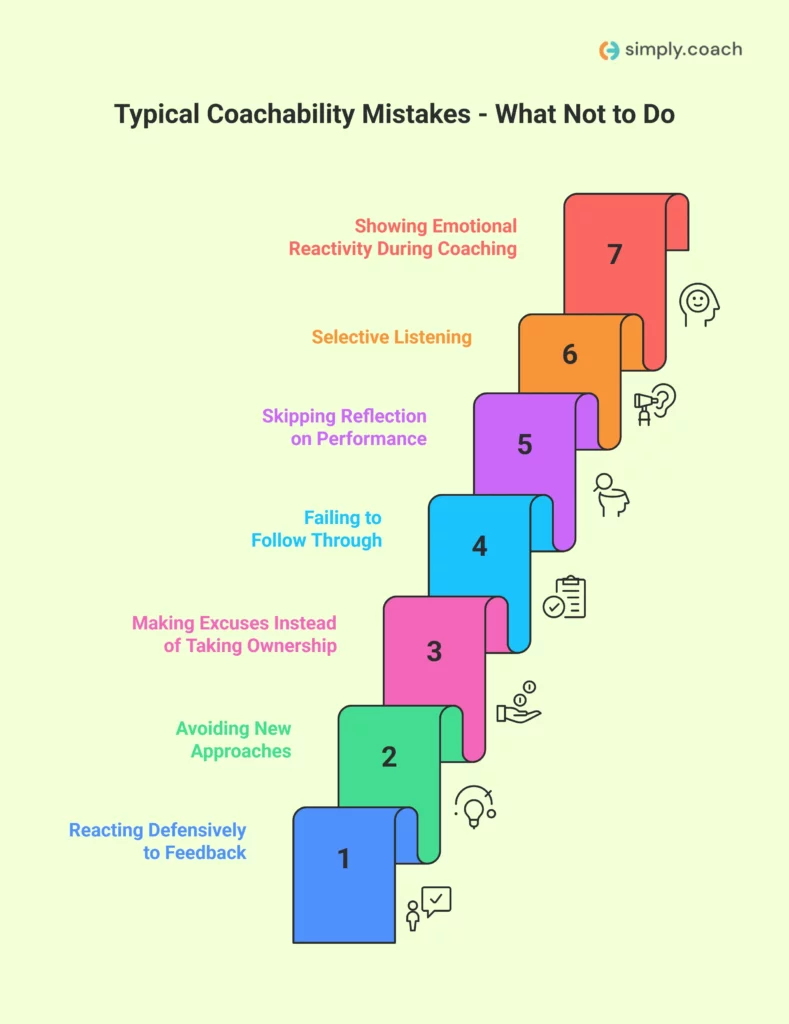
- Reacting defensively to feedback: Immediately justifying your actions or explaining away suggestions prevents you from fully understanding opportunities for improvement.
- Avoiding new approaches: Sticking to familiar methods even when they are ineffective limits learning and prevents meaningful progress.
- Making excuses instead of taking ownership: Blaming external factors rather than examining what you could change undermines accountability and long-term growth.
- Failing to follow through: Ignoring agreed-upon action steps results in feedback having little to no impact on your coaching practice.
- Skipping reflection on performance: Not reviewing sessions, outcomes, or feedback patterns stops you from identifying recurring gaps and improvement opportunities.
- Selective listening: Only paying attention to feedback that confirms your existing beliefs keeps you from addressing blind spots.
- Showing emotional reactivity during coaching: Defensiveness, frustration, or tension when receiving feedback erodes trust and hinders open communication.
Identifying and addressing these common mistakes early allows you to strengthen your coachability and create a more effective, growth-oriented coaching environment.
Also read: How to Prevent Coaching Burnout: 12 Proven Strategies Every Coach Needs in 2026
How Simply.Coach Strengthens Your Coachability
Simply.Coach provides structured tools to help you receive feedback, take action, and track your growth consistently. Its features turn insights into measurable improvements for both you and your clients.
- Goal setting and tracking: Define SMART goals, monitor progress, and adjust strategies based on results.
- Action plans with reminders: Record tasks after sessions and get automated nudges for consistent follow-through.
- 360 feedback and self-reflection: Collect insights from clients and stakeholders to identify blind spots.
- Progress reports: Visual dashboards show engagement, goal completion, and behavior changes over time.
- Integrated session notes: Link feedback and actions to session notes for easy reference and follow-up.
- Client workspaces: Share goals, actions, and reflections to strengthen accountability and collaboration.
- Stakeholder input: Include peers, managers, or direct reports to get a full view of client development.
Using Simply.Coach ensures your coachability becomes measurable, actionable, and embedded into every session you run.
Conclusion
Coachability shapes the effectiveness of your sessions and the outcomes your clients achieve. By actively listening, embracing feedback, and applying insights consistently, you drive real progress. Recognizing mistakes and understanding your coachability level ensures continuous growth and stronger client trust. These practical strategies give you a roadmap to elevate your coaching impact every session.
Simply.Coach, an all-in-one coaching platform, helps you turn coachability into measurable action. With goal tracking, 360 feedback, self-reflection, and integrated action plans, you stay accountable and focused. The platform organizes insights, tracks progress, and highlights areas for improvement automatically. Using Simply.Coach empowers you to enhance your skills and deliver consistent, measurable results for every client.
FAQs
1. Can anyone improve their coachability over time?
Yes, coachability is a skill, not a fixed trait, and you can strengthen it through deliberate practice and reflection. It becomes easier as you build routines for feedback integration and behavior change.
2. How to measure coachability in a coaching engagement?
You can measure coachability using structured tools like feedback adoption rates, self-reflection scores, and behavior change tracking over time. These provide clear indicators of how well someone applies feedback.
3. What separates coachable people from merely teachable people?
Being teachable means you can learn new knowledge, while being coachable requires applying feedback with humility and commitment to change behavior. Coachability involves continuous reflection and implementation.
4. What is the role of emotional intelligence in coachability?
Emotional intelligence helps you recognize defensive reactions and stay present during feedback, making your responses more intentional and less reactive. Improving EQ deepens your capacity to act on guidance constructively.
5. Is coachability important outside of formal coaching relationships?
Absolutely, coachability helps you learn from everyday interactions, feedback from peers, and self-reflection, driving long-term personal and professional growth even without a formal coach.