
Which relationship coach certification will prepare you for the people you want to work with? Start with your intended clients, your existing training, and the coaching practice and feedback each course provides. Then compare the full cost and the exact qualification awarded, including what it does and does not let you claim.
A short specialty course and a broader training program can serve different purposes, even when their names sound similar. Understanding that difference helps you avoid paying for a certificate that misses the preparation you need. The program comparison below separates tuition, study requirements and credential claims, while the selection checklist helps you turn those details into an enrollment decision.
TL;DR
Choose relationship-coach training for the work you intend to offer and the experience you already have. Compare course content, observed practice, feedback, entry requirements and the full payment total. A provider’s certificate, continuing education hours and an independent professional credential mean different things. Some courses accept beginners; others require prior coach training. Prices also need context, particularly where payment plans, books or ongoing licensing add to the cost. Use the comparison to form a shortlist, then obtain the current syllabus, assessment requirements and written fee terms. Training should help you recognize the limits of your role as well as develop the skills to support clients.
How These Relationship Coaching Programs Were Compared
What we compared: Ten relationship-coaching providers, including introductory courses, specialty training for existing coaches and programs built around a particular coaching method.
What matters: Intended clients, entry requirements, learning format, assessed practice, tuition and the exact certificate or education credit offered are the comparison points.
Where details come from: Provider course descriptions and published tuition terms support the program facts. Unresolved prices and requirements are marked for confirmation.
What is excluded: Salary forecasts, promotional rankings and assurances of specific relationship results do not establish what a course prepares you to do.
Before enrolling: Ask for the current syllabus and a written total that includes required extras. Check recognition for the specific course you intend to take.
What Is Relationship Coaching?
Relationship coaching supports clients in clarifying relationship goals, examining communication habits and choosing actions they want to try. A session might explore how a client prepares for a difficult conversation or follows through on an agreement. The coach helps the client reflect and plan without deciding the relationship’s future for them.
A coaching certificate does not qualify you to provide mental-health treatment. Coaching and therapy can both address current concerns and future goals, so a simple past-versus-future distinction is misleading. Your training should cover scope, consent, confidentiality and referral, including situations involving abuse or serious distress.
Types of Relationship Coaching You Can Specialize In
Your intended client group shapes the skills and practice you need from a relationship coaching certification. These specialties can overlap, but a course focused on one does not automatically prepare you for all the others.
- Marriage coaching. Work with married clients on agreed communication habits, shared goals and everyday relationship decisions. Training should address the responsibilities involved when two people participate.
- Family coaching. Support family members in discussing expectations and making practical agreements. Check whether the training covers the ages and family situations you intend to work with.
- Divorce recovery coaching. Help clients plan routines and goals after separation. Keep legal advice and mental-health treatment outside a coaching role unless you hold the relevant separate qualifications.
- Business relationship coaching. Focus on professional communication, teamwork and working relationships. Workplace power differences and confidentiality need attention alongside interpersonal skills.
- Singles and dating coaching. Help clients clarify what they want, reflect on dating experiences and practice communication. Becoming a certified dating coach does not mean guaranteeing a partner or directing someone else’s choices.
- Couples coaching. Support partners in discussing goals, agreements and patterns they want to change. Look for couples coaching training that includes practice with more than one participant.
- Intimacy coaching. Work within your competence on clients’ communication about emotional or sexual intimacy. Consent, boundaries and appropriate referral are essential; this specialty is not a substitute for sex therapy.
The relationship advice resources you share should fit the client’s question and the limits of your service. A reading list can support reflection, but it does not replace the conversation or training needed to handle a difficult situation.

Benefits of Relationship Coach Certification
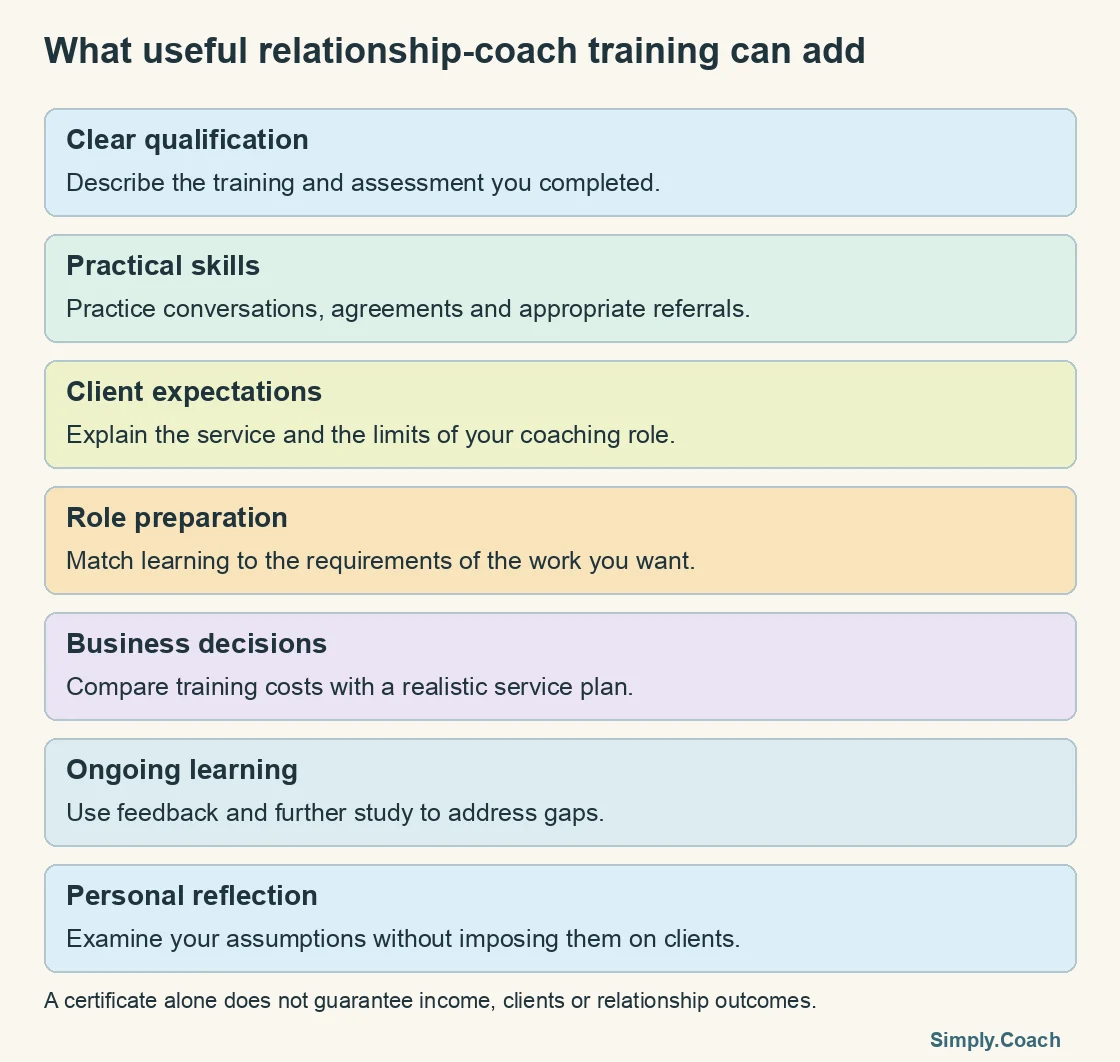
Useful training can give you a clearer way to conduct sessions and assess your own work. Its value depends on the course content, practice and feedback involved, rather than the certificate’s name alone.
- Professional credibility. You can describe the training and assessment you completed accurately. A certificate is evidence of that qualification, not proof that every client will trust you or achieve a particular outcome.
- Relationship coaching skills. Practice can develop listening, questioning, agreements and recognition of your limits. Ask how the course checks those skills instead of relying only on completed videos or quizzes.
- Clearer client expectations. Explaining your qualifications helps clients understand the service you offer. Client confidence also depends on your conduct, the agreement and whether the work suits their needs.
- Preparation for opportunities. Training may help you meet the requirements of a role or referral arrangement. Check those requirements directly; no certificate guarantees employment or a referral network.
- Better business decisions. Knowing the cost and limits of your training helps you plan a service you can deliver responsibly. Higher fees, a full practice and a return on tuition are not automatic results of certification.
- Continued learning. Feedback, peer practice and further education can reveal gaps in your approach. Confirm which support continues after graduation and whether it carries an extra fee.
- Personal reflection. Studying communication may help you notice assumptions you bring into sessions. Use that awareness to listen more carefully, without treating your own relationship experience as the answer for a client.
An emotional audit exercise is one way to structure reflection on feelings and responses. Learning a tool also means understanding when to use it, how to invite participation and when another kind of support is more appropriate.
Is Relationship Coach Certification Worth It?
A relationship coach certification is worth considering when it supplies preparation you need for a clearly defined service. Compare the gap it fills with the time, cost and quality of assessed practice. A course that repeats your existing knowledge may be less useful than targeted training with feedback on your sessions.
A relationship coaching onboarding form can help organize the goals and expectations you discuss before an engagement. Your training should prepare you to interpret that information, agree on the work and recognize when the proposed service is outside your scope.
Best Relationship Coach Certification Programs to Compare in 2026
Compare what each program prepares you to do against the coaching experience you already have. The table separates quoted fees from details that need confirmation, so a short specialty course is not mistaken for a complete professional pathway.
Program details and published prices were checked on 2026-10-21. Amounts are in US dollars; confirm the current offer, required extras and payment terms before you enroll.
| Program | Published tuition | Duration or format | Certificate or recognition basis | What to check |
|---|---|---|---|---|
| Relationship Coaching Institute (RCI) | Request current quote | Confirm current track | Confirm the exact award and recognition | Singles versus couples course content and assessed practice |
| Fisher Relationship Coach Academy (FRCA) | $2,997 total | 12 weeks; live teaching and recordings | Provider lists 9 Core Competency and 1 Resource Development hour | Couples practicum, required book and optional ongoing support |
| Center for Thriving Relationships | Request current quote | Confirm current schedule | Confirm the exact award and recognition | Training, mentoring and post-course access |
| IAP Career College | Request current quote | Confirm current course terms | Relationship Coach Certificate Course; confirm requirements | Practice and feedback included with the learning material |
| Universal Coach Institute | Request current quote | Confirm current course terms | Confirm the exact award and recognition | Assessment, access limits and included resources |
| Laura Doyle | $27,950 upfront; $33,300 across four payments | 12 months | Provider certification; separate ongoing licensing terms | Women-focused method and $564 annual independent-coach licensing fee |
| Life Purpose Institute | Request current quote | Confirm current schedule | Provider lists 41 CCE hours | Required foundational coach training |
| Institute for Life Coach Training (ILCT) | Request current quote | 8 weeks | Confirm current credit details | 20 hours of prior coach training |
| The Relationship School | Tuition explained after application | 9 months | Provider certification; its Q&A page says it is not ICF accredited | Relationship Mastery requirement and client practice |
| World Coach Institute (WCI) | Request a quote for your track | Self-study estimate of 2 to 8 weeks; teleclass described as 8 weeks | 66 self-study hours; confirm current recognition of each track | Full course versus add-on requirements |
1. Relationship Coaching Institute (RCI)
The Relationship Coaching Institute is a provider to investigate when comparing relationship-focused training. Request its current program information before treating a particular duration, training-hour total or support package as part of your offer.
- Price and schedule. Obtain a written quote for the exact course and cohort.
- Course content. Ask how singles and couples training differ, and which track matches your intended clients.
- Qualification. Confirm assessment, prerequisites and the current recognition attached to that track.
The decision depends on what you will practice and who will review your work. Ask for an example of the feedback process and the terms of any support after the course ends.

2. Fisher Relationship Coach Academy (FRCA)
The FRCA relationship coaching program combines live teaching with a practicum involving real couples. Led by Wyatt Fisher, it includes recordings of the teaching sessions and does not require prior coaching or counseling experience.
- Price. The listed total is $2,997, with the required course book purchased separately.
- Duration. The program runs for 12 weeks.
- Education credit. The provider lists 9 Core Competency hours and 1 Resource Development hour. These hours do not, by themselves, award an ICF credential.
- Ongoing support. One month of its support membership is included after completion. Continuing membership is optional at $47 per month.
Ask who supervises the couples practicum and how your coaching is evaluated. Check how participants are prepared to work with couples and what support is available if a situation falls outside coaching.

3. Center for Thriving Relationships
The Center for Thriving Relationships is another option for your program shortlist. Its current tuition, delivery schedule and certificate requirements need confirmation before you can compare the full package.
- Price and access. Request the full tuition, any installment total and the length of access to learning materials.
- Teaching and mentoring. Ask which sessions are live, how coaching practice is assessed and who gives feedback.
- After the course. Confirm whether community access, client resources and business support continue, and at what cost.
Separate the relationship-coaching course content from any business-building material in the offer. Both can be useful, but marketing lessons should not substitute for developing and assessing your ability to coach.

4. IAP Career College Relationship Coach Certificate Course
The IAP relationship coach course is worth investigating if you are comparing an introductory certificate with more extensive training. Confirm the current tuition and certificate requirements before deciding how it fits your learning plan.
- Cost and duration. Ask for current tuition, completion deadlines and any certificate fee.
- Learning and assessment. Find out how much of the course is reading, independent work, coaching practice or reviewed assessment.
- Recognition. Ask what the completion certificate represents and whether it meets a requirement relevant to your intended work.
For a beginner, the important distinction is between learning about the role and becoming prepared to conduct sessions. Check what further education or supported practice you would need after this course.

5. Universal Coach Institute Relationship Coach Certification
The Universal Coach Institute course is another relationship-coaching option whose current package needs confirmation. Ask for the syllabus, fee terms and assessment requirements together so you can evaluate what the offer includes.
- Price and pace. Confirm total tuition, the study format and any deadline for completion.
- Practice. Check whether someone observes your coaching and provides feedback, or whether assessment is based on independent assignments.
- Resources. Ask which forms, scripts or templates are included, how you may use them and how long access lasts.
Downloadable tools can save preparation time, but they do not demonstrate coaching competence on their own. Evaluate the teaching and assessment before placing value on the number of resources offered.
6. Laura Doyle Relationship Coach Certification
The Laura Doyle training program focuses on supporting women through the Six Intimacy Skills and the Connecting Coaching Method. Its format includes teaching, peer practice, private coaching and group support.
- Tuition. The 12-month program lists $27,950 upfront or four monthly payments of $8,325. Those four payments total $33,300.
- Certification. Assessment covers the provider’s method and skills. Additional training can cost extra if you need it to complete certification.
- Licensing. The published annual fee for an independent coach is $564, subject to change. Review the agreement governing use of the method and materials.
This is a substantial commitment to a specific approach and client group. Read the course content and licensing terms together, and decide whether that approach fits the service you intend to offer.
7. Life Purpose Institute Relationship Coach Certification Program
The Life Purpose Institute specialty builds on foundational coach training. Its current course page lists 41 Continuing Coach Education (CCE) hours and covers relationship-focused work with individuals and couples.
- Prerequisite. You need its Life or Spiritual Coach Certification, or an equivalent ICF-accredited coach training program.
- Course content. Topics include communication, boundaries, client goals, conflict repair and relationship transitions.
- Price and schedule. Request current tuition, delivery arrangements and a breakdown of the education credit relevant to your credential plans.
This entry is most relevant if you already have a coaching foundation and want relationship-specific study. CCE hours describe continuing education; they should not be presented as a complete independent credential or a replacement for the prerequisite training.
8. Institute for Life Coach Training Introduction to Relationship Coaching
The ILCT relationship coaching course covers relationship skills, questioning, listening and the distinction between coaching and counseling. Its syllabus also includes boundaries, abuse awareness, marriage coaching, and the SMART and GROW models.
- Prerequisite. The course requires 20 hours of prior coach training.
- Study commitment. It runs for eight weeks and requires weekly reading, short written assignments and class participation.
- Price and credit. Ask for current tuition, the next available class and the exact education credit. Check whether required books add to your costs.
The course is a specialty option for someone with basic coach training, rather than an automatic starting point for a complete beginner. Its attention to boundaries is relevant when deciding which relationship concerns you are prepared to work with.
9. The Relationship School Level 1 Relationship Coach Certification Program
The Relationship School training program combines relationship study with coaching practice over nine months. It describes peer practice and work with a real client under supervision.
- Tuition. The school explains its tuition structure after you apply.
- Foundation. Relationship Mastery is included in the tuition and may be taken before or alongside the coach training.
- Recognition. The provider’s Q&A page explicitly says the program is not accredited by the International Coaching Federation.
- Workload. Ask how the relationship-study component, live teaching, homework and practice sessions fit your weekly schedule.
Consider this course if its approach and supervised practice fit your learning needs. If an ICF education pathway is essential to your plans, do not assume that a provider certificate supplies it.
10. World Coach Institute Certified Relationship Coach
The WCI relationship coaching course has separate self-study, teleclass and add-on routes. Identify the exact route before comparing hours, prerequisites or recognition.
- Self-study. The provider lists 66 training hours, an estimated completion time of two to eight weeks and no prerequisites for this option.
- Assessment. The self-study description includes an open-book examination and 22 module assignments.
- Teleclass and add-ons. The teleclass is described as eight weeks. Add-on options have their own foundational-training requirements.
- Tuition and recognition. Request a quote for your route and confirmation of its current status. The page’s older ACSTH terminology should not be treated as proof of a current ICF pathway.
The course content spans relationship topics, coaching tools and business preparation. Keep the study-hour description separate from calendar time and independent credential eligibility when comparing it with another provider.

Once you can describe your service accurately, relationship coaching blog topics can help you explain the questions your practice addresses. Keep that public description consistent with your training and the limits you discuss with prospective clients.
How to Choose the Right Relationship Coach Certification Program
To become a relationship coach, choose your intended client group, identify the preparation you need and compare courses against that gap. Complete the training and assessment you select, then describe your qualification accurately and check the requirements that apply to your service and location.
1. Budget vs. Value
Calculate the full cost before comparing offers. Add required books, assessment fees, payment-plan differences and continuing licensing or support charges, rather than comparing one provider’s installment with another’s total tuition.
A coaching course cost breakdown can help you account for foundational training as well as a specialty course. If a prerequisite is missing, include the cost and time needed to meet it in your plan.
You can use free coaching preparation courses to explore the subject before committing to paid study. Check access and certificate terms, and do not assume that introductory learning replaces assessed professional training.
2. Time Commitment
Compare weekly work as well as the advertised course length. Live attendance, reading, assignments, peer sessions and client practice can make two programs of the same duration feel very different.
For online or home-study training, confirm deadlines, time zones and access to feedback. If you need in-person classes, ask the provider directly rather than assuming that an online course includes a local option.
3. Accreditation and Credibility
Check what a recognition claim applies to: the provider, the specific course, continuing education or an independently awarded credential. An ICF-accredited education program does not automatically make every graduate an ICF-credentialed coach.
An ICF-accredited coaching course comparison helps distinguish foundational education options from a relationship specialty. Confirm current approval and any remaining credential requirements with the relevant body before relying on the claim.
4. Course Content
Choose practice that resembles the service you intend to offer. For example, a coach preparing to work with couples needs to understand agreements and participation involving two clients; a dating coach certification may focus on work with individuals.
Ask how the program teaches listening, communication, boundaries and referral. If a provider describes its methods as research-backed, request the evidence and check whether it supports the particular claim.
5. Mentorship and Community
Find out who reviews your coaching, how often feedback is available and whether you can discuss difficult situations. A large alumni group and individual feedback serve different purposes, even when both are described as support.
- Ask whether mentoring involves observation of your sessions or general discussion.
- Check how peer practice is organized and what participation requires.
- Confirm which alumni activities are included and which need a separate subscription.
6. Unique Program Features
Judge extra features by the work they help you learn. A demonstration followed by practice and specific feedback may be useful in a different way from a library of scripts or business templates.
Ask what a successful assessment requires and what happens if you need more preparation. Before you accept clients, also decide how you will handle agreements, session records, scheduling and follow-up within the limits of your role.

Conclusion
Choose a program you can explain in terms of the work it prepares you to do. Your shortlist should make the training gap, assessed practice, complete cost and qualification clear enough to compare. If one of those remains uncertain, resolve it with the provider before committing.
Once you are prepared to offer the service, build a consistent process around your sessions. Simply.Coach can support client records, scheduling and follow-up while you remain responsible for the coaching, agreements and professional boundaries.
Key Takeaways
- Define the service. Name the clients and relationship concerns you intend to work with before choosing a course.
- Check the foundation. Establish whether you meet the prerequisites or need broader coach training first.
- Request an assessment. Ask what work demonstrates competence and who gives feedback on your coaching.
- Total every payment. Include required extras and ongoing licensing in the cost you compare. Ask for the terms in writing.
- Verify exact recognition. Keep course completion, education credit and independent credentials distinct.
- Review support terms. Confirm what continues after graduation, how it works and what it costs.
- Prepare your process. Set up agreements, records and follow-up alongside clear scope and referral arrangements.
When you are ready to manage client engagements, session details and follow-ups need a consistent home. Simply.Coach’s coaching and mentoring software brings scheduling, client notes, goals and actions together. Use it to organize the work around your sessions while keeping your attention on the client’s agreed goals.
Frequently Asked Questions (FAQs)
What is a relationship coach certification?
A relationship coach certification usually documents completion of a provider’s training and assessment in relationship-focused coaching. Check exactly what the award represents. A course certificate, continuing education credit and an independent professional credential are different, and none should be described as another qualification.
Do you need certification to become a relationship coach?
Requirements depend on your location, the service you offer and any employer or credentialing body involved. A coaching certificate does not establish universal legal permission to practice. Choose relevant training, describe your qualifications accurately and stay within your competence, with appropriate referral arrangements.
How long does it take to get a relationship coach certification?
Duration varies with the course and your starting point. FRCA lists twelve weeks, ILCT eight weeks and Laura Doyle twelve months. Compare the required weekly work and prerequisites as well as calendar length; a short specialty course may assume training you must complete first.
How much does a relationship coach certification cost?
Published examples include FRCA at $2,997 and Laura Doyle at $27,950 upfront. Laura Doyle’s four-payment option totals $33,300, with separate ongoing licensing terms. Obtain a current written quote and add required books, further assessment or training, and any continuing fees before comparing programs.
Is relationship coach certification worth it?
It can be worthwhile when the course content and assessed practice fill a gap in your preparation for a specific service. Compare that benefit with the time, cost and alternatives. A certificate alone does not guarantee clients, earnings, employment or the ability to work with every relationship concern.
What is the best relationship coach certification program?
The best program depends on your intended clients, existing training and learning needs. Compare practical preparation, feedback, entry requirements, full costs and the exact qualification offered. If a particular professional credential matters to you, verify that your chosen course supports its current requirements.
What should I look for in a relationship coach certification program?
Look for course content suited to your intended clients, clear prerequisites, observed practice and useful feedback. Check total fees, support after the course and what the certificate represents. Training should also address agreements, confidentiality, professional boundaries and when to refer someone for other support.
What is the difference between a relationship coach and a therapist?
Relationship coaching supports client-chosen goals, reflection and practical actions within the coach’s competence. Therapy can include assessment and treatment of mental-health concerns by appropriately qualified professionals. Both can address present and future issues; a coaching certificate does not qualify you to provide psychotherapy.