
The U.S. market for job training and career counseling reached $16.9 billion in 2024, growing steadily at a 2.6% CAGR since 2019. Professionals across industries are increasingly seeking guidance to navigate career transitions, climb the corporate ladder, or pivot into entirely new fields. As a career coach, you are uniquely positioned to help clients set clear goals, build confidence, and achieve measurable career growth.
Career coaching goes far beyond offering advice. It requires structured strategies, practical frameworks, and the ability to empower clients to take consistent action. The right career coaching skills can transform a client’s uncertainty into clarity, enabling them to reach their professional objectives efficiently and confidently.
In this article, you’ll discover 15 specific career coaching skills every coach should master. Each skill is tailored for experienced professionals like you, complete with actionable tips, real-world scenarios, and ways to streamline client management, track progress, and deliver measurable results. By mastering these skills, you’ll elevate your coaching practice, strengthen client relationships, and create lasting impact.
Key Takeaways
- Career coaching requires a mix of strategic, interpersonal, and technical skills to guide clients effectively.
- Career Pathway Mapping helps clients visualize their growth and identify skill gaps.
- Skills like interview coaching, salary negotiation, and personal branding directly impact client success.
- Time management, stress management, and emotional intelligence are essential for client performance and well-being.
- Goal setting, continuous learning, and networking skills ensure long-term career progression.
- Using tools like Simply.Coach can streamline workflows, track client progress, and enhance coaching outcomes.
What Career Coaching Is and What You Do as a Career Coach
Career coaching is a structured, client-centered process designed to help professionals clarify their career goals, navigate transitions, and achieve measurable growth. Unlike mentoring, which provides advice based on personal experience, or counseling, which focuses on resolving emotional challenges, career coaching equips your clients with actionable strategies and frameworks to make informed career decisions. Training programs teach skills but often lack the personalized guidance that clients need to apply them effectively.
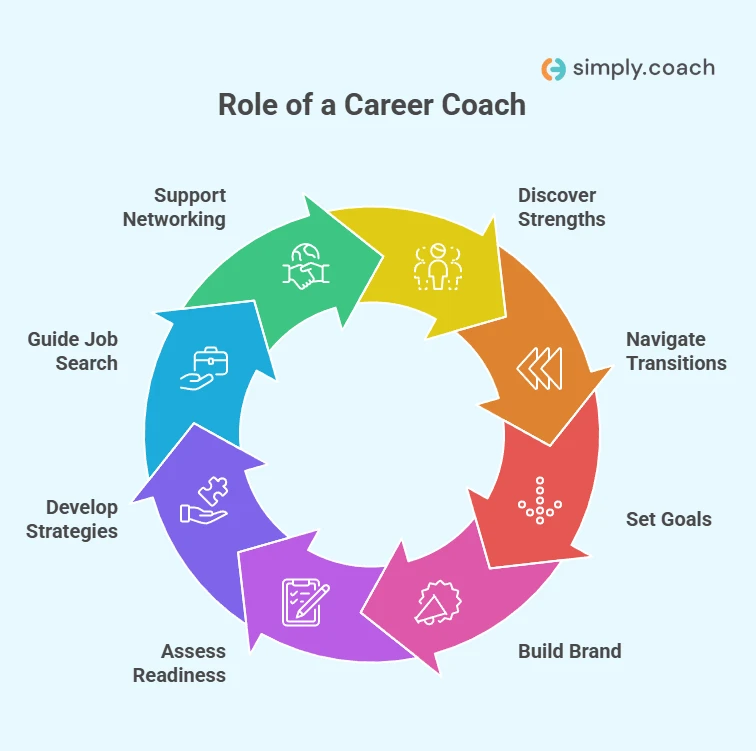
As a career coach, your role goes far beyond offering generic guidance. You help clients:
- Discover strengths and interests through assessments, reflective exercises, and targeted questioning techniques.
- Navigate career transitions, whether moving into leadership roles, switching industries, or returning to the workforce after a gap.
- Set specific, achievable career goals and design actionable plans to reach them.
- Build a personal brand by refining professional narratives, improving online presence, and enhancing confidence in interviews and networking.
- Assess skills, experiences, and career readiness, identifying gaps and opportunities for growth.
- Develop personalized career strategies tailored to each client’s aspirations and circumstances.
- Guide job search tactics including targeted applications, interview preparation, and follow-up strategies.
- Support professional presence and networking, helping clients connect strategically in their industry.
By applying these roles consistently, you ensure clients take meaningful steps toward growth while positioning yourself as a trusted, results-driven coach.
Transform your career coaching practice with the Simply.Coach Career Coaching Track.
Master essential career coaching skills, guide clients through transitions, and set measurable goals. Access tools to manage your practice efficiently, track progress, and implement actionable strategies. Grow your impact and build a thriving, results-driven coaching business.

15 Specific Skills Every Career Coach Must Possess
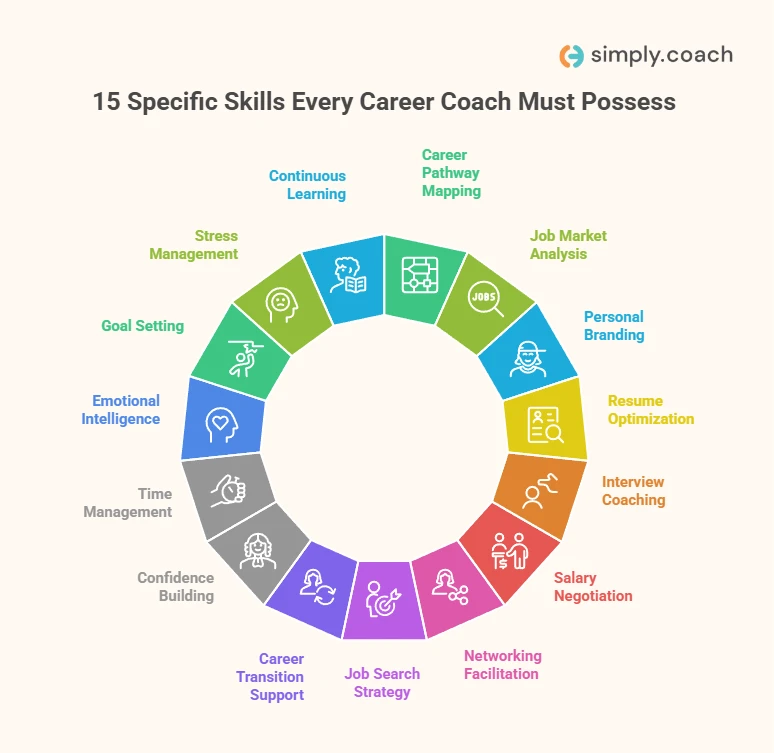
To truly make an impact as a career coach, you need more than experience, you need a set of precise, actionable skills that guide clients toward clarity, growth, and measurable results. Mastering these skills ensures your clients move confidently through career transitions while achieving their goals efficiently.
1. Career pathway mapping
Career pathway mapping is the ability to help clients visualize their career trajectory in a structured and actionable way. By mastering this skill, you enable clients to move from uncertainty to clarity, with tangible steps for growth. Here’s how you can apply it effectively:
- Identify potential roles and growth opportunities: Guide clients to explore realistic career options based on their skills, interests, and experience.
- Spot skill gaps: Highlight areas where additional training or development is needed to reach their desired roles.
- Create a clear roadmap: Use visual tools to map short-term and long-term goals, turning abstract aspirations into actionable steps.
- Use assessment frameworks: Leverage career assessments or competency matrices to align client strengths with opportunities.
- Keep clients motivated: A visualized pathway helps clients see progress, maintain focus, and take ownership of their career journey.
By implementing career pathway mapping, you position yourself as a coach who not only inspires but also provides a practical, results-driven path to success.
2. Job market analysis
Job market analysis is your ability to help clients understand industry trends, in-demand roles, and emerging opportunities. Mastering this skill allows you to guide your clients toward informed career decisions that maximize growth and minimize risk. Here’s how you can apply it effectively:
- Interpret labor market trends: Analyze employment growth, declining sectors, and emerging roles that match your client’s experience and aspirations.
- Spot high-demand opportunities: Use job boards, company reports, and government labor statistics to identify roles with strong growth potential for your clients.
- Align opportunities with client goals: Ensure the positions you focus on fit their skills, interests, and long-term career plans.
- Anticipate challenges: Prepare clients for industry competition, skill gaps, or changing market conditions to make strategic moves confidently.
By mastering job market analysis, you help your clients make strategic career decisions that keep them ahead in a competitive market.
3. Personal branding strategy
Personal branding strategy is your ability to position clients as credible, standout professionals in their industry. When you help clients craft a coherent and compelling personal brand, they attract the right opportunities and make lasting impressions. Key steps include:
- Optimize LinkedIn profiles: Showcase accomplishments, skills, and professional narratives aligned with your client’s goals.
- Develop elevator pitches: Equip clients with concise, persuasive introductions for networking, interviews, or events.
- Align resumes and online presence: Ensure all branding elements consistently reflect their career objectives and professional persona.
- Reinforce goals through visibility: Help clients participate in activities, forums, and groups that strengthen their professional reputation.
Implementing personal branding strategy ensures your clients are recognized for their unique value and can confidently position themselves for career growth.
Also read: Top 11 Career Coaches to Follow on LinkedIn
4. Resume and cover letter optimization
Resume and cover letter optimization is your ability to create documents that capture attention and pass applicant tracking systems. This skill ensures your clients showcase their achievements and potential effectively. Focus on:
- Tailoring for each role: Customize resumes and cover letters to highlight relevant skills, accomplishments, and career objectives.
- Keyword optimization: Integrate role-specific terms to improve ATS visibility and ensure recruiters find your clients.
- Showcasing measurable results: Use quantifiable achievements to demonstrate impact and professional credibility.
- Professional formatting: Ensure documents are clear, readable, and visually appealing to leave a strong impression.
By mastering resume and cover letter optimization, you empower your clients to secure interviews and move confidently toward their career goals.
5. Interview coaching
Interview coaching is your ability to prepare clients to perform confidently and effectively in real interview situations. By mastering this skill, you ensure clients demonstrate their capabilities clearly and leave a strong impression. Key techniques include:
- Conduct realistic mock interviews: Recreate the exact format and pressure of the client’s upcoming interview to build familiarity and reduce anxiety.
- Behavioral interview preparation: Help clients craft responses that clearly illustrate problem-solving, leadership, and critical thinking.
- Apply the STAR method: Train clients to structure answers around Situation, Task, Action, and Result for precise and memorable responses.
- Provide targeted feedback: Identify gaps in answers, tone, and body language, then offer concrete improvements clients can apply immediately.
Mastering interview coaching turns preparation into confident performance, giving your clients a measurable edge in competitive hiring processes.
6. Salary negotiation tactics
Salary negotiation tactics is your ability to guide clients in securing compensation that fairly reflects their skills and experience. This skill ensures clients approach discussions strategically and with confidence. Key steps include:
- Research compensation benchmarks: Use reliable industry data to determine appropriate salary ranges for each role.
- Develop negotiation strategies: Coach clients on phrasing requests clearly, handling pushback, and emphasizing their unique contributions.
- Prepare evidence-based talking points: Help clients highlight achievements, certifications, and measurable results to justify their request.
- Practice negotiation scenarios: Conduct role-plays so clients can respond naturally and assertively in real negotiations.
Developing salary negotiation tactics, you help clients secure offers that match their value, reinforcing their professional confidence and satisfaction.
7. Networking facilitation
Networking facilitation is your ability to help clients create meaningful professional relationships that support career growth. Excelling in this skill ensures clients can access guidance, opportunities, and collaborations that matter. Key actions include:
- Identify relevant contacts: Help clients pinpoint individuals and organizations that align with their career objectives.
- Teach effective engagement: Show clients how to initiate conversations, ask insightful questions, and maintain professional connections.
- Develop follow-up routines: Encourage consistent check-ins and value-driven communication to maintain relationships.
- Turn connections into opportunities: Guide clients in using these relationships to gain advice, interviews, referrals, or project collaborations.
Mastering networking facilitation allows you to equip clients with practical relationship-building skills that directly influence career progress.
8. Job search strategy development
Job search strategy development is your ability to create tailored plans that help clients secure the right opportunities efficiently. By applying this skill, you guide clients to approach the job market strategically rather than reactively. Key steps include:
- Design personalized search plans: Map out target roles, companies, and industries based on each client’s skills and career goals.
- Implement structured follow-ups: Coach clients on timing and methods for following up on applications to maintain professionalism and visibility.
- Proactive outreach: Teach clients to reach out to potential employers, industry experts, or alumni networks with clear, goal-driven communication.
- Track progress systematically: Help clients monitor applications, responses, and next steps to stay organized and focused.
Using effective job search strategy development ensures your clients approach opportunities with precision and achieve measurable career results.
9. Career transition support
Career transition support is your ability to help clients move between roles, industries, or career paths confidently. This skill ensures clients identify opportunities that match their experience while minimizing uncertainty and fear. Key actions include:
- Analyze transferable skills: Highlight competencies from past roles that are relevant in new industries or positions.
- Explore new industries: Research sectors, roles, and growth areas that align with client aspirations.
- Address fear and resistance: Provide coaching exercises to overcome self-doubt, uncertainty, and decision paralysis.
- Create transition plans: Develop step-by-step action plans for clients to move smoothly into new roles or career paths.
With strong career transition support, you help clients navigate change strategically, reducing stress and increasing confidence in their next steps.
Also read: Navigating the Change Curve: A Coach’s Guide to Supporting Clients Through Transitions
10. Confidence building
Confidence building is your ability to help clients project self-assurance and professionalism in all career interactions. This skill enhances client performance in interviews, networking, and workplace situations. Key techniques include:
- Boost self-esteem: Use reflection exercises and affirmations to reinforce clients’ strengths and achievements.
- Develop assertiveness: Teach clients how to communicate needs, set boundaries, and negotiate effectively without hesitation.
- Enhance presentation skills: Guide clients on body language, tone, and delivery for interviews, pitches, and meetings.
- Simulate real scenarios: Conduct role-plays or public speaking exercises to build practical confidence under pressure.
By strengthening confidence building, you equip clients to approach professional situations with clarity, composure, and credibility.
11. Time management coaching
Time management coaching is your ability to help clients plan, prioritize, and execute career development tasks efficiently. By guiding clients to manage their time strategically, you ensure they make consistent progress toward their goals. Key steps include:
- Create structured schedules: Help clients allocate time for applications, networking, skill development, and interviews.
- Prioritize high-impact tasks: Teach clients to focus on activities that directly move their career forward.
- Implement tracking systems: Introduce tools like digital calendars, task boards, or reminders to monitor progress.
- Address procrastination: Provide techniques to overcome distractions and maintain focus on critical career actions.
Effective time management coaching allows your clients to use their time intentionally, increasing productivity and reducing stress.
12. Emotional intelligence enhancement
Emotional intelligence enhancement is your ability to help clients understand and manage their emotions while navigating professional relationships. This skill improves how clients interact with colleagues, interviewers, and mentors. Key techniques include:
- Develop self-awareness: Guide clients to recognize emotional triggers and patterns that impact their career decisions.
- Teach empathy: Help clients understand perspectives of hiring managers, peers, or team members for stronger connections.
- Strengthen interpersonal skills: Coach clients on communication, conflict resolution, and relationship-building strategies.
- Manage emotional responses: Provide exercises to maintain composure under pressure, especially in interviews or negotiations.
By enhancing emotional intelligence, you equip your clients to interact more effectively and make career decisions with confidence.
13. Goal setting and achievement planning
Goal setting and achievement planning is your ability to help clients define clear, actionable objectives and track progress consistently. This skill ensures clients stay focused and accountable throughout their career journey. Key approaches include:
- Create SMART goals: Guide clients to set Specific, Measurable, Achievable, Relevant, and Time-bound objectives.For example: ‘Secure a mid-level Project Manager position in the SaaS industry in the next 3 months by applying with the new PMP certification and submitting at least 20 targeted applications.’
- Develop progress tracking systems: Introduce dashboards, checklists, or digital tools to monitor milestones.
- Assign actionable steps: Break down long-term goals into weekly or monthly tasks that are achievable.
- Ensure accountability: Implement regular check-ins or automated reminders to keep clients on track.
Helping clients with goal setting and achievement planning ensures they move forward systematically, turning aspirations into measurable results.
14. Stress management techniques
Stress management techniques are your ability to help clients handle pressure effectively during job searches, career transitions, and workplace challenges. By coaching clients on managing stress, you ensure they stay focused, resilient, and perform at their best. Key strategies include:
- Identify stress triggers: Help clients recognize situations or tasks that cause anxiety or overwhelm.
- Teach coping mechanisms: Introduce breathing exercises, mindfulness practices, and structured routines to reduce stress.
- Develop time and workload strategies: Guide clients in prioritizing tasks and avoiding burnout during job searches or busy work periods.
- Encourage reflective practices: Use journaling or self-assessment to help clients process challenges constructively.
With stress management techniques, you empower your clients to maintain composure, make clear decisions, and approach career challenges with confidence.
15. Continuous learning advocacy
Continuous learning advocacy is your ability to instill the habit of ongoing skill development in clients. This ensures they remain competitive, adaptable, and prepared for evolving career opportunities. Key approaches include:
- Identify relevant learning opportunities: Recommend courses, certifications, workshops, or training programs that match career goals.
- Encourage skill diversification: Help clients develop complementary skills that expand their career options.
- Create learning plans: Establish timelines and milestones for completing courses or gaining new competencies.
- Promote accountability: Check in regularly to ensure clients are applying and retaining new knowledge effectively.
By developing continuous learning advocacy, you position your clients to grow professionally, stay market-relevant, and confidently pursue career advancement.
Also read: Navigating Professional Growth: Effective Career Coaching Strategies
How Simply.Coach Supports Your Career Coaching Practice
Simply.Coach is an all-in-one career coaching platform designed to help you manage every aspect of your coaching practice efficiently while maximizing impact for your clients. By integrating its features into your workflow, you can focus more on coaching and less on administrative tasks. Here’s how it helps:
- Organize client progress: Set goals, assessments, and action plans in one centralized dashboard to monitor each client’s journey effectively.
- Streamline session management: Schedule sessions and manage video calls directly through the platform without juggling multiple tools.
- Automate follow-ups: Use automated reminders to keep clients accountable and on track with their career goals.
- Enhance reporting and insights: Generate progress reports that demonstrate measurable outcomes, making your coaching more transparent and results-driven.
- Deliver personalized coaching resources: Share forms, exercises, and learning materials tailored to each client’s needs, ensuring engagement and consistent growth.
- Create structured coaching programs with Journey Builder: Build reusable program templates, set session cadence, and automate workflows for each client.
With Simply.Coach, you can provide a structured, professional, and measurable coaching experience, helping clients achieve career success while growing your practice efficiently.
Conclusion
Career coaching is no longer just about giving advice; it’s about providing measurable guidance, personalized strategies, and actionable steps that genuinely advance a client’s career. By mastering these 15 career coaching skills, you position yourself as a coach who can help clients navigate transitions, achieve goals, and build confidence with clarity and purpose. Every skill you apply translates directly into tangible results for your clients and strengthens your professional credibility.
Simply.Coach, as an all-in-one career coaching platform, helps you put these skills into practice efficiently. From tracking client progress and automating follow-ups to running sessions via embedded video conferencing and creating structured programs with Journey Builder, the platform equips you to deliver results-driven coaching while managing your practice smoothly and professionally.
FAQs
1. How can I build rapport with clients during coaching sessions?
Building rapport is essential for effective coaching. Start by practicing active listening, acknowledge your clients’ feelings and validate their experiences. Maintain open body language and ask open-ended questions to encourage dialogue. Sharing relevant personal anecdotes can also help clients feel understood and connected.
2. What are some effective strategies for career coaches to stay updated with industry trends?
To stay informed, subscribe to industry newsletters, attend webinars, and participate in professional networks. Engage with platforms like LinkedIn to follow thought leaders and join relevant groups. Regularly reading industry-specific publications and research papers can also provide valuable insights.
3. How can I measure the success of my coaching sessions?
Success can be measured through client feedback, progress toward set goals, and improvements in key performance indicators like job placement rates or skill acquisition. Implementing regular check-ins and using tools like surveys can help quantify outcomes and identify areas for improvement.
4. What are some common challenges faced by career coaches, and how can they be overcome?
Common challenges include managing client expectations, dealing with resistance to change, and maintaining motivation. Overcome these by setting clear goals, establishing trust, and using motivational interviewing techniques. Continuous professional development and seeking supervision can also provide support.
5. How can I effectively market my career coaching services?
Develop a strong online presence through a professional website and active social media profiles. Offer free resources like webinars or eBooks to showcase your expertise. Networking with HR professionals and attending industry events can also help in building referrals and expanding your client base.