
As a coach, you rely on more than intuition and experience to guide your practice. You want to know if the industry is growing, where new opportunities lie, and what direction your peers are moving in. That’s where ICF coaching statistics become valuable. They give you a clear picture of the profession’s current state and its future potential, helping you align your business with real trends instead of guesswork.
Latest data shows the global coaching industry market size at USD 5.34 billion, about 17% higher than before. The number of coach practitioners rose accordingly: approximately 122,974 globally, with many actively serving clients. In North America alone, average one-hour session fees are hovering around USD 234, while coaches handle an average of 11.6 coaching hours per week.
In this blog, you’ll get a clear picture of where coaching stands in 2026. You’ll see U.S.-specific growth, income benchmarks, and how operational challenges like no-shows affect your bottom line. You’ll also explore how tools such as goal tracking, video conferencing integration, action plans, and automated reminders (email & text) can simplify your work. Everything here is backed by recent ICF data and examples relevant to coaches like you.
Key Takeaways
- The global coaching industry is valued at USD 5.34 billion in 2026.
- The number of active coaches grew from 71,000 in 2019 to 109,200 in 2022. In 2026 there are 122,974 coach practitioners globally, an increase of 54% in just six years.
- Fastest-growing niches include executive coaching (USD 103.6 billion in 2026, projected to go up to USD 161.1 billion by 2030), health coaching, and AI-driven coaching platforms.
- Coaches earn an average of USD 49,283 annually, with North American coaches reporting the highest incomes.
- 87% of organizations report a positive ROI from coaching, citing gains in productivity, retention, and goal achievement.
- Main challenges for coaches remain no-shows, scheduling, and admin work, highlighting the need for digital platforms.
- The future of coaching (2024–2034) is being shaped by AI, hybrid models, corporate demand, and stronger regulations.
Coaching Industry Market Overview
As a coach, you know that your success depends not just on skill but on timing and awareness. Understanding the size and growth of the coaching industry helps you measure where demand is rising. It also shows you how competitive the field is becoming as more professionals join the market. By looking at recent ICF data, you’ll see where your practice fits and where new opportunities exist.
Current market size and projections
- The global coaching industry was valued at ~USD 4.56 billion in 2022, and has been showing steady growth year after year.
- In 2026, the worldwide coaching market size is at a robust ~USD 5.34 billion, underscoring sustained demand for coaching services worldwide.
- These numbers focus on revenue generated by active coach practitioners, rather than including startups or ancillary platforms, giving you a clear picture of the professional market.
- For coaches like you, this means that the profession is financially healthy and expanding, creating opportunities to grow your client base while competition also increases.
Revenue growth and CAGR
- From 2015 to 2026, coaching revenue grew from approximately USD 2.35 billion to USD 5.34 billion.
- This represents more than a 100% increase over ten years, even during times of economic uncertainty.
- The growth equates to a compound annual growth rate (CAGR) of more than 9%, showing consistent upward momentum.
- This resilience proves that clients and organizations view coaching as an essential investment, not a luxury.
- For your practice, it means coaching continues to gain credibility and acceptance, strengthening your long-term business outlook.
Number of active coaches
- 2019: 71,000 coaches
- 2022: 109,200 coaches
- 2025: 122,974 coaches worldwide
- This expansion means the coach population has almost doubled between 2019 and 2026.
- Out of the total number of coaches, 91% are practicing coaches. 72% of these are women.
- North America with 34,200 coaches and Western Europe with 30,800 coaches account for over half of the worldwide total.
- For you, this reflects both opportunity and competition. While demand is rising, more peers are entering the field, making differentiation essential.
- To stand out, you’ll need not just coaching expertise but also efficient systems to manage clients, measure results, and sustain engagement.
Interpreting market size estimates
- Market size figures vary across publications, sometimes ranging from billions to tens of billions.
- The variation happens because some analysts include coaching-related startups, wellness apps, training programs, and platforms, not just coaching practitioners.
- ICF focuses on direct coaching revenue generated by practicing coaches, which gives you a more accurate view of your professional ecosystem.
- When you read alternative reports, always check the methodology, since different definitions of “coaching” can significantly shift the numbers.
- Understanding this distinction helps you position your business realistically and make data-driven decisions without being misled by inflated estimates.
Also read: Understanding the International Coaching Federation (ICF)
Coaching Specializations & Niches on the Rise
As a coach, you’ll want to know which niches are expanding most rapidly so you can align your offers where growth and demand intersect. The data shows not just rising numbers, but also shifting client priorities, towards wellness, leadership, and flexibility. In the following sections, you’ll see recent market sizes, growth rates, and emerging directions that matter for you in 2026.
1. Life Coaching
If your focus is life coaching, you’re working in a segment that continues to see steady growth as more clients seek balance, clarity, and emotional support.
- In the U.S., the life coaching market was worth about USD 1.5 billion in 2022 and grew to nearly USD 1.6 billion in 2024. Projections suggest it will cross USD 2.1 billion by 2030, growing at around 4.85% CAGR.
- There are approximately 25,500 life coaching businesses in the U.S. alone, reflecting the growing demand for these services.
- Globally, life coaching services were valued at about USD 3.4 billion in 2024, with estimates pointing to USD 8.4 billion by 2034, reflecting a 9.5% CAGR.
- More than half of the revenue in the U.S. now comes from virtual delivery, which means online sessions are no longer an alternative, they’re the norm.
2. Executive Coaching
If you work with leaders or plan to, executive coaching offers some of the most promising opportunities for high-value engagements.
- The global market for executive coaching and leadership development is projected to be USD 103.6 billion in 2026, with expectations to reach USD 161.1 billion by 2030.
- There are around 87,900 business/executive coaches worldwide in 2026, catering to the growing demand for leadership and business management coaching.
- About 14% of coaching clients hire coaches specifically for leadership or business management, reflecting the increasing reliance on coaching for strategic and organizational growth.
- Today, about one-third of Fortune 500 companies rely on executive coaching to strengthen their leadership pipelines, demonstrating how mainstream executive coaching has become.
3. Career Coaching
Career coaching is becoming more relevant as professionals rethink their paths, adapt to remote work, and explore new roles in the gig economy.
- The career coaching industry in the US was estimated at USD 16.9 billion in 2024. The global career coaching industry market size is valued at USD 1.43 billion in 2026 and is projected to reach USD 2.5 billion by 2034.
- In the U.S., job training and career counseling services recorded a 2.6% CAGR growth between 2019–2024, reflecting resilience despite economic shifts.
- Services such as resume building, interview preparation, and personal branding are in higher demand, making this niche particularly attractive for those supporting career pivots.
4. Business Coaching
Business coaching remains the backbone of professional coaching, offering opportunities to work with both individuals and organizations.
- The U.S. business coaching market(professional development and skill training) is valued at USD 20 billion in 2026, growing at a 4.5% CAGR.
- Globally, the business coaching services market was valued at USD 1.42 billion in 2026, with projections to reach USD 2.77 billion by 2033.
- Around 65% of professional coaches identify as business coaches, making it the largest specialization in the industry.
- About 30% focus on leadership coaching and another 34% support career growth, meaning you can position your practice around leadership strategy, communication, or performance improvement.
5. Health & Wellness Coaching
Health coaching is growing as more clients and companies prioritize preventive care and well-being.
- The global health and wellness coaching market (including tech and apps) is valued at USD 20.1 billion in 2026, growing at an 8.3% CAGR.
- In the U.S., the health coaching market size is estimated at USD 7.6 billion in 2026.
- The workforce in the U.S. includes approximately 128,000 health coaches/educators, reflecting the rising demand for health-focused services.
6. Sales Coaching
As a coach working in sales, you’re part of a market that’s experiencing significant growth as businesses increasingly recognize the value of effective sales strategies and training.
- The global market for sales coaching software and training platforms was valued at USD 47.6 billion in 2022, and it’s projected to reach USD 88.7 billion by 2032.
- Sales coaching programs can deliver impressive results, with up to 962% ROI and the potential to increase company revenue by as much as 16.7%.
Note: Most estimates here focus on sales coaching software and training platforms, not just practitioner-led services.
7. Platforms, AI & Specialized Tech-Enabled Coaching
If you want to scale your practice, technology-driven coaching tools and platforms offer you the most leverage.
- The coaching platform market is forecast to grow from USD 3.8 billion in 2026 to USD 11.1 billion by 2035, a CAGR of 11.2%, as HR teams, schools, and enterprises integrate digital coaching into their systems.
- The AI coaching avatars market is projected to grow from USD 1..2 billion in 2026 to USD 8.2 billion by 2032, growing at an impressive 27% CAGR.
- Hybrid coaching models, where you guide clients through live sessions while AI provides follow-ups and progress tracking, are becoming increasingly common.
Read more to understand Why You Should Choose a Coaching Niche
Coaching Industry Growth: Past Trends Vs Future Outlook
As a coach, it helps to step back and see how your industry has grown and where it’s headed. Between 2019 and 2023, coaching shifted from being primarily in-person to largely digital, fueled by global changes and rising demand. Now, forecasts for 2024 through 2034 point to even stronger growth, powered by AI, scalable platforms, and deeper corporate investment. Understanding this shift gives you a clearer view of where opportunities will come from in the years ahead.
| 2019–2023: What you experienced | 2024–2034: What you can expect |
| Market growth: Industry revenue rose from USD 2.85 billion in 2019 to USD 4.65 billion in 2022, showing a 17% CAGR. | Projected growth: Revenue is expected to pass USD 7.3 billion in 2026 and continue at a 13.9% CAGR through 2034, reflecting stronger demand for coaching services. |
| COVID-19 impact: You shifted from in-person sessions to virtual and hybrid coaching, making online delivery the standard way of working. | Digital-first norm: You’ll see AI-powered platforms, group coaching models, and predictive analytics become central to how you deliver coaching. |
| Client delivery: You adopted video calls, scheduling tools, and digital forms to manage admin and streamline sessions. | Platform innovation: You’ll have access to tools like AI avatars (USD 1.2B in 2026 → USD 8.2B by 2032), dashboards, and automated insights to personalize every client journey. |
| Business models: You experimented with packages, subscriptions, and group programs, often as a way to stabilize income. | Scalable programs: You’ll rely more on group coaching and bundled packages as corporations look for scalable coaching solutions. |
| Professional standards: Certifications such as ICF and EMCC became more recognized, but regulation was still uneven across markets. | Regulation and verification: You’ll see stronger emphasis on credential verification, ethics, and compliance with data laws like GDPR, HIPAA, and CCPA, raising the bar for transparency. |
| Data and privacy: You relied on third-party tools for data storage and communication, with limited privacy oversight. | Privacy priority: You’ll need to follow stricter data protection and consent protocols to build trust and meet regulatory requirements. |
| Corporate adoption: Coaching was used mostly for leaders and high-potential employees, not as a company-wide strategy. | Mainstream corporate strategy: You’ll see coaching integrated into talent development and retention programs, with ROI studies showing up to 87% net profit margin gains in coaching cultures. |
Practitioner Insights: Who are Today’s Coaches?
As a coach, you may wonder how your peers across the world compare in terms of age, background, and business practices. The International Coaching Federation’s Global Coaching Study and other recent reports paint a clear picture of today’s coaching workforce, showing both diversity and common challenges. By looking at this data, you can benchmark your own practice and spot areas where tools like Simply.Coach can make your work smoother.
- Demographics by gender and age: According to ICF, about 72% of coach practitioners are female, while 28% are male. The largest group falls between ages 36–55, placing the majority of active coaches in mid-career or senior stages of their professional journey.
- Regional distribution: Europe leads with 43% of global coaches, followed by North America at 33%. Asia accounts for 9%, while Latin America, the Middle East, and Africa together make up about 15%, reflecting steady international expansion.
- Average client load: On average, coaches manage 12 active clients at a time, though this varies by specialization. Executive and business coaches tend to have fewer but higher-value clients, while life and wellness coaches often balance larger volumes at lower fees.
- Income levels: The 2023 ICF study reports that the average annual income per coach is around USD 52,800, though this varies widely by region. Coaches in North America report higher averages (around USD 67,800 although this figure can vary with location), while Asia and Latin America see lower median earnings.
- The challenge of no-shows:: Missed sessions, often called “no-shows,” remain one of the biggest frustrations for practitioners. They disrupt schedules, reduce income, and weaken client accountability.
For you, these insights highlight two key realities: the coaching profession is expanding rapidly, and competition is stronger than ever. To stay ahead, you need to not only sharpen your coaching skills but also adopt the right tools to manage clients, reduce lost time, and grow income more effectively.
Learn more: 22 Effective Techniques and Tools Used in Coaching Sessions
ROI of Coaching: Why Organizations & Individuals Invest
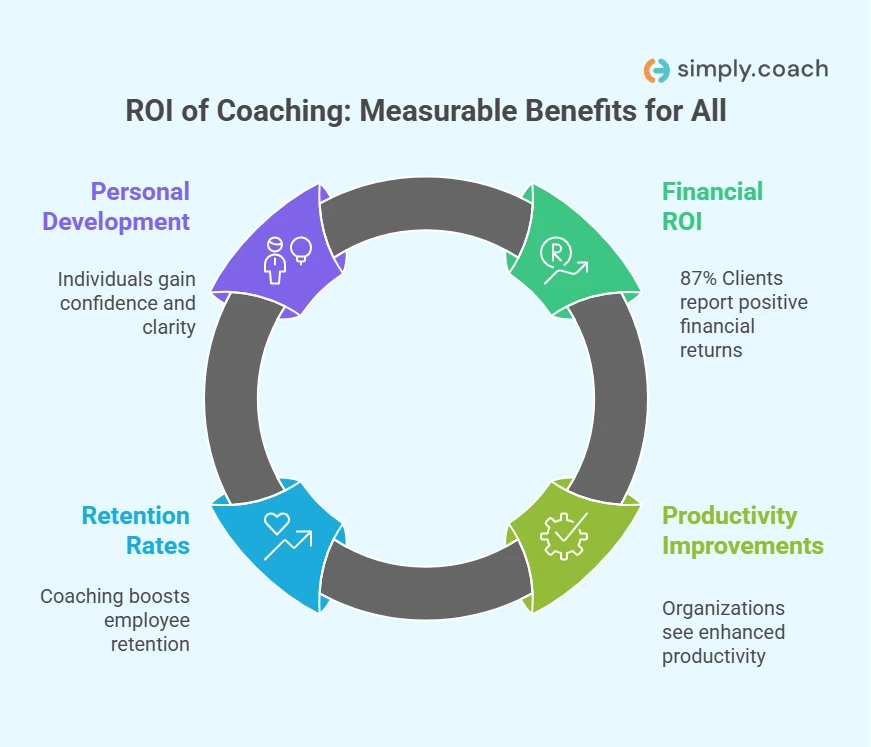
As a coach, you already know the value you bring in every session. But many of your potential clients want more than intuition, they want proof. Both individual clients and corporate leaders look for solid evidence that coaching produces measurable results. The latest data confirms that coaching delivers strong returns, which explains why investment in coaching is increasing worldwide.
- Research from the International Coaching Federation (ICF) shows that 87% of coaching clients report a positive return on investment, with many describing the financial and personal benefits as exceeding the initial cost.
- Organizations consistently point to measurable improvements in productivity, employee engagement, and goal achievement after introducing coaching programs. Studies reveal that teams with access to coaching see sharper focus, faster execution, and stronger accountability.
- Beyond productivity, companies credit coaching with improving retention rates. Employees who feel supported through career coaching or leadership development are more likely to stay with their organizations long-term.
- For individual clients, the ROI often shows up in improved confidence, clarity, and decision-making. These intangible benefits translate directly into career advancement, higher earnings, or stronger relationships.
For you, this means presenting coaching not just as a service but as an investment that pays off. Whether you’re pitching to a company or speaking with a prospective individual client, highlighting ROI makes your offer both credible and compelling.
Also read: Understanding the ROI of Coaching
The Role of Technology in Coaching Growth: How Simply.Coach Elevates your Practice
As a coach, you’ve probably noticed how much easier it is to run your practice when technology supports you in the background. The adoption of digital coaching platforms has transformed coaching from being a paper-heavy, fragmented process into a seamless and scalable business. By integrating your tools into one system, you save time, reduce no-shows, and deliver a smoother experience to clients.
- Video conferencing integration: Instead of juggling multiple apps, platforms like Simply.Coach connect directly with Zoom, Google Meet, and Microsoft Teams, so your sessions and notes stay in one place.
- Automated reminders: Email and text nudges reduce no-shows by keeping clients on track with upcoming sessions and pre-session tasks.
- Pre-session forms: Digital forms allow you to collect input before a session, so you can start with clarity and focus.
- Progress tracking & accountability: Real-time dashboards allow both you and your clients to track their progress toward goals. These insights help maintain focus and motivation throughout the coaching journey, while clients can see tangible evidence of their growth.
- Facilitating payments & invoicing: Built-in invoicing tools simplify billing and make it easier for clients to pay, eliminating the hassle of chasing overdue payments.
Conclusion
The data from the latest ICF coaching statistics makes one thing clear: coaching is no longer a niche practice but a global industry on the rise. From life and health coaching to executive and AI-driven specializations, opportunities for growth are multiplying. As demand increases and competition intensifies, staying informed about where the industry is headed gives you an edge. For you, this means building a practice that balances meaningful client work with smart business management.
That’s exactly where Simply.Coach steps in. As the leading digital coaching platform, it helps you manage sessions, reduce no-shows, facilitate payments, and track client progress, all while keeping data secure. It’s built to let you spend less time on admin and more time coaching, so you can scale confidently in a growing market.
FAQs
1. What are the different levels of ICF coaching credentials and requirements?
ICF credentials are divided into three levels: Associate Certified Coach (ACC), Professional Certified Coach (PCC), and Master Certified Coach (MCC). ACC requires ~60 hours of accredited training plus 100 hours of client coaching, PCC requires ~125+ hours of training with 500 hours coaching, and MCC is the highest level with ~200+ training hours and 2,500+ coaching hours. These credentials build credibility and are widely recognized by clients and organizations.
2. How many coaches work globally with clients outside their country?
The profession is increasingly international. A 2024 report shows that 72% of coaches now serve clients outside their home country, made possible by digital delivery and time-zone flexibility. This cross-border trend expands your potential market beyond geography, giving you access to clients worldwide.
3. What is the average hourly rate for life coaches in the US in 2026?
According to the Life Purpose Institute, the average hourly rate for life coaches in the U.S. is about USD 244 per session, reflecting a steady increase in value perception. Higher rates are usually charged by coaches with ICF credentials, strong specialization, or corporate clients, while newer coaches may charge less.
4. How much of coaching revenue comes from virtual or online coaching?
Virtual delivery is no longer a side option, it’s the core model. In the U.S., more than half of life coaching revenue (~53.2%) already comes from online sessions. The shift accelerated after 2020 and remains strong as clients prefer flexibility and digital access. For you, this means offering hybrid or fully online programs is now a competitive necessity.
5. Is there a standard “coach-client ratio” or ideal number of clients coaches should serve?
There’s no single standard, but surveys show that most full-time coaches manage 10–15 active clients at a time. Executive and business coaches usually take fewer clients due to higher fees and deeper engagements, while life and wellness coaches may serve more at lower session rates. Balancing client load with quality of delivery is the real key.