
You have finished coach training, but the ACC application still asks for evidence your course certificate cannot provide. The ICF ACC requirements combine education, client coaching experience, mentor coaching and assessments of your skills and knowledge. You need to meet each requirement before ICF can award the credential.
The practical question is which requirements you already meet and which still need time or documentation. Your education also affects the application path and fee, while PCC and MCC have higher eligibility thresholds. A Look at the ICF ACC Requirements gives you the checklist, and Applying for an ICF Credential and What to Expect explains how to assemble your application.
TL;DR
To qualify for ACC, you need at least 60 education hours, 100 client coaching hours, mentor coaching and both knowledge and performance assessments. You must coach at least 8 clients, receive payment for at least 75 hours and complete 25 hours during the 18 months leading up to your application. Mentor coaching requires 10 hours over at least three months, including three individual hours. The Level 1 or Level 2 application costs $175 for members or $325 for non-members; Portfolio applications cost $475 or $625. The first ACC Exam attempt is included. PCC and MCC require more education and experience, so compare their thresholds with your records before choosing which credential to pursue.
What Is ICF and Why Does It Matter to You?
The International Coaching Federation sets coaching standards that give you and your clients a shared basis for professional practice. Its credentials assess coaching against its Core Competencies and Code of Ethics.
ICF offers Associate Certified Coach (ACC), Professional Certified Coach (PCC) and Master Certified Coach (MCC) credentials. ACC is the entry credential within the wider ICF certification process, with PCC and MCC requiring more training and client experience.
The ACC Certification for Professional Coaching
You need evidence of your training, client experience and assessed skills to qualify for ICF’s entry credential. For ACC coaching certification, the application routes on ICF’s ACC page cover Level 1 or Level 2 graduates and Portfolio applicants.
1. A Look at the ICF ACC Requirements
Start by separating your training hours from the hours you spend coaching clients. They meet different requirements, and your records need to support each total.
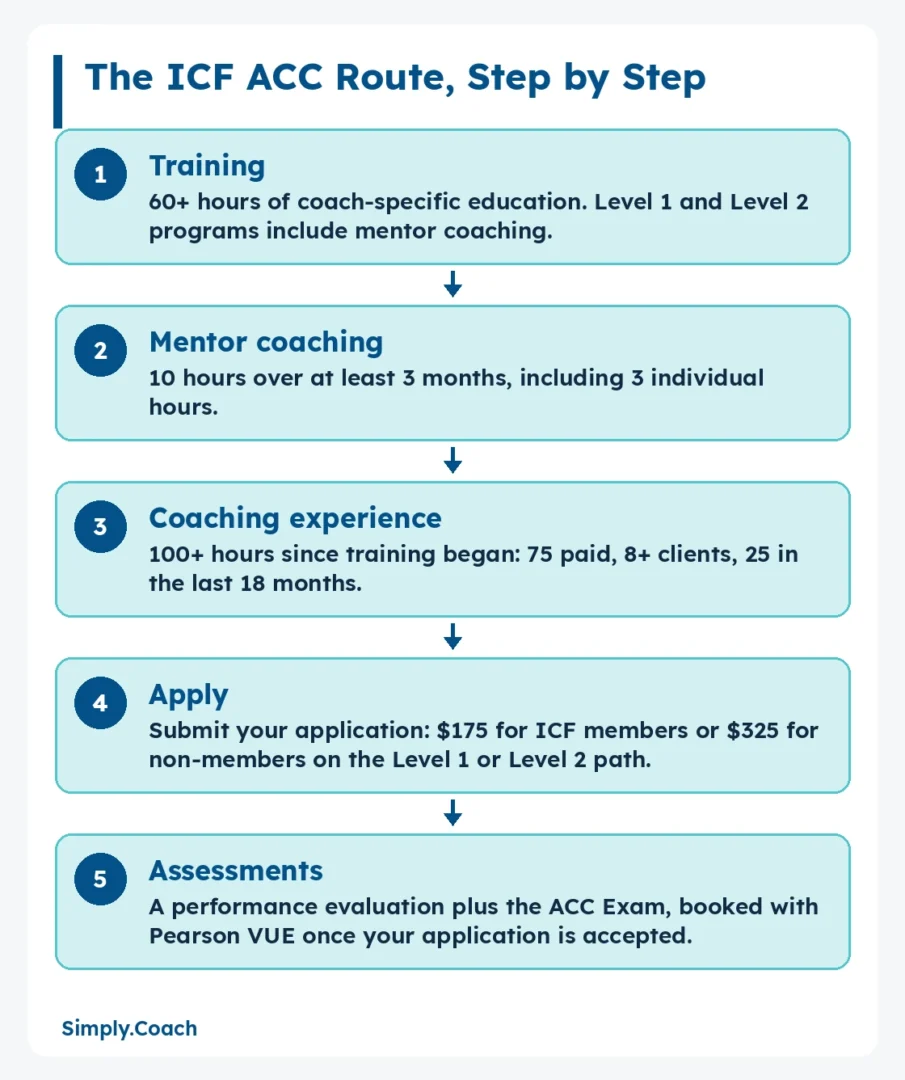
- Coach-specific education: Complete at least 60 hours of coach-specific education. Keep your training certificates to support your application.
- Mentor coaching: Complete 10 hours over at least three months, including three individual hours. Level 1 and Level 2 programs include mentor coaching. Portfolio applicants arrange it separately.
- Client coaching: The ACC candidate guide requires at least 100 coaching hours since training began, including at least 75 paid hours. Those hours must cover at least 8 clients, with 25 hours in the 18 months before you apply.
- Knowledge and performance: A performance evaluation and the ACC Exam are separate requirements. The first assesses your coaching skills, while the second assesses your knowledge.
Your education determines whether you use the Level 1 or Level 2 path or the Portfolio path. Confirm that route before assembling your application, since the fee and required supporting documents depend on it.
2. Costing of ACC
The application fee depends on your education path and whether you qualify for ICF member pricing. These are application fees in US dollars; budget separately for any training and mentor coaching costs.
| Application Path | ICF Member Fee (USD) | Non-Member Fee (USD) |
|---|---|---|
| Level 1 or Level 2 | $175 | $325 |
| Portfolio | $475 | $625 |
The application fee includes the first ACC Exam attempt, and a retake costs $105.
ICF membership is optional for credential applicants. Member pricing requires active ICF Professional Coaches or ICF Coaching in Organizations membership.
3. Keeping Your ACC Credential Current
Renew your ACC credential every three years with 40 Continuing Coach Education (CCE) credits. At least 24 must cover Core Competencies, including 3 in coaching ethics.
The remaining 16 credits may come from Core Competencies or Resource Development. ACC holders also need 10 hours of mentor coaching within the Core Competency credits.
Renewal costs $175 for members or $275 for non-members. A $100 late fee applies to late renewal.
The PCC Certification for Leveling Up Your Coaching Skills
PCC requires more education and coaching experience than ACC, with separate thresholds for training and client coaching hours. Compare these thresholds with your documented hours before choosing PCC as your next application.
1. To Qualify for PCC Certification
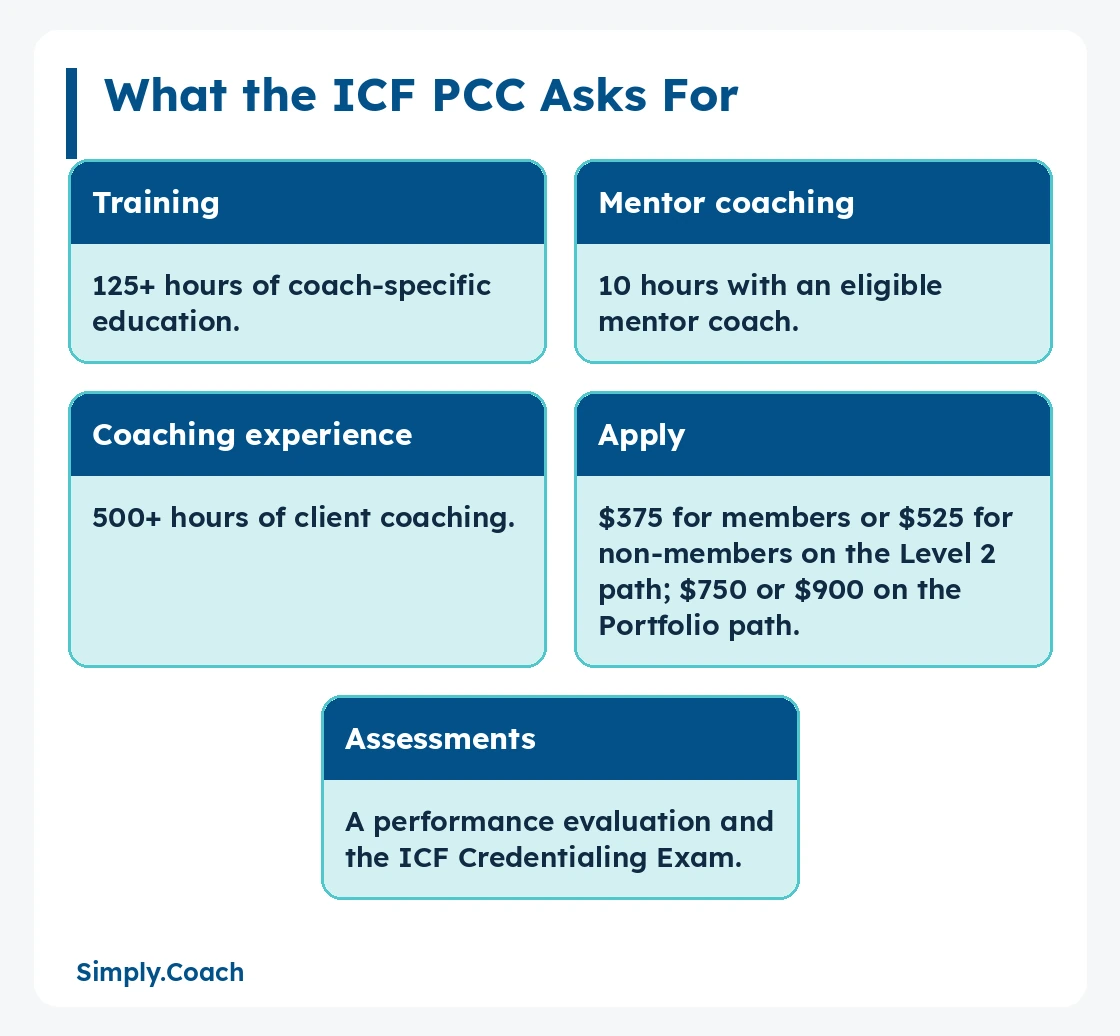
The PCC certification requirements include at least 125 hours of coach-specific education and at least 500 hours of client coaching. You also need 10 hours of mentor coaching, a performance evaluation and the ICF Credentialing Exam.
2. Costing of PCC
Use the row that matches your education path when budgeting your PCC application. The amounts below are application fees in US dollars.
| Application Path | ICF Member Fee (USD) | Non-Member Fee (USD) |
|---|---|---|
| Level 2 | $375 | $525 |
| Portfolio | $750 | $900 |
The MCC Certification and Coaching Mastery
MCC, or Master Certified Coach, requires substantial coaching experience and a current or past PCC credential before you can apply. It is the highest of ICF’s three credential levels.
For MCC, the minimums are 200 training hours and 2,500 client coaching hours. Plan for 10 hours of mentor coaching as well. A performance evaluation and the ICF Credentialing Exam make up the assessment portion of the ICF MCC requirements.
Costing of MCC
Both MCC application paths carry the same fee for each membership category. The amounts below are application fees in US dollars.
| Application Path | ICF Member Fee (USD) | Non-Member Fee (USD) |
|---|---|---|
| Level 3 | $675 | $825 |
| Portfolio | $675 | $825 |
ICF listed these fees on October 27, 2026. Fees can change, so confirm the current amounts on ICF’s site before you apply.
Applying for an ICF Credential and What to Expect
Your ACC application is easier to assemble when your training documents, coaching log and mentor coaching evidence are ready together. ICF organizes its process into six stages, from preparing for the credential to taking the exam.
- Prepare for ACC: Review the requirements and identify gaps in your education, client experience, mentor coaching or performance assessment. Allow time to meet each requirement before applying.
- Explore your path: Complete ICF’s Credential Path Survey to identify the application path that matches your education. Keep the result with your application records.
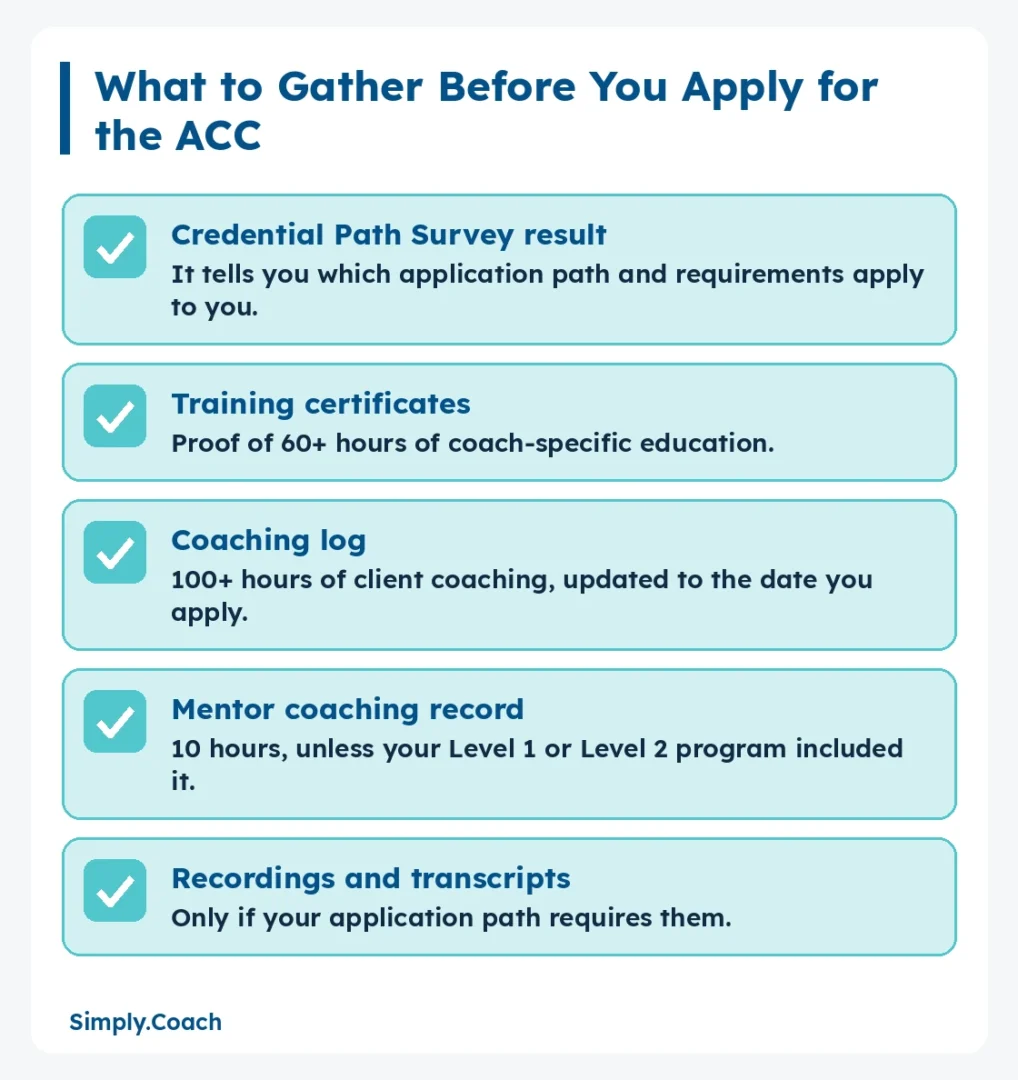
- Gather your records: Collect certificates for at least 60 education hours and a coaching log showing at least 100 hours, updated through your application date. Include a record of 10 mentor coaching hours unless your Level 1 or Level 2 program included them. Add recordings and transcripts only if your path requires them.
- Apply to ICF: Submit the documents required for your path and pay the applicable application fee. Check them carefully because application fees are nonrefundable once submitted.
- Study for assessment: The ICF ACC exam assesses the ICF definition of coaching, Core Competencies and Code of Ethics. This is the knowledge assessment required for the ACC credential.
- Take the exam: After ICF accepts your application, schedule the ACC Exam with Pearson VUE at a test center or online. This exam is separate from your performance evaluation.
The Importance of ICF Credentials to Your Clients
An ICF credential tells clients that your training, coaching experience and assessments meet a defined set of professional standards. Clients also need clear expectations for their coaching engagement.
A coaching contract checklist helps you define scope, responsibilities and confidentiality expectations before sessions begin. These agreements make your working relationship clearer to the client.
Regular reflection in coaching gives you time to review your practice and notice where your skills need attention. A coaching plan connects the client’s goals with agreed actions and progress reviews.
Conclusion
Choose ACC when your records meet its requirements, then use your training background to confirm the right application path. Check that your coaching log includes the required paid hours, client count and recent experience before you apply. If an hour threshold or document is missing, address that gap before paying the application fee.
PCC and MCC become relevant when your education and coaching experience meet their higher thresholds. For now, a clear record of your client work gives you a practical basis for your ACC application.
Key Takeaways
- Separate the evidence: Treat education hours and client coaching hours as separate requirements. A course certificate alone cannot demonstrate both.
- Choose your path: Use the Credential Path Survey before you assemble your application. Your education determines which documents and fees apply.
- Check recent hours: Check the recency requirement against your intended application date. An older total may leave you short of recent coaching experience.
- Confirm mentor coverage: Check what your Level 1 or Level 2 program includes before arranging separate mentor coaching.
- Budget by stage: Keep training, application and renewal costs distinct in your budget. Include a possible exam retake when planning your available funds.
- Set client expectations: Pair your credential with a clear agreement about scope, confidentiality and goals. Explain what the coaching engagement will involve before sessions begin.
- Plan for renewal: Keep continuing education records as you go. ACC renewal includes mentor coaching as well as education credits.
Keep your client work organized as you build experience toward ACC. Simply.Coach’s client management tools support goals, action plans and notes. Use them to manage ongoing client work while you maintain the training, experience and mentor coaching evidence needed for your credential application.
Frequently Asked Questions (FAQs)
How do I get an ICF ACC credential?
Complete the required education, coaching experience and mentor coaching, then use ICF's Credential Path Survey to identify your application route. Gather the required evidence and submit your application. You must meet the performance assessment requirement and pass the ACC Exam before receiving the credential.
What is the cost of the ICF ACC exam?
ICF includes your first ACC Exam attempt in the application fee. Members pay $175 on the Level 1 or Level 2 path or $475 for Portfolio; non-members pay $325 or $625 respectively. An ACC Exam retake costs $105.
What is the ICF ACC Portfolio path?
The Portfolio path is an application route for coaches who have not completed an accredited Level 1 or Level 2 program. You arrange mentor coaching separately and provide the evidence your path requires. The application fee is $475 for members or $625 for non-members.
What is the difference between ACC and PCC?
ACC requires at least 60 education hours and 100 coaching hours; PCC requires at least 125 education hours and 500 coaching hours. Both require mentor coaching and performance assessment. ACC candidates take the ACC Exam, while PCC candidates take the ICF Credentialing Exam.
Which coaching hours count toward ACC?
Your 100 coaching hours must have been completed since your coach-specific education began. At least 75 must be paid, and the experience must cover at least eight clients. At least 25 hours must fall within the 18 months before your application.
Do I need to arrange my own mentor coaching for ACC?
Level 1 and Level 2 programs include mentor coaching, while Portfolio applicants arrange it separately. ACC requires 10 mentor coaching hours over at least three months, including three individual hours. Check your program's coverage when gathering evidence for your application.
Do I have to be an ICF member to apply for ACC?
Membership is optional, so you can apply for ACC as a non-member. To receive member pricing, you need active ICF Professional Coaches or ICF Coaching in Organizations membership. Your application path still determines the fee, and application fees are nonrefundable once submitted.
How do I renew my ACC credential?
Renew every three years with 40 CCE credits. At least 24 must be Core Competency credits, including three in ethics. ACC also requires 10 mentor coaching hours within those Core credits. Renewal costs $175 for members or $275 for non-members, with a $100 late fee.