
Many coaches reach a point where experience alone no longer helps you stand out in a competitive coaching market. Clients often ask about your credentials before committing to long-term coaching engagements. Without a recognized certification, you may struggle to justify higher coaching fees or attract executive-level clients. A respected credential can strengthen your professional reputation and help position your coaching practice more competitively.
The Master Certified Coach (MCC) credential represents the highest level of professional certification offered by the International Coaching Federation. Coaches pursue this designation after building substantial coaching experience and completing advanced training requirements. The certification process also includes rigorous evaluation to ensure coaches demonstrate high professional standards and coaching competence.
This guide explains what you should know before pursuing the Master Certified Coach credential. You will learn what MCC certification means, who should consider it, and the key benefits it offers. The article also outlines the eligibility requirements, the step-by-step certification process, and the typical timeline involved. In addition, you will understand the salary potential that many experienced MCC coaches achieve.
Key Takeaways
- Master Certified Coach (MCC) is the highest professional credential awarded by the International Coaching Federation (ICF).
- MCC requires 200+ hours of coach‑specific training, 2,500+ coaching hours, and 10 hours of mentor coaching.
- You choose either the Level 3 Path or Portfolio Path based on your coach‑specific education source.
- MCC applicants must submit two real coaching recordings and transcripts for performance evaluation.
- After passing the performance evaluation, you must complete the ICF Credentialing Exam.
- MCC salaries in the US average around $139,505 per year, with significant variation by niche and experience level.
- MCC credentialing enhances credibility, expands high‑level coaching opportunities, and supports premium fee structures.
- Simply.Coach helps MCC coaches manage clients, track sessions, and scale their coaching practice efficiently.
What is a Master Certified Coach (MCC)?
A Master Certified Coach (MCC) is the highest professional credential awarded by the International Coaching Federation (ICF). This certification recognizes coaches who demonstrate advanced mastery of professional coaching competencies and significant real-world coaching experience.
You must complete extensive training, document thousands of coaching hours, and meet strict performance standards established by the ICF. The credential shows that your coaching practice meets the highest professional benchmarks recognized across the coaching industry.
As an MCC, you typically work with clients who expect thoughtful guidance, structured reflection, and clear professional outcomes. Your coaching engagements often involve supporting professionals who manage complex responsibilities and leadership expectations.
MCC coaches work with:
- Senior executives who need support with leadership decisions and organizational direction.
- Leadership teams working to improve collaboration, accountability, and strategic execution.
- Entrepreneurs and founders navigating business growth, scaling challenges, and leadership transitions.
- High-performing professionals seeking clarity on career progression, leadership presence, and performance goals.
Only a small percentage of ICF-credentialed coaches reach the MCC level, which makes this certification highly respected within the coaching profession. For experienced coaches, the MCC designation strengthens credibility and positions your coaching practice among the most qualified professionals globally.
Also read: Understanding the International Coaching Federation (ICF)
Who Should Consider Becoming a Master Certified Coach?
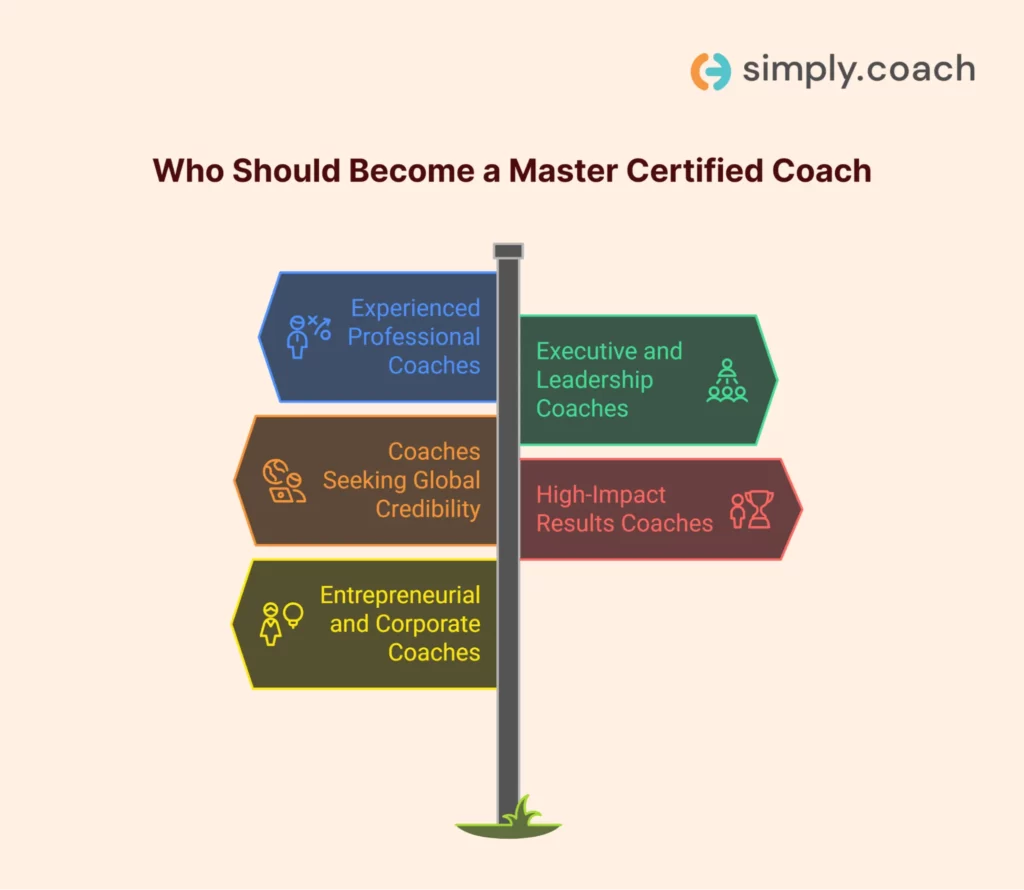
The MCC credential is designed for coaches like you who have substantial experience and want to operate at the highest professional level. It is most suitable for:
- Experienced professional coaches: You have multiple years of client work and want to demonstrate mastery of ICF competencies and advanced coaching techniques.
- Executive and leadership coaches: You work with senior executives, C-suite leaders, or leadership teams who need strategic and transformational coaching support.
- Coaches seeking global credibility: You want to differentiate yourself in high-stakes environments, secure corporate contracts, and gain international recognition.
- Coaches focused on high-impact results: You help clients achieve measurable business or leadership outcomes rather than basic skill development.
- Entrepreneurial and corporate coaches: You manage or scale your coaching practice and aim for long-term growth with premium client engagements.
This credential is not for entry-level coaches. It is for those ready to commit to rigorous standards, extensive client work, and advanced professional development.
Also read: Choosing ICF or NBHWC: Which Coaching Credential Is Right for You?
Why the Master Certified Coach Credential Matters
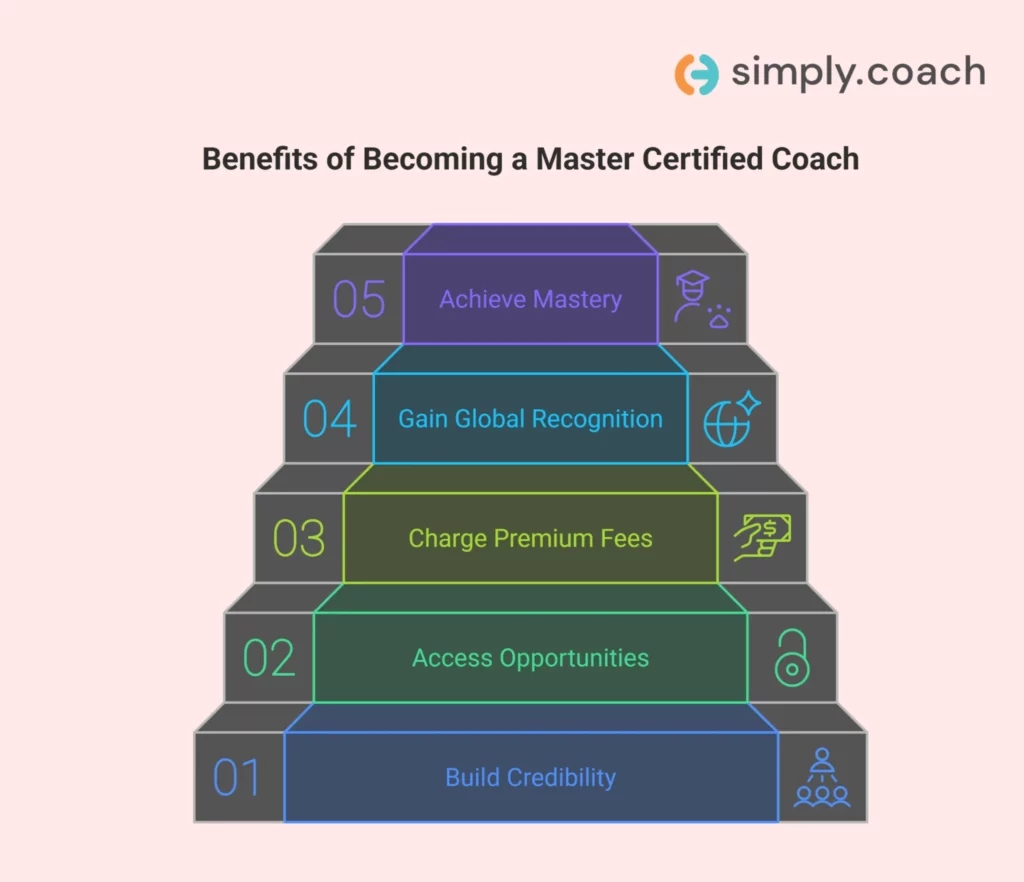
Earning the MCC credential provides coaches like you with advantages that go far beyond a standard certification. It signals a level of expertise and professionalism that opens doors to high-level coaching opportunities and strengthens your practice in measurable ways.
- Strong professional credibility: MCC certification confirms that you have mastered ICF core competencies and met rigorous performance standards, making clients and organisations trust your expertise immediately.
- Access to high-level coaching opportunities: Many corporations, executive teams, and leadership programs specifically seek MCC-certified coaches for complex coaching engagements that impact organizational strategy.
- Ability to charge premium coaching fees: With an MCC designation, you can set higher session rates, often ranging from $300 to $1,000 per session, reflecting your advanced experience and results-driven approach.
- Global professional recognition: The ICF credential is recognized internationally, allowing you to attract clients across countries and work on global leadership or executive coaching programs.
- Deeper coaching mastery: The MCC journey hones your ability to facilitate transformational change, improve client outcomes, and apply advanced techniques consistently in high-stakes environments.
For coaches ready to take their practice to the highest professional level, the MCC credential positions you as a leader in the coaching industry, opening opportunities that are otherwise inaccessible.
Eligibility to Become a Master Certified Coach
To qualify for the Master Certified Coach (MCC) credential, you must meet strict experience, training, and performance requirements set by the ICF. These standards ensure that only coaches with advanced skills, substantial client experience, and mastery of professional coaching competencies are eligible to apply.
| Requirement Area | Details |
| Prerequisite Credential | Must hold or have previously held a Professional Certified Coach (PCC) credential. |
| Coach‑Specific Education | Complete at least 200 hours of coach‑specific training (ICF‑accredited or equivalent). |
| Coaching Experience | Minimum 2,500 client coaching hours after starting coach education, with at least 2,250 paid hours. |
| Client Requirement | Work with at least 35 individual clients. |
| Mentor Coaching | Complete 10 hours of mentor coaching with an eligible mentor coach over a minimum 3‑month period. |
| Performance Evaluation | Submit recorded coaching sessions and meet MCC performance standards. |
| Credentialing Exam | Pass the official ICF Credentialing Exam. |
| Standards Compliance | Must not be under investigation or sanction for violations of the ICF Code of Ethics. |
Meeting these criteria allows you to formally apply for the MCC credential through the ICF, positioning you among the most qualified professional coaches globally.
Also read: Understanding ACC, PCC, and MCC: Guide to ICF Credential Levels
MCC Application Paths
You can apply for the MCC credential through two main paths: the Level 3 Path or Portfolio Path. The right path for you depends on the type of coach-specific education you completed. Both paths lead to the same credential and require identical coaching hours, mentor coaching, performance evaluation, and a written exam.
- Level 3 Path: Designed for coaches who have completed an ICF-accredited Level 3 program, which includes all required education hours and mentor coaching.
- Portfolio Path: For coaches who completed other accredited or non-ICF programs to meet the 200+ hours of coach-specific training. You must submit detailed documentation to show alignment with ICF standards.
The table below shows the key differences and requirements for each path:
| Requirement Area | Level 3 Path | Portfolio Path |
| Prerequisite | Must hold or have held a PCC credential. | Must hold or have held a PCC credential. |
| Coach-Specific Education | Completion of the ICF-accredited Level 3 program. | 200+ hours of coach-specific training (ICF-accredited Level 1, 2, ACSTH, ACTP, CCE, or non-ICF programs). |
| Coaching Experience | 2,500 hours (2,250 paid) with at least 35 clients. | 2,500 hours (2,250 paid) with at least 35 clients. |
| Mentor Coaching | Completed within the Level 3 program. | 10 hours with an MCC credentialed coach over 3+ months (3 hours must be one-on-one). |
| Performance Evaluation | Submit two recorded coaching sessions with transcripts. | Submit two recorded coaching sessions with transcripts. |
This table makes it easy to see the nuances of each path, helping you determine the best route based on your coaching education and experience.
Also read: ICF Coach Certification: Things to Know Before Getting Certified
Step-by-Step MCC Certification Process (Application to Final Credential)
After choosing the appropriate MCC application path (Level 3 or Portfolio), the next stage is completing the official credentialing process. The Master Certified Coach (MCC) certification process involves submitting your application, undergoing a performance evaluation, and passing the final credentialing exam.
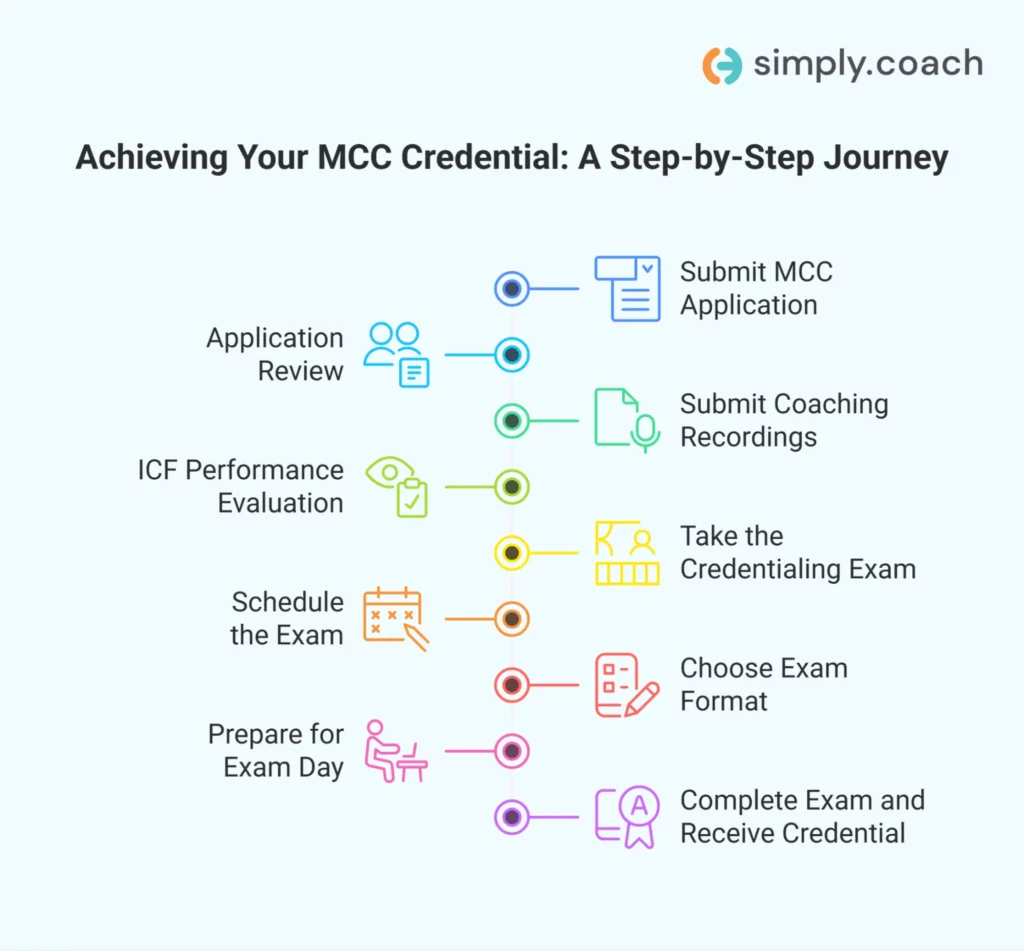
The steps below outline the entire process from application submission to receiving the MCC credential.
Step 1: Submit your MCC application
The first step toward becoming an MCC is submitting your credential application through the online portal of the International Coaching Federation. Before applying, ensure that you have completed all eligibility requirements.
How to apply
You can submit your application through the ICF website by following these steps:
- Visit the ICF website and navigate to the Credentialing section.
- Click “Apply for Credential.”
- Complete the eligibility survey to determine your correct credential level and application path.
- Log in to your ICF account or create a new account.
- Choose your application path (Level 3 or Portfolio).
- Fill out the online application form.
- Upload required documentation, such as education certificates and mentor coaching details.
- Submit your coaching experience records and client information.
- Pay the credential application fee.
Before final submission, you must attest that all information provided is accurate.
ICF may conduct an application audit to verify coaching hours or training details. If audited, you may be asked to provide additional documentation or client verification.
Step 2: Application review and approval
Once submitted, the ICF credentialing team reviews your application to confirm that all requirements have been met.
During this stage, the review team verifies
- Coaching education credentials
- Coaching experience hours
- Mentor coaching completion
- Client records and documentation
If the application is incomplete, ICF may request additional information before continuing the review.
After the review is complete and all qualifications are confirmed, your application moves to the performance evaluation stage.
Step 3: Submit coaching recordings for performance evaluation
All MCC candidates must pass the ICF Performance Evaluation, which assesses real coaching sessions to determine whether your coaching meets MCC-level competency standards.
Applicants must submit two recorded coaching sessions along with written transcripts.
These sessions allow trained assessors to evaluate how effectively you demonstrate the ICF Core Competencies in real coaching situations.
Recording requirements
The coaching recordings must meet the following criteria:
- Each recording must be 20–60 minutes long.
- The session must be complete and unedited.
- Coaching beyond the 60-minute mark will not be evaluated.
- Sessions must be conducted with a real client (paid or pro bono).
- The client cannot be part of a coaching training program.
- The recording must be audio only.
- Accepted formats include MP3, WMA, MP4, or M4A.
- Each file must be 95 MB or smaller.
- Only one audio file per session is allowed.
- Files must be uploaded directly to the application portal.
Using scripts or staged coaching sessions is strictly prohibited and may lead to credential denial or disciplinary action.
Transcript requirements
Each recording must include a verbatim transcript of the session.
Transcripts must follow these guidelines:
- Provide a word-for-word record of the coaching conversation.
- Clearly identify the coach and client speakers.
- Place each speaker’s statement on separate lines.
- Include timestamps whenever the speaker changes.
- Do not include notes, commentary, or images.
- Submit transcripts as Word documents (.doc or .docx).
If the coaching session is conducted in a language not supported by ICF assessors, you must submit:
- The original transcript
- An English translation of the transcript
Step 4: Assessment by ICF evaluators
Your recordings and transcripts are reviewed by trained ICF assessors.
During the evaluation process, assessors:
- Listen to the recorded coaching session
- Review the transcript alongside the recording
- Identify evidence of MCC-level coaching behaviors
- Evaluate alignment with the ICF Code of Ethics
Each candidate receives one of two results:
- Pass
- Below Passing Standard
To pass the performance evaluation, the majority of assessors must confirm that your coaching demonstrates the ICF Core Competencies at the MCC level.
This stage typically takes 4 to 8 weeks.
Once the evaluation is completed, you will receive an email with:
- Your evaluation result
- Feedback from assessors
- Instructions for the next step
Candidates who do not meet the passing standard receive guidance on the re-evaluation process.
Step 5: Take the ICF credentialing exam
After completing the performance evaluation, candidates must take the ICF Credentialing Exam, which is the final step in the certification process.
The exam assesses your knowledge and application of the ICF Core Competency framework.
1. Exam structure
The credentialing exam consists of 78 situational judgment questions that present realistic coaching scenarios.
For each scenario, candidates must identify:
- The best response
- The least effective response
Key exam details include:
| Feature | Details |
| Total questions | 78 |
| Exam duration | 3 hours |
| Sections | Two sections with a break |
| Question type | Situational judgment |
| Delivery | Computer-based |
The exam structure is:
- Instructions – 4 minutes
- Section 1 – 39 questions (83 minutes)
- Break – 10 minutes
- Section 2 – 39 questions (83 minutes)
Ten questions are unscored field-test items used to improve future exams.
2. Exam scoring
Exam scores are reported using a scaled scoring system.
| Score range | Passing score |
| 200–600 | 460 |
Candidates must achieve a minimum score of 460 to pass.
Step 6: Schedule your exam
Once your application and performance evaluation are approved, you will receive an email authorizing you to schedule the exam with Pearson VUE, the official testing partner.
Candidates have 60 days to schedule and complete the exam.
To schedule your exam:
- Log in to your ICF account.
- Navigate to My Applications.
- Select Exam Info for your MCC application.
- Choose your preferred testing format.
- Select an available date and time.
Step 7: Choose your exam delivery method
The credentialing exam can be taken in two ways:
- In-person testing: Candidates can take the exam at one of Pearson VUE’s global testing centers.
- Remote online testing: Candidates can take the exam remotely through Pearson OnVUE, where the exam is monitored by a live online proctor.
Before taking a remote exam, candidates must complete a system compatibility test to ensure their device meets technical requirements.
Step 8: Prepare for the exam day
Before taking the ICF credentialing exam, candidates must complete several verification and technical preparation steps. These requirements help maintain exam integrity and ensure a secure testing environment for all candidates.
1. Identification requirements for the exam
Before beginning the exam, candidates must complete the identity verification process.
Candidates will be required to:
- Take a photo of themselves
- Take a photo of their identification
- Take a photo of their testing space
The testing environment must be clear of all materials, and the desk should contain only the computer used for the exam and any items pre-approved by the exam sponsor.
Candidates must provide one valid, original government-issued photo ID.
The identification must include:
- A recent recognizable photo
- The candidate’s full name
- A valid signature
- An unexpired issue date
The first and last name on the ID must exactly match the name used when registering for the exam.
Acceptable forms of identification include:
- Valid passport
- Valid driver’s license
- Valid national identification card
Unacceptable forms of identification include:
- Certain restricted government IDs
- Identification issued by countries where remote testing services are restricted
Candidates may bring a secondary form of identification in case verification issues arise.
2. Testing space and security rules
Candidates taking the exam through remote proctoring must complete the exam in a private and secure environment.
Your testing space must:
- Be enclosed and private
- Have a stable internet connection
- Allow the door to be closed to prevent interruptions
- Ensure that no one else can see the computer screen
The following environments are not recommended:
- Public locations such as libraries or cafés
- Hotels with unstable Wi Fi connections
- Corporate offices where firewalls or VPNs may block exam software
Once the exam begins, candidates must follow strict security rules.
- Candidates must remain visible on the webcam at all times
- No one may enter or pass through the room
- Candidates may not speak, read questions aloud, or cover their faces
Failure to follow these rules may result in exam termination and forfeiture of exam fees.
3. Prohibited items during the exam
To maintain exam security, candidates cannot have unauthorized materials within reach during the exam.
Prohibited items include:
- Books or notes
- Paper or writing instruments
- Mobile phones or electronic devices
- Headphones or headsets
- Wallets, purses, or bags
- Watches or smart devices
Candidates may use their mobile phone only during the check-in process to capture required photos. Once the exam begins, the phone must be placed out of reach and kept on silent mode.
4. Technical requirements for remote testing
Candidates taking the exam remotely must ensure their system meets the required technical specifications.
Minimum system requirements include:
| Requirement | Details |
| Operating system | Windows 10 or 11 and macOS 10.15 or later |
| RAM | Minimum operating system requirement. 4 GB recommended |
| Internet speed | 6 Mbps download and 3 Mbps upload |
| Webcam | Minimum resolution of 640 × 480 |
| Browser | Latest Chrome, Edge, Safari, or Firefox |
Additional requirements include:
- Only one monitor may be used during the exam.
- Tablets are not allowed unless they include a physical keyboard and a supported operating system.
- Candidates must remain connected to a power source during the exam.
Candidates are strongly encouraged to complete the system test before exam day to confirm that their device and internet connection meet all requirements.
Step 9: Complete the exam and receive your MCC credential
After completing the credentialing exam, candidates receive their final score based on the ICF scoring system.
Once all requirements are successfully completed, including the application review, performance evaluation, and credentialing exam, the International Coaching Federation officially awards the Master Certified Coach (MCC) credential.
This certification recognizes coaches who demonstrate the highest level of professional coaching competence according to ICF standards.
Also read: Useful Tips to Pass the New ICF ACC Credentialing Exam
How Much Does The ICF MCC Certification Cost
Applying for the Master Certified Coach credential involves several fees depending on your membership status and application path. The International Coaching Federation offers discounted pricing for active members, while non-members pay a higher application fee and recertification cost.
The tables below outline the typical costs associated with the MCC credentialing process.
ICF Member Pricing
| Application Path | Application Review and Exam | Performance Evaluation Retake (If Required) | ICF Credentialing Exam Retake (If Required) | Recertification (Every Three Years) |
| MCC Level 3 Path | $675 USD | $150 USD per recording | $105 USD | $175 USD |
| MCC Portfolio Path | $675 USD | $150 USD per recording | $105 USD | $175 USD |
ICF Non-Member Pricing
| Application Path | Application Review and Exam | Performance Evaluation Retake (If Required) | ICF Credentialing Exam Retake (If Required) | Recertification (Every Three Years) |
| MCC Level 3 Path | $825 USD | $150 USD per recording | $105 USD | $275 USD |
| MCC Portfolio Path | $825 USD | $150 USD per recording | $105 USD | $275 USD |
Important notes about MCC fees
- Active members of ICF Professional Coaches and ICF Coaching in Organizations receive discounted credential application fees.
- Membership is not required to apply for the MCC credential.
- To qualify for member pricing, you must be an active ICF member at the time of submitting your application.
- If candidates do not pass the performance evaluation or exam, additional retake fees may apply.
- MCC credentials must be renewed every three years, and recertification fees depend on membership status.
Understanding these costs in advance helps you plan your MCC certification journey and avoid unexpected expenses during the credentialing process.
Master Certified Coach Salary in the United States
Becoming a Master Certified Coach can also open doors to strong earning potential, especially for experienced coaches working with executives, organizations, or leadership teams. According to recent data from ZipRecruiter, salaries for Master Certified Coaches in the United States vary depending on experience, industry, specialization, and location.
Average salary of a master certified coach
As of March 2026, the average annual salary for a Master Certified Coach in the United States is $139,505.
This compensation translates to approximately:
- $67.07 per hour
- $2,682 per week
- $11,625 per month
These figures reflect the average earnings of professionals who hold the Master Certified Coach (MCC) credential and work in coaching roles across different industries.
Salary range for master certified coaches
While the average salary is around $139,505 annually, compensation for Master Certified Coaches can vary significantly.
| Salary Level | Annual Pay |
| Lowest reported salaries | $30,500 |
| 25th percentile | $118,000 |
| Average salary | $139,505 |
| 75th percentile | $165,500 |
| Top 10 percent | $198,500 |
| Highest reported salaries | $208,000 |
The wide salary range indicates that many opportunities exist for higher earnings depending on professional reputation, coaching niche, and years of experience.
Related: Life Coach Salary 2026: How Much Does a Life Coach Make & Earn?
Conclusion
Becoming a Master Certified Coach (MCC) is one of the most respected achievements in the coaching profession. It reflects years of dedication, advanced coaching expertise, and a strong commitment to professional growth. From fulfilling rigorous experience requirements to passing the performance evaluation and credentialing exam, the journey requires persistence and skill. For coaches who aim to work with senior leaders and organizations, the MCC credential represents the highest standard of coaching excellence.
As your coaching practice expands after earning MCC, managing clients, sessions, and business operations efficiently becomes essential. This is where Simply.Coach can make a significant difference for professional coaches. The all-in-one platform is designed to help streamline your coaching workflow, including client engagement, session scheduling, goal tracking, and progress management. With powerful tools built specifically for coaches, Simply.Coach enables Master Certified Coaches to scale their practice while focusing on delivering meaningful coaching outcomes.
FAQs
1. What credentials does ICF require before pursuing MCC?
To pursue MCC, you must hold, or have held, the Professional Certified Coach (PCC) credential from the ICF. MCC also requires documented coach‑specific education hours, mentor coaching, and coaching experience. This progression ensures coaches demonstrate increasing mastery at each credential level.
2. Can you skip PCC and apply directly for MCC?
Yes, you may apply for MCC without first completing PCC, but most applicants choose PCC first because MCC requires significantly more training and hours. The ICF credentialing system does not mandate a formal sequence, though PCC experience often strengthens an MCC application.
3. Do you have to be ICF certified to work as a professional coach?
No, you do not need an ICF credential to work as a professional coach, and many coaches build successful practices without one. However, ICF credentials like MCC signal mastery and can enhance credibility with clients and organizations.
4. How often must the MCC credential be renewed?
The MCC credential must be renewed every three years to remain valid. Renewal helps ensure you stay current with continuing education and professional standards set by the ICF, maintaining your professional credibility.
5. What skills does MCC certification demonstrate?
MCC credential holders must show mastery in advanced coaching competencies such as active listening, powerful questioning, coaching presence, and ethical practice. These skills reflect high‑level coaching fluency, consistent with ICF standards for professional excellence.
6. Which is better, ICF or EMCC?
Choosing “better” depends on your goals rather than a simple ranking. The International Coaching Federation (ICF) is often more recognized globally and in corporate settings. The European Mentoring and Coaching Council (EMCC) places greater emphasis on reflective practice and supervision, which some coaches value more. Both have strong frameworks, but ICF tends to be more widely known in the US and internationally.