
If you’re considering PCC coaching certification, you may be asking whether your current client work is enough to qualify. PCC stands for Professional Certified Coach, an International Coaching Federation (ICF) credential that requires coach education, client experience, mentor coaching and assessments. Its value for your skills comes from practicing against defined standards and receiving feedback on your coaching.
You might already hold the ACC or be deciding which credential fits the practice you want to build. The right choice depends on your experience, learning needs and the work still ahead of you. The sections below connect those decisions to the requirements, application fees and assessments you need to plan for.
TL;DR
PCC coaching certification is ICF’s Professional Certified Coach credential for coaches who meet its education, experience and assessment requirements. You need 125+ education hours, 500+ coaching hours with at least 25 clients, and 10 hours of mentor coaching. A performance evaluation and the ICF Credentialing Exam complete the assessment requirements. Apply through the Level 2 or Portfolio path according to your education. Your application fee depends on that path and your membership status, while training and mentor coaching prices vary by provider. The practical benefit is a structure for reviewing your coaching against professional standards. Earning the credential also starts an ongoing renewal commitment.
What Is PCC (Professional Certified Coach)?
ICF awards the Professional Certified Coach credential to coaches who meet its education, experience and assessment requirements. It sits between ACC and MCC among the ICF coach credentials, with different requirements for each level. The MCC requirements apply to the next credential level if that becomes your later goal.
What Does It Mean to Hold an ICF Coaching Certification?
Holding an ICF coaching certification means you have met the requirements for that credential and accepted its ethical responsibilities. For PCC, that evidence includes assessed coaching skill as well as education and experience.
- Assessed coaching skills: A performance evaluation assesses your coaching against ICF criteria for the PCC level.
- Ethical standards: The Code of Ethics provides standards for your professional responsibilities and relationships.
- Continual professional growth: Renewal keeps continuing coach education part of maintaining your credential.
- Credibility: You can point to documented requirements when explaining your qualifications to prospective clients.
- International credential: Name ICF as the organization that awards your PCC. Clients can consider that qualification alongside your coaching experience.
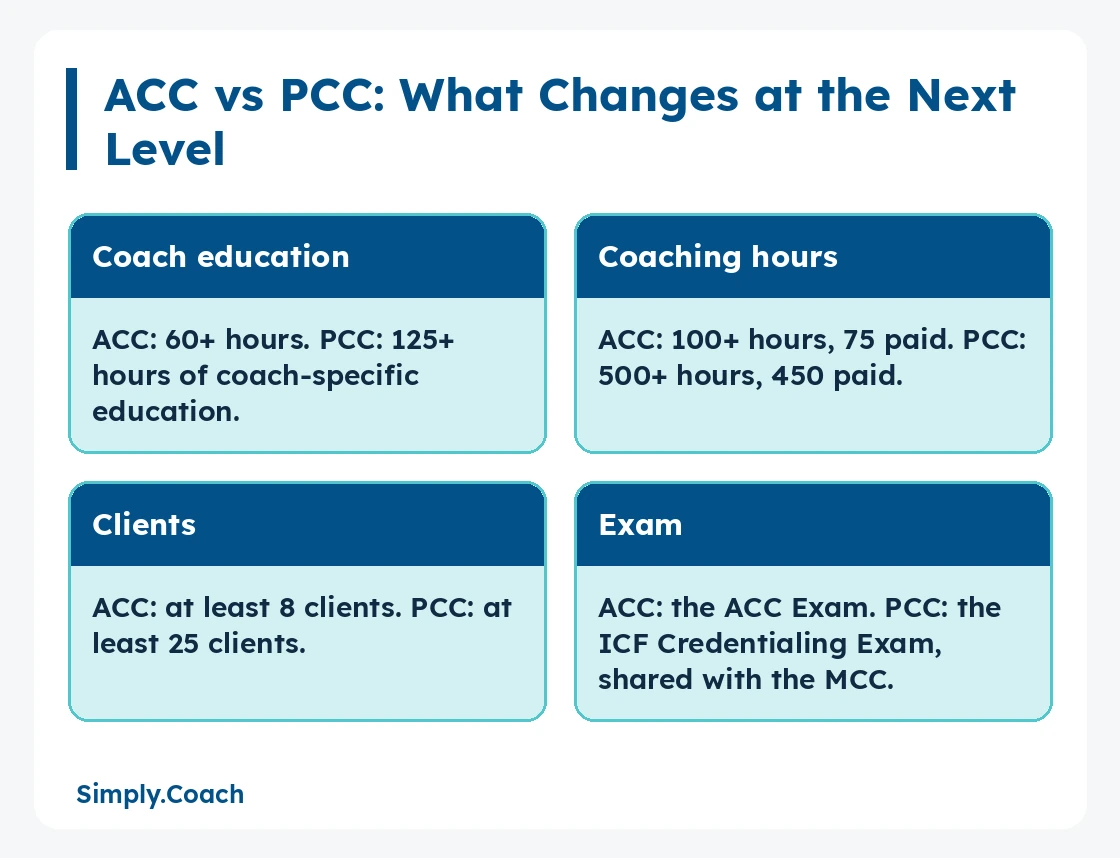
The ACC requirements start at 60+ hours of coach-specific education and 100+ coaching hours, including 75 paid hours. ACC applicants also need at least 8 clients. PCC requires 125+ hours of coach-specific education and 500+ coaching hours, including 450 paid hours, with at least 25 clients.
ACC candidates take the ICF ACC Exam, while PCC candidates take the ICF Credentialing Exam shared with MCC candidates. These differences let you compare the required experience and assessments before choosing which credential to pursue.
Why Is PCC Certification Important for Starting a Coaching Business?
PCC gives you a concrete qualification to explain to potential clients when you are starting or growing a coaching business. Use it to describe your preparation while keeping your services and client needs at the center of the conversation.
- Building client trust: Explain what the credential required when a client asks about your qualifications. Education, coaching experience and assessments give that conversation specific evidence.
- Improving professionalism: Use clear agreements and ethical boundaries in your client relationships. The Code of Ethics is a standard for your conduct after qualification.
- Marketing your services: List your PCC accurately alongside your relevant experience and the clients you serve. Connect it to how you work without predicting a client’s results.
Before committing, compare the ICF credentialing requirements with the experience you already have and the coaching work you want. That gives you a practical basis for deciding whether the next credential is worth the investment.
Steps to Achieve PCC Certification
You qualify for PCC by meeting the education, experience, mentor coaching and assessment requirements for your chosen application path. Use these steps to organize your evidence, while checking which requirements your education program includes.
Step 1 Complete ICF-Accredited Training
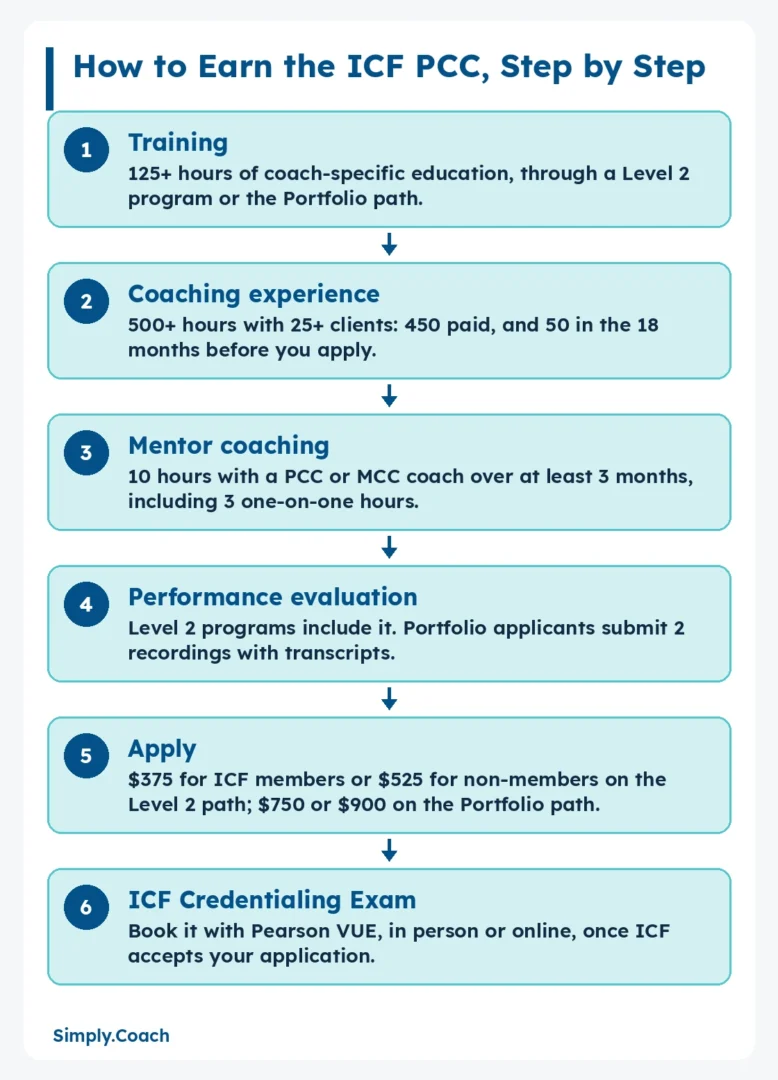
PCC requires 125+ hours of coach-specific education through the Level 2 or Portfolio application path. The Level 2 path is for coaches who complete an entire ICF-accredited Level 2 program. The Portfolio path can combine accredited and non-accredited courses to meet the education requirement.
When comparing ICF-accredited coaching programs, check for a Level 2 program if you want that application path. PCC has no Level 1 application path, so confirm how any existing education fits before enrolling.
Focus your education on understanding the ICF Core Competencies and how they apply in a coaching conversation. Use practice and mentor feedback to examine your listening, questions and work on client goals.
Step 2 Accumulate Coaching Hours
You need 500+ coaching hours with at least 25 clients, and at least 450 of those hours must be paid. At least 50 hours, paid or unpaid, must fall within the 18 months before you apply.
Keep your client coaching log current so you can check totals, paid hours and recent experience. Under ICF’s coaching experience requirements, mentor coaching hours do not count toward your client coaching hours.
Step 3 Complete Mentor Coaching
Complete 10 hours of mentor coaching with a coach who holds a PCC or MCC credential. These hours must span at least 3 months and include at least 3 hours of one-on-one mentor coaching.
Use this time to ask for specific feedback on how your coaching demonstrates the ICF Core Competencies. Discuss both the skills you show consistently and the areas that need further practice.
Step 4 Pass the Performance Evaluation
You must pass a performance evaluation that assesses your coaching against the ICF Core Competencies at the PCC level. A Level 2 program includes this evaluation, so that path does not need a separate evaluation submission. Portfolio applicants submit 2 recordings with transcripts as part of their credential application.
Each recording must be a full, unedited coaching session lasting 20 to 60 minutes. Trained ICF assessors who hold PCC or MCC credentials review the sessions against the criteria for your credential level.
The PCC Minimum Skills Requirements describe what assessors listen for in your coaching. Review them with your mentor to understand where your sessions demonstrate the competencies and where you need practice.
Step 5 Submit Your Application
Organize your education certificates, client coaching log, mentor coaching evidence and any required recordings and transcripts before submitting your application. Use ICF’s Credential Path Survey to confirm your path and create your application.
ICF membership is optional for eligibility. Member pricing requires active ICF Professional Coaches or ICF Coaching in Organizations membership when you apply.
- Level 2 path: The PCC application fee is $375 for ICF members or $525 for non-members.
- Portfolio path: The PCC application fee is $750 for ICF members or $900 for non-members.
ICF listed these fees on October 27, 2026. Fees can change, so confirm the current amounts on ICF’s site before you apply.
Step 6 Pass the ICF Credentialing Exam
PCC candidates must pass the ICF Credentialing Exam, which is also used for MCC candidates. It assesses the ICF definition of coaching, the Core Competencies and the Code of Ethics, including their application in practice. You can begin studying while your application is being reviewed.
Once ICF accepts your application, you receive an invitation with instructions for scheduling your exam. Book with Pearson VUE, either in person or online, using those instructions.
During preparation, explain why a coaching decision fits the competencies and ethical responsibilities you are studying. Use any uncertainty to choose what to review next, alongside the feedback you received during mentor coaching.
7. Time and Financial Investment for PCC Certification
Training and mentor coaching prices vary by provider, so request those quotes separately from the ICF application fee. Reaching 500 hours with at least 25 clients takes most coaches a sustained period of practice.
The mentor coaching requirement alone spans at least 3 months, so include it when you plan your application. Your budget also needs to account for maintaining the credential after you earn it.
PCC renewal is due every 3 years and requires 40 Continuing Coach Education (CCE) credits. Of those, 24 credits must be in Core Competencies, including 3 in Coaching Ethics. The remaining 16 may be in Core Competencies or Resource Development.
The renewal fee is $175 for ICF members or $275 for non-members. Keep a record of continuing education as you earn it so renewal is part of your ongoing planning.
Get our guide, "The Enterprise Guide to Scaling Internal Coaching Programs."
This guide offers actionable insights and strategies to help you expand your coaching business, improve client outcomes, and scale your impact. Learn how to implement effective coaching programs that drive measurable results and position your business for sustainable growth.

How PCC Improves Coaching Skills
PCC can help you improve by connecting repeated client practice with mentor feedback and clearly defined coaching standards. The ICF Core Competencies give that work a shared focus, while the performance evaluation checks how you apply them.
- Advanced communication techniques: Use mentor feedback to examine how you listen and respond during a session. Review moments when your assumptions shaped a question or you moved past something the client said.
- Client-centered approach: The PCC Minimum Skills Requirements describe client-driven sessions with shared responsibility. Ask whether the client’s priorities shaped the conversation and the actions they chose.
- Ethical standards: The Code of Ethics gives you a basis for reviewing boundaries, confidentiality and professional responsibilities. Use it when discussing difficult decisions with your mentor.
- Practical application: The coaching experience requirement gives you repeated opportunities to apply the competencies with clients. Use feedback to identify a behavior to practice, then reflect on how it affected the conversation.
Ask your mentor to review an exchange where your message missed what the client meant. That gives you a concrete starting point for practicing adaptive communication in coaching during later sessions.
How to Market Your Coaching Business With PCC Certification
Market your PCC by explaining what the credential represents and how your coaching services relate to a prospective client’s needs. Keep your message specific to your experience, the work you offer and the evidence you can share.
1. Building Your Brand
Your brand should make it easy to understand who you coach and what you bring to that work. Once you hold PCC, name the credential accurately and explain the preparation behind it.
- Position your specialty: Describe the clients or situations you work with, supported by your actual training and experience. Present PCC as a coaching credential alongside that background.
- Tailor your message: Explain how your services relate to the client’s priorities. Describe the coaching you offer without treating the credential as proof of a particular result.
- Focus on credibility: Keep your credential wording consistent across your website, biography and service materials.
2. Use Digital Platforms
Your website and social profiles should connect your qualification to a clear description of your coaching services. Give prospective clients enough information to decide whether a conversation about working together would be useful.
- Professional website: Include your credential, services and relevant experience. Describe what a client can expect when they contact you.
- Social media: Share coaching ideas on channels your prospective clients use. Keep your credential visible in your professional profile.
- Content marketing: Use a blog or podcast to discuss client challenges within your expertise. Choose topics that reflect the work you actually offer.
3. Client Testimonials and Case Studies
Testimonials and case studies give you space to describe real client experiences when you have permission to share them. Keep any claims tied to what the client actually said and the evidence you have.
- Gather testimonials: Ask clients for feedback in their own words. Agree on what you may publish before using a quotation.
- Showcase case studies: Describe the client’s goal, the coaching work and the outcome you can document. Obtain consent before sharing the account.
- Use real examples: Explain the context behind a before-and-after story. Keep individual results specific to that client.
You also need to manage the client work behind the services you describe in your marketing. Simply.Coach supports client management, goals and action plans, notes, scheduling, invoicing and payments. It has been audited and certified compliant for SOC 2, HIPAA and GDPR.
| Practice Need | Available Tools |
|---|---|
| Client work | Client management, goals and action plans |
| Session records | Notes |
| Appointments | Scheduling |
| Business administration | Invoicing and payments |
Conclusion
Pursue PCC when its requirements fit the coaching practice you want to develop and the experience you can build. Start by identifying what you have already completed and where you still need education, client hours or mentor feedback.
The value comes from using those requirements to review your coaching and make deliberate choices about your development. Simply.Coach can help you organize client work while you make space for that learning. Choose your next action from the gap you need to close, then keep your application evidence current as you progress.
Key Takeaways
- Check your education: Confirm whether your completed education supports Level 2 or Portfolio before committing to another course.
- Audit your log: Check client counts, paid hours and recent experience separately. Keep mentor coaching out of the client total.
- Plan mentor feedback: Confirm your mentor’s credential and agree on enough time for the required individual sessions.
- Prepare your recordings: Check your application path before arranging evaluation submissions. Portfolio recordings need transcripts and full, unedited sessions.
- Compare total costs: Add provider quotes to the application fee for your path. Include renewal in your ongoing professional budget.
- Study the standards: Connect exam preparation to the definition of coaching, Core Competencies and Code of Ethics.
- Market with evidence: Describe your qualification accurately and support client stories with consent and documented details.
Preparing for PCC still leaves you with client sessions, notes and follow-up work to manage. Simply.Coach brings goals, action plans and notes into its client management software for coaches, alongside scheduling, invoicing and payments. Keep that work organized while you make room for study and mentor feedback.
Frequently Asked Questions (FAQs)
What does PCC stand for in coaching?
PCC stands for Professional Certified Coach, an International Coaching Federation credential. Earning it requires coach-specific education, client coaching experience, mentor coaching, a passing performance evaluation and passing the ICF Credentialing Exam.
What is the difference between ACC and PCC?
ACC requires 60+ education hours, 100+ coaching hours and at least 8 clients. PCC requires 125+ education hours, 500+ coaching hours and at least 25 clients. The paid-hour minimums are 75 for ACC and 450 for PCC. ACC uses the ACC Exam; PCC uses the ICF Credentialing Exam.
What are the requirements to become a PCC coach?
For the PCC credential, ICF requires 125+ education hours and 500+ coaching hours with at least 25 clients, including 450 paid hours. At least 50 hours must be from the 18 months before applying. You also need 10 mentor coaching hours, a performance evaluation and the ICF Credentialing Exam.
Which training path can I use for PCC?
The Level 2 path requires completion of an entire ICF-accredited Level 2 program. The Portfolio path allows accredited and non-accredited courses to combine toward the 125+ hours of coach-specific education. PCC has no Level 1 application path.
How much does coaching certification cost?
PCC application fees are $375 for ICF members or $525 for non-members on the Level 2 path. Portfolio applicants pay $750 or $900, respectively. These are the fees ICF listed on October 27, 2026. Training and mentor coaching prices vary by provider.
What happens in the PCC performance evaluation?
Level 2 programs include the performance evaluation. PCC Portfolio applicants submit 2 recordings with transcripts. Each must be a full, unedited coaching session lasting 20 to 60 minutes. Trained ICF assessors with PCC or MCC credentials use criteria based on the ICF Core Competencies.
Which exam do PCC coaches take?
PCC candidates take the ICF Credentialing Exam, which is shared with MCC candidates. It assesses the ICF definition of coaching, Core Competencies and Code of Ethics. Once ICF accepts your application, you book with Pearson VUE, in person or online.
How do I renew my PCC credential?
Renew PCC every 3 years with 40 Continuing Coach Education credits. You need 24 credits in Core Competencies, including 3 in Coaching Ethics. The remaining 16 can be in Core Competencies or Resource Development. Renewal costs $175 for ICF members or $275 for non-members.