
Imagine reaching clients across the United States (and beyond), turning subscription-based coaching into stable income, and scaling without living in a constant reactive mode. 2024 data shows that 72% of clients now prefer remote or hybrid formats, marking a clear shift in demand. In 2026, this trend is expected to accelerate further – remote-first clients, automation tools, and niche expertise will define the online coaching segment.
Despite having the expertise, many coaches still trade time for money because they lack systems that support growth and automation. That’s the real challenge when you’re working out how to start a coaching business online.
In this post, you’ll learn exactly what online coaching is, explore its key benefits, discover what makes a successful online coaching business, and then follow a practical 9-step action plan designed to launch and scale your practice in 2026.
Key Takeaways:
- The demand for online coaching is growing rapidly, with 72% of clients now preferring remote or hybrid formats.
- Success starts with clarity of niche, validated offers, and structured systems that support long-term scalability.
- Follow a 9-step roadmap: choose your niche, validate your offer, design your signature program, set up legal and tech foundations, launch, and scale.
- Automate core tasks such as onboarding, scheduling, and reporting so you can focus more on coaching instead of admin work.
- Deliver an exceptional client experience through structured onboarding, consistent tracking, and measurable results.
- Scale your business through group programs, digital products, and automation tools once your systems are running smoothly.
- Simply.Coach helps you manage clients, track progress, and grow your business efficiently, all in one place.
What Is Online Coaching?
Online coaching is a structured, results-focused process where you guide clients remotely through both live sessions and self-paced activities. It helps clients achieve measurable transformation in specific areas such as career, leadership, relationships, or personal growth.
You can coach individuals one-on-one, lead group or cohort-based programs, or offer hybrid models that combine live coaching with recorded lessons. Many coaches also build membership or subscription programs to deliver ongoing value and maintain steady revenue.
At its core, online coaching gives you the flexibility to reach clients anywhere while maintaining a consistent and high-impact experience. It allows you to design your own framework, personalize each client’s journey, and track progress toward clear outcomes.
What Are the Benefits of an Online Coaching Business?
Running your coaching business online gives you more freedom, stability, and growth potential while helping your clients achieve stronger results. Here are the most valuable benefits you’ll experience as a coach:
- Reach and scale: Work with clients across the globe and remove the limits of location or time zones.
- Flexibility and higher margins: Reduce costs like office rent or travel and design programs that fit your schedule.
- Predictable income: Offer subscriptions, session packages, or retainers to create steady monthly revenue.
- Improved client outcomes: Track progress consistently and send timely reminders to keep clients accountable.
- Efficiency through automation: Automate onboarding, scheduling, and payments so you can focus on coaching, not admin work.
- Stronger credibility: Share case studies, testimonials, and visible results to establish authority in your niche.
- Greater visibility: Build your digital presence through social content, online profiles, and a professional website.
When structured well, online coaching lets you serve more clients, earn more consistently, and deliver lasting transformation, all without burning out or losing personal connection.
Also read: 20 Best Online Coaching Platforms & Tools in 2025
What Makes a Successful Online Coaching Business?
A successful online coaching business runs on clarity, structure, and consistency. It’s not just about your coaching skills but how you deliver, manage, and grow your practice. When each part of your business is intentional and systemized, you create predictable success and lasting client impact. Here are the key pillars that make an online coaching business stand out:
- Clarity of niche and outcome: Know exactly who you help and what transformation you create. A clear “I help” statement like “I help new managers become confident leaders in 90 days” instantly attracts the right clients.
- A signature, repeatable offer: Create one well-defined program that delivers a specific result. A structured 12-week leadership program, for example, can be repeated for every new client without starting from scratch.
- Reliable systems and technology: Use tools for scheduling, payments, and client progress tracking. This keeps your operations smooth and ensures clients always know what’s next.
- Consistent client acquisition: Build a simple, reliable funnel that guides prospects from interest to enrollment, through content, email nurturing, and discovery calls.
- Exceptional client experience: Focus on strong onboarding, regular check-ins, and measurable outcomes. A great experience turns clients into long-term advocates.
- Business-grade operations: Treat your practice like a business. Use contracts, manage invoicing, and ensure compliance with data and payment regulations.
- Data and optimization: Track key metrics such as retention, lifetime value, and conversion rates. Use these insights to refine your programs and improve your results over time.
- Scalability mindset: Think beyond one-on-one coaching. Introduce group programs, digital courses, or team coaches to grow without increasing your workload.
When you master these pillars, your coaching business becomes predictable, scalable, and impactful, built to deliver results while giving you the freedom to grow.
Also read: How to Start an Online Life Coaching Business (Step-by-Step Blueprint)
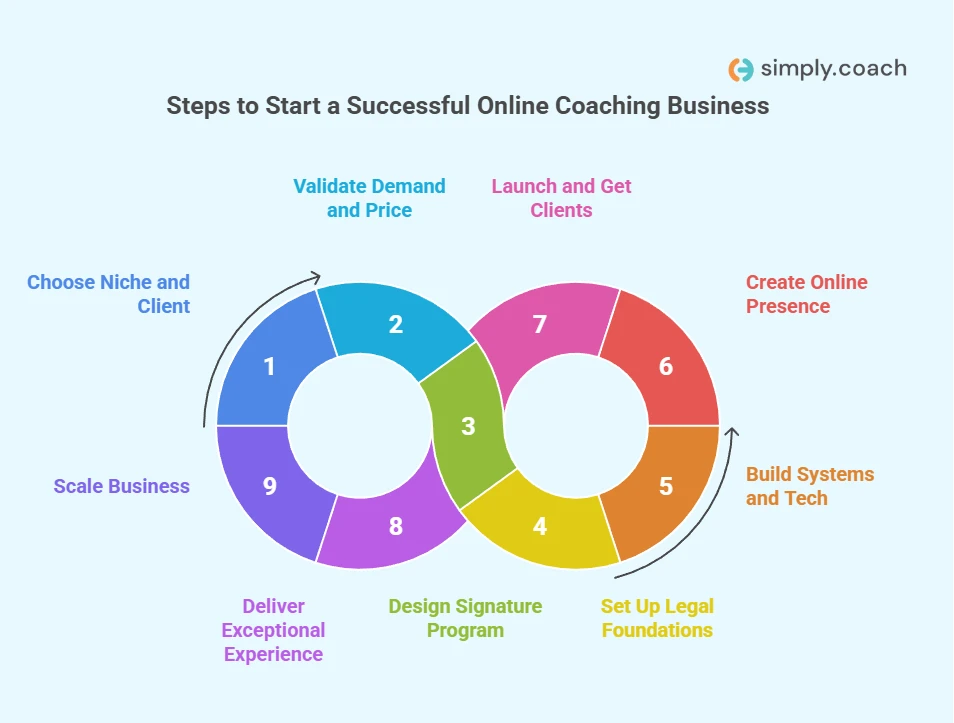
9 Actionable Steps to Start a Successful Online Coaching Business
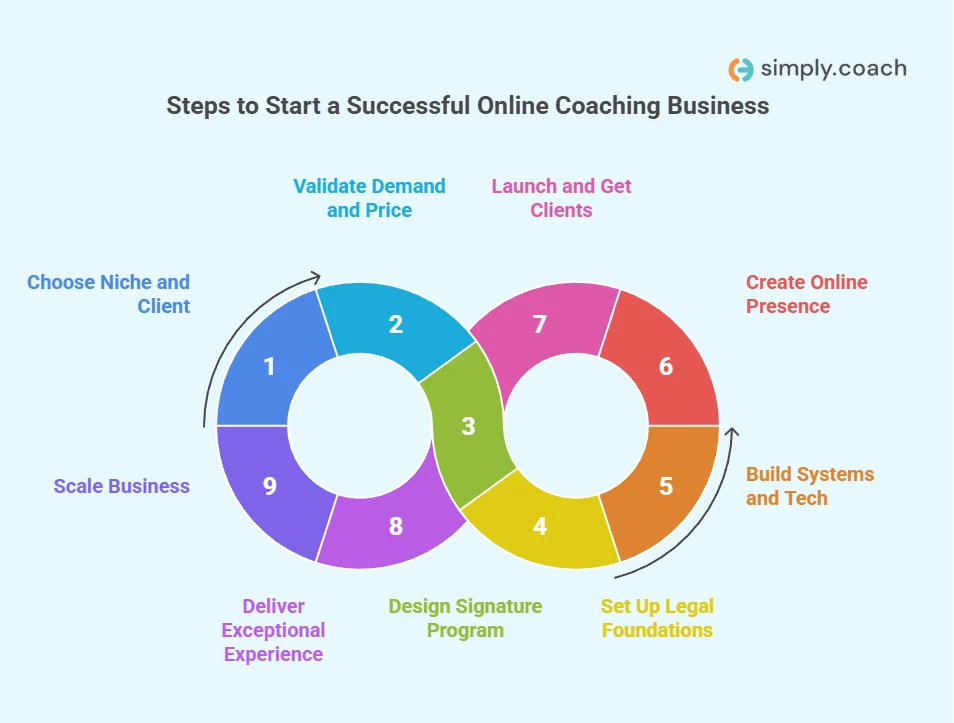
Building an online coaching business that actually works takes more than passion. You need structure, clarity, and a roadmap that turns your expertise into a profitable, scalable practice. The following nine steps will help you start strong, attract the right clients, and create a business that grows with you. Each step is practical, focused, and built for real-world coaching success.
Step 1: Choose a profitable niche and ideal client
The foundation of every successful coaching business starts with clarity. Knowing exactly who you help and what transformation you deliver makes it easier for clients to find you and trust your expertise.
- Define the problem you solve, the outcome you deliver, and the type of client you serve.
- Use this simple framework: Passion × Market × Problem × Proof. Passion keeps you motivated, the market ensures demand, the problem gives direction, and proof builds credibility.
- Identify your ideal client’s age, career stage, challenges, and goals. The more specific you are, the faster you’ll attract the right audience.
- Try this quick exercise: write your one-line positioning statement: “I help [who] achieve [what result].”
Key action: Draft your “I help…” statement and test it with three peers or existing clients to validate clarity and impact.
Also read: Benefits of Choosing a Coaching Niche for Yourself
Step 2: Validate demand and price your offer
Before investing time in building your full program, confirm that people actually want what you’re offering. Market validation helps you understand real client needs and ensures your pricing matches the value you deliver.
- Start with simple validation methods like short surveys, social polls, or five discovery calls with your target audience. Ask about their challenges, what results they want, and what they’ve already tried.
- Offer a small paid pilot to test your idea. Keep it focused on solving one specific problem in a set timeframe. Collect feedback to refine your approach and confirm that clients are willing to pay.
- When pricing, look at US market benchmarks. One-on-one coaching often ranges from $100–$300 per session, while group or program-based formats can run from $500–$2,000 per package, depending on the transformation offered.
- Create a Minimum Viable Offer (MVO) that lets you test your model without overbuilding. Focus on delivering strong outcomes before scaling.
Key action: Run five discovery calls and offer one paid pilot at an introductory price to validate both your niche and pricing.
Want detailed pricing strategies?
Download our free guide, “The Complete Guide: Pricing Strategies for Your Coaching Business” and learn how to set the right price for every offer.

Step 3: Design your signature program
Your signature program is the structured path that turns your coaching into a repeatable, results-driven experience. It’s where transformation becomes measurable and consistent across every client you work with.
- Start with outcome mapping: Break down your client’s transformation into clear milestones. For example: Week 1 – clarity and goal-setting, Week 6 – confidence and skill application, Month 3 – measurable results and review. Each milestone should have a defined outcome that proves progress.
- Choose the right delivery format: Decide how you’ll coach: weekly sessions, worksheets, reflection templates, or group discussions. Add homework or community check-ins to reinforce learning and accountability.
- Build your program blueprint: Outline modules, session agendas, and supporting materials. For instance, a 3-module leadership program might include Mindset Reset, Communication Mastery, and Strategic Execution, each with clear deliverables, tools, and reflection prompts.
Key action: Create a 3-module program outline with deliverables for each module and review it against your client’s transformation goals.
Ready to build your own structured coaching framework?
Download our free guide, “How to Design and Launch Your Signature Coaching Program”, your step-by-step blueprint to design, validate, and scale your signature offer.
Step 4: Set up legal and business foundations
Before you begin coaching clients online, make sure your business is legally sound and compliant. This protects you, your clients, and your income.
- Choose the right business structure: Most US-based coaches register as an LLC for liability protection or an S-Corp for potential tax benefits. Each structure has different filing and reporting requirements, so consult a qualified accountant or attorney before registering.
- Create clear legal documents: Prepare a written coaching agreement outlining terms, refund policies, and confidentiality clauses. Add terms of service and privacy policy to your website. If you serve corporate clients, include non-disclosure agreements (NDAs) to protect shared information.
- Secure proper insurance: Professional liability (errors and omissions) insurance can protect you if a client claims dissatisfaction or harm from your advice. Business insurance may also cover data breaches or accidental loss of client information.
- Ensure compliance and data privacy: If you handle sensitive client data or serve clients in regulated industries, comply with HIPAA, GDPR, and other data protection laws. Use a secure coaching platform that offers encrypted storage and role-based access to client information.
Key action: Upload a templated coaching agreement to your coaching platform or use a vetted legal template reviewed by a professional.
Step 5: Build your systems and tech stack
Your business efficiency depends on how well your systems work together. A solid tech stack helps you automate repetitive tasks, save hours each week, and create a seamless client experience from the first call to ongoing sessions.
- Set up essential systems: You’ll need dependable tools for scheduling, video conferencing, payments, client portals, forms, CRM, and reporting.
- Understand your setup options: You can go with a best-of-breed approach (using different tools for each function) or an all-in-one platform that integrates everything in one place. The latter reduces friction and ensures consistent client communication.
- Automate your client journey: Build workflows that trigger onboarding emails, session reminders, and progress nudges automatically.
Key action: Set up a single automated workflow — discovery call → signed contract → first session scheduled → onboarding form sent — to simplify your process and enhance client experience.
Pro tip: Use an all-in-one coaching management platform like Simply.Coach. It streamlines your scheduling, payments, client workspace, and reporting in one secure place.
Step 6: Create your online presence and lead magnet
Your online presence is your digital storefront. It’s where potential clients decide if you’re credible and worth connecting with. A clear message, a strong offer, and a simple lead funnel can help you attract and convert the right audience.
- Build your website with intent: Include a homepage promise that clearly states who you help and how, a program page that outlines your offer, and a CTA that directs visitors to book a discovery call.
- Design a lead magnet that delivers quick value: Offer a 10-question self-assessment, a 30-minute group workshop, or a micro-course to give prospects a taste of your coaching style.
- Optimize for search: Use the keyword ‘how to start a coaching business online’ across your homepage, blog, and landing pages to improve visibility and attract organic traffic.
Key action: Publish one lead magnet and build a one-step funnel — landing page → email sequence → discovery call — to start generating qualified leads consistently.
Pro tip: Use your Simply.Coach Showcase Page to present your coaching services, client testimonials, and lead magnets in one place. It acts as a conversion-ready landing page without needing extra tech or design work.
Step 7: Launch and get your first paying clients
Your first launch should be intentional and focused on proving that your offer delivers results. Instead of trying to reach everyone, start by connecting with people who already trust your expertise. The goal is to validate your program, gather testimonials, and create early success stories that attract more clients.
- Start with warm outreach: Create a list of 25–30 people from your personal and professional network. Send a direct, personalized message inviting them to a discovery call. This approach helps you convert faster than cold outreach or ads.
- Build meaningful partnerships: Connect with other professionals such as HR consultants, trainers, or wellness experts who serve a similar audience. Offer joint webinars or referral collaborations to increase your reach.
- Host a pilot cohort: Offer a short 4-week paid pilot version of your program. Use this phase to refine your delivery, get feedback, and prove results.
- Use an authentic sales process: Keep your discovery calls structured and transparent. Focus on identifying client goals, confirming fit, and helping them make an informed decision.
- Use social proof: After your pilot, gather client testimonials and create one mini case study that highlights the transformation achieved. This adds immediate credibility to your brand.
Key action: Run a 4-week pilot program and collect at least 3 detailed testimonials to power your first full launch.
Step 8: Deliver exceptional client experience and measure results
Delivering a remarkable coaching experience is what builds long-term success. A satisfied client becomes your best marketing channel, and structured tracking ensures you can measure real transformation.
- Start with a solid onboarding process: Share a welcome kit, clarify session goals, and confirm how progress will be tracked. This sets clear expectations and builds early trust.
- Use consistent session templates: Keep each coaching session structured with agenda points, key takeaways, and next steps. This helps clients stay accountable and see measurable progress.
- Monitor results with simple metrics: Track engagement, completion rates, client satisfaction, and retention. Use these data points to adjust your approach and improve outcomes.
- Gather mid-program feedback: After the third session, send a short check-in asking about progress, challenges, and goals for the next phase.
- Celebrate milestones: Collect testimonials and referrals when clients complete major milestones or finish the program. These moments strengthen relationships and your credibility.
Key action: Implement a 3-question check-in after the third session to track progress, identify obstacles, and plan the next step.
Also read: 22 Effective Techniques and Tools Used in Coaching Sessions
Step 9: Scale your coaching business through automation, products, and team support
Once your coaching business runs smoothly and delivers consistent results, the next step is scaling without burning out. Scaling is not about doing more sessions; it is about creating systems, products, and a team that multiplies your impact while maintaining quality.
- Turn your expertise into scalable products: Convert parts of your one-on-one coaching into group programs, self-paced courses, or membership models. These formats help you reach more clients without increasing your session hours.
- Automate your backend: Set up systems for billing, reminders, onboarding, and reporting. Automation saves hours each week and ensures every client gets a consistent experience.
- Build a small support team: Start by delegating repetitive work such as admin, scheduling, or marketing. As your client base grows, add specialists like co-coaches or group facilitators.
- Track what truly drives growth: Review your data regularly to identify which offers have the highest retention, lifetime value, or referral rate. Scale the ones that generate both impact and income.
Key action: Choose one part of your current delivery to productize, such as a group version of your one-on-one coaching program.
Read more: Simply.Coach: A Comprehensive Online Coaching Software to Grow your Business
Conclusion
Learning how to start a coaching business online in 2026 is not just about building a digital presence; it’s about creating a structured, scalable system that transforms your expertise into measurable results for your clients. With the right strategy, clarity, and tools, you can design a business that delivers consistent value, drives growth, and builds long-term client relationships. Each step in this guide helps you create a coaching practice that is both profitable and deeply impactful.
Simply.Coach, the leading digital coaching platform gives you everything you need to make this journey seamless. From client onboarding and scheduling to progress tracking, automated reporting, and team management, it simplifies every part of your coaching business. You can focus on coaching, while Simply.Coach manages the systems that help you grow and scale with confidence.
FAQs
1. How long does it take to get my first paying client?
Many coaches secure their first paying client within 4-8 weeks when they target a clear niche, run live discovery calls, and follow up promptly. The key is consistent outreach and a polished offer, not waiting for perfection.
2. Do I need a certification to offer coaching online?
Certification is not always required; your ability to deliver a transformation is what matters most. That said, certification can boost credibility and help you charge higher rates, so consider it if your niche values credentials.
3. What’s the best pricing model for online coaching?
The most effective pricing models bundle outcomes rather than hours: e.g., “12-week transformation” instead of “8 sessions”. Consider tiered options like entry group, premium 1-on-1, and ongoing membership to match different client budgets.
4. Can I use social media instead of a website when starting?
Yes, you can start with a strong social profile and lead magnet but eventually you’ll benefit from a dedicated website for credibility, SEO-visibility, and control of client experience. Think of social media as lead generation, the website as your hub.
5. How many clients do I need to make my business viable?
Viability depends on your pricing and costs: for example, if your program is $2,000 and overhead is low, 5-10 clients per year may suffice; if your program is $500, you may need 20-30 clients. Track revenue per client, retention rate, and lifetime value.
6. How do I know which clients to onboard for a cohort?
Use a short discovery call and a screening survey to assess motivation, need, and budget. Choose clients who match the ideal profile and show readiness to act, this improves group dynamics and results, which fuels referrals.