
As a stress management coach, you know how much pressure your clients face every day. They struggle to balance work, personal life, and responsibilities, often feeling overwhelmed and anxious. Recent data shows that 43% of U.S. adults report feeling more anxious than before, with stress taking a significant toll on mental health. This means your expertise is needed more than ever.
Stress management coaching allows you to guide your clients in identifying their stress triggers, building coping strategies, and developing resilience. Through structured sessions, actionable plans, and consistent support, you help them regain control, improve well-being, and achieve better results in both their personal and professional lives.
In this blog, you’ll learn what stress management coaching is, how it effectively reduces stress, and the specific skills and techniques you need to become a successful coach. Whether you are already coaching or aspiring to specialize in this field, this guide will provide clear steps to grow your practice and make a real impact for your clients.
Key Takeaways
- Stress management coaching helps you guide clients to reduce stress, improve focus, and enhance overall well-being.
- As a stress management coach, you assess client stress, design personalized plans, and track progress over time.
- Essential skills include emotional intelligence, active listening, goal-setting, and knowledge of stress physiology.
- Top techniques you can use include mindfulness and breathing exercises, journaling, deep breathing, the 10-second pause, and the 5-5-7 stress-relief method.
- To become certified, focus on defining your niche, completing relevant education, practicing coaching, building a coaching package, and launching your practice with tools like Simply.Coach.
- Certifications such as CSMC, Spencer Institute, and Managing Stress Institute validate your expertise and enhance credibility.
- Stress management coaches in the U.S. earn competitive salaries, which vary by experience, niche, and location.
What Is Stress Management Coaching?
Stress management coaching is a structured process where you help clients identify, understand, and manage the factors that trigger their stress. Unlike therapy, your role focuses on practical strategies, goal-setting, and skill development that empower clients to cope effectively and build resilience. As a coach, you guide them through personalized plans that improve both mental and physical well-being while enabling measurable progress over time.
How stress management coaching helps reduce stress
Stress management coaching goes beyond simply talking about stress, it gives you the tools to guide clients toward real, measurable change. By addressing both the mind and body, you help clients manage pressure more effectively and create lasting relief.
- Improves emotional health: You help clients recognize their emotional triggers and manage frustration, anxiety, or sadness. By teaching techniques to shift negative emotions, clients feel calmer and more in control.
- Enhances physical well-being: Stress impacts the body through headaches, tension, or sleep issues. You guide clients with relaxation exercises, better sleep routines, and daily habit adjustments to improve energy and overall health.
- Builds coping skills: Clients learn practical tools for managing stress, such as time management, setting boundaries, and saying “no.” Developing these skills equips them to handle pressure without becoming overwhelmed.
- Encourages accountability and consistency: Through goal-setting, progress tracking, and regular check-ins, clients stay committed to stress-reducing habits.
- Promotes long-term resilience: By combining emotional, physical, and coping strategies, clients develop sustainable habits that reduce stress and improve life balance.
What Does a Stress Management Coach Do?

As a stress management coach, your role is pivotal in guiding clients through the complexities of stress, helping them develop personalized strategies to manage and mitigate its effects. Your responsibilities extend beyond traditional coaching, encompassing various specialized tasks that address both the psychological and physiological aspects of stress.
- Conducting comprehensive stress assessments: You begin by evaluating clients’ stress levels through detailed questionnaires and discussions, identifying specific stressors and their impact on daily life. This assessment forms the foundation for tailored coaching strategies.
- Developing personalized stress reduction plans: Based on the initial assessment, you create customized plans that incorporate techniques such as time management, relaxation exercises, and cognitive restructuring to address individual stressors effectively.
- Implementing mindfulness and relaxation techniques: You teach clients practices like deep breathing, progressive muscle relaxation, and mindfulness meditation to help reduce immediate stress and promote long-term resilience.
- Facilitating cognitive behavioral strategies: By identifying and challenging negative thought patterns, you assist clients in developing healthier perspectives and coping mechanisms, leading to reduced stress and improved emotional well-being.
- Monitoring progress and adjusting strategies: Through regular follow-ups and progress tracking, you assess the effectiveness of the implemented strategies, making necessary adjustments to ensure continuous improvement in stress management.
- Collaborating with healthcare professionals: In cases where stress leads to significant health issues, you work alongside therapists, doctors, or HR professionals to provide a holistic approach to stress management, ensuring comprehensive care for the client.
Essential Skills and Qualities to Become a Stress Management Coach
To excel as a stress management coach, you need a combination of specialized skills and personal qualities that allow you to guide clients effectively, create actionable strategies, and foster lasting behavioral change. Below is a table outlining the key skills and qualities you should develop:
| Skills | Qualities |
| Designing personalized stress reduction plans: Ability to tailor strategies based on individual client needs, goals, and stress triggers. | Patience: Guide clients through gradual progress without frustration or rushing outcomes. |
| Implementing evidence-based techniques: Proficiency in mindfulness, cognitive behavioral strategies, and relaxation exercises that reduce stress effectively. | Empathy: Understand and connect with clients’ unique stress experiences, building trust and rapport. |
| Conducting structured stress assessments: Skill in using questionnaires, interviews, and observation to identify stress patterns and triggers. | Adaptability: Modify coaching approaches dynamically based on client feedback and evolving needs. |
| Monitoring and tracking progress: Ability to measure behavioral and physiological changes, ensuring strategies are effective. | Strong observational skills: Detect subtle changes in clients’ stress levels and responses. |
| Creating actionable coping strategies and accountability frameworks: Develop clear, practical steps and systems to help clients manage stress consistently. | Integrity: Maintain confidentiality and professionalism, establishing trust with every client interaction. |
Mastering these skills and embodying these qualities ensures you are fully equipped to provide effective, measurable stress management coaching and become a trusted partner in your clients’ journey toward resilience.
Top 5 Techniques Used in Stress Management Coaching
As a stress management coach, your role is to equip clients with practical techniques that provide immediate relief while building long-term resilience. Each method targets different aspects of stress, allowing clients to regain control over their mental and physical well-being. Using these techniques consistently can help clients develop healthier coping habits and improve overall performance in both personal and professional life.
1. Mindfulness Exercises
Mindfulness helps clients focus on the present moment and observe their thoughts without judgment. This practice allows them to detach from overwhelming feelings and gain perspective on stressful situations. You can guide a client through a short session where they sit quietly, focus on their breathing, and let thoughts come and go.
Example: Before a high-pressure meeting, a client practices mindful breathing for five minutes, which calms their mind and reduces anxiety.
2. Journaling
Journaling allows clients to process emotions and identify recurring stress patterns. By writing down thoughts and feelings regularly, clients can declutter their minds and reflect on the causes of their stress. You might ask a client to write about their day, mood, or challenges each evening. Over time, reviewing these entries reveals triggers and patterns.
Example: A client notices that tight deadlines consistently increase their stress and begins planning their tasks differently to manage pressure more effectively.
3. Deep Breathing Exercises
Deep breathing targets the physical impact of stress by increasing oxygen intake and lowering tension. Teaching clients this technique helps them regulate their nervous system and maintain calm in high-pressure situations. You teach clients diaphragmatic breathing, where they inhale fully, letting their lower belly rise, and exhale slowly.
Example: Before giving a presentation, a client uses this technique to stabilize energy, calm nerves, and focus on the task at hand.
4. The 10-second Pause
The 10-second pause is a quick technique to reset the nervous system and regain focus. It allows clients to step out of a stressful mindset for a brief moment and return with clarity and composure. You instruct clients to sit straight, take five deep breaths, and consciously relax tense areas such as the shoulders or jaw.
Example: A client feeling overwhelmed during a busy day uses this pause to reset, allowing them to approach the next task with clarity.
5. The 5-5-7 Stress-Relieving Exercise
This structured breathing exercise helps shift the body from fight-or-flight to a calm state. It is particularly effective for clients who experience sudden spikes of anxiety or tension during the day. You guide clients to inhale for five seconds, hold for five, and exhale for seven, repeating ten cycles.
Example: A client experiencing pre-meeting anxiety practices this technique and reports feeling relaxed, focused, and more confident.
Also read: Effective Stress Management Coaching Techniques and Tools for Coaches
How to Become a Stress Management Coach

You don’t need decades of experience or advanced psychology degrees to become a successful stress management coach. What matters is your curiosity about human behavior, your ability to listen, and your willingness to guide others with structure and empathy.
Here’s a simple, step-by-step roadmap to help you start your coaching journey.
Step 1: Define your niche and audience focus
The foundation of a successful coaching practice is clarity. You need to decide who you want to help and what type of stress they struggle with the most. A clear niche helps you design relevant programs, create meaningful content, and communicate results that resonate.
Examples of focused niches:
- Corporate professionals: Help executives and teams manage chronic burnout and workload fatigue.
- Entrepreneurs: Support founders in handling decision overload and uncertainty.
- Students and young adults: Guide them through academic stress and career anxiety.
- Parents and caregivers: Teach strategies for emotional balance and energy recovery.
- Healthcare workers: Provide tools for coping with compassion fatigue and high-pressure environments.
When you know your audience, you can develop stress management techniques that fit their routines and real-life challenges.
Step 2: Complete relevant education and certifications
You don’t need formal clinical credentials to coach effectively, but structured education gives you the tools to build confidence and trust. Focus on programs that enhance your understanding of stress, behavior, and personal transformation.
Recommended learning paths:
- Mindfulness-Based Stress Reduction (MBSR): Learn evidence-based meditation and awareness techniques.
- Cognitive Behavioral Coaching (CBC): Understand how thoughts shape emotional responses.
- Positive Psychology Programs: Strengthen your knowledge of resilience and growth mindset.
- ICF-Accredited Certifications: Build a professional foundation for ethical and effective coaching.
- Self-Learning through Books and Podcasts: Explore credible sources like The Huberman Lab or Why Zebras Don’t Get Ulcers.
Choose programs that align with your focus area and coaching approach, not just popular certifications.
Also read: ICF Coach Certification: Things to Know Before Getting Certified
Step 3: Practice coaching even before you feel ready
Confidence comes from practice, not preparation. The best way to grow as a coach is by working with real people and reflecting on the experience.
Practical ways to gain experience:
- Offer free or low-cost sessions to peers, communities, or small groups.
- Join online coaching networks and exchange practice sessions with other coaches.
- Record and review sessions with consent to identify areas of improvement.
- Request feedback from every client or participant and note recurring patterns.
Every conversation helps you understand how different people experience stress and how your methods can adapt to their needs.
Step 4: Build a results-driven coaching framework
A strong coaching framework sets you apart. It ensures your sessions follow a structure and lead clients toward measurable progress. You can adjust it over time, but start with a clear outline that defines what happens in each session and what outcomes clients can expect.
Include these elements in your framework:
- Session structure: Plan 60 to 90-minute coaching sessions with a defined focus for each meeting.
- Goal setting: Begin with specific outcomes such as “reduce daily stress triggers” or “build focus during high-pressure situations.”
- Practical tools: Use breathing routines, reflective journaling, mindfulness exercises, or stress-tracking methods.
- Progress tracking: Use digital or manual systems to evaluate improvement in stress levels and emotional control.
A consistent process helps clients trust your approach and commit to their transformation.
Step 5: Create a coaching package
Once you have a defined framework, turn it into a structured coaching package that delivers value and clear outcomes. A well-designed package simplifies your offer, sets expectations, and helps clients understand exactly what they are investing in.
Steps to design your package:
- Decide on duration: Start with a 4 to 6-week program focused on one major goal such as improving work-life balance or managing anxiety triggers.
- Determine the format: Offer one-on-one video sessions, small group programs, or hybrid options with email support.
- Set clear outcomes: Define what success looks like for your clients and how you will measure it.
- Price your services: Charge based on the results you provide rather than just the session count.
- Add bonuses: Include worksheets, daily routines, or stress management resources to enhance value.
A clear package allows potential clients to see your program as a solution, not just a service.
To make building your program easier, grab the Simply.Coach guide
on “How to Design & Launch Your Signature Coaching Program.” It walks you step by step through creating packages that deliver real results, set clear outcomes, and add value your clients will love.

Step 6: Launch your practice with Simply.Coach
Once you have your coaching package and approach ready, it’s time to bring your practice online. Simply.Coach the leading digital life coaching platform provides everything you need to manage, promote, and grow your coaching business effectively.
How Simply.Coach helps you launch and scale:
- Showcase pages: Create professional profiles highlighting your coaching expertise, methods, and success stories.
- Client dashboards: Track your clients’ progress and visualize their stress management improvements in real time.
- Session management tools: Schedule, automate, and manage your coaching sessions efficiently.
- Goal-setting and action plan tools: Help clients define clear goals, build personalized action plans, and monitor their progress.
- Performance analytics: Measure engagement, retention, and results to refine your programs.
Simply.Coach lets you focus on what you do best in coaching while it handles the operational, marketing, and management aspects of your business.
Top 4 Certifications for Stress Management Coaches
If you’re aiming to become a certified stress management coach, selecting the right program is crucial. Below are four reputable certifications that offer structured training, practical tools, and recognized credentials to help you effectively guide clients in managing stress.
1. Certified Stress Management Coach (CSMC)– National Career Certification Board (NCCB)

The CSMC certification equips you with proven techniques to help clients manage stress and build resilience. By completing this program, you gain credibility and practical tools you can immediately apply in your coaching practice.
- Focus & curriculum: Learn meditation, guided imagery, progressive relaxation, and self-hypnosis to help clients identify stressors and manage their response.
- Exam & cost: The certification exam costs around $175, with practice exams available for approximately $19.95.
- Ideal for: Independent coaches, wellness professionals, and those looking to expand into corporate wellness programs.
- Recognition: NCCB recognizes this certification as a mark of expertise in stress management coaching.
2. Stress Management Coach Certification– Spencer Institute

This program is perfect if you want to integrate stress management into your existing coaching practice. It focuses on helping clients improve resilience, emotional regulation, and overall well-being.
- Focus & curriculum: Create client stress profiles, design personalized stress-reduction plans, and understand the psychological and physiological impacts of stress.
- Format & pricing: Self-paced online course, $297 for the full certification program.
- Accreditation/CEUs: Approved for CEUs via ISSA, NESTA, MMACA, and other bodies.
- Strengths: Lifetime access to course materials and tools you can implement immediately in client sessions.
3. Stress Management & Wellbeing Coaching Certification– Centre for Stress Management

This four-day program combines stress management with wellbeing coaching, giving you the skills to support clients’ mental and physical health in a holistic way.
- Format & duration: 4-day immersive workshop or online program.
- Recognition: Affiliated with ISMA UK and the International Society for Coaching Psychology.
- Suitable for: Coaches seeking specialization in stress management and holistic wellbeing, especially in corporate or healthcare environments.
- What to check: Verify CEU availability, program dates, and pricing before enrolling.
4. Stress Management Strategies Course – Health Coach Institute
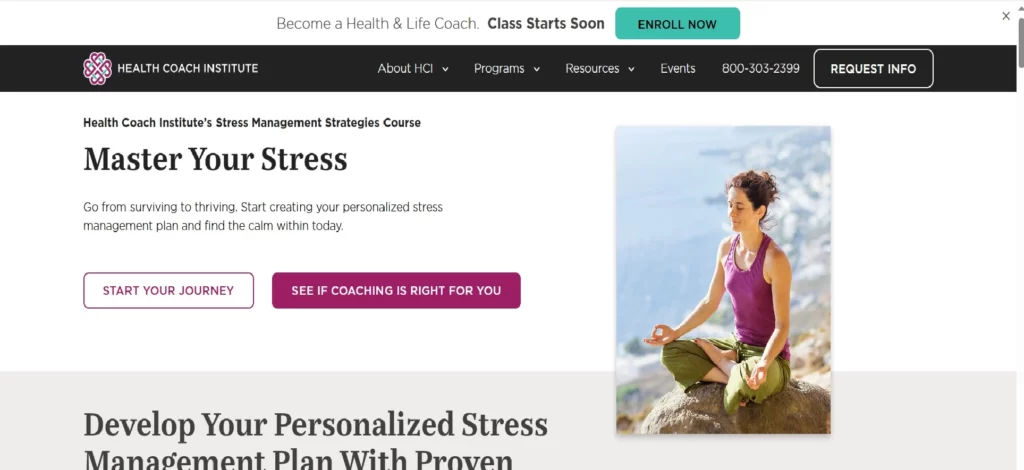
Before helping others, this program focuses on teaching you how to manage your own stress. By mastering your own strategies, you can coach clients more effectively and authentically.
- Format & length: Six self-paced modules over six weeks.
- Curriculum includes: Stress biology, emotional and physical effects, self-care practices, and designing a personal stress plan.
- Cost & accreditation: $497 (or three monthly payments of $199); no formal third-party accreditation.
- Best use case: Gain personal mastery of stress management and prepare for further advanced certification.
Stress Management Coach Salary in the United States
The compensation for stress management coaches in the United States depends on where you work, your experience level, and whether you’re self-employed or part of an organization. Here’s a clear overview of what you can expect to earn across different states:
Average hourly wage
- National average: As of September 2025, the average hourly pay for a stress management coach in the U.S. is approximately $20.
Salary range by employment type
- Full-time positions: Salaries for full-time stress management coaches can range from $49,350 to $143,936 per year, depending on experience and location.
- Remote positions: Remote stress management coaches have the potential to earn between $56 to $76 per hour, with some positions offering up to $65.95 per hour.
Salary by state
- New York: The average hourly pay is $21.55, with a range between $17.36 and $22.60.
- Texas: The average hourly pay is $18.35, with a range between $14.76 and $19.28.
- Florida: The average hourly pay is $14.72, with a range between $11.88 and $15.43.
- California: The average hourly pay is $15.67, with a range between $15.67 and $30.13.Nevada: The average hourly pay is $20.06, with a range between $16.15 and $21.06.
- Arizona: The average hourly pay is $18.36, with a range between $14.81 and $19.28.
Factors influencing salary
Several factors can influence a stress management coach’s salary, including:
- Experience: More experienced coaches often command higher rates.
- Location: Urban areas and states with higher costs of living tend to offer higher salaries.
- Employment setting: Coaches working in corporate wellness programs or healthcare settings may earn more than those in private practice.
- Certifications: Holding certifications such as Certified Stress Management Coach (CSMC) can enhance earning potential.
Conclusion
Stress management coaching goes beyond helping clients “feel less stressed.” It’s about teaching them how to understand their triggers, build healthy coping habits, and develop emotional resilience that lasts. When you combine evidence-based techniques with empathy and structure, you create lasting results for your clients. Focusing on your niche, getting certified, and practicing consistently help you grow as a credible professional in this field. Over time, your work as a stress management coach becomes not just a service, but a catalyst for better mental well-being and performance.
Simply.Coach is a leading all-in-one coaching platform built to help you manage your entire practice with confidence. From setting goals and tracking progress to automating sessions and maintaining client dashboards, everything you need is in one place. Use ready-made templates, action plans, and analytics to create real impact while staying organized. With Simply.Coach, growing your stress management coaching practice becomes smoother, smarter, and more rewarding.
Why You’ll Love Simply.Coach: Hear it From the Coaches Who Use Simply.Coach
FAQs
1. What’s the difference between stress coaching and therapy?
Many people confuse the two. As a coach, you guide clients toward practical changes in their daily habits and mindset, focusing on the present and future. Therapists, on the other hand, work with clients on deeper emotional trauma and clinical issues from the past.
2. How quickly can clients expect to see results?
Some clients feel relief after the first few sessions, especially when using relaxation or breathing techniques. However, long-term results usually take several weeks or months, depending on how consistently clients apply what they learn.
3. How long should a coaching session be and how often should you meet?
Most stress management coaching sessions last between 45 and 60 minutes. In the beginning, weekly sessions work best. Once clients start feeling more confident, you can move to biweekly or monthly sessions.
4. Can stress management coaching work remotely or online?
Yes, stress management coaching can be fully online. You can connect with clients through video calls, share worksheets or plans, and track their progress using digital tools or dashboards..
5. How can you handle clients who are unsure if coaching will help them?
You can share success stories or client testimonials to build trust. Remind them that stress coaching is about practical strategies and accountability. Change happens gradually when they commit to applying what they learn.
6. Is stress management coaching right for people with serious mental health issues?
Coaching works best for people who are stable but struggling to manage everyday stress. Clients dealing with severe anxiety, depression, or trauma should seek help from licensed mental health professionals.