
You find a course marked “free,” then reach a payment screen when you select a certificate. Free health coach certification searches mix free study, paid completion certificates and credentials with eligibility requirements. Check which one an option actually provides before committing your time or money.
Introductory learning can help you understand nutrition, behavior and coaching-related subjects. It does not automatically qualify you to work with clients, meet an employer’s requirements or earn a professional credential. The course comparison below separates the learning opportunity from the certificate, while the free-versus-paid section helps you decide what your next training step should accomplish.
TL;DR
You can begin learning about health and wellness without buying a professional training program. Alison offers free study with optional paid certificates. Coursera’s access depends on the course and enrollment option; a free trial or free sign-up does not guarantee a free full course or certificate. California’s Certified Wellness Coach certificate is free for applicants who meet its degree and experience requirements, which makes it a different option from an open online course. Use introductory study to explore the subject or fill a knowledge gap. For a professional qualification, check the exact training, assessment, practice and credential requirements before choosing a program or describing yourself as certified.
How These Health Coaching Learning Options Were Compared
Comparison scope: Two Alison courses, three university courses on Coursera and California’s Certified Wellness Coach pathway offer different kinds of learning or recognition.
Source material: Official course pages describe subjects and access. California’s certification page explains its separate eligibility requirements.
Decision criteria: Compare learning purpose, available access, certificate fees, practical preparation and the requirements attached to any credential.
Scope boundary: Paid professional-training packages and clinical degree programs require a different comparison from introductory learning options.
Before enrolling: Check what the free option includes. A course-completion certificate, professional certification and a workforce credential do not mean the same thing.
What Is Health and Wellness Coaching?
Health and wellness coaching supports clients as they choose goals, examine habits and work on changes that matter to them. The focus can include food routines, movement, sleep, stress and broader well-being within the coach’s training and scope.
Programs use “health” and “wellness” in different ways, so the title alone does not establish two fixed scopes of practice. The health and wellness coaching route includes learning how to support clients, while a specific wellness coach training pathway may have its own education and practice requirements.
Typical coaching goals include building a consistent routine, preparing for a difficult week or deciding how to follow through on a chosen action. A coach can help the client reflect and plan. Without a separate relevant clinical qualification, a health coach does not diagnose symptoms or provide medical treatment.
- Agree on a routine the client wants to try and how they will review it.
- Explore obstacles to an action, such as time, access or competing priorities.
- Discuss what the client has noticed, without treating observations as a diagnosis.
- Recognize when the concern needs another qualified professional.
The way established health and wellness coaches describe their focus can help you clarify your own learning interests. Their profiles are examples of different practices, not evidence that one short course prepares you for the same work.
Skills Required for Health and Wellness Coaching
Useful coaching skills help you understand the client’s perspective and support their decisions without taking over. The table shows how the same skill can apply to different goals while keeping the work within appropriate limits.
| Skill | Health-related coaching use | Broader wellness coaching use |
|---|---|---|
| Whole-person context | Ask how food, movement or sleep routines fit the client’s daily circumstances. | Explore how work, relationships and personal priorities affect a chosen goal. |
| Self-reflection | Notice when your own habits or preferences are shaping the advice you want to give. | Reflect on your assumptions without making the client’s experience about your own. |
| Empathy | Acknowledge frustration with an attempted change without promising a health outcome. | Recognize the client’s experience of stress or uncertainty without treating it as a clinical assessment. |
| Active listening | Check what the client means by a goal such as having more energy. | Ask which values or concerns matter most before suggesting a next step. |
| Effective communication | Help the client make an agreed action specific and understandable. | Summarize the client’s choices and invite them to correct your understanding. |
| Problem-solving | Explore a practical obstacle to an agreed food or activity routine. | Help the client compare realistic ways to make room for a priority. |
| Knowledge base | Understand the limits of general nutrition and lifestyle education, and when referral is needed. | Distinguish coaching support from mental-health assessment or treatment. |
Active listening helps you test your understanding, while effective coaching communication makes the agreed next step clearer. Neither skill is demonstrated merely by watching course videos; look for opportunities to practice and receive feedback.
Some clients may want to explore simple mindfulness practices or approaches to managing everyday stress. Check that a proposed activity fits your training, the client’s preferences and the agreed coaching purpose.
Benefits of Online Wellness and Health Coach Training
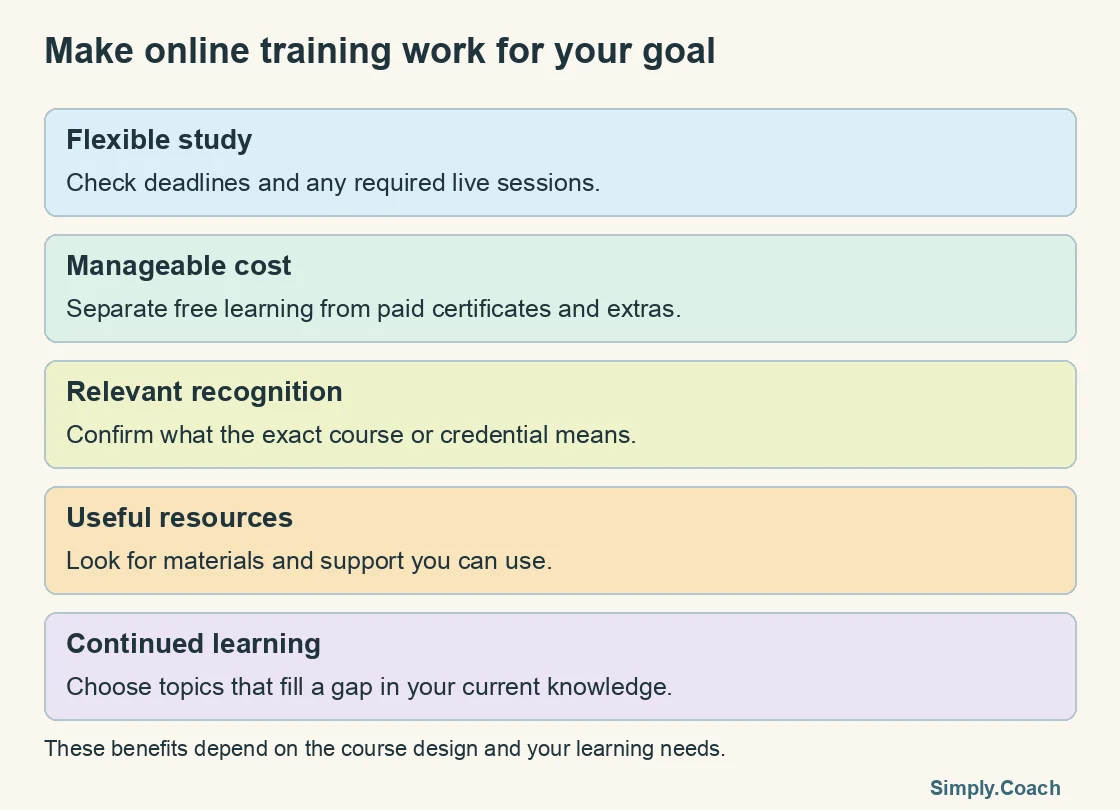
Online study can make learning easier to fit around your life, but the benefits depend on the course design. Check what a program actually provides instead of assuming every online certificate includes the same support.
1. Flexibility and convenience
Self-paced materials let you choose when to study, which can help around work or caregiving. Check for deadlines, required live sessions and assessment dates before assuming that every part of the program is flexible.
2. Cost-effectiveness
Free lessons can help you explore a subject without paying tuition, and online delivery may reduce travel costs. Check certificate fees, subscriptions and any required practical training when comparing the full expense.
3. Credibility and career requirements
A relevant qualification may help you demonstrate that you completed a particular training and assessment. Employer acceptance and professional recognition depend on the exact credential, so a paid or free completion certificate should not be assumed to meet a job requirement.
4. Access to resources, tools and support
Course materials, peer discussions and instructor feedback can help you apply what you learn when they are included. Practical coaching templates can also give your practice exercises structure, but templates do not replace supervised learning or feedback.
5. Keeping your knowledge current
Further study can help you revisit a topic you use in practice or identify a gap in your understanding. Check whether a course carries accepted continuing education credit if you need it to maintain a credential.
Learning about behavior change in coaching can help connect an abstract concept to an agreed client action. The useful question is what you can understand and practice afterward, rather than how many certificates you collect.
Six Online Health and Wellness Courses and Credential Options
The first five entries are subject courses, while the sixth is a California workforce credential with entry requirements. Compare them by their purpose and access conditions instead of treating all six as free professional health-coach certifications.
| Option | Learning time or pathway | Access and certificate | Useful starting purpose |
|---|---|---|---|
| Alison Coaching Health and Wellness | 1.5 to 3 hours | Free study; optional paid completion certificate | Introductory fitness and wellness topics |
| Alison Mental Health Studies | 1.5 to 3 hours | Free study; optional paid completion certificate | Awareness of behavior, burnout and depression |
| Yale Introduction to Psychology on Coursera | 7 modules; suggested 2 weeks at 10 hours per week | Check the enrollment option; a full course or certificate is not universally free | Foundations of psychology |
| Stanford Introduction to Food and Health on Coursera | 5 modules; about 6 hours | Check the enrollment option and certificate fee | General food and health education |
| Yale Essentials of Global Health on Coursera | 10 modules; suggested 4 weeks at 10 hours per week | Check the enrollment option and certificate fee | Public health and health disparities |
| California Certified Wellness Coach | Degree and field-experience pathway | Free certificate for eligible applicants; education has separate requirements and costs | California’s youth behavioral-health workforce |
Course time estimates describe study schedules, not how long it takes to become competent to coach independently. Check the current enrollment screen for available access and the provider’s requirements for any credential.
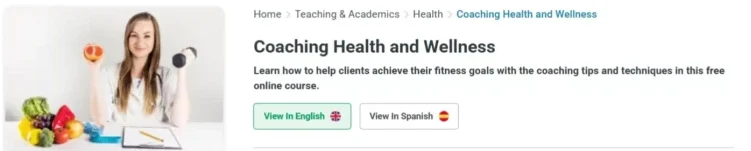
1. Coaching Health and Wellness from Alison
Alison’s Coaching Health and Wellness course introduces fitness and wellness topics, including nutrition and habits. It lists approximately 1.5 to 3 hours of learning and is published by Felix Harder.
The learning is free, while an optional Alison completion certificate is a paid product. That certificate should not be described as an accredited professional health-coach qualification or as permission to provide individualized clinical nutrition care.
- Use it to explore basic nutrition, food choices and wellness concepts.
- Review how its advice distinguishes general education from work that needs another qualification.
- Look for further coaching practice if your goal is to work with clients.
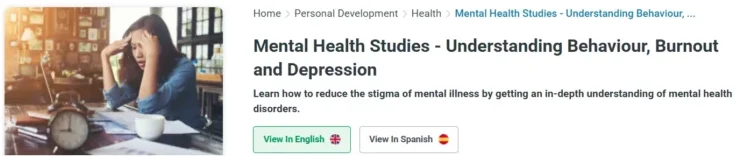
2. Mental Health Studies from Alison
Alison’s Mental Health Studies course introduces topics involving behavior, burnout and depression. The page lists approximately 1.5 to 3 hours of learning, with free study and an optional paid certificate.
This is mental-health subject education, not a mental health coaching certification. A graduate does not gain a clinical qualification from this course. Diagnosis, psychotherapy and treatment remain separate professional responsibilities.
- Use the course to build awareness of terminology and the need for appropriate support.
- Keep clinical assessment and treatment separate from a coaching role.
- Check claims against reliable clinical sources before using them in practice.
If a client brings a concern beyond your competence, the next step is an appropriate referral or support pathway. A completion certificate does not expand your scope automatically.
3. Introduction to Psychology from Yale on Coursera
Yale’s Introduction to Psychology course, taught by Paul Bloom, covers topics such as perception, learning, memory, development and social behavior. The page lists seven modules and suggests two weeks at ten hours per week.
It can help you understand ideas that arise in conversations about behavior and decision-making. It is an academic subject course, not supervised coach training or preparation to practice psychology.
Coursera’s public Q&A page says access to materials, assignments and a certificate generally requires the certificate experience. Eligible learners may have a free-trial option, and some courses offer a full-course option without a certificate; check what this enrollment actually offers.

4. Stanford Introduction to Food and Health on Coursera
Stanford’s food and health course, taught by Maya Adam, addresses food choices, eating environments and practical cooking ideas. Its page lists five modules and an estimated six hours of study.
The course is useful for general food and health education. It does not replace nutrition-coach practice training, a dietetics qualification or the authorization required for individualized clinical advice.
Check the access and certificate terms shown at enrollment rather than assuming the entire course can be audited free. If you later want focused professional study, compare nutrition coach certification options by their course content, assessment and intended scope.

5. Essentials of Global Health from Yale on Coursera
Yale’s Essentials of Global Health course, taught by Richard Skolnik, examines health systems, disease burdens, inequality and responses to public-health challenges. Its page lists ten modules and suggests four weeks at ten hours per week.
The course can broaden your understanding of the social and economic context in which people make health decisions. That is different from teaching the practical skills of a coaching session.
- Explore public-health concepts and differences in health outcomes across populations.
- Consider how resources and living conditions can affect a person’s choices.
- Keep population-level learning separate from conclusions about an individual client.
As with the other Coursera courses, check the actual access option and certificate fee. A free account or trial does not establish that all coursework and the certificate are free.

6. California Certified Wellness Coach
The California Certified Wellness Coach pathway is a workforce credential supporting preventive, nonclinical services for children and youth. The official page states that the certificate is free, but applicants must meet its education and field-experience requirements.
Its Education Pathway is for qualifying recent graduates of specified California degree programs. Its Workforce Pathway is for people with an appropriate degree and relevant experience providing direct pre-clinical behavioral-health services to children and youth.
- Check which Certified Wellness Coach level fits your degree and experience.
- Review the degree, subject, location, recency and experience requirements for your pathway.
- Separate the free certificate from the cost of obtaining the required education.
- Check any funding program’s own terms instead of assuming every applicant receives a scholarship.
The role includes services such as wellness education, individual or group support, care coordination and crisis referral within the program’s defined scope. Certified coaches must also meet recertification requirements; this is not an unrestricted free online course available to anyone.

Free vs. Paid Health Coach Training and Certification
Choose free or paid learning according to what you need it to accomplish. Price alone does not tell you whether a course includes coaching practice, recognized training or the credential required for a particular job.
| Decision | Introductory or free learning | Professional training to assess |
|---|---|---|
| Content depth | Often focuses on a defined subject or an introduction. | Check that the course covers coaching skills, ethics and appropriate scope. |
| Learning format | May offer self-paced lessons and quizzes. | Look for practice, observation, feedback and meaningful assessment. |
| Recognition | A completion certificate records the course completed. | Confirm recognition of the exact program and any separate credential requirements. |
| Cost | Free study can still involve paid certificates or subscriptions. | Compare total tuition, additional training, examination and renewal costs. |
| Career use | Can help clarify interests or supplement existing knowledge. | Match the qualification to the employer, role and work you intend to do. |
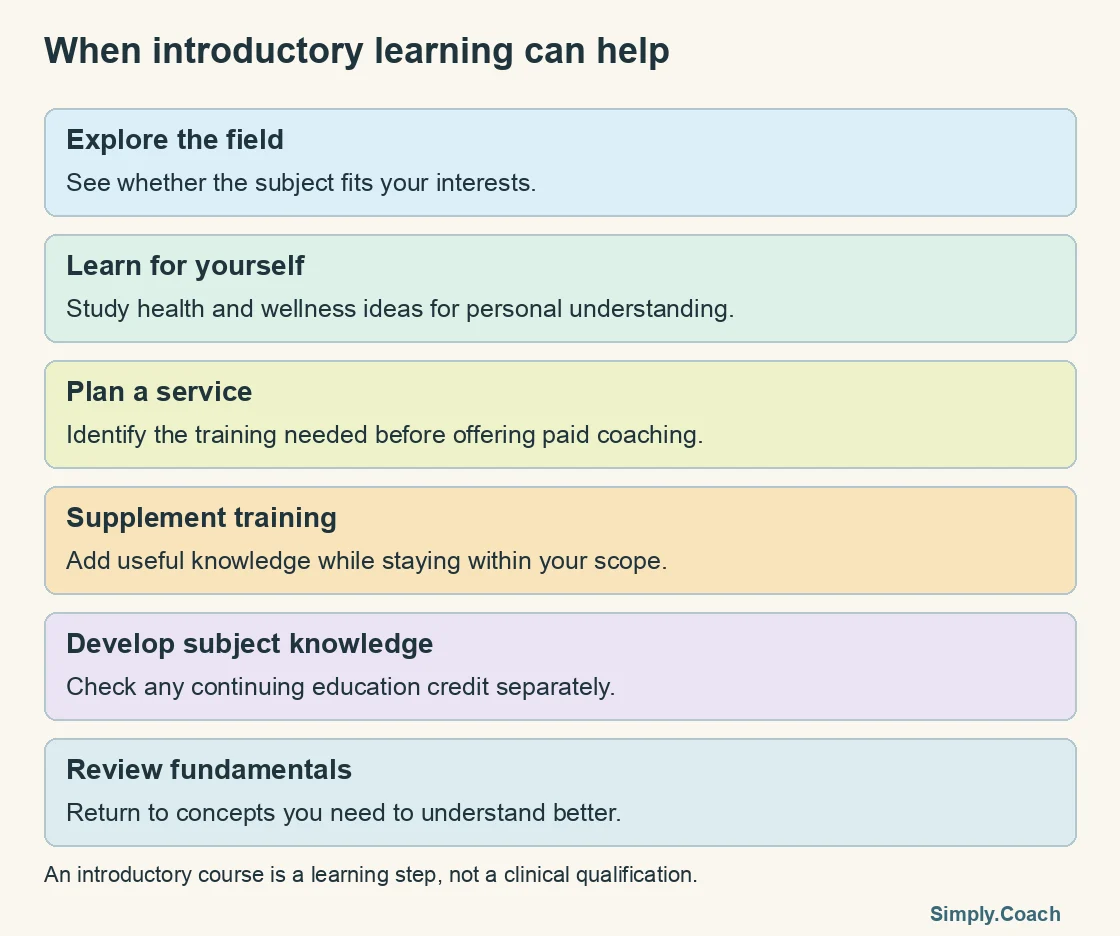
1. When free courses are a good idea
Free learning makes sense when your immediate goal is to explore a subject, understand your interests or fill a specific knowledge gap. It can also supplement an existing qualification without being presented as a new professional credential.
- Initial exploration: Learn enough to decide which area deserves further study.
- Personal understanding: Study a subject for your own knowledge without turning it into a client service.
- Service planning: Identify the skills and qualifications you would need before offering paid coaching.
- Supplemental learning: Add relevant subject knowledge while working within your existing scope.
- Professional development: Confirm any continuing education credit with the body that maintains your credential.
- Refreshing fundamentals: Revisit a concept that needs more attention in your current learning.
No-cost introductory coaching courses can help you explore general coaching alongside health-related subjects. Check whether each option includes practice and feedback rather than assuming that a subject certificate demonstrates coaching competence.
2. When professional training is the next step
Choose a professional pathway when you need a specific qualification or assessed preparation for the work you intend to offer. Start with that requirement, then identify the approved training and practical experience that lead to it.
The NBHWC examination requirements include approved training, qualifying coaching sessions, and an education or work-experience requirement. NBHWC is a credentialing body; completing an introductory course is not the same as earning its board credential.
Providers such as the Institute for Integrative Nutrition sell different course and training packages. Ask which exact package serves your intended pathway and what else is required, rather than relying on the provider’s name.
If your aim includes broader professional coaching, online ICF-accredited coach education is a separate comparison. A health subject course does not gain that recognition simply because coaches might find it useful.
Your health coach bio should state the training and credentials you actually hold. A clear description of a completed course is more accurate than a broad certification claim it cannot support.
Conclusion
Use a free learning option for a clear purpose, then decide whether you need further training or a particular credential. The distinction between access, a completion certificate and professional eligibility helps you avoid paying for the wrong next step. Record the course and credential requirements before enrolling.
When you have the preparation required for your coaching work, Simply.Coach can help organize sessions, actions and records. Keep the learning decision focused on competence and qualifications, and choose practice-management tools to support the service you are prepared to offer.
Key Takeaways
- Define your goal: Decide whether you want introductory knowledge, practical coach training or a specific credential.
- Check free access: A free account or trial does not necessarily include the full course or its certificate.
- Separate certificate types: Course completion, professional certification and a workforce credential have different meanings.
- Review California eligibility: Its free certificate has degree and experience requirements; it is not an open short course.
- Look for practice: Check how training develops and assesses coaching skills beyond subject knowledge.
- Describe credentials accurately: State what you completed without implying a license or board qualification.
- Support qualified work: Use Simply.Coach to organize the client work you are prepared and permitted to offer.
As you move from learning to appropriately qualified client work, session details and follow-ups need a consistent home. Simply.Coach’s coaching management platform helps you organize appointments, client goals and agreed actions so the day-to-day administration supports the service you have prepared to deliver.
Frequently Asked Questions (FAQs)
Are free health coach certifications accepted by employers?
Acceptance depends on the employer, role and exact qualification. An introductory course certificate may document learning, but it does not necessarily meet a professional-training or credential requirement. Read the job requirements and ask which programs or credentials qualify before choosing a course for employment.
Can I legally call myself a health coach with a free certification?
A free certificate does not establish permission to practice or use a title everywhere. Requirements vary by location and by the service you offer. Check the applicable rules and your qualification limits, especially where nutrition advice, medical conditions or mental-health treatment are involved.
What skills should a good free health coach certification teach?
Look for clear subject content, communication, active listening, ethical boundaries and an explanation of appropriate referral. If a course claims to prepare you to coach, check how it develops and assesses those skills. Videos and quizzes alone do not demonstrate that you can conduct a coaching session.
How do I know if a free health coach certification is reputable?
Check who provides the course, what the curriculum covers, how learning is assessed and what the certificate actually represents. Verify any accreditation or approval against the exact program. Separate a course-completion certificate from a professional credential, and read the access and payment terms before enrolling.
Do free health coach certifications include hands-on practice?
Some introductory courses focus on videos, readings and quizzes. Check whether an option includes observed coaching, structured practice and meaningful feedback rather than assuming these are included. Any additional practice should stay within your competence and the supervision or training arrangements appropriate to the work.
Can I upgrade from a free certification to an accredited program later?
You can pursue further training after an introductory course, but transfer credit or exemptions are not automatic. Ask the professional program whether it accepts any prior learning and what evidence it needs. Choose the next course according to the exact credential and practical preparation you want.
How to become a wellness coach for free?
You can start with free subject learning, but a professional pathway may require paid training and assessed practice. California offers a free Certified Wellness Coach certificate for eligible applicants with the required degree and experience. That pathway is different from completing a free online introductory course.