
A visitor lands on your About page, reads three lines and decides whether you are the coach for them. That is all the time a health coach bio gets. It has to say who you help, why you are credible and what to do next, and it has to say it fast, in plain words a stranger can follow.
Below you will find the five elements every health coach bio needs, how to write them so a reader acts, a complete sample you can adapt, and versions for your website, Instagram and search. Start with the opening line, then build the rest around it.
TL;DR
A good health coach bio names the client you help, the problem you solve and the proof that you can solve it, in a few short paragraphs. It starts with a line aimed at that client’s problem, states each credential in terms of what it does for the client, explains how you coach and adds one real result or testimonial. Five elements and four writing habits turn those parts into a bio that gets a reply. Write the full version for your website and a short version for social profiles, then keep both current. The sections below give sample wording for each part.
Why a Health Coach Bio Matters?
Your health coach bio is often the first thing a potential client reads, and it sets their expectations before you have spoken to them. It is the first step in:
- Building rapport
- Establishing authority
- Showing how you can make a real difference in a client’s life
More than a resume, it is a chance to explain your philosophy, your experience and how you fit the needs of the people you want to help. Without a clear bio, you risk being overlooked in a crowded field.
And the field is growing. A June 2024 report from Research and Markets, issued as a paid press release, forecasts the U.S. health coaching market rising from USD 7.47 billion in 2023 to USD 10.76 billion by 2029, a compound annual growth rate of 6.27%.
That estimate covers spending across the country. A prospective client wants to know whether your work fits a particular goal, such as finding time for lunch on a busy shift.
The same story, voice and promise should appear on your website, your social profiles and in conversation, which is what personal branding for coaches is about. Because the bio doubles as a sales page, it belongs in how you run your coaching business, next to your offers, pricing and booking process. If you plan to apply to one of the companies hiring health coaches, you will need a bio for that application too.
What are the Key Elements of a Health Coach Bio?
To stand out, a health coach bio needs five elements. Together they show your expertise, create an emotional connection and make your offer easy to understand, so the right client sees themselves in it.

1. Strong opening line
The first sentence of your bio is the hook. It should speak to your ideal client’s problem straight away, the way an elevator pitch does in one sentence.
Here is sample wording to adapt:
“Struggling with weight loss despite your best efforts? I help professionals lose weight without the stress of restrictive diets and extreme fitness routines.”
If that sounds like your client, use the part you can back up. A coach who helps people plan meals around shift work can say exactly that in the opening line.
2. Highlighting your certifications and qualifications
Your credentials build trust and show your level of expertise. The point is to frame them by what they do for the client, not to recite a list.
Here is sample wording to adapt:
“With [your certification] and specialized training in stress management, I can guide you toward sustainable health habits.”
Name each credential exactly as it is issued, and list only those you hold. If you are board certified, write out the full title. The National Board for Health & Wellness Coaching describes its board-certified health and wellness coaches as partners with clients in the behavior change process, so the full title tells a reader what the letters stand for.
3. Your unique coaching approach
What makes your coaching different? It might be your method or the way you combine several strategies. Explaining your philosophy sets you apart and reassures clients that you offer a tailored plan, not a one-size-fits-all program.
Here is sample wording to adapt:
“I believe in a whole-person approach that combines nutrition guidance with mindfulness practices, aiming for a balanced lifestyle rather than quick fixes.”
Your approach is easier to state once your purpose is clear. If you have not written yours down yet, a coaching mission statement gives you the sentence to build this line on.
4. Sharing client success and results
Potential clients want to know your coaching leads to real change. A client story or a specific outcome shows your track record.
Here is sample wording to adapt:
“I have worked with [number] busy executives to [specific change], building habits that last beyond the program.”
Use only outcomes you can document and have permission to share. If you are new and have no results yet, describe your method and the kind of client you work with instead of inventing a number.
5. Personal touch to make your bio relatable
A personal touch makes your bio read as written by a person. A few lines about your hobbies, your interests or why you became a health coach make you easier to approach.
Here is sample wording to adapt:
“When I am not coaching, I am exploring new hiking trails or testing healthy recipes. My path into health coaching began when I saw how much nutrition and wellness changed my own life.”
Pick details that are true and that a client can connect with. One or two are enough.
How to Write a Health Coach Bio That Converts
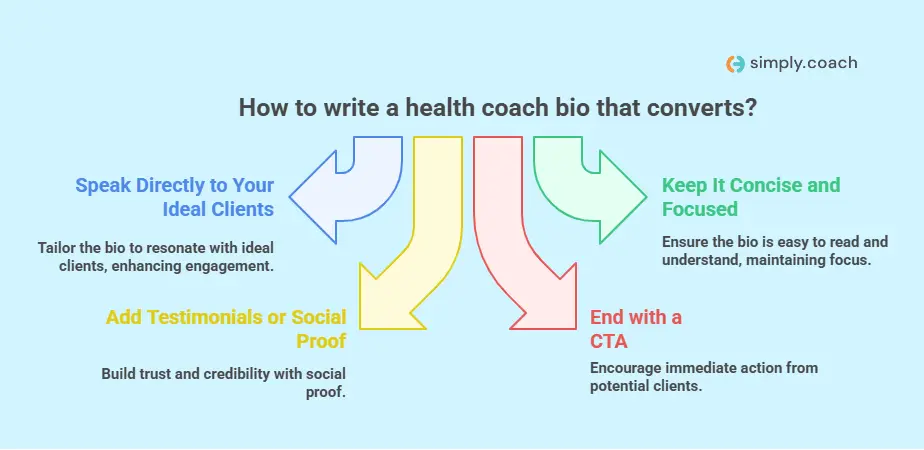
With the five elements in place, the next step is to write a bio that earns a response. A bio that converts moves the reader to take the next step and get in touch with you.
1. Speak directly to your ideal clients
A successful health coach bio speaks to the worries and wishes of your ideal clients. When you describe their challenges and offer a clear way forward, the bio feels relatable and personal.
Here is sample wording to adapt:
“Tired of restrictive diets and complicated workout plans? I help busy professionals lose weight sustainably with simple, practical strategies that fit into their lifestyle.”
This shows empathy for their situation and positions your approach as built for them.
2. Keep it concise and focused
Cover the essentials, but keep the bio short and easy to read. Skip jargon and stay with the points that define your expertise and your offer.
Here is sample wording to adapt:
“I help clients improve their health by simplifying nutrition and fitness, making it sustainable even for the busiest people.”
A concise bio lets a client understand what you do and what they gain without wading through detail.
3. Add testimonials or social proof
Short quotes from clients validate your expertise and build credibility. Ask each client for permission and use their own words, then keep the quote specific to one change they noticed.
Here is sample wording to adapt:
“After working with [coach name], I [specific result in the client’s own words].” Client first name or initials, shared with permission.
Specific client testimonials let a reader hear what changed in one person’s life. Ask what the client can do now that felt difficult when you first met. Never write a testimonial for a client who did not give one.
4. End with a clear call-to-action (CTA)
A clear next step tells the reader what to do, such as booking a consultation or joining a program.
Here is sample wording to adapt:
“Ready to start building habits that last? Book a free consultation today and let us find the right first step.”
A good call to action gives a potential client one easy way to reach you.
A Complete Health Coach Bio Example
The samples above are single sentences. Here they are put together into one bio you can adapt. It is an illustration with placeholders, not a real coach, so replace every bracket with a true detail.
Tired of diets that work for a month and then fall apart? I help busy professionals build eating, movement and stress habits they can keep. I am a [credential] with training in [specialty], and I coach one-on-one and in small groups. My approach is simple: we choose one change at a time, test it in your real week and adjust. [One documented result, such as the number of clients you have worked with and the change they made.] Outside coaching, I [a true personal detail]. If you would like to see whether we are a good fit, book a free consultation.
Read it once more and you can find each element in order: the opening line, the credential, the approach, the proof, the personal touch and the call to action. If a sentence does not belong to one of them, cut it.
Formatting and Presentation Tips
A bio has to read well as well as say the right things. How you lay it out changes how many people finish it.
1. Structure your bio for easy reading
Keep your bio easy to scan with clear headings, short bullet points and brief paragraphs. On a long page, split it into sections such as “About Me,” “Certifications,” “Coaching Approach” and “Success Stories,” so clients can find what they care about quickly.
2. Use a professional photo
A clear, professional photo makes the bio feel personal and approachable. A friendly, confident photo helps a potential client feel at ease before they have met you.

Adapting Your Health Coach Bio for Digital Platforms
Your health coach bio should fit the place where it appears. A website, a social profile and a coaching platform each give a reader a different amount of time, so each needs its own version. Where you work changes the emphasis too, and the roles in where health coaches work range from independent practice to clinics and employer programs.
| Where it appears | How much to write | What to lead with |
|---|---|---|
| Website About page | A few short paragraphs | The client you help, your approach and a real result |
| Coaching platform profile | One or two short paragraphs | Credentials and the kind of change you support |
| Instagram profile | One or two lines | Your title, your niche and one next step |
| Spoken introduction | One or two sentences | The client you help, then your name |
1. Bio for your website’s “About Me” page
For your website, you can go into more detail about your approach, your certifications and your client stories.
A website bio has room for a scene from a first meeting:
“If work keeps interrupting your plans to eat lunch, we can start there. In our first session, we look at your calendar together and choose one change you want to try before we meet again.”
2. Bio for social media profiles
On social media, keep your bio short and clear. Put your title first, your niche second and a next step last.
Here is sample wording to adapt:
“Certified Health Coach | Helping professionals feel healthy and energized | DM for a free consultation”
Improving Your Health Coach Bio for Search Engines
For potential clients to find your bio online, it has to use the words they type. Someone looking for a coach may search for your specialty, your location or a particular health goal. Use the words clients use when they first describe why they came to you.
1. Use relevant keywords
Include phrases tied to your niche, such as “health coach for weight loss,” “whole-person health coaching” or “stress management coaching.” Use them where they fit in a sentence and write for the reader first, since a bio stuffed with keywords is hard to read and does not help you win a client.
2. Keep it fresh and updated
Your bio should change as you gain new experience, training or results. Update it when you earn a certification, finish advanced training, share a client success story, appear in the media or speak at an event. You can also add partnerships with reputable brands or programs you have joined.
How Simply.Coach Supports Your Health Coaching Practice
A strong bio brings clients in. Once they arrive, you need a way to manage the coaching itself, and Simply.Coach is built around that part of the work. For example, a client who books a first call needs a time to meet and a place to keep the goal you agree on.
- Client goals and progress: record a client’s goals, attach actions to each one and use progress check-ins, all visible on the client dashboard.
- Session scheduling: clients book from your public Showcase Page within the availability you set, your Google, Apple or Microsoft calendars connect, and time zones convert automatically.
- Action plans: action plans record the tasks a client takes toward each goal, and an action dashboard shows what is upcoming or overdue so you can send a reminder.
- Resource sharing: share articles, videos and other resources with each client in one place instead of by email or messaging.
- Invoicing and payments: send invoices with payment links, run payment plans and retainers, and collect payment through Stripe or PayPal with the invoicing and payment tools.
Conclusion
A well-written health coach bio helps the right client choose you. When it names the person you help, backs your credentials with what they mean for the client, explains how you coach and gives one honest piece of proof, a stranger can decide in seconds whether to get in touch.
Keep it clear, true and short, write a version for each place it appears, and revisit it as your work grows. A bio you update is one that keeps matching the clients you want.
Key Takeaways
- Lead with the client: open with the problem your ideal client has, not with your own history.
- Translate credentials: name each one exactly and say what it means for the person reading.
- Only real results: use outcomes you can document and testimonials a client gave you permission to share.
- Say how you coach: one line on your method tells a client what working with you will be like.
- One clear next step: end with a single action, such as booking a consultation.
- Fit the platform: write a longer version for your website and a one-line version for social profiles.
- Keep it current: update the bio when your training, niche or results change.
Once the bio brings in new clients, you still need one place to hold their goals, sessions and payments. Simply.Coach keeps each client’s goals, action plans and progress together, so you spend your time coaching. See how its client management features work for a health coaching practice.
Learn more about Simply.Coach with these detailed videos
Introduction to Simply.CoachWhy You’ll Love Simply.Coach

Frequently Asked Questions (FAQs)
How do you introduce yourself as a health coach?
Lead with the person you help and the change you support, then give your name and one line of proof. For example: I help busy professionals build eating and movement habits they can keep. Keep it to two sentences you can say in one breath.
What is the purpose of health coaching?
Health coaching helps people make lasting changes to their health habits. A coach sets realistic goals with the client, works through obstacles and builds action plans in areas such as nutrition, movement, sleep and stress. Your bio should make that purpose clear in a sentence.
Can you suggest a health coach bio for Instagram?
Here is an original sample to adapt: Health Coach | Helping busy professionals build habits that last | Nutrition, movement and stress | DM me to book a free consultation. Replace the title with your real credential and keep each part to a short phrase.
What can be a perfect example of a mental health coach bio?
There is no perfect bio, only one that fits your client. An original sample: I coach people who feel stuck and stressed to build calmer routines through mindfulness and small daily habits. I do not provide therapy or diagnosis. Book a call to see if we fit.
What is a good bio for a coach?
A good bio names the client you help, backs your credentials with what they mean for that client, explains how you coach, shares one result you can document and ends with one next step. It is short, true and easy to scan.
How long should a health coach bio be?
Match the length to the place. A website About page can run a few short paragraphs, a coaching platform profile one or two, an Instagram bio one or two lines and a spoken introduction one or two sentences. Write the long version first and cut from it.
How often should I update my health coach bio?
Update it whenever your training, niche, results or offer change, and read it again at least once a year. Add a new certification, a documented client result or a speaking appearance when it happens, and remove anything that is no longer true.