
As a life coach, you often meet clients who seem motivated and ready to change, yet their progress can stall despite their best intentions. Many clients struggle silently with fears, limiting beliefs, or conflicting priorities that they may not even be fully aware of themselves. In fact, 73% of coaching clients report significant improvements in relationships, communication, and work performance, yet many still grapple with unaddressed obstacles. These hidden challenges can quietly hold clients back and prevent them from achieving lasting results.
Understanding these hidden challenges is not just beneficial, it is essential to delivering meaningful outcomes. By uncovering what truly holds a client back, you can tailor your sessions, set actionable goals, and help clients achieve breakthroughs that are both lasting and transformational.
In this blog, you will discover 12 powerful life coaching questions designed to reveal these hidden obstacles. Each question is crafted to help you uncover the underlying issues, understand the client’s mindset, and guide them toward actionable solutions that drive real progress.
Key Takeaways
- Hidden challenges often block client progress and remain unnoticed without targeted questioning.
- Asking precise coaching questions helps uncover internal beliefs, recurring patterns, and external obstacles.
- Understanding these challenges allows you to design actionable strategies linked to measurable goals.
- Using structured workflows—Form → Goal Setting → Action Plan → Progress Check-in → Nudge—ensures clients stay accountable.
- Simply.Coach provides tools to capture responses, track progress, and automate reminders, making the coaching process efficient and effective.
- Download The Ultimate Guide to Asking Powerful Life Coaching Questions to enhance your questioning skills and uncover hidden client challenges.
Why Understanding Hidden Challenges Matters
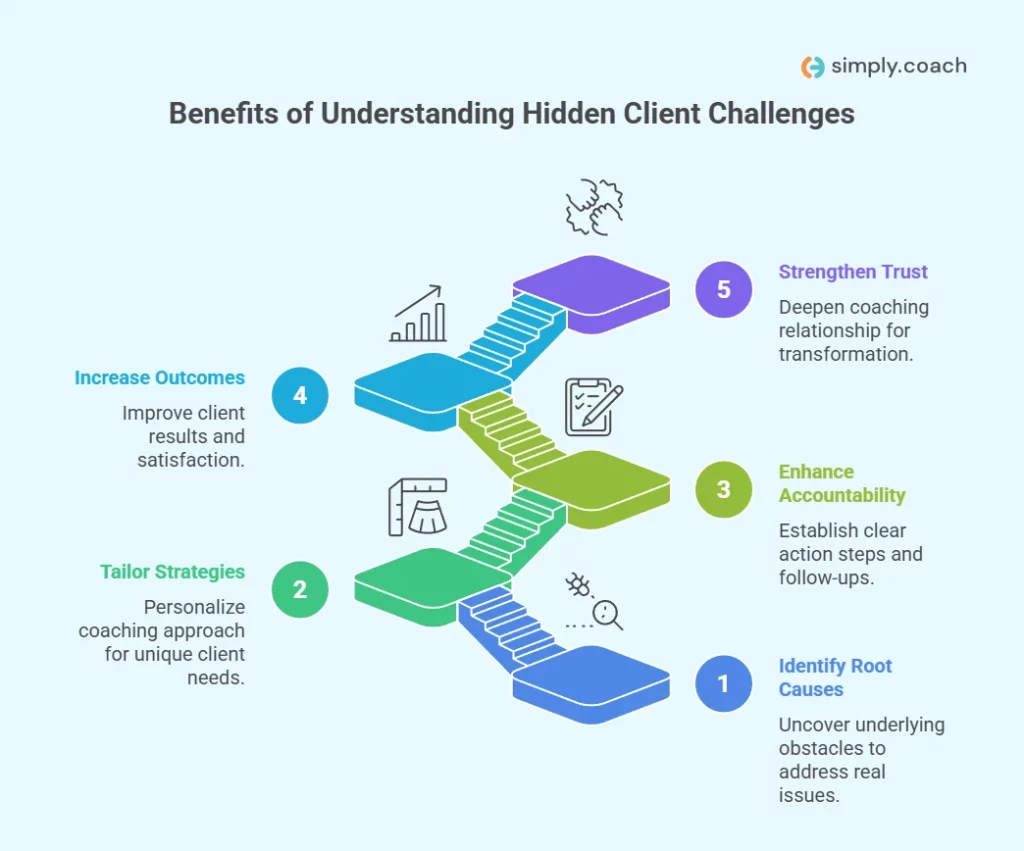
As a life coach, recognizing and addressing your clients’ hidden challenges is one of the most impactful steps you can take. Surface-level conversations rarely reveal the barriers that truly impede progress. Hidden challenges often include internal conflicts, unspoken fears, limiting beliefs, or patterns of behavior that clients may not even consciously notice. Understanding these obstacles allows you to:
- Identify root causes of stagnation: Clients may consistently fall short of their goals because underlying obstacles are never addressed. By uncovering these root causes, you can design strategies that target the real issues rather than just the symptoms.
- Tailor coaching strategies effectively: Knowing what truly holds a client back allows you to personalize your approach, set realistic milestones, and create actionable plans that align with their unique context.
- Enhance accountability and engagement: When hidden challenges are identified, you can establish clear action steps and follow-ups. Clients are more likely to stay committed when they feel understood and supported in overcoming their real obstacles.
- Increase measurable outcomes: Addressing challenges early improves client results, whether in relationships, career growth, or personal development. It also increases client satisfaction and long-term retention, as clients experience tangible, meaningful progress.
- Strengthen trust and credibility: Clients open up more when they see that you are focused on understanding their true struggles. This deepens the coaching relationship and fosters an environment where transformation is possible.
By focusing on hidden challenges, you shift coaching from reactive advice-giving to proactive, insight-driven guidance. This approach not only accelerates results but also positions you as a coach who delivers real transformation.
Simply.Coach Life Coaching Track
For coaches who want to take their skills to the next level, the Simply.Coach Life Coaching Track is an invaluable resource.This track provides actionable content to help you fully understand the life coaching profession, get certified, start and grow your business, attract clients, improve your coaching skills, and leverage the right tools and technology.By equipping yourself with these resources, you’ll be better prepared to uncover your clients’ hidden challenges and guide them toward real, lasting progress.

12 Coaching Questions to Reveal Your Client’s Hidden Challenges
To help your clients break through barriers, you need to ask questions that go beyond surface-level answers. Many of your clients may present a version of themselves that hides fears, limiting beliefs, or recurring patterns that quietly prevent progress. These twelve questions are designed to help you identify the internal and external obstacles your clients face, understand their impact on their goals, and create actionable strategies for transformation. By asking these questions thoughtfully, you can guide your clients toward insights that drive measurable results.
1. What’s been standing in the way of your progress lately?
This question invites your clients to reflect deeply on what has slowed their recent achievements. It encourages them to articulate obstacles they may have overlooked or been avoiding.
- Coaching tip: Ask in an open and curious tone, such as “I want to understand what might be slowing your progress. Can you share what comes to mind?” Follow up by exploring specific examples or situations they mention. Validate their experiences and encourage them to differentiate between internal and external barriers.
- Why this matters: When you uncover what is directly hindering your client’s progress, you can address real issues rather than temporary symptoms. This clarity helps your clients focus on actionable solutions and prevents repeated frustration.
Also read: 80 Wheel of Life Coaching Questions to Ask in Your Sessions for Deeper Client Insights
2. Can you describe a recent situation where you felt stuck or frustrated?
Asking for a concrete example helps your clients move from abstract feelings to real-life scenarios. It encourages them to analyze their experiences and emotions, providing insight into recurring obstacles.
- Coaching tip: Encourage storytelling by prompting, “Walk me through what happened and how you felt in that situation.” Listen carefully for patterns in behavior, emotional triggers, and responses. Use reflective questions like “What do you think contributed to this outcome?” to help your client gain deeper insight.
- Why this matters: Specific situations reveal the context of hidden challenges and highlight triggers your clients may not consciously notice. This allows you to target strategies precisely and support your clients in responding more effectively.
3. What recurring patterns do you notice that slow your progress?
This question helps your clients identify habits or behaviors that consistently create obstacles. Recognizing these patterns is key to addressing long-term challenges.
- Coaching tip: Ask your clients to reflect on both personal and professional patterns. You can prompt, “How often do these situations occur and what usually triggers them?” Encourage them to explore how these patterns influence outcomes and decision-making.
- Why this matters: When your clients understand recurring patterns, you can design interventions that target systemic issues rather than one-off problems. This approach leads to lasting improvement and helps them avoid repeated setbacks.
4. Are there beliefs or assumptions holding you back?
Clients often operate under internalized assumptions or limiting beliefs that subtly influence their choices and actions.
- Coaching tip: Ask this question with curiosity, such as “What beliefs about yourself or your situation might be influencing your decisions?” Encourage your client to explore the origin of these beliefs and examine whether they are serving or restricting them.
- Why this matters: Limiting beliefs are powerful hidden obstacles. By helping your clients recognize and challenge them, you empower them to replace restrictive thinking with more constructive perspectives that support their growth.
Read more: Effective Coaching Check-In Questions: Unlock Deeper Client Insights and Growth
5. What external obstacles, such as people, resources, or systems, affect your progress?
External factors can quietly hinder your clients’ ability to achieve their goals. This question draws attention to environmental or systemic barriers they may have overlooked.
- Coaching tip: Encourage specificity by asking, “Who or what in your environment makes achieving your goals difficult?” Explore both direct and indirect influences and guide your clients to consider potential solutions or workarounds.
- Why this matters: Recognizing external obstacles helps you design practical strategies that account for real-world constraints. Your clients are more likely to stay motivated and take consistent action when they understand and address these factors.
6. When have you felt challenged and how did you respond?
Reflecting on past challenges helps your clients identify coping mechanisms and resilience patterns, giving you insight into how they handle stress and setbacks.
- Coaching tip: Ask your clients to share both successful and less effective responses. Use prompts such as “What did you learn from that experience?” and explore how they might approach similar challenges differently in the future.
- Why this matters: Understanding how your clients respond under pressure allows you to reinforce productive behaviors and address unhelpful reactions. This insight helps them navigate future challenges more effectively.
7. What risks or fears have prevented you from taking action?
Fear often underlies inaction, but your clients may not openly acknowledge it. This question helps uncover those hidden influences.
- Coaching tip: Approach with empathy. Ask, “What would happen if you tried this and it did not work out?” Encourage them to explore emotional impacts and potential consequences, not just outcomes.
- Why this matters: When you uncover fears, you can create strategies that reduce perceived risk and build confidence. Your clients are more likely to take meaningful steps forward when they feel supported in confronting their fears.
8. Which past failures still influence your current choices?
Clients’ past experiences can unconsciously shape decisions and limit growth. This question encourages them to reflect on how history affects current behavior.
- Coaching tip: Ask, “How have past experiences shaped the way you approach challenges today?” Guide your clients to identify lessons learned while distinguishing between useful insight and limiting narratives.
- Why this matters: Identifying the influence of past failures helps your clients break free from outdated thinking and approach challenges with a fresh perspective, which increases their confidence and ability to make bold choices.
Also read: Effective Mindset Coaching Questions to Unlock Client Breakthroughs
9. Are there conflicts between your goals and current priorities?
Your clients may struggle when their daily actions do not align with their long-term objectives.
- Coaching tip: Help them map their priorities against their goals. Ask, “Which of your current commitments support your goals and which conflict with them?” Work together to identify adjustments that increase alignment and focus.
- Why this matters: Clarifying these conflicts helps your clients make intentional decisions and concentrate energy on high-impact activities. This reduces wasted effort and accelerates progress toward meaningful goals.
10. Who or what creates friction in your journey toward your goals?
Interpersonal or systemic friction can create hidden resistance. Clients may not immediately recognize sources of tension that impact their actions.
- Coaching tip: Ask your clients to reflect on relationships, organizational dynamics, or societal pressures. Prompt them with, “How does this friction influence your decisions or actions?” Help them explore strategies to manage or navigate these challenges.
- Why this matters: Understanding sources of friction allows you to support your clients in mitigating resistance and maintaining forward momentum. This ensures smoother progress toward their goals.
11. What would be different if these challenges were removed?
This question encourages your clients to envision a future without obstacles. It clarifies desired outcomes and the potential impact of overcoming challenges.
- Coaching tip: Use visualization prompts such as, “Imagine your progress without these barriers. What would your day, work, or mindset look like?” Capture insights for actionable goal setting.
- Why this matters: Visualizing success motivates clients and provides a clear picture of what they are working toward. It also helps you and your clients create action plans that are focused on meaningful change.
Know more: A Guide to Using Vision Boards in Coaching to Help Clients
12. How can you or we take the first step to overcome these barriers?
Turning insights into practical actions is critical for progress. This question moves clients from reflection to implementation.
- Coaching tip: Collaborate to define small, achievable first steps. Ask, “What is the one action you can take today to start moving past this challenge?” Support them in tracking these actions and setting reminders to maintain momentum.
- Why this matters: Immediate action transforms insights into results. Your clients build accountability, confidence, and tangible progress while you guide them through a structured path for overcoming hidden challenges.
The Ultimate Guide to Asking Powerful Life Coaching Questions
To uncover hidden challenges effectively, mastering the art of asking the right questions is essential.“The Ultimate Guide to Asking Powerful Life Coaching Questions” helps you explore all aspects of life coaching questions, from understanding their importance to crafting ones that leave a lasting impact on your clients.You can use this guide to expand your questioning skills, gain deeper insights into client behavior, and enhance every coaching session.

Turning Insights into Action: A Workflow for Life Coaches
As a life coach, uncovering your client’s hidden challenges is only the first step. The real impact comes from analyzing responses, identifying recurring patterns, and translating insights into clear, actionable goals. By linking challenges to specific objectives, you provide clients with a roadmap that drives measurable progress and keeps them accountable.
Here’s a practical workflow using Simply.Coach’s all in one life coaching platform to turn insights into action:
- Forms: Capture client responses to your coaching questions with Simply.Coach forms, ensuring you have structured data on hidden challenges.
- Goal setting: Define specific, measurable goals based on the obstacles identified, giving your clients a clear vision of what overcoming these challenges looks like.
- Action plan: Break goals into actionable steps and assign them to clients, ensuring each challenge has a tangible next move.
- Progress check-in: Schedule automated check-ins to monitor how clients are advancing toward their goals and addressing challenges.
- Nudges: Send timely reminders or positive reinforcement to keep clients on track and maintain momentum between sessions.
By following this workflow, you create a structured system that not only highlights hidden obstacles but also guides your clients toward meaningful growth and sustained success.
Also read: Why Simply.Coach is the Best Life Coaching Platform for Your Business
Conclusion
Understanding your client’s hidden challenges is critical for delivering meaningful coaching outcomes. By asking precise, targeted coaching questions, you uncover the internal beliefs, recurring patterns, and external obstacles that quietly hinder progress. Analyzing these insights, linking them to clear goals, and implementing structured action plans ensures that your clients move past barriers, stay accountable, and achieve measurable results. The key is not just identifying challenges but creating a roadmap that transforms insights into tangible growth.
To make this process seamless, Simply.Coach provides tools to capture client responses, set goals, assign action steps, track progress, and send timely nudges. With dashboards, forms, and automated check-ins, you can streamline your coaching workflow and focus on what matters most to helping clients overcome obstacles and reach their full potential.
FAQs
1. What are the most common hidden challenges clients face in life coaching?
Clients often grapple with limiting beliefs, fear of failure, lack of clarity, low self-esteem, and unresolved past traumas. Identifying these hidden barriers is crucial for effective coaching.
2. How can I identify hidden challenges in my clients during sessions?
Active listening, asking open-ended questions, observing non-verbal cues, and creating a safe space for clients to express themselves can help uncover underlying issues.
3. Why do clients sometimes resist acknowledging their hidden challenges?
Fear of judgment, lack of self-awareness, or previous negative experiences can cause clients to avoid confronting their true obstacles.
4. How can I help clients reframe their limiting beliefs?
Encourage clients to challenge negative thoughts, explore alternative perspectives, and focus on their strengths and past successes to shift their mindset.
5. What role does emotional intelligence play in uncovering hidden challenges?
High emotional intelligence allows coaches to empathize with clients, recognize emotional cues, and build trust, facilitating the discovery of underlying issues.