
Bookkeeping for therapists often gets overlooked until something goes wrong; missed payments, unclear income, or last-minute tax stress. You likely started your practice to focus on clients, not spreadsheets, but without a clear financial system, even a steady client load can start to feel unpredictable.
If you are trying to stay on top of your income, manage expenses, prepare for taxes, or simply understand how your practice is performing, bookkeeping becomes essential. It directly affects your pricing decisions, cash flow stability, and the long-term growth of your therapy practice.
Updated for 2026, this guide walks you through bookkeeping for therapists using a practical, no-fluff approach. You will learn how to set up a simple system, avoid common mistakes, and apply a clear framework that works whether you are solo, part-time, or scaling your practice.
Key Takeaways
- Bookkeeping for therapists is the foundation for tracking income, expenses, and overall practice health, not just a tax-time activity.
- Cash basis accounting works best for most therapists with direct, upfront payments and simple revenue models.
- Accrual or hybrid methods become relevant when dealing with insurance reimbursements, invoices, or complex income streams.
- The “primary revenue” rule helps you choose the right method based on how your practice actually earns money.
- As your services expand (programs, courses, group practice), your bookkeeping setup should evolve accordingly.
- Common mistakes come from misalignment, choosing the wrong method, not updating systems, or relying too heavily on tools.
- A structured approach to bookkeeping improves financial clarity, reduces errors, and supports long-term practice growth.
- Simply.Coach supports bookkeeping accuracy by structuring session, program, and client data, making it easier to match income with actual services delivered and maintain consistent financial records.
Bookkeeping For Therapists: What’s Relevant for You in 2026
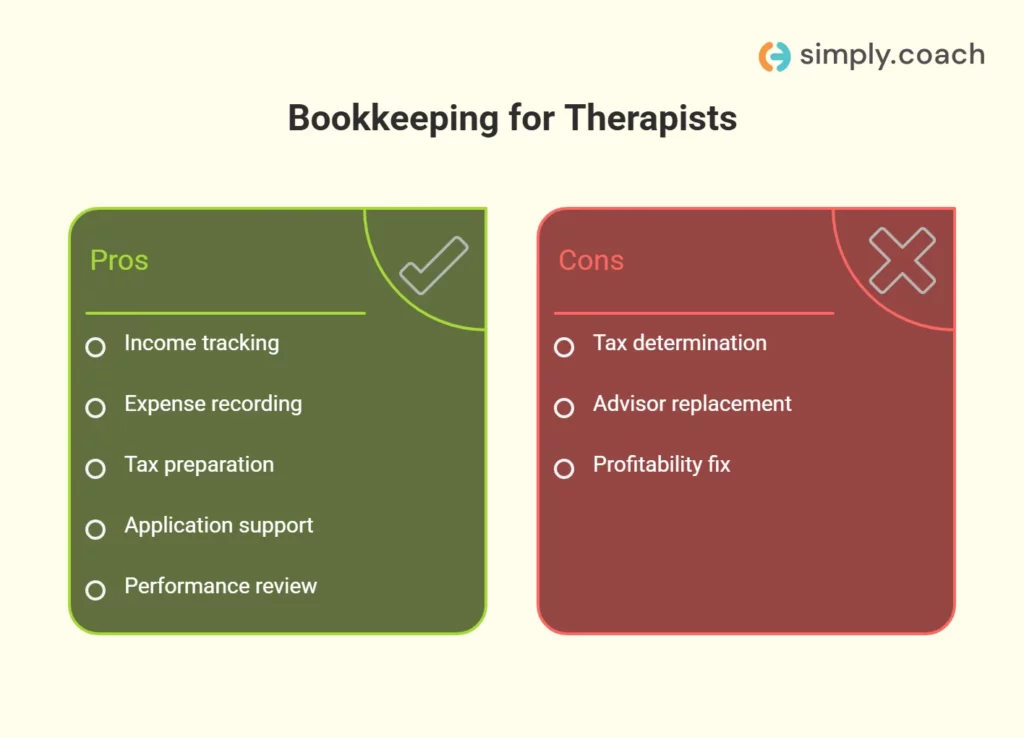
Bookkeeping for therapists means consistently recording and reviewing how money moves through your practice; what you earn from sessions, when payments actually come in, what you spend to run the practice, and what remains available.
In day-to-day terms, this is not a one-time setup. You are logging income as sessions are delivered, categorising expenses in a way that reflects your work, and keeping records updated so you are not reconstructing data during tax season or audits.
Where this shows up most clearly is in how you handle different types of income. A single-session private pay client, a prepaid package, and an insurance reimbursement do not behave the same way financially. If all of them are tracked the same way, your monthly numbers can quickly become misleading.
Where bookkeeping shows up in your actual workflow
If your system is working, you should be able to do the following without second-guessing:
- Track income based on how services are delivered: Separate 1:1 sessions, group work, and programs instead of recording everything as a single total.
- See what has been earned vs what has been received: Especially relevant if you deal with delayed payments, reimbursements, or prepaid sessions.
- Categorise expenses in a way that reflects your practice: For example, supervision, clinical tools, continuing education, and admin software, rather than generic labels.
- Match payments to actual sessions or services delivered: This helps you catch missed payments, partial payments, or unused sessions early.
- Keep records ready for review at any point: Whether for taxes, an accountant, or a loan application, without needing to clean up months of data.
What bookkeeping does not handle (and where confusion starts)
A clean bookkeeping system gives you visibility, but it does not replace financial decisions.
- It does not optimise your taxes, you still need planning or a professional for that
- It does not tell you what to charge or which services to prioritise
- It does not correct inconsistent income patterns, it only makes them visible
Why structure matters early
Most therapy practices do not stay limited to one income stream. Over time, you may add group programs, workshops, or hybrid service models.
If your bookkeeping is not structured around how you actually earn, it becomes harder to answer basic questions:
- Which services are stable vs unpredictable?
- Where is income delayed or uneven?
- What is contributing most to your monthly revenue?
Setting this up early keeps your numbers usable as your practice evolves, instead of needing to rebuild your system later.
Also Read: 11 Group Therapy Techniques Every Therapist Should Use in 2026
Cash vs Accrual Accounting for Therapists: Which Should You Choose?
When setting up bookkeeping for your therapy practice, the key decision is how you record income and expenses. The method you choose affects how your revenue appears, how predictable your cash flow looks, and how easy it is to review your numbers over time.
The choice is not about complexity, it is about matching your bookkeeping to how your income actually flows.
1. Cash basis accounting (best for direct-pay practices)
With cash basis, you record income when you receive payment and expenses when you pay them. This keeps your records aligned with your bank balance, which makes it easier to track what is currently available.
This works well if most of your income is collected at or around the time of the session.
Where it fits in practice:
- You charge clients per session and collect payment upfront or immediately after
- You run small group sessions or workshops with upfront payments
- You do not rely heavily on invoices or delayed reimbursements
What to watch for:
- Prepaid packages can inflate income in the month you receive payment
- Months with delayed payments can appear weaker than they actually are
- You do not see what is owed to you, only what has been received
2. Accrual accounting (for delayed or layered income)
With accrual accounting, you record income when it is earned (when the session is delivered), even if payment comes later. Expenses are recorded when they are incurred, not when paid.
This gives a more accurate view of performance over time, especially when payments are not immediate.
Where it fits in practice:
- You work with insurance and receive reimbursements weeks later
- You invoice clients or organisations instead of collecting upfront
- You manage contracts, retainers, or multi-session agreements
What to watch for:
- Requires tracking receivables (what clients or insurers owe you)
- Your reported income may not match your bank balance at any given time
- Needs more consistency in how you record and review entries
3. Hybrid approach (when your revenue model is mixed)
If your practice includes both upfront payments and delayed income, a strict cash or accrual system may not fully reflect your situation.
In this case, many therapists use a hybrid setup – keeping day-to-day tracking simple while adding structure where needed.
What this looks like:
- You track regular sessions using cash basis
- You separately track pending insurance payments or invoices
- You adjust for prepaid packages or outstanding income during reviews or tax reporting
Where this helps:
- You avoid overcomplicating your system early
- You still maintain visibility into delayed or structured income
- You can transition to full accrual later if needed
How to choose the right method (without overthinking it)
Instead of choosing based on what sounds more “professional,” look at your dominant revenue pattern.
- If most of your income is collected upfront → cash basis will be sufficient
- If a large portion is delayed, invoiced, or reimbursed → accrual or hybrid will give better visibility
A simple rule to apply: If more than half your income is not received immediately after service delivery, cash basis alone will start to create blind spots.
Where therapists usually run into issues
Even after choosing a method, problems tend to come from how it is applied:
- Recording all income the same way, even when timing differs
- Ignoring prepaid sessions or packages in cash-based systems
- Not tracking outstanding payments in insurance-heavy practices
- Switching methods without adjusting past records
The method itself is rarely the issue; misalignment between your system and your actual revenue flow is.
Also read: Top 18 Apps for Therapists to Use With Clients in 2026
When Cash Basis Accounting Stops Working for Your Therapy Practice
Cash basis works well when your income is simple and collected upfront. But as your practice evolves, there comes a point where it stops reflecting what is actually happening in your business.
The shift is about timing and structure of income. When payment and service delivery start to separate, cash basis begins to create blind spots.
Signs your current setup is no longer giving you clarity
You do not need to switch methods early, but if you notice these patterns consistently, your bookkeeping setup is likely misaligned:
- Your income looks inconsistent, even when your schedule is full: This often happens when insurance payments or invoices are delayed, but sessions are being delivered regularly.
- You cannot clearly see how much money is owed to you: If you rely only on what has been received, you lose visibility into pending payments.
- Large upfront payments distort your monthly numbers: Prepaid packages or programs can make one month look unusually high and the following months lower than expected.
- You struggle to explain your numbers to an accountant or lender: Especially when reported income does not match actual work completed.
When accrual or hybrid becomes more useful
If your practice includes any of the following, cash basis alone may not be enough:
- Insurance-based billing: You deliver sessions now, but payments come weeks later. Without tracking receivables, you cannot see what you have actually earned.
- Installments, packages, or prepaid programs: Income needs to be spread across delivery, not recorded all at once.
- Invoices or organisational contracts: Work is completed before payment is received, which requires tracking outstanding amounts.
- Multiple revenue streams with different timing: For example, private pay (immediate) + insurance (delayed) + workshops (upfront).
What to do instead (without overcomplicating your system)
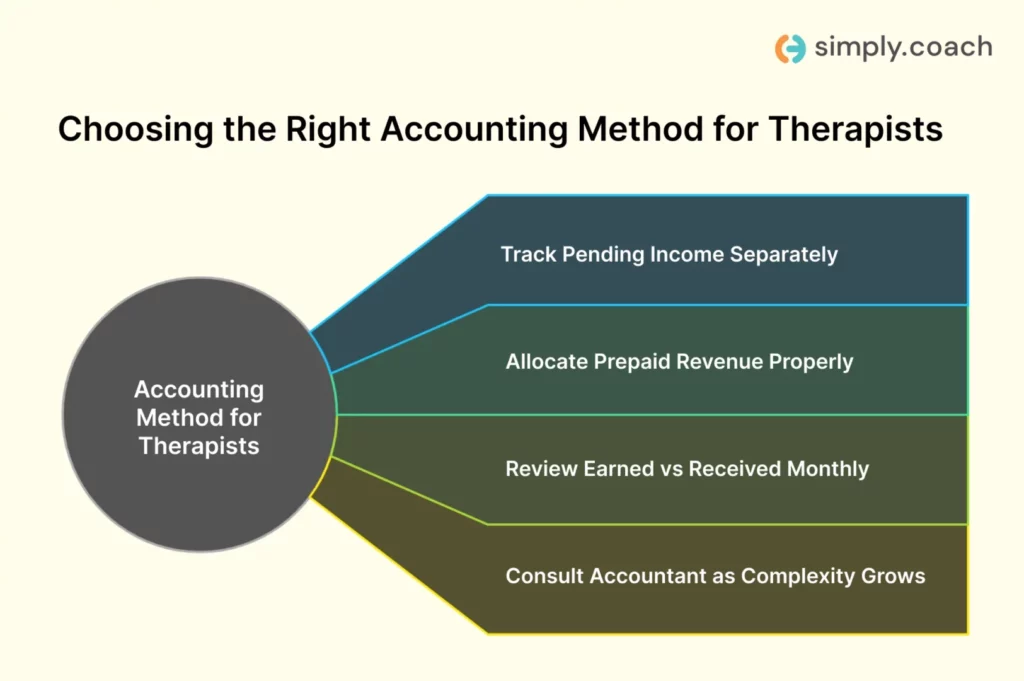
You do not need to fully switch to accrual overnight. Start by introducing structure where your current system falls short.
- Track pending income separately: Maintain a simple receivables view for insurance claims, invoices, or unpaid sessions.
- Break out prepaid revenue across delivery: Even if you use cash basis, manually track how many sessions are “owed” from packages.
- Review earned vs received income monthly: This gives you a more accurate view of performance without changing your entire system.
- Work with an accountant when complexity increases: Especially if insurance or contracts become a major part of your revenue.
The practical rule to follow
Do not switch methods because your practice is growing; switch when your current method stops answering basic questions:
- How much have I actually earned this month?
- How much is still pending?
- Does this income reflect work delivered or just payments received?
If your current setup cannot answer these clearly, it is time to introduce accrual logic, either partially or fully.
What most therapists get wrong here
- Switching to accrual too early and overcomplicating their system
- Staying on cash basis too long despite clear gaps in visibility
- Mixing both methods without a clear structure
- Ignoring timing differences between revenue streams
The goal is not to adopt a “better” method, it is to use the one that reflects how your practice actually operates.
Also read: Best Mental Health Software for 2026: Top Platforms Compared
Bookkeeping Setups for Therapists with Multiple Income Streams
As your practice moves beyond 1:1 sessions, bookkeeping stops being a single-method decision. Each revenue stream behaves differently in terms of timing, delivery, and payment structure.
The goal is not to complicate your system. It is to ensure each type of income is tracked in a way that reflects how it is earned, collected, and delivered.
1. Therapy practice with insurance or reimbursement-based income
If you rely on insurance, your income is earned at the time of the session but received later. This gap is where most tracking issues start.
If you only track deposits, you lose visibility into what is pending and whether claims are delayed or rejected.
Set this up clearly:
- Create a simple receivables tracker for all submitted claims
- Record each session as earned income when delivered
- Track three states: submitted, approved, paid
Review this monthly:
- Total pending amount
- Average time to receive payment
- Claims older than 30 days
What this solves: You can see expected income, not just received income, and identify delays early.
2. Therapy combined with coaching or consulting services
Here, income is often tied to timelines or milestones rather than individual sessions. Payments may come upfront, in parts, or after delivery.
If you record everything when cash is received, you lose track of how much work is still tied to that payment.
Set this up clearly:
- Break each engagement into phases or time blocks
- Assign a portion of revenue to each phase
- Track remaining value for active clients
Review this monthly:
- Revenue earned vs revenue remaining per client
- Active contracts and their completion status
- Time spent vs revenue generated
What this solves: You avoid overestimating income in early months and get a clearer view of workload vs earnings.
3. Therapy with workshops, group programs, or cohorts
Group programs usually involve upfront payments with delivery spread over multiple sessions. Recording full payment immediately can distort performance.
Set this up clearly:
- Define total sessions per program
- Divide total revenue across those sessions
- Track delivery progress per cohort
Review this monthly:
- Sessions delivered vs remaining
- Revenue recognised vs pending
- Drop-offs or incomplete participation
What this solves: You understand actual program performance instead of seeing artificial revenue spikes.
4. Therapy with digital products or online courses
Digital income is not tied to your time in the same way. The challenge shifts from tracking delivery to tracking consistency and performance trends.
Set this up clearly:
- Track revenue by product or offer
- Separate launch revenue from ongoing sales
- Record refunds or cancellations explicitly
Review this monthly:
- Revenue per product
- Conversion periods (launch vs steady state)
- Month-over-month trends
What this solves: You can distinguish between one-time spikes and repeatable income.
5. Group practice or team-based model
Once you involve other therapists, your bookkeeping needs to reflect both total revenue and distribution.
If you only track top-line income, you lose visibility into margins and payouts.
Set this up clearly:
- Track revenue per therapist
- Record payouts, splits, or salaries separately
- Maintain a view of outstanding client payments
Review this monthly:
- Revenue per therapist vs payout
- Total practice margin
- Pending payments across providers
What this solves: You understand profitability, not just total earnings.
How to structure your system without overbuilding it
You do not need separate systems for each revenue stream. You need one structure with clear separation inside it.
Start with:
- Revenue categories based on service type
- A simple way to track pending income where timing differs
- Monthly review points tied to how each stream behaves
If you cannot answer these questions quickly, your setup needs adjustment:
- What has been earned but not yet received
- Which services generate consistent income
- Where delays or gaps are happening
Where most therapists lose clarity as they grow
- Combining all income into one category
- Recording upfront payments without tracking delivery
- Not separating clinical and non-clinical revenue
- Ignoring pending income until it becomes a problem
Each new service you add changes how money flows. Your bookkeeping needs to reflect that change immediately, not months later.
Also read: How to Write Group Therapy Notes: Examples, Templates & Best Practices
How to Choose the Right Bookkeeping Method for Your Therapy Practice
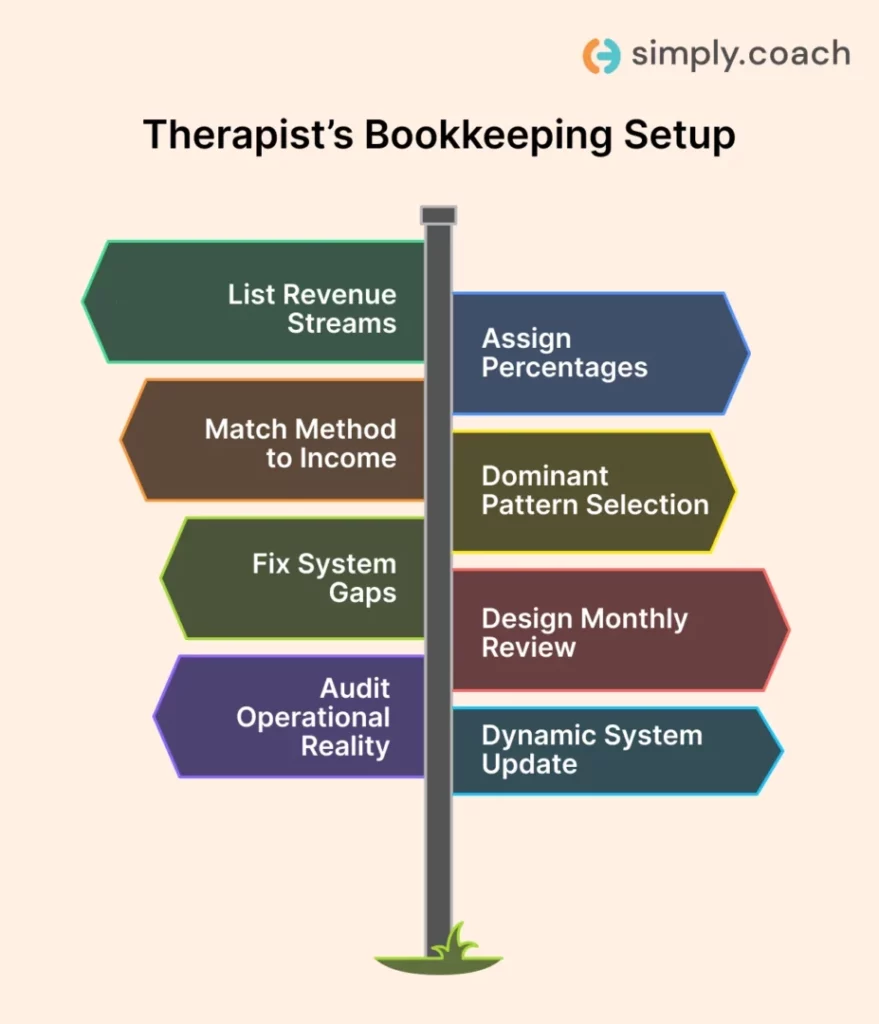
Choosing a bookkeeping method is less about accounting preference and more about accurately representing how your practice earns and collects money. If your method does not reflect timing, structure, and variability of income, your numbers will look clean but will be misleading.
Use this framework to align your bookkeeping with how your practice actually operates.
Step 1: Break down your revenue by how it behaves
Start by listing all income sources from the past 6 to 12 months. Then group them based on payment behaviour, not just service type.
Most therapists default to categories like sessions or programs, but that is not what affects bookkeeping accuracy. What matters is how and when money moves.
For example:
- Immediate payment: Private pay sessions, one-time consultations
- Delayed payment: Insurance reimbursements, invoices
- Staggered payment: Packages, retainers, installment-based programs
Action: Create three columns and place each income stream accordingly.
Why this matters: Two services that look similar operationally can behave very differently financially. A weekly session paid upfront and a session reimbursed after 30 days require different tracking logic.
Step 2: Quantify your dominant pattern
Once grouped, assign a rough percentage to each category. This step reveals the actual source of your income, ensuring your strategy is based on facts rather than assumption.
Many therapists underestimate how much of their revenue is delayed or staggered.
Action: Estimate percentages using recent months if needed. Precision is not required, but direction is.
What you are diagnosing: Whether your practice is primarily:
- Cash-flow driven (immediate payments)
- Pipeline-driven (pending or delayed income)
- Mixed (multiple timing layers)
This directly determines how much structure your bookkeeping needs.
Step 3: Map the gap between earned and received income
Now shift from categories to timing. For each income type, look at when the service is delivered versus when the payment is received. This is where most bookkeeping issues originate.
Action: Take one recent month and compare:
- Sessions delivered
- Payments received
- Pending claims or unpaid invoices
What to look for:
- Consistent delays of 2 to 6 weeks
- Revenue that appears in a different month than delivery
- Large portions of income sitting in “pending”
Why this matters: If there is a gap, cash-based tracking alone will not show your true performance. You may appear to earn less in busy months and more in slower ones.
Step 4: Choose your base method using your dominant pattern
At this point, the decision becomes mechanical rather than subjective.
- If most of your income is immediate, cash basis will reflect your reality accurately
- If a significant portion is delayed or spread across time, accrual or hybrid becomes necessary
Refined rule: If more than 30 to 40 percent of your income is received in a different period than it is earned, you need visibility beyond cash basis.
Why this matters: The wrong method does not break your bookkeeping immediately, but it introduces small distortions that compound over time, especially when reviewing trends or making decisions.
Step 5: Build structure around where your system fails
Even after choosing a base method, parts of your practice will not fit neatly into it. The goal here is not to switch systems, but to fix blind spots.
If you are using cash basis:
- Add a receivables tracker for anything not paid immediately
- Track prepaid sessions as remaining obligations, not just received cash
If you are using accrual:
- Track actual cash inflow separately to avoid overestimating available funds
- Monitor delays between expected and actual payments
Action: Identify one gap in your current system and fix that first.
Why this matters: Most breakdowns happen in edge cases, not in the core system.
Step 6: Create a monthly review that reflects how your practice runs
Your bookkeeping only becomes useful when you review it consistently and in the right way. Instead of just checking totals, your review should mirror how your income flows.
Each month, review:
- Income earned vs income received
- Total pending amount and how long it has been pending
- Revenue split across services and payment types
- Any mismatch between expected and actual inflow
Why this matters: This is where bookkeeping shifts from record-keeping to decision support. Patterns become visible only when reviewed consistently.
Step 7: Test your system against real operational questions
A working bookkeeping setup should answer questions without extra analysis.
Test it using real scenarios:
- Can you estimate next month’s income based on current sessions and pending payments
- Can you identify which services create delays in cash flow
- Can you see whether a new offering is actually contributing to stable income
If not: The issue is not your data, it is how it is structured.
Step 8: Update your system when your revenue model changes
Bookkeeping is not static because your practice is not static. As soon as your income structure changes, your bookkeeping assumptions need to change with it.
Trigger points:
- You introduce insurance billing
- You move from single sessions to packages or programs
- You start working with organisations or contracts
- You expand into digital or scalable offers
Action: Re-run Steps 1 to 4 when any of these changes occur.
Why this matters: Most bookkeeping issues come from using an old system on a new business model.
What a well-aligned system should give you
At this stage, your bookkeeping should allow you to:
- Separate earned, received, and pending income clearly
- Understand which services drive consistent revenue
- Anticipate cash flow instead of reacting to it
- Make pricing and growth decisions based on actual data
If your system does not give you this level of clarity, the issue is structural, not effort-related.
Also read: Top 10 HIPAA-Compliant Therapy Practice Management Software: A 2026 Guide for Therapists
Why Bookkeeping Matters for Therapists: Cash Flow, Taxes, and Practice Decisions
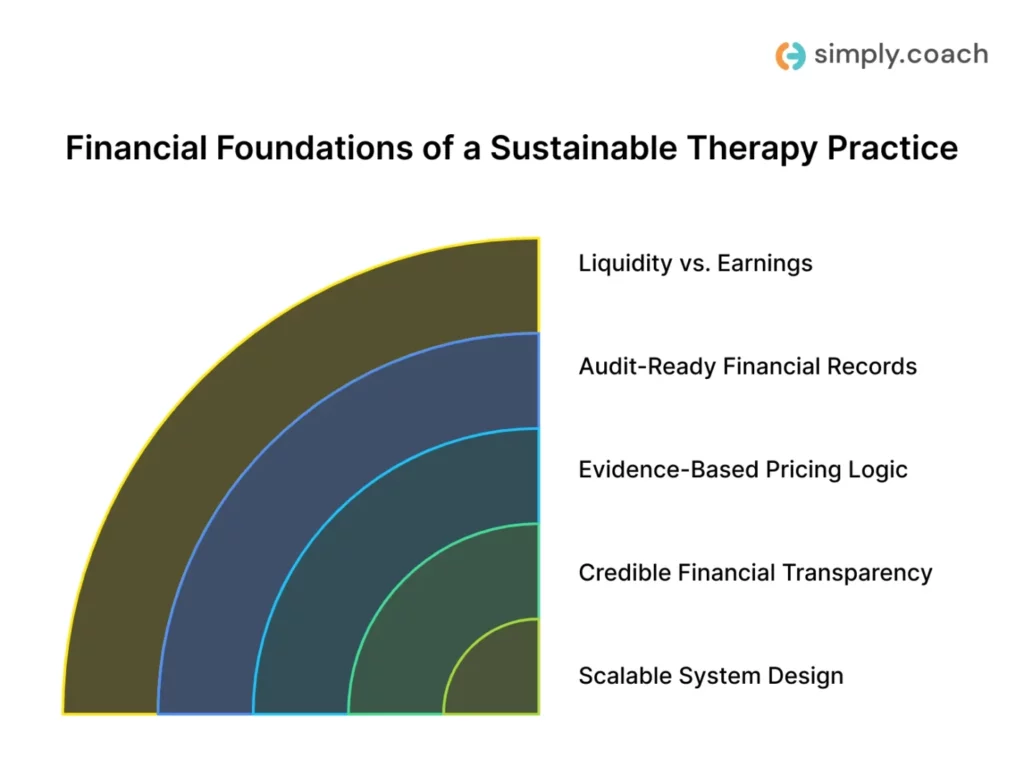
Your bookkeeping setup directly affects how accurately you understand your practice. If your system does not reflect how income is earned and received, you end up making decisions based on incomplete or misleading numbers.
This shows up in three areas where most therapists feel friction: cash flow, taxes, and day-to-day decision-making.
1. Cash flow visibility is not the same as income tracking
A full calendar does not guarantee stable cash flow. This becomes clear when payments are delayed, spread across time, or collected in advance.
If your bookkeeping only tracks received payments:
- Insurance-heavy months can look underperforming
- Months with prepaid packages can look artificially strong
- You cannot see what is actually expected vs already collected
What to track instead:
- Income earned from sessions delivered
- Income received in the same period
- Pending income and how long it has been outstanding
What this changes in practice:
You can anticipate shortfalls, plan expenses, and avoid reacting to cash gaps after they happen.
2. Tax preparation depends on clean, consistent records
Most tax issues are not caused by complexity. They come from inconsistent or incomplete bookkeeping.
Common patterns:
- Mixing personal and business expenses
- Missing receipts or poorly categorised transactions
- Income recorded inconsistently across months
What to maintain throughout the year:
- Categorised expenses aligned with your actual practice
- Clear records of all income sources
- Supporting documents for major transactions
What this changes in practice:
You reduce last-minute corrections, avoid underreporting or overreporting, and make it easier for your accountant to work with accurate data.
3. Pricing and service decisions depend on real numbers
Without structured bookkeeping, it is difficult to evaluate which parts of your practice are actually working.
For example:
- A service may bring in high revenue but require disproportionate time
- A lower-priced offering may be more consistent and predictable
- Certain services may introduce delays in cash flow
What to review regularly:
- Revenue by service type
- Time spent relative to income generated
- Variability in monthly income across services
What this changes in practice:
You can adjust pricing, reduce low-return work, and prioritise services that support both income and sustainability.
4. External evaluations rely on how your numbers are presented
At some point, your financial records will be reviewed by someone outside your practice. This could be for a loan, lease, grant, or audit.
What they look for is consistency and clarity.
Where issues show up:
- Income that fluctuates without explanation
- Mismatch between reported revenue and deposits
- Lack of documentation for income or expenses
What to maintain:
- Consistent recording method
- Clear separation of income types
- Supporting records for key transactions
What this changes in practice:
You can present your finances without needing to explain inconsistencies or reconstruct past data.
5. Growth introduces complexity that basic tracking cannot handle
What works when you are seeing only 1:1 clients may break when you introduce:
- Insurance billing
- Group programs or cohorts
- Multiple practitioners
- Digital or scalable offers
If your bookkeeping does not evolve, you start losing clarity instead of gaining it.
What to adjust as you grow:
- Separate revenue streams clearly
- Track pending and deferred income
- Monitor margins, not just total revenue
What this changes in practice:
You maintain control as complexity increases, instead of relying on estimates or assumptions.
What this means for your setup
If your bookkeeping is working, you should be able to:
- Explain your monthly income without cross-checking multiple tools
- Identify what is pending vs already received
- See which services are stable vs inconsistent
- Make decisions without relying on guesswork
If not, the issue is not effort. It is that your current setup does not reflect how your practice actually operates.
Also read: Top HIPAA-Compliant Scheduling Software for Therapists in 2026
7 Common Bookkeeping Mistakes Therapists Make (and How to Fix Them)
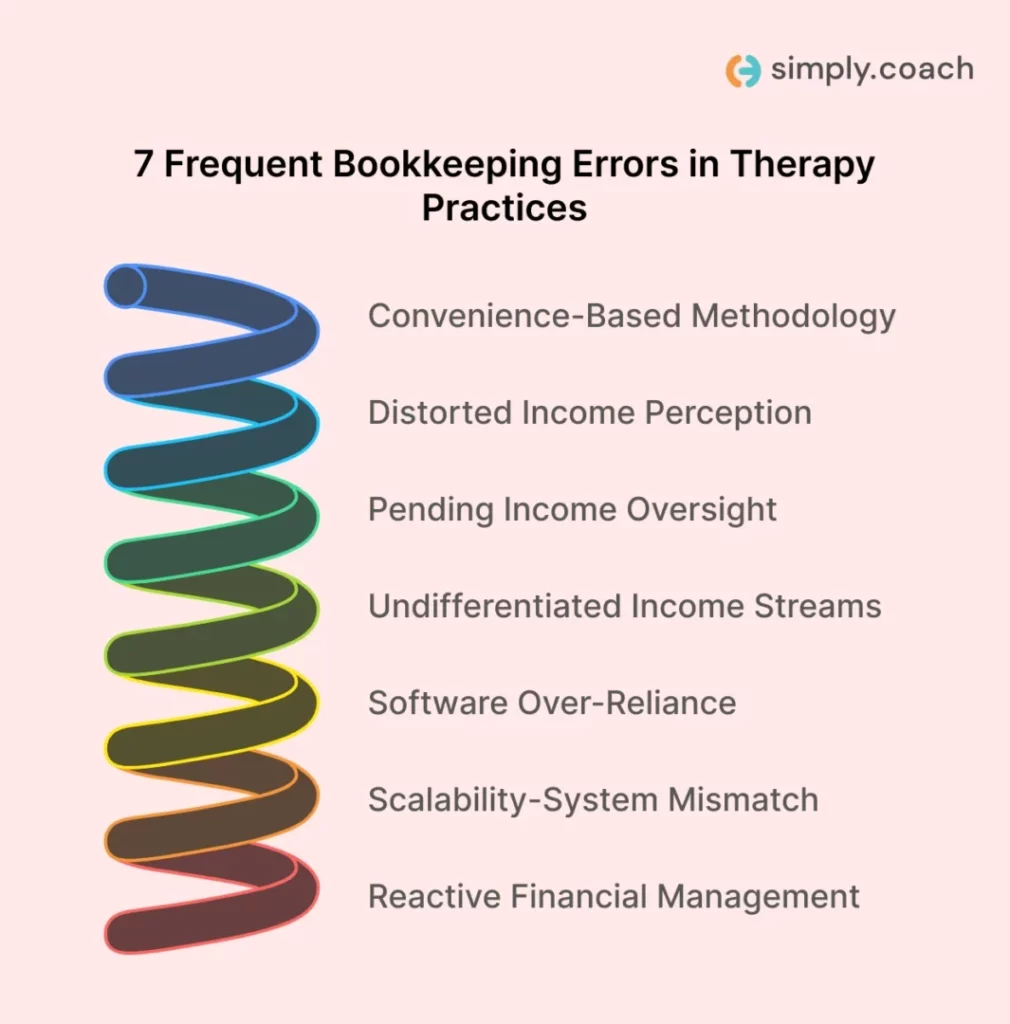
Most bookkeeping issues in therapy practices do not come from lack of effort. They come from small structural decisions that stop working as your practice evolves.
The patterns below are not beginner mistakes. They are the ones that show up even when you are actively tracking your finances.
1. Choosing a method based on simplicity instead of income structure
It is common to default to cash basis because it feels easier to manage. This works early on, but once your income includes insurance, packages, or staggered payments, it starts to distort your numbers.
What this looks like:
- Income appears inconsistent despite a full schedule
- Busy months do not reflect in your reported revenue
- You rely on your bank balance to understand performance
Why it happens: The method was chosen once and never revisited as the practice changed.
What to do instead:
- Re-evaluate your income mix once a year
- Identify whether payment timing has shifted
- Introduce accrual or hybrid tracking where delays exist
2. Recording income without considering delivery timing
Many therapists record income when it is received, even when the service is delivered later. This is common with packages, programs, and prepaid sessions.
What this looks like:
- Revenue spikes in months with upfront payments
- Lower income in months where sessions are actually delivered
- Difficulty understanding true monthly performance
Why it happens: Payment and delivery are treated as the same event.
What to do instead:
- Track how many sessions are included in each package
- Allocate income across sessions as they are delivered
- Maintain a simple “sessions remaining” view for prepaid work
3. Not tracking pending income (especially with insurance)
If you work with insurance or invoices, a portion of your income is always in transit. Ignoring this creates a major visibility gap.
What this looks like:
- You cannot say how much is owed to you at any time
- Cash flow feels unpredictable
- Delayed or rejected payments go unnoticed
Why it happens: Only received payments are tracked, not expected income.
What to do instead:
- Maintain a receivables tracker for all submitted claims or invoices
- Track status across submitted, approved, and paid
- Review aging of pending payments monthly
4. Combining all income into a single category
When all revenue is grouped together, it becomes difficult to evaluate what is actually working in your practice.
What this looks like:
- You know total income, but not which services drive it
- High-effort services look similar to low-effort ones financially
- Decisions about pricing or focus are unclear
Why it happens: Bookkeeping is set up for tracking totals, not analysis.
What to do instead:
- Separate income by service type
- Further split by payer type if relevant (private pay vs insurance)
- Review revenue trends for each category monthly
5. Over-relying on tools without defining your structure
Software can automate tracking, but it does not decide how your bookkeeping should be organised. Without a clear structure, tools can create inconsistent or misleading records.
What this looks like:
- Categories change over time without consistency
- Reports exist but are difficult to interpret
- Different income types are grouped incorrectly
Why it happens: The tool is driving the system instead of supporting it.
What to do instead:
- Define your core categories before using any tool
- Keep categories consistent across months
- Use tools to execute your structure, not create it
6. Not updating your system as your practice evolves
A setup that works for 1:1 sessions often breaks when you add programs, insurance billing, or a team. Many therapists continue using the same structure even when it no longer fits.
What this looks like:
- Increasing confusion as new services are added
- Manual workarounds to “fix” gaps
- Reports that no longer reflect reality
Why it happens: Bookkeeping is treated as a one-time setup.
What to do instead:
- Review your system annually or after major changes
- Reassess revenue structure and payment timing
- Adjust categories and tracking methods accordingly
7. Reviewing finances only when there is a problem
Bookkeeping becomes reactive when it is only reviewed during tax season or when something feels off.
What this looks like:
- Missing entries or incomplete records
- Last-minute corrections before filing
- Difficulty explaining numbers for a given period
Why it happens: There is no consistent review rhythm.
What to do instead:
- Set a monthly 20 to 30 minute review
- Check income, expenses, and pending amounts
- Identify any gaps or inconsistencies early
What ties these mistakes together
Most of these issues come from one root cause: Your bookkeeping is not aligned with how your practice actually earns and collects money.
Fixing that alignment removes the need for constant corrections, workarounds, or guesswork.
Also read: 50+ Resources, Tools, and Worksheets for Therapists
How Simply.Coach Helps Therapists Stay Organized with Their Bookkeeping
Most bookkeeping issues in therapy practices do not start in accounting. They start when session delivery, client activity, and program structure are not clearly tracked.
If you cannot consistently see what was delivered, when it was delivered, and for whom, it becomes difficult to:
- Match payments to services
- Track prepaid or pending sessions
- Maintain accurate financial records over time
Simply.Coach, through their HIPAA-compliant therapy practice management software, helps you structure your practice in a way that makes your bookkeeping inputs clearer and easier to maintain.
Where Simply.Coach directly supports your bookkeeping workflow:
- Client Workspaces (Session and Service Tracking): Every session, note, and client interaction is recorded in one place. This allows you to verify what was delivered before recording or reviewing income, especially for ongoing or multi-session work.
- Journeys (Program and Package Structuring): Define how many sessions are included in a program or package and track delivery against it. This helps you allocate income correctly instead of recording everything at the time of payment.
- Scheduling and Session Logs: Each session is time-stamped and linked to a client. This gives you a clean record to reconcile against payments received, reducing missed or unaccounted sessions.
- Progress and Engagement Tracking: See how long clients stay engaged and how sessions are distributed over time. This helps you understand whether revenue from programs or long-term clients is being delivered as expected.
- Action Plans and Continuity Tracking: Track what happens between sessions and across engagements. This gives context when reviewing longer-term work tied to packages or retainers.
- Secure Documentation and Audit-Ready Records: All client data and session records are stored in a structured format. This makes it easier to support financial reviews, tax documentation, or external audits without reconstructing history.
When your delivery and client activity are clearly structured:
- You can match income to sessions delivered without manual reconstruction
- You can track prepaid sessions and remaining obligations accurately
- You reduce errors in recording income across months
- You maintain consistent records for tax filing and financial review
Simply.Coach does not replace bookkeeping. It ensures that the data behind your numbers is complete, structured, and reliable.
Why this matters in practice? If your bookkeeping feels difficult, the issue is often not the tool you are using. It is the lack of structured data around your services.
Once session delivery, programs, and client activity are clearly tracked, your financial records become easier to maintain and interpret.
Conclusion
Bookkeeping for therapists becomes manageable when your system reflects how your practice actually earns and collects money. Once you separate what is earned, what is received, and what is still pending, your numbers start to make sense. You can see which services are consistent, where delays are happening, and how your income is distributed across your work.
As your practice evolves, through insurance, programs, or multiple income streams, your bookkeeping needs to evolve with it. The goal is not to build a complex system, but to maintain one that gives you clear, reliable visibility at any point.
If you want your bookkeeping to stay accurate, your practice operations need to stay structured. Simply.Coach helps you track sessions, programs, and client activity in a way that makes it easier to match what was delivered with what was paid, without relying on manual tracking or scattered tools. This operational clarity allows you to avoid administrative overwhelm and focus on delivering impactful therapy outcomes.
FAQs
1. Where can therapists find bookkeeping templates or PDFs?
Many therapists look for bookkeeping PDFs or templates to get started, but most are too generic. A better approach is to use simple, customizable spreadsheets or tools that match how your practice actually runs, rather than forcing your workflow into a rigid template.
2. Is there a way to do bookkeeping for therapists for free?
Yes, many therapists start with free tools like spreadsheets to track income and expenses. This works well early on, but as your practice grows, free setups can become harder to maintain and may lack the structure needed for accurate reporting.
3. Should therapists manage bookkeeping online or offline?
Online bookkeeping tools are generally more practical because they allow real-time tracking, backups, and easier collaboration with accountants. Offline methods can work initially, but they increase the risk of errors and data loss over time.
4. What do therapists usually discuss about bookkeeping on online forums?
Most discussions focus on choosing between cash vs accrual methods, managing taxes, and selecting the right tools. A common theme is that therapists often start simple but later need to upgrade their system as their practice becomes more complex.
5. Do therapists need different accounting practices compared to other businesses?
Yes, private practice therapists often deal with unique factors like session-based income, insurance reimbursements, and mixed service models. This makes it important to choose a bookkeeping approach that reflects both timing of payments and service delivery.
6. What should therapists look for in accounting software?
The key is simplicity and relevance. Look for software that can track session-based income, categorize expenses clearly, and generate basic reports without requiring advanced accounting knowledge.
7. When should a therapist hire a CPA or accountant?
It usually makes sense to involve a CPA once your practice grows beyond basic income tracking, especially if you are handling taxes, multiple revenue streams, or planning to scale. A professional can help ensure accuracy and prevent costly mistakes.