
The way you accept new coaching clients shapes the long-term success of your coaching relationships. A smooth start helps clients feel confident, supported, and ready to commit to the work ahead. Small details influence how clients view your professionalism, reliability, and coaching structure.
Many coaches struggle when their onboarding feels scattered. You may deal with late paperwork, unclear expectations, or missed information that slows the start of your engagement. These gaps create confusion and reduce client trust. You also lose valuable time that could go into preparation, reflection, or deeper client work.
This guide gives you a repeatable process to accepting new clients with clarity and consistency. You will learn how to qualify clients, manage each stage of the onboarding flow, and create a structured experience that brings ease to both sides. When you follow a simple system, you protect your time, improve outcomes, and strengthen every coaching relationship.
Key Takeaways
- Start with pre-qualification: Screen clients using a short questionnaire to ensure alignment with your coaching style, goals, and readiness.
- Use discovery calls effectively: Clarify client goals, expectations, and your coaching structure while establishing trust.
- Collect detailed intake information: Gather background, challenges, goals, availability, and communication preferences for personalized sessions.
- Formalize agreements and payments: Define scope, session count, fees, cancellation rules, and confidentiality clearly.
- Send a structured welcome packet: Include session logistics, pre-work, resources, and a personal note to set expectations and build confidence.
- Prepare for first sessions: Draft agendas, review intake responses, and assign optional pre-work to maximize session impact.
- Follow up early: Conduct 30-day check-ins to track progress, gather feedback, and strengthen client commitment.
- Avoid common mistakes: Don’t delay paperwork, overcomplicate forms, or treat onboarding as a one-time task.
- Use an all-in-one platform: Simply.Coach centralizes scheduling, forms, agreements, client notes, and communications for a seamless onboarding experience.
Why a Smooth New Client Process Matters
A smooth new-client experience helps you build trust from the first interaction. It gives clients a clear path, reduces confusion, and sets the tone for a focused coaching relationship. You avoid unnecessary administrative delays because every step follows a predictable rhythm. This helps you begin the engagement with clarity instead of scrambling for missing details.
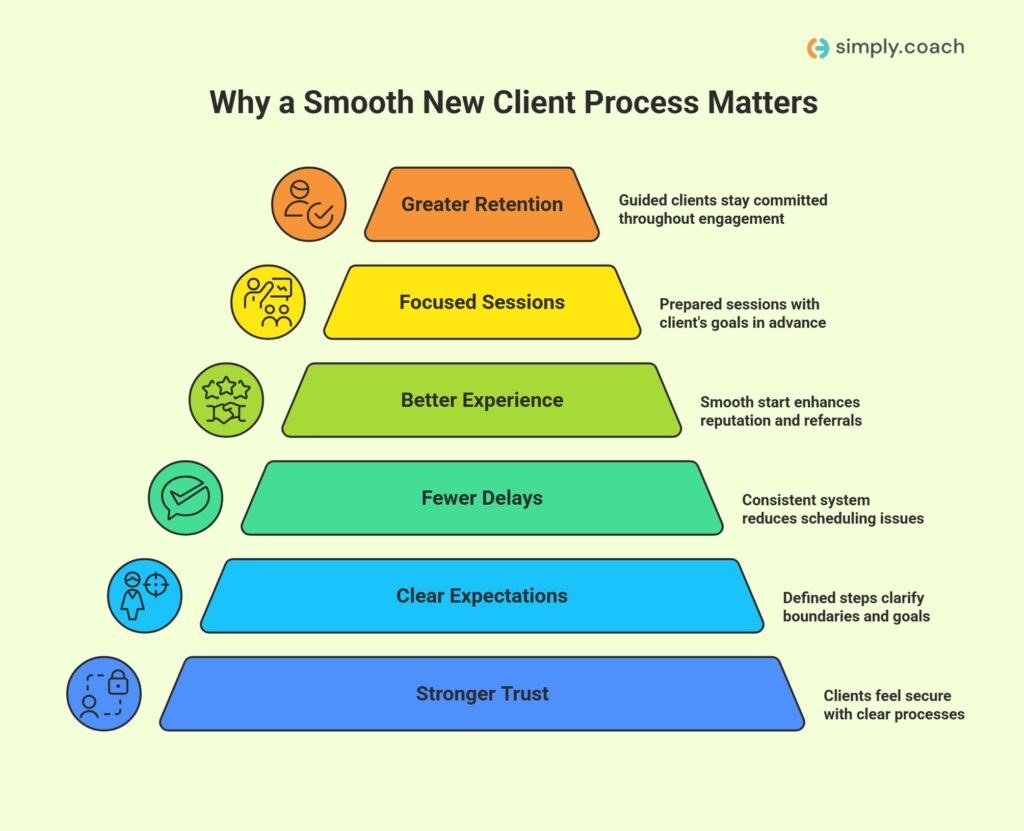
- Stronger trust right from the start: Clients feel secure when your process is clear, organized, and easy to follow.
- Clear expectations for both sides: Defined steps help clients understand boundaries, goals, and your coaching structure.
- Fewer missed sessions and delays: A consistent system reduces no-shows, payment confusion, and scheduling issues.
- Better client experience and referrals: Clients talk about coaches who create a smooth start, which strengthens your reputation and increases recommendations.
- More focused sessions from day one: You enter the first session prepared because you have the client’s goals, context, and preferences in advance.
- Greater retention throughout the engagement: Clients stay committed when they feel guided from the start and understand the value of each stage in your process.
A clear and predictable acceptance process allows you to focus on coaching while giving clients a confident and organized start to their journey.
Also read: 35+ Vital Life Coaching Intake Questions for Seamless Onboarding
How Coaches Can Successfully Accept New Clients
A structured client acceptance process allows you to welcome new clients professionally while creating clarity for both sides. It ensures you work with the right clients, communicate expectations upfront, and enter the first session fully prepared. Following this framework reduces administrative stress and builds a consistent, high-value experience.
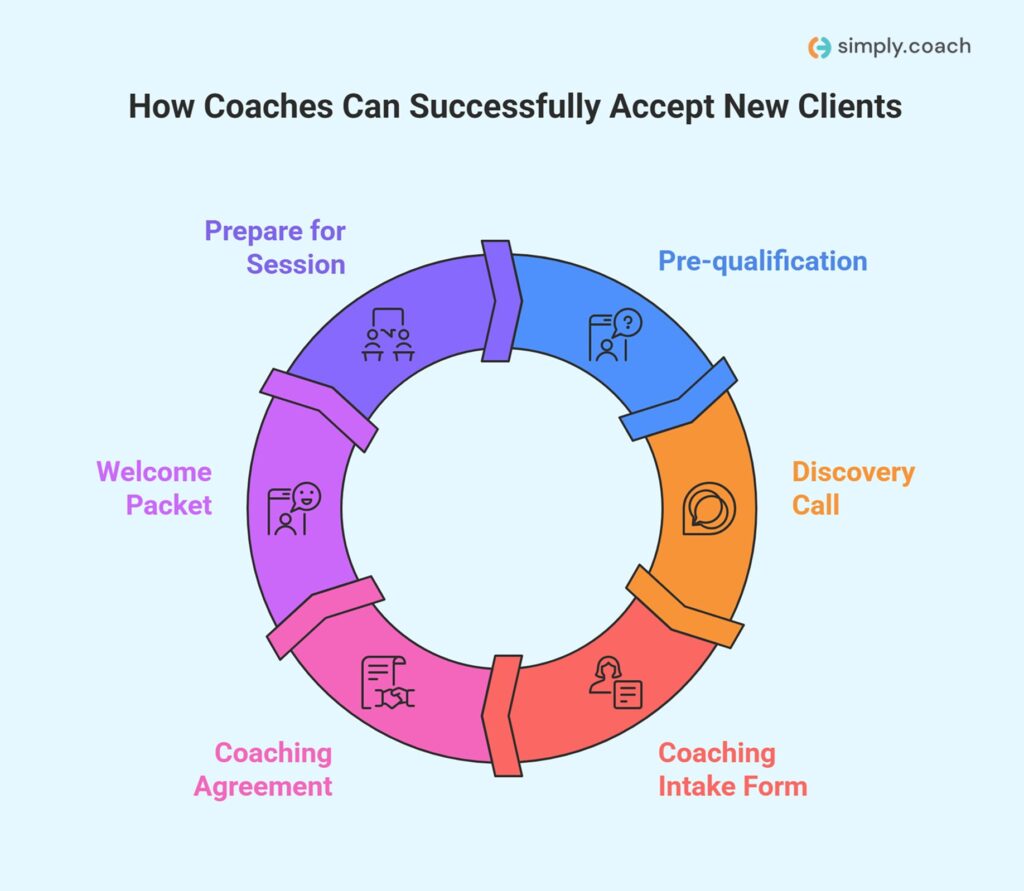
1. Pre-qualification: Identifying ideal-fit clients
Pre-qualification ensures your coaching time is spent on clients who are committed, aligned with your style, and ready for meaningful change.
- Use a concise questionnaire: Ask about goals, readiness, timeline, and budget to assess commitment.
- Include reflective questions: “What outcome do you want from coaching?” or “How ready are you to take consistent action?” help you gauge motivation.
- Spot red flags early: Watch for vague goals, passive attitudes, or unrealistic expectations that may hinder progress.
- Automate lead collection: Use lead forms to help you gather information efficiently and organize prospects.
- Provide context with examples: Share case studies or typical client scenarios on your pre-qualification page to help prospects self-assess alignment.
Practical tip: Only schedule discovery calls with clients who complete the questionnaire. Review responses to refine your ideal client profile and adjust your messaging to attract the right clients.
Also read: The comprehensive client onboarding form template for relationship coaches
2. Discovery call: Setting the foundation
The discovery call lets you understand client goals, clarify expectations, and demonstrate your coaching approach, creating trust from the start.
- Keep it focused: 20–30 minutes is usually enough to explore goals, challenges, and motivation without overwhelming the client.
- Ask targeted questions: Examples include “What change are you hoping to achieve in the next 90 days?” or “How will you measure success in coaching?”
- Explain your approach clearly: Cover session frequency, coaching style, tools, and communication expectations.
- Guide next steps: End with a plan for completing the intake form, signing the agreement, or scheduling the first session.
- Enhance personalization: Take notes on client tone, energy, and style to adapt your coaching approach later.
Practical tip: Use this call to set clear expectations around client effort, preparation, and follow-through. This increases engagement and reduces misunderstandings later.
3. Coaching Intake form: What Coaches should collect
A well-structured intake form gives you the context needed to deliver personalized, high-impact sessions from day one.
- Collect essential background: Ask about work environment, daily routines, and current challenges to understand context.
- Identify short-term and long-term goals: Helps prioritize session topics and create early wins.
- Capture availability and communication preferences: Prevents scheduling conflicts and miscommunication.
- Include previous coaching experience: Adjust your approach based on what clients have experienced before.
- Add optional reflection prompts: Ask clients to share what has worked or not worked for them in the past, which informs your strategy.
Practical tip: Review responses before the first session to identify patterns, tailor exercises, and plan discussion topics for a higher-impact meeting.
Also read: The 11 Essential Coaching Forms Every Coach Needs
Free Client Onboarding Template for Coaches
Start every coaching relationship professionally with Simply.Coach’s ready-to-use Client Onboarding Template. Collect client info, set expectations, and streamline your process in minutes.

4. Coaching agreement and payment setup: Setting clear terms upfront
A clear agreement protects both the coach and client, providing clarity about commitments, boundaries, and expectations.
- Define the scope and structure: Include number of sessions, duration, and coaching focus areas.
- Communicate payment options and terms: Include packages, subscriptions, or per-session rates along with due dates.
- Set policies clearly: Include cancellation, reschedule policies, and boundaries for communication.
- Include confidentiality: Reinforces trust and adherence to ethical coaching standards.
- Provide examples: Share a sample session structure or payment plan to increase client comfort and transparency.
Practical tip: Consolidate all agreement details in one document, and use automated billing and reminders to reduce administrative burden and maintain client commitment.
Get your free Coaching Agreement Template
Simplify your onboarding and protect your coaching practice with Simply.Coach’s ready-to-use Coaching Agreement Template. Customize it for your services, clearly define client expectations, and streamline payment and session policies.
5. Welcome packet for new coaching clients: Setting expectations from day one
A welcome packet reinforces your professionalism, sets clear expectations, and helps clients feel confident and prepared.
- Personalized note: A short, warm message makes clients feel welcomed and motivated.
- Explain the coaching journey: Include milestones, session flow, and what clients can expect.
- Pre-session reflection: Include exercises or prompts to engage clients before the first session.
- Provide logistics and resources: Share Zoom links, session instructions, or relevant worksheets.
- Offer access to a client portal: Centralize documents, forms, and resources for easy access.
Practical tip: Send immediately after agreement and payment confirmation, and consider adding a short video introduction to create a more personal connection.
6. Preparing for the first session: Ensuring a high-impact first meeting
Preparation ensures a structured, effective first session that builds confidence and sets the tone for the coaching relationship.
- Draft a clear agenda: Use intake form responses to outline discussion topics and goals.
- Identify key patterns and priorities: Review client history to determine early focus areas.
- Set initial session goals: Helps clients understand purpose and value from the first meeting.
- Optional pre-work or exercises: Encourage reflection or small tasks to boost engagement.
Practical tip: Use a coaching management platform to track client notes, goals, and progress. Adding relevant examples or exercises can increase session impact and client buy-in.
By following this structured framework, you can confidently accept new clients, reduce administrative stress, and create a professional, high-impact experience that sets every coaching relationship up for success.
Also read: 20+ Best Coaching Platforms to Run and Scale Your Coaching Business in 2025
Common Mistakes Coaches Make When Accepting New Clients
Many coaches treat onboarding as a low-priority admin step. That often leads to problems before the coaching even begins. Here are common mistakes and concrete advice to avoid them.
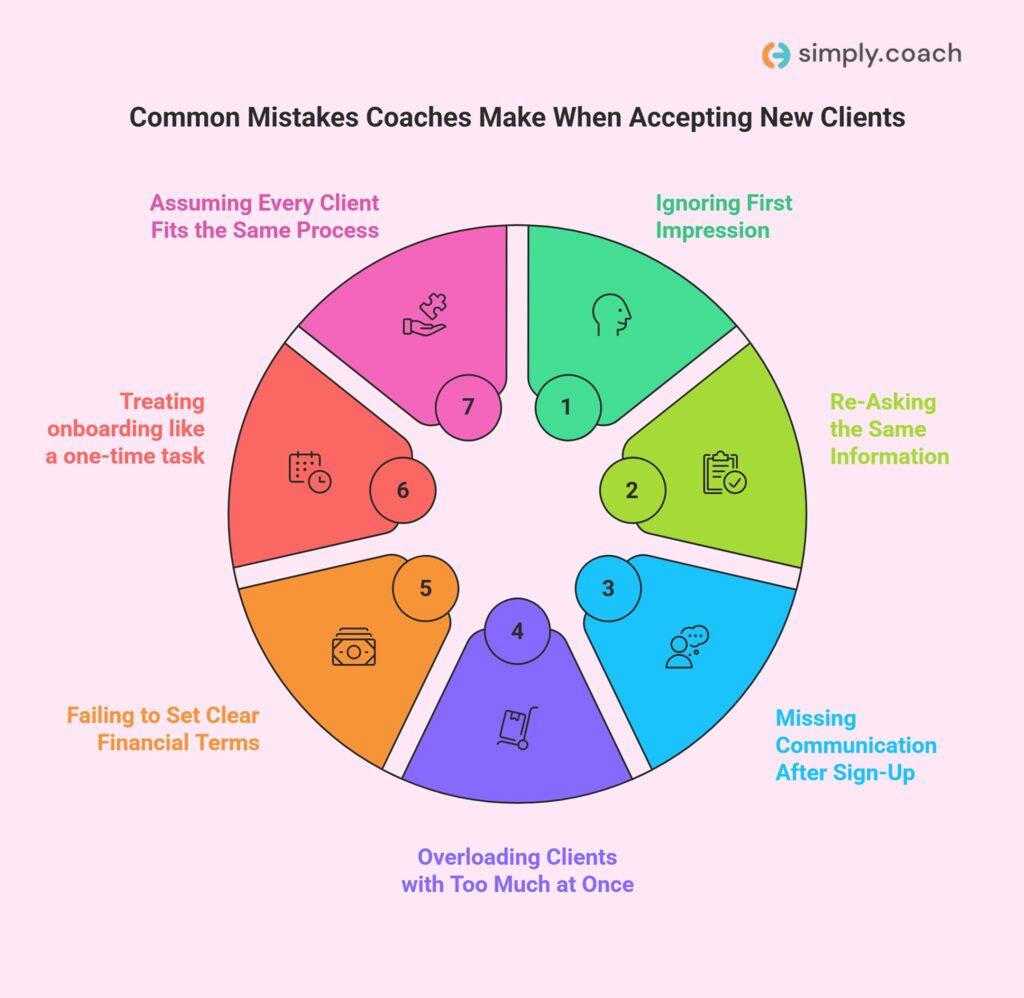
- Ignoring the first impression: Clients form lasting opinions when you onboard them. A disorganized first contact or late paperwork erodes trust and reduces engagement at the outset.
- Re-asking the same information: Making clients fill out identical details across multiple forms frustrates them. When tools do not sync, information gets lost or repeated. Use a unified onboarding form or portal to collect data once.
- Poor or missing communication after sign-up: Some coaches send a welcome email then go silent until session one. That silence creates uncertainty. Keep clients informed at every step, including what is next, when they should expect it, and how long things will take.
- Overloading clients with too much at once: Flooding clients with forms, long contracts, and too many resources can overwhelm them. Instead, stagger the process. Send essentials first and deliver additional resources after each milestone.
- Failing to set clear financial terms and boundaries: Many coaches skip detailed payment scheduling, cancellation rules, or session-frequency expectations. That later leads to misunderstanding and friction. A clear agreement reduces confusion and protects both parties.
- Treating onboarding like a one-time task rather than a process: Onboarding does not end with a signed agreement. Without ongoing structure, such as welcome packets, scheduled check-ins, and follow-ups, clients may feel neglected. This reduces satisfaction and increases churn.
- Assuming every client fits the same process: Each coach and client relationship is unique. A one-size-fits-all onboarding often misses important personal context and expectations. Tailor onboarding steps based on the client’s background, goals, and communication preferences.
Acknowledge these mistakes early. Fixing them improves client trust, reduces churn, and makes your coaching more professional and scalable.
How Simply.Coach Helps Coaches Accept New Clients Smoothly
Managing new clients doesn’t have to be complicated. Simply.Coach brings all the essential tools into one platform, helping you streamline client onboarding, stay organized, and deliver a professional experience from the first interaction.
- Automated scheduling: Clients can book sessions based on your availability, receive reminders, and reduce back-and-forth emails.
- Centralized client management: Store intake forms, agreements, notes, and session plans in one secure location. Track progress, milestones, and client history effortlessly.
- Customizable forms: Collect client details, goals, and preferences automatically before the first session. Ensure you have all the context needed for a personalized coaching experience.
- Integrated client portal: Give clients access to session materials, worksheets, contracts, and resources in one convenient hub. Improves engagement and professionalism.
- Simplified payment processing and contracts: Send invoices, manage subscriptions, and formalize agreements within the platform, reducing delays and administrative work.
Practical tip: Using Simply.Coach as your all-in-one coaching management software allows you to focus on coaching rather than juggling multiple apps. Every step from inquiry to onboarding to session tracking is simplified and professional.
New Client Acceptance Checklist for Coaches
Use this checklist as a clear roadmap for onboarding new clients. It ensures you don’t miss critical steps while delivering a professional and consistent client experience.
- Lead captured and pre‑qualification form completed
- Discovery call scheduled and completed
- Intake form sent, filled out, and reviewed
- Coaching agreement + payment terms shared and signed
- Deposit or initial payment collected (if applicable)
- Welcome packet or client‑onboarding document delivered
- Session logistics communicated (date, time, link/platform, resources)
- First session agenda drafted based on intake responses
- Pre‑session prep assigned (if relevant)
- First session conducted and notes recorded
- Follow‑up plan communicated (next session, homework, check‑ins)
- 30‑day check‑in scheduled to review progress, feedback, and alignment
Use this checklist as both an internal reference and a client‑facing guarantee that you run a structured, professional coaching process.
Also read: How to Attract New Clients as an Online Independent Coach
Conclusion
A structured new-client process ensures you start every coaching relationship with confidence and clarity. You reduce misunderstandings, save time, and create a professional, consistent experience. Clients feel guided and supported from day one. This foundation helps your coaching be more effective and results-driven.
Simply.Coach makes managing your client acceptance process seamless and efficient. From intake forms to agreements, scheduling, and session tracking, everything is centralized in one platform. You can focus on coaching while maintaining organization and professionalism. Every step of your client onboarding becomes smoother and more impactful.
FAQs
1. What should I ask during a first discovery call to decide if the client is right for me?
Ask about their main goals, their motivation to change, their available time commitment, and how they have tried to solve the issue so far. This helps you assess readiness and fit before you start working together.
2. How soon should I send the intake form after a client says yes?
Send the intake form within 24 hours of agreement or confirmation. Prompt action keeps momentum, shows professionalism, and helps avoid losing engagement before onboarding begins.
3. How can I make my intake form non-intimidating but still informative?
Combine short multiple-choice questions for logistics, availability, and contact details with a few open-ended questions about goals, challenges, and expectations. Keep the form simple and clear. This respects the client’s time while collecting useful information.
4. When should I collect the first payment, before or after the first session?
Collect payment or deposit before the first session or when the agreement is signed. This ensures client commitment and avoids last-minute cancellations or payment delays. It sets clear expectations from the start.
5. How many sessions should I plan before reviewing progress with a new client?
Plan a progress review after 3 to 4 sessions or about a month. This gives enough time to assess early results, adjust coaching focus if needed, and reinforce commitment or set next milestones.
6. What’s the best way to communicate cancellation or reschedule policies to clients?
Share your cancellation and reschedule policy in the coaching agreement and again in the welcome packet. Make terms clear and simple so clients understand rules before they commit. Transparency avoids confusion and protects your schedule.
7. How often should I check in with clients outside regular sessions?
Send a brief check-in message or resource 7 to 10 days after the first session and another around day 30. These early follow-ups reinforce support, maintain momentum, and improve retention by keeping communication open.