
Many therapy sessions follow a familiar pattern. Clients describe themselves through problem-heavy stories that feel permanent and deeply personal. These narratives often shape how clients interpret their struggles, relationships, and future possibilities. Over time, repeated storytelling can strengthen the belief that the problem defines who they are.
This dynamic creates a challenge for you as a therapist. Conversations may remain stuck in explanations of what went wrong instead of exploring how the story formed and what it overlooks. Narrative therapy addresses this challenge by separating the person from the problem and inviting clients to examine how their stories influence identity and behavior.
This article explores narrative therapy from a practical perspective. You will learn its definition, guiding philosophy, common techniques, and situations where it supports meaningful therapeutic change. The guide also explains how narrative conversations help clients reinterpret experiences and develop alternative stories that reflect their values, strengths, and future possibilities.
Key Takeaways
- Narrative therapy helps clients examine the stories shaping their identity, beliefs, and emotional responses. Understanding these narratives allows you to guide clients toward healthier interpretations of their experiences.
- A core principle is separating the person from the problem. Techniques like externalization help clients view challenges such as anxiety or self-doubt as influences rather than defining traits.
- Therapists identify dominant narratives shaped by past experiences, relationships, and cultural expectations. Recognizing these patterns helps clients question limiting assumptions.
- Techniques such as externalization, deconstruction, narrative questioning, and identifying unique outcomes reveal overlooked strengths and moments of resilience.
- The goal is to help clients re-author empowering narratives that reflect their values, strengths, and preferred identity.
- Platforms like Simply.Coach help you implement narrative therapy more effectively by organizing session notes, tracking client progress, and managing reflection exercises between sessions.
What is Narrative Therapy?
Narrative therapy is a collaborative counseling approach that examines how clients interpret their experiences through personal stories. In many sessions, clients describe themselves through problem-saturated narratives such as “I am a failure” or “I always ruin relationships.” Narrative therapy helps you guide clients to examine how these stories developed and how they influence identity, decisions, and emotional responses.
This approach treats identity as something shaped through meaning, culture, and lived experiences rather than fixed personality traits. During conversations, you help clients analyze the stories they repeatedly tell about themselves and their lives. Through careful questioning and reflection, clients begin to identify alternative interpretations that highlight skills, values, and intentions often ignored in dominant narratives.
Narrative therapy therefore focuses less on diagnosing internal deficits and more on understanding how meaning develops around life events. Clients explore how family expectations, cultural messages, and past experiences influence their interpretations. This process allows you to support clients in constructing narratives that better reflect their abilities, goals, and preferred identity.
Origin of narrative therapy

Narrative therapy developed during the late twentieth century through work in family therapy and community counseling. Michael White (from Australia) and David Epston (from New Zealand) introduced the approach while studying how language and cultural narratives shape personal identity.
Timeline of development
- Late 1970s: Michael White began exploring how family stories influence identity and problem interpretation in therapy conversations.
- Early 1980s: White and David Epston collaborated to develop structured narrative conversations that separate people from problems.
- 1990: They published Narrative Means to Therapeutic Ends, which formally introduced narrative therapy concepts and therapeutic practices.
- 1990s onward: Narrative therapy spread through counseling, family therapy, social work, and community mental health programs across North America and Australia.
Their work drew heavily from Michel Foucault and other postmodern thinkers who studied how language and social discourse influence identity. These ideas helped therapists examine how dominant cultural narratives shape beliefs about success, relationships, gender roles, and personal worth.
Also read: Gestalt Therapy: Techniques and the Power of Present-Moment Healing
What Issues can Narrative Therapy Help With?
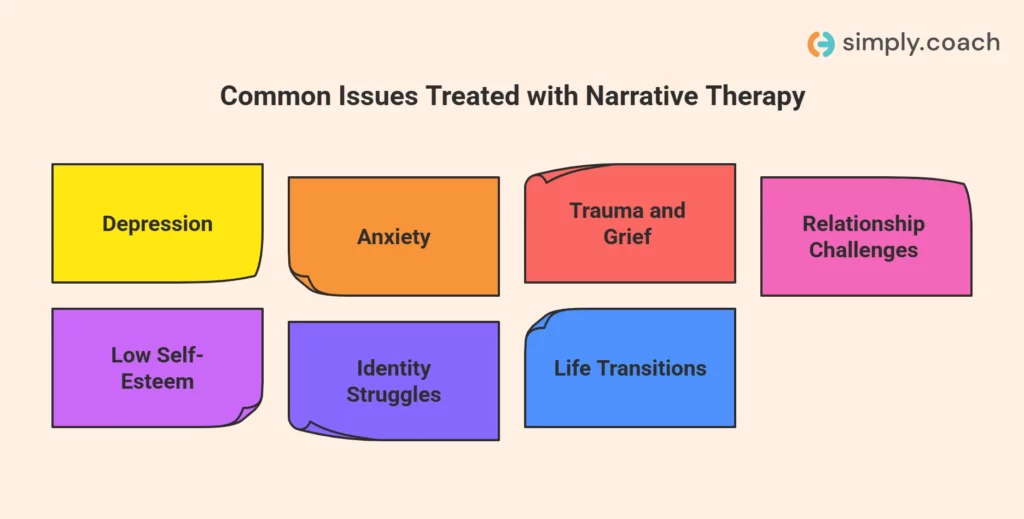
Narrative therapy helps clients examine the stories shaping how they interpret problems, relationships, and personal identity. You can use this approach when clients feel defined by limiting narratives about their experiences.
Common issues addressed in narrative therapy
- Depression: Clients with depression often internalize stories centered on failure or hopelessness. Narrative conversations help uncover alternative experiences that challenge these beliefs.
- Anxiety: Anxiety frequently develops around stories of danger, inadequacy, or losing control. Narrative questioning helps clients examine how those beliefs formed and reshape them.
- Trauma and grief: Trauma can distort how clients understand painful experiences. Narrative therapy helps organize memories into a coherent story that supports emotional processing.
- Relationship challenges: Couples and families often repeat fixed stories about blame or intention. Narrative work helps each person examine those interpretations and explore new perspectives.
- Low self-esteem: Clients with low self-esteem usually repeat narratives focused on inadequacy. Therapy highlights overlooked moments of competence, commitment, and resilience.
- Identity struggles: Clients questioning identity often carry conflicting stories shaped by culture, family expectations, and past experiences. Narrative therapy helps clarify preferred identity.
- Life transitions: Events such as divorce, relocation, or career change can disrupt personal meaning. Narrative conversations help clients integrate these changes into a meaningful life story.
Therapists commonly use narrative therapy in individual therapy, family therapy, and couples counseling, where multiple perspectives influence shared stories.
Also read: What Is Person-Centered Therapy: A Practical Guide for Mental Health Practitioners
What Narrative Therapy May Not Be Best For
Narrative therapy works well for clients who can reflect on experiences and explore personal meaning. Some situations require more structured clinical interventions before narrative work becomes effective.
- Severe psychiatric disorders requiring medical intervention: Clients experiencing psychosis, severe bipolar episodes, or acute psychiatric instability may need medication and psychiatric care first. Stabilization helps ensure therapy conversations remain grounded and safe.
- Crisis situations requiring immediate stabilization: Clients facing suicidal risk, severe trauma reactions, or immediate safety concerns often require crisis intervention. Therapists may prioritize safety planning and stabilization before narrative exploration.
- Conditions requiring structured behavioral treatment: Disorders such as obsessive-compulsive disorder or severe phobias often respond well to structured behavioral methods. Approaches like cognitive behavioral therapy provide clear protocols for symptom reduction.
- Clients uncomfortable with reflective storytelling approaches: Narrative therapy relies on discussion, reflection, and meaning-making. Clients who prefer directive guidance or solution-focused strategies may respond better to more structured interventions.
Recognizing these limitations helps you select the most appropriate therapeutic approach for each client. Thoughtful method selection strengthens clinical judgment and improves treatment outcomes.
Related: Types of Therapeutic Interventions for Mental Health Progress
Core Advantages of Narrative Therapy
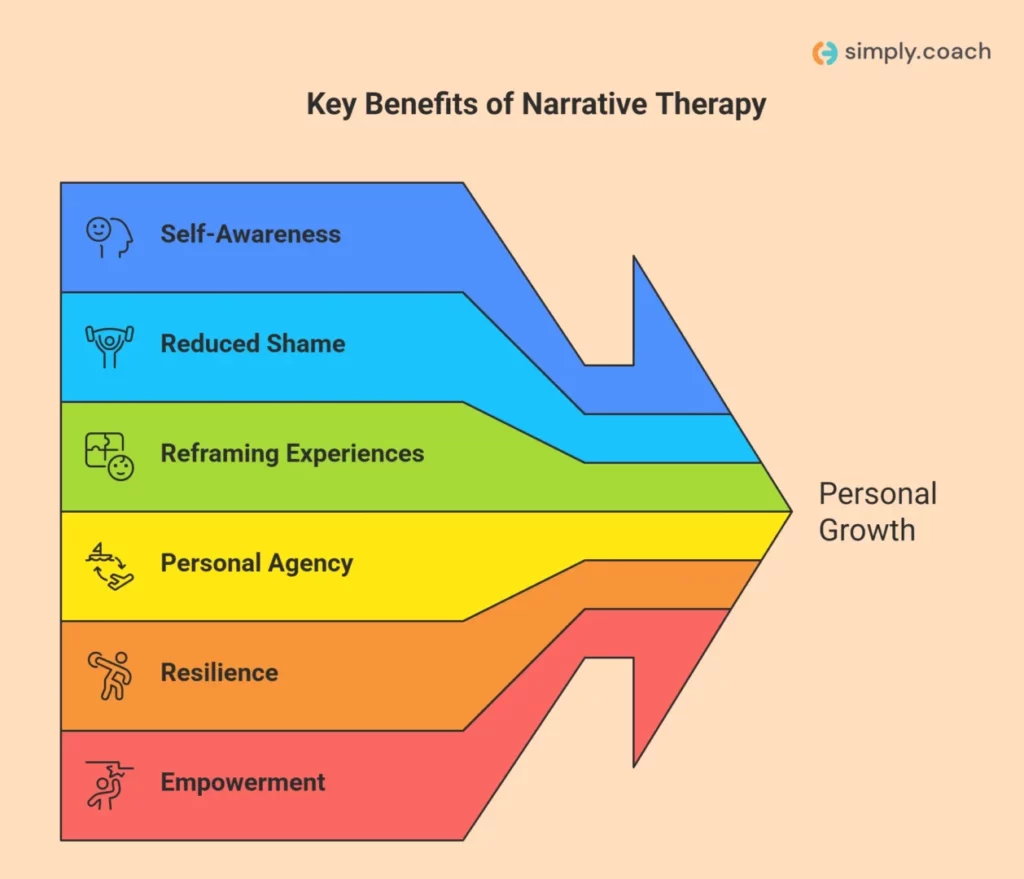
Narrative therapy helps you uncover how clients’ stories shape identity, choices, and emotional responses. Through structured conversations, clients begin to examine narratives that previously limited their possibilities.
- Encourages self-awareness: Clients identify recurring patterns in their stories about relationships, failure, or personal ability. This awareness shows how narratives influence decisions and emotions, forming a foundation for meaningful change.
- Reduces shame and self-blame: Externalizing separates the person from the problem. Clients see depression, anxiety, or anger as experiences rather than identity traits, reducing self-criticism and opening space for constructive coping.
- Helps people reframe negative experiences: Clients often focus on events reinforcing failure-based narratives. Narrative exploration highlights overlooked actions showing persistence or care, helping clients interpret past experiences from a balanced perspective.
- Strengthens personal agency: Clients recognize moments where they influenced outcomes despite challenges. This helps them see their role in shaping decisions and responses, supporting confidence in future situations.
- Builds resilience and emotional clarity: Narrative conversations organize complex life events into a coherent story. Understanding patterns of response improves emotional clarity and strengthens coping with difficulties.
- Encourages empowerment and identity development: Clients describe the person they want to become instead of repeating limiting labels. Highlighting values, strengths, and intentions gradually guides behavior and long-term decisions.
Over time, clients shift from problem-saturated stories to narratives reflecting capabilities, values, and preferred directions in life.
Also read: Values Clarification in Counseling: Tools and Exercises for Lasting Client Change
Foundational Pillars of Narrative Therapy

Narrative therapy is guided by principles that help therapists explore clients’ stories, reshape limiting narratives, and foster identity growth. Each principle provides actionable strategies you can apply in practice.
1. Separation of person and problem
This principle emphasizes that the individual is not defined by the issues they experience. It helps clients reduce self-blame and gain control over their narratives.
- Externalizing the problem: Clients learn to see anxiety, depression, or anger as external forces affecting their lives rather than traits defining who they are.
- Empowering the client: Treating the problem separately allows clients to explore solutions and make changes without feeling personally deficient.
2. Stories shape identity
Clients’ beliefs about themselves are influenced by the recurring stories they tell. Understanding this connection allows you to help clients re-author their self-narratives.
- Understanding dominant narratives: Past experiences, family messages, and societal expectations reinforce repeated stories that shape behavior and self-perception.
- Exploring alternative narratives: Highlighting overlooked experiences helps clients develop stories reflecting strengths, resilience, and values rather than failures.
3. People are experts in their own lives
Clients hold the deepest understanding of their experiences. Narrative therapy positions you as a facilitator rather than an authority, guiding discovery rather than instructing.
- Client-centered expertise: Clients provide insight into their lived experiences, helping them recognize patterns and meaning.
- Uncovering hidden strengths: Reflective questioning reveals resilience, skills, and accomplishments, increasing self-confidence and agency.
4. Collaboration between therapist and client
Therapy is a shared process where meaning is co-created. Collaboration ensures the therapeutic insights emerge from the client’s perspective.
- Co-creation of meaning: Dialogue allows clients to interpret experiences, make connections, and explore new storylines.
- Building engagement and trust: Joint exploration increases client ownership, making therapeutic interventions more effective.
5. Focus on strengths rather than deficits
Narrative therapy emphasizes what clients do well instead of what is “wrong.” This strengths-based focus fosters resilience and confidence.
- Highlighting competence: You guide clients to recognize moments of skill, effort, and intentional action in their lives.
- Promoting constructive change: Focusing on strengths reframes challenges as opportunities for growth and reinforces proactive decision-making.
6. Cultural and social context influence narratives
Clients’ stories are shaped by family, culture, and societal expectations. Understanding context allows clients to integrate or challenge these narratives intentionally.
- Examining social influences: Cultural norms, community expectations, and family stories shape self-perception and behavioral patterns.
- Empowering client choice: You help clients identify which societal messages align with their values and which to reframe, supporting authentic identity development.
Overall, applying these principles allows you as a therapist to guide clients toward self-awareness, empowerment, and the creation of narratives that reflect their true identity and strengths.
Essential Narrative Therapy Techniques Every Therapist Should Know
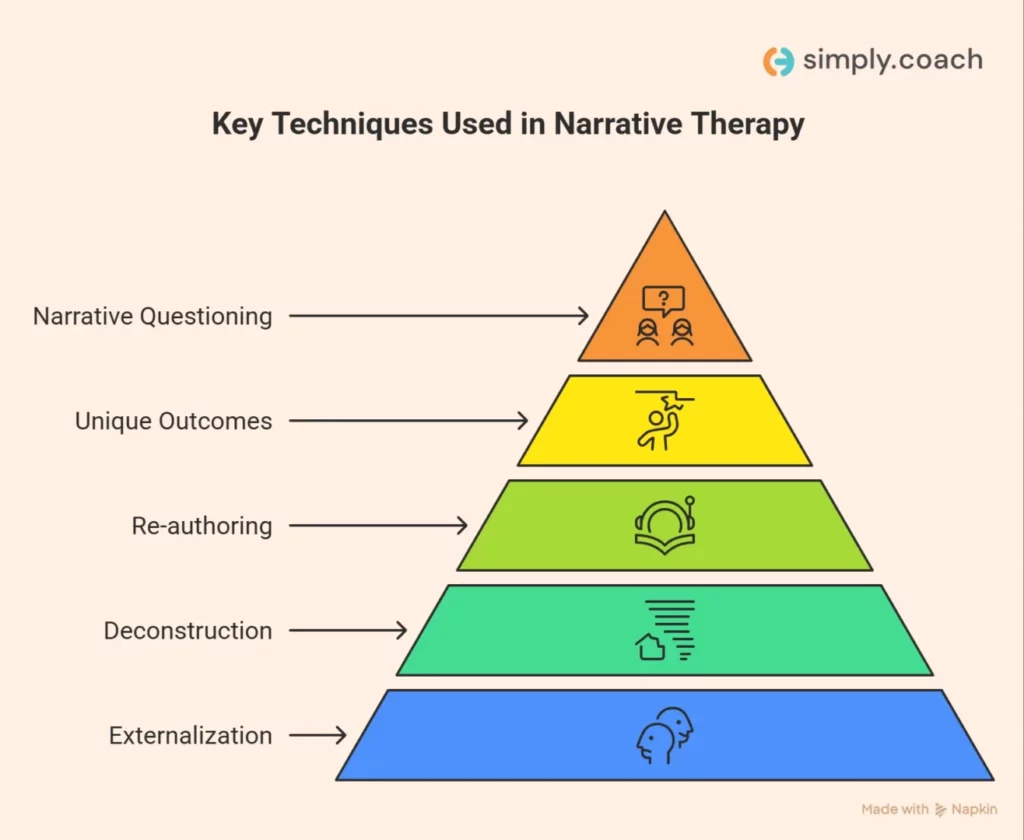
Narrative therapy relies on specific techniques that help clients explore, challenge, and reshape the stories they tell about themselves. Mastery of these techniques allows therapists to guide clients toward empowerment, self-efficacy, and meaningful change in individual, family, or couples therapy.
1. Externalization
Externalization helps clients separate their identity from the problem, allowing them to see challenges as external influences rather than personal flaws.
This technique reduces self-blame and creates a mental space for clients to examine how the problem affects their choices and relationships. By naming the problem, you can make abstract issues tangible and manageable.
2. Deconstruction
Deconstruction breaks down dominant narratives and assumptions shaping the client’s life. It helps uncover hidden messages from family, culture, or society that may reinforce limiting beliefs.
Through careful questioning, you help clients identify contradictions or rigid patterns in their story, enabling new interpretations and freeing them from problem-dominated thinking.
3. Re-authoring
Re-authoring empowers clients to rewrite personal narratives in ways that reflect their strengths, values, and resilience. It shifts focus from problem-saturated stories to stories of capability and growth.
By highlighting alternative experiences, you can help clients see themselves as active agents, creating narratives that reinforce confidence, intentionality, and adaptive behavior.
4. Unique outcomes
Unique outcomes focus on moments when the client successfully acted despite the influence of the problem. These exceptions demonstrate agency and resilience that often go unnoticed.
You can use this technique to show clients that they already possess skills and strengths to handle challenges, which supports building empowering narratives for the future.
5. Narrative questioning
Narrative questioning uses reflective, open-ended questions to guide clients in exploring meaning, identity, and underlying assumptions. It deepens self-awareness and facilitates insight.
This technique helps you uncover hidden strengths, alternative perspectives, and potential paths forward, enabling clients to intentionally reframe experiences and make conscious choices.
Also read: How to Ask the Right Therapy Intake Session Questions: A Practical Guide for Therapists
Overall, these techniques equip therapists to systematically guide clients from problem-focused stories to narratives that highlight personal strengths, resilience, and purposeful action. Mastery of these methods creates a strong foundation for meaningful and lasting therapeutic change.
How Therapists Use Narrative Therapy in Practice
Narrative therapy provides a structured approach to help clients explore, challenge, and reshape their personal stories. The following steps outline how therapists can apply this method effectively.
1. Identifying the dominant narrative
Start by uncovering the recurring stories your clients tell about themselves. These narratives often shape beliefs, emotions, and behaviors.
- Observe recurring themes: Listen for repeated statements that indicate self-limiting beliefs or identity labels.
- Ask focused questions: Encourage clients to describe their experiences in specific contexts to reveal patterns.
- Document narratives: Note the language and metaphors clients use to describe challenges or failures.
- Tip: Encourage clients to tell a recent story about a typical day to highlight dominant patterns.
2. Separating the problem from the person
Clients often conflate their identity with the challenges they face. Externalizing the problem allows them to see it as an influence rather than a defining trait.
- Name the problem: Assign a concrete name such as Anxiety or The Critic to make it external.
- Use externalizing language: Guide clients to describe the problem’s effects rather than labeling themselves.
- Encourage reflection: Ask how the problem interacts with thoughts, feelings, and behaviors without controlling them.
- Tip: Visual aids like drawing the problem as an object or force can make separation more tangible.
3. Exploring how the problem influences life experiences
Examine the ways the problem affects clients’ emotions, decisions, and relationships. Understanding this impact helps clients gain insight.
- Map the impact: Ask, “How has this problem influenced your work, relationships, or daily routines?”
- Identify patterns: Look for repeated consequences or behaviors caused by the problem.
- Encourage detailed reflection: Have clients provide concrete examples of situations where the problem influenced choices.
- Tip: Timelines or visual charts can help clients see connections and understand recurring patterns.
4. Identifying exceptions or “unique outcomes”
Highlight moments when clients acted independently of the problem. Recognizing these exceptions strengthens self-efficacy and agency.
- Ask for specific examples: Encourage clients to recall times when the problem did not dominate their actions.
- Explore enabling factors: Discuss what allowed them to act differently and how these skills can be repeated.
- Reinforce successes: Use these moments to create alternative narratives that show competence and resilience.
- Tip: Chart or timeline these unique outcomes to make them tangible and memorable.
5. Re-authoring a more empowering narrative
Guide clients to reshape their stories to emphasize strengths, values, and agency. This creates a foundation for long-term growth.
- Highlight alternative stories: Focus on moments of intentional action, resilience, and success.
- Encourage new storytelling: Have clients write or verbalize their story in a way that reflects capability and hope.
- Integrate into daily life: Explore how the new narrative can guide future decisions and behaviors.
- Tip: Use journaling, role-play, or storytelling exercises to reinforce the new empowering narrative.
Applying these steps allows you, as a therapist, to systematically guide clients from problem-focused stories toward empowered, meaningful narratives. This structured approach builds self-awareness, agency, and long-term resilience.
Also read: How to Set Goals that Help Clients Achieve Progress in Therapy
Common Misunderstandings About Narrative Therapy

Even experienced therapists sometimes misinterpret narrative therapy concepts or apply them in ways that weaken clinical impact. Understanding these misconceptions helps you apply narrative therapy accurately and achieve stronger outcomes for your clients.
- Narrative therapy is simply storytelling: You may assume it’s casual storytelling, but narrative therapy uses structured techniques to examine how clients’ stories shape identity and meaning.
- It ignores real problems: Remember, narrative therapy acknowledges problems but separates them from the person. This reduces self-blame and allows you to guide clients toward intentional coping.
- Clients must produce positive outcomes immediately: Your clients won’t change overnight. Narrative therapy focuses on perspective shifts and understanding, building lasting change through reflection and repeated practice.
- It is only useful for mild issues: Narrative therapy can address a range of concerns, but when issues are severe, you may need to combine it with other clinical strategies for safety and effectiveness.
- Therapists lead the story: In narrative therapy, your role is to guide exploration. You help clients uncover insights rather than impose interpretations or solutions.
- It rejects structure and technique: You might think narrative therapy is unstructured, but it relies on specific techniques like externalization, deconstruction, and re-authoring to direct interventions effectively.
By addressing these common misunderstandings, you can apply narrative therapy with confidence, ensuring your clients engage deeply and reshape their stories in meaningful, empowering ways.
Narrative Therapy Vs Other Therapeutic Approaches
Understanding how narrative therapy differs from other approaches helps you choose the right method for each client. The table below clearly highlights key focus and your role as a therapist across different approaches.
| Comparison | Key Focus / Goal | Therapist & Client Role |
| Narrative Therapy vs Cognitive Behavioral Therapy (CBT) | Focuses on client stories, identity, and meaning. CBT targets thoughts and behaviors for measurable change. | You guide clients to externalize problems and re-author narratives. In CBT, you help clients restructure maladaptive thoughts and track behavior change. |
| Narrative Therapy vs Solution-Focused Therapy | Explores meaning, identity, and life stories over time. Solution-focused therapy emphasizes quick goal achievement and actionable solutions. | You help clients reflect on experiences, identify exceptions, and reshape narratives. In solution-focused therapy, you guide clients toward practical steps and immediate problem-solving. |
| Narrative Therapy vs Psychodynamic Therapy | Centers on conscious stories and personal meaning. Psychodynamic therapy explores unconscious conflicts, past experiences, and emotional drives. | You collaborate with clients to build empowering narratives. In psychodynamic therapy, you interpret unconscious patterns and guide insight into behavior. |
Overall, narrative therapy stands out by focusing on personal stories, identity, and meaning, complementing other approaches that emphasize thoughts, solutions, or unconscious processes. This perspective allows you to tailor interventions effectively for each client.
Also read: Top 10 HIPAA-Compliant Therapy Practice Management Software: A 2026 Guide for Therapists – Simply.Coach
Conclusion
Narrative therapy helps you guide clients in examining the stories shaping their identity and lived experiences. Through techniques like externalization, deconstruction, and re-authoring, clients begin separating themselves from their problems and assumptions. This process allows them to identify unique outcomes, reinterpret difficult experiences, and build more empowering personal narratives. When applied intentionally, narrative therapy helps you support clients in developing greater agency, clarity, and long-term identity change.
How Simply.Coach Helps You Implement Narrative Therapy in Practice
Applying narrative therapy effectively requires structured reflection, consistent documentation, and organized client engagement across sessions. Simply.Coach is an all-in-one HIPAA-compliant therapy practice management platform that helps you manage these processes securely while focusing on meaningful client work.
Key tools that support narrative therapy practice include:
- Session notes and client timelines: Document narrative themes, identity shifts, and key insights emerging from each therapy conversation.
- Goal tracking and development plans: Monitor how clients reshape personal narratives and track progress toward identity and life goals.
- Action plans and reflection exercises: Assign journaling prompts, narrative reframing tasks, or reflection activities between therapy sessions.
- Secure client workspace: Share worksheets, narrative exercises, and resources within a confidential portal for continued reflection.
- Scheduling, contracts, and payments: Manage appointments, agreements, and billing so you can focus on meaningful therapeutic conversations.
Using a structured platform like Simply.Coach allows you to deliver narrative therapy more consistently while maintaining organized client records and measurable progress.
FAQs
1. How long does narrative therapy typically take to show results?
The timeline varies depending on the client’s goals and the depth of narrative exploration. Some clients notice perspective shifts within a few sessions, while deeper identity work may require longer-term engagement.
2. Can narrative therapy be used in group or family settings?
Yes. Narrative therapy is often applied in family and group therapy because multiple perspectives help challenge dominant problem stories. Collaborative storytelling allows participants to witness and support alternative narratives.
3. What types of questions do narrative therapists typically ask?
Narrative therapists use reflective questions that explore how problems influence life experiences and how clients influence the problem. These questions help uncover values, strengths, and moments that contradict the dominant story.
4. Is narrative therapy evidence-based?
Narrative therapy is widely used in clinical practice and is supported by qualitative research and case studies. It is especially recognized for its collaborative, non-pathologizing approach to identity and meaning-making.
5. Can narrative therapy be combined with other therapy approaches?
Yes. Many therapists integrate narrative techniques with modalities like CBT or family therapy. Combining approaches allows clinicians to address both cognitive patterns and the broader life stories shaping client identity.
6. What skills do therapists need to practice narrative therapy effectively?
Therapists need strong listening, reflective questioning, and collaborative conversation skills. The approach relies on helping clients explore meaning, values, and identity through carefully guided dialogue.
7. Is narrative therapy suitable for children and adolescents?
Narrative therapy works well with younger clients because storytelling and imaginative language make complex emotions easier to explore. Externalizing problems can also reduce fear and help children see challenges as manageable.