
As a practitioner, you’ve likely seen technically correct interventions fail due to weak alliance or client resistance. For coaches and clinicians optimizing retention, engagement depth becomes a key metric. Clients who feel deeply understood disclose faster and commit more fully. Person centered therapy places the therapeutic relationship at the core of client progress.
Instead of positioning the practitioner as the primary change agent, this model activates client-led growth. That shift increases accountability, improves intrinsic motivation, and supports durable psychological outcomes. The method strengthens both alliance quality and long-term transformation rates.
This article explores the foundations, clinical applications, process, and practical implementation of person centered therapy for modern practitioners.
Key Takeaways
- Psychological distress in this model is conceptualized as incongruence between self-image and lived experience, with therapy aiming to reduce that discrepancy through relational conditions rather than interpretation.
- Rogers identified six necessary and sufficient conditions, including therapist congruence, empathic understanding, unconditional positive regard, and the client’s perception of these conditions.
- The therapist avoids directive advice, cognitive disputation, and structured homework, instead using reflective listening and clarification to increase client-led insight and internal locus of control.
- Research indicates non-directive supportive therapy is effective for adult depression and may show comparable long-term outcomes to structured models when researcher allegiance bias is controlled.
- Person-centered therapy is adaptable across individual, group, family, and low-resource settings, with evidence suggesting lower dropout rates in trauma treatment contexts.
- Simply.Coach enables therapists to implement person-centered approaches efficiently by centralizing client management, session tracking, goal planning, and progress monitoring in a secure, HIPAA-compliant platform.
Origins of Person-Centered Therapy
In the early 1940s, Carl Rogers challenged the dominance of psychoanalytic and behavioral frameworks. At a time when Sigmund Freud emphasized unconscious conflict and B. F. Skinner focused on conditioning, Rogers redirected attention to subjective experience. He argued that clients possess innate psychological resources for growth.
Rogers’ approach replaced interpretation with reflective listening and unconditional positive regard. This reframed the therapist’s role from authority to facilitator. The intervention was not an analysis but a relational presence grounded in empathy.
By the 1960s, his work aligned with the Human Potential Movement, which emphasized self-actualization and intrinsic capacity. Rogers proposed that individuals naturally move toward growth when conditions of acceptance exist. Psychological distress, he believed, results from internalized conditions of worth that distort self-perception.
For modern practitioners, this historical pivot remains operationally relevant. When clients internalize external performance metrics as identity markers, incongruence increases. Person centered therapy addresses that incongruence through relational safety and structured empathic engagement.
Now, let’s explore when person-centered therapy is applied in practice.
When Is Person-Centered Therapy Used
Person-centered therapy is adaptable across private practice, coaching engagements, group facilitation, and hybrid care models. Below are high-impact use cases relevant to coaches, therapists, and mental health professionals.
- Identity Consolidation & Self-Concept Repair: Clients struggling with imposter syndrome, role confusion, or authenticity gaps benefit from structured empathic reflection. The modality helps them examine internalized conditions of worth. Over time, congruence increases and self-directed decision-making strengthens.
- Anxiety & Depressive Patterns Rooted in Incongruence: When anxiety or low mood stems from misaligned life choices or suppressed emotions, empathic processing reduces internal conflict. Clients begin identifying distortions between real and ideal self. This often improves emotional regulation and reduces avoidance behaviors.
- Relational and Interpersonal Difficulties: Clients with attachment wounds or repeated relational breakdowns gain insight through reflective dialogue. Experiencing unconditional positive regard in-session models corrective relational dynamics. This strengthens emotional literacy and interpersonal effectiveness.
- Grief, Life Transitions, and Existential Stressors: Major transitions often destabilize identity frameworks. The non-directive structure allows clients to process ambiguity without premature reframing. Practitioners can track progress through increased clarity, emotional articulation, and self-trust indicators.
- High-Functioning Professionals Experiencing Burnout: Leaders and founders frequently suppress affect to maintain performance output. The approach creates space to unpack values-performance misalignment. Outcome indicators include improved boundary-setting and reduced emotional exhaustion scores.
- Adolescents Developing Autonomy: Younger clients respond well to environments that minimize authority pressure. Reflective listening strengthens self-expression and reduces defensive shutdown. Engagement rates often improve when clients feel ownership of session direction.
Next, we’ll see what a typical person-centered therapy session looks like.
What to Expect in Person-Centered Therapy
For practitioners trained in structured modalities, the non-directive stance can initially feel counterintuitive. Below is what practitioners and their clients can typically expect.
- Client-Led Dialogue Structure: The client directs the session flow based on lived experience and present-moment awareness. You avoid steering content unless clarification supports deeper processing. This increases autonomy and strengthens the internal locus of control.
- Reflective Listening as Core Intervention: You restate content and emotional undertones without judgment or reinterpretation. Clients often self-correct or deepen their statements after hearing them reflected. This iterative loop accelerates clarity and reduces cognitive distortion.
- Minimal Interpretation or Advice-Giving: The model avoids premature reframing or directive solutions. Instead, clients arrive at their own conclusions through supported exploration. Ownership of insight improves implementation fidelity outside sessions.
- Therapeutic Silence as Processing Space: Silence is intentional, not awkward. It allows affective material to surface and integrate. Skilled containment during these pauses enhances emotional tolerance and self-trust.
- Focus on Congruence and Emotional Accuracy: You monitor discrepancies between stated beliefs and felt experience. When gently reflected, clients often recognize misalignment independently. Over time, self-concept becomes more stable and coherent.
Also Read: How to Run a Coaching Discovery Session That Converts and Attracts Serious Clients
Next, let’s examine the step-by-step process of this therapeutic approach.
Process of Person-Centered Therapy

Rogers proposed that psychological distress emerges from incongruence between self-image and lived experience. This gap produces vulnerability, defensiveness, and chronic anxiety in clients. Person centered therapy works by reducing that discrepancy through structured empathic engagement rather than directive correction. Below is how the therapeutic process typically occurs in clinical or coaching settings.
- Identification of Incongruence: Clients often present with anxiety, low self-worth, or decision paralysis rooted in misaligned self-concepts. Through reflective dialogue, discrepancies between stated identity and emotional reality become visible. Awareness reduces defensiveness and increases cognitive flexibility.
- Nonjudgmental Therapeutic Climate: You establish psychological safety by suspending evaluation, advice, and interpretive authority. This decreases external validation dependency. Clients begin testing and revising internal narratives without fear of correction.
- Reflective Clarification Without Prescription: Instead of offering solutions, you ask precise, clarifying questions and reflect emotional undertones. Clients refine their thinking in response to accurate mirroring. Self-generated conclusions increase implementation adherence outside sessions.
- Strengthening Internal Locus of Control: Directive advice can unintentionally reinforce external solution-seeking. By maintaining a facilitative stance, you reinforce client agency. Over time, decision confidence and accountability metrics improve.
- Self-Esteem and Decision Trust Development: As incongruence decreases, clients report increased self-acceptance and reduced rumination. They tolerate the consequences of their choices with less shame. Emotional resilience becomes internally anchored rather than therapist-dependent.
Understanding the process leads us to the necessary and sufficient conditions identified by Rogers.
6 Necessary Conditions of Person-Centered Therapy
Rogers identified six relational conditions he believed were both necessary and sufficient for therapeutic change. These conditions define the operational framework of person centered therapy.
The Six Foundational Conditions:
- Therapist–Client Psychological Contact: Both practitioner and client must be emotionally and cognitively engaged in authentic relational exchange. This goes beyond attendance or structured dialogue. Psychological contact requires attuned presence, eye contact, vocal alignment, and responsiveness.
- Client Incongruence: The client experiences a gap between self-concept and lived experience. This discrepancy often manifests as anxiety, defensiveness, shame, or role confusion. Incongruence creates internal tension that drives help-seeking behavior.
- Therapist Congruence: You remain internally aligned, transparent, and emotionally present within the relationship. Congruence eliminates performative professionalism and hierarchical distance. Clients detect authenticity quickly and adjust their own openness accordingly.
- Unconditional Positive Regard: You communicate consistent acceptance regardless of the client’s behaviors, beliefs, or emotional volatility. This does not imply agreement; it signals non-evaluative presence. When clients sense freedom from judgment, defensive posturing decreases.
- Empathic Understanding: You accurately track and reflect the client’s internal frame of reference. Empathy targets emotional meaning and subjective experience rather than narrative accuracy.
- Client Perception of Acceptance and Empathy: Therapeutic impact depends on the client perceiving empathy and acceptance, not merely your intention to provide it. Subtle misattunements can disrupt this perception. When clients internalize relational safety, shame decreases, and cognitive flexibility improves.
Also Read: Coaching vs Counseling: Understanding the Key Differences
Now, let’s explore the clinical applications and effectiveness of this therapy.
5 Clinical Applications of Person-Centered Therapy
For practicing clinicians, the relevance of person centered therapy lies in its impact on alliance quality, dropout reduction, and client autonomy outcomes. Below are common clinical indications relevant to practitioner decision-making.
- Treatment of a Psychiatric Disorder
Clients presenting with mood, anxiety, trauma-related, or adjustment disorders may benefit from a non-directive relational framework. The approach can complement pharmacotherapy or stand alone, depending on severity. Alliance-driven work often enhances medication adherence and engagement stability.
- Maladaptive Thoughts or Behavioral Patterns
Clients experiencing cognitive rigidity, self-critical narratives, or avoidance behaviors benefit from reflective exploration. Rather than restructuring thoughts directly, the therapist facilitates insight into their emotional origins. This promotes internally motivated behavioral change.
- Support During Acute or Chronic Stressors
Major life transitions, caregiving burden, medical diagnoses, or occupational strain may impair functioning. A nonjudgmental environment supports emotional processing without escalating distress. Clients build coping tolerance while preserving autonomy.
- Behavioral Change and Health Adherence
Person-centered interventions can improve adherence to medical regimens and lifestyle changes. When clients feel understood rather than instructed, resistance decreases. Internal motivation strengthens follow-through metrics.
- Interpersonal or Relational Difficulties
Clients struggling with attachment patterns or communication breakdowns benefit from corrective relational experiences in-session. Experiencing unconditional positive regard often alters relational expectations. Improved emotional literacy enhances interpersonal outcomes.
Also Read: Top 10 Executive Coaches in the US to Follow in 2026
Before starting, there are a few considerations practitioners should keep in mind.
6 Things to Consider Before Using This Modality
Before implementing this model, assess client readiness for self-directed exploration and tolerance for emotional ambiguity. Person centered therapy requires clients to articulate their internal experiences without relying on a therapist-led structure.
Below are key practitioner-level considerations to evaluate during intake and early sessions:
- Client Readiness and Reflective Capacity: Assess whether the client can identify and verbalize internal states without heavy prompting. Limited emotional literacy may slow progress. Early micro-interventions can build reflective skills before deeper exploration.
- Expectation Alignment Around Therapist Role: Some clients expect structured homework, interpretation, or directive advice. Clarify early that the therapist functions as a facilitator rather than an expert authority. Misaligned expectations often increase dropout risk.
- Tolerance for Emotional Ambiguity: Non-directive work includes silence and exploratory uncertainty. Clients uncomfortable with open-ended processing may experience frustration. Screening for distress tolerance improves modality fit.
- Alliance Sensitivity and Perception of Empathy: Progress depends on the client perceiving acceptance and understanding. Subtle misattunements can reduce disclosure depth. Use early alliance check-ins to monitor relational safety.
- Motivation and Autonomy Orientation: The model performs best with clients seeking self-directed growth. Externalized blame patterns or low ownership may limit gains. Collaborative contracting strengthens accountability metrics.
- Suitability Compared to Directive Modalities: Clients requiring rapid symptom stabilization or structured skill training may benefit from adjunctive approaches. Consider integration with CBT or other structured models when clinically indicated. Treatment matching protects long-term outcome integrity.
Discover how Sensiba standardized coaching processes, improved visibility, and scaled a high-impact coaching culture with measurable outcomes using Simply.Coach. Read the full case study.
Next, let’s review some practical examples of person-centered therapy in action.
7 Examples of Person-Centered Therapy in Practice
Below are clinically grounded micro-scenarios illustrating core relational techniques. These examples reflect how high-fidelity delivery impacts client insight and engagement. Each example highlights observable practitioner behaviors rather than abstract principles.
- Active Listening Example
Client: “I feel exhausted trying to keep everyone happy at work.”
Therapist: “You’re carrying constant pressure to meet expectations, and it’s draining you.”
The therapist reflects emotional tone rather than offering solutions. This reduces defensiveness and invites elaboration.
- Accurate Empathy Example
Client: “I got promoted, but I don’t feel proud. I feel exposed.”
Therapist: “Instead of pride, the promotion feels like vulnerability and risk.”
This captures emotional nuance beyond surface content. Clients often deepen disclosure when accurately understood.
- Accepting Negative Emotions Example
Client: “Sometimes I resent my family for needing me so much.”
Therapist: “There’s resentment there, even though you care deeply.”
The therapist normalizes complex emotions without moral judgment. This reduces shame and supports emotional integration.
- Unconditional Positive Regard Example
Client: “I made a decision that hurt someone, and I’m not sure I regret it.”
Therapist: “You’re being honest about mixed feelings, and that honesty matters.”
Acceptance does not equal endorsement. It reinforces psychological safety and authentic self-exploration.
- Reflection Example
Client: “I always say I value balance, but I keep overworking.”
Therapist: “Part of you wants balance, yet your actions move toward overcommitment.”
Reflection highlights incongruence without accusation. Clients often initiate corrective insight independently.
- Self-Exploration Encouragement Example
Client: “I don’t know why I react so strongly.”
Therapist: “What do you notice happening inside you just before the reaction?”
Open-ended inquiry directs attention inward. This strengthens metacognitive awareness and emotional tracking.
- Client-Led Process Example
Client: “I’m not sure what to talk about today.”
Therapist: “What feels most present for you right now?”
The therapist resists agenda-setting. Ownership of session direction reinforces an internal locus of control.
Also Read: Fundamentals of Entrepreneurship Coaching: Principles, Tools, and Techniques
Even though the model is useful, it’s crucial to understand its limitations.
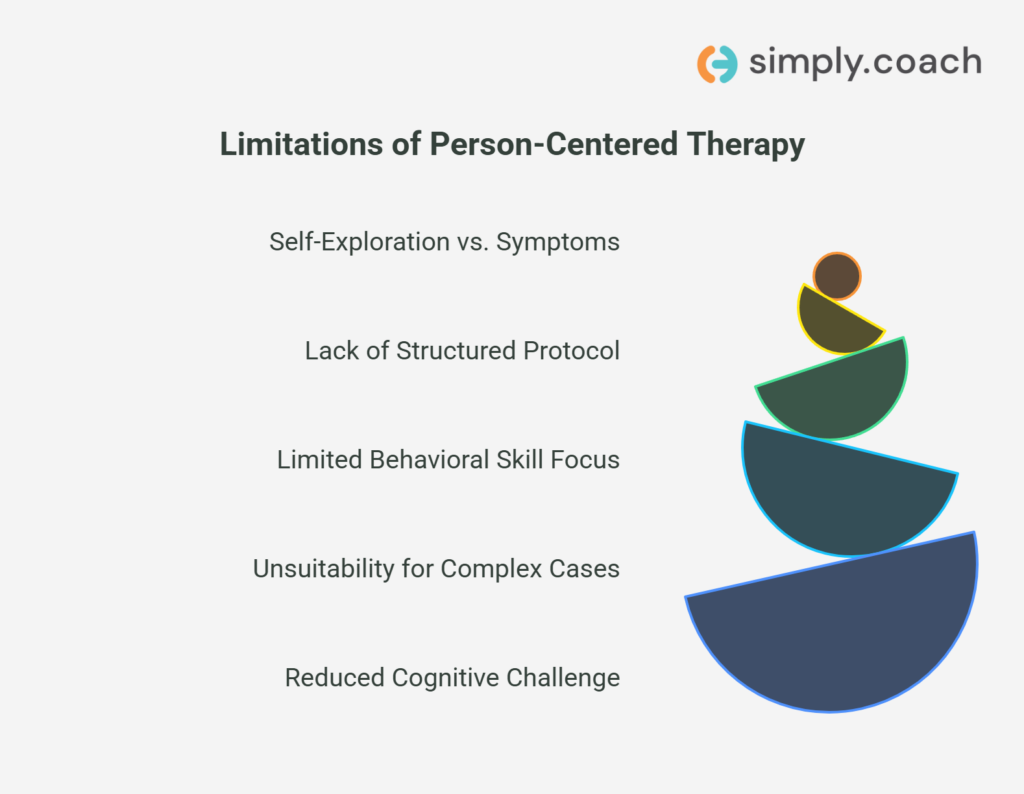
5 Limitations of Person-Centered Therapy
r̥While person centered therapy offers strong alliance-based outcomes, it presents structural limitations in certain clinical contexts. Practitioners should evaluate symptom severity, cognitive capacity, and treatment urgency before selecting this modality. Treatment matching remains cenr̥r̥r̥r̥tral to ethical and outcome-driven care. Below are clinically relevant limitations to consider when determining fit.
- Self-Exploration May Not Directly Target Acute Symptoms
Clients seeking rapid symptom reduction may require structured interventions. Severe panic, compulsions, or trauma flashbacks often need specific protocols. Non-directive exploration alone may not provide sufficient stabilization.
- Lack of Structured Protocol Compared to EMDR or DBT
Unlike Eye Movement Desensitization and Reprocessing (EMDR) or Dialectical Behavior Therapy (DBT), this model does not follow manualized phases. Absence of structured sequencing may limit predictability. Some clients benefit from clearly defined intervention roadmaps.
- Limited Emphasis on Behavioral Skill Acquisition
The modality prioritizes insight and self-concept integration over skill rehearsal. Clients needing emotional regulation tools or behavioral activation plans may require adjunctive strategies. Integration with skills-based models can enhance outcomes.
- Potential Unsuitability for Complex or Neurodevelopmental Presentations
Clients with intellectual disabilities, severe cognitive impairment, or active psychosis may struggle with open-ended introspection. Insight-driven dialogue may not align with their processing capacity. Additional structure or multimodal care may be necessary.
- Reduced Direct Cognitive Challenge
The therapist avoids actively disputing unhelpful beliefs. Clients entrenched in rigid cognitive distortions may benefit from structured cognitive restructuring. Without gentle challenge, maladaptive patterns can persist longer.
Download the guide How to Design & Launch Your Signature Coaching Program to structure, package, and scale a results-driven coaching offer.
Next, let’s see how to get started applying client-centered therapy with your clients.
How to Get Started With Client-Centered Therapy
Client-centered therapy can be delivered in individual, group, outpatient, or inpatient settings. Implementation depends on clinical population, infrastructure, and practitioner training. Proper onboarding strengthens engagement and retention from the outset.
Below is a practitioner-informed overview of the initiation process.
- Referral and Intake Process: Clients may be referred by primary care providers or self-refer through private practice channels. Early screening should assess motivation, insight capacity, and risk factors. Clear informed consent protects therapeutic boundaries.
- First Session Structure: During the initial session, you explore presenting concerns and treatment goals. You explain the non-directive framework and collaborative nature of the work. Transparency around billing, frequency, and insurance reduces administrative friction.
- Establishing the Collaborative Contract: You clarify that clients share responsibility for session direction. This sets expectations around autonomy and participation. Early alignment reduces future frustration regarding lack of directive advice.
- Ongoing Session Dynamics: Throughout treatment, you reflect emotional meaning and clarify internal experience. You avoid prescriptive interventions unless clinically necessary. Over time, clients demonstrate increased self-trust and decision confidence.
- Monitoring Progress and Adjusting Care: Track alliance strength, disclosure depth, and client-reported clarity gains. If progress plateaus, consider integrative strategies or stepped-care adjustments. Flexibility enhances long-term therapeutic effectiveness.
When implemented with careful screening and expectation management, person-centered therapy supports sustainable client autonomy. For practices prioritizing relational depth and reduced dropout, it remains a strategically valuable modality.
Conclusion
For coaches, therapists, and mental health practitioners, person centered therapy remains less about technique and more about relational precision. When you consistently deliver congruence, accurate empathy, and unconditional positive regard, clients reorganize their self-concept from the inside out.
It may not offer scripted protocols or rapid symptom hacks, but it reliably strengthens alliance depth, reduces dropout risk, and builds durable autonomy. In a field increasingly driven by metrics and manualization, this model reminds us that therapeutic presence itself is a intervention.
Simply.Coach: Your All-in-One Coaching Platform
Simply.Coach is an all-in-one platform designed for therapists, counselors, and mental health practitioners specializing in person-centered therapy. It centralizes client management, session tracking, communication, billing, and program planning into a single secure platform, helping you run your practice efficiently while delivering meaningful, client-focused care.
- Client Management and Progress Tracking: Capture detailed client profiles, therapy goals, session notes, emotional assessments, and reflections, while monitoring progress with visual dashboards and milestone tracking tailored to person-centered approaches.
- Scheduling, Automation, and Reminders: Manage one-on-one or group therapy sessions effortlessly, with automated reminders, calendar syncing, and time zone adjustments to reduce missed appointments and improve client engagement.
- Interactive Tools and Resource Library: Assign reflective exercises, journaling prompts, self-exploration worksheets, and curated template resources to engage clients between sessions and reinforce therapeutic outcomes.
- Payments, Subscriptions, and Contracts: Handle invoicing, recurring session packages, subscriptions, and client agreements directly within the platform for a seamless administrative workflow.
- Integrated Communication and Tools: Conduct secure HIPAA-compliant video sessions, manage messaging, integrate with email, and coordinate care across multidisciplinary teams for seamless therapy delivery.
Simply.Coach consolidates all essential tools for person-centered intervention into one platform, enabling you to focus on client growth, nurture meaningful connections, and scale your practice efficiently.
FAQs
1. How does Person-Centered Therapy differ from other therapy approaches?
It prioritizes relational conditions over techniques, avoids directive interventions, minimizes interpretation, and positions client self-concept restructuring, not symptom targeting, as the primary mechanism of change.
2. What happens during a Person-Centered Therapy session?
The client leads the discussion while the therapist reflects emotional meaning, clarifies incongruence, maintains a nonjudgmental presence, and allows silence to facilitate cognitive-emotional integration.
3. What is the role of the therapist in Person-Centered Therapy?
The therapist functions as a relational catalyst, delivering congruence, accurate empathy, and unconditional positive regard without prescribing solutions or restructuring cognition directly.
4. How many sessions of Person-Centered Therapy will I need?
Session length varies by client readiness, insight capacity, and complexity; short-term work may span 8–12 sessions, while identity-level restructuring often requires longer engagement.
5. How do I measure progress without structured symptom tools?
Monitor alliance strength, reduced defensiveness, improved emotional articulation, autonomous decision-making, and sustained self-concept coherence across sessions.