
Great coaching doesn’t sell itself, your words do. You might have amazing programs, clear strategies, and proven methods, but if your ideal clients don’t understand the transformation you offer, they won’t sign up. Many coaches struggle to fill sessions because their messaging doesn’t connect, even when their expertise is exceptional.
Copywriting for coaches is more than writing words, it’s the skill that turns curiosity into commitment. It helps potential clients see the value of your coaching programs, trust your expertise, and take action. Without effective copy, even the most transformative services can go unnoticed, leaving you frustrated and under booked.
In this guide, you’ll discover how to write a copy that attracts more clients without sounding pushy. We’ll cover website messaging, sales pages, email sequences, social media posts, and practical frameworks. Whether you write your own copy or hire a copywriter for coaches, you’ll walk away with actionable strategies that convert prospects into clients.
Key Takeaways
- Copywriting for coaches turns curiosity into commitment: Your words help potential clients see the transformation you offer and take action.
- Understand your ideal coaching buyer first: Research their goals, language, and objections to write a copy that truly resonates.
- Use proven frameworks that convert: Frameworks like Problem–Shift–Outcome, BAB, and AIDA guide prospects from interest to action.
- Address common client objections early: Answer doubts about time, money, or results to reduce hesitation and boost conversions.
- Focus on benefits, not features: Highlight the transformational results clients will get, not just what you deliver.
- Support your copy with efficient coaching operations: Platforms like Simply.Coach help you manage clients, track progress, and automate administrative work so you can focus on creating impactful copy that attracts more clients.
What is Copywriting for Coaches and Why it Matters
Copywriting for coaches is the skill of using words to clearly show the transformation your clients can achieve. It’s different from general content writing, which informs or entertains but rarely drives action. Coaching copy focuses on outcomes, emotional impact, and guiding prospects toward action.
Coaching copy also differs from other industries because clients invest in personal growth. Your messaging must resonate with their desires, fears, and long-term goals. Generic marketing language rarely works in this context.
Why copywriting is important for coaches
Effective copywriting transforms your coaching expertise into messages that attract the right clients. It ensures prospects clearly understand the value you deliver.
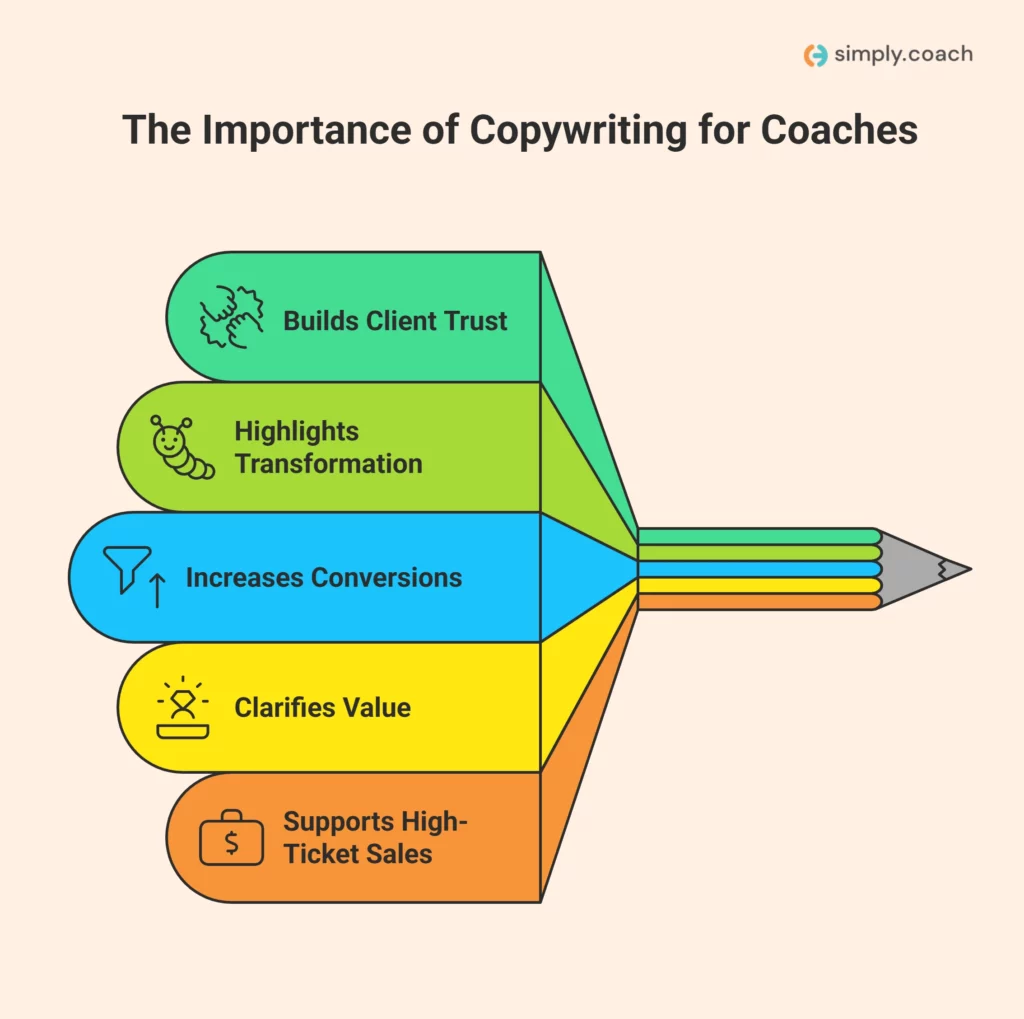
- Builds client trust: Your words show that you understand clients’ challenges and can guide them toward results.
- Highlights transformation: Copy communicates the outcomes your coaching programs deliver, making the benefits tangible.
- Increases conversions: Persuasive messaging encourages potential clients to take action, such as booking a session or joining a program.
- Clarifies your value: Copy differentiates you from competitors by emphasizing what makes your coaching unique.
- Supports high-ticket sales: For personal growth or executive coaching, clear copy reassures clients about their investment.
For example, instead of saying, “I offer career coaching,” transformational copy would say: “Land the career you deserve in 90 days.” This approach highlights results, not services.
Also read: How to Build a High-Ticket Coaching Funnel That Converts Clients
How to Understand Your Coaching Buyer Before You Write a Single Word
You can write amazing copy, but if it doesn’t speak to your ideal client, it won’t convert. Understanding your coaching buyer ensures every message resonates with their needs, goals, and emotions. It allows you to craft copy that attracts the right clients and drives real action.
Who is your ideal coaching client?
- Pain-aware vs solution-aware: Some clients know their problem and are actively searching for help, while others are unaware they need guidance. Identify both types so your copy addresses their stage in the journey.
- Emotional and practical motivators: Clients hire coaches to achieve results and feel better. Determine what excites, frustrates, and motivates them daily. Use these insights to craft benefits-focused copy.
- Focus beyond demographics: Age, gender, or location alone isn’t enough. Look at aspirations, challenges, and mindset. What keeps them awake at night, and what dream result do they seek?
What coaching clients are searching for
- Transformation-driven queries: Clients search for solutions to gain confidence, clarity, career advancement, or improved health. Identify the language they use and incorporate it into your messaging.
- Translate search intent into copy: Use their queries to shape headlines, lead magnets, emails, and social posts. This ensures your copy answers questions before clients even book a session.
- Map problems to solutions: For every pain point clients express, show a clear pathway through your coaching program. This positions your services as the transformation they want.
How to conduct market research
- Online research: Explore discussions in Reddit threads, LinkedIn posts, Facebook groups, and competitor websites. Note how clients describe challenges and the solutions they seek.
- Offline research: Conduct short interviews or surveys with three to five prospects. Ask why they want coaching, what’s holding them back, and what success looks like to them.
- Use real client language: Record the exact words prospects use. Incorporate these phrases in your copy to make it feel authentic and relatable.
Understanding your client is the foundation of irresistible copy. When your copy mirrors your audience’s language, desires, and challenges, it naturally engages and converts them.
Also read: 17 Proven Strategies to Find Clients and Grow Your Coaching Business
Core Copywriting Principles Every Coach Must Know
Writing effective copy isn’t about fancy words or long paragraphs, it’s about connecting with your ideal clients and showing them why your coaching matters. These principles ensure your messaging is persuasive, clear, and focused on results.
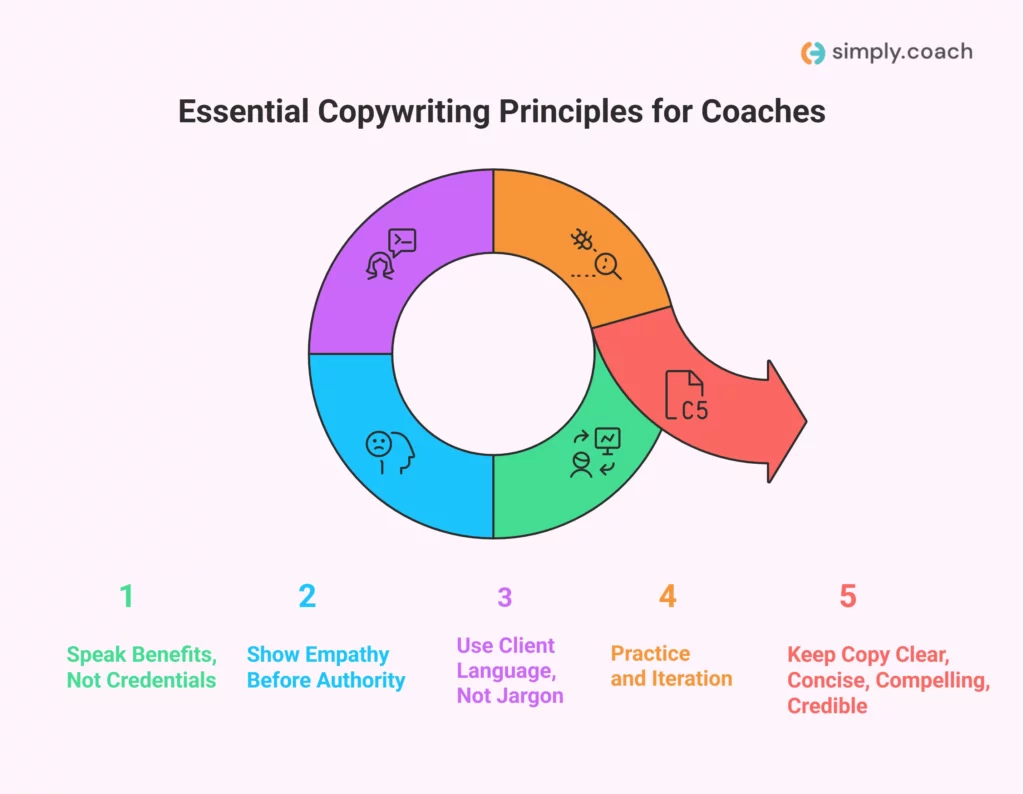
1. Speak benefits, not credentials
Clients don’t buy your experience, they buy the transformation it creates. Instead of saying, “I have 10 years of career coaching experience,” focus on the outcome: “Land your dream promotion within 90 days of coaching.” Highlighting results over qualifications makes your copy client-centered and compelling.
2. Show empathy before authority
Before establishing credibility, acknowledge your client’s struggles. Statements like, “Feeling stuck in your career is frustrating, and uncertainty can be overwhelming,” immediately resonate. Once empathy is established, briefly demonstrate your authority to reassure clients that you can guide them effectively.
3. Use client language, not jargon
Avoid technical coaching terms or corporate phrases your clients don’t use. Listen to how they describe their challenges in forums, social media, or calls. Incorporating their words creates relatability, trust, and a sense that you truly understand them.
4. Practice and iteration
A great copy doesn’t happen in one draft. Test headlines, social posts, emails, and website sections. Track engagement and conversions to see what resonates. Iteration allows you to refine messaging, improve clarity, and optimize for client response over time.
5. Keep copy clear, concise, compelling, credible (4 Cs)
- Clear: Every sentence should communicate a single idea. Avoid ambiguity or long-winded explanations.
- Concise: Eliminate fluff. Clients skim copy, so brevity improves retention and readability.
- Compelling: Focus on transformation, emotions, and the outcomes your coaching delivers.
- Credible: Include testimonials, case studies, or small proofs that validate your claims.
Applying these core principles ensures your copy attracts the right clients, builds trust, and encourages action, turning casual readers into committed coaching clients.
Related: Mastering Transformational Coaching: Techniques, Tools, and Strategies for Lasting Change
High-Converting Copywriting Frameworks for Coaches
Using structured copywriting frameworks ensures your messages resonate with clients, clearly communicate transformation, and guide them toward action. These frameworks make writing copy less overwhelming while improving engagement and conversions.
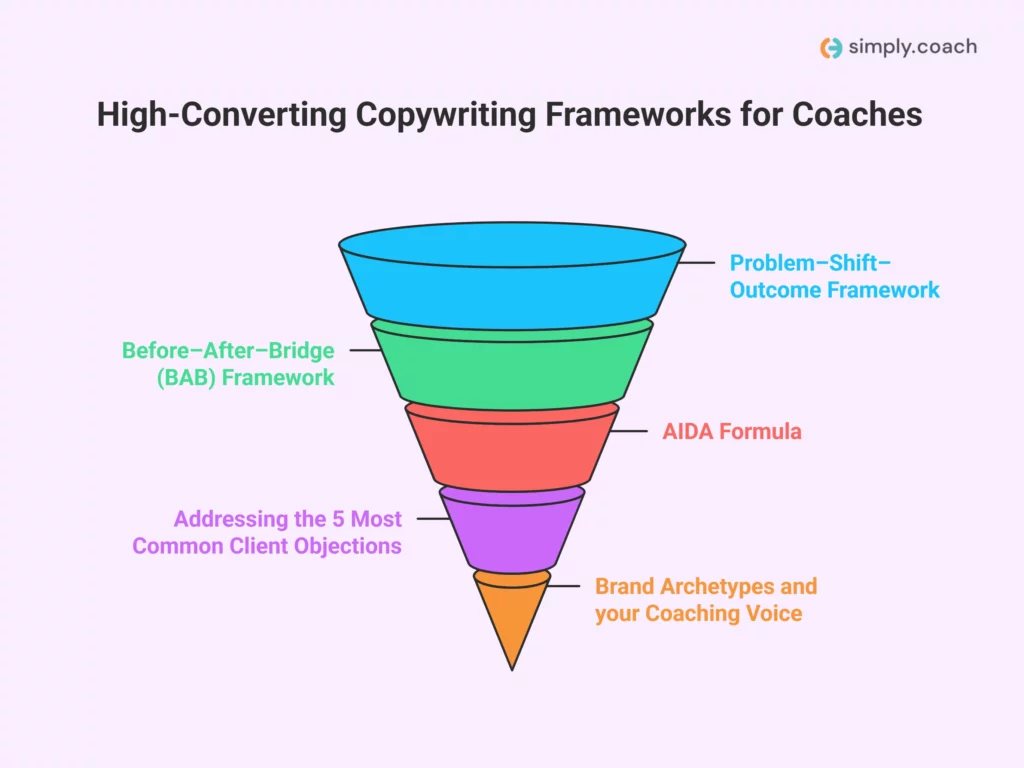
1. Problem–shift–outcome framework
This framework helps coaches show that they truly understand client struggles and can deliver tangible results. By breaking your message into three steps, you first highlight the problem, then present your solution, and finally emphasize the outcome your coaching delivers.
- Problem: Identify a client’s pain or frustration that immediately captures attention and creates connection.
- Shift: Position your coaching program as the solution that bridges their current struggle to desired results.
- Outcome: Show the transformation clients experience after working with you, emphasizing measurable or emotional benefits.
- Mini example snippet: “Struggling to lead your team? My coaching helps you inspire confidence and achieve measurable results in 60 days.”
The Problem–Shift–Outcome framework ensures your copy clearly demonstrates the journey your clients will take and why your coaching matters.
2. Before–after–bridge (BAB) framework
The BAB framework is designed to help clients visualize their transformation. By showing where they are now, where they want to be, and how your coaching bridges the gap, you make the benefits tangible and relatable. This approach simplifies complex outcomes into a story clients can immediately understand.
- Before: Describe the client’s current situation, pain points, or challenges to create relatability.
- After: Paint a clear picture of the desired result or transformation your coaching achieves.
- Bridge: Explain how your coaching program closes the gap, providing guidance, tools, or strategies.
- Mini example snippet: “Before: Feeling stuck in your career. After: Leading your team with clarity. Bridge: Our career coaching program provides actionable strategies to reach leadership goals in three months.”
Using BAB allows your prospects to see exactly what their life could look like after your coaching, making the benefits concrete and compelling.
3. AIDA formula (Attention, Interest, Desire, Action)
AIDA is a classic framework for guiding prospects from awareness to action. It ensures your copy captures attention, builds engagement, and motivates clients to act by structuring your messaging logically and persuasively.
- Attention: Craft a headline that immediately stops scrolling or captures interest.
- Interest: Share a relatable story, insight, or situation that keeps readers engaged.
- Desire: Highlight benefits, results, and social proof that make clients eager to take action.
- Action: Include a clear and simple call-to-action: book a session, join a program, or download a resource.
When applied correctly, AIDA helps your copy flow naturally while keeping your client’s journey in mind, making it easier for them to take the next step.
4. Addressing the 5 most common client objections
Anticipating and addressing objections strengthens your copy and builds trust. Coaches can use this framework to proactively tackle doubts, making clients feel understood and confident about investing in themselves.
- Not enough time: Explain how coaching fits into busy schedules without adding stress.
- Not enough money: Highlight the ROI and long-term value clients gain by investing in themselves.
- It won’t work for me: Share testimonials or case studies from clients with similar challenges.
- I don’t believe you: Provide proof through credentials, certifications, or measurable results.
- I don’t need it: Show the consequences of inaction and the transformation they’ll miss out on.
- Mini tip: Integrate real client stories throughout your copy to naturally counter objections.
Addressing objections directly ensures clients feel understood, reducing hesitation and increasing the likelihood they will take action.
5. Brand archetypes and your coaching voice
Some copywriters use brand archetypes to define personality and voice. There are twelve archetypes: Outlaw, Magician, Hero, Lover, Jester, Everyman, Caregiver, Ruler, Creator, Innocent, Sage, and Explorer.
While archetypes can help with branding, you don’t need them to write effective coaching copy. Focus on understanding your client’s pain points, goals, and transformations. That is enough to create a strong and relatable voice.
Also read: How Coaches Can Improve Coachability and Drive Better Client Results
Key Places Coaches Need Strong Copy
Strong copy is what guides potential clients through your coaching funnel. It shows them your value, builds trust, and helps them take action at every stage. From your website to emails and social media, each touchpoint needs messages that connect and convert.
1. Website copy
Your website is usually the first place clients experience your coaching. The copy there should clearly communicate the transformation you offer and encourage visitors to engage with you.
- Home page: Focus on the results clients can achieve. Include a free resource or lead magnet to encourage them to join your email list. This way, even if they don’t buy immediately, you capture their attention and start building a relationship.
- About page: The about page is the second most visited page on your website. Use it to tell your story, but also reflect your client’s journey. Include their struggles, goals, and aspirations. Add your bio and opt-in forms to build credibility and grow your audience.
- Services page: Your services or work with me page is where you clearly outline what you offer. Focus on benefits, not features. End with a clear call to action that encourages clients to book a session or join your program.
Website copy that highlights transformation and provides clear next steps will keep visitors engaged and moving toward becoming clients.
Check out Simply.Coach’s ‘Showcase Page‘ a fast and easy to create intuitive landing page to attract new clients quickly.
2. Discovery call and sales page copy
Discovery calls and sales pages are critical conversion points. Copy here should grab attention, show results, and build trust so clients feel confident investing in your coaching.
- Headlines: Your headline should grab attention within 10 to 20 seconds. It needs to make the visitor want to read further.
- Highlight results, not features: Clients want to know how your coaching will change their lives, not the number of calls or PDFs they will receive. Emphasize transformation and benefits.
- Build trust: Include testimonials and mini case studies that demonstrate results. Short quotes or video snippets work well to show proof and credibility.
Effective discovery call and sales page copy turns interest into action by showing clients what is possible and proving that you deliver results.
3. Email copy
Email allows you to nurture leads over time. Your copy should build relationships, educate, and encourage action without feeling pushy.
- Welcome emails: Use welcome emails to introduce yourself, share your coaching approach, and establish rapport with new subscribers.
- Nurturing emails: Provide tips, insights, or client stories that deliver value and keep your audience engaged.
- Promotional emails: Highlight benefits, address objections, and include a clear call to action. Make it easy for readers to take the next step.
Emails that consistently provide value build trust and keep your audience moving toward becoming paying clients.
4. Social media copy
Social media is where you can engage casually and authentically. Copy should feel conversational, relatable, and valuable in small doses.
- Practice conversational tone: Write as if you are talking to a single client, not a crowd. Keep it friendly and approachable.
- Share micro-stories and tips: Post short coaching insights, client results, or practical tips that followers can immediately apply.
- Highlight transformations: Use brief examples of client success to build credibility and inspire others to take action.
Social media copy that feels human and relatable strengthens trust, increases awareness, and draws the right clients toward your coaching programs.
Also read: How to Generate Engaging Life Coaching Content Ideas for Social Media
Should You Hire a Copywriter for Coaches or Write It Yourself?
Deciding whether to write your coaching copy yourself or hire a professional is a key business decision. The right choice depends on your stage, audience, and goals. Both options have advantages, but understanding when to DIY versus hire can save time and increase conversions.
- When DIY makes sense: If you’re early-stage or offering simple coaching programs, writing your own copy allows you to define your voice and connect personally with clients. It also keeps costs low while you test messaging and offers.
- When hiring is smarter: For high-ticket programs, scaling businesses, or corporate clients, professional copywriters bring expertise in persuasion, structure, and high-converting messaging. They can create polished copy that resonates quickly with sophisticated audiences.
- What to look for in a professional copywriter for coaches: Seek someone who understands coaching transformations, can write in your authentic voice, and has proven experience with similar clients. Ask for samples and case studies to ensure they can deliver measurable results.
- How hiring aligns with business growth strategy: A copywriter can free up your time to focus on coaching and strategy while ensuring your messaging converts consistently. This alignment allows you to scale faster, maintain quality, and attract the right clients efficiently.
Choosing the right approach ensures your coaching message connects with clients, drives results, and supports the long-term growth of your business.
Also read: Top Business Coaching Podcasts for Growth and Performance (2026)
Common Copywriting Mistakes Coaches Make and How to Fix Them
Even experienced coaches often struggle with copy that converts. Identifying these mistakes helps you connect with clients, build trust, and drive action.
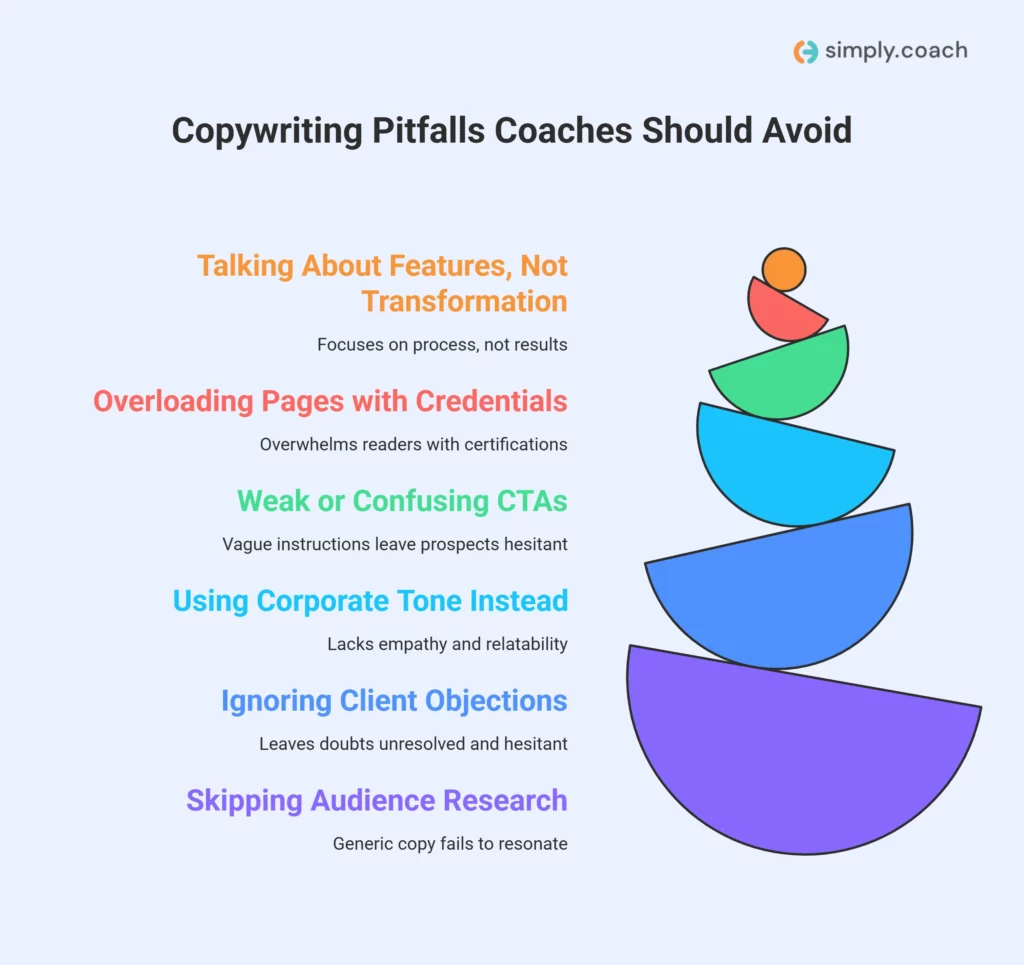
- Talking about features, not transformation: Focus on the result your client gets, not just the number of sessions, worksheets, or PDFs. Highlight outcomes like confidence, career clarity, or health improvements.
- Overloading pages with credentials: While credibility matters, too many certifications or awards can overwhelm readers. Showcase 1–2 key credentials and emphasize how they help deliver client results.
- Weak or confusing CTAs: Every page should have one clear next step. Replace vague prompts like “Learn more” with action-driven instructions like “Book your free strategy session today.”
- Using corporate tone instead of authentic voice: Avoid stiff, formal language. Write as you speak, showing empathy, understanding, and relatability. Your personality builds connection faster than polished jargon.
- Ignoring client objections: Failing to address doubts like “I don’t have time” or “Will this work for me?” leaves prospects hesitant. Integrate solutions and testimonials to overcome these objections.
- Skipping audience research: Writing without understanding your ideal client’s struggles, desires, or language makes copy generic and ineffective. Research forums, surveys, and interviews to know exactly what resonates.
Correcting these mistakes ensures your copy is clear, compelling, and client-focused, making it easier to attract and convert the right people.
Conclusion
Great coaching deserves great communication, and your copy plays a huge role in getting clients to see the value you provide. When your messages speak to client needs, highlight transformation, and guide prospects through a clear journey, you naturally attract more engagement and conversions. This blog has shown you how to understand your audience, apply proven frameworks, and avoid common copy mistakes that hold coaches back. With these strategies, every part of your funnel, from emails to sales pages, can start converting better and building stronger client relationships.
Simply.Coach gives you the platform to support the copy you create with tools that enhance the client experience at every stage. You can manage client goals, track progress, and automate reminders so clients stay engaged beyond your words. The software also streamlines scheduling, contracts, invoicing, and reporting, freeing up your time to focus on crafting persuasive messaging. With client workspaces, digital forms, and integrated email capabilities, you can reinforce your copy with structured coaching journeys that feel cohesive and professional.
FAQs
1. What writing skills should a coach develop to write better copy?
A coach should focus on understanding client language, structuring persuasive messages, and writing clear, benefit‑focused headlines. Practice editing, empathy, and result‑oriented storytelling to improve engagement.
2. How long does it take to write effective coaching copy?
The time varies, but a focused draft for a landing page or email sequence can take a few hours to a day. Quality improves with feedback, iteration, and testing over time.
3. Can AI tools replace human copywriting for coaching services?
AI can help generate ideas, headlines, or drafts, but it cannot replace human insight into client emotions and transformation. Coaches should edit AI suggestions to maintain authenticity and connection.
4. How can a coach test whether their copy is working?
Measure click‑through rates, conversion rates, and engagement metrics on emails, landing pages, and CTAs. Use split testing to compare variations and refine messaging based on real responses.
5. What mistakes make coaching copy lose potential clients fast?
Copy that lacks clarity, ignores client pain points, or focuses only on features instead of outcomes tends to disengage readers. Also avoid generic language that doesn’t speak to specific client goals