
If you’re charging $200 per session, you’re stuck in a time-for-money cycle. You hit an income ceiling fast, and burnout isn’t far behind.
High ticket coaching funnels change that. When you offer a $3,000 or $5,000 transformation, your clients show up more invested, and your work creates deeper results. It’s not about pricing high just for the sake, it’s about matching the value of your offer with the depth of change you’re guiding.
Still, most coaches struggle to sell these premium offers because their funnels aren’t working. The problem isn’t the offer. It’s how you’re guiding people toward it. Without trust, structure, and clarity, even the best coaching programs go unnoticed.
In this blog, you’ll learn exactly how to build a high ticket coaching funnel that feels natural, builds trust, and helps the right clients say yes. We’ll break down each stage of the funnel so you can stop guessing and start enrolling consistently.
What is a High-Ticket Coaching Funnel?
A high-ticket coaching funnel isn’t just a landing page followed by a few emails. It’s a step-by-step experience that moves a potential client from curiosity to commitment.
As a coach, your funnel is how you guide a potential client from total stranger to fully committed. It’s not about selling hard. It’s about helping them see the value of working with you, one intentional step at a time.
In the coaching context, a high-ticket funnel has five main stages:
- Awareness: The client first comes across your content or offer.
- Interest: They realize your coaching might be relevant to their needs.
- Nurture: You share stories, proof, and insights that show how you work and who you help.
- Discovery call: They book a free session to explore if it’s the right fit.
- Enrollment: They decide to join your coaching program.
The truth is, high-ticket coaching decisions aren’t impulsive. People need to feel safe before they invest. A well-built funnel gives them space to explore, ask, reflect, and eventually decide with confidence.
If you’re still relying on one-off promotions or hoping people “just find you,” a funnel can help you grow consistently, without burning out.
Why Your Coaching Business Needs a High-Ticket Funnel
If you’re still relying on word-of-mouth or social media to fill your coaching calendar, you’re doing more work than necessary. A high-ticket funnel helps you automate, attract, and enroll ideal clients without burning out or chasing every lead manually.
- Attract clients consistently without chasing them: Instead of relying on word-of-mouth or daily content, your funnel brings in qualified leads through a reliable system.
- Save time through automation that nurtures for you: You don’t have to manually follow up with every lead. A well-structured funnel builds trust and connection while you focus on coaching.
- Sell in a way that feels natural, not pushy: With the right funnel, your discovery calls become genuine conversations. Prospects already understand your value before they speak with you.
- Work only with aligned clients: Your funnel filters out mismatched prospects so you’re only spending time with people ready and excited to work with you.
- Confidently raise your rates: When your process consistently delivers results, charging premium pricing feels natural because your client experience backs it up.
Step by Step Guide to Building a High-Ticket Coaching Funnel
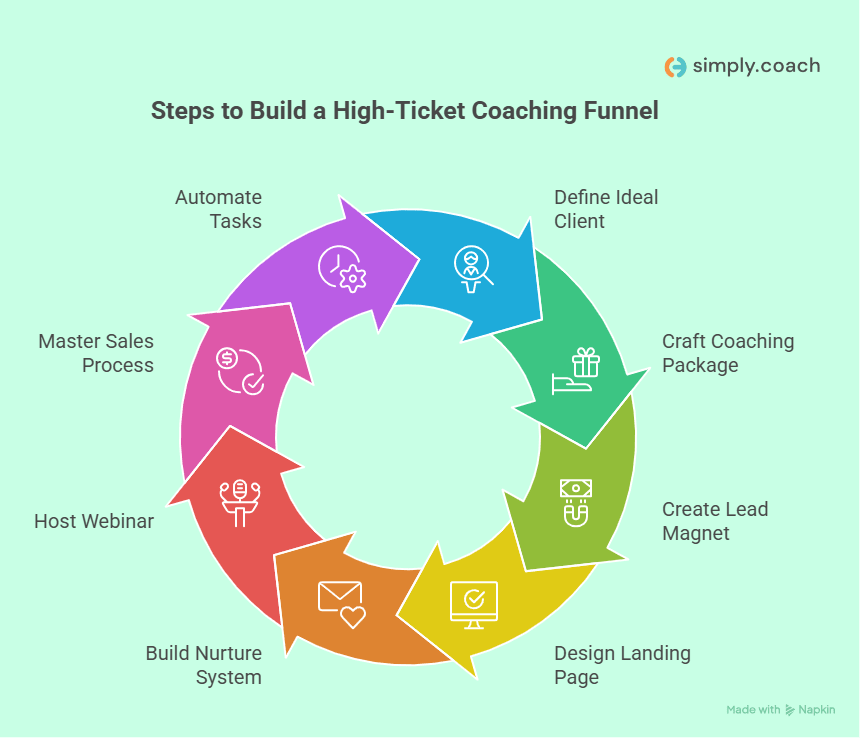
A high-ticket funnel isn’t about flashy pages or pushy sales tactics. It’s a step-by-step journey that earns trust, filters the right clients, and positions your offer as the obvious next move. Here’s how to build yours, one stage at a time.
1. Define your ideal client (beyond the niche)
If you want to attract high-ticket clients, you need more than just a niche. You need to understand the person behind the problem.
Go beyond broad labels like “business owners” or “women in transition.” Ask:
- What are they afraid of?
- What have they already tried and failed at?
- What would make them say yes on a discovery call?
This level of clarity helps you speak to the real decision triggers, like fear of staying stuck or the desire to prove themselves. The more you dial in on their internal world, the more magnetic your message becomes.
Already have a few clients?
Use Simply.Coach’s secure client notes and progress reports to track what your best clients had in common. This data becomes gold when refining your funnel messaging and offers.
Tip: Your “ideal client” isn’t just the one who can pay. It’s the one who gets the best results with you.
2. Craft a coaching package your ideal client is willing to pay 4 figures for
Selling high-ticket coaching isn’t about adding more sessions or throwing in bonus worksheets. It’s about solving a problem your client wants handled right now.
For instance, if you’re a career coach, don’t offer a generic 12-week program. Instead, offer a result like “Land a leadership role in 90 days without applying to 100 jobs.” That’s what earns trust and high-ticket investment.
To design a package that converts:
- Solve one urgent problem your ideal client is actively looking to fix
- Define a clear outcome they can expect by the end of your program
- Break the journey into 3 to 5 milestone outcomes instead of listing session counts
- Offer support outside live calls, such as action plans, nudges, or form check-ins using Simply.Coach
- Use progress tracking so clients can see how far they’ve come and what’s next
This isn’t just about delivering coaching—it’s about packaging and presenting the transformation in a way that feels valuable and believable. With Simply.Coach, you can turn your process into a results-driven experience that justifies your pricing.
3. Create a lead magnet that filters for quality, not just volume
When you’re selling high-ticket coaching, your lead magnet shouldn’t be something everyone grabs and forgets. It should attract people who are already thinking seriously about change, and who are ready to invest.
A good lead magnet at this level doesn’t just inform. It positions you as a premium coach and sets the stage for a deeper conversation.
Here’s how to make yours work:
- Solve a micro-problem your ideal client needs clarity on before they can hire you
(e.g., “3 questions to find your next career direction” for career coaches) - Use a high-intent format like a quiz, checklist, or mini training, not just a generic PDF
- Gate it behind a short form that captures more than just name and email (e.g., goals, current struggles)
- Make the follow-up feel personalized using Simply.Coach’s pre-session forms and client tagging
- Use the lead magnet to qualify leads so you attract fewer freebie hunters and more decision-ready clients
This lead magnet isn’t about going viral. It’s about pulling in the right-fit prospects who resonate with your message and are one step away from a discovery call.
4. Design a conversion-optimized landing page
Your landing page is where serious prospects decide if your coaching offer feels right for them. It’s not just about capturing emails. It’s about setting the tone for your coaching relationship.
For high-ticket coaching, this page should qualify, inspire, and invite the right kind of client to take the next step. Here’s what matters most:
- Use a clear, benefits-first headline that reflects the outcome your client wants, not just what you offer
- Speak in your client’s language, review consultation transcripts, client notes, or onboarding responses to write copy that connects
- Include social proof with real results, not just praise, but before-and-after style transformations or relevant wins
- Make the call-to-action specific and relevant, such as “Book a free clarity call” or “Apply for private coaching.”
- Keep the page focused, avoid extra links, multiple offers, or anything that distracts from the next step
If you don’t want to deal with custom design or tech setup, Simply.Coach’s Showcase Page gives you a conversion-ready alternative. It lets you list your coaching programs, embed testimonials, collect leads, and offer direct scheduling on one page. It’s purpose-built to help coaches turn interest into action.
For high-ticket offers, clarity and structure always convert better than clever copy. Your landing page should act like a confident first handshake — warm, intentional, and focused.
5. Build your nurture system (email sequence + pre-call trust)
Once someone lands on your page or joins your email list, the real work begins. Nurturing is how you warm up leads and get them ready for your high-ticket offer, without pressure.
A solid nurture sequence builds trust, positions your method, and qualifies clients before a discovery call. Here’s how to create one that works:
Use a 5-part email sequence that mirrors the client journey
Each email should guide your lead one step closer to action. Keep it simple and intentional.
- Problem: Describe the core challenge your ideal client faces in their own words
- Possibility: Paint a picture of what life looks like after coaching with you
- Proof: Share a real client story that mirrors their struggle and success
- Process: Briefly explain your coaching approach or unique framework
- Pitch: Invite them to book a discovery call, apply, or respond directly
This sequence works best when it feels personal — like you’re speaking to one person, not a list.
Layer in pre-call trust builders
- Use Simply.Coach’s automated emails to schedule and send this sequence without extra tools
- Set up pre-call forms to gather client context and qualify leads before the discovery call
- Share valuable content before the call, like a quick video or PDF walkthrough of your method
You don’t need complicated funnels or constant selling. Just a clear, consistent system that creates value before you ever get on a call.
6. Host a high-value webinar or live masterclass
Webinars are one of the most effective ways to turn cold leads into qualified, ready-to-talk prospects. But only if you treat them like a real coaching experience — not a sales event.
To make it work for high-ticket coaching, focus on delivering actual value before making any kind of offer.
Pick a focused topic that solves a real issue
Choose a small but meaningful part of your overall coaching solution.
Examples:
- A financial coach might break down a simple cash flow system for solopreneurs
- A mindset coach could run a session on overcoming imposter syndrome before big career leaps
Keep the topic outcome-driven. Give enough value to shift their thinking but leave room for deeper transformation through coaching.
Lead to the next step with a soft invitation
End your session with a clear call-to-action, typically, a free discovery call. Position it as a space for personalized guidance, not a sales trap.
You can say something like:
“If this resonated with you and you’re ready to apply it in your life or business, I’d love to invite you to a free clarity call. We’ll explore where you are and what the right next move could look like.”
| Manage interested leads efficiently with Simply.CoachUse the Prospect Management feature within Simply.Coach to track webinar signups, auto-tag warm leads, and follow up without missing a beat. You can qualify prospects before the call, send automated reminders, and stay organized without spreadsheets. |
Repurpose your webinar for ongoing lead generation
- Add the replay to your Simply.Coach Showcase Page
- Turn highlights into email nurture content or Instagram reels
- Use FAQs from the webinar as future blog or podcast topics
This one event can feed your funnel for weeks, helping you engage and qualify leads while focusing on coaching.
7. Master your sales process (without being pushy)
Selling high-ticket coaching isn’t about hard closes or persuasion. It’s about showing up as a guide, and helping the right people make the right decision.
Lead with an enrollment mindset
Think of your discovery call as a two-way filter, not a pitch.
Ask meaningful, emotionally resonant questions:
- “Why is now the time for you to make a change?”
- “What’s at stake if nothing changes in the next six months?”
- “What do you need most to move forward?”
This helps prospects self-identify their urgency and readiness, while also allowing you to gauge fit.
Communicate your offer with clarity
Once you feel alignment, introduce your coaching framework — not as a bunch of sessions, but as a structured transformation.
Break down:
- What’s included
- What outcomes to expect
- How long it takes
- The investment
The more clearly you position your offer, the more confidence they’ll feel in moving forward.
Ditch pressure, stay in service
If someone’s a no for now, respect it. But if they’re a yes with hesitation, help them understand what’s holding them back, often, it’s fear or uncertainty.
Remember, you’re not selling coaching. You’re selling clarity, accountability, and change. When your prospect feels that, price becomes secondary.
Also read: How to Create a Sales Funnel for Coaches: A Step-by-Step Guide
8. Automate everything that’s not coaching
Your time should be spent where it matters most, serving clients, not buried in admin work.
The more you automate, the more energy you save for powerful conversations, program development, and business growth.
What to automate:
- Booking and reminders: No more back-and-forth scheduling. Use a calendar tool that handles time zones, sends confirmations, and nudges clients before the call.
- Contracts and invoicing: Get paid and protect your business without chasing paperwork. Set up e-signatures and recurring billing once, and let it run.
- Forms and session notes: Send intake forms automatically, collect pre-session insights, and store everything in one place for easy tracking.
| Turn your entire funnel into a well-oiled machineFrom booking and reminders to contracts, forms, and client notes — Simply.Coach helps you automate every part of your coaching funnel inside one secure, all-in-one digital coaching platform.Built for coachesReady for high-ticket funnelsNo tech headacheSchedule your free demo and see how Simply.Coach can power your high-ticket coaching journey. |
How Do You Know Your High-Ticket Coaching Funnel is Working?
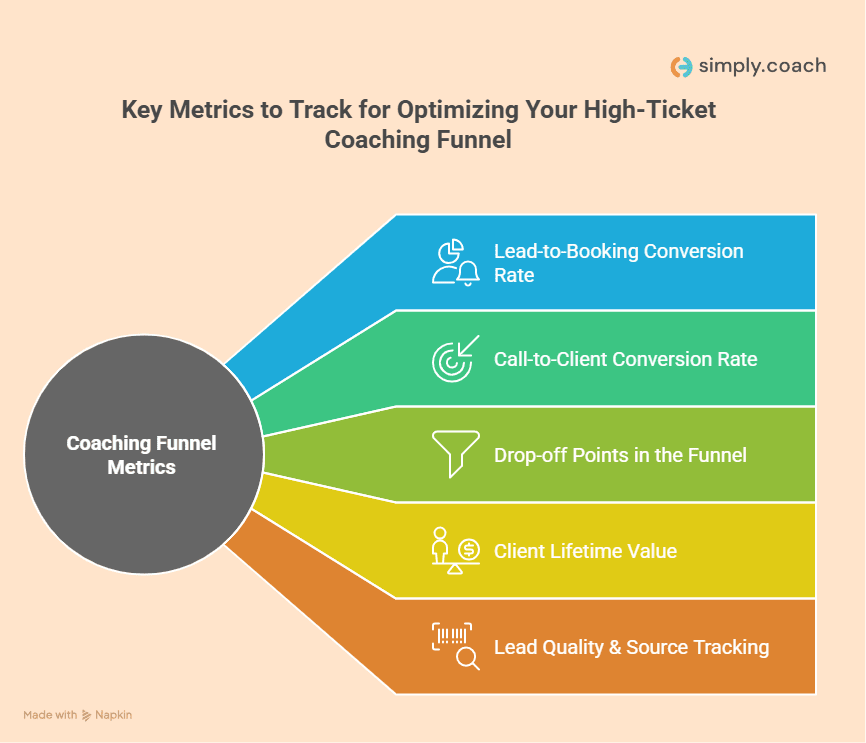
Building your funnel is only half the job, optimizing it is where the real growth happens. A high ticket coaching funnel should not only bring in leads but consistently convert the right clients. To know whether yours is performing, here are the core metrics every coach should track:
- Lead-to-booking conversion rate: This tells you how well your funnel is turning visitors into scheduled calls. If your calendar isn’t filling up, your landing page, lead magnet, or CTA might not be compelling enough. Look at how many people are opting in vs how many are booking calls.
- Call-to-client conversion rate: Are your discovery calls actually leading to paid enrollments? This number reflects the effectiveness of your sales conversations and how well your offer resonates with the prospect’s needs. If this is low, revisit how you’re qualifying leads or presenting your value.
- Drop-off points in the funnel: Map out your client journey, from ad or post, to email nurture, to landing page, to call. Where are people disengaging? If you see drop-offs between emails or before calls, it’s a sign to tweak your content or sequence timing.
- Client lifetime value (CLTV): For high-ticket coaches, this is crucial. CLTV shows how much revenue one client brings over their full relationship with you. This can guide pricing decisions, upsells, and help you estimate ROI on lead generation.
- Lead quality & source tracking: Not all leads are created equal. Track where your best-fit clients are coming from, Instagram? LinkedIn? Referrals? Optimize your marketing to focus on what’s working.
Tools like Simply.Coach’s built-in reports and stakeholder feedback give you a full view of your funnel health. You’ll know exactly what’s converting, what needs adjusting, and where to scale, without piecing data together manually.
What Mistakes Do Coaches Make When Building A High-Ticket Funnel?
Even seasoned coaches can trip up when creating a high-ticket funnel. It’s not about effort, it’s about direction. Here are five of the most common mistakes coaches make, along with how you can avoid them.
- Copying funnels without niche clarity: Using someone else’s funnel without understanding your ideal client rarely works. Your funnel should speak directly to their pain points, goals, and decision-making triggers.
- Making the tech too complex: Piecing together multiple tools can slow things down and confuse prospects. Keep your systems simple, integrated, and user-friendly—for both you and your clients.
- Ignoring follow-up emails: Most leads won’t convert after the first touchpoint. Without timely, value-driven follow-ups, you lose trust and momentum. A consistent email sequence builds a connection and drives action.
- Relying too much on social media: Instagram and LinkedIn are great for visibility, but they’re not reliable sales channels. If you’re not moving followers into your own ecosystem, like an email list or lead form, you’re not in control.
- Avoiding automation: Manual follow-ups, scheduling, and onboarding can drain your energy. When automation is done right, it doesn’t feel robotic; it actually creates a smoother, more consistent client experience.
Also read: How to Scale a Coaching Business Without Burning Out
Conclusion
A high ticket coaching funnel isn’t just about having a landing page and an email sequence, it’s about creating a seamless journey that builds trust, qualifies leads, and converts the right clients. From defining your ideal client to hosting webinars, automating follow-ups, and tracking conversion metrics, every step plays a role in helping your coaching business scale sustainably.
And when done right, your funnel doesn’t just attract leads, it brings in committed, aligned clients who are ready for transformation.
You don’t need five different tools to run your funnel. Simply.Coach brings everything together in one place, from landing pages (via the Showcase Page), pre-session forms, and scheduling, to email automation, contracts, invoicing, and secure client management. It’s built specifically for coaches, so you get the structure and automation you need without the tech overwhelm.
Listen to the highly engaging Growth Dialogues Podcast with Dr Karen Semien-McBride
‘How to Scale Your Coaching Business’ for deep insights on what it really takes to grow your coaching practice!
