
After a full day of sessions, the last thing you want is to spend hours finishing documentation. But as an ABA therapist, your notes are not optional. They protect your license, support insurance billing, guide supervision, and show real client progress. When documentation is rushed or unclear, you risk denied claims, audit issues, and gaps in care.
ABA is built on structured, evidence-based practice. Research shows well-implemented ABA programs improve emotional and social skills in individuals with autism. That same level of structure is just as important in your documentation. Clear, well-written notes support better treatment decisions and long-term progress.
This is why many therapists search for strong ABA SOAP notes examples that are practical, compliant, and easy to follow. You do not just need a template. You need guidance that reflects real clinical situations.
In this blog, you will learn what ABA SOAP notes are, their benefits, how to structure them properly, the ideal length, detailed ABA SOAP notes examples, common mistakes to avoid, and how to simplify your session documentation process.
Key Takeaways
- ABA SOAP notes follow the S-O-A-P format to document session context, measurable behavior data, clinical interpretation, and next steps.
- Strong notes include objective, quantifiable data (frequency, duration, prompts, accuracy, reinforcement).
- Assessment must connect data to clinical reasoning and explain progress or barriers clearly.
- Avoid vague or redundant language and ensure all audit details (date, duration, CPT, signature) are included.
- Well-written notes support compliance, billing, supervision, and treatment planning.
- Simply.Coach streamlines documentation with customizable templates, HIPAA-compliant storage, scheduling, and progress tracking in one platform.
What is Applied Behavior Analysis (ABA)
Applied Behavior Analysis, or ABA, is a scientific approach to understanding behavior and how it is influenced by the environment. It focuses on using evidence-based techniques to teach new skills, improve communication, and reduce challenging behaviors. ABA relies on careful observation, consistent data collection, and structured interventions to support meaningful progress. It is widely used in therapy for individuals with autism and other developmental conditions.
What are ABA SOAP notes
ABA SOAP notes are structured records written after each therapy session to document what occurred, the client’s responses, and the clinical decisions made. They follow the SOAP format, which includes Subjective observations, Objective data, Assessment of progress, and the Plan for future sessions.
Unlike other note types, such as DAP (Data, Assessment, Plan) or BIRP (Behavior, Intervention, Response, Plan), ABA SOAP notes provide measurable, detailed, and clinically oriented documentation. This structure ensures clarity, accountability, and consistency across sessions and therapists.
Important Role of ABA SOAP notes
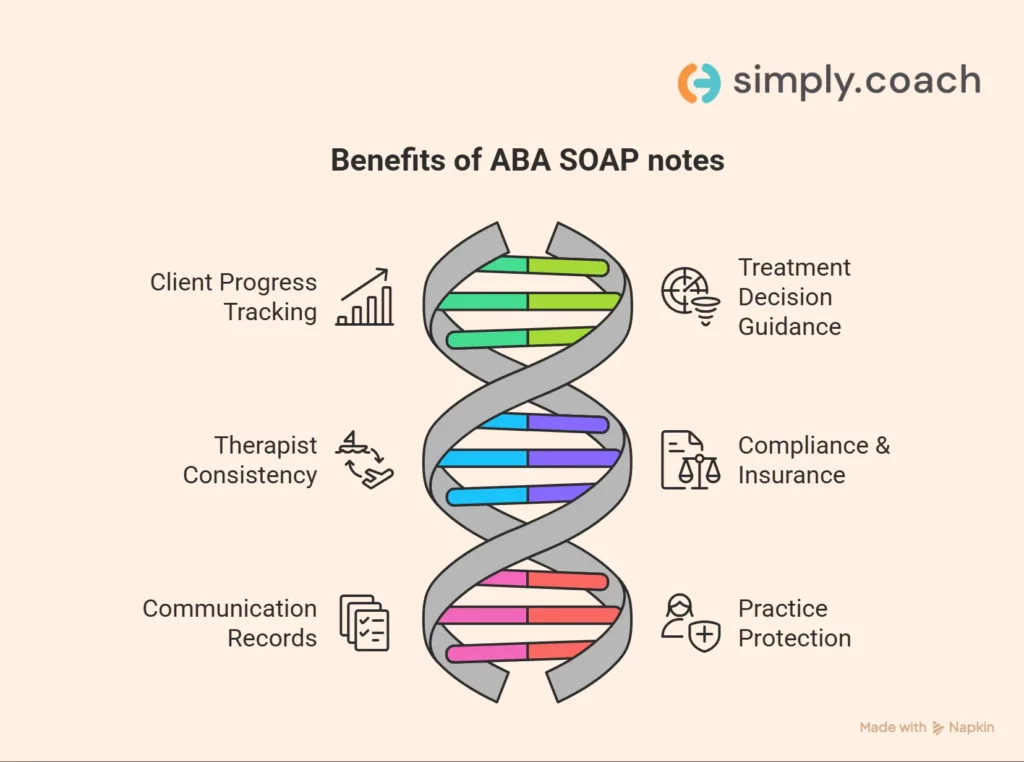
Keeping detailed ABA SOAP notes after each session is crucial for making therapy effective and consistent. These notes help you see patterns, adjust interventions, and communicate clearly with your team and caregivers. Here are the main benefits:
- Track client progress: Record measurable changes in behavior and skill acquisition so you can see what strategies are working and where more support is needed.
- Guide treatment decisions: Objective session data helps you adjust programs, select interventions, and plan next steps tailored to each client’s needs.
- Maintain consistency across therapists: Standardized notes ensure that multiple therapists working with the same client understand previous sessions and continue interventions seamlessly.
- Meet compliance and insurance requirements: Detailed documentation supports billing, audit readiness, and regulatory standards, reducing the risk of denied claims.
- Improve communication with supervisors and caregivers: Notes provide a clear record of what occurred during sessions, making it easier to discuss progress and recommendations.
- Protect your practice: Accurate, structured notes serve as evidence of clinical decisions and services delivered, safeguarding your work in case of reviews or disputes.
By keeping ABA SOAP notes detailed and structured, you ensure that every session contributes to meaningful progress and professional accountability.
Also read: Understanding SOAP Note Format with Tips and Examples
Understanding the Structure of ABA SOAP Notes
Accurate ABA therapy documentation is not just about recording behaviors. It is about capturing measurable treatment data, clinical reasoning, and next-step programming decisions in a structured format. When written correctly, ABA SOAP notes support insurance compliance, supervision review, treatment planning, and long-term behavior tracking.
Below is a clinically specific breakdown of each section of ABA SOAP notes, written for practicing ABA therapists.
1. Subjective (S): Contextual and reported information
The Subjective section documents contextual variables that may influence behavior and performance during the session. In ABA therapy documentation, this includes caregiver-reported updates, client verbal statements, environmental changes, and observable mood indicators before formal intervention begins.
Focus on relevant factors that may affect skill acquisition or behavior reduction outcomes.
Include:
- Caregiver reports about sleep, medication changes, illness, or behavior outside sessions
- Client statements related to motivation, frustration, avoidance, or preference
- Changes in routine, staffing, setting, or schedule
- Observable indicators such as fatigue, resistance, heightened sensory sensitivity
ABA-specific examples:
- The caregiver reported the client slept 4 hours and skipped breakfast prior to session.
- The client stated, “I don’t want to do work today,” during the initial task presentation.
- Session conducted in classroom instead of therapy room due to schedule change.
- Client appeared distracted and required repeated redirection during transition from free play.
This section sets the clinical context. It explains variables that may influence the data collected in the Objective section.
2. Objective (O): Measurable behavioral data
The Objective section is the foundation of ABA session notes. This is where you document observable, quantifiable data related to treatment goals and target behaviors. Avoid subjective language. Use measurable terms only.
Include:
- Frequency of target behaviors
- Duration of behaviors
- Latency to respond
- Prompt levels used
- Percent accuracy across trials
- Reinforcement schedule applied
- Type of intervention implemented (DTT, NET, task analysis, shaping, extinction, differential reinforcement)
Strong measurable example:
- Client independently completed 9 out of 12 receptive identification trials (75 percent accuracy).
- Aggressive behavior occurred once, lasting 45 seconds, during denied access to preferred items.
- Most-to-least prompting hierarchy used; client required verbal prompt on 3 trials.
- Reinforcement delivered on a fixed ratio 2 schedule using a token system.
Your Objective section should allow another BCBA to review your note and fully understand what occurred without guessing.
3. Assessment (A): Clinical interpretation of data
The Assessment section connects the Objective data to clinical decision-making. This is where you analyze progress toward treatment goals and evaluate the effectiveness of interventions.
This section should answer: What does the data mean?
Include:
- Progress trends across sessions
- Comparison to baseline performance
- Response to reinforcement strategy
- Effectiveness of prompting hierarchy
- Emerging skills or plateau patterns
- Behavioral function insights if relevant
ABA-specific example:
- Independent responding increased from 60 percent last session to 75 percent today, indicating gradual acquisition of receptive labeling skills.
- Aggression frequency decreased compared to previous two sessions, suggesting reinforcement schedule is reducing escape-maintained behavior.
- Client continues to require verbal prompting for task initiation, indicating need for prompt fading plan.
Avoid vague conclusions such as “client improving.” Instead, tie improvement directly to measurable change.
4. Plan (P): Treatment adjustments and next steps
The Plan section outlines clear, actionable steps for future sessions. It should directly reflect your Assessment findings. This ensures continuity of care and supports supervision review.
Include:
- Modifications to reinforcement schedule
- Prompt fading strategy
- Introduction of new targets
- Generalization plans across settings
- Caregiver training instructions
- Data collection changes if needed
ABA-specific examples:
- Reduce verbal prompts to gestural prompts during receptive identification trials beginning next session.
- Increase token reinforcement requirement from FR2 to FR3 if independent responding remains above 80 percent.
- Introduce generalization trials in home settings with caregiver participation.
- Provide caregivers with modeling of transition routines to reduce escape behavior.
The Plan section should make it clear what will change and why.
Also read: How to Write Effective SOAP Notes for Your Occupational Therapy Practice
Best Practices for Writing ABA SOAP Notes
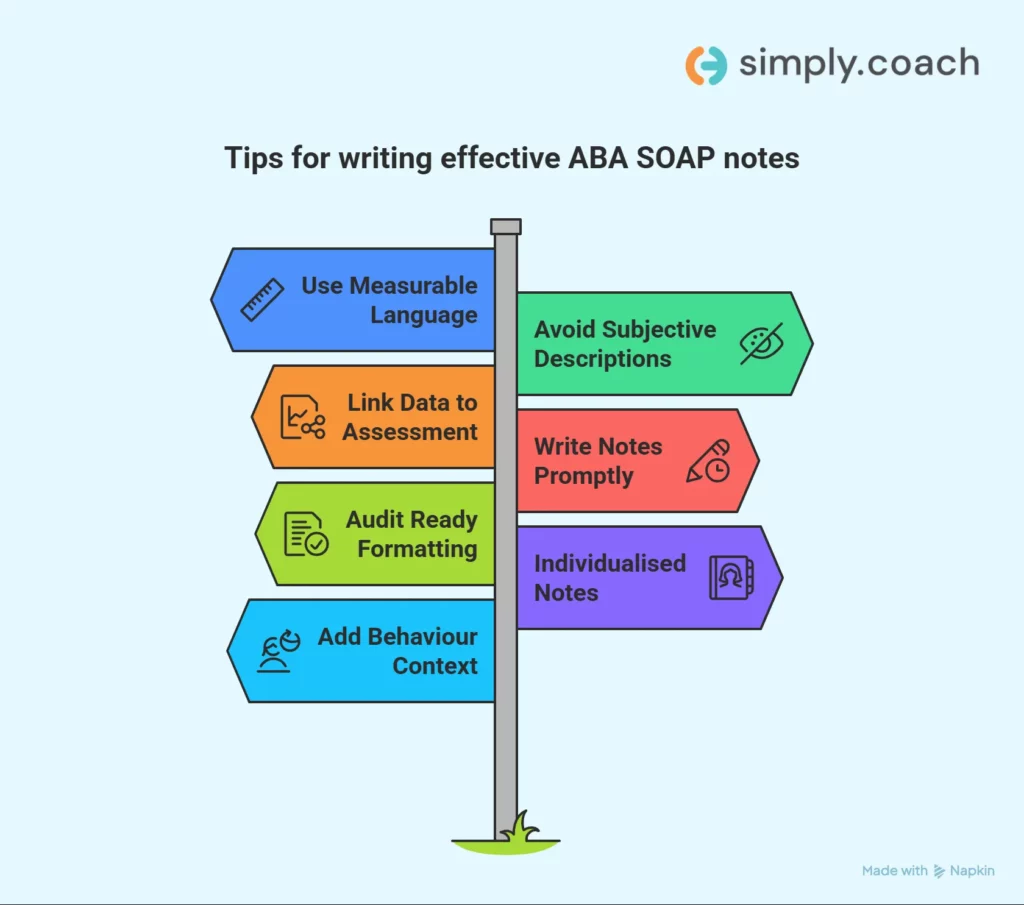
Clear and accurate ABA SOAP notes help you capture what actually happened in a session, make data-driven decisions, and keep your documentation ready for supervision and insurance review. By keeping notes measurable, structured, and actionable, you can save time and support better client outcomes.
1. Use measurable, behavior-focused language
Vague statements like “Client did well” or “Participated okay” don’t provide meaningful data. Focus on what the client actually did, how often, and with what level of support. Include numbers, percentages, or prompt levels.
Example:
- Weak: “Client worked on matching tasks.”
- Strong: “Client independently completed 8 out of 10 matching trials (80% accuracy) and required minimal verbal prompts on 2 trials.”
Tip: Always compare data to baseline or previous sessions to show progress or trends. This is especially useful for supervision or insurance reviews.
2. Avoid emotional or subjective descriptors
Your notes should focus on observable behaviors, not your impressions or emotions. Words like “happy,” “lazy,” or “unmotivated” can be misinterpreted and reduce credibility. Instead, describe actions, responses, and engagement objectively.
Example:
- Weak: “Client seemed unmotivated during tasks.”
- Strong: “Client required repeated verbal prompts to initiate 3 of 10 trials and walked away from task once during the session.”
Tip: If you notice changes in mood, describe behavioral indicators, e.g., “Client rocked back and forth for 30 seconds before beginning the activity,” rather than assigning a label.
3. Link objective data to assessment and treatment planning
Your Assessment should clearly explain why the data matters and inform next steps. Don’t write a separate section without connecting it to session data.
Example:
- Objective: “Client completed 75% of receptive labeling trials independently, up from 60% last session.”
- Assessment: “Increased independent responding indicates the current prompting strategy is effective; fading verbal prompts gradually is appropriate.”
Tip: This makes your notes actionable and defensible. Supervisors and insurance reviewers can immediately see the rationale for your clinical decisions.
4. Write notes promptly after the session
Delayed documentation risks forgetting details or misreporting behaviors. Notes written immediately capture accuracy, context, and nuances.
Tip: Keep a simple session checklist to quickly jot down key data during therapy. Then, expand into full notes within 15 – 20 minutes post-session. This approach saves time and reduces errors.
5. Maintain audit-ready formatting
Structured, complete notes make supervision review and insurance audits smoother.
Include:
- Session date and time
- Duration of therapy
- CPT or billing codes, if applicable
- Therapist signature or initials
Tip: Consistent formatting across clients and sessions allows you to quickly reference past notes, making program adjustments faster and easier.
6. Keep notes individualized and goal-specific
Avoid copy-pasting from templates. Each client behaves differently, so notes should reflect their performance, context, and session-specific observations.
Example:
- Template copy: “Client worked on social skills targets.”
- Individualized: “Client engaged in 3 peer-interaction trials; initiated conversation twice and responded appropriately to peer requests 4 out of 5 times.”
Tip: Individualized notes also make it easier to identify patterns, monitor progress, and create reports that are clinically meaningful and data-driven.
7. Bonus tip: Include context for unusual behaviours
When behaviors are outside typical patterns, briefly note context.
Example:
- “The client displayed increased hand-flapping after arrival, possibly due to lack of breakfast.”
- “Tantrums occurred during transition because the preferred item was removed unexpectedly.”
This additional detail helps supervisors and caregivers understand the behavior without speculation.
By applying these strategies, your ABA SOAP notes will become measurable, actionable, and defensible, supporting better treatment decisions, efficient supervision, and compliance with insurance and regulatory standards.
Unlock a ready‑to‑use ABA SOAP
Unlock a ready‑to‑use ABA SOAP notes template designed for therapists who want structured, professional documentation without the guesswork. Download this free, editable ABA SOAP notes template to streamline your session notes, stay audit‑ready, and save time on every case.

ABA SOAP Notes Examples
Below are two practical, detailed examples of ABA SOAP notes written for therapists. These examples show how to document realistic session data, measurable outcomes, and actionable plans using the SOAP format.
Example 1: Receptive language session
| Section | Description |
| Subjective (S) | Caregiver reported that the client slept poorly last night and had a delayed breakfast. Client expressed frustration, saying, “I don’t want to do this today,” but engaged after a short preferred activity. |
| Objective (O) | Client completed 9 of 12 receptive labeling trials independently (75% accuracy). Required minimal verbal prompts on 2 trials. Target behaviors: maintained eye contact during 8 of 12 trials. Reinforcement: token system on FR2 schedule. Duration: 45-minute session. |
| Assessment (A) | Client demonstrated improvement in independent responding compared to previous session (increased from 60% to 75%). Frustration at the start of the session did not affect overall participation. Token reinforcement continues to support engagement effectively. |
| Plan (P) | Reduce verbal prompts to gestural prompts for next session. Introduce 3 generalization trials in home setting with caregiver participation. Continue token reinforcement with FR2 schedule and monitor engagement at session start. |
Example 2: Functional communication / Manding session
| Section | Description |
| Subjective (S) | Caregiver reported client had increased tantrum behaviors at home due to denied access to a preferred toy. Client appeared tired at session start but expressed interest in preferred items when introduced as reinforcement. |
| Objective (O) | Client successfully initiated 6 of 8 manding trials using vocalizations independently (75% success). Required model prompts on 2 trials. Tantrum behavior occurred once, lasted 1 minute, during denied access to preferred item. Reinforcement: edible preferred items delivered immediately upon correct mand. |
| Assessment (A) | Client shows consistent improvement in independent manding. Single tantrum behavior appears linked to denied access, indicating escape-maintained behavior. Prompting strategy and reinforcement are effective, but transitions may need additional support. |
| Plan (P) | Introduce fade of model prompts in next session. Add visual schedule to reduce transition-related tantrums. Continue reinforcement for correct manding and track tantrum frequency. Provide caregiver with brief training on managing denied access at home. |
Example 3: Behavior reduction session
| Section | Description |
| Subjective (S) | Caregiver reported aggression at home. Client anxious and engaged in hand-flapping initially. |
| Objective (O) | Two aggression incidents (<2 min each) during transitions. Escape-maintained behavior observed. FCT implemented: 3/4 independent vocal requests. Reinforcement delivered immediately. |
| Assessment (A) | Aggression decreased from the previous session (4→2). FCT effective; transitions still trigger escape behavior. Engagement improved after preferred items were introduced. |
| Plan (P) | Continue FCT with reinforcement. Introduce visual transition schedule. Track aggression frequency/duration. Fade prompts for requesting breaks. |
Common ABA SOAP Notes Mistakes Therapists Must Avoid
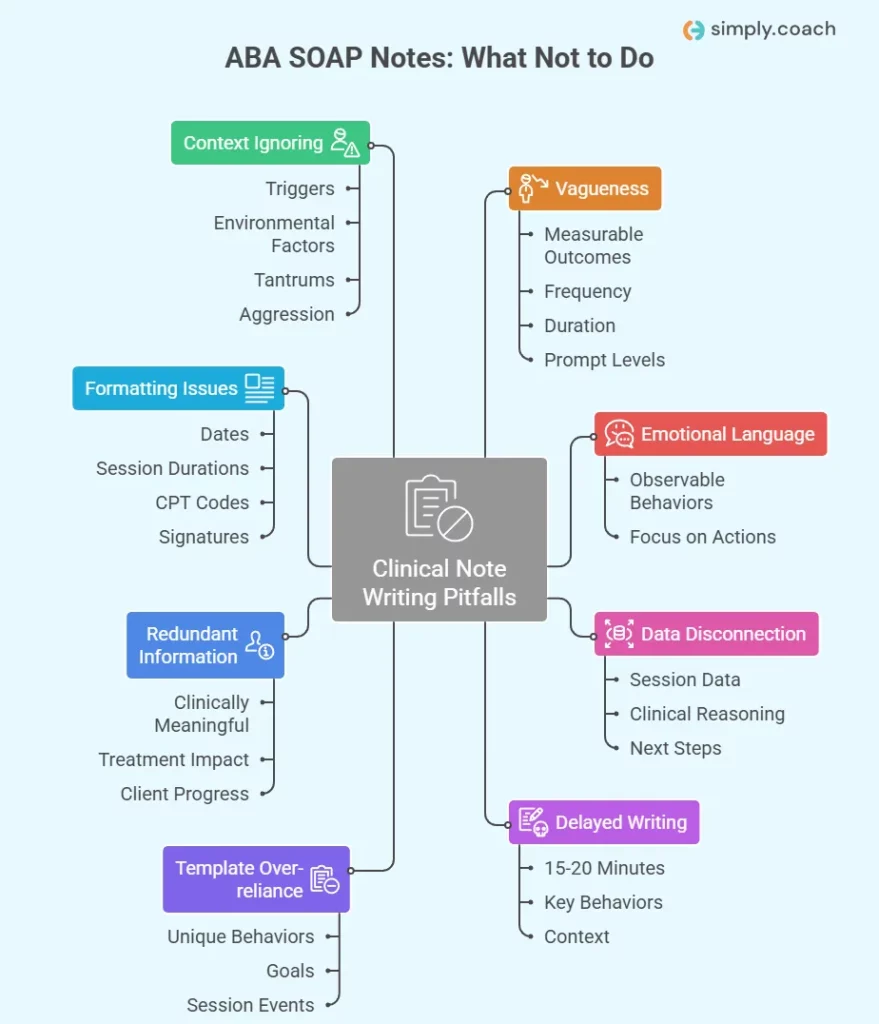
Accurate ABA SOAP notes are essential for effective therapy, supervision, and insurance compliance. Avoiding these common mistakes ensures your session documentation is clear, measurable, and defensible. Here are the key errors therapists often make:
- Being vague or non-measurable: Avoid statements like “Client did well” or “Progress observed.” Always include measurable outcomes, frequency, duration, and prompt levels.
- Using emotional or subjective language: Words like “lazy,” “unmotivated,” or “frustrated” can misrepresent the client. Focus on observable behaviors, not interpretations.
- Disconnecting objective data from assessment: Don’t include an assessment section that doesn’t reference session data. Always link measurable results to clinical reasoning and next steps.
- Delaying note writing: Waiting hours or days increases the risk of missing key behaviors or forgetting context. Document within 15 – 20 minutes post-session.
- Over-relying on templates: Copy-pasting generic notes reduces clinical relevance. Each note should reflect the client’s unique behaviors, goals, and session events.
- Including redundant information: Avoid adding unnecessary details that don’t impact treatment or client progress. Focus on what is clinically meaningful.
- Incomplete or inconsistent formatting: Missing dates, session durations, CPT codes, or signatures can cause audit or compliance issues. Keep notes structured and consistent.
- Ignoring context for unusual behaviors: Failing to note triggers or environmental factors makes it hard to interpret incidents accurately. Include context for tantrums, aggression, or unusual behaviors.
By avoiding these mistakes, your ABA SOAP notes remain clear, data-driven, and audit-ready, helping you track progress, make informed decisions, and support better therapy outcomes.
Also read: How to Write Effective SOAP Notes for Speech Therapy: Tips & Tools for SLPs
Conclusion
Effective ABA SOAP notes are the backbone of high-quality therapy. By documenting sessions clearly, using measurable data, and avoiding common mistakes, you ensure your notes are actionable, audit-ready, and supportive of client progress. Incorporating structured examples and templates can make note-taking faster, consistent, and clinically meaningful.
How Simply.Coach Can Enhance Your ABA Practice
Simply.Coachis an all-in-one, HIPAA-compliant therapy practice management software designed to streamline your ABA practice. It helps you manage session notes, client data, and workflows efficiently. Here’s how it supports your practice:
- Customizable note-taking features: Capture session details quickly and consistently.
- Session scheduling: Manage appointments with calendar integration and minimize conflicts.
- Video conferencing integration: Connect with clients on Zoom, Google Meet, or Teams seamlessly.
- Progress tracking: Monitor client outcomes over time with visual charts and reports.
- HIPAA-compliant storage: Secure cloud storage ensures client data is protected and easily accessible.
- Client management dashboard: Centralized view for client records, appointments, and progress for streamlined workflow.
By combining best practices in ABA SOAP notes with Simply.Coach, you can save time, improve documentation quality, and enhance therapy outcomes for your clients.
FAQs
1. What are ABA SOAP notes and why are they used?
ABA SOAP notes are structured clinical records that document what occurred during an applied behavior analysis session using the Subjective, Objective, Assessment, and Plan format. They help therapists track behavior data, interpret progress, plan future interventions, and maintain compliance with insurance and supervision standards.
2. What should be included in each section of an ABA SOAP note?
A quality ABA SOAP note should include caregiver or therapist‑reported context in Subjective, measurable behavior data in Objective, clinical interpretation in Assessment, and clear next steps or modifications in Plan. Including measurable data, prompts, and reinforcement details improves clarity.
3. How soon should ABA SOAP notes be completed after a session?
Session notes should be completed as soon as possible after the session, ideally before the end of the day. Prompt documentation helps ensure accuracy, reduces missing details, and supports audit readiness.
4. How detailed should ABA SOAP notes be?
Notes should be concise but detailed enough to describe session activities, client response, interventions used, and future plans. Include measurable outcomes, specific interventions, and context that links directly to treatment goals.
5. Are ABA SOAP notes the same as other note formats like DAP or BIRP?
No. While all session notes document therapy, ABA SOAP notes separate observation (Objective) from interpretation (Assessment) and future planning (Plan), offering clearer data handling than some formats like DAP or BIRP.
6. What are common mistakes to avoid when writing ABA SOAP notes?
Avoid vague descriptions, subjective language, missing administrative details (date, time, duration), late entries, and disconnected assessment sections. Notes that don’t include measurable data or clear connection to goals may be flagged by payors or supervisors.
7. Can ABA SOAP notes include caregiver reports?
Yes. Information reported by caregivers or others that you did not directly observe belongs in the Subjective section, but it should be attributed clearly to the source (e.g., “Caregiver reported…”).