
As an Occupational Therapist (OT) you help people live as independently and productively as possible, overcoming physical, mental, or developmental challenges by encouraging your patients to engage in meaningful activities that support their well being.
As a professional therapist you know that keeping detailed, accurate records is essential for clinical documentation. However, with the demands of managing multiple clients and balancing treatment sessions, documenting patient progress can feel like a time-consuming task. You’re already stretched thin with assessments, exercises, and client interactions, so it’s easy to overlook the importance of proper documentation. But without clear, consistent records, it becomes harder to track patient progress, justify treatments, or ensure smooth communication with other healthcare professionals.
That’s where SOAP notes come in. They offer a straightforward, efficient way to document your patients’ conditions, progress, and next steps, ensuring you’re always prepared for every session and meeting compliance standards. In this guide, we’ll walk you through how SOAP notes occupational therapy can make your job easier and improve patient care, without adding extra stress to your already busy schedule.
Key Takeaways
- SOAP notes provide a structured and efficient way to document patient progress in Occupational Therapy, ensuring clear communication and tracking.
- Subjective (S) captures the patient’s perspective, while Objective (O) records measurable data and functional observations.
- Assessment (A) connects subjective and objective data, helping you analyze progress and plan for continued therapy. Plan (P) outlines the next steps in treatment, providing a clear path for therapy progression.
- Benefits of SOAP notes include improved communication, accurate progress tracking, legal compliance, and enhanced patient care.
- Best practices include being concise, specific, and focused on functional goals while maintaining clarity and objectivity in your documentation.
- Simply.Coach can help streamline your SOAP note documentation with customizable templates, automated reminders, and easy client management.
What are SOAP Notes in Occupational Therapy and Why Use SOAP Notes?
SOAP notes are a structured method of documenting patient information in Occupational Therapy. The acronym stands for:
- Subjective, which captures the patient’s perspective
- Objective, which includes measurable data and observations
- Assessment, which reflects the therapist’s clinical judgment
- Plan, outlining the next steps in treatment
This format ensures comprehensive and consistent documentation, providing a clear overview of the patient’s progress and treatment plan.
In Occupational Therapy, SOAP notes are more than just a way to document; they are an essential tool for tracking progress, justifying treatment, and communicating with other healthcare providers. Each section of the SOAP note ensures that the full picture of a patient’s condition is captured, allowing you to develop more personalized and effective treatment plans.
SOAP notes help you stay organized, track functional progress over time, and ensure that you’re meeting both patient needs and regulatory requirements. This structure is key to ensuring that your therapy sessions are not only effective but also compliant with the latest healthcare standards.
Benefits of SOAP Notes in Occupational Therapy
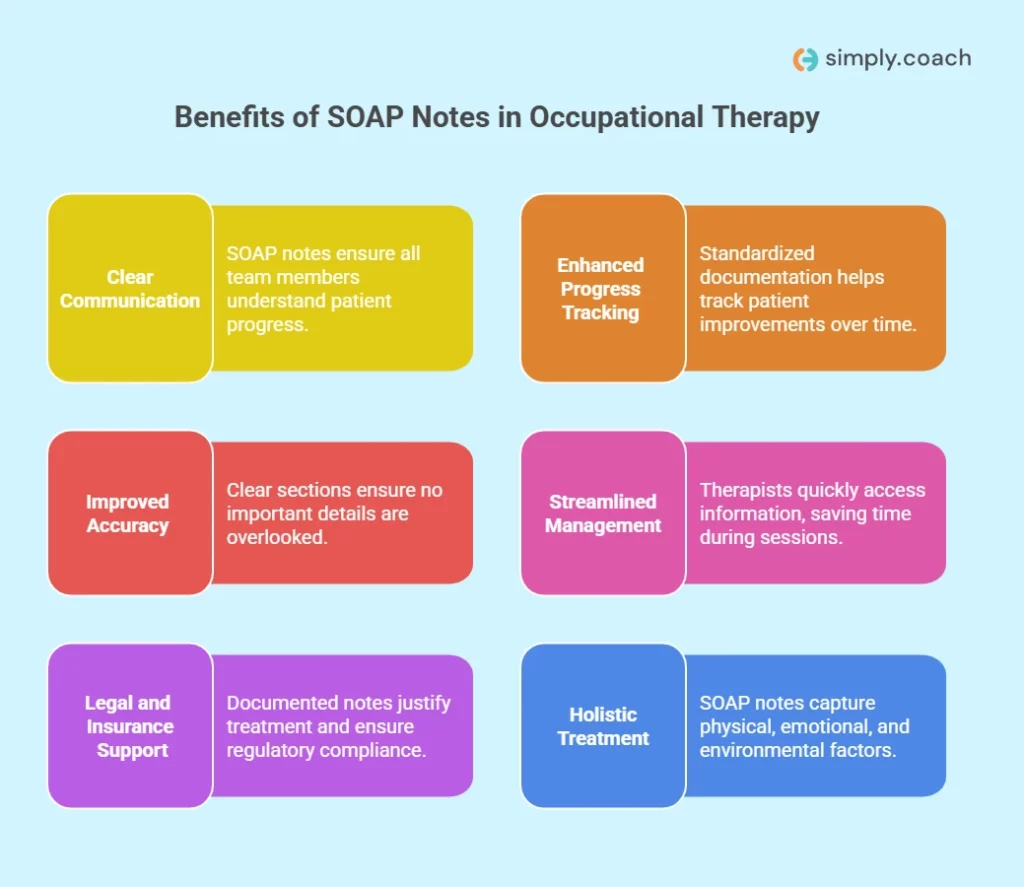
SOAP notes provide significant value by improving patient care and streamlining documentation. They ensure that all key aspects of a patient’s progress are tracked effectively and consistently. This not only enhances the quality of care but also ensures compliance with legal and insurance requirements.
- Clear communication: SOAP notes provide a structured way to document patient information, ensuring that all team members, from therapists to caregivers, can easily understand the patient’s progress and needs.
- Enhanced progress tracking: With standardized documentation, SOAP notes help track patient improvements and setbacks over time, making it easier to adjust the treatment plan as needed.
- Improved documentation accuracy: The clear breakdown of each section ensures that no important details are overlooked, leading to more accurate and complete records.
- Streamlined patient management: SOAP notes allow therapists to quickly access essential information, making it easier to manage multiple patients and save valuable time during sessions.
- Support for legal and insurance needs: Properly documented SOAP notes help justify treatment, ensuring you meet insurance requirements and stay compliant with regulations, while also protecting your practice during audits.
- Holistic treatment approach: SOAP notes enable you to capture not only physical symptoms but also emotional and environmental factors, allowing for a more comprehensive treatment plan tailored to the patient’s needs.
By using SOAP notes, you’re enhancing both patient care and the efficiency of your practice, while ensuring accurate documentation that meets legal and regulatory standards.
Also read: Writing SOAP Notes for Therapy Documentation Cheat Sheet
Understanding the SOAP Note Structure for Occupational Therapy
SOAP notes are critical for documenting patient care in Occupational Therapy. This format allows you to provide a clear, organized snapshot of your patient’s progress, challenges, and future therapy needs. Below is a breakdown of what to include in each section, with a specific focus on Occupational Therapy goals and interventions:
1. Subjective (S):
This section captures the patient’s self-reported experience, which is essential for understanding their perspective on their condition and therapy needs.
What to Include:
- Patient’s description of symptoms, complaints, or goals: For instance, the patient may describe difficulty in performing activities of daily living (ADLs), such as brushing teeth, dressing, or cooking (e.g., “I can’t button my shirt with my right hand due to pain in my thumb”).
- Patient’s emotional or psychological state: Emotional responses to disability, treatment anxiety, or frustration with recovery (e.g., “I’m feeling frustrated because I can’t get back to work”).
- Family or caregiver’s reports: Feedback from those assisting the patient can reveal challenges not always seen in therapy (e.g., “My husband says I struggle to use the walker when standing up”).
2. Objective (O):
In this section, you document measurable data and clinical observations that support your treatment decisions. This is vital for tracking progress and making informed adjustments.
What to Include:
- Measurable data: This includes physical measurements such as Range of Motion (ROM), strength tests, and results from functional assessments (e.g., “Right shoulder flexion: 90°; left shoulder: 120°”).
- Functional performance observations: Detailed observations on how the patient performs ADLs (e.g., “Patient requires moderate assistance to dress self; able to feed self with adaptive utensils”).
- Results from standardized OT assessments: Tools such as the Barthel Index or Functional Independence Measure (FIM), which assess a patient’s ability to perform daily activities independently (e.g., “Barthel Index score: 45, indicating moderate dependence”).
3. Assessment (A):
This section provides your professional interpretation of the subjective and objective findings, offering insight into the patient’s condition, progress, and challenges. It’s crucial for planning effective therapy.
What to Include:
- Analysis of findings: Use clinical reasoning to connect the patient’s subjective reports with objective findings. For example, limited ROM in a joint might impede the patient’s ability to perform functional tasks (e.g., “Limited wrist flexion is impacting the patient’s ability to perform self-feeding tasks independently, including using a fork or spoon”).
- Functional limitations: Document the specific functional tasks the patient is struggling with, such as dressing, cooking, or returning to work, based on the patient’s reports and your observations.
- Justification for continued therapy: Assess the need for ongoing therapy, adjustments to interventions, or additional assessments (e.g., “Continued therapy is required to address limited ROM and pain management in the wrist, with focus on increasing functional independence in self-care tasks”).
4. Plan (P):
This section outlines the next steps in the patient’s therapy, offering a clear treatment path forward.
What to Include:
- Future interventions: These may include specific exercises, therapy techniques, or adaptive equipment designed to improve the patient’s functional capacity (e.g., “Introduce passive range of motion exercises for the wrist; recommend ergonomic tools for writing”).
- Home exercises: Provide exercises or tasks for the patient to work on between sessions to reinforce progress (e.g., “Patient will perform stretching exercises for wrist flexibility twice daily to improve range of motion”).
- Frequency and schedule: Determine the frequency of future sessions and any adjustments based on patient progress (e.g., “Continue with bi-weekly sessions focusing on strength training and ADL performance; reassess in 4 weeks”).
Additional Value for Occupational Therapy
In Occupational Therapy, SOAP notes are not just about documenting progress but also about providing a holistic, patient-centered approach to care. Through clear and consistent documentation, SOAP notes allow you to:
- Track specific functional goals related to ADLs, such as improving fine motor skills, mobility, and the ability to perform self-care tasks.
- Provide personalized interventions based on both the physical and psychological aspects of the patient’s condition.
- Ensure ongoing communication with other healthcare professionals, caregivers, and family members, helping to provide cohesive and well-rounded care.
This detailed structure allows you to create actionable treatment plans that improve patient outcomes, maintain compliance, and streamline your documentation process.
Download: SOAP Notes Template
Tips for Writing Effective SOAP Notes for Occupational Therapy

Writing clear, accurate, and actionable SOAP notes is essential for Occupational Therapists. Here are some practical tips to help you create effective and reliable SOAP notes, along with examples to demonstrate each point:
1. Be concise and specific
Use exact measurements and objective language in every section. Avoid vague terms like “improved” or “better” unless supported by quantifiable data. The more specific your documentation, the clearer your assessment and plan will be.
- Example: Instead of: “Patient’s grip strength is better.”
Write: “Right hand grip strength increased from 20 lbs to 25 lbs over the last two sessions.”
This ensures you have a clear, measurable record of the patient’s progress, which is essential for tracking improvements.
2. Focus on functionality
In Occupational Therapy, the ultimate goal is to help patients regain the ability to perform daily activities. Focus your documentation on how the patient’s condition impacts their functional abilities, and highlight any challenges they face in performing ADLs (Activities of Daily Living).
- Example: Instead of: “The patient has pain in the wrist.”
Write: “Patient reports difficulty dressing due to pain and decreased wrist flexibility, limiting ability to button shirts independently.”
This helps ensure that therapy goals are directly linked to improving functional outcomes for the patient.
3. Prioritize clarity
Ensure each section of the SOAP note is clear and easy to read. Avoid overly complex sentences or jargon that could confuse readers. Use straightforward language and a logical progression from one section to the next.
- Example: “The patient states that they have pain when reaching for objects above shoulder height (S). The objective assessment shows decreased shoulder flexion (O). This limited range of motion is affecting their ability to reach for items on high shelves (A). The plan is to focus on shoulder mobility exercises during future sessions (P).”
This ensures a smooth flow from one section to the next, allowing anyone reading the notes to easily understand the patient’s status and the planned interventions.
4. Maintain objectivity
In the Objective and Assessment sections, it’s essential to document facts and avoid subjective interpretations or assumptions. Stick to measurable data and avoid making judgments that are not supported by evidence.
- Example: Instead of: “The patient is feeling frustrated and needs more help.”
Write: “Patient requires moderate assistance with dressing, indicating a need for additional interventions to improve fine motor coordination and independence in ADLs.”
This approach helps you maintain professionalism and objectivity, ensuring that your notes focus on the patient’s measurable progress rather than emotional reactions or assumptions.
5. Use standardized terminology
Always use terms consistent with Occupational Therapy practice. Using standardized terminology ensures that your notes are universally understood, preventing confusion and improving communication with other healthcare providers.
- Example: Instead of: “Patient can’t hold things with their hand.”
Write: “Patient exhibits decreased grip strength in the right hand, with a strength measurement of 15 lbs compared to 30 lbs on the left.”
By using standardized terms such as “grip strength” and citing specific measurements, you ensure that your notes align with industry norms and make it easier for others to interpret your documentation.
How Long Should a SOAP Note be?
SOAP notes should be concise while still capturing the essential information. In general, each section should be brief but thorough enough to convey key details. A typical SOAP note should be between 150 to 300 words, depending on the complexity of the patient’s session. Keep the information relevant and focused, making it easier to quickly assess the patient’s condition and the steps moving forward.
For example, ensure the Subjective section reflects the patient’s key concerns, the Objective section includes measurable data, the Assessment section offers a clear interpretation, and the Plan outlines the next steps for treatment. The goal is to have an organized, clear note without unnecessary details or long descriptions.
Common terms and their abbreviations used in Occupational Therapy
Occupational Therapy often requires using certain terms and abbreviations to simplify documentation and maintain clarity. Below is a list of common terms and their abbreviations used in SOAP notes:
| Term | Abbreviation |
| Range of Motion | ROM |
| Activities of Daily Living | ADL |
| Strength Testing | ST |
| Functional Independence Measure | FIM |
| Grip Strength | GS |
| Cognitive Behavioral Therapy | CBT |
| Occupational Therapy Assistant | OTA |
| Manual Muscle Testing | MMT |
| Sensory Processing Disorder | SPD |
| Occupational Performance | OP |
Using these standard abbreviations ensures clarity and efficiency, allowing you to focus on the patient’s progress without getting bogged down by lengthy terms. Just make sure that your practice setting recognizes and follows these abbreviations for consistency across notes.
Examples of SOAP Notes for Occupational Therapy
When documenting a patient’s progress in Occupational Therapy, it’s essential to capture both measurable data and subjective experiences accurately. Below are two specific examples of SOAP notes that demonstrate how to document the patient’s condition, therapy goals, and interventions clearly and effectively.
Example 1: Pediatric Occupational Therapy SOAP Note
| Section | Content |
| Subjective (S) | The patient’s mother reports that the child struggles with fine motor skills, especially during school tasks such as writing and using utensils. The patient expresses frustration with difficulty holding a pencil and is not able to perform tasks such as buttoning shirts or zipping up jackets independently. The child says, “I can’t do it by myself; my hand hurts.” |
| Objective (O) | – Right hand grip strength: 12 lbs (compared to 20 lbs on the left).- ROM in right wrist: 45° flexion, 80° extension.- Observation: Difficulty with pencil grasp, utilizing a palmar grip instead of a tripod grasp.- Completed 3/5 repetitions in fine motor dexterity task (pegboard), requiring assistance with placing pegs.- Completed 2/4 attempts in buttoning practice, requiring moderate assistance. |
| Assessment (A) | The child’s decreased grip strength and limited wrist ROM are affecting their ability to perform fine motor tasks such as writing and dressing. The child’s frustration may be contributing to task avoidance, further hindering progress. There is moderate improvement in hand strength, but fine motor tasks remain challenging. Continued therapy is necessary to increase grip strength and improve hand dexterity, particularly for self-care tasks like dressing. |
| Plan (P) | – Increase fine motor exercises targeting grip strength and wrist flexibility.- Continue with buttoning and zipping exercises using adaptive tools.- Begin handwriting tasks with a focus on improving pencil grasp.- Schedule bi-weekly sessions for fine motor development and self-care tasks, reassess in 4 weeks. |
Example 2: Geriatric Occupational Therapy SOAP Note
| Section | Content |
| Subjective (S) | The patient reports difficulty with balance and coordination when standing up from a seated position. The patient also states that getting in and out of the car is challenging due to limited lower body strength. The patient expresses concern about falling and states, “I feel unsteady when I try to stand or walk after sitting for a while.” |
| Objective (O) | – Observation: Requires moderate assistance to stand up from a seated position.- Lower body strength: 3/5 in both legs (manual muscle test).- Balance: Unable to perform single-leg stance on the right leg for more than 5 seconds.- Completed 4/6 sit-to-stand repetitions with minimal assistance, but requires physical support to stabilize.- Patient uses a walker for mobility. |
| Assessment (A) | The patient’s weakness in the lower extremities and impaired balance are limiting their functional independence in tasks such as standing up and getting into the car. The patient’s concern about falling is valid, as their balance deficits pose a significant risk. There is some improvement in sit-to-stand ability, but lower body strength remains a barrier. Continued strengthening and balance training are necessary to improve mobility and reduce fall risk. |
| Plan (P) | – Continue with lower body strengthening exercises focusing on quads and hamstrings.- Add balance training using a standing frame to increase stability.- Teach proper use of the walker for safe mobility and reduce fall risk.- Schedule follow-up sessions twice a week for strength and balance work, reassess in 3 weeks. |
By following these examples, you can ensure that your SOAP notes are detailed, well-structured, and aligned with the unique needs of Occupational Therapy patients. This will not only improve the quality of care but also ensure compliance with documentation standards.
Also read: Effective Strategies to Grow Your Therapy Practice in 2025
How Simply.Coach Can Enhance Your Occupational Therapy Practice
Incorporating efficient technology into your Occupational Therapy practice can drastically improve your workflow, reduce administrative burden, and enhance client care. Simply.Coach offers an all-in-one therapy practice platform that streamlines the management of client notes, appointments, and progress. Here’s how it can benefit your practice:
- Note-taking feature: Simply.Coach provides customizable templates to capture session details quickly and consistently. This ensures your documentation is organized, reducing time spent on administrative tasks and enhancing your ability to focus on patient care.
- Session scheduling: Easily schedule and manage your appointments with Simply.Coach’s seamless calendar integration. This minimizes scheduling conflicts, ensuring you stay on top of client sessions without the hassle.
- Video conferencing integration: With integration to platforms like Zoom, Google Meet, and Microsoft Teams, Simply.Coach makes it simple to transition from virtual therapy sessions to note-taking, saving you time and eliminating the need to switch between multiple tools.
- Automated reminders: Set up reminders for client tasks, appointments, and follow-ups. This helps ensure you stay on top of client needs without adding more to your workload, improving client satisfaction and reducing missed sessions.
- Progress tracking: Monitor patient progress over time using visual charts and graphs. This feature makes it easier to assess progress, adjust treatment plans, and ensure the best outcomes for your clients.
- HIPAA-compliant storage: With Simply.Coach, all client data is securely stored in the cloud, ensuring compliance with HIPAA regulations and providing easy access to vital information whenever necessary.
- Client management dashboard: The centralized dashboard allows you to manage client records, sessions, and progress in one place, improving organization and streamlining the daily operations of your practice.
By integrating Simply.Coach into your practice, you can save time on administrative tasks, enhance patient care, and improve overall efficiency, empowering you to focus more on what matters most: your clients’ well-being.
Conclusion
As an Occupational Therapist, documenting patient progress accurately and efficiently is crucial for providing the best care. SOAP notes in Occupational Therapy offer a structured and effective way to track progress, adjust treatments, and communicate with other healthcare providers. By integrating SOAP notes into your practice, you ensure that your documentation is clear, consistent, and compliant with regulatory standards. With streamlined documentation, you can focus more on what matters most – your patients’ well-being.
Simply.Coach is designed to simplify and enhance your practice. With features like customizable note taking, seamless scheduling, video conferencing integration, and progress tracking, Simply.Coach allows you to manage your practice more efficiently while improving patient care. It provides you with all the tools you need to focus on your patients, not paperwork.