
As an SLP (Speech-Language Pathologist), you’re aware of the challenges that come with managing detailed client information while trying to focus on therapy outcomes. Without proper documentation, it’s easy to lose track of progress or miss key insights. Disorganized records can delay treatment goals and result in inconsistent therapy outcomes. With increasing demands and the need for efficiency, accurate documentation becomes essential.
SOAP notes (Subjective, Objective, Assessment, and Plan) are critical in overcoming these challenges. They offer a structured, clear, and concise way to document each client’s progress, track therapy results, and plan future sessions. SOAP notes not only streamline your workflow but also enhance collaboration with other professionals, ensuring your clients receive the best possible care.
In this blog, we’ll explore how to write effective SOAP notes SLP, with a focus on key components and practical tips for better documentation in speech therapy.
Key Takeaways
- SOAP notes are essential for tracking client progress, ensuring clear documentation, and improving collaboration with other healthcare providers.
- Each section (Subjective, Objective, Assessment, Plan) serves a distinct purpose in documenting a client’s therapy session.
- Benefits of SOAP notes include improved communication, legal compliance, and better tracking of client progress over time.
- Mistakes to avoid include vague language, repetition, and failing to record specific measurements or observations.
- Effective SOAP notes require clarity, consistency, and timely documentation to ensure the best outcomes for clients.
- Digital tools like Simply.Coach can simplify SOAP note documentation, offering features like customizable templates and automated reminders.
What Are SOAP Notes in Speech Therapy and Why Use SOAP Notes?
SOAP notes are a standardized method for documenting client progress in therapy. The acronym S.O.A.P. stands for Subjective, Objective, Assessment, and Plan. Each section serves a distinct purpose in recording client information during therapy sessions.
- Subjective (S): This section includes the client’s personal account of their condition, feelings, or progress. It might include direct quotes or observations about the client’s state or challenges.
- Objective (O): Here, you, as the therapist, will record measurable data. This includes test results, observable behaviors, or other quantifiable aspects of therapy.
- Assessment (A): This is your professional evaluation of the session. It ties together the subjective and objective data, giving insight into progress or challenges.
- Plan (P): The plan outlines the next steps in therapy. This section guides future sessions, outlining goals and any adjustments needed.
In speech therapy, SOAP notes standardize how client progress is tracked. These notes help in assessing speech issues like stuttering or articulation delays. By using SOAP notes consistently, you document the effectiveness of interventions and adjust strategies when necessary.
Accurate SOAP notes allow you to communicate progress with clients or caregivers, making therapy more transparent. They also serve as a record for any external professionals or agencies involved, ensuring continuity of care. Without well-documented notes, there’s no clear way to monitor improvements or challenges in speech therapy.
Also read: Understanding SOAP Note Format with Tips and Examples
Benefits of SOAP notes in speech therapy
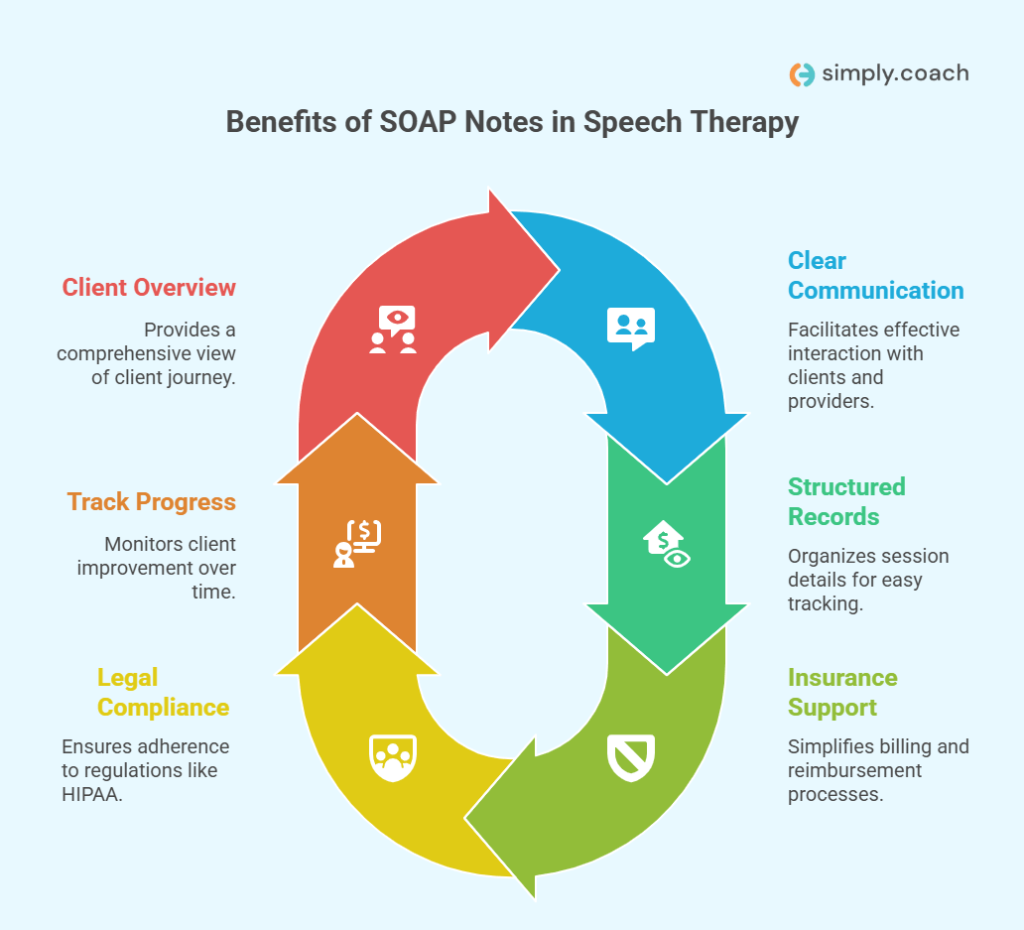
SOAP notes are essential for you as an SLP to keep organized, clear, and accurate documentation. They help you track client progress, improve communication, and maintain compliance with regulations. Here are the key benefits you’ll experience by using SOAP notes:
- Clear communication: SOAP notes ensure you maintain effective communication with both your clients and other healthcare providers.
- Structured session records: You’ll have a well-organized record of each session, making it easier to track progress and build on previous work.
- Support for insurance billing: SOAP notes help you document treatment specifics, making insurance approvals and reimbursements smoother.
- Legal compliance: SOAP notes serve as a legal document, ensuring you stay compliant with HIPAA and other necessary regulations.
- Track client progress: SOAP notes allow you to monitor a client’s progress over time and make necessary adjustments to their treatment plan.
- Client progress overview: With SOAP notes, you’ll have a clear overview of where your clients started and how much they’ve improved.
Understanding the SOAP Note Structure for Speech Therapy
SOAP notes are essential for organizing and documenting speech therapy sessions in a clear, structured way. The purpose of each section is to ensure accurate tracking of client progress and inform treatment decisions. Here’s a breakdown of each section:
1. Subjective (S)
The Subjective section captures the client’s self-reported experiences, feelings, and concerns during the session. This data is essential for understanding the client’s perspective and emotional state. Ensure that the language used is direct and based on the client’s own words.
Examples to include:
- Client’s concerns: “Client reports feeling frustrated with their inability to communicate effectively in group settings.”
- New symptoms or difficulties: “Client notes increased difficulty with word recall, especially in stressful situations.”
- Direct quotes: “Client said, ‘I feel embarrassed when I can’t remember the right words during conversations.'”
- Client’s emotional state: “Client appeared anxious about upcoming public speaking engagements.”
- Client’s motivation or progress comments: “Client expressed optimism about improvement after practicing daily articulation exercises.”
2. Objective (O)
The Objective section contains measurable, observable data that provides evidence of the client’s performance during the session. It includes results from assessments, tests, and behavioral observations. The goal is to document factual information that can be objectively verified.
Examples to include:
- Assessment results: “Client scored 85% on the sentence repetition task, showing improvement from 78% in the last session.”
- Speech fluency data: “Client demonstrated a stuttering frequency of 3% during structured conversation, down from 5% in the previous session.”
- Behavioral observations: “Client maintained appropriate eye contact and used hand gestures while speaking, indicating improved communication skills.”
- Speech rate or articulation performance: “Client produced 8 out of 10 /s/ sounds correctly during articulation drills.”
- Results of screenings or formal assessments: “Client scored within the normal range on the Boston Naming Test, with a score of 25/30.”
3. Assessment (A)
The Assessment section provides your clinical interpretation of the subjective and objective information. It links the client’s reported experiences with measurable data and provides insight into their progress or challenges. This is where you analyze what the data means in terms of therapy outcomes.
Examples to include:
- Progress summary: “Client is making steady progress with articulation; however, anxiety during social interactions continues to impede fluency in spontaneous speech.”
- Client’s strengths: “Client demonstrates improved ability to sustain attention and follow multi-step directions.”
- Barriers to progress: “Client’s lack of confidence in speaking in social settings continues to interfere with therapy goals.”
- Therapy response: “Client responded well to the new articulation exercises, showing improved accuracy with targeted sounds.”
4. Plan (P)
The Plan section outlines the next steps in the therapy process. This includes adjustments to the treatment approach, specific goals for the next session, and any external referrals or resources required. This section ensures the session’s progress is continued and that any challenges are addressed.
Examples to include:
- Next session goals: “Continue with fluency shaping techniques to reduce stuttering frequency. Introduce relaxation exercises to help with speaking anxiety.”
- Home practice recommendations: “Client is encouraged to practice articulation drills at home three times a week, focusing on the /s/ sound.”
- Adjustments to goals: “Increase focus on social communication skills for the next few sessions to address client’s anxiety during group interactions.”
- Referrals or external resources: “Recommend referral to a behavioral therapist to address underlying anxiety issues impacting communication.”
- Follow-up plans: “Reassess client’s progress in 4 weeks, focusing on fluency and social communication skills.”
This structure ensures that your SOAP notes are both thorough and practical, providing clear insights into the therapy process while documenting critical data for future reference. By using specific examples, you create a comprehensive record of each session that supports effective treatment planning and client progress tracking.
| Download SOAP Notes Template |
Tips For Writing Effective SOAP Notes For Speech Therapy
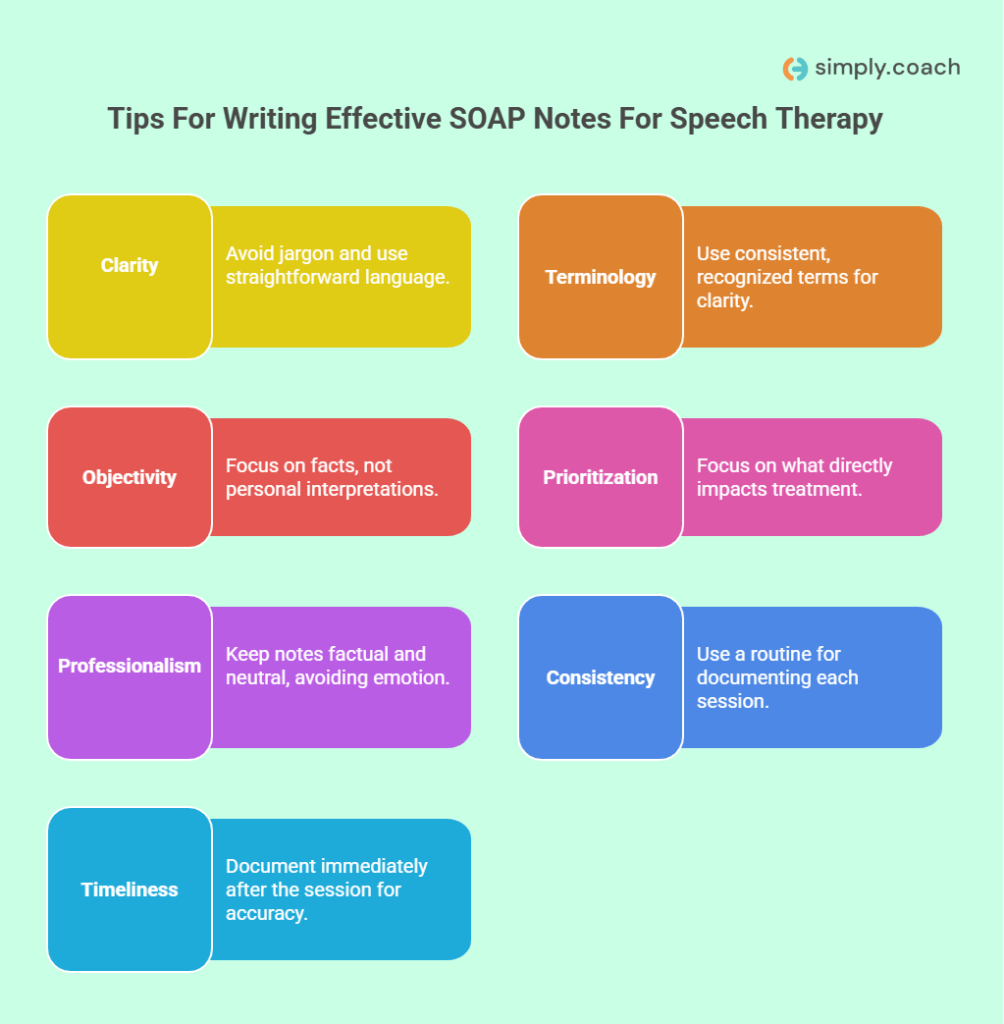
Writing clear and effective SOAP notes SLP is essential for maintaining accurate records, improving communication with colleagues, and ensuring quality care for your clients. By following these tips, you can streamline your documentation process and make it more efficient and meaningful.
1. Be clear and concise: Avoid jargon and keep your language straightforward. This makes your notes easier to understand for other professionals involved in the client’s care.
- Example: Instead of saying “The client demonstrates marked improvement in speech fluency,” say “The client’s stuttering frequency decreased from 6% to 3% in structured tasks.”
2. Use standardized terminology: Consistency in terms is important across your SOAP notes. This helps avoid confusion and ensures clarity.
- Example: Use “articulation disorder” rather than vague terms like “speech problem” or “mispronunciation.”
3. Be objective: When recording observations and data, focus on facts, not personal interpretations.
- Example: “Client produced 8 out of 10 /s/ sounds correctly during articulation drills” is more objective than “Client did well in articulation drills.”
4. Prioritize relevant information: Focus on what directly impacts the treatment and client progress. Avoid unnecessary details that don’t add value to the session’s documentation.
- Example: Instead of including extraneous information like “Client wore a red shirt,” focus on what’s important, such as “Client successfully completed 10 minutes of vocal warm-up exercises.”
5. Maintain a professional tone: Your notes should remain factual and neutral. Avoid using emotional language or subjective terms that could alter the interpretation of the therapy process.
- Example: Instead of saying “Client was frustrated and gave up,” say “Client demonstrated reduced engagement during the session and required frequent encouragement.”
6. Consistency: Establish a routine for documenting each session. This helps you stay organized and ensures you don’t miss any important details.
- Example: Always start your SOAP notes with the date and time of the session, followed by a brief overview of the client’s goals for that day.
7. Timeliness: Document your SOAP notes immediately after the session to ensure accuracy. This minimizes the chance of missing important details or recalling inaccurate information.
- Example: Write the notes right after the session while the details are fresh, rather than waiting until later in the day or week.
Ideal length of SOAP notes
When it comes to SOAP notes, striking the right balance between thoroughness and brevity is essential. You want to capture all necessary details without overwhelming the reader with excess information. Here’s what to consider:
- General length guidelines: SOAP notes should typically range between 100–300 words. This ensures all key points are included without being overly detailed.
- Factors affecting length: The complexity of the case may determine how long your SOAP notes need to be. More complex cases, like speech delays or multiple co-occurring issues, may require more detailed notes.
- Efficiency vs. detail: While brevity is important, each section should contain enough detail to be accurate and clear. Focus on providing relevant information that reflects the client’s progress or challenges.
Also read: Mental Health Session Notes Templates: Tips and Examples
Examples of SOAP Notes
To help you better understand how to apply the SOAP note format in speech therapy, here are several detailed examples showcasing real-world scenarios. These examples demonstrate how you can document progress, challenges, and treatment plans for different speech therapy cases.
1. SOAP Note for School-Age Child with Speech Sound Disorder
| SOAP Section | Details |
| Subjective (S) | The client was eager to start the session, saying, “I want to practice my words today!” The child reported feeling confident about improving their speech clarity but mentioned still struggling with specific sounds like /r/ in words. |
| Objective (O) | The session focused on producing the /r/ sound in the initial and medial positions of words, such as “red,” “ring,” and “car.” The client practiced using a mirror to observe tongue placement. |
| Assessment (A) | The client is making progress with their /r/ sound production, particularly with visual cues. Though still needing support, their motivation and active participation are increasing. |
| Plan (P) | Continue with the current treatment plan for the /r/ sound, increasing practice in spontaneous speech. Encourage home practice with words provided during the session. Introduce auditory cues next week to reduce reliance on visual prompts. |
2. SOAP Note for Preschool Child with Phonological Disorder
| SOAP Section | Details |
| Subjective (S) | The client entered the session excited, saying, “Look, my toy bunny!” and immediately included it in the activities. The child seemed motivated and ready to engage in the tasks. |
| Objective (O) | The session focused on targeting final consonant sounds in words like “cat,” “dog,” and “fish.” The child practiced saying these words with visual and verbal cues. |
| Assessment (A) | The client showed progress in producing final consonants with cues, though they still need support to produce these sounds independently. Their motivation to practice was high, and they responded well to the structured practice in a playful setting. |
| Plan (P) | Continue with the current focus on final consonant sounds and increase independent practice. Provide a list of target words for home practice and encourage repetition in daily conversations. Reassess in two weeks to determine if further strategies are needed. |
3. SOAP Note for Teenager with Social Communication Disorder
| SOAP Section | Details |
| Subjective (S) | The client arrived on time for their session and stated, “I don’t really know what to talk about today, but I want to try.” They appeared somewhat anxious but willing to engage in the session. The parent noted that the client often struggles with initiating and maintaining conversations. |
| Objective (O) | The session focused on teaching the client strategies for initiating and maintaining conversations with peers. We practiced role-playing scenarios, including asking about a classmate’s interests and making small talk. |
| Assessment (A) | The client demonstrated an increased willingness to initiate conversations, although they need prompts to stay engaged for longer periods. They show some difficulty maintaining conversations independently, but their progress is evident in structured role-playing scenarios. |
| Plan (P) | Continue practicing conversation initiation and maintenance strategies in future sessions. Focus on increasing the client’s ability to engage for longer periods without prompts. Assign home practice to initiate conversations with family members and report back in the next session. |
Mistakes to Avoid While Writing SOAP Notes for Speech Therapy
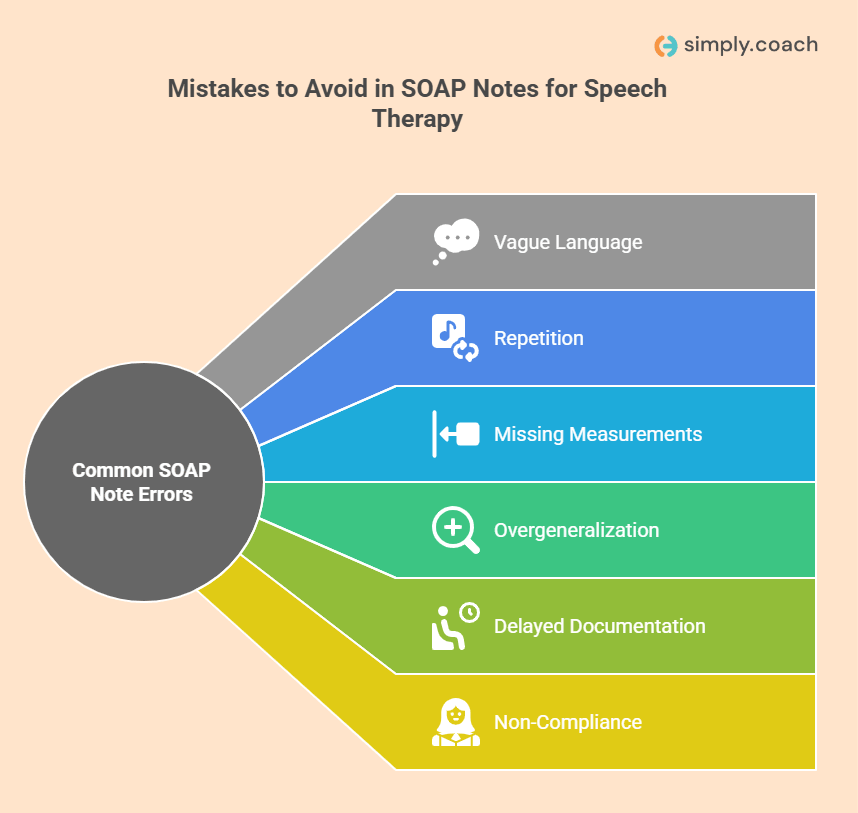
Accurate and detailed SOAP notes are crucial for effective documentation in speech therapy. Avoiding common mistakes will help you create clear, actionable, and compliant records. Here are the key mistakes to watch out for:
- Vague or non-specific language: Avoid using phrases like “doing better” or “improving” without clear evidence or measurable outcomes. Always use specific data to track progress.
- Repetition: Don’t repeat information unnecessarily across different sections of the SOAP note. Each section should contain unique, relevant content that contributes to a clear overall picture of the client’s progress.
- Failing to record measurements: Always include concrete data points, such as test scores or specific session outcomes. This helps in objectively measuring progress over time.
- Overgeneralization in assessments: Be specific in your assessments and avoid making broad statements without supporting evidence. Each assessment should be backed by clear, observable data.
- Delayed documentation: Writing SOAP notes days after the session can lead to missed details and inaccuracies. Document the notes as soon as possible after each session to ensure accuracy.
- Non-compliance with standards: Ensure your SOAP notes meet legal and institutional standards, such as HIPAA compliance, to protect client privacy and ensure proper record-keeping.
How Simply.CoachCan Enhance Your Speech Therapy Practice
Incorporating the right technology into your speech therapy practice can save you time and streamline your workflow. Simply.Coach offers an all-in-one therapy practice platform designed to help you manage client notes, appointments, and progress more efficiently. Here’s how it can benefit you:
- Note-taking feature: Simply.Coach provides customizable templates to capture session details quickly and consistently. This helps ensure your documentation is organized and efficient, saving you time on administrative tasks.
- Session scheduling: Simply.Coach allows you to schedule sessions seamlessly. Its calendar integration minimizes scheduling conflicts and ensures you stay on top of client appointments.
- Video conferencing integration: The platform integrates with popular video conferencing tools like Zoom, Google Meet, and Microsoft Teams. This makes transitioning from virtual sessions to note-taking effortless, saving you time and effort.
- Automated reminders: Set automated reminders for client tasks, appointments, and follow-ups. This ensures you stay on top of client needs without the additional workload.
- Progress tracking: Monitor client progress over time with visual charts and graphs. This feature allows you to easily adjust treatment plans and track outcomes, ensuring your clients are getting the care they need.
- HIPAA-compliant storage: With Simply.Coach, all client data is securely stored in the cloud, ensuring compliance with HIPAA and providing easy access to important information when needed.
- Client management dashboard:The centralized dashboard allows you to manage client records, appointments, and progress in one place, improving organization and efficiency.
| What Therapists Say About Simply.Coach: “With Simply.Coach, I have everything in the platform. And everything means everything!” – Eva Martín For detailed review, watch the full video on YouTube – Simply.Coach a Review: Eva Martin, Coach and Therapist What customers of Simply.Coachsay about the Platform l Testimonials |
Conclusion
Effective documentation through SOAP notes SLP is a vital part of every speech therapy session. They provide clarity, help track client progress, and improve collaboration with other professionals. By following best practices and avoiding common mistakes, you can streamline your documentation process, making it easier to monitor outcomes and plan future interventions. With the right tools and strategies in place, you can ensure that your therapy sessions are not only more organized but also more impactful.
Simply.Coach is the all-in-one platform designed to simplify the process of note-taking and practice management for SLPs. With features like customizable templates, automated reminders, and secure, HIPAA-compliant cloud storage, Simply.Coach enables you to focus on what really matters, delivering quality care to your clients. Say goodbye to disorganized records and hello to seamless, efficient documentation, especially for your SOAP notes SLP.
FAQs
1. How do I write SOAP notes during a therapy session?
Writing SOAP notes during a session can be efficient. Use a structured template on a tablet or laptop to document observations in real-time. This approach ensures accuracy and saves time post-session.
2. What are the common mistakes to avoid when writing SOAP notes?
Avoid vague language, such as “doing better,” without measurable data. Ensure each section is unique and doesn’t repeat information. Also, refrain from including unsourced opinions or irrelevant details.
3. How can I make SOAP notes more efficient?
Utilize digital tools with customizable templates to streamline note-taking. Document notes immediately after sessions to maintain accuracy. Consistency in your documentation routine also enhances efficiency.
4. How do I ensure SOAP notes are legally compliant?
Ensure your SOAP notes meet legal and institutional standards, such as HIPAA compliance, to protect client privacy and ensure proper record-keeping. This includes secure storage and controlled access to the notes.
5. How can I improve the clarity of my SOAP notes?
Use simple, direct language and avoid jargon. Be specific in your descriptions and avoid overgeneralization. Ensure each section flows logically into the next, maintaining coherence throughout the note.