
Even if you’re an experienced therapist, you eventually hit a ceiling where clinical skill is no longer the constraint, but the workflow is. A poorly structured business plan for a therapy practice shows up as inconsistent follow-ups, rising no-shows, and session time spent reconstructing context instead of moving work forward.
Over time, this fragmentation affects continuity of care, weakens goal tracking, and increases cognitive load between sessions. A well-defined plan changes how your practice functions day to day. It creates clarity around intake decisions, session structure, and between-session follow-through, so progress builds instead of resetting.
In this article, we will break down the business plan for therapy practice, how to structure it for real-world caseloads, and how to implement systems that support consistent client progress without adding operational complexity.
Key Takeaways
- A business plan gives you a clear framework to define your therapy services, set client boundaries, and organize daily workflows, reducing burnout and operational stress.
- Identifying your ideal client and niche ensures you deliver targeted therapeutic interventions while attracting the right population for your specialized approach.
- Mapping pricing, session types, and scheduling strategies helps prevent gaps in care, reduces no-shows, and allows better management of both in-person and telehealth sessions.
- Integrating outcome measurement, progress tracking, and clinical goal alignment keeps your interventions effective, consistent, and aligned with client recovery and therapeutic objectives.
- Using Simply.Coach features like goal & development planning, action plans, nudges, client workspaces, and reports automate administrative tasks, improve session efficiency, and enhance client engagement for sustainable practice growth.
What is a Therapy Business Plan?
A business plan for therapy practice helps you turn your clinical decisions into consistent results. As your caseload grows, the challenge is usually not your skill; it’s staying consistent. Sessions may lose direction, follow-ups can vary, and no-shows can break the flow of care.
In practice, this means standardizing workflows that you might otherwise handle by instinct.
- When do you introduce structured interventions?
- How do you track progress without relying on memory?
- What triggers a follow-up versus a shift in approach?
A strong business plan answers these questions upfront, reducing decision fatigue while preserving clinical judgment where it actually matters. It also makes it clear what type of clients you work with and how, not just their demographics, but also their ability to follow the rules, their patterns of behavior, and their readiness for change.
Once you define what a therapy business plan actually governs, the next step is understanding why experienced therapists cannot afford to operate without one.
Strategic Value of a Business Plan for Your Therapy Practice
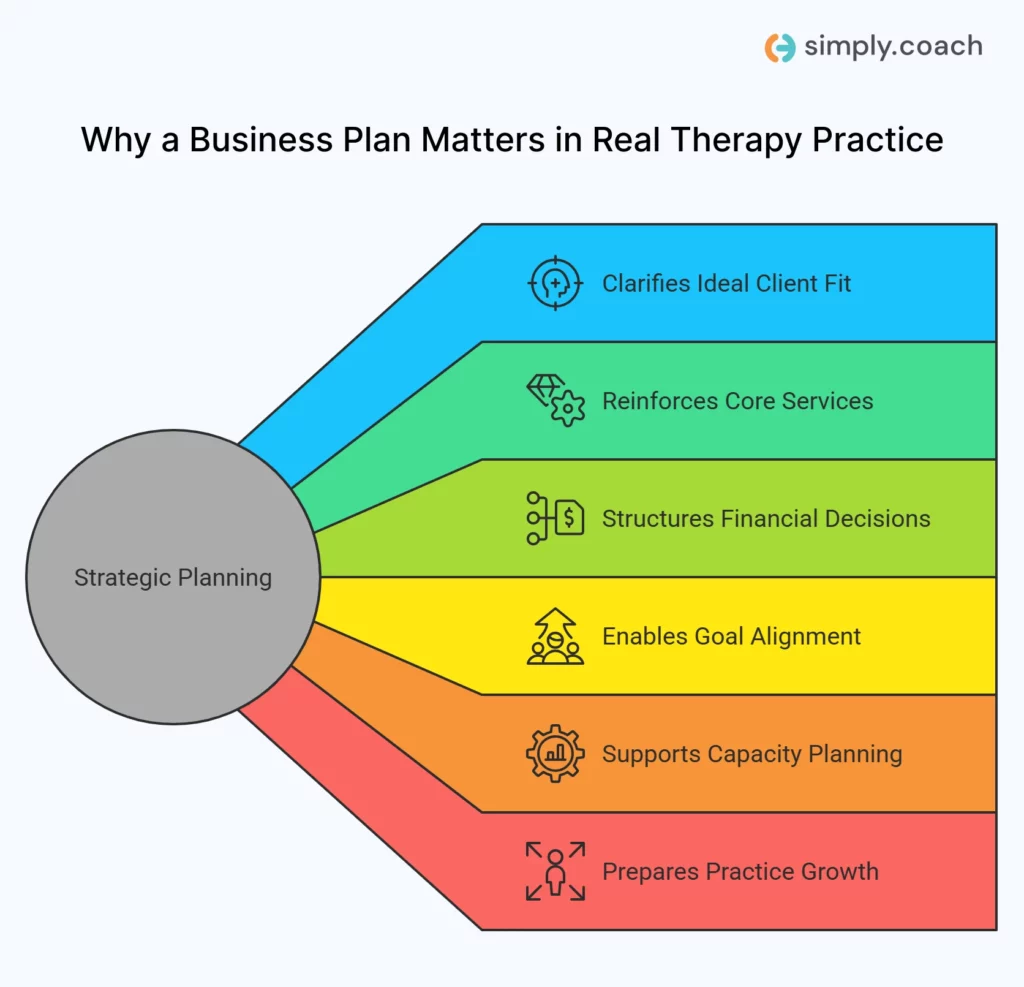
A business plan for your therapy practice becomes critical the moment your caseload stops behaving predictably. One client needs stabilization, another is ready for structured work, and a third keeps missing sessions. Without a defined structure, you start compensating in real time, which slowly erodes consistency and disrupts client progress.
- Clarifies your ideal client: Defines who actually benefits from your approach based on regulation capacity, motivation, and presenting patterns, not just age group or problem category.
- Reinforces your core services: Keeps your modalities and Intervention style consistent, so you are not shifting frameworks every session without a clear clinical reason.
- Structures your financial decisions: Aligns session fees, scheduling patterns, and workload limits so financial pressure does not push you into unsustainable caseloads.
- Enables goal alignment and tracking: Creates a repeatable way to define and revisit goals, reducing reliance on memory and preventing vague or drifting session outcomes.
- Supports workload and capacity planning: Helps you decide how many clients you can hold without affecting session quality, especially when working with emotionally intensive cases.
- Prepares your practice for growth: Allows you to introduce group work, team-based care, or structured programs without disrupting continuity for existing clients.
Also read: How to Create an Effective No Call No-Show Policy Template for Your Therapy Practice
Knowing why you need a plan leads naturally to the next step: what specific elements ensure your plan is actionable and tailored for your practice?
15 Major Components to Incorporate in a Therapy Business Plan
Creating a comprehensive therapy business plan is essential for experienced therapists to run a practice with clarity and purpose. This section breaks down the core components you should include to build a structured, actionable plan.
1. Executive summary
The executive summary serves as a concise snapshot of your therapy practice, highlighting purpose, services, and high-level objectives. It should clearly convey who you serve, how you deliver care, and what sets your practice apart. A strong summary anchors the rest of your business plan, making every subsequent section easier to contextualize.
Questions to evaluate in this step
- Practice vision
- What is the overarching purpose of your therapy practice?
- Which client populations and therapeutic needs do you prioritize?
- How does your practice uniquely address client challenges compared to other providers?
- Core services & specializations
- What modalities, therapeutic aaproaches, or specialties define your practice?
- Are there niche services (e.g., trauma-focused therapy, executive coaching, couples therapy) that differentiate you?
- Which services generate the most consistent clinical impact for your clients?
- Key metrics snapshot
- What client metrics matter most (caseload, session frequency, progress indicators)?
- Which financial metrics should be summarized (revenue from sessions, session packages, and subscriptions)?
- How will you track both clinical and operational performance at a glance?
- Unique selling points
- What makes your practice stand out to prospective clients?
- How do your clinical results, client experience, and administrative efficiency create a competitive advantage?
- Are there technology tools that enhance client engagement and practice efficiency?
2. Mission statements
A mission statement is the core of your therapy practice, clarifying why you exist, who you serve, and how you provide care. It should be specific enough to guide daily operations but flexible enough to adapt to client needs and emerging therapeutic trends.
Questions to evaluate in this step
- Purpose & motivation
- Why did you choose counseling as your professional path?
- What core values drive your clinical approach and decision-making?
- How do these motivations influence the types of clients you want to serve?
- Impact & client Focus
- How can your practice tangibly improve clients’ well-being or outcomes?
- Which client challenges are you best equipped to address?
- What tangible improvements or transformations do you aim to achieve?
- Method & approach
- How do you want to deliver therapy: individual sessions, group programs, or a hybrid?
- What therapeutic modalities, frameworks, or tools reflect your practice philosophy?
- How does your approach differentiate your practice from other providers?
3. Description of your business
A clear description of your therapy business anchors every decision, from clinical priorities to operational workflows. This section communicates who you are, what you do, and how your practice is structured, providing both clarity for internal planning and credibility for stakeholders.
Questions to evaluate in this step
- Business structure & ownership
- What is your practice’s legal structure (LLC, S-Corp, sole proprietorship), and how does it affect liability and taxes?
- Who are the owners, partners, or stakeholders, and what are their defined roles?
- How does ownership structure influence decision-making and clinical oversight?
- Operational scope & staffing
- What is the potential caseload your practice can handle while maintaining quality care?
- Are you operating as an individual therapist, a group practice, or a hybrid model?
- How many therapists, assistants, or administrative staff support daily operations?
- Professional & historical background
- What is your professional history and expertise that adds credibility to your practice?
- If relevant, what backgrounds or certifications do other owners or partners hold?
- How does the history of your practice inform current policies, workflows, and client engagement strategies?
4. Ideal client and niche
Defining your ideal client and clinical niche is central to a business plan for a therapy practice because by specifying demographics, presenting issues, and preferred modalities, you reduce scheduling mismatches and avoid overextending yourself.
Questions to evaluate in this step
- Client demographics
- What age ranges, life stages, or professional backgrounds do your ideal clients represent?
- Are there specific geographic regions or communities you aim to serve?
- Preferred treatment approaches
- Which modalities or techniques resonate best with your ideal client population?
- How do these approaches differentiate your practice from local alternatives?
- Referral & access considerations
- Who refers your ideal clients – physicians, colleagues, or online channels?
- Are there accessibility considerations (insurance, telehealth, sliding scale) that affect client alignment with your niche?
5. Services offered
Clearly outlining the services your practice provides ensures operational clarity and sets client expectations. Detailing individual, group, and specialty services, along with session duration and modality (in-person, telehealth, hybrid), prevents scheduling errors and improves client satisfaction.
Questions to evaluate in this step
- Core services
- What primary therapy services do you offer (individual, couples, family, or group)?
- Are there specialized programs or workshops that align with your niche?
- Session structure & format
- What is the typical session length and frequency for each service type?
- Are services offered in-person, virtually, or in a hybrid model?
- Customization & flexibility
- Can services be adapted for client-specific goals or unique challenges?
- How do you ensure continuity and integration across multiple service types?
6. Pricing structure
Your pricing structure determines how clients pay for sessions, packages, and specialty programs. It ensures transparency, aligns with your therapy goals, and supports manageable caseloads. Consider rates per session, bundled packages, sliding scale options, and insurance participation.
Questions to evaluate in this step
- Session rates
- Are your individual, couples, and group session rates competitive for your niche and location?
- Do your rates reflect your specialization, expertise, and years of experience?
- Are your rates clearly communicated on your website and intake materials?
- Sliding scale & accessibility
- Are sliding scale options structured so clients can access care without overextending your workload?
- How will you determine eligibility for reduced rates fairly and consistently?
- Have you set boundaries to prevent overuse of discounted sessions?
- Package & program pricing
- Which bundled session packages or programs encourage consistent client engagement?
- Do packages include measurable goals and structured follow-ups for clients?
- Are pricing tiers clearly defined to differentiate standard vs. premium offerings?
- Insurance & billing
- Which insurance providers do you accept, and are reimbursement procedures clearly defined?
- Have you documented all required billing codes and forms to prevent claim delays?
- Are policies communicated upfront to avoid confusion for new and existing clients?
Also read: Billing for Therapists: An Updated Guide for 2026
7. Market research and analysis
Market research validates your niche, ensures your services meet client needs, and prevents overextending resources in saturated areas. Gathering actionable insights allows you to position your practice strategically and create targeted outreach initiatives that resonate with potential clients.
Questions to evaluate in this step
- Demographics & Target population
- What is the population size, age range, and socioeconomic profile in my target area?
- What are the prevalent mental health challenges or client needs in this geographic area?
- Are there underserved client segments or specialty treatment areas that align with my expertise?
- Competitor analysis
- Which practices provide similar services or specialty modalities, and what gaps exist in their offerings?
- How do competitors position themselves in terms of pricing, marketing, and client engagement strategies?
- What evidence can I present to demonstrate a demand for my therapy services in this area?
- Networking & market access
- Which local networking groups, professional events, or memberships will give visibility to my practice?
- What online directories, social media platforms, or niche networks are most effective for reaching my ideal clients?
- How can I utilize collaborations or partnerships to differentiate my services from competitors?
8. Client acquisition strategy
A well-defined client acquisition strategy ensures your therapy practice attracts clients aligned with your niche, values, and treatment approach. It integrates referrals, online presence, and direct engagement. By defining sources, channels, and outreach tactics, you can create a steady stream of appropriate clients while protecting your energy and time.
Questions to evaluate in this step
- Referral sources
- Which professionals, clinics, or community organizations can reliably refer clients in my target niche?
- How can I establish mutually beneficial partnerships without over-relying on a single source?
- Are referral expectations, communication methods, and feedback loops clearly defined for consistency?
- Online client acquisition
- Which directories, social media platforms, or digital channels will most effectively reach my ideal clients?
- How will my website, blog, and online profiles communicate expertise, trust, and therapeutic approach?
- Which types of content (articles, videos, testimonials) will engage clients and encourage them to book sessions?
- Direct engagement strategies
- Which workshops, webinars, or community programs can I offer to attract and educate potential clients?
- How can I utilize public speaking, networking events, or professional associations to gain visibility?
- How will I track engagement and evaluate which activities convert participants into long-term clients?
- Client onboarding process
- Is the intake process clear, efficient, and aligned with client expectations?
- Are automated reminders, pre-session forms, and scheduling tools integrated to reduce no-shows?
- Does the onboarding experience reflect my niche, therapeutic approach, and practice values?
Also read: 7 Strategies to Attract More Therapy Clients in Private Practice
9. Plan of operations
A thorough plan of operations ensures your therapy practice runs efficiently while maintaining clinical quality and client safety. From session formats to recordkeeping and safety protocols, every process should be intentional and aligned with your practice goals.
Questions to evaluate in this step
- Hours and scheduling
- What are the optimal operating hours for clients’ accessibility while protecting therapists’ well-being?
- How will sessions, breaks, and administrative time be scheduled to avoid overload and burnout?
- Team roles in-office
- What are the responsibilities of administrative staff, receptionists, or clinical assistants in daily operations?
- How will tasks like scheduling, client communication, and intake forms be delegated efficiently?
- Are backup procedures in place if key staff are unavailable?
- Team roles outside the office
- Who manages critical external functions such as accounting, legal matters, or website management?
- How will communication with external partners ensure timely support and compliance?
- Are expectations, reporting, and accountability mechanisms clearly established for outside contributors?
Also read: How to Create Effective Therapy Schedule Templates
10. Financial plan
The financial plan outlines the full monetary picture of your therapy practice. It shows not only current earnings and expenses but also your projected growth over the next five years. It helps anticipate challenges, such as balancing self-pay and insurance clients or planning for unexpected expenses that could affect session availability.
Questions to evaluate in this step
- Current earnings
- What are your total earnings from all active clients each month? Track variations to spot trends or seasonal dips.
- How has your annual income changed over the past few years? Identify patterns that influence session availability or pricing.
- Which services contribute most to your income (individual therapy, group sessions, packages)? How does each impact cash flow?
- Projected income
- How much do you expect from incoming clients, packages, or subscription models?
- How will payment types affect your projected income and collection timelines?
- What are realistic income targets for the next year and five-year horizon, considering market trends?
- Expenses and overhead
- What recurring expenses must you cover (rent, utilities, insurance, software subscriptions)?
- Which costs fluctuate with client load or seasonal demands (supplies, continuing education, staffing)?
- What reserves or contingencies are in place for unforeseen costs like equipment replacement or technology upgrades?
- Profit and loss tracking
- Are you accurately tracking net income after all expenses?
- How often do you analyze financial reports to adjust strategies or budgets?
- Are there recurring areas where expenses can be optimized without compromising client care?
- Debt and financial obligations
- What loans or liabilities exist, and how do they affect monthly cash flow?
- Are repayment schedules realistic without straining operations?
- How will debt influence decisions about hiring, marketing, or expanding your practice?
Also read: Bookkeeping for Therapists: Everything You Need to Know in 2026
11. Setting up your office space
Your office is the operational base of your therapy practice. The way you arrange therapy rooms, reception, and private areas directly influences session flow, client comfort, and your ability to manage multiple clients efficiently.
Beyond aesthetics, office setup determines how well you can implement clinical workflows: secure client intake, pre-session assessments, telehealth integration, and automated reminders all rely on a thoughtful environment.
Questions to evaluate in this step
- Physical layout and environment
- Is your office easily accessible for clients with mobility challenges, including parking and entrances?
- Does the layout promote comfort while ensuring privacy during sessions and video conferencing?
- Are therapy rooms organized to allow smooth transitions between different session activities (individual, couples, group)?
- Atmosphere and client experience
- Do your choices create a calming, professional, and approachable environment?
- Are sessions free from distracting sounds, ensuring clients feel safe to open up?
- Is the waiting area organized, comfortable, and easy for clients to get around?
12. Risk management and compliance
Running a therapy practice exposes you to complex ethical, legal, and clinical risks that can impact client safety and professional credibility. You must deal with confidentiality obligations, reporting requirements, and crisis management while maintaining consistent therapeutic quality.
A comprehensive compliance plan makes sure you maintain consistent, ethical care, reduce operational mistakes, and anticipate potential crises before they compromise clinical outcomes or client trust.
Questions to evaluate in this step
- Client confidentiality and data protection
- Are all client records stored securely, both physically and digitally, to prevent unauthorized access?
- Do you have policies aligned with HIPAA and local regulations for handling sensitive client information?
- Are clients informed about how their data is collected, stored, and shared?
- Informed consent and documentation
- Do you provide clear written consent forms covering the scope of therapy, session formats, and limitations?
- Are consent forms updated periodically to reflect any changes in policies or therapeutic approaches?
- Do you document all sessions, agreements, and communications to ensure transparency and accountability?
- Crisis and safety procedures
- Do you have protocols for managing client emergencies, suicidality, or severe emotional dysregulation?
- Are all staff trained on these procedures and aware of escalation steps?
- Are emergency contacts and local resources readily available and clearly communicated to clients?
- Professional liability and malpractice protection
- Have you secured professional liability insurance appropriate for your scope of practice?
- Are you aware of legal obligations regarding reporting, documentation, and ethical standards?
- Do you have procedures for handling complaints, disputes, or allegations from clients?
- Regulatory compliance
- Are you up-to-date on state licensing requirements, continuing education, and certifications?
- Do you review federal, state, and local laws regularly to ensure ongoing compliance?
- Are all marketing, website content, and public communications aligned with legal and ethical guidelines?
13. Technology and workflow optimization
The right technology keeps your sessions on track and your client care consistent by automating scheduling, reminders, and follow-ups, ensuring no client falls through the cracks and reducing the mental load of managing multiple cases.
Digital tools can organize session notes, track progress, and highlight when interventions or check-ins are due, so decisions are based on data, not memory. By designing your workflow around these tools, you maintain focus on meaningful clinical work while keeping the practice running smoothly and predictably.
Questions to evaluate in this step
- Client management systems
- Are client records centralized and easily accessible for each session?
- Can you track client goals, progress, and action steps within the system?
- Does the system support automated reminders and nudges to improve adherence?
- Clinical outcome measurement
- Do you have a structured method to quantify client progress (behavioral, emotional, and functional metrics)?
- Can you generate real-time reports to identify trends in client engagement or outcomes?
- Are outcome measures integrated with session notes and treatment plans for continuity?
- Administrative and operational workflows
- Are scheduling, billing, and session logistics automated or partially manual?
- Can the system accommodate telehealth, hybrid, or in-person sessions without duplication?
- Are compliance tasks (e.g., HIPAA, GDPR, documentation standards) tracked efficiently?
Also read: Top 10 HIPAA-Compliant Therapy Practice Management Software: A 2026 Guide for Therapists
14. Community and referral networks
Networking with fellow clinicians, specialists, or clinics builds credibility, ensures timely referrals for complex cases, and supports collaborative care. Establishing structured referral pipelines allows you to connect clients with complementary services while maintaining ethical boundaries and client safety.
Questions to evaluate in this step
- Professional networking
- Which clinicians, specialists, or therapy centers align with your practice’s niche?
- Are you actively attending local or virtual professional events to build connections?
- How do you maintain ongoing relationships without creating conflicts of interest?
- Referral system
- Do you have a structured process for accepting and sending referrals?
- Are referral sources tracked for quality and client satisfaction feedback?
- How do you ensure timely follow-up and communication with referred clients?
- Community engagement
- Are you participating in professional associations, workshops, or public awareness events?
- Do you provide educational resources or sessions to local organizations to enhance visibility?
- Is there a plan for ethically sharing client success stories or testimonials with permission?
15. Growth and expansion plan
Well-defined goals allow you to track progress, prioritize resources, and ensure sustainable growth while maintaining high-quality client outcomes. It involves strategic hiring, adding specialized services, expanding into new populations, and strengthening professional skills.
Questions to evaluate in this step
- Client growth targets
- How many active clients do you aim to serve over the next 6–12 months, and what metrics will track engagement and retention?
- Which client populations or therapy modalities will you prioritize to balance demand and clinical capacity?
- How will you determine when your current caseload is at capacity, requiring additional staffing or scheduling adjustments?
- Team and staffing expansion
- Which clinical and administrative roles are essential to sustain growth while maintaining quality care?
- What onboarding processes, supervision plans, and workflow integrations will ensure new hires are effective quickly?
- How will technology, like automated reminders, scheduling, and client workspaces, support a growing team without adding manual workload?
- Service diversification and professional development
- Which new therapy modalities, specialties, or client populations will you expand into, and what research supports this?
- What certifications or advanced training are required before offering new services safely and effectively?
- How will you evaluate the clinical and operational impact of added services, ensuring outcomes align with your practice goals?
Also read: 14 Practical Tips for Therapists to Succeed in Everyday Practice
Knowing the essential components is just the start; let’s look at the pitfalls you might face when putting them into practice.
4 Mistakes to Avoid in a Business Plan for Therapy Practice
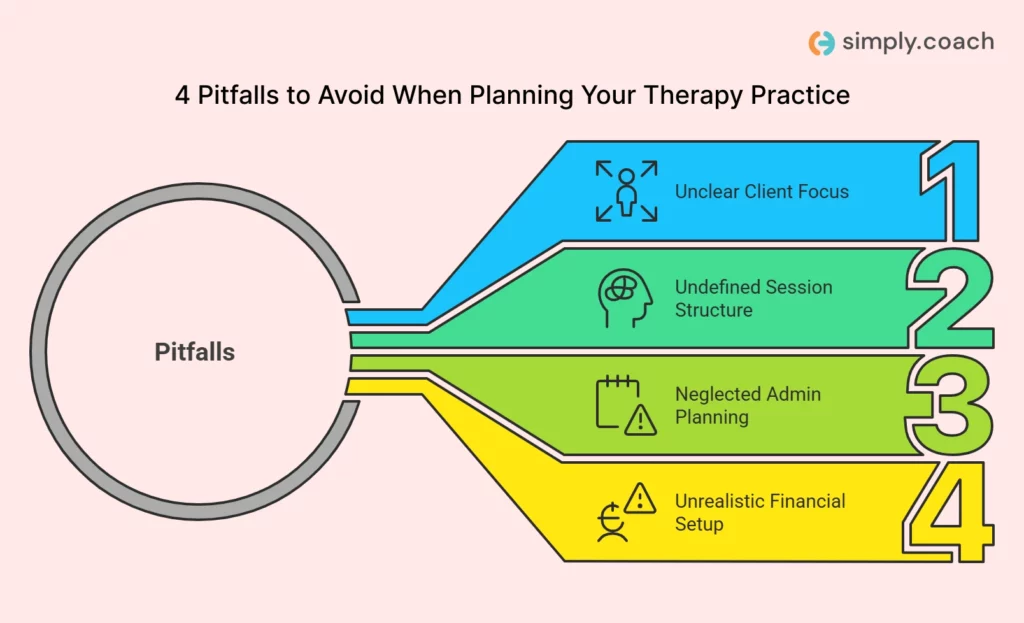
Even highly qualified therapists can struggle when building a business plan. Small oversights can disrupt workflow, client care, and long-term growth. Here are some pitfalls to look out for:
- Unclear client focus: Not defining exactly who you serve makes intake, treatment planning, and marketing inconsistent.
- Undefined session structure: Skipping standardized workflows for intake, follow-ups, or progress checks leads to reactive practice.
- Neglected admin planning: Leaving scheduling, documentation, or reminders unstructured increases stress and errors.
- Unrealistic financial setup: Overly complex projections or ignored caseload limits can strain resources and reduce clinical focus.
Once you understand the common mistakes, you can apply focused strategies to make your business plan practical, efficient, and effective.
4 Strategies for a Successful Business Plan for Your Therapy Practice
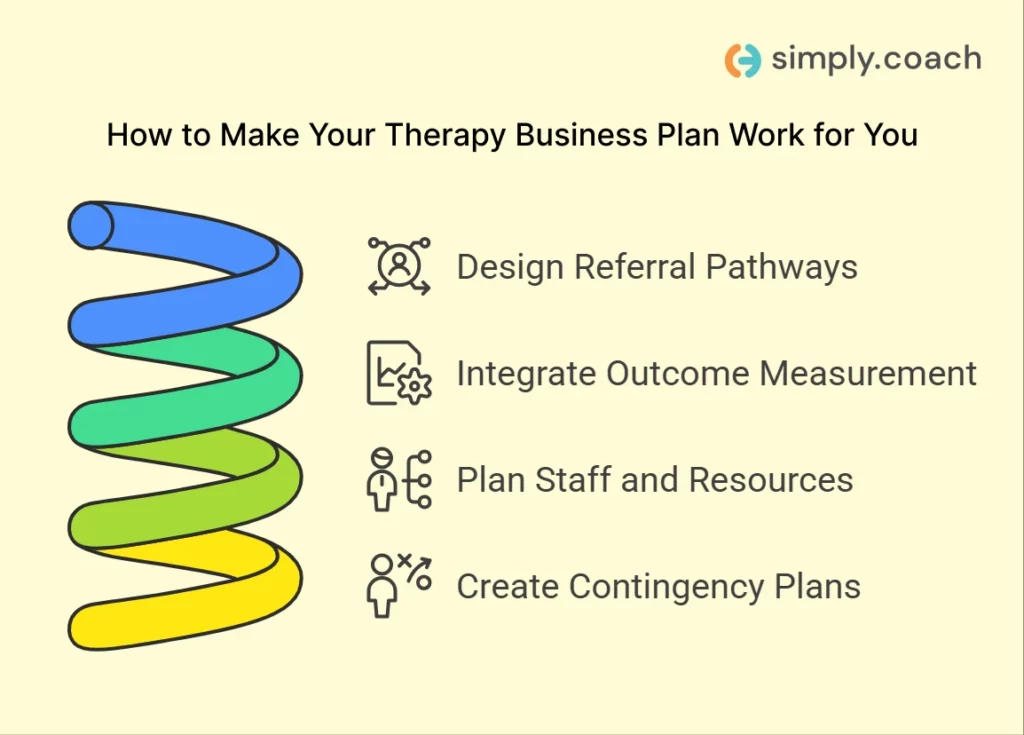
A clear plan turns your therapy practice into a predictable, high-functioning system. These strategies help you stay consistent while supporting growth.
- Design referral and collaboration pathways: Build clear protocols for referring to specialists or collaborating with other providers, ensuring continuity of care and stronger clinical outcomes.
- Integrate outcome measurement systems: Decide which metrics you’ll track (e.g., symptom scales, goal progress, client satisfaction) and embed them into workflows to guide session planning and program improvements.
- Plan for staff and resource needs: Even if solo, anticipate when you might need support, administrative help, supervision, or digital tools to maintain consistent service quality.
- Create contingency and growth plans: Prepare strategies for no-shows, sudden caseload spikes, or adding new services, so your practice remains stable and scalable without compromising care.
Also read: Effective Strategies to Grow Your Therapy Practice in 2026
Integrating with a platform like Simply.Coach helps you execute your business plan efficiently while staying focused on client care.
Maximize Your Therapy Business Plan With Simply.Coach
Creating a business plan for a therapy practice can feel overwhelming; balancing client care, scheduling, financial tracking, and growth strategies can often leave even experienced therapists stretched thin. Without a system to centralize these moving parts, critical details like caseload limits, session follow-ups, and operational goals can slip through the cracks.
A leading HIPAA-compliant therapy practice management software like Simply.Coach, can turn your business plan into a living, actionable framework, giving you clarity, structure, and control over both the clinical and operational sides of your practice.
- Action plans: Break your goals into actionable steps for both administrative workflows and clinical operations, keeping every task aligned with your business strategy.
- Nudges: Automated, non-intrusive reminders for tasks, client follow-ups, and operational deadlines reduce cognitive load, so you can focus on delivering high-quality therapy.
- Scheduling: Seamlessly manage client appointments, staff calendars, and telehealth sessions in one platform, reducing no-shows and optimizing client access.
- Goal & development planning: Map out strategic practice objectives, track clinical outcomes, and monitor progress toward expansion goals, ensuring your vision translates into measurable results.
- Client workspaces: Centralized hubs for notes, shared resources, forms, and progress tracking allow you to maintain structured documentation and strengthen client engagement.
- Reports: Generate real-time insights into client progress, operational efficiency, and practice growth, helping you make data-driven decisions without extra manual effort.
With Simply.Coach, you can turn a well-structured business plan into a consistent, day-to-day system that supports client progress, reduces friction, and sustains high-quality clinical work.
Conclusion
Creating a business plan for therapy practice helps you define who you serve, what services you offer, and how you’ll structure every aspect of your day-to-day functioning, from pricing to client acquisition. It also keeps your clinical goals front and center, ensuring you maintain focus on meaningful outcomes while dealing with the practical realities of running a practice.
With a clear business plan, you can anticipate challenges, measure clinical outcomes, and adjust strategies in real time, making your practice both resilient and responsive to client needs.
Simply.Coach makes turning your plan into reality simple through their all-in-one HIPAA-compliant therapy practice management software. With action plans, scheduling and client workspace, you can streamline operations, reduce no-shows, automate follow-ups, and track both client progress and practice growth.
FAQs
1. What is a business plan for a therapy practice?
A business plan is a detailed roadmap outlining how your therapy practice operates, your ideal clients, services, financial projections, and long-term goals. It helps you maintain clinical focus while managing operational demands.
2. Why do I need a business plan for my therapy practice?
It provides clarity on your niche, pricing, and client acquisition strategy. A structured plan reduces overwhelm, ensures consistent workflows, and keeps your practice aligned with both clinical and operational objectives.
3. How detailed should my financial plan be?
Your financial plan should project expenses, income, and session rates for both insurance and self-pay clients. Include monthly projections for year one and annual projections for subsequent years to guide realistic growth.
4. What should I include in a marketing plan for my practice?
Include strategies like networking, social media, website optimization, directories, and branding. The plan should define target audiences, marketing budget, and measurable outreach goals.
5. How can I measure clinical outcomes in my business plan?
Track client progress through session notes, goal completion, and outcome reports. Incorporating measurable therapeutic objectives ensures your practice stays results-driven and aligned with client needs.
6. How often should I update my business plan?
Review your plan quarterly or annually to reflect client growth, financial changes, staff updates, or workflow adjustments. Frequent updates help you pivot strategies while maintaining clinical consistency.
7. Should I include technology in my business plan?
Yes. Outline tools for scheduling, electronic health records, telehealth, reminders, and progress tracking. Utilizing technology reduces administrative burden and improves client engagement.
8. Can a business plan help with client acquisition?
Absolutely. Mapping marketing strategies, referral networks, and service offerings in your plan ensures you attract the right clients efficiently and ethically.