
Ever feel like tracking coaching progress is as difficult as navigating without a compass? Fret not; we’ve got the right tools to make the process simple and manageable.
As a coach, your top priority is to help your clients reach their goals and grow their business. But how do you clearly measure the impact of your coaching sessions and track progress over time?
Tracking progress matters for both you and your client. It gives you a clear view of the journey, helps set realistic goals, and keeps both of you aligned on expectations and outcomes. When progress is visible, clients stay motivated, and you gain confidence in the value you deliver.
In this blog, you’ll learn how to track coaching progress using practical tools that help you stay organized, improve accountability, and show real, measurable results to your clients.
Key Takeaways
- Coaching tracking helps you measure how consistently your clients move toward their goals using data, not intuition.
- Effective coaching tracking combines goal setting, feedback, assessments, reflection, reporting, and follow-through into one structured process.
- Tools such as SMART goals, 360-degree feedback, behavioral assessments, and self-reflection forms make progress visible and measurable over time.
- Regular tracking keeps you aligned with your client’s priorities, strengthens accountability between sessions, and improves coaching outcomes.
- Common tracking mistakes include relying only on conversations, tracking goals without actions, inconsistent updates, and ignoring qualitative progress.
- An all-in-one coaching platform like Simply.Coach simplifies coaching tracking by bringing goals, actions, feedback, sessions, and reports into one connected system.
What Is Coaching Tracking?
Coaching tracking is the process of regularly measuring how far your client has progressed toward their goals during a coaching engagement. It helps you document actions taken, behavioral changes, milestones achieved, and outcomes over time.
Instead of relying solely on session conversations or intuition, coaching tracking gives you a clear, structured way to see what is working, what needs adjustment, and how your client is growing. It turns your coaching sessions from isolated conversations into a visible journey with measurable results, allowing you to guide your client more effectively.
Why Tracking progress is critical in coaching engagements
Tracking progress plays a key role in creating effective and meaningful coaching engagements. When progress is tracked consistently, both you and your client gain clarity and confidence in the coaching process.
For you as a coach, progress tracking helps you:
- Stay aligned with your client’s goals and priorities
- Identify patterns, challenges, and areas that need more focus
- Adjust your coaching approach based on real outcomes, not assumptions
For your clients, tracking progress:
- Makes growth visible and motivating
- Builds accountability between sessions
- Reinforces commitment to actions and goals
Progress tracking also becomes especially important when coaching is sponsored or outcome-driven. Clear records of progress make it easier to demonstrate value, show impact, and communicate results to stakeholders when needed.
Also read: 10 Effective Strategies for Tracking Progress in Coaching Sessions
Types of Tools Used for Coaching Tracking
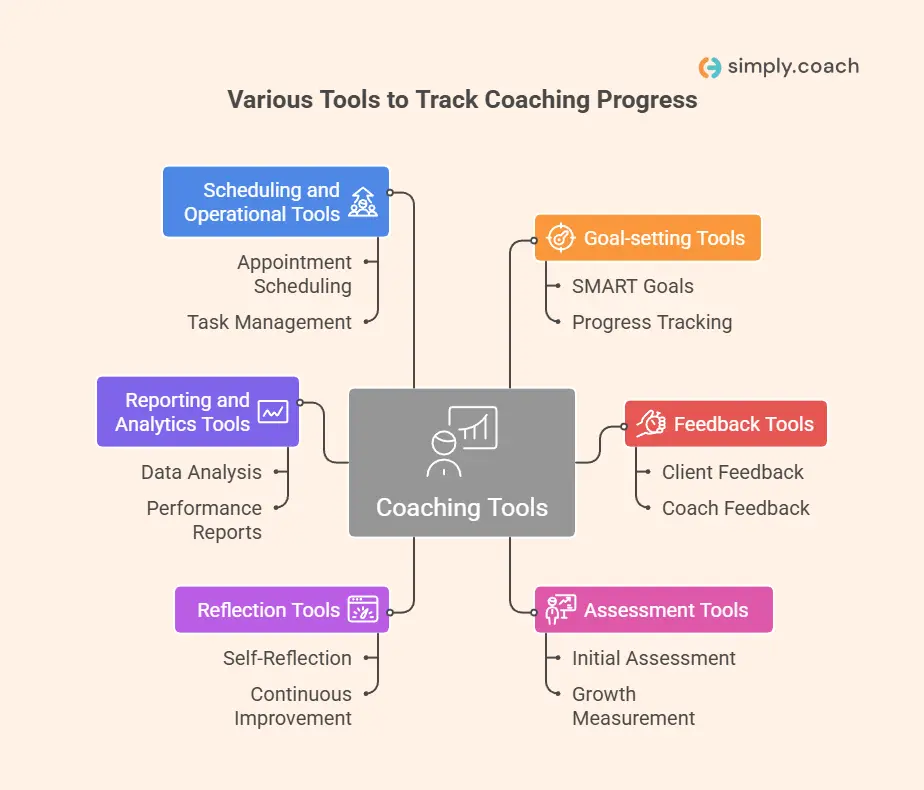
Tracking coaching progress is not done with a single method: it requires a combination of tools that capture goals, actions, feedback, assessments, reflections, and outcomes over time. Each type of tool plays a distinct role at different stages of the coaching journey, helping you move from intention to measurable results for your clients.
Understanding how these tool categories work together allows you to choose the right tools based on your coaching style, client needs, and the outcomes you are accountable for.
1. Goal-setting tools for tracking coaching progress
Goal-setting tools form the foundation of progress tracking in coaching: they move objectives from conversation into measurable actions. You can use frameworks such as:
- SMART goals (Specific, Measurable, Achievable, Relevant, Time-bound): You can track progress by reviewing milestones weekly, marking completed actions, and adjusting plans when delays occur.
- GROW model (Goal, Reality, Options, Will): You define the goal with your client, assess the current reality, explore options, and agree on committed actions. Progress is tracked by reviewing the “Will” actions each session.
- OKRs (Objectives and Key Results): Breaks large objectives into measurable key results. You can track each key result over time to quantify progress toward strategic outcomes.
Using these tools, you can:
- Record both long-term and short-term goals in detail
- Attach specific actions or steps to each goal
- Monitor completion status and update progress regularly
- Celebrate milestones and adjust coaching interventions when necessary
Example: If your client’s goal is to improve team collaboration, you can set an OKR with key results like conducting weekly team check-ins and gathering team feedback, tracking completion and progress each week.
2. Feedback tools to measure coaching impact
Feedback tools help you measure how your coaching is being experienced and what impact it is creating beyond simple task completion. They capture behavioral changes, leadership growth, and self-awareness that goals alone cannot reveal. Specific tools include:
- 360-degree feedback: Collect input from peers, managers, and direct reports to track improvements in leadership, decision-making, and interpersonal skills.
- Qualitative feedback forms: Gather narrative observations from stakeholders, helping you spot strengths, challenges, and triggers.
- Stakeholder feedback integration: Consolidates feedback from multiple sources to provide a holistic view of your client’s development.
Using these tools, you can:
- Compare feedback across sessions to identify trends
- Track how your client’s behavior shifts in response to coaching
- Highlight areas that require more focus or reinforcement
Example: If 360-degree feedback shows consistent improvement in decision-making but stagnation in delegation, you can adjust your coaching sessions to target delegation skills specifically.
3. Assessment tools for establishing baselines and growth
Assessment tools give you a measurable starting point and allow you to quantify progress:
- DiSC assessment: Evaluates behavioral styles, allowing you to monitor collaboration, leadership, and communication improvements.
- Myers-Briggs Type Indicator (MBTI): Provides personality insights to tailor your coaching approach and track interpersonal growth.
- StrengthsFinder (CliftonStrengths): Identifies your client’s strengths and tracks how they apply them to achieve their goals.
- Impact assessment tools: Measure outcomes at individual, team, and organizational levels, comparing results to baseline assessments.
By conducting assessments at key points in the coaching journey, you can:
- Establish a clear baseline before coaching begins
- Track changes over time to measure tangible growth
- Provide evidence-based insights to clients or sponsors
Example: You can repeat a DiSC assessment after a three-month leadership coaching program to show measurable improvement in team collaboration and decision-making.
4. Reflection tools that support continuous client progress
Reflection tools help your clients process experiences between sessions and convert learning into action. They capture insights that might otherwise be lost if limited to verbal discussion. Examples include:
- Self-reflection forms: Structured questionnaires clients complete weekly to assess successes, challenges, and next steps.
- GDD (Good – Difficult – Different): Guides clients to reflect on what went well, what was challenging, and what they would do differently next time.
- Weekly journaling prompts: Track mindset shifts, behavioral changes, and lessons learned.
Using reflection tools, you can:
- Identify patterns and recurring obstacles
- Monitor whether coaching interventions are taking effect
- Build a record of progress that complements goal tracking and assessments
Example: A client might note in a GDD reflection that they successfully delegated a task for the first time, aligning with your goal to improve leadership delegation skills.
5. Reporting and analytics tools in coaching
Reporting and analytics tools consolidate all tracked data into clear, actionable insights. These are essential for demonstrating client progress and coaching ROI. Examples include:
- Automated coaching dashboards: Display client progress on goals, completed actions, feedback, and reflections in one visual interface.
- ROI and impact reports: Quantify coaching results and improvements in measurable terms, particularly for executive clients or sponsored programs.
- Customizable visual reports: Highlight milestones, trends, and behavioral improvements over time.
By using reporting tools, you can:
- Track client engagement and consistency over time
- Share tangible progress with clients and sponsors
- Identify coaching interventions that are most effective
Example: You can generate a quarterly dashboard showing completed goals, feedback improvements, and reflection patterns to provide clear evidence of impact.
6. Scheduling and operational tools that support progress tracking
Scheduling and operational tools ensure sessions, follow-ups, and check-ins are consistent, which directly supports accurate progress tracking. Key tools include:
- Calendar integration: Sync coaching sessions with Google Calendar, Outlook, or other scheduling platforms to prevent missed sessions.
- Video conferencing integration: Link Zoom, Microsoft Teams, or Webex sessions to your progress tracking tools.
- Action tracking: Document tasks, assignments, and follow-ups to ensure accountability.
When operational tools are aligned with coaching metrics, you can:
- Maintain consistent coaching rhythm
- Track whether clients complete assigned actions between sessions
- Ensure all session outcomes and reflections are recorded for analysis
Example: Linking your client’s calendar and session notes ensures that weekly reflection forms and action items are tracked automatically and nothing falls through the cracks.
Also read: 10 Best Coaching Tools for Tracking Progress in 2026
Common Coaching Tracking Mistakes Coaches Should Avoid
Even experienced coaches can struggle with progress tracking when the process is not intentional or structured. Avoiding these common mistakes helps you create clearer outcomes, stronger accountability, and more credible coaching engagements.

- Relying only on session conversations: If you depend solely on what is discussed during coaching sessions, important actions, insights, and behavior changes can get lost over time. Without written records or tracked data, progress becomes subjective and difficult to review objectively.
- Tracking goals but not actions: Setting goals without tracking the actions tied to them makes progress unclear. When you do not monitor what the client is actually doing between sessions, it becomes hard to understand what is driving results or holding them back.
- Measuring progress inconsistently: Irregular check-ins and inconsistent updates break momentum. When progress is tracked sporadically, you lose visibility into patterns, and clients may disengage or deprioritize commitments.
- Ignoring qualitative progress: Focusing only on completed tasks overlooks important shifts in mindset, confidence, and behavior. Coaching progress includes how clients think, decide, and act, not just what they finish.
- Not establishing a clear baseline: Without an initial assessment or starting point, progress lacks context. You may sense improvement, but you cannot clearly show how far the client has actually come.
- Overcomplicating the tracking process: Using too many tools or manual systems can create friction for both you and your client. When tracking feels heavy, consistency drops and data becomes incomplete.
- Failing to review progress with the client: Tracking progress without reviewing it together limits its value. Regular progress reviews reinforce accountability, celebrate wins, and keep coaching aligned with outcomes.
Avoiding these mistakes allows coaching tracking to support your work rather than slow it down, helping you deliver clearer value and stronger results for your clients.
How an All-in-One Coaching Platform Like Simply.Coach Supports Your Coaching Tracking Process
As a coach, managing multiple tools for goal setting, client feedback, assessments, scheduling, and reporting can slow down your coaching tracking process. Simply.Coach brings all of these elements together in one platform, helping you monitor your clients’ progress more effectively, stay organized, and focus on the outcomes that matter.
- Goal setting and progress check-ins: Capture client goals directly in Simply.Coach, assign actions, and receive regular progress check-ins so you can track movement toward outcomes without manual follow-ups.
- Action plans and accountability nudges: Create structured action plans and use automated nudges to remind clients of upcoming or overdue actions, improving consistency between sessions.
- Feedback and stakeholder input: Collect 360-degree feedback and qualitative inputs from clients and stakeholders, then track changes over time to understand behavioral and leadership progress.
- Forms and assessments: Use built-in digital forms and assessments to gather structured data, establish baselines, and support ongoing coaching tracking within the same workspace.
- Reporting and analytics: Generate visual reports that summarize goals, actions, engagement, and impact, making it easier to demonstrate progress and ROI to clients or sponsors.
- Scheduling and session management: Sync calendars, automate reminders, and run sessions through integrated video tools so sessions, notes, and progress data stay connected.
- Client workspaces and collaboration: Give clients a dedicated workspace to update goals, complete check-ins, and access shared resources, keeping all coaching tracking data centralized.
By using Simply.Coach as your central platform for coaching tracking, you eliminate scattered tools and create a seamless process that captures goals, actions, feedback, assessments, and measurable results, all from one dashboard.
Conclusion
Tracking coaching progress does not have to feel complex or overwhelming. When you use the right mix of goals, feedback, assessments, reflection, and reporting, you turn coaching into a structured, visible journey rather than a series of disconnected conversations. Clear tracking helps you stay aligned with your client’s goals, strengthens accountability, and makes growth measurable over time. Most importantly, it allows you to confidently demonstrate the real impact of your coaching.
An all-in-one coaching platform like Simply.Coach makes this entire coaching tracking process easier to manage. By bringing goal setting, action tracking, feedback, assessments, reporting, scheduling, and client collaboration into one space, Simply.Coach helps you stay organized without juggling multiple tools. You gain a clear view of progress at every stage of the coaching engagement. This allows you to focus less on administration and more on delivering meaningful, results-driven coaching experiences.
FAQs
1. How often should you track coaching progress?
There’s no one-size-fits-all frequency, but most coaches track progress weekly or bi-weekly so they can adjust actions quickly and keep clients accountable without overwhelming them.
2. Can coaching tracking tools integrate with other software?
Yes, many coaching tracking tools can integrate with calendars, video conferencing, and CRM platforms to streamline scheduling, session notes, and client communication.
3. Is it important to track both quantitative and qualitative progress in coaching?
Yes, tracking both measurable actions (like milestones achieved) and qualitative insights (like feedback trends or client reflections) gives a complete picture of development.
4. What’s the best way to get clients to stay engaged with coaching tracking?
Encourage regular check-ins, set clear expectations upfront, and show clients the progress visually, this makes coaching tracking feel purposeful rather than burdensome.
5. Do coaching tracking tools help with coaching ROI?
Yes, structured tracking tools can aggregate data over time so you can demonstrate measurable outcomes and return on investment, especially in sponsored or executive coaching.
6. What should a good coaching tracking tool include?
A robust coaching tracking tool should support goal metrics, feedback collection, progress reports, baseline assessments, and easy collaboration between coach and client.
7. Can you track coaching progress without software?
Yes, you can track progress manually using spreadsheets, journals, or check-in forms, but dedicated software makes it faster, more accurate, and easier to scale.