
Many integrative health coaches struggle to price their services because income benchmarks remain inconsistent across the industry. You often rely on scattered data, making it difficult to evaluate offers or plan sustainable growth.
At the same time, demand for your role continues to rise across healthcare, corporate wellness, and private practice. The health coaching market is growing rapidly, reaching over $24.1 billion in 2026 and projected to exceed $35 billion by 2030.
This growing demand creates more opportunities, but it also increases competition and pricing complexity for your services. Without clear salary benchmarks, you may underprice your work or miss higher-value opportunities.
Understanding salary data becomes essential if you want to build a stable and scalable coaching career. Clear numbers help you set pricing, compare roles, and position your services more effectively.
In this guide, you will explore the average integrative health coach salary in the USA for 2026. You will also see detailed breakdowns by experience, location, and role type, along with practical strategies to increase your income.
Key Takeaways
- Average salary baseline: Integrative health coaches earn ~$48,790/year in the USA, with hourly rates around $23.46.
- Income varies by experience & niche: Entry-level $26K–$37.5K, mid-level $37.5K–$57.5K, top earners up to $66K+.
- Location impacts pay: Highest salaries in Washington, D.C., New York, and Massachusetts; targeting premium cities boosts earning potential.
- State & city strategy matters: Remote or targeted coaching allows access to high-paying clients without relocation.
- Key income drivers: Certifications, specialty niches, proven client outcomes, program design, and business model affect revenue.
- Proven strategies to increase earnings: Multi-week programs, group workshops, hybrid coaching, premium pricing, online courses, and corporate wellness.
- Efficient business management: Using an all-in-one coaching platform like Simply.Coach streamlines operations and scales revenue effectively.
What Does an Integrative Health Coach Do?
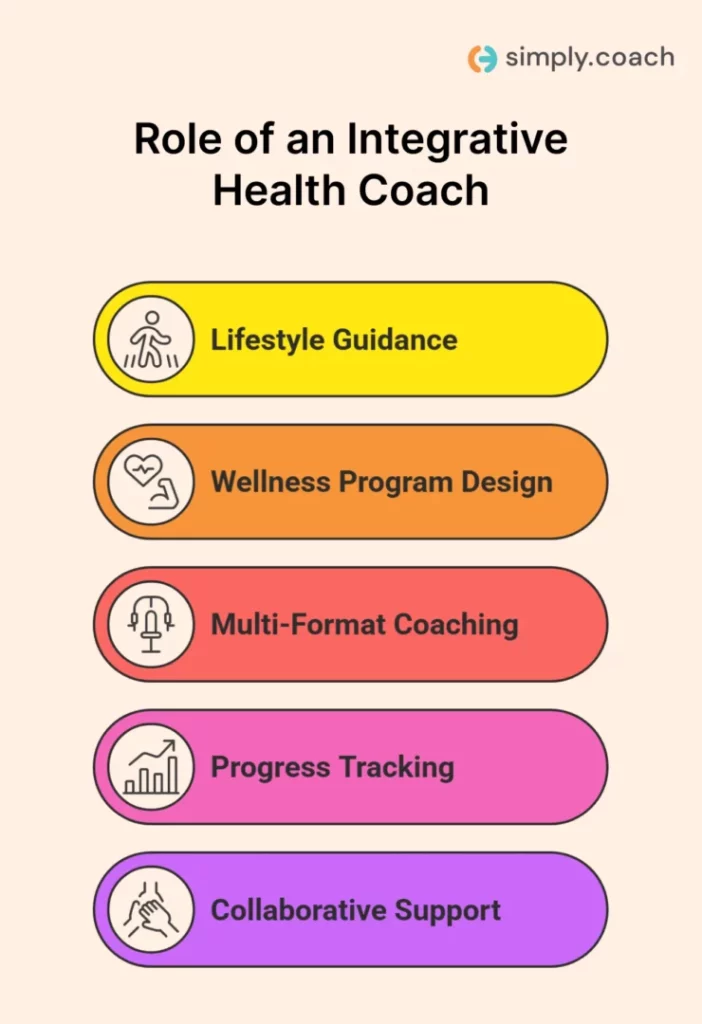
As an integrative health coach, you guide clients through structured lifestyle changes that improve overall health and daily functioning. Your role focuses on sustainable habits that create long-term results rather than short-term fixes.
You work across individual, group, and corporate settings, delivering personalized support based on each client’s goals and health conditions. Your approach combines behavior change, accountability, and practical implementation.
Below are the core responsibilities that define your role:
- Lifestyle and behavior change guidance: You help clients build consistent habits around sleep, nutrition, movement, and stress management. Your focus stays on realistic routines that clients can maintain long term.
- Personalized wellness program design: You create structured plans that align with each client’s health history, goals, and readiness for change. These programs often include weekly actions, milestones, and measurable outcomes.
- Multi-format coaching delivery: You conduct one-on-one sessions, group programs, and corporate wellness workshops based on your business model. This flexibility allows you to serve diverse client segments effectively.
- Progress tracking and accountability: You monitor client progress through habit tracking, check-ins, and outcome-based reviews. You adjust strategies when needed to ensure steady improvement and client commitment.
- Collaborative care support: You may work alongside dietitians, therapists, or medical professionals when clients need specialized support. This helps you deliver more comprehensive and coordinated health outcomes.
If you want a deeper breakdown of responsibilities, explore this detailed guide: What Do Health Coaches Do? Roles, Responsibilities & Career Opportunities
How Much Does an Integrative Health Coach Make in the USA?
If you want to build a predictable income as an integrative health coach, you need clear salary benchmarks. These numbers help you set pricing, evaluate opportunities, and plan your growth with confidence.
As per recent data, the average integrative health coach salary in the United States is $48,790 per year. This gives you a realistic baseline to compare roles, clients, and pricing strategies.
Average salary breakdown
Understanding how this translates across different time frames helps you assess your earning potential more accurately:
- Annual salary: $48,790
- Hourly rate: $23.46
- Monthly income: $4,065
- Weekly earnings: $938
These figures reflect typical earnings for employed roles and early-stage independent coaches across the country.
Salary range from entry-level to top earners
Your income can vary widely depending on experience, niche, and how you structure your services.
- Entry-level (lower range): $26,000 – $37,500
- Mid-level (average range): $37,500 – $57,500
- Top earners (upper range): Up to $66,000+
This wide range shows that your earning potential increases significantly as you gain experience and specialize.
Integrative health coach salary by percentile
Percentile data gives you a clearer picture of where most coaches fall and how you can progress:
- 10th percentile: ~$26,000
- 25th percentile: $37,500
- 50th percentile (median range): ~$48,790
- 75th percentile: $57,500
- 90th percentile: $66,000
This structure highlights a clear growth path, where moving into the top 25% can increase your income by $10,000 or more annually.
Income trends and career growth potential
The variation in salary, often exceeding $20,000, shows strong potential for income growth in this field. Your earnings depend heavily on how you position your services and build your expertise.
You can move beyond average salary ranges by shifting from fixed-pay roles to private coaching or program-based models. Coaches who package services, specialize in high-demand niches, or target premium clients often earn significantly more than standard benchmarks.
As demand for preventive and lifestyle-focused health support continues to rise, your opportunity to scale income also improves. The key lies in aligning your skills, pricing, and delivery model with higher-value client outcomes.
State-by-State Salary Overview for Integrative Health Coaches in the USA
Your earning potential as an integrative health coach depends heavily on the state where you work or acquire clients. Location affects your pricing power, client demand, and access to premium opportunities.
The table below presents state-wise annual salaries and hourly rates, arranged alphabetically for easier comparison.
| State | Annual salary | Hourly wage | State | Annual salary | Hourly wage |
| Alabama | $44,223 | $21.26 | Montana | $44,782 | $21.53 |
| Alaska | $52,544 | $25.26 | Nebraska | $46,519 | $22.36 |
| Arizona | $45,467 | $21.86 | Nevada | $49,683 | $23.89 |
| Arkansas | $40,345 | $19.40 | New Hampshire | $47,449 | $22.81 |
| California | $48,151 | $23.15 | New Jersey | $49,533 | $23.81 |
| Colorado | $51,304 | $24.67 | New Mexico | $47,281 | $22.73 |
| Connecticut | $46,413 | $22.31 | New York | $53,378 | $25.66 |
| Delaware | $48,832 | $23.48 | North Carolina | $44,340 | $21.32 |
| District of Columbia | $55,134 | $26.51 | North Dakota | $51,624 | $24.82 |
| Florida | $36,460 | $17.53 | Ohio | $46,385 | $22.30 |
| Georgia | $41,197 | $19.81 | Oklahoma | $45,050 | $21.66 |
| Hawaii | $50,691 | $24.37 | Oregon | $51,585 | $24.80 |
| Idaho | $45,906 | $22.07 | Pennsylvania | $48,907 | $23.51 |
| Illinois | $47,279 | $22.73 | Rhode Island | $47,781 | $22.97 |
| Indiana | $46,427 | $22.32 | South Carolina | $45,275 | $21.77 |
| Iowa | $45,827 | $22.03 | South Dakota | $48,790 | $23.46 |
| Kansas | $43,513 | $20.92 | Tennessee | $44,283 | $21.29 |
| Kentucky | $42,375 | $20.37 | Texas | $45,455 | $21.85 |
| Louisiana | $41,722 | $20.06 | Utah | $44,417 | $21.35 |
| Maine | $47,238 | $22.71 | Vermont | $51,876 | $24.94 |
| Maryland | $47,353 | $22.77 | Virginia | $48,372 | $23.26 |
| Massachusetts | $53,285 | $25.62 | Washington | $55,260 | $26.57 |
| Michigan | $42,525 | $20.44 | West Virginia | $37,772 | $18.16 |
| Minnesota | $47,786 | $22.97 | Wisconsin | $49,246 | $23.68 |
| Mississippi | $46,208 | $22.22 | Wyoming | $46,898 | $22.55 |
| Missouri | $45,765 | $22.00 |
Highest-paying states and what drives these salaries
States like Washington, District of Columbia, New York, and Massachusetts offer the highest salaries for integrative health coaches. These regions have higher living costs, stronger wellness markets, and greater demand for personalized health services.
You will also find more corporate wellness programs, private clinics, and high-income clients in these areas. This increases your ability to charge premium rates or secure better-paying roles.
Lower-paying states often have limited access to high-value clients and fewer structured wellness programs. This directly impacts how much you can earn or charge for your services.
How to use location to increase your income
You do not need to relocate to benefit from high-paying states if you structure your services strategically. Many coaches work remotely with clients based in higher-income regions.
You can position your services toward corporate clients or specialized niches in these states to increase your rates. This approach helps you move beyond local limitations and access better-paying opportunities.
If you want to scale your income, focus on targeting high-demand markets while building outcome-driven coaching programs. This combination allows you to maximize both reach and revenue.
Top 10 Highest-Paying Cities for Integrative Health Coaches
Targeting certain cities can significantly increase your earning potential as an Integrative Health Coach. Locations with high demand, premium clients, and limited competition often offer salaries well above the national average.
| City | Annual salary | Monthly pay | Weekly pay | Hourly wage |
| Barrow, AK | $60,781 | $5,065 | $1,168 | $29.22 |
| California City, CA | $59,838 | $4,986 | $1,150 | $28.77 |
| Berkeley, CA | $59,741 | $4,978 | $1,148 | $28.72 |
| Atqasuk, AK | $59,410 | $4,950 | $1,142 | $28.56 |
| Bedford, MA | $58,854 | $4,904 | $1,131 | $28.30 |
| Sitka, AK | $58,776 | $4,898 | $1,130 | $28.26 |
These cities show salaries 22–25% above the national average of $48,790, highlighting the financial advantage of targeting high-paying regions. Locations like Alaska see higher pay due to niche demand and fewer professionals, while California and Massachusetts benefit from high-income client segments and corporate wellness programs.
What Influences Integrative Health Coach Salaries
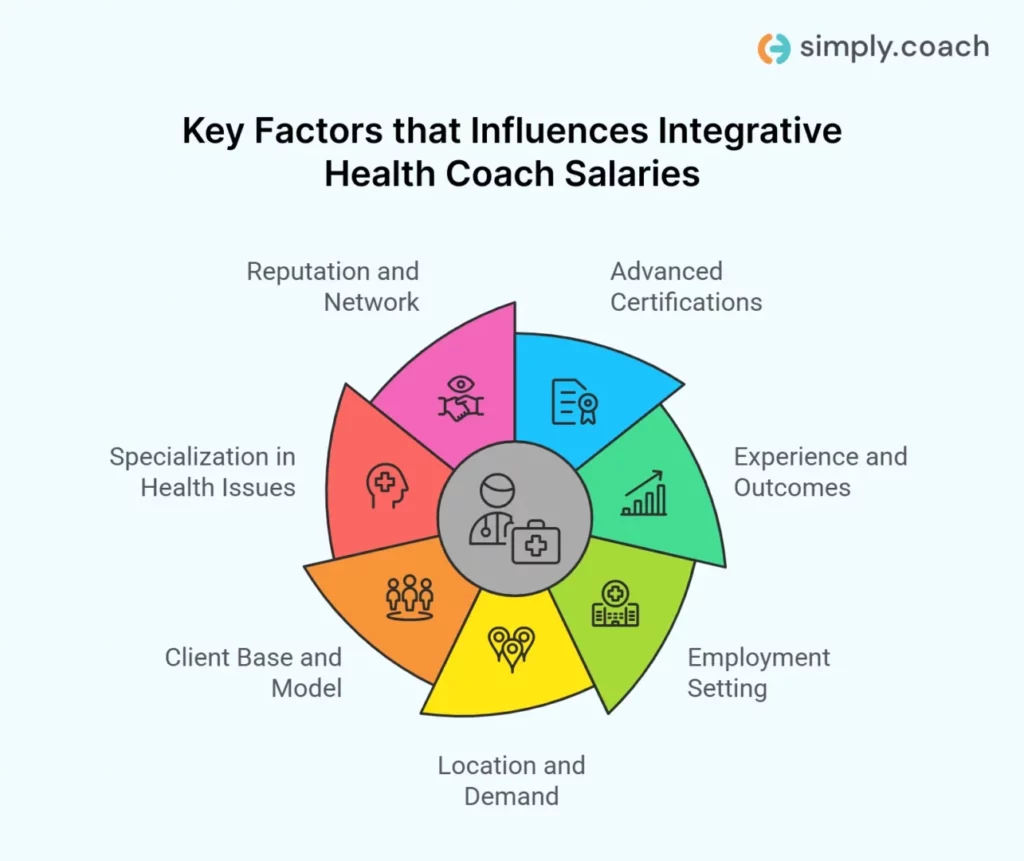
Several factors determine how much you can earn as an integrative health coach. Understanding these can help you target higher-paying opportunities and structure your services effectively.
- Advanced certifications and specialty training: Holding credentials like National Board for Health & Wellness Coaching (NBHWC) or certifications in functional nutrition, gut health, or chronic disease management can increase your rates by 15–25%. These qualifications demonstrate measurable expertise to high-paying clients.
- Years of experience and clinical outcomes: Coaches with 5+ years of client success in areas such as metabolic health, stress management, or autoimmune support often command higher fees. Proven results allow you to justify program pricing above average.
- Employment setting and client access: Private practice and boutique wellness clinics generally pay higher hourly rates than corporate wellness programs. Online coaching platforms with outcome-tracking tools allow scaling without geographic limitations, significantly increasing income.
- Geographic location and local demand: Urban centers like New York, Washington, D.C., and San Francisco offer higher salaries due to client wealth, competitive wellness markets, and corporate wellness contracts. Rural areas may require remote offerings to match income potential.
- Client base, program design, and business model: High-value clients, multi-week integrative programs, hybrid one-on-one plus group sessions, and subscription-based coaching increase lifetime client value. Coaches who package results-driven programs rather than hourly sessions earn consistently more.
- Specialization in high-demand health issues: Focusing on areas like metabolic syndrome, hormonal balance, or post-COVID recovery attracts clients willing to pay premium fees for measurable outcomes. Niche expertise often commands 20–30% higher rates than general health coaching.
- Reputation, testimonials, and referral network: Documented client outcomes, online reviews, and professional partnerships with dietitians or therapists can increase perceived value. Coaches with visible expertise often charge higher rates and secure corporate or high-net-worth clients.
By considering these factors, you can strategically plan your career path, focus on high-demand areas, and maximize your earning potential as an integrative health coach.
Strategies to Increase Your Integrative Health Coach Salary
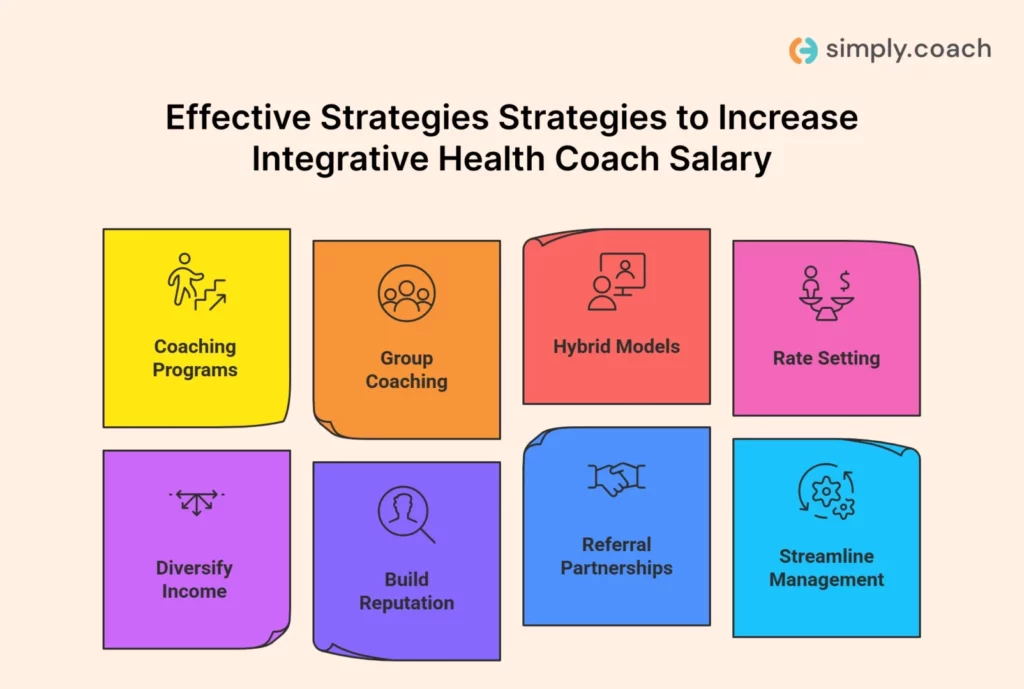
Boosting your income as an integrative health coach requires strategic planning, program design, and client management. The following actionable strategies can help you earn more while providing measurable value to clients.
1. Offer multi-week integrative coaching programs with measurable outcomes
Structured coaching programs allow clients to achieve tangible health improvements while increasing your revenue per client.
- Tier your offerings: Create foundational, intermediate, and premium programs with clearly defined outcomes.
- Focus on results: Align program milestones with specific goals like weight management, stress reduction, or hormonal balance.
- Include progress tracking: Offer weekly check-ins, assessments, and action plans to demonstrate client progress.
- Add value with resources: Provide guides, meal plans, and exercise routines to enhance perceived value.
How to Design & Launch Your Signature Coaching Program
For a step-by-step approach to designing and launching profitable programs, explore Simply.Coach’s “How to Design & Launch Your Signature Coaching Program” guide. It walks you through program positioning, transformation mapping, pricing tiers, and delivery methods, helping you convert structured programs into predictable revenue streams.

2. Run group coaching sessions or wellness workshops
Group coaching programs let you serve multiple clients simultaneously, improving efficiency and income.
- Small cohort sessions: Limit to 4–8 clients to maintain personalization while scaling.
- Specialized workshops: Run focused sessions on gut health, stress resilience, or integrative nutrition.
- Digital group options: Conduct virtual group programs to reach clients nationwide.
- Engagement activities: Include interactive exercises, Q&A sessions, and peer support to increase retention.
3. Create hybrid coaching models combining individual, group, and digital support
Hybrid models diversify service delivery while maintaining high client engagement.
- Mix one-on-one and group sessions: Offer personalized attention and peer learning simultaneously.
- Incorporate online resources: Provide access to instructional videos, worksheets, and progress dashboards.
- Offer ongoing support: Include email check-ins, maintenance sessions, or digital follow-ups.
- Flexible scheduling: Allow clients to choose formats that fit their lifestyle, increasing participation and satisfaction.
4. Set strategic rates based on expertise, outcomes, and market demand
Proper pricing ensures your work reflects your skills and client results.
- Evaluate your credentials: Use certifications, years of experience, and specialized training to justify higher rates.
- Analyze market trends: Research local and online demand to position rates competitively.
- Bundle services: Combine one-on-one coaching, group programs, and digital resources for higher per-client revenue.
- Adjust by niche: Premium pricing is possible for high-demand specialties such as autoimmune support or post-COVID recovery.
The Complete Guide: Pricing Strategies for Your Coaching Business.
For a complete framework on pricing your services for maximum income, check out Simply.Coach’s “The Complete Guide: Pricing Strategies for Your Coaching Business.” This guide helps you build pricing models that reflect your expertise, market demand, and client outcomes.

5. Diversify income streams with online courses, corporate wellness, and memberships
Multiple income sources stabilize earnings and expand client reach.
- Develop online courses: Create modules on nutrition, stress management, or lifestyle interventions.
- Offer corporate wellness programs: Partner with companies to provide workshops, coaching, or wellness plans.
- Membership subscriptions: Deliver recurring programs with monthly guidance, accountability, or specialized resources.
- Recurring revenue models: Use structured follow-ups, digital tools, or group memberships for predictable income.
6. Build reputation and niche expertise to command higher fees
Your professional credibility directly impacts your earning potential.
- Specialize in high-demand areas: Hormonal balance, post-COVID recovery, or autoimmune management.
- Showcase results: Use client testimonials, case studies, and measurable outcomes in marketing materials.
- Network strategically: Attend conferences, workshops, or online communities to gain recognition.
- Target premium clients: Focus on clients willing to invest in specialized, results-driven programs.
7. Expand your coaching practice through referral partnerships
Partnerships create steady client pipelines and increase program reach.
- Collaborate with allied professionals: Dietitians, therapists, gyms, or wellness centers.
- Offer bundled services: Joint programs that integrate multiple expert services at higher fees.
- Access corporate networks: Partner with organizations to deliver workplace wellness programs.
- Mutual referrals: Exchange clients with complementary professionals to grow your base without heavy marketing.
8. Streamline coaching management using Simply.Coach
Using a single platform like Simply.Coach helps you manage every aspect of your integrative coaching business efficiently, saving time and increasing revenue.
- Automate scheduling and payments: Handle appointments, recurring sessions, and billing seamlessly without manual tracking.
- Centralize client management: Store client profiles, session notes, and program progress in one secure location.
- Deliver multi-format programs: Run individual, group, hybrid, and digital coaching all through the same platform.
- Track outcomes and progress: Use built-in tools to monitor client goals, collect feedback, and adjust plans effectively.
- Scale your business effortlessly: Free from administrative tasks, you can take on more clients, launch new programs, and grow income.
An all-in-one platform like Simply.Coach positions you to focus on coaching results while your business operations run smoothly.
Also read: Health Coach Pricing and Hourly Rates: How Much to Charge
Conclusion
The integrative health coaching field offers strong earning potential, with the integrative health coach salary influenced by experience, location, and niche specialization. Understanding state and city pay differences helps you strategically target high-value opportunities. Implementing multi-week programs, group sessions, and hybrid models can significantly boost your income. Focused strategies and continuous skill development ensure long-term career growth and client impact.
Ready to grow your coaching practice efficiently? Simply.Coach provides an all-in-one coaching platform to manage clients, deliver structured programs, and track results. Automate scheduling, payments, and program delivery while expanding your reach with multi-week and group coaching options. Use actionable guides to design signature programs and set strategic pricing. Position your practice for growth while maximizing both income and client outcomes.
FAQs
1. Does an integrative health coach need a degree to earn a higher salary?
No. While a degree isn’t always required, employers and clients often pay more for formal health‑related education alongside credible coaching certification to justify premium pricing.
2. Can integrative health coaches earn more with private practice compared to employment?
Yes. Running your own private practice often allows you to set higher rates and retain full revenue per client, compared with average hourly pay as an employee.
3. How does remote coaching affect salary potential?
Remote coaching lets you work with clients across high‑paying regions, often enabling you to charge higher rates than your local market alone would allow.
4. Are there benefits to working for corporate wellness programs?
Corporate wellness roles often offer steady pay, benefits, and structured hours, though hourly rates may be lower than private or niche specialty work.
5. Does niche specialization increase demand and earning potential?
Yes. Coaches specializing in areas like chronic disease support, hormonal health, or metabolic optimization generally attract clients willing to pay for expert outcomes.
6. Do client outcomes influence salary or pricing?
Absolutely. Coaches who can demonstrate measurable results often justify higher rates, retain clients longer, and attract referrals that boost long‑term earnings.
7. Is certification from a recognized board linked to higher pay?
Yes. Board‑certified credentials (e.g., NBC‑HWC or advanced specialty certifications) can help you negotiate higher fees and secure better‑paying clients or contracts.