
Ever noticed how the same conflict keeps resurfacing across sessions, between partners, within families, or inside a client’s own internal dialogue? Unresolved conflict is rarely just a single incident; it’s often the hidden force slowing emotional progress and exhausting session time. Conflict resolution therapy helps move those stuck conversations forward before they derail the therapeutic process.
During sessions, you have to manage competing demands, track emotional triggers, document insights, and guide clients toward meaningful breakthroughs. Without a structured approach, conflicts can spiral into repetitive narratives rather than therapeutic progress. Conflict resolution therapy offers a practical framework to identify underlying needs, reframe communication patterns, and turn high-tension moments into productive clinical work.
In this article, you’ll explore practical techniques you can use to guide your clients through conflict constructively. We’ll break down actionable strategies and structured approaches that help you reduce session friction, strengthen client engagement, and create measurable progress in your practice.
Key Takeaways
- Techniques like active listening, NVC, and interest-based negotiation turn tense client interactions into measurable progress.
- Integrating conflict resolution therapy with automated reminders, pre-session forms, and goal tracking reduces admin load while maintaining session quality.
- Resolving interpersonal tension effectively reduces no-shows, increases program adherence, and strengthens long-term client relationships.
- Frameworks like mediated dialogue and interest mapping allow you to manage multi-stakeholder conflicts efficiently.
- Simply.Coach helps you scale conflict resolution therapy by using goal & development planning, action plans, nudges, and client workspaces to track progress and engagement.
Development of Conflict Resolution Therapy
Conflict resolution therapy has its roots in the mid-20th century, when psychologists noticed recurring patterns of unresolved interpersonal tension affecting personal and professional outcomes. Early pioneers like Morton Deutsch emphasized understanding interests, not positions, to turn disputes into cooperative solutions.
By the 1980s and 1990s, research integrated behavioral science and organizational studies, making conflict resolution therapy applicable beyond families or couples. Modern tools now automate reminders, facilitate payments, and track progress, letting you focus on insight and action rather than administrative chaos.
As Dr. Marshall Rosenberg noted, “To practice the process of conflict resolution, we must completely abandon the goal of getting people to do what we want,” a principle you can apply directly with your clients at therapy sessions.
Understanding its emergence helps you recognize why these specific techniques consistently drive results in high-stakes therapy scenarios.
How can Conflict Resolution Therapy Help?
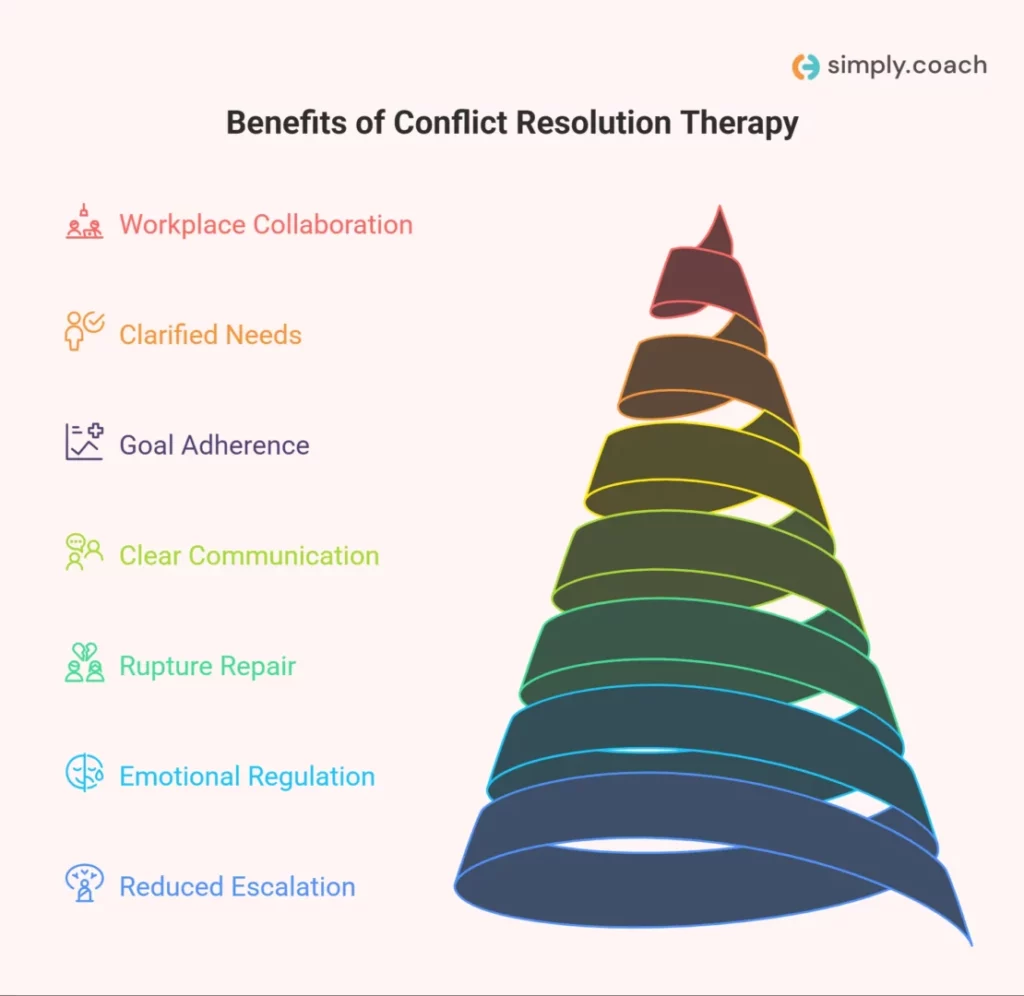
Conflict resolution therapy doesn’t just smooth over disagreements; it changes how clients approach challenges. Let’s explore exactly how these techniques deliver tangible benefits for high-performing therapy practices.
1. Reduces escalation and emotional flooding
Conflict resolution techniques help clients recognize early escalation signals, raised tones, defensive language, or emotional flooding, and pause before reactions intensify. You can guide clients through structured dialogue and emotional labeling so discussions remain regulated rather than spiraling into confrontation. This is especially valuable in couples therapy, where arguments can quickly derail sessions.
2. Strengthens emotional regulation skills
Clients learn to identify triggers, regulate physiological responses, and articulate feelings before reacting impulsively. Techniques such as reflective listening and affect labeling help your clients slow down emotionally charged exchanges. Over time, this builds sustainable emotional regulation, particularly for clients prone to reactive conflict patterns or unresolved relational trauma.
3. Improves rupture repair in therapeutic relationships
Conflict resolution therapy also supports you in repairing therapeutic ruptures, moments when your clients feel misunderstood, criticized, or disengaged. By modeling transparency, validation, and collaborative problem-solving, you strengthen trust and maintain the therapeutic alliance, which research consistently links to better treatment outcomes.
4. Creates clearer communication patterns between clients
Structured interventions, such as reframing statements, separating intent from impact, and identifying unmet needs, help your clients replace accusatory language with collaborative dialogue. This shift is particularly impactful in couples and family therapy settings, where entrenched communication cycles often drive conflict.
5. Supports adherence to therapeutic goals
When underlying conflicts are addressed directly, clients are more likely to stay engaged with therapeutic goals. Instead of repeatedly revisiting the same unresolved tension, sessions can move toward actionable change, whether that means rebuilding trust, setting boundaries, or practicing healthier communication habits.
6. Clarifies underlying needs and motivations
Conflict often masks deeper unmet needs, recognition, autonomy, emotional safety, or fairness. Conflict resolution therapy helps you guide your clients beyond surface arguments to these underlying drivers. This approach is particularly effective in individual therapy, where interpersonal conflicts may reflect internalized beliefs or unresolved past experiences.
7. Improves collaboration in the workplace or organizational coaching
For clients dealing with workplace conflict, the therapy framework helps clarify role expectations, decision authority, and communication boundaries. You can guide your clients through perspective-taking and interest-based dialogue, reducing defensiveness and enabling more constructive professional interactions.
Once you know the tools, it’s easy to see how they directly translate into measurable client breakthroughs and KPI improvements.
Also read: How to Set Goals that Help Clients Achieve Progress in Therapy
6 Primary Techniques of Conflict Resolution Therapy
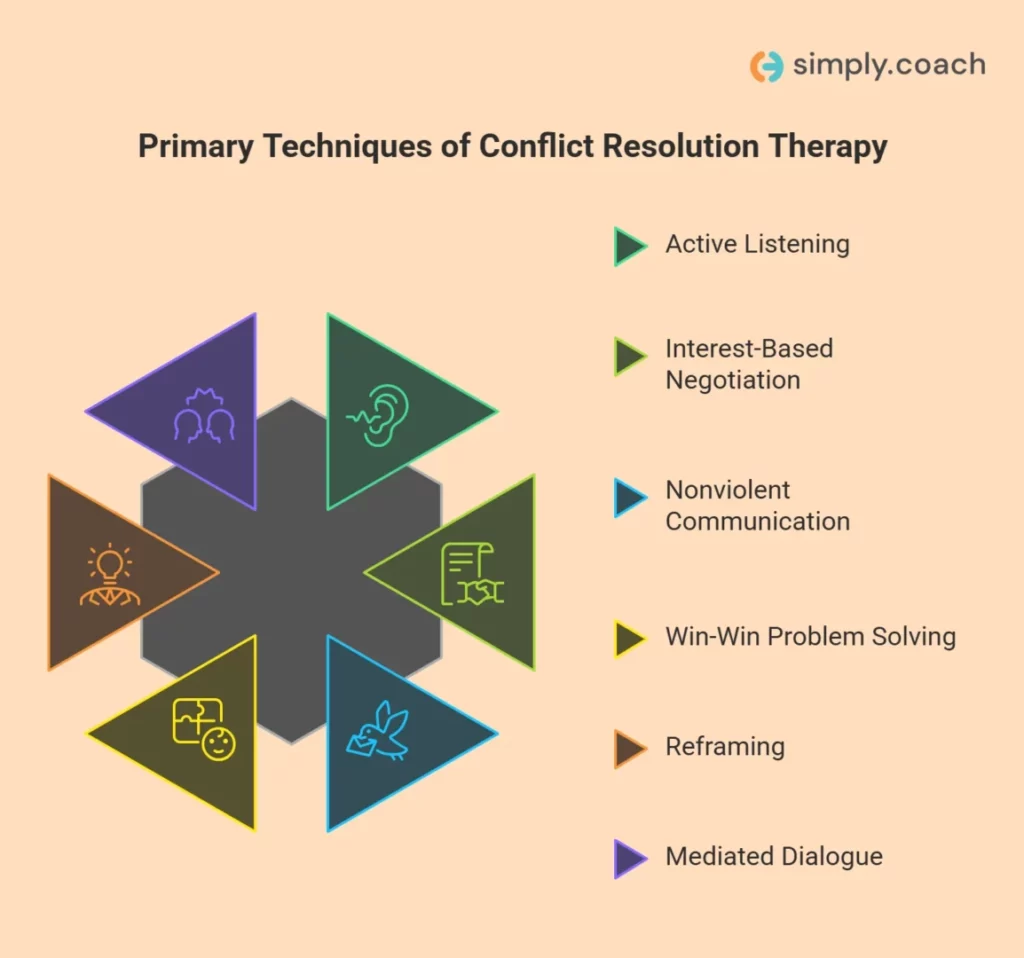
In conflict resolution therapy, you should use specific, research‑backed techniques that move clients from discord to clarity fast. The following techniques prioritize de‑escalation, understanding of underlying needs, and co‑created solutions that improve client outcomes and session efficiency.
1) Active listening & reflective presence
Active listening in conflict resolution therapy involves intentionally reflecting both the content and emotional meaning of what a client expresses. Rather than immediately analyzing or offering solutions, you should mirror language, summarize concerns, and validate emotional experiences. This approach slows the conversation, reduces defensiveness, and helps clients feel psychologically safe enough to explore the real drivers behind the conflict.
When you can use it:
- During early de-escalation phases, when emotional intensity is rising.
- In couples therapy sessions where arguments escalate quickly.
- In family therapy settings, where multiple members speak over each other or interrupt.
- In individual therapy, when clients are processing relational resentment, anger, or betrayal.
When it may not be appropriate:
- When there is coercion, intimidation, or abuse dynamics present in the relationship.
- When a client is experiencing severe emotional dysregulation or trauma activation.
- When reflective listening unintentionally reinforces distorted narratives or blame cycles.
- When the session requires clear boundaries or safety-focused interventions rather than dialogue.
What it looks like in-session:
Instead of offering interpretation or advice immediately, you might say:
- “What I’m hearing is that when the decision was made without your input, it felt like your perspective didn’t matter.”
- “It sounds like there’s frustration underneath the anger, almost a sense of being overlooked.”
Common mistakes:
- Repeating the client’s words verbatim without capturing emotional meaning can feel mechanical.
- Moving into problem-solving before clients feel heard often escalates defensiveness.
- Validation should acknowledge emotions without endorsing blame, manipulation, or aggression.
2) Interest‑based negotiation & principled engagement
Interest-based negotiation shifts the conversation away from rigid positions (“I want this outcome”) toward the underlying needs, motivations, and concerns driving the conflict. You should guide your clients to identify what actually matters beneath the argument: autonomy, recognition, fairness, security, or emotional validation. Once those interests are clarified, clients can collaborate on solutions that address shared concerns rather than defending fixed positions.
When you can use it:
- When couples or families are stuck in repetitive arguments over the same issue.
- When both parties want a resolution but are locked into opposing positions.
- In the workplace or organizational coaching where role expectations or resource decisions cause friction.
- After emotional intensity has stabilized and clients are ready for collaborative problem-solving.
When it may not be suitable:
- When there is a significant power imbalance or coercion between parties.
- When one participant is not negotiating in good faith or refuses to acknowledge shared interests.
- When emotional regulation has not yet been restored and clients remain in escalation mode.
- When conflicts involve non-negotiable safety or ethical boundaries.
What it looks like in-session:
Instead of debating positions like “You never help with household decisions” or “You’re controlling finances,” as the therapist, you redirect the conversation toward underlying interests:
- “It sounds like one of you is looking for financial stability, while the other needs more autonomy in spending decisions. Let’s explore how both needs could exist in the same system.”
- “If the goal is to feel respected in decision-making, what would that look like in everyday situations?”
Common mistakes:
- Addressing positions without exploring underlying needs.
- Pushing solutions before interests are clear.
- Treating unequal relationships as equal negotiations.
- Making the conversation feel like a formal mediation rather than therapy.
3) Nonviolent communication (NVC) framework
The Nonviolent Communication (NVC) framework helps clients express observations, feelings, needs, and requests without blame, criticism, or judgment. You can use NVC to help your clients translate reactive statements into clearer emotional communication in conflict resolution therapy. By separating facts from interpretations and focusing on unmet needs, the framework reduces defensiveness and supports constructive dialogue.
When you can use it:
- When clients frequently use blame-based or accusatory language during conflicts.
- In couples therapy, where emotional misunderstandings escalate arguments.
- When clients struggle to identify or articulate underlying emotional needs.
- During communication skills training in relationship or workplace coaching.
When it may not be suitable:
- When clients are experiencing severe emotional flooding or dysregulation.
- When the conflict involves abuse, intimidation, or coercive control.
- When a participant uses structured communication tools manipulatively or performatively.
- When clients require initial emotional validation before structured dialogue.
What it looks like in-session:
Instead of a reactive statement like:
“You never listen to me, and you always make decisions without asking.”
You may guide the client to reframe using the NVC structure:
- Observation: “When decisions about the budget are made without discussing them first…”
- Feeling: “…I feel frustrated and overlooked.”
- Need: “…because I need to feel included in decisions that affect both of us.”
- Request: “…could we agree to review major expenses together before committing?”
Common mistakes:
- Teaching the NVC formula too rigidly can make client conversations sound scripted and inauthentic.
- Correcting clients too quickly can interrupt emotional expression before the underlying feeling is fully explored.
- Using NVC before emotional de-escalation can lead to resistance or disengagement.
- Over-coaching language can make the session feel like a communication drill rather than a therapeutic conversation.
4) Win‑win strategy (structured problem‑solving)
The win-win strategy, often referred to as a structured problem-solving approach, guides conflicting parties through a stepwise process where each person expresses concerns, explores underlying needs, and collaboratively designs solutions. In the context of conflict resolution therapy, you should facilitate this process to ensure both perspectives are acknowledged while identifying shared priorities that can support mutually acceptable outcomes.
When you can use it:
- When clients are ready to move from emotional processing to practical resolution.
- In couples or family therapy, where recurring logistical disputes need structured agreements.
- During workplace or executive coaching conflicts involving responsibilities, expectations, or decision authority.
- After the underlying emotions and interests have been clarified and clients can collaborate constructively.
When it may not be suitable:
- When conflict participants are still emotionally escalated or unwilling to listen.
- When the issue involves non-negotiable ethical or safety concerns.
- When one party holds disproportionate power or influence over the outcome.
- When deeper relational issues require emotional processing before solution design.
What it looks like in-session:
Instead of debating accusations such as “You never help with planning” or “You always criticize my decisions,” you structure the conversation around shared outcomes:
- Each person states their primary concern and the impact of the issue.
- You identify overlapping goals, such as fairness, efficiency, or shared responsibility.
- Clients brainstorm multiple potential solutions before choosing one that addresses both perspectives.
Common mistakes:
- Moving into solution design before emotional concerns are acknowledged.
- Framing the process like a formal negotiation rather than therapy.
- Allowing one client to dominate the solution-building stage.
- Pushing for compromise before shared goals are clearly defined.
5) Reframing & perspective shift
Reframing involves helping clients reinterpret a situation, behavior, or interaction from a different perspective to reduce emotional intensity and uncover alternative responses. In conflict resolution therapy, can you guide your clients to move from reactive interpretations (“They’re trying to control me”) toward broader, curiosity-driven perspectives (“What concern might they be protecting?”). This shift often helps clients disengage from rigid narratives and consider more constructive responses.
When you can use it:
- When clients are stuck in rigid or negative interpretations of another person’s behavior.
- In couples or family therapy, where assumptions about intent drive repeated arguments.
- When clients show cognitive distortions such as personalization or catastrophizing.
- After emotional expression has stabilized and clients can reflect on alternative perspectives.
When it may not be suitable:
- When clients are processing fresh emotional hurt or betrayal, that first requires validation.
- When it risks downplaying genuine harm, safety concerns, or violations of boundaries.
- When trauma-related experiences require careful processing before reinterpretation.
- When clients perceive reframing as invalidating their emotional experience.
What it looks like in-session:
A client might say:
“They ignored my suggestion in the meeting because they don’t respect my expertise.”
You may explore alternative interpretations through reflective questioning:
- “What other factors might have influenced that response in the meeting?”
- “Could there be a different priority or pressure affecting their decision?”
- “If their goal was efficiency rather than dismissal, how might that change your response?”
Common mistakes:
- Reframing too quickly before validating emotions.
- Offering interpretations instead of guiding the client to discover them.
- Using reframing in ways that minimize real conflict or harm.
- Over-intellectualizing the situation instead of acknowledging emotional impact.
6) Mediated dialogue & third‑party facilitation
Mediated dialogue involves a neutral facilitator, often you, guiding conflicting parties through structured communication to clarify concerns, balance participation, and build shared understanding. In conflict resolution therapy, you should manage the pacing, ensuring each participant is heard, and help translate emotionally charged statements into constructive dialogue.
When you can use it:
- When direct conversations between clients consistently escalate or shut down.
- In couples or family therapy, where one partner dominates or withdraws from discussion.
- During workplace or executive coaching, conflicts involving multiple stakeholders.
- When you need to structure dialogue to ensure equal participation.
When it may not be suitable:
- When conflicts involve abuse, intimidation, or coercive dynamics.
- When participants are unwilling to follow basic communication boundaries.
- When clients are too emotionally dysregulated to engage constructively.
- When individual processing is needed before bringing parties into joint dialogue.
What it looks like in-session:
Instead of allowing an unstructured argument, you moderate the exchange by creating clear speaking turns and reflective summaries:
- One participant explains their concern while the other listens without interruption.
- You summarize the key concern to confirm accuracy.
- The second participant reflects what they heard before responding with their perspective.
Common mistakes:
- Allowing one participant to dominate the conversation.
- Intervening too late during escalating exchanges.
- Over-controlling the dialogue so clients speak to you instead of each other.
- Moving to solutions before concerns are fully clarified.
Mastering these techniques provides a foundation for structured, hands-on training programs that drive measurable client outcomes.
Training for Conflict Resolution Therapy: 6 Key Considerations
Conflict resolution therapy is a structured methodology that equips you to resolve client tension efficiently, improve session flow, and scale delivery without quality loss. Proper training ensures you can handle complex interpersonal dynamics, high-stakes executive disagreements, or emotionally charged relationship conflicts with precision.
1. Foundational Theory & Applied Psychology
Training explores social-emotional triggers, cognitive biases, and systemic dynamics that drive client conflict. You learn to decode client behavioral patterns, anticipate escalation signals, and map these insights to client goals, team performance, or relationship alignment.
2. Technique Mastery Workshops
Workshops focus on active listening with reflective mirroring, interest-based negotiation, NVC, and cognitive reframing tailored for executive and group clients. You practice session scripting, layered questioning, and real-time conflict de-escalation, ensuring techniques integrate seamlessly into high-value client programs without appearing contrived.
3. Role-Play & Simulation Practice
Scenarios simulate multi-party boardroom conflicts, cross-functional team tensions, or high-stakes couple therapy sessions. You practice structured interventions, facilitation of difficult dialogues, and mediated problem-solving, receiving targeted feedback on pacing, language framing, and session flow to maximize client insight and engagement.
4. Technology-Enhanced Session Management
Training includes integrating goal-tracking technology dashboards, automated session reminders, pre-session reflection forms, and video conferencing check-ins. You learn to optimize session adherence, progress visibility, and multi-client scaling while focusing on intervention quality rather than administrative burden.
5. Certification & Evidence-Based Evaluation
Certification programs validate competency in mediation frameworks, facilitated dialogue techniques, and behavioral observation skills. You demonstrate mastery via case-based analysis, simulated executive sessions, and outcome-driven evaluations, assuring clients and organizations of high-quality impact.
6. Continuous Professional Development (CPD)
Ongoing modules keep you updated on emerging mediation models, advanced negotiation strategies, and session analytics tools. Regular practice ensures scaling of multi-client programs, consistent delivery of conflict resolution frameworks, and maintenance of session fidelity, even in high-pressure or complex therapy environments.
Also read: Types of Therapeutic Interventions for Mental Health Progress
Even the most effective approaches have pitfalls; recognizing them ensures you can maintain session quality and client engagement.
5 Constraints and Risks of Conflict Resolution Therapy
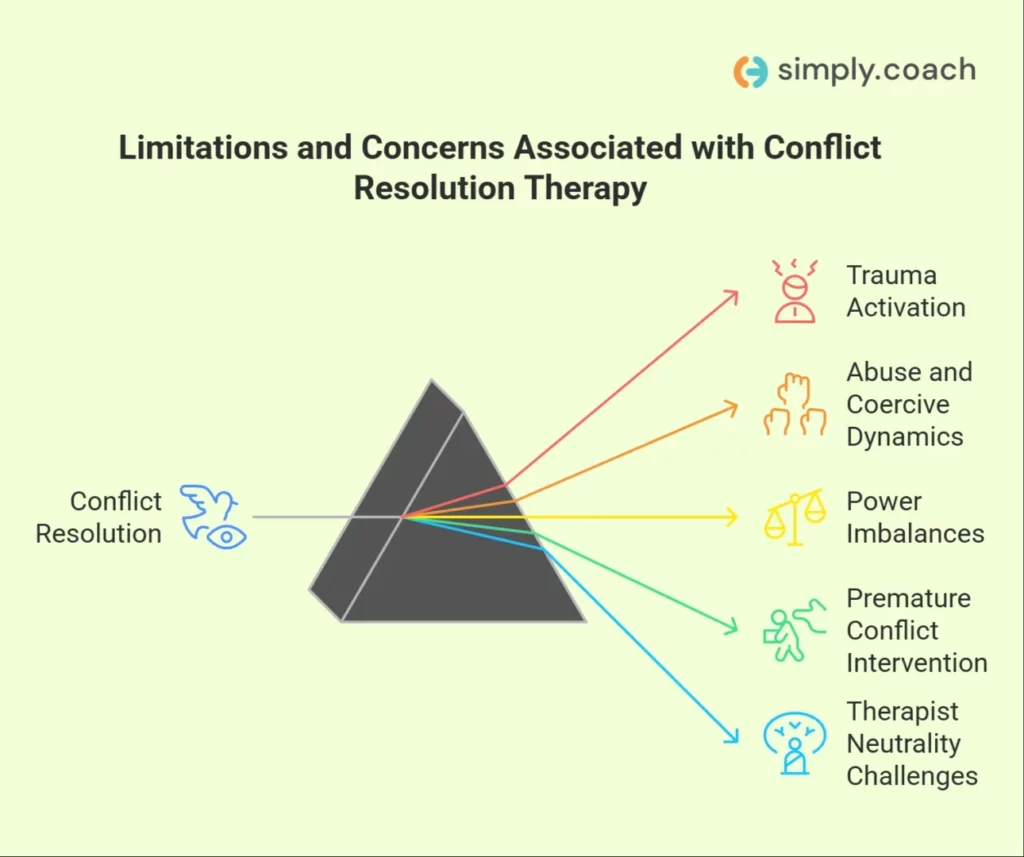
Even the most structured conflict resolution therapy has challenges. You must understand potential limitations to prevent session breakdowns, client disengagement, or reduced ROI.
1. Trauma activation can escalate conflict
Clients with trauma histories may experience intense emotional activation when discussing relational conflict. Direct confrontation or joint dialogue can trigger fight-or-flight responses, emotional flooding, or dissociation, making productive engagement difficult. In these cases, conflict discussions may unintentionally reinforce distress rather than facilitate resolution.
Solution: Prioritize trauma-informed stabilization before initiating direct conflict work. You may need to use grounding techniques, emotional regulation skills, or individual processing sessions before bringing parties together for structured dialogue.
2. Conflict resolution therapy is not appropriate in abusive or coercive dynamics
In relationships involving coercive control, intimidation, or psychological abuse, encouraging open negotiation can unintentionally place the vulnerable client at greater risk. Power imbalances may pressure clients to compromise in ways that reinforce unhealthy dynamics.
Solution: When safety concerns are present, you should focus on individual support, boundary development, and safety planning rather than collaborative negotiation frameworks.
3. Power imbalances can distort collaborative dialogue
Even in non-abusive relationships, unequal power, such as differences in authority, communication dominance, financial control, or emotional influence, can undermine fair dialogue. One participant may dominate the conversation or steer outcomes toward their own interests.
Solution: Use structured facilitation methods that regulate speaking turns and ensure balanced participation. You may also conduct individual preparatory sessions to clarify concerns and strengthen each participant’s ability to communicate their needs safely.
4. Premature joint conflict work can backfire
Introducing structured negotiation or mediated dialogue too early in the therapeutic process can intensify defensiveness. Clients who have not yet developed emotional regulation or communication skills may revert to blame, criticism, or withdrawal during conflict discussions.
Solution: Build foundational skills first, such as emotional regulation, reflective listening, and needs identification, before facilitating direct conflict resolution. Gradual preparation helps clients approach difficult conversations with greater stability and awareness.
5. Therapist neutrality can be difficult to maintain
In emotionally charged disputes, you may unintentionally appear to side with one participant through subtle cues such as validation patterns, questioning style, or time allocation. Even perceived bias can weaken trust and disrupt therapeutic progress.
Solution: Maintain explicit neutrality through structured facilitation, balanced reflection, and transparent session guidelines. You should also engage in supervision or consultation when working with complex relational conflicts to ensure balanced clinical judgment.
Also read: How to Create Effective Therapy Schedule Templates
Before applying conflict resolution therapy, you can carefully evaluate whether the clients, context, and therapeutic stage are ready for structured conflict work.
What You Should Evaluate Before Starting Conflict Work
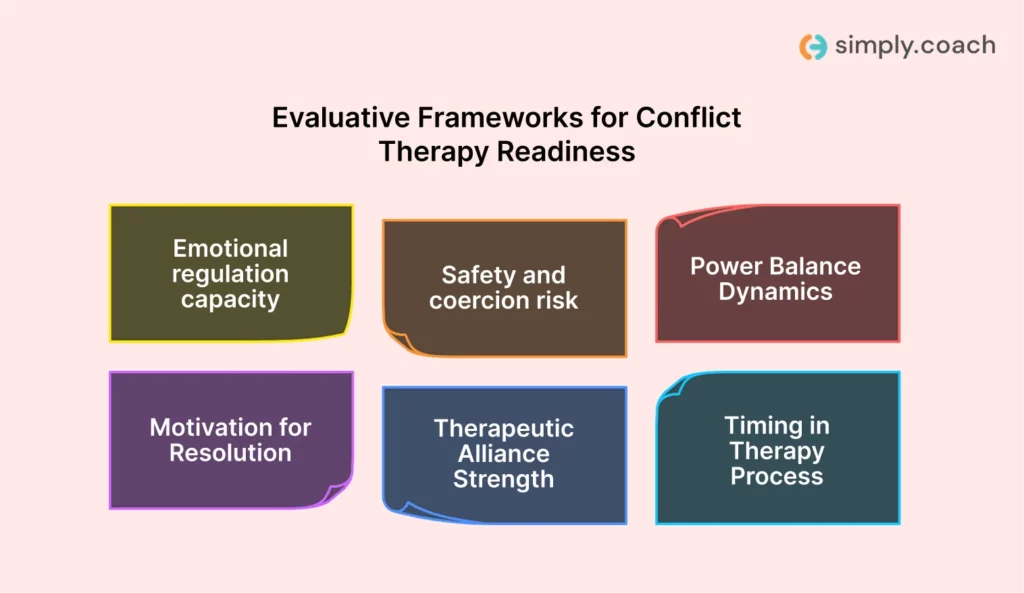
Before initiating conflict resolution therapy, you should assess several clinical readiness factors to determine whether conflict work will be productive, premature, or potentially harmful. These evaluations help ensure that therapy addresses conflict safely, ethically, and in a way that supports genuine progress rather than escalation.
1. Emotional regulation capacity
You first assess whether your clients can remain emotionally present during difficult conversations without becoming overwhelmed or reactive. If a client quickly escalates into anger, shuts down, or becomes emotionally flooded, direct conflict discussions may deteriorate into an argument rather than a productive dialogue.
2. Safety and coercion risk
One of the most critical evaluations involves determining whether the relationship dynamic contains abuse, intimidation, or coercive control. Conflict resolution therapy assumes that participants can negotiate openly and safely, which may not be possible when power is exercised through fear, manipulation, or pressure.
3. Power balance within the relationship
Even when abuse is not present, subtle power imbalances can influence the outcome of conflict discussions. Differences in communication style, financial authority, organizational status, or emotional dominance may allow one participant to shape decisions disproportionately.
4. Client motivation and readiness for resolution
Conflict work is most effective when clients are genuinely motivated to understand each other and find workable solutions. If one or both parties remain focused solely on proving the other person wrong, conflict discussions may reinforce adversarial dynamics.
5. The therapeutic alliance with each participant
You must also consider whether you have established sufficient trust and rapport with all involved clients. When participants feel misunderstood or unsupported by you, mediated conflict conversations may intensify defensiveness rather than promote openness.
6. Timing within the therapeutic process
Finally, as an experienced therapist, you consider whether the timing of conflict work aligns with the stage of therapy. Addressing conflict too early, before emotional insight, trust, or communication skills have developed, can lead to repetitive arguments rather than constructive change.
Also read: Effective Strategies to Grow Your Therapy Practice in 2026
However, with the right technology, you can overcome these challenges and scale your conflict resolution programs without sacrificing impact.
Make Every Conflict Resolution Therapy Session Actionable Using Simply.Coach
If you’re working with couples or running multi-client programs, conflict resolution therapy can deliver significant outcomes, but only if sessions are structured and clients stay accountable.
Too often, you lose time to scattered notes, missed progress tracking, and inconsistent follow-ups, which impact client retention, session effectiveness, and measurable KPIs like behavioral change or team alignment. Simply.Coach bridges that gap.
Here’s how it impacts your practice:
- Goal & development planning: For an executive therapy program, set SMART goals like “reduce team conflict escalation by 30% in 6 weeks.” Track client compliance with automated progress check-ins, ensuring interventions are measurable and clients stay accountable.
- Action plans & nudges: Assign actions such as “practice reflective listening in team meetings” or “journal triggers daily,” and reinforce them with automated nudges. Track adherence rates and behavioral improvements between sessions, boosting KPI metrics like emotional self-regulation and follow-through.
- Client workspaces: Give your clients a dedicated space to log insights, complete exercises, and reflect on recurring conflict patterns. For example, a leadership client can see patterns in decision-making conflicts, increasing engagement scores and session participation.
- Forms: Digitize pre-session assessments, emotional readiness forms, and conflict triggers surveys. Automated collection ensures every session starts data-informed, making it easier to quantify client improvement and align interventions with KPIs like reduction in escalations or improved interpersonal ratings.
- Scheduling & embedded video conferencing: Run multi-stakeholder executive sessions or remote couple/relationship sessions seamlessly, with time zone-adjusted self-booking and integrated Zoom/Teams. Reduce no-shows, save hours in administrative work, and improve session completion rates, directly impacting your client retention KPIs.
- Reports & stakeholder integration: Generate detailed behavioral change reports for team or executive clients, integrating manager, peer, or family feedback. Demonstrate measurable ROI, like improved collaboration scores or reduced conflict incidents, proving the impact of your conflict resolution therapy.
Through a HIPAA-compliant therapy practice management software, Simply.Coach helps you maintain session fidelity and scale multi-client conflict resolution programs without losing quality. Track engagement, adherence, and behavioral KPIs, all while focusing on your clients’ breakthroughs instead of spreadsheets or admin chaos.
Also read: Top 18 Apps for Therapists to Use With Clients in 2026
Conclusion
Conflict resolution therapy is the playbook for turning tense sessions into breakthroughs. From active listening that decodes hidden client motivations to reframing and mediated dialogue that unearths solutions no one saw coming, this article has unpacked how structured conflict strategies turn chaos into clarity. If you’re an executive, team, or relationship therapist, you can harness these methods to guide your clients past stuck points, align objectives, and actually see evident progress.
Integrating structured frameworks with smart workflow systems, like automated check-ins, pre-session forms, and goal-tracking dashboards, reduces administrative headaches, eliminates no-shows, and keeps every session sharply focused.
With Simply.Coach, you can use goal & development planning to set SMART goals, assign actionable steps, and automate progress check-ins, ensuring every client stays on track between sessions. Combine this with client workspaces for collaborative goal tracking, so conflict resolution strategies translate into real, sustained progress.
FAQs
1. Can conflict resolution therapy be integrated with other therapeutic models?
Definitely. Many practitioners blend it with solution‑focused strategies, narrative reframing, or cognitive‑behavioral approaches to enhance insight, foresight, and practical client action planning.
2. Who can benefit most from conflict resolution therapy?
Anyone facing recurring interpersonal tension, like executive teams, couples, family members, or workplace groups, can benefit. It’s especially effective for clients who struggle with emotional regulation, repeated patterns, or avoidance of difficult conversations.
3. What are the common conflict styles I should know as a therapist?
Clients often show up with predictable patterns like avoidance, accommodation, fighting, or freezing under stress. Identifying these helps you tailor interventions to reduce reactivity and improve collaborative behaviors in sessions.
4. How long does conflict resolution therapy usually take to show results?
There’s no fixed timeline; simple pattern shifts can occur in a few sessions, while deeper relational patterns often take longer. Progress depends on client engagement, frequency of sessions, and the complexity of conflicts at hand.
6. What techniques are commonly used in conflict resolution therapy?
You can use methods like active listening, reflective mirroring, nonviolent communication (NVC), reframing, and interest‑based negotiation to guide your clients toward understanding and resolution.
7. What if one party won’t participate in the conflict resolution process?
This is common. You can start with individual sessions to build readiness and then invite participation by demonstrating the value of structured dialogue and emotional safety principles.
8. Do clients ever resist conflict resolution therapy? Why?
Yes, clients often fear vulnerability or worry about escalation. You can mitigate this by building safety, normalizing emotional responses, and using gradual exposure techniques rather than pushing your clients too quickly.