
As a coach, your main goal is to help clients set and achieve their objectives. But before commencing, it’s crucial to establish a clear framework for your coaching relationship, and that’s where a written coaching contract comes in. A legal coaching contract outlines the terms and sets the boundaries between you and your client. It typically includes goals, session details, confidentiality clauses, fees, and the responsibilities of both parties.
This contract helps ensure that everyone is on the same page, clarifies expectations, establishes parameters, and creates a productive coaching environment. While coaching contracts vary by niche, such as life coaching versus executive coaching, it’s essential to customize the agreement to fit your services.
Let’s look into the importance of coaching contracts, their key aspects, and how to effectively use templates.
Key Takeaways
- A well-structured coaching contract clearly defines both coach and client responsibilities, reducing confusion during the engagement.
- Including payment terms, cancellation policies, and liability clauses safeguards coaches from disputes or non-payment issues.
- Explicit confidentiality clauses build client confidence and align with professional standards like ICF guidelines.
- Defining measurable goals, outcomes, and progress checkpoints keeps clients accountable and ensures the coaching process delivers tangible results.
- A detailed coaching agreement serves as a go-to guide for handling scheduling, disputes, or scope questions, keeping the coaching relationship professional and smooth.
What Is a Coaching Contract?
A coaching contract is a formal agreement that defines how the coaching relationship will operate. It outlines the scope of the engagement, expectations from both parties, the structure of the program, payment terms, and the professional boundaries that guide the work.
For experienced coaches, the contract does more than protect both parties legally, it establishes a clear operational framework for the coaching engagement. It ensures that clients understand the structure of the program, how sessions will run, and what outcomes the coaching process is designed to support.
Most professional coaches follow a standardized format similar to an example coaching contract used across the industry. These agreements typically document the program structure, responsibilities, confidentiality expectations, and dispute procedures so that both coach and client begin the engagement with aligned expectations.
Before going further, it’s important to understand why these contracts are essential for structured client engagement.
Why Do You Need a Coaching Contract?
A clear coaching agreement is one of the most important tools for maintaining professional coaching relationships. It reduces ambiguity, protects both parties, and ensures the engagement begins with clear expectations.
Here are three reasons every professional coaching engagement should include a contract.
- It sets the tone for the engagement
Your contract often becomes the first formal document a client interacts with after committing to coaching. The structure, clarity, and professionalism of the agreement signal how the coaching engagement will operate.
A thoughtful coaching contract communicates organization, professionalism, and clarity, qualities experienced clients expect from established coaches.
- It defines expectations for both coach and client
Not everything discussed in a discovery call translates clearly into practice. A coaching contract clarifies operational details such as communication expectations, session preparation, and follow-up between meetings.
For example, an example coaching contract may specify whether clients can email questions between sessions and how quickly the coach typically responds. These details prevent misunderstandings later in the engagement.
- It prepares both parties for potential challenges
Even well-run coaching engagements can face logistical issues, such as last-minute rescheduling requests or payment delays. A coaching contract anticipates these situations and explains how they will be handled.
Instead of resolving disagreements reactively, both parties can simply refer back to the agreement. Over time, experienced coaches refine their coaching agreement based on these real-world scenarios, improving the structure of future engagements.
Also read: Coaching Plan Template: Key Elements and Free Samples
Once you see why contracts matter, the next step is identifying the specific elements that make them effective.
What are the Key Aspects of a Coaching Contract?
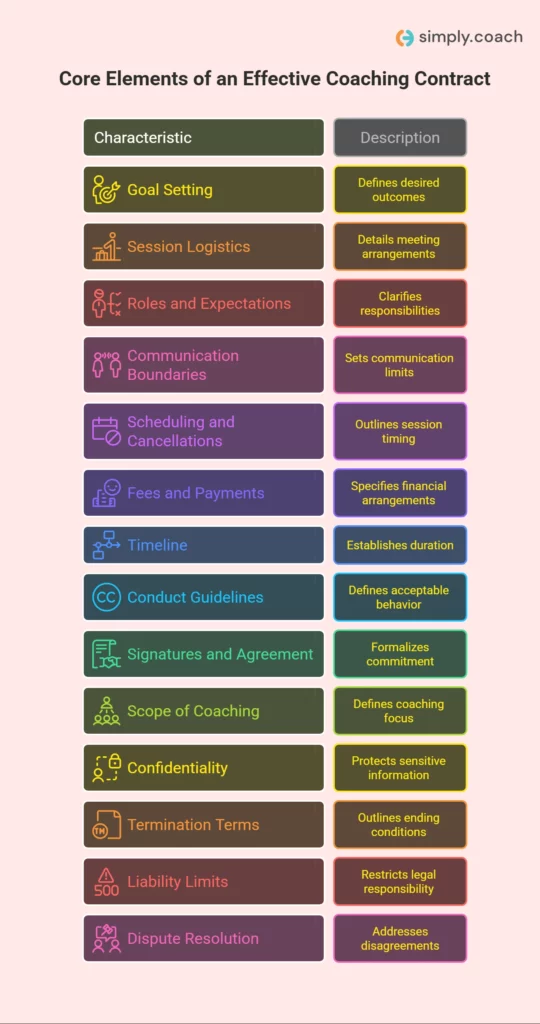
A solid coaching contract isn’t just paperwork; it’s the playbook for how you and your client will work together. It brings clarity, professionalism, and structure to your engagement. Here’s what to include to ensure everything flows smoothly from day one:
- Clear objectives and specific goal setting: Establish the direction by working with the client to define their key goals. For example, a client wants to improve their leadership skills and set measurable objectives like ‘lead a team project within 6 months’ or ‘receive positive feedback from at least 3 direct reports.’
- Session logistics: Be specific about the number of your coaching sessions, their duration, how often they’ll happen, and the format (online, phone, in-person).
- Roles and expectations: Outline what you’re responsible for (e.g., showing up prepared, offering guidance) and what the client is expected to do (e.g., follow through, stay engaged and committed).
- Communication boundaries: Set clear guidelines for how clients can contact you between sessions and also how to contact you to know when you’re available.
- Scheduling and cancellations: Include how to book sessions, how much notice is needed to cancel or reschedule, and whether there are penalties for your clients for no-shows or last-minute changes.
- Fees and payment process: Lay out how much your services cost, when payments are due, how they should be made, and your refund policy (if applicable).
- Timeline of the coaching relationship: Clarify the overall duration of the engagement, whether it’s a fixed term or ongoing, and any review or renewal points.
- Conduct guidelines: State expectations for professionalism and respectful behavior from both sides to keep your sessions productive and safe.
- Signatures and agreement: Finalize the contract with both parties’ signatures and the date to confirm mutual understanding and consent.
- Scope of coaching: Clearly define what coaching will focus on and what falls outside its scope. Coaching supports reflection, goal-setting, and accountability, it does not replace therapy, consulting, or professional advice.
- Confidentiality: Outline how client information will be protected and kept private. Also clarify any exceptions, such as legal obligations or agreed progress updates in organizational coaching contexts.
- Termination terms: Explain how either party can end the coaching engagement if needed. Include notice requirements and how any remaining prepaid sessions will be handled.
- Liability limitations: Clarify that coaching supports personal and professional development but does not guarantee specific outcomes. This helps set realistic expectations for both coach and client.
- Dispute resolution: Specify how disagreements will be addressed if they arise. This may include mediation, arbitration, or the legal jurisdiction that governs the agreement.
To ensure clarity and alignment with the coaching goals, define what success looks like by identifying key milestones, such as demonstrating effective leadership through team project management or receiving positive feedback from direct reports, which will indicate progress and achievement in enhancing leadership skills.
This approach ensures both you and your client are aligned on expectations, providing a clear path forward for progress.
Given the key aspects, it’s crucial to understand the main clauses that protect both coach and client.
9 Main Clauses Included in a Coaching Contract
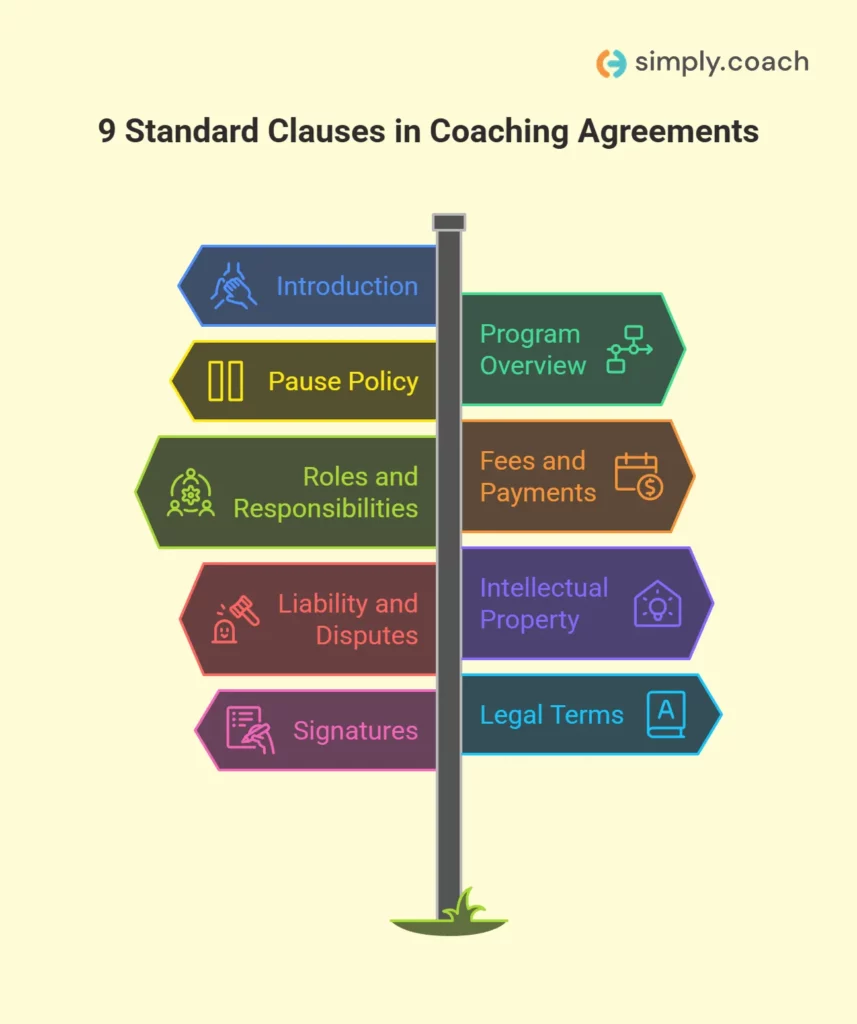
A well-structured coaching agreement brings clarity to the coaching relationship before the first session even begins. It defines expectations, responsibilities, and boundaries for both the coach and the client, helping prevent misunderstandings later in the engagement. If you are drafting your own agreement or reviewing an example coaching contract, most professional coaching agreements follow a similar structure.
Below are the key sections typically included in a comprehensive coaching contract used by experienced coaches.
1. Introduction
The introduction sets the tone for the coaching agreement. It typically welcomes the client, confirms the purpose of the document, and defines any key terms used in the contract.
This section may also explain the next steps after signing the agreement, for example, receiving a scheduling link for the first coaching session or onboarding materials.
2. Program overview and inclusions
This section outlines what the coaching engagement includes. It usually covers:
- The duration of the program
- The official start date
- The core components of the coaching package
For instance, a six-month program may include two monthly coaching sessions, implementation calls, and access to learning resources. In many example coaching contracts, this section clearly lists every element of the coaching program so clients understand what they are paying for.
3. Pause or break policy
Sometimes coaching engagements need to be temporarily paused. This section explains how a pause works and under what circumstances it may occur.
Common situations include vacations, medical leave, or unexpected personal commitments. Including a pause policy ensures that both coach and client know how to handle breaks without disrupting the overall coaching timeline.
4. Fees and payment terms
Every coaching agreement should clearly explain the financial terms of the engagement. This typically includes:
- The total program fee
- Payment schedule or installment plan
- Accepted payment methods
- Late payment or failed payment policies
Many coaches also clarify whether payments are automated and what happens if a transaction fails.
5. Results, responsibilities, and coaching relationship
This section clarifies the nature of the coaching relationship and outlines the responsibilities of both parties.
It typically explains that coaching is a collaborative process where the coach provides guidance and accountability while the client is responsible for taking action. Most example coaching contracts also clarify that coaching does not replace professional services such as therapy, legal advice, or financial consulting.
Refund policies and expectations around communication may also be included here.
6. Intellectual property and content usage
Coaches often share proprietary frameworks, exercises, worksheets, or course materials during the coaching process. This section protects those resources.
It typically states that coaching materials cannot be copied, distributed, or reproduced without permission. Some agreements also include consent for using client testimonials or feedback in marketing materials.
7. Default, liability, and dispute resolution
This section outlines what happens if a disagreement or dispute arises during the coaching engagement.
Many coaching agreements include clauses that limit the coach’s liability and define the steps for resolving conflicts, such as mediation before legal action. While disputes are rare, this section ensures there is a clear process in place if challenges arise.
8. Miscellaneous legal terms
This section contains additional legal provisions that support the validity of the contract.
For example, it may confirm that electronic signatures are legally binding or specify which jurisdiction’s laws govern the agreement. These clauses help ensure the contract remains enforceable.
9. Conclusion and signatures
The final section closes the coaching agreement by thanking the client for their commitment to the coaching process.
Both the coach and client then sign and date the document, confirming that they understand and agree to the terms outlined in the contract. In most example coaching contracts, this section formally activates the coaching relationship once both signatures are recorded.
Also read: Appointment Reminder Email Templates for Therapists: Best Practices and Key Tips
While clauses define structure, ensuring your contract meets legal standards is equally important.
Legal Compliance Checklist for Coaching Contracts
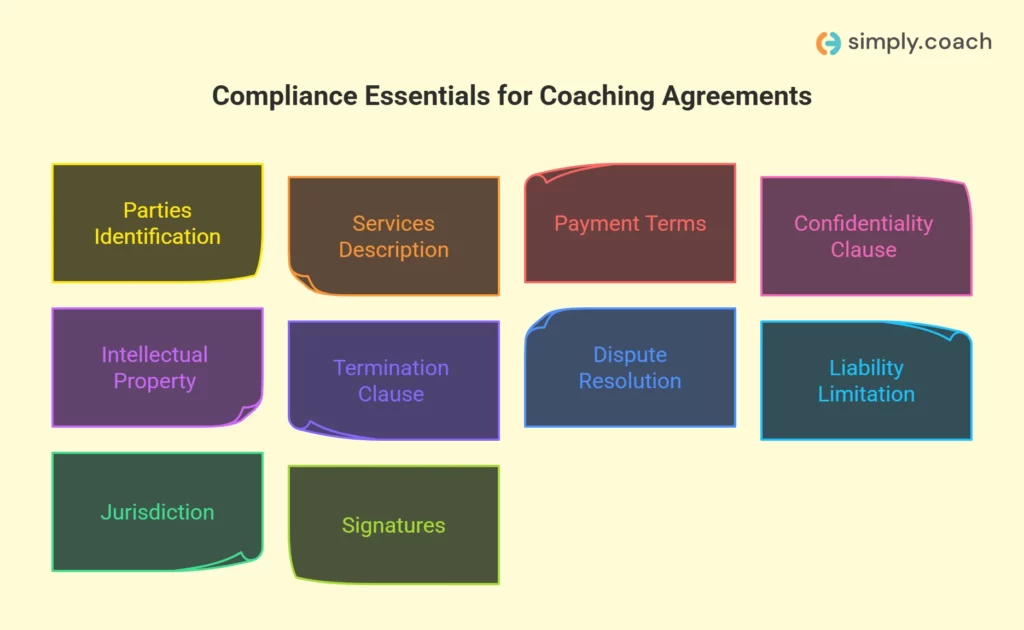
A coaching contract is more than a working agreement; it’s a legal shield for your business. If disputes, misunderstandings, or legal issues arise, this is the document that protects you. Here’s a compliance-focused checklist to cover your legal bases:
- Full identification of parties: Include complete legal names and roles of both coach and client to ensure the contract is legally binding.
- Detailed description of services: Specify what’s being delivered (e.g., one-on-one coaching, group sessions), how, and how often. This helps avoid future claims of misrepresentation and disputes.
- Payment terms and structure: Document the total cost, payment plan (upfront, installments), deadlines, late payment penalties, and refund terms.
- Confidentiality clause: Include a formal agreement that protects both your and your client’s sensitive information. Outline what is confidential, what’s not, and under what circumstances information may be disclosed (e.g., legal obligation).
- Intellectual Property (IP): Clearly state who owns the materials shared during the coaching relationship, such as workbooks, frameworks, session recordings, or any custom content. Define how your client can use them. For example, clients may use your materials for personal growth but not copy, share, or sell them.
- Termination clause: Include conditions under which either party can exit the contract, how much notice is required, and whether any fees or refunds apply.
- Dispute resolution process: Spell out how conflicts will be resolved, such as through mediation, arbitration, or formal legal action. This helps you and your client manage risk and avoid courtroom battles.
- Limitation of liability: Add language that limits your legal exposure, especially around the outcomes of coaching. You’re a guide, not a guarantee.
- Jurisdiction clause: Specify which region’s laws govern the contract. This matters if you work with clients across different states or countries.
- Signature with legal acknowledgment: Ensure both parties sign and date the agreement with the clear intent to form a legally binding contract.
| Additionally, make sure you answer this question: “Do you periodically review your business operations with a legal professional to stay updated on changing laws?’’You need to answer this to show that your business actively works to prevent legal risks by staying informed and adjusting practices as regulations change. |
Conduct regular reviews of your business practices and contracts with a lawyer to stay ahead of any legal changes.
Even with legal clarity, many coaches hesitate, let’s address some common misconceptions.
Myth-Busting: Contracts Aren’t Scary
Many of you avoid contracts, fearing they’re complex or intimidating. In reality, they’re a valuable tool for establishing professionalism and protecting both you and your clients. A coaching contract clarifies expectations, prevents misunderstandings, and builds a strong foundation for the relationship.
Let’s address and debunk some of the most common myths surrounding coaching contracts:
- Myth 1: “Coaching contracts are only for legal experts”
Reality: Coaching contracts can be designed to be simple and user-friendly. They’re not complex legal documents but rather tools that clarify expectations and responsibilities. Although having legal expertise is beneficial in complicated legal matters, you don’t need to be a lawyer to draft or understand a basic coaching contract.
- Myth 2: “Having a contract implies distrust”
Reality: Establishing a contract is a professional practice that builds trust. Importantly, a contract also acts as a shield of protection for both you and your client in case of any unforeseen disputes arising in the future. A well-structured contract ensures that both parties understand their roles, responsibilities, and boundaries. This mutual understanding actually develops trust, as both you and your client know what to expect from one another.
- Myth 3: “Contracts are only necessary for long-term engagements”
Reality: If your coaching engagement is long-term or short-term, a contract is essential. It sets clear expectations, defines boundaries, and ensures both parties are aligned. Even in shorter engagements, a contract can prevent misunderstandings.
- Myth 4: “Once signed, a contract cannot be altered”
Reality: Contracts are flexible. They can be amended or adjusted with mutual consent if circumstances change. They are living documents that can change along with the coaching relationship to stay relevant.
- Myth 5: “Legal expertise is required to draft a coaching contract”
Reality: As mentioned above, while legal advice can be beneficial (or necessary) in more complex matters, many coaching platforms offer customizable contract templates that are easy to use and tailor to your specific needs. These templates are designed to simplify the process, making it accessible even for those without legal backgrounds.
- Myth 6: “Contracts are only for big businesses”
Reality: Contracts aren’t just for large corporations; they are crucial for every business, no matter the size. For coaches, contracts safeguard both you and your clients by outlining clear agreements and preventing disputes.
- Myth 7: “I don’t need a contract for simple agreements”
Reality: Even seemingly simple coaching agreements can lead to misinterpretation. A written contract clarifies expectations and ensures that both you and your client are on the same page, preventing potential conflicts.
- Myth 8: “Contracts are only for when something goes wrong”
Reality: Contracts help prevent problems from arising in the first place. They clearly set out the rights, duties, and obligations of both parties, ensuring that everyone is on the same wavelength and reducing the risk of future conflicts.
- Myth 9: “Contracts are all about protecting the other party”
Reality: Contracts are about protecting both parties. They ensure mutual respect, fairness, and security for both you and your client. They’re not designed to favor one party over the other but to create a balanced and professional framework for the relationship.
By dispelling these myths, you can see that contracts are not something to fear but an essential tool to protect your coaching practice, build trust, and ensure clear, professional relationships with your clients. Don’t let misconceptions hold you back from using contracts to your advantage.
Understanding myths paves the way to choosing a template that works for your specific practice.
The Best Template to Use for Coaching Contracts
The following coaching agreement template illustrates how many experienced coaches structure their contracts. This example coaching contract can be adapted depending on your coaching services, delivery format, and client engagement model.
1. Services
This Agreement is entered into by and between you (“Client” or “you”) and the coaching provider (“Company”).
The Company provides coaching and training services through a network of professional coaches and program resources. These services may include structured coaching, training guidance, access to educational materials, and digital learning resources delivered through the Company’s platforms.
Depending on the program selected, the services may involve direct interaction with an assigned coach or access to structured training plans and educational content delivered without ongoing coach communication.
Collectively, these offerings are referred to as the “Services” within this coaching agreement.
2. Service fees
(a) Fees for the Services (“Service Fees”) must be paid in advance through an approved payment method such as a debit or credit card. By signing this coaching contract, the Client authorizes the Company to charge the payment method on file for all applicable Service Fees.
(b) The Client is responsible for ensuring that billing information on file remains accurate and current. Failure to maintain valid payment details may result in interruptions to the Services.
The Company reserves the right to suspend or discontinue access to the Services in cases of non-payment. If payment remains outstanding, the Company may take appropriate steps to recover unpaid balances, including the use of third-party collection services where necessary.
3. Coaching services
Depending on the Services purchased under this coaching agreement, the following terms may apply:
(a) Once the Agreement is signed and all required terms are accepted, the Client will receive a confirmation email welcoming them to the program and outlining the next steps in the coaching process.
(b) If the Client has enrolled in a coaching program that includes direct support from a coach, the Company will initiate contact within a reasonable timeframe to schedule an introductory meeting. During this session, the Client and Coach will align on the structure of future sessions and establish a mutually convenient schedule.
(c) Coaching sessions are generally scheduled during standard working hours within the Client’s time zone. In certain circumstances, additional scheduling flexibility may be arranged when mutually agreed upon between the Client and the Coach.
(d) All coaching sessions and program components are delivered through online platforms, coaching tools, or digital applications selected by the Company. The Company may update or change these platforms from time to time as part of maintaining or improving the delivery of the Services.
4. Client responsibilities
(a) The Client agrees to provide the Coach with any requested information, documents, or materials required to support the coaching process. These materials must be submitted within the timeframe requested by the Coach and no later than twenty-four (24) hours before any scheduled coaching session unless otherwise agreed.
If requested information is not provided within the required timeframe, the Company or Coach reserves the right to reschedule the session or treat the session as completed under the terms of this coaching contract.
(b) Any cancellations or requests to reschedule a coaching session must be submitted at least twenty-four (24) hours before the scheduled appointment time. Requests made after this notice period may result in the session being forfeited without rescheduling.
5. Monthly subscription
(a) If the Client enrolls in a monthly subscription program (“Monthly Subscription”), the Client agrees to pay the applicable monthly fee at the current subscription rate. The Client acknowledges that this fee will be charged automatically on a recurring monthly basis unless the subscription is canceled according to the cancellation terms described in this coaching agreement.
(b) Once enrollment is confirmed, the Company will process the first monthly payment and continue to charge the subscription fee automatically during each subsequent billing cycle at the then-current subscription rate.
The Client accepts responsibility for all recurring charges associated with the Monthly Subscription until the subscription is formally canceled before the next billing cycle in accordance with the Company’s cancellation policy.
6. Annual subscription
(a) If the Client purchases an annual subscription (“Annual Subscription”), the Client agrees to make a full upfront payment covering one year of Services once enrollment is confirmed. At the end of the initial subscription period, the Annual Subscription will renew automatically each year at the then-current rate unless the Client cancels the subscription prior to the next billing cycle, as outlined in this coaching agreement.
(b) The Company will notify the Client before processing the renewal charge. Renewal payments will be billed using the payment method stored on file unless the Client updates their billing details or cancels the subscription before the renewal date.
(c) For example, if the Client begins an Annual Subscription in October that runs through September of the following year, the renewal fee for the next subscription period will be charged in October unless the Client cancels prior to that billing cycle. The Client accepts responsibility for all applicable recurring charges until cancellation is processed in accordance with this coaching agreement.
7. Cancellation policy
(a) Either the Client or the Company may terminate or cancel the subscription at any time. The Client acknowledges that cancellation of the subscription is the primary remedy in the event of a dispute relating to the Services, including disputes related to the enforcement of this coaching agreement, the Company’s policies, or the Client’s use of the Services.
Upon cancellation or termination, the Company may deactivate the Client’s account and restrict access to associated program materials, files, or digital services unless otherwise stated.
(b) The Client may submit a cancellation request by contacting customer support or by using any cancellation method provided by the Company. The Company will make reasonable efforts to process cancellation requests within seventy-two (72) hours after receiving the request.
(c) For monthly subscriptions, cancellations must be submitted at least eight (8) days before the next billing date in order to avoid the following month’s charge. Partial refunds for unused time within a billing period are not offered. The Client will retain access to the Services until the end of the paid billing cycle.
(d) Monthly payments are non-refundable and cannot be prorated or transferred to other services, products, or clients unless explicitly approved by the Company. Where refunds are approved, they will generally be processed within thirty (30) days from the approval date.
(e) Requests to temporarily pause participation in the Services may be treated as a cancellation at the end of the current billing cycle. Clients who wish to resume services later may re-enroll through the Company’s registration process.
8. Equipment and participation responsibility
The Company shall not be responsible for any loss, damage, or injury related to the Client’s personal equipment used while participating in the Services.
The Client is responsible for ensuring that all equipment and materials required to participate in the Services are properly maintained and, where appropriate, insured.
In the event that the Client is unable to participate due to equipment limitations or related circumstances, fees paid under this coaching agreement will not be refunded.
9. Independent contractors
Certain services may be delivered by independent contractors or third-party professionals engaged by the Company. These individuals operate independently and are not employees of the Company.
By participating in the Services, the Client acknowledges that services provided by such professionals are performed independently. The Client agrees to release and hold the Company harmless from any claims, losses, or liabilities arising from services delivered by independent contractors in connection with this coaching agreement.
10. Subscription data
(a) To access the Services, the Client agrees to provide accurate and complete information during the registration or subscription process (“Subscription Data”). This information may include the Client’s legal name, contact details, address, email address, and payment information required for billing purposes.
The Client authorizes the Company to share necessary Subscription Data with third parties for payment processing, verification, and service administration. The Client agrees to maintain and update this information to ensure it remains accurate throughout the duration of this coaching agreement.
(b) The Client agrees not to create multiple accounts, register accounts on behalf of another person without authorization, or provide misleading identity information. If the Company determines that inaccurate or false information has been provided, it reserves the right to suspend or terminate the Client’s account and restrict access to the Services.
(c) The Client is responsible for maintaining the confidentiality of account credentials and must notify the Company immediately in the event of any suspected unauthorized use, security breach, or loss of login information. The Client remains responsible for activities conducted through their account until such notification has been received and addressed.
11. Confidentiality
(a) The Client agrees that all information shared as part of the Services is confidential and must not be disclosed to any third party without the prior written consent of both the Coach and the Company. This includes, but is not limited to, materials provided during the coaching engagement, methodologies used by the Coach or the Company, and the substance of communications between the Client and the Coach under this coaching agreement.
This provision does not prevent the Client from sharing relevant information with a qualified healthcare professional if necessary for medical care.
(b) The Client agrees not to reproduce, distribute, or duplicate any materials provided by the Coach or the Company without written authorization. Any proprietary notices, copyright markings, or confidentiality notices included within these materials must remain intact.
(c) The Company retains sole ownership of all intellectual property associated with the Services, including programs, concepts, frameworks, materials, trademarks, and other proprietary resources developed or provided as part of the coaching engagement.
(d) Both parties agree that neither party will make defamatory or disparaging statements about the other following termination of this coaching agreement.
12. Client responsibilities
(a) The Client acknowledges that they are responsible for their own physical, mental, and emotional well-being throughout the coaching process. Decisions, actions, and outcomes that arise from the coaching engagement remain the responsibility of the Client.
Accordingly, the Company and the Coach cannot be held liable for decisions made or actions taken by the Client as a result of participating in the Services.
(b) The Client understands that coaching services are not intended to replace professional advice provided by qualified legal, medical, psychological, or financial professionals. Where such guidance is required, the Client agrees to seek appropriate professional assistance independently.
If the Client is currently receiving care or treatment from a healthcare professional, they are encouraged to inform that professional before participating in the Services.
13. Assumption of risk
(a) The Client confirms that they are at least eighteen (18) years of age and legally able to enter into this coaching agreement.
(b) The Client acknowledges that participation in the Services is voluntary and may involve physical activity or training that carries inherent risks. These risks may include injury, illness, or other unforeseen outcomes associated with physical exertion or performance activities.
(c) By participating in the Services, the Client confirms that they are physically capable of engaging in the activities involved and have not been advised by a qualified healthcare professional to avoid such participation.
(d) The Client also acknowledges that they are responsible for arranging any transportation, equipment, or related logistics required to participate in the Services. All associated costs or expenses remain the responsibility of the Client.
14. Waiver and release
(a) The Client acknowledges that participation in the Services is voluntary and undertaken with full awareness of potential risks. The Company and the Coaches shall not be held liable for injuries, damages, or losses that may occur in connection with participation in the Services, including but not limited to risks related to training activities, equipment use, or physical exertion.
(b) The Client agrees not to initiate legal action against the Company, its representatives, Coaches, employees, contractors, or affiliated parties for claims arising from participation in the Services. The Client further agrees to indemnify and hold these parties harmless from claims, losses, or damages that may arise directly or indirectly from their participation in the coaching program.
(c) This waiver extends to the Client’s heirs, successors, and legal representatives. The Client acknowledges that the Company does not guarantee specific outcomes or performance improvements. Responsibility for achieving individual goals remains solely with the Client.
15. Health disclaimer
The Services, including any associated website, platforms, or third-party applications used to deliver coaching resources, are intended solely to support individuals in their personal training and development efforts.
The Company and the Coaches are not medical professionals and do not provide medical advice, diagnosis, or treatment. Any information shared through the Services should not be interpreted as medical guidance or a substitute for consultation with a licensed healthcare professional.
Clients are strongly encouraged to consult a physician or qualified healthcare provider before beginning any new training or physical activity program. The Services are intended for use by healthy adults who choose to participate voluntarily under the terms of this coaching agreement.
16. Disclaimers of warranties
The Services, including all related content, materials, and resources, are provided on an “as is” and “as available” basis. The Company makes no guarantees or warranties, either express or implied, regarding the Services provided under this coaching agreement.
To the fullest extent permitted by law, the Company disclaims all warranties, including but not limited to warranties of merchantability, fitness for a particular purpose, accuracy, reliability, security, compatibility, or non-infringement.
Any materials, programs, or content accessed or downloaded through the Services are obtained at the Client’s own risk. The Client accepts responsibility for any damage to systems, devices, or loss of data that may occur as a result of accessing or using such materials.
No advice or information obtained from the Company, its Coaches, or through any materials associated with the Services shall create any warranty not expressly stated in this coaching agreement.
17. Limitation of liability
The Client acknowledges and agrees that the Company, the Coaches, and their respective affiliates shall not be held liable for any direct, indirect, incidental, consequential, special, or exemplary damages arising from participation in the Services.
This includes, but is not limited to, damages related to loss of profits, loss of data, loss of goodwill, service interruptions, or other intangible losses that may occur in connection with:
- the use or inability to use the Services
- reliance on content or materials provided through the Services
- transactions conducted through the Company’s platforms
- unauthorized access to data or account information
- actions or conduct of third parties connected to the Services
In all circumstances, the total liability of the Company under this coaching agreement shall not exceed the total amount paid by the Client for the Services.
If the Client is dissatisfied with any aspect of the Services or with any provision of this agreement, the Client’s sole remedy is to discontinue use of the Services.
18. Indemnification
The Client agrees to indemnify, defend, and hold harmless the Company and its affiliates, officers, directors, employees, Coaches, independent contractors, agents, and representatives from and against any claims, damages, liabilities, or expenses arising from:
- misuse of the Services
- violation of the terms outlined in this coaching agreement
- infringement of intellectual property or other rights belonging to any third party
- actions taken by the Client or any person accessing the Services through the Client’s account
This obligation includes responsibility for reasonable legal fees and costs incurred as a result of such claims.
19. Media consent and release
The Client acknowledges that the Company or its Coaches may capture photographs, video recordings, or audio recordings during program activities or events associated with the Services.
By agreeing to this coaching agreement, the Client grants permission for the Company to record and use their likeness, voice, or image in photographs, videos, digital recordings, or other media formats. These materials may be used for educational, training, marketing, or promotional purposes across print, digital, or multimedia platforms.
The Client releases the Company and any authorized representatives from liability related to the use of such materials. All recordings and media created in connection with the Services shall remain the property of the Company.
20. Force majeure
The Company shall not be held responsible for delays, interruptions, or failure to deliver the Services due to circumstances beyond its reasonable control.
Such circumstances may include, but are not limited to:
- natural disasters or severe weather
- acts of war or terrorism
- strikes or labor disruptions
- government regulations or restrictions
- epidemics or public health emergencies
- technical disruptions or infrastructure failures
If the Services cannot be delivered due to such events, the Client acknowledges that refunds may not be provided under this coaching agreement.
21. Amendments
The terms of this coaching agreement may not be altered, modified, or amended unless such changes are made in writing and approved by the Company. Any modification to the agreement must be formally documented and accepted by both parties in order to be considered valid and enforceable.
22. Assignment
The Client may not transfer, assign, or delegate any rights or responsibilities under this agreement without prior written approval from the Company. The Services provided under this agreement are intended solely for the Client and are not transferable to any other individual or organization without explicit authorization.
23. Severability
If any provision of this coaching agreement is determined to be invalid, unlawful, or unenforceable by a court or relevant authority, the remaining provisions will continue to remain in full force and effect.
Where possible, any invalid or unenforceable provision will be interpreted or modified to the extent necessary to make it enforceable while preserving the original intent of the agreement.
24. Entire agreement
This coaching agreement, together with any related terms, policies, or documents referenced within it, constitutes the complete understanding between the Client and the Company regarding the Services.
It supersedes all prior discussions, proposals, communications, or agreements, be they written or verbal, related to the subject matter of this agreement. In the event of any inconsistency between this agreement and other related documents, the terms outlined in this coaching agreement will take precedence.
25. Governing law
Tfhis coaching agreement shall be interpreted and governed in accordance with the laws of the jurisdiction in which the Company operates, without regard to conflict-of-law principles.
Any legal dispute or proceeding arising from or relating to this agreement shall be handled according to the dispute resolution procedures established by the Company and conducted under the applicable laws of the governing jurisdiction.
With Simply.Coach, you can now create, organize, and manage all your client contracts in one centralized location.
- Create contracts from ready templates: You can develop contracts that meet ICF specifications.
- Digitally sign and share contracts: Easily sign contracts digitally and send them to clients for their signatures.
- Access contracts easily: Quickly access all contracts and client details in one place.
Also read: The Best 10 Coaching Software with Client Management
Once you have the right template, the next step is learning how to use it effectively with your clients.
How to Use the Coaching Contract Template Effectively
Let’s explore how to use a coaching contract template effectively to ensure it’s tailored to your needs and is legally sound. Here’s how to make the most of the template:
1. Customize the template to meet specific coaching needs
It is essential to customize the coaching contract template to meet the specific needs and expectations of the coaching relationship. This may involve adding or modifying sections, updating language, or including additional information as needed.
2. Recommend e-signature software for formal signing
Using e-signature software can streamline the process of signing and managing coaching contracts. This technology ensures that contracts are signed quickly and securely, reducing the risk of delays or errors.
3. Seek legal review and advice for a more solid contract
Seeking legal review and advice can help to ensure that the coaching contract is solid and legally compliant. A legal professional can provide valuable insights and recommendations, helping to address any potential issues or concerns.
4. Offer support for setting up the contract
Providing support for setting up the coaching contract can help to ensure that both parties understand and agree to the terms. This may involve discussing the contract in detail, addressing any questions or concerns, and providing additional information or clarification as needed.
With these strategies, you can ensure every session runs smoothly, expectations are clear, and client progress is supported.
Conclusion
A clear and comprehensive coaching agreement is the foundation of a professional coaching relationship. It sets expectations, defines responsibilities, and provides a roadmap for achieving client goals while reducing misunderstandings and potential conflicts. Including essential sections like program scope, session logistics, payment terms, confidentiality, and dispute resolution ensures your coaching engagements are structured and effective.
Having a solid coaching contract protects both coach and client and also enhances the overall client experience. It demonstrates professionalism, builds trust, and creates a framework where clients can fully engage in the process, knowing exactly what to expect from the relationship.
With Simply.Coach, managing your coaching agreements has never been easier. You can create contracts from ICF-aligned templates, send and receive digital signatures, track client commitments, and access all your contracts in one centralized dashboard, streamlining your coaching practice while keeping every engagement organized and professional.
FAQs
1. What is a coaching agreement?
A coaching agreement is a formal document that clearly outlines the working relationship between a coach and a client. It defines the roles, expectations, and responsibilities to ensure both parties are aligned from the start.
2. Why do I need a coaching agreement?
A coaching agreement protects both the coach and client by setting boundaries and expectations. It also helps prevent misunderstandings and provides a framework for handling cancellations, payments, and potential disputes.
3. What should be included in a coaching agreement?
Essential elements include the scope of coaching, session frequency and duration, fees and payment terms, confidentiality clauses, dispute resolution, and cancellation policies. These sections ensure a professional and structured coaching engagement.
4. How do I create a coaching agreement?
You can draft a coaching agreement from scratch or use an example coaching contract as a reference. Many professionals use templates aligned with ICF standards to save time while ensuring all critical elements are included.
5. Can a coaching agreement be updated once signed?
Yes. Agreements can include clauses for amendments or extensions, allowing adjustments to session schedules, program scope, or fees. Updating the agreement keeps the relationship flexible and responsive to changing client needs.
6. Is a coaching agreement legally binding?
While primarily a professional and ethical document, a coaching agreement can carry legal weight if disputes arise. Properly written agreements protect both parties and clarify liabilities and responsibilities in the coaching process.
7. How do I handle cancellations in a coaching agreement?
Include a clear cancellation and rescheduling policy with notice periods, fees, and procedures. This prevents confusion, ensures fairness, and protects the coach’s schedule while respecting the client’s needs.