
Demand for Agile coaches in the United States continues to grow as organizations struggle with stalled transformations and increasing delivery complexity. As Agile adoption matures, many companies are realizing that sustainable change depends on shifting behaviors and decision-making, not just implementing processes.
Companies are not hiring Agile coaches to teach frameworks alone. They need professionals who can change team behavior, influence leaders, and address resistance during Agile adoption. That shift has created space for people who understand coaching, not just delivery models.
If you are aspiring to become an Agile coach, your interest likely comes from observing these gaps firsthand. You may have seen teams follow ceremonies without improvement, or leaders adopt Agile without changing decisions. Agile coaching exists to close that gap through focused guidance and behavior change.
This blog explains what Agile coaching actually involves, the skills you must build, and the steps required to enter the role. You will also find realistic salary insights and expectations, so you can decide your next move with clarity.
Key Takeaways
- Agile coaching focuses on changing team and leadership behavior rather than enforcing frameworks or ceremonies.
- Becoming an Agile coach requires mindset development, hands-on experience, and strong coaching and facilitation skills.
- Agile coaches work across teams and leadership levels to improve decision-making, ownership, and delivery outcomes.
- Certifications help build credibility, but real coaching impact and documented outcomes drive long-term career growth.
- Agile coaching offers strong earning potential in the United States, with experienced coaches earning well into six figures.
- Simply.Coach supports Agile coaches by helping them structure engagements, track progress, and demonstrate coaching impact consistently.
What Is Agile Coaching?
Agile coaching is a professional discipline that helps teams and leaders apply Agile principles effectively in real organizational environments. It focuses on changing behaviors, decision-making patterns, and collaboration methods that prevent teams from delivering consistent outcomes.
As an aspiring Agile coach, you work at the intersection of people, processes, and leadership habits rather than enforcing frameworks. The goal of Agile coaching is to enable sustainable improvement through reflection, guided experimentation, and continuous learning across teams.
What does an agile coach do?
An Agile coach supports teams and leaders during Agile adoption by addressing specific behaviors that block progress. You work across roles and levels to ensure Agile practices produce real, measurable improvements.

- Observe team dynamics: Identify communication breakdowns, ownership gaps, and decision delays that reduce delivery effectiveness.
- Coach leadership behaviors: Help managers shift from task-driven control to outcome-focused decision-making models.
- Facilitate targeted retrospectives: Design sessions that uncover root causes and lead to clear, testable improvement actions.
- Develop Scrum Masters: Guide Scrum Masters to move beyond coordination into coaching teams on accountability and collaboration.
- Align Agile practices: Ensure team workflows support organizational goals, constraints, and delivery expectations.
An Agile coach succeeds when teams operate with clarity, ownership, and the ability to improve without external direction.
Also read: Understanding the Basics of Team Coaching
Skills and Qualities Required to Become an Agile Coach
Becoming an effective Agile coach requires combining coaching expertise with practical skills used inside real team environments.
This section connects traditional coaching strengths with the specific demands Agile teams and leaders face daily.

| Skills (What you actively do) | Qualities (How you show up) |
| Active listening in team settings: Track spoken and unspoken signals during ceremonies to surface hidden blockers. | Emotional steadiness: Stay composed when teams resist change or react defensively to feedback. |
| Powerful questioning for teams: Ask questions that expose assumptions behind delivery delays or ownership issues. | Curiosity: Seek to understand system constraints before suggesting changes or experiments. |
| Behavior-focused feedback: Offer clear feedback tied to observable actions rather than personal traits. | Directness with respect: Address issues honestly without damaging trust or psychological safety. |
| Retrospective facilitation: Design sessions that move teams from venting toward specific behavioral commitments. | Patience: Allow teams time to internalize change instead of forcing immediate compliance. |
| Workshop design: Structure workshops that help teams redefine working agreements and decision boundaries. | Adaptability: Adjust coaching approach based on team maturity and organizational context. |
| Agile framework application: Apply Scrum, Kanban, Lean, or XP based on team needs, not certification rules. | Systems thinking: Recognize how leadership decisions influence team behavior and delivery outcomes. |
| Stakeholder alignment: Facilitate conversations between teams and leaders to clarify priorities and constraints. | Credibility: Earn trust through consistent actions rather than positional authority. |
| Conflict navigation: Guide teams through disagreements without taking sides or imposing solutions. | Self-awareness: Recognize personal bias and avoid projecting it onto teams or leaders. |
| Outcome tracking: Help teams define and review indicators that reflect real improvement, not activity. | Accountability mindset: Hold teams responsible for commitments while supporting learning from failure. |
Strong Agile coaches succeed because their skills and qualities reinforce each other during real, high-pressure situations. When both develop together, you move from learning Agile concepts to influencing lasting behavioral change.
Also read: How to Become the Best Coach: Qualities and Habits
Steps to Become an Agile Coach
Becoming an Agile coach is a structured progression that combines mindset, skills, hands-on experience, and positioning. Many aspiring coaches focus on frameworks or certifications before understanding how teams and leaders actually behave, which limits impact. The steps below reflect how experienced Agile coaches develop credibility, influence behaviors, and deliver measurable change.
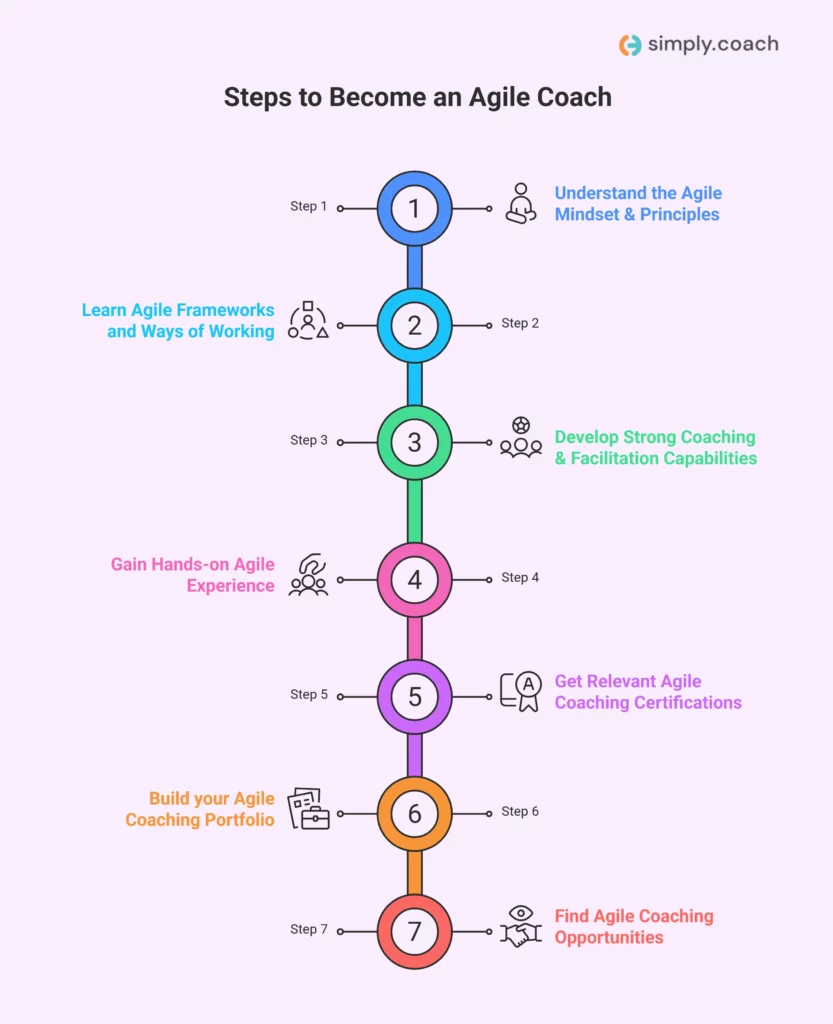
Step 1: Understand the Agile mindset and principles
Before applying any frameworks, you must internalize the purpose behind Agile and why it exists. Agile addresses challenges caused by rigid processes, slow feedback, and centralized decision-making. Without this foundation, teams adopt ceremonies without improving collaboration or outcomes.
- Study Agile Manifesto values: Focus on why individuals, collaboration, and responding to change matter more than following processes. This helps you coach teams to prioritize outcomes over compliance.
- Understand Agile principles: Pay attention to principles like iterative delivery, continuous feedback, and sustainable pace, which directly influence team behavior and learning.
- Observe mindset conflicts: Notice situations where teams claim Agile adoption but still rely on approvals, fixed timelines, or command-driven decisions.
- Connect to coaching philosophy: Agile values align with coaching beliefs such as awareness, responsibility, and reflection. Recognizing this alignment strengthens your interventions.
Tip: Spend time observing teams and leaders to see where stated values contradict actual behavior. Document these insights to guide coaching conversations later.
Step 2: Learn Agile frameworks and ways of working
Frameworks help translate Agile principles into concrete ways of working, but they are not the goal. Your role is to understand their intent and fit, then guide teams accordingly.
- Scrum: Learn how defined roles, events, and time-boxes create transparency and enable regular inspection and adaptation, not just scheduling routines.
- Kanban: Understand how visualizing work, limiting work-in-progress, and exposing bottlenecks changes team behavior without requiring iterations.
- Lean: Study value streams, identify waste, and understand cross-team dependencies to help teams focus on real value creation.
- Extreme Programming (XP): Learn how technical practices provide fast feedback and maintain product quality, which influences team confidence and decision-making.
Example: A team may follow Scrum events but still escalate decisions to leadership. Your coaching focus is on changing decision-making behaviors, not the events themselves.
Step 3: Develop strong coaching and facilitation capabilities
Coaching and facilitation skills determine whether you create lasting change or only surface-level improvements. Agile coaching requires presence, neutrality, and the ability to manage group dynamics effectively.
- Shift from advising to coaching: Replace giving solutions with questions that help teams explore problems and take ownership of improvements.
- Coach teams vs individuals: Focus on collective accountability, shared decision-making, and behavioral patterns rather than isolated personal growth.
- Facilitate retrospectives and workshops: Design sessions that move teams from identifying problems to committing to actionable improvements.
- Handle resistance and conflict: Learn to navigate emotional responses, surface hidden issues, and guide teams toward productive solutions without taking sides.
Tip: Strong facilitation allows teams to confront uncomfortable truths and make behavioralchanges, which is where real Agile transformation begins.
Step 4: Gain hands-on Agile experience
Experience is the key to developing judgment and credibility. Theory alone does not teach you how teams behave under real delivery pressures.
- Start in delivery-facing roles: Roles such as Scrum Master or team facilitator provide exposure to planning challenges, leadership interactions, and delivery pressures.
- Integrate Agile coaching into your work: Introduce small experiments and reflect on team responses to your interventions to build practical insights.
- Shadow experienced coaches: Observe how they intervene, handle resistance, and maintain neutrality during challenging situations.
- Reflect and document lessons: Record interventions, observations, and results to refine your approach and create a portfolio of impact.
Example: Tracking how a team adapts to a new working agreement can provide evidence of behavioral improvement, which strengthens your credibility.
Step 5: Get relevant Agile coaching certifications
Certifications are tools for structured learning and shared language, not substitutes for experience. They help you frame coaching interventions and communicate credibility, especially in organizations unfamiliar with Agile coaching.
- ICAgile (ICP-ACC, ICP-ENT): Focuses on coaching mindset, systems thinking, and professional stance, building foundational knowledge.
- Scrum Alliance (CTC track): Emphasizes coaching maturity, ethics, and facilitation skills for more complex team and organizational contexts.
- SAFe Agile Coach: Useful for large enterprises adopting scaled frameworks but should be paired with practical experience.
Tip: Certifications open doors, but your ability to influence teams and leaders will determine real success.
Step 6: Build your Agile coaching portfolio
A portfolio demonstrates impact, not knowledge. Hiring managers and clients want evidence of behavioral change and team improvement rather than a list of frameworks you know.
- Document context and challenges: Include team size, environment, constraints, and behavioral gaps you addressed.
- Describe interventions and rationale: Explain why you chose a specific coaching approach, what experiments you ran, and adjustments made.
- Highlight measurable outcomes: Show improvements in collaboration, decision-making, delivery consistency, or leadership alignment.
- Reflect honestly: Include lessons learned, what worked, and where change was slower than expected.
Tip: A well-documented portfolio builds trust and signals maturity before results are visible.
Step 7: Find Agile coaching opportunities
Positioning yourself determines whether organizations recognize your value. You must clearly articulate your ability to influence behavior and outcomes, not just implement frameworks.
- Corporate Agile coaching roles: Focus on developing team and leadership capabilities over time, aligning behaviors with organizational goals.
- Independent consulting: Requires strong stakeholder management, boundary setting, and influencing skills to achieve results across multiple clients.
- Engage in Agile communities: Participate in meetups, forums, or workshops to learn, share, and expand your professional network.
- Clarify your value: Speak in terms of behavioral change, team learning, and measurable outcomes rather than ceremonies, tools, or buzzwords.
Closing insight: Organizations hire Agile coaches to improve how teams think, decide, and deliver, not to run meetings. Your success comes from demonstrating this value consistently.
Also read: How Business Alignment Coaching Drives Growth and Efficiency in Organizations
Agile Coach Salary in the USA: How Much Does an Agile Coach Earn?
If you are exploring how to become an Agile coach, salary expectations play an important role in career planning. Current U.S. data shows that Agile coaching, especially in remote roles, offers strong and competitive compensation.
- Average annual salary: The average annual pay for a Remote Agile Coach in the United States is $139,505, reflecting mid-to-senior level coaching responsibilities.
- Hourly rate (full-time equivalent): This salary translates to approximately $67.07 per hour, based on a standard full-time schedule.
- Monthly and weekly earnings: On average, Agile coaches earn about $11,625 per month or $2,682 per week, providing consistent earning potential in salaried roles.
- 25th to 75th percentile range: Most Remote Agile Coach salaries fall between $118,000 (25th percentile) and $165,500 (75th percentile), depending on experience and role scope.
- Top 10 percent earnings: Highly experienced Agile coaches in the 90th percentile earn up to $198,500 per year, often supporting enterprise or multi-team transformations.
- Salary spread and growth potential: ZipRecruiter reports salaries ranging from $30,500 to $208,000 annually, indicating significant growth opportunities based on skills, experience, and coaching maturity.
Overall, Agile coaching in the U.S. offers strong earning potential, particularly for coaches who build experience across teams, leadership layers, and organizational change initiatives.
Conclusion
Becoming an Agile coach is a deliberate progression that goes beyond learning frameworks or earning certifications. It requires you to understand human behavior, guide teams through resistance, and influence leadership decisions that shape delivery outcomes. When you focus on mindset, real-world experience, and measurable behavior change, Agile coaching becomes a role of sustained impact rather than surface-level adoption. With clear steps, realistic salary insights, and defined skills, you are now better positioned to decide your path into Agile coaching.
As you begin or scale your Agile coaching journey, Simply.Coach supports you in managing the complexity that comes with professional coaching work. The platform helps you structure engagements, track goals, document progress, and demonstrate coaching impact across teams or clients. Instead of juggling tools or losing visibility into outcomes, you can maintain clarity and consistency in your coaching practice. Simply.Coach, the all in one coaching platform, enables you to focus on creating meaningful change while staying organized and professional.
FAQs
1. How long does it take to become an effective Agile coach?
Most Agile coaches develop real effectiveness over two to five years of progressive experience. This includes mindset development, hands-on coaching exposure, and learning how to influence teams and leaders consistently.
2. What are the biggest challenges Agile coaches face in organizations?
Agile coaches often face resistance from leadership, unclear role expectations, and pressure to focus on ceremonies instead of outcomes. Navigating these challenges requires strong presence, stakeholder alignment, and patience with change.
3. How do Agile coaches measure the impact of their coaching?
Agile coaches assess impact through behavioral indicators such as improved ownership, clearer decision-making, and stronger collaboration. Delivery consistency and team reflection quality often signal sustained improvement.
4. What is the difference between an Agile coach and a Scrum Master?
A Scrum Master typically focuses on one team and facilitates Scrum practices. An Agile coach works across multiple teams and leadership levels, addressing systemic issues and long-term behavior change.
5. Can Agile coaching be done remotely or in hybrid environments?
Agile coaching works effectively in remote and hybrid settings when sessions are intentionally designed. Coaches rely on strong facilitation, observation skills, and clear agreements to maintain engagement and accountability.