
If you’re a therapist overpaying taxes every year, it may be simply because you overlook legitimate write-offs. Tax deductions often go unused, even though private practitioners routinely spend thousands on tools, supervision, and continuing education. When expenses stay buried across receipts, spreadsheets, and bank statements, valuable deductions slip through the cracks.
Most practitioners are trying to do something simple: keep more of what they earn while staying compliant with IRS rules. If you are running an active practice, then you might deal with session notes, no-show management, client progress tracking, and billing cycles. Without a clear deduction strategy, financial admin grows messy, and tax season becomes a scramble.
In this article, you’ll see a practical decision framework, real practice examples, and specific categories of tax deductions for therapists that help protect your revenue while simplifying practice operations.
Key Takeaways
- Claiming expenses like office supplies, software, and therapy tools directly lowers taxable income for your practice.
- Continuing education, workshops, and certification fees are deductible when they maintain or enhance professional skills.
- Health insurance premiums and professional liability insurance reduce taxable income while protecting you financially.
- Business-related meals, client visits, and travel costs can be partially or fully deducted if properly documented.
- Startup costs, home office expenses, and professional memberships provide additional tax savings when clearly tracked and reported.
- By centralizing agreements, revenue records, and prospect data in one platform, Simply.Coach helps you maintain clean operational documentation, making financial tracking and tax preparation significantly easier when tax season arrives.
How Do Tax Deductions for Therapists Work?
Tax deductions reduce the portion of your income that is subject to tax. Instead of lowering your tax bill directly, they lower the taxable income on which your final tax calculation is based. For private practice, this usually includes expenses tied to operations, software tools, supervision, office space, continuing education, and professional services.
Here’s how the deduction process typically works:
- Calculate your total practice income: Add up all revenue earned from therapy sessions or workshops.
- Subtract eligible business expenses: Deduct qualified operational costs such as software subscriptions, licensing fees, rent, insurance, marketing, and professional development.
- Determine your net business income: The remaining amount after expenses becomes your taxable business income.
- Apply your applicable tax rate: Your final tax liability is calculated based on this reduced income figure, not your total revenue.
Example
Consider a therapist whose practice generated $120,000 in annual revenue. During the year, they recorded $40,000 in deductible business expenses, including office rent, continuing education, supervision, professional liability insurance, and practice management software.
- Total income: $120,000
- Deductible expenses: $40,000
- Net taxable income: $80,000
If the therapist’s effective tax rate is 24%, their tax liability would be $19,200 (24% of $80,000). Without claiming deductions, taxes would have been calculated on the full $120,000, resulting in $28,800 owed. By properly tracking and claiming eligible expenses, the therapist reduces their taxable income and keeps a larger portion of their earnings.
The next step is learning how to actually claim tax deductions for your therapy practice.
How to Claim Tax Deductions for Your Practice
Claiming deductions requires consistent documentation and accurate financial records. During tax filing, you must report practice income and expenses using the appropriate tax forms while maintaining supporting proof for each claimed expense. Organized financial records not only simplify filing but also protect your practice if deductions are ever reviewed.
To claim tax deductions for your therapy practice, you typically need the following documents:
- Form 1040 (Individual income tax return): The primary tax return used to report your total personal income.
- Schedule C (Profit or loss from business): Used by self-employed professionals to report practice revenue and deductible expenses.
- Receipts and expense documentation: Proof of purchases for items such as office supplies, software tools, professional memberships, and training programs.
- Bank and credit card statements: Transaction records that support and verify business expenses.
- Mileage logs: Required if you claim vehicle expenses for travel related to client sessions, workshops, or professional events.
- Home office records: Measurements and utility costs used to calculate deductions if you operate your practice from a home workspace.
Beyond standard business deductions, you may also qualify for specific tax advantages depending on how your practice is structured.
Do Therapists Qualify for QBI Deductions?
If you own a private practice, you can benefit from the Qualified Business Income (QBI) deduction, a tax provision introduced under the Tax Cuts and Jobs Act. The deduction allows eligible small business owners to deduct up to 20%of qualified business income from their taxable income. However, eligibility for therapists depends on income thresholds and business structure.
Mental health professionalsfall under the IRS category known as Specified Service Trades or Businesses (SSTBs). Because of this classification, you may still claim the deduction, but income limits determine if you receive the full benefit, a reduced amount, or none at all.
Key factors that affect eligibility for SSTB:
- Business structure: The deduction typically applies to pass-through entities such as sole proprietorships, partnerships, and S corporations.
- Qualified business income (QBI): Only profits from the business count toward the deduction. Income paid to you as W-2 wages does not qualify as QBI.
- Income thresholds: Therapists below certain income limits may claim the full 20% deduction, while higher incomes trigger phase-outs due to the SSTB classification.
- Annual threshold adjustments: Income limits increase periodically due to inflation, meaning eligibility thresholds shift each tax year.
QBI deduction income thresholds by year
2023
- Full QBI eligibility generally applied to therapists earning up to $182,000 (single filers) or $364,000 (married filing jointly).
- Above these limits, the deduction gradually phased out because therapy practices are classified as SSTBs.
2024
- Income thresholds increased due to inflation adjustments.
- Therapists with taxable income up to $191,950 (single) or $383,900 (married filing jointly) could claim the full Qualified Business Income deduction.
- The deduction phased out between $191,950–$241,950 (single) and $383,900–$483,900 (joint) and disappears for higher earners in specified service businesses.
2025
- Eligible pass-through businesses could still deduct up to 20% of qualified business income (QBI).
- Updated thresholds were $197,300 for single filers and $394,600 for married couples filing jointly.
- The rule may change because key provisions of the Tax Cuts and Jobs Act are scheduled to expire after 2025 unless renewed by Congress.
While QBI can significantly reduce taxable income, as a therapist, you should also understand the broader set of deductions available to your practice.
10 Main Tax Deductions for Therapists
Running a therapy practice involves more than client sessions; it also comes with a range of everyday business expenses. Many of these costs, from promoting your services to maintaining your online presence, can be claimed as tax deductions.
1. Marketing and Advertising
Growing a therapy practice requires consistent visibility, and that usually means investing in marketing. Most promotional expenses used to attract and retain clients are fully deductible business costs. If you’re building your online presence, running targeted ads, or creating professional branding materials, these expenses directly support the growth of your practice.
- Website design and maintenance: Costs related to building, hosting, and maintaining your therapy website are deductible. This includes domain registration, hosting fees, design updates, and ongoing technical support.
- Business cards and brochures: Printed materials used for networking, referrals, or office distribution count as marketing expenses. This includes design, printing, and reordering costs.
- Online and print advertising: Any paid promotions, such as search ads, local directory listings, magazine placements, or sponsored posts, can typically be written off as advertising costs.
- Social media marketing expenses: Paid campaigns, content creation services, and social media management tools used to promote your therapy practice are eligible deductions.
- Professional photography for branding: Hiring a photographer for professional headshots, website images, or promotional content can be deducted when used for marketing purposes.
- Promotional items with your practice branding
Branded items such as pens, notebooks, or wellness resources distributed to clients or referral partners may qualify as promotional expenses. - SEO tools and specialists: Fees for SEO software, keyword tools, or hiring an SEO consultant to improve your website’s search visibility are deductible marketing investments.
Also read: Marketing for Therapists: 9 Effective Marketing Strategies to Grow your Practice
2. Office Expenses
Keeping a therapy practice running smoothly requires a functional and comfortable workspace. From everyday supplies to higher operational costs, many expenses related to maintaining your office environment qualify as tax deductions. If you run a dedicated clinic space or work from a home office, these operational costs are typically considered ordinary and necessary business expenses, making them fully deductible in most cases.
- Office supplies: Everyday items such as pens, notebooks, folders, sticky notes, and printing paper used for administrative work or client documentation can be deducted as routine office expenses.
- Printer ink and toner: The ongoing cost of replacing printer cartridges or toner for printing intake forms, therapy worksheets, or administrative documents is considered a deductible supply expense.
- Office furniture: Purchases like therapy chairs, desks, bookshelves, and filing cabinets used in your practice space may qualify as deductible equipment or depreciable assets.
- Computer hardware and software: Laptops, desktops, tablets, and professional software used to manage scheduling, documentation, or billing are typically deductible business tools.
- Telephone and internet services: If your phone line or internet connection supports client communication, telehealth sessions, or administrative work, the business-use portion can be written off.
- Cleaning supplies and services: Costs associated with keeping your therapy space clean and professional, including disinfectants, cleaning materials, or professional cleaning services, are deductible.
- Rent or mortgage payments for office space: Payments made for leasing or owning a dedicated therapy office can often be deducted as a major operational expense.
- Utilities: Electricity, water, heating, and gas used to maintain a functional therapy environment may qualify as deductible office operating costs.
- Artwork and décor: Decorative items such as framed artwork, calming wall décor, or furnishings that contribute to a welcoming therapy environment can sometimes be considered business-related expenses.
- Home office deduction: If you run your practice from home, you may be able to deduct a portion of household expenses based on the percentage of your home used exclusively for business.
3. Legal and Professional Fees
Running a therapy practice involves legal compliance, financial oversight, and strategic decision-making. Many therapists rely on professionals such as attorneys, accountants, and consultants to keep their practice legally sound and financially organized.
- Attorney fees for business-related legal advice: Legal services related to contracts, business formation, compliance, or client documentation are typically deductible when they directly support your therapy practice.
- Accountant or bookkeeper fees: Payments made to accountants or bookkeepers for managing financial records, preparing tax filings, or reviewing your practice finances can be written off.
- Consulting fees for practice strategy: If you hire consultants for business growth, marketing strategy, or practice management guidance, these advisory fees generally qualify as deductible expenses.
- Professional liability insurance premiums: Insurance policies that protect your practice against malpractice claims or professional risks are considered necessary business costs and are usually fully deductible.
- Licensing and certification fees: Payments for maintaining state licensure, renewing professional credentials, or obtaining certifications required to legally practice therapy are deductible professional expenses.
4. Accounting and Bookkeeping
Accurate financial tracking is essential if you’re managing a private practice. From recording income to organizing expenses and preparing for tax season, accounting systems help keep your finances clear and compliant. The costs associated with maintaining these financial tools and services are considered legitimate business expenses, meaning they can usually be deducted from your taxable income.
- Accounting software subscriptions: Monthly or annual subscriptions to bookkeeping or accounting platforms used to track revenue, expenses, and invoices are typically deductible.
- Bookkeeping services: Hiring a professional bookkeeper to categorize transactions, reconcile accounts, and maintain financial records qualifies as a deductible business service.
- Tax preparation software or services: Tools or services used specifically for preparing and filing business-related taxes can generally be written off as tax preparation expenses.
- Financial management tools and apps: Expense trackers, budgeting tools, and invoicing platforms that help manage your therapy practice finances may qualify as deductible software costs.
- Professional financial consultations: Fees paid to financial advisors or consultants for guidance on budgeting, tax planning, or practice finances are often deductible when tied to business management.
Also read: Top 10 HIPAA-Compliant Therapy Practice Management Software: A 2026 Guide for Therapists
5. Continuing Education
Maintaining licensure, earning the required Continuing Education Units (CEUs), credits you must complete to renew your licenses, and staying current with evidence-based practices require ongoing training throughout the year.
When a course, workshop, or certification helps maintain or improve the skills needed in your current profession, the IRS generally treats it as a legitimate business expense.
- Workshops and seminar fees: Registration fees for professional workshops, clinical seminars, and specialized therapy trainings can usually be deducted if they support your current scope of practice.
- Online course subscriptions: Subscriptions to professional learning platforms or therapy training programs used to complete continuing education credits are typically deductible.
- Textbooks and professional publications: Books, clinical manuals, journals, and professional publications used for skill development or client work may qualify as deductible educational resources.
- Travel for conferences or training events: Transportation, lodging, and other travel costs associated with attending professional conferences or certification training may be deductible when the event is business-related.
- Licensing exam fees: Fees paid for professional licensing exams or certification renewals required to practice therapy are generally considered deductible professional expenses.
- Professional coaching or mentoring: Costs for coaching, mentoring, or structured professional development programs designed to improve your therapy practice may qualify as deductions.
- Supervision costs for certifications or licensure: Payments made to supervisors for required clinical supervision, particularly when pursuing additional credentials, can often be deducted as professional development expenses.
- Educational materials and supplies: Items such as notebooks, printed course materials, workbooks, or other supplies used during professional training programs may be written off.
Related: What is the Role of Technology in Counseling and Therapy in 2026
6. Meals and Transportation
Travel and meal expenses often come up when you attend conferences, meet referral partners, or participate in professional events. When these costs are clearly tied to running your practice, they may qualify as legitimate business write-offs.
- Business meals with clients or referral partners: Meals where business discussions take place, such as networking lunches or referral meetings, are generally 50% deductible when the purpose is directly related to your therapy practice.
- Meals during business travel: If you’re attending workshops, conferences, or training programs outside your city, meals purchased during the trip are typically 50% deductible as business travel expenses.
- Office snacks or refreshments: Providing snacks, coffee, or light refreshments for employees or clients in your office can sometimes qualify as deductible workplace expenses, depending on the situation.
- Airfare, train, or bus tickets: Transportation costs for traveling to professional events, training sessions, or therapy conferences are generally deductible when the primary purpose of the trip is business.
- Hotel accommodations: Lodging expenses for overnight trips related to professional development, conferences, or certification programs can typically be written off as business travel costs.
- Rental cars for business trips: If you rent a vehicle during a work-related trip, such as attending a training or conference, the rental cost can usually be deducted.
- Mileage for business-related driving: Driving to off-site client sessions, professional events, or training locations may qualify for mileage deductions, as long as the travel is not part of your regular commute.
- Parking fees and tolls: Parking charges, toll roads, and similar travel costs incurred during business-related trips are generally deductible.
- Car expenses based on business use: While you can’t deduct the full cost of a personal vehicle, you can write off the portion used for business travel using either the standard mileage rate or the actual expense method.
7. Banking and Financial Management Fees
Behind every therapy practice is a financial system that keeps payments, expenses, and cash flow organized. You may often rely on banking services and payment platforms to process client payments, manage transactions, and track financial activity.
The fees associated with these services are considered operational costs, which means they often qualify as tax deductions when used specifically for business purposes.
- Business bank account fees: Monthly maintenance fees, transaction charges, or service fees tied to your dedicated business bank account are generally deductible operating expenses.
- Credit card processing fees: If your practice accepts card payments, the processing fees charged by payment providers can typically be written off as business expenses.
- Payment platform fees: Charges from digital payment platforms used for client payments, such as transaction fees or withdrawal fees, may qualify as deductible costs.
- Loan interest for business financing: Interest paid on loans used for practice-related expenses, such as office setup or equipment purchases, can usually be deducted.
- Financial software subscriptions: Tools used to manage invoicing, payments, or financial reporting are typically considered legitimate, deductible business expenses.
8. Therapeutic Tools
You can use specialized materials and tools to support different treatment approaches and improve client engagement. These resources, if used for play therapy, relaxation techniques, or assessments, are generally considered necessary practice supplies. Because they are directly used during sessions, many of these purchases qualify as fully deductible business expenses in the year they are bought.
- Art supplies for art therapy: Materials such as paints, clay, sketchbooks, markers, and craft supplies used during therapeutic activities can usually be deducted.
- Play therapy toys and equipment: Dolls, puppets, sand trays, figurines, and other play therapy tools designed for therapeutic interaction often qualify as deductible practice materials.
- Biofeedback devices: Equipment used to help clients monitor physiological responses during therapy sessions may be written off as clinical tools.
- Relaxation and mindfulness aids: Items like white noise machines, aromatherapy diffusers, or calming sensory tools used in therapy environments may qualify as deductible purchases.
- Therapeutic games and activities: Board games, card sets, or structured therapeutic activities designed to support emotional expression or cognitive development can often be deducted.
- Assessment tools and psychological tests: Standardized testing materials, scoring manuals, and diagnostic assessment kits used for evaluating clients are generally deductible professional resources.
Also read: 50+ Resources, Tools, and Worksheets for Therapists
9. Professional Membership Fees
Staying connected with professional organizations is essential if you want to maintain credentials, network, and stay informed on best practices. Membership fees paid to industry-specific associations are generally tax-deductible because they directly support your practice and professional development.
- American Psychological Association (APA): Annual or monthly dues for APA membership used to access research, professional resources, or networking opportunities are usually deductible.
- National Association of Social Workers (NASW): Membership fees supporting professional standards, ethical guidance, and continuing education for social workers can typically be written off.
- American Counseling Association (ACA): Fees paid to the ACA for certification, training, and resources related to counseling are usually deductible.
- State-specific professional associations: Dues for state licensing boards, local therapy organizations, or professional advocacy groups may qualify as business expenses.
- Local therapy networking groups: Membership costs for regional or specialty-focused networking organizations are deductible if they support professional development or client referrals.
10. Business Start-up Costs
Starting a new therapy practice comes with a range of initial expenses. Many of these start-up costs are deductible, which can help reduce your first-year tax burden while you get your practice off the ground.
- Incorporation fees: Legal costs to register your business entity are generally deductible as start-up expenses.
- Licenses and permits: Fees for state licensure, local permits, or professional certifications required to legally operate are deductible.
- Initial marketing and advertising costs: Early promotional efforts, including website setup, brochures, or networking events, may be claimed.
- Office equipment and furniture: Desks, chairs, therapy tools, and furnishings purchased before opening can often be deducted or depreciated.
- Professional consultations: Fees for legal, accounting, or business strategy guidance tied to setting up your practice are usually deductible.
- Deposits for office space: Initial rent deposits or security deposits for a dedicated therapy office can sometimes qualify as deductible start-up costs.
As your practice grows, keeping financial and client records organized becomes just as important as delivering great sessions. Simply.Coach helps you manage the operational side of your work without scattered tools. With client workspaces, notes, and invoicing & payments, you can keep session records, client interactions, and financial activity structured in one place, making it far easier to review expenses when tax season arrives.
However, not every expense related to therapy work qualifies as a deductible business cost.
What Therapists Cannot Deduct From Their Taxes?
Not every expense you incur qualifies for a tax deduction. Understanding what cannot be written off helps avoid IRS audits and keeps your practice compliant. Certain common costs, even if related to your work, don’t reduce taxable income.
- Discounts given to insurance companies: Reductions you offer to insurers on standard session fees cannot be deducted as a business expense.
- Unpaid patient balances: Money owed by clients that is never collected doesn’t count as a deductible expense; only actual paid or reimbursable costs qualify.
Knowing what cannot be deducted helps avoid compliance issues and makes it easier to focus on legitimate ways to lower your tax liability.
5 Effective Methods to Minimize Your Taxable Income
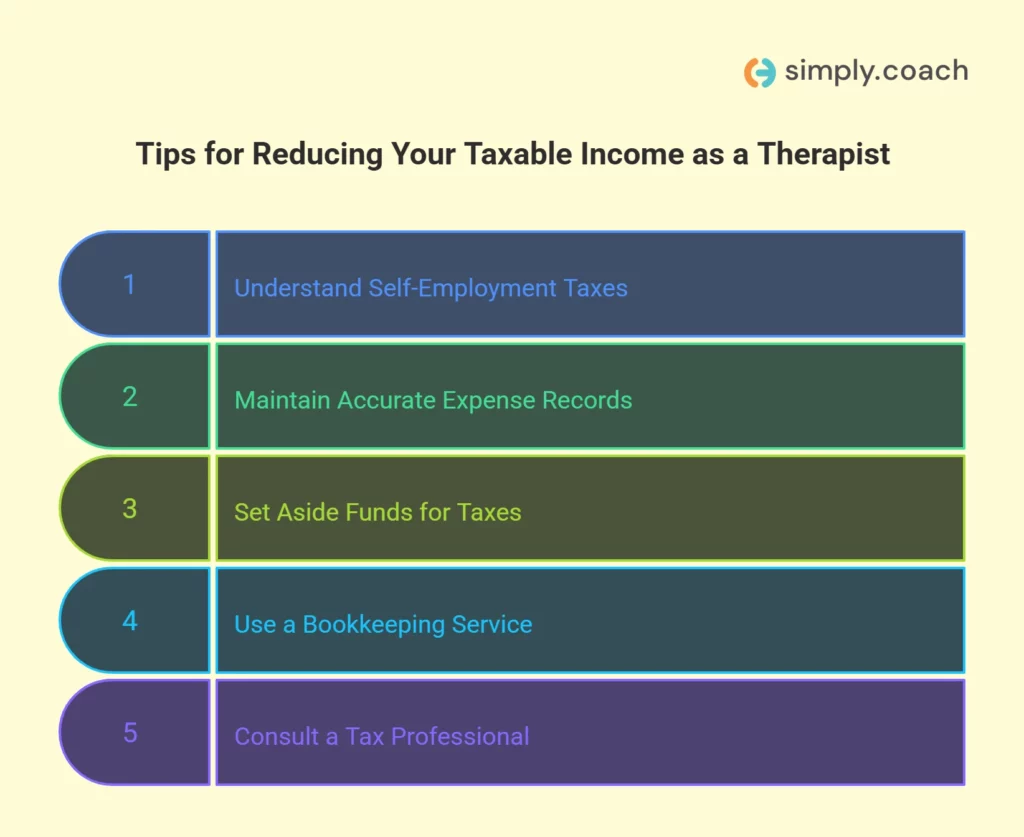
Proactive tax management can save you thousands each year. Beyond claiming deductions, strategic planning ensures you maximize savings while staying compliant. These steps make it easier to lower taxable income and manage cash flow throughout the year.
- Understand self-employment taxes: Familiarize yourself with Social Security and Medicare obligations to anticipate tax liabilities and plan accordingly.
- Keep accurate expense records: Track receipts, invoices, and payment logs for all business-related purchases to substantiate deductions.
- Set aside funds for taxes: Calculate your estimated tax rate and reserve money regularly to avoid surprises at filing time.
- Use a bookkeeping service: Professional bookkeeping keeps finances organized, ensures expenses are categorized correctly, and helps identify overlooked deductions.
- Consult a tax professional: Personalized guidance from a CPA or tax advisor ensures you maximize deductions, credits, and strategies specific to therapy practices.
With the right planning and documentation, you can reduce taxable income while maintaining clear and compliant financial records.
Also read: Effective Strategies to Grow Your Therapy Practice in 2026
Conclusion
Taxes might not be your favorite part of running a practice, but once you understand how tax deductions for therapists actually work, the process becomes far less intimidating. Everyday expenses, office tools, professional training, liability coverage, software, and even certain travel costs can quietly reduce your taxable income when they’re tracked correctly.
What usually slows you down isn’t the tax rules; it’s the mess around the paperwork. Receipts sitting in email threads, mileage tracked inconsistently, and expenses buried in bank statements can make tax prep unnecessarily frustrating. A well-organized practice makes tax season far less stressful, especially when your operational and financial data is already structured.
Simply.Coach, through their all-in-one HIPAA-compliant therapy practice management software, helps you streamline your practice using contracts, subscriptions & session packages, and prospect management, keeping client agreements, recurring revenue streams, and onboarding records centralized and easy to reference. With clear documentation and organized client lifecycle data throughout the year, preparing expense reports and identifying eligible deductions becomes far more straightforward.
FAQs
1. What expenses can therapists deduct from their taxes?
You can deduct expenses directly tied to running your practice, including office supplies, therapy tools, marketing, software subscriptions, professional memberships, continuing education, liability insurance, and travel for business purposes.
2. Can I deduct my health insurance premiums as a self-employed therapist?
Yes. Premiums for yourself, your spouse, dependents, and children under 27 can be deducted if you report net profit on Schedule C, are a partner with self-employment income, or a >2% S-corp shareholder.
3. Are continuing education costs tax-deductible?
Yes. Workshops, online courses, textbooks, professional publications, licensing exam fees, and travel for required training are deductible when they maintain or improve skills needed for your current therapy practice.
4. Can therapists deduct meals and travel expenses?
Yes. Business meals with clients or referral partners are 50% deductible. Travel expenses, airfare, lodging, rental cars, mileage, parking, and tolls are deductible when tied to conferences, training, or off-site client sessions.
5. Are professional memberships deductible?
Yes. Fees for associations like APA, ACA, NASW, state boards, and local therapy networks are deductible if they support professional development, networking, or licensure maintenance.
6. Can I claim home office or office rent expenses?
Yes. Rent or mortgage for your office, utilities, and a home office portion used exclusively for sessions or administrative work can be deducted. Keep clear measurements and records to support the deduction.
7. Are personal therapy sessions deductible?
Only if the therapy directly supports your professional development, coping strategies, or performance as a therapist. Personal counseling unrelated to your practice, family therapy, or couples counseling is not deductible.
8. Can I deduct software, tools, and professional liability insurance?
Yes. Practice management software, EHR systems, bookkeeping tools, therapeutic equipment, and professional liability insurance premiums are fully deductible when used for business purposes in your practice.