Companies across the United States are investing heavily in operational efficiency to stay competitive and protect margins. Labor data from 2026 shows process improvement and management analyst roles growing about 11% nationally. That growth reflects how critical your expertise has become inside complex, multi team large organizations.
You step in when workflows stall, deadlines slip, and leadership lacks clear visibility into root causes. Instead of guessing, you map current processes, gather data, and test targeted measurable structured improvements. You work directly with managers and frontline teams to ensure changes actually stick over time.
This guide explains what you do on a daily basis and how your impact is measured. You will see the core skills employers expect and the certifications that strengthen your credibility. It also breaks down salary ranges across the United States and outlines a path to enter and advance in process consulting.
Key Takeaways
- Process consultants improve operational efficiency: You analyze workflows, eliminate bottlenecks, and implement structured improvements that reduce cost, improve speed, and increase accountability.
- The role is growing nationally: Process improvement and management analyst roles are projected to grow around 11%, reflecting rising demand in complex, multi-team organizations.
- Core skills drive credibility: Process mapping, data analysis, Lean Six Sigma, change management, and stakeholder alignment are essential for measurable results.
- Certifications strengthen earning potential: Lean Six Sigma, PMP, and CBPP significantly improve job prospects and salary growth.
- Average U.S. salary is $107,182 (2026): Most professionals earn between $88,500 and $121,500, with top earners reaching $152,000+.
- Scale your consulting practice with Simply.Coach: The platform helps you systemize client delivery, track progress, and manage engagements efficiently, ensuring consistent, data-backed consulting outcomes.
What is a Process Consultant?
A process consultant is a professional who evaluates business workflows, identifies inefficiencies, and designs structured improvements that increase performance and reduce operational waste. You focus on how work moves across teams, systems, and decision points to ensure consistent, measurable results.
Your work centers on diagnosing operational gaps that affect cost, speed, and quality. You examine current processes in detail and compare them against expected outcomes. You then recommend practical adjustments that teams can implement without disrupting critical operations.
The core purpose of your role is simple and measurable. You help organizations run smoother, reduce avoidable expenses, and improve accountability across departments. Your success depends on delivering changes that show clear performance improvements over time.
What does a process consultant do?
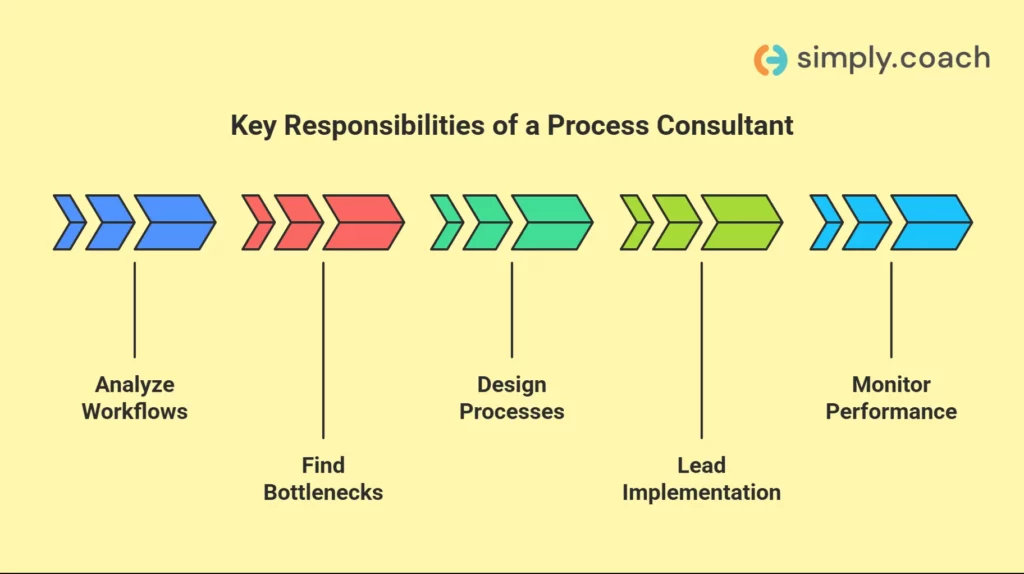
A process consultant typically:
- Analyzes business workflows: You examine how tasks move between departments, systems, and decision makers. You review documentation, shadow teams, and identify where handoffs break down.
- Identifies inefficiencies and bottlenecks: You look for duplicated work, approval delays, unclear ownership, and manual steps that slow execution. These gaps often increase costs and reduce team productivity.
- Designs optimized processes: You create structured workflows with clear responsibilities, defined timelines, and measurable checkpoints. Each process includes documented steps that teams can follow without confusion.
- Leads implementation initiatives: You work directly with managers and frontline teams to introduce changes. You facilitate workshops, clarify expectations, and address resistance during the transition phase.
- Monitors performance improvements: You track metrics such as cycle time, error rates, and cost reduction. Regular reviews ensure the improved process delivers consistent and sustained results.
These responsibilities together ensure that the improvements you implement deliver lasting impact, measurable results, and smoother operations across the organization.
Read: 23 Consulting Niches That Actually Make Money (And How to Choose Yours)
Key Skills Every Process Consultant Needs
To succeed as a process consultant, you must combine precise technical expertise with strong interpersonal abilities. Your effectiveness depends on applying tools correctly while influencing teams and stakeholders. Mastering the following skills ensures you deliver measurable improvements and gain credibility in your organization.
| Technical Skills | Soft Skills |
| Process mapping: Create clear visual workflows to highlight decision points, handoffs, and redundancies. | Facilitation: Guide cross-functional teams through discussions and workshops to reach consensus. |
| Data analysis: Interpret operational data to identify inefficiencies and prioritize improvements. | Stakeholder management: Engage managers and employees early to build support for changes. |
| Lean & Six Sigma: Apply structured methods to reduce waste and standardize high-quality outputs. | Change management: Communicate changes clearly and support adoption to ensure sustained results. |
| Project management: Plan initiatives with milestones, resource allocation, and risk tracking. | Strategic thinking: Link process improvements to organizational goals and measurable outcomes. |
| Workflow automation: Identify repetitive tasks and implement automated solutions for faster execution. | Communication & reporting: Share insights and results effectively with both technical and non-technical teams. |
When you combine these technical and soft skills, you not only identify and fix process inefficiencies but also guide teams effectively to adopt sustainable, measurable improvements.
Tools & Frameworks Used by Process Consultants
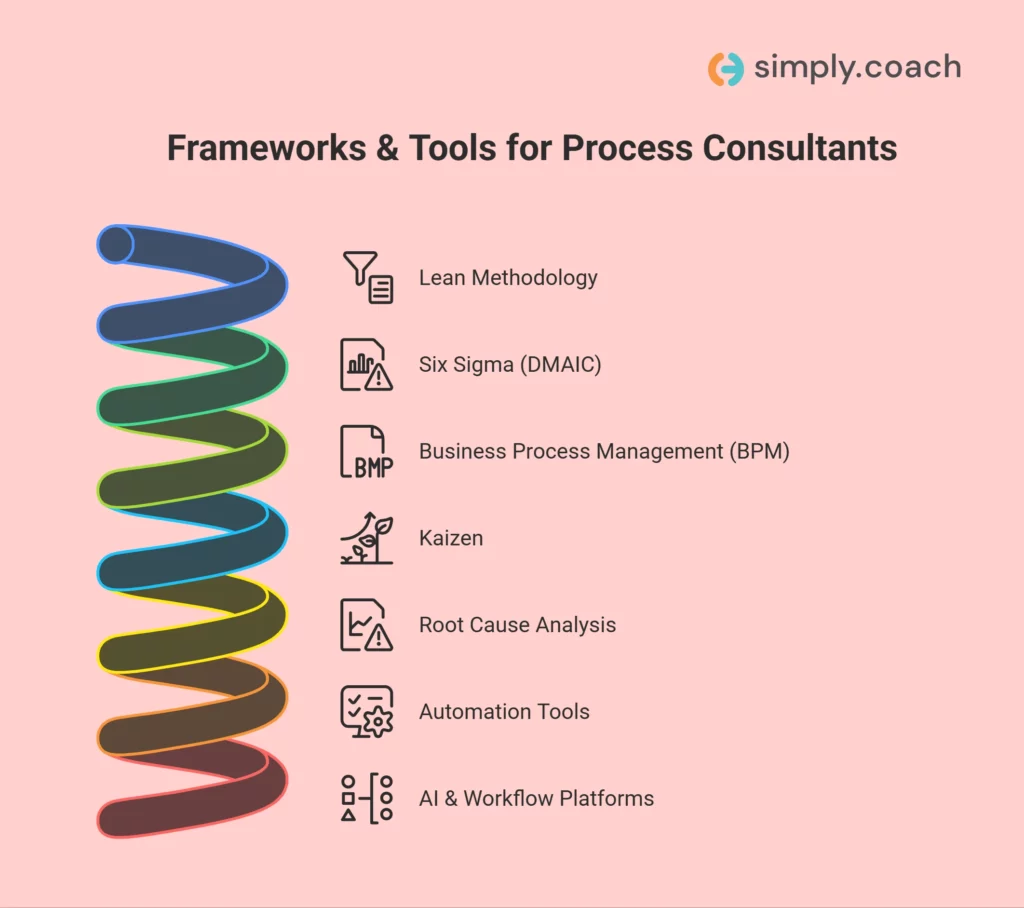
As a process consultant, the frameworks and tools you choose determine how effectively you can diagnose issues, implement improvements, and guide teams to adopt lasting changes. Each tool provides a structured method to analyze, optimize, and monitor processes.
1. Lean Methodology
Lean methodology helps you remove non-value-added steps and streamline workflows.
- Observe workflows carefully: You identify redundant steps, unnecessary approvals, and bottlenecks that slow down the team.
- Simplify process steps: You restructure workflows to make tasks clear and executable without confusion or wasted effort.
- Improve efficiency and consistency: Your changes reduce delays while maintaining quality standards across operations.
2. Six Sigma (DMAIC)
Six Sigma gives you a structured, data-driven approach to minimize errors and variation in processes.
- Collect and measure data: You track cycle times, error rates, and output quality to identify critical improvement areas.
- Analyze and improve processes: You apply the DMAIC framework to systematically reduce defects and enhance performance.
- Monitor results consistently: You ensure that changes produce predictable outcomes and can be repeated across teams.
3. Business Process Management (BPM)
BPM allows you to visualize, monitor, and improve workflows from start to finish.
- Map workflows end-to-end: You document every step, decision point, and handoff so teams understand the full process.
- Assign ownership and accountability: Clear responsibilities ensure that each part of the process is managed effectively.
- Track key performance indicators: You measure improvements to verify that changes deliver measurable results.
4. Kaizen
Kaizen focuses on small, continuous improvements that accumulate into substantial operational gains.
- Introduce incremental changes: You implement manageable adjustments that increase efficiency without disrupting work.
- Engage teams in improvement: You involve employees to encourage adoption and create ownership of new processes.
- Measure cumulative impact: You track small improvements over time to demonstrate visible, lasting benefits.
5. Root Cause Analysis
Root cause analysis ensures that recurring issues are addressed at their source.
- Identify underlying problems: You investigate why inefficiencies or errors happen rather than just fixing symptoms.
- Develop targeted solutions: You design interventions that remove the root cause and prevent future recurrence.
- Verify effectiveness: You monitor the process post-implementation to confirm that the issue is fully resolved.
6. Automation Tools
Automation toolshelp you remove repetitive manual work and increase process reliability.
- Set up automated workflows: You create systems for approvals, notifications, and task handoffs that run without manual intervention.
- Reduce human error: Automated steps ensure consistent execution and fewer mistakes.
- Free up team capacity: Teams can focus on analytical and strategic work instead of repetitive tasks.
7. AI & Workflow Platforms
AI and workflow platforms give you insights and predictive capabilities to optimize processes.
- Analyze process patterns: You identify inefficiencies, recurring bottlenecks, and workload imbalances.
- Predict potential issues: You anticipate delays or risks and implement corrective actions before they escalate.
- Measure and report improvements: You track metrics to ensure AI-driven insights translate into measurable performance gains.
These tools and frameworks give you the ability to analyze, optimize, and sustain process improvements while guiding teams toward operational excellence.
Related: Top 9 Business Consulting Platforms to Scale Your Business in 2026
How to Become a Process Consultant (Step-by-Step Roadmap)
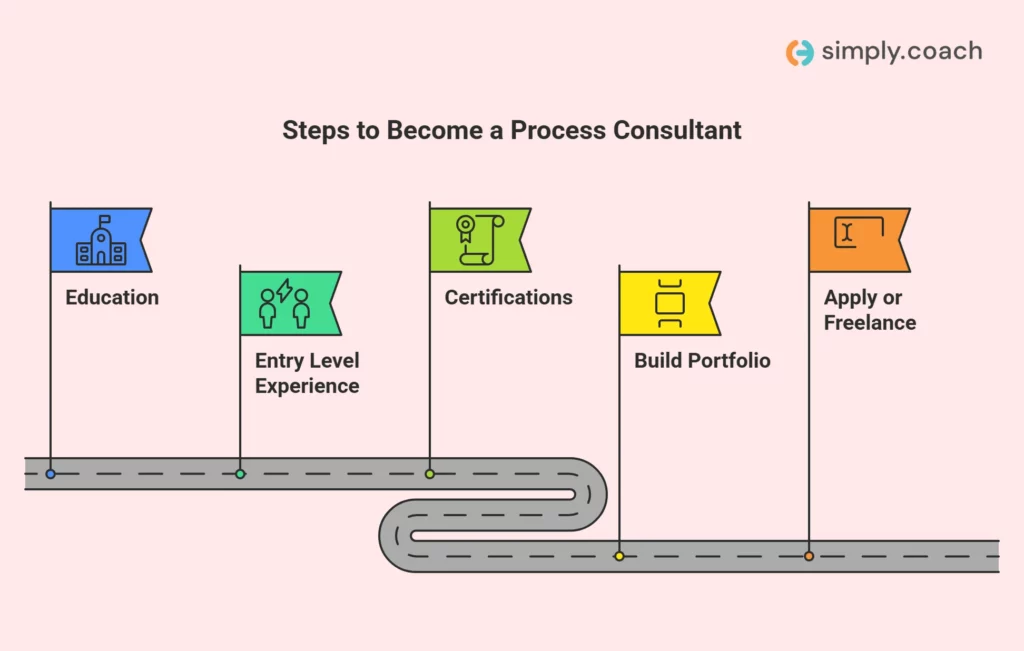
To build a successful career as a process consultant, you need a clear roadmap that combines education, real experience, professional credentials, demonstrable work examples, and strategic career moves. This step-by-step guide outlines exactly what to do at each stage to enter and advance in this field.
Step 1: Education
Your educational background sets the foundation for analytical thinking and an understanding of business operations. While there is no single degree requirement, certain fields prepare you better for process consulting work.
- Choose relevant majors: Degrees in business administration, industrial engineering, operations management, supply chain management, or systems engineering give you core knowledge of processes, workflows, and organizational systems. These programs teach you how operations connect across functions and how to evaluate performance metrics.
- Focus on analytical coursework: Take classes in statistics, data analysis, process design, and workflow optimization. These subjects prepare you to work with real data, evaluate process performance, and propose measurable improvements.
- Complement with business fundamentals: Courses in organizational behavior, communication, and leadership equip you with the skills needed to influence teams and stakeholders, a key part of consulting.
Your degree alone won’t make you a consultant, but it gives you a strong foundation to understand how process decisions impact business outcomes.
Step 2: Entry-level experience
To become effective in process consulting, you must develop real-world experience solving business problems and working within teams. Entry-level roles help you understand workflows from the inside and build credibility.
- Start in analyst roles: Positions like business analyst, process analyst, operations analyst, or quality analyst expose you to data collection, process mapping, and performance measurement. These roles teach you how to track KPIs, interpret trends, and identify areas for improvement.
- Gain project coordination experience: Roles in project coordination or project support help you understand how cross-functional work gets planned and executed. You learn scheduling, stakeholder communication, and how to manage multiple priorities, all essential consulting skills.
- Work in operational teams: Spend time working within operations, manufacturing, logistics, or service delivery teams. This direct experience gives you a grounded view of how processes behave in real conditions and what common challenges teams face.
- Document early wins: As you work, record specific improvements you contributed to, even small ones. These become the early evidence of your ability to improve processes, which you will use later in your portfolio.
Your first jobs should build your analytical mindset, comfort with data, and ability to work with operational teams, all core to the role you want to play as a consultant.
Step 3: Certifications
Certifications demonstrate your mastery of industry-recognized methods and tools. They improve your credibility with employers and clients and often impact your compensation.
- Lean Six Sigma Green Belt: This certification proves you can apply structured methods like DMAIC to reduce waste and improve quality. Lean Six Sigma teaches you how to define problems, measure performance, and implement solutions that yield measurable results. Most Green Belt programs include hands-on projects that you can later showcase.
- Project Management Professional (PMP): The PMP credential from PMI shows that you can manage complex initiatives, plan resource allocation, and ensure project delivery. As a process consultant, you often lead improvement projects that require coordination, planning, and risk management, all skills validated by PMP.
- Certified Business Process Professional (CBPP): Offered by ABPMP, CBPP focuses specifically on process management frameworks and best practices. This certification signals that you understand process architecture, performance measurement, and process governance, core competencies for your role.
- Other relevant certifications: Consider additional credentials such as Certified ScrumMaster (for Agile environments), data analytics certificates (e.g., Tableau, Power BI), or change management certifications (Prosci). These attest to complementary skills that make you more effective in complex engagements.
Choose certifications that match both your current skill level and the role you want to target next. Some professionals earn multiple credentials over time to build depth.
Step 4: Build portfolio
Your portfolio is your most powerful asset when entering process consulting. It demonstrates your ability to diagnose issues, design improvements, and deliver results, not just talk about them.
- Document real case studies: Capture specific problems you’ve solved, the analysis you performed, the solutions you implemented, and the measurable results achieved. Include before-and-after performance metrics like cycle time reduction, error rate improvement, or cost savings.
- Use structured storytelling: For each case study, write a concise problem statement, your approach, the tools you used (e.g., Lean, BPM, automation), the implementation steps, and the outcomes. This format makes your work easy to understand for prospective employers or clients.
- Include visuals: Process maps, performance dashboards, SIPOC diagrams, and data charts make your work tangible. Visual evidence strengthens your portfolio and shows your technical competence.
- Show diversity of experience: Include examples from different functions or industries if possible. A portfolio that shows you improved workflows in customer service, manufacturing, or IT demonstrates your versatility.
- Gather testimonials: Ask managers or stakeholders you worked with to provide brief recommendations or comments on your contributions. These validate your impact from another perspective.
A strong portfolio sets you apart from others with similar resumes but no demonstrable results. It shows not just what you can do, but that you have done it.
Step 5: Apply to consulting firms or start freelancing
Once you have education, experience, credentials, and a strong portfolio, you can choose your path forward, corporate consulting or independent practice.
- Target consulting firms: Apply to roles at management consulting firms, operational improvement practices, or specialized process excellence teams. Tailor your resume to highlight relevant case studies, certifications, and framework expertise. Interview preparation should focus on real examples of improvements you delivered.
- Join internal process excellence teams: Many mid-to-large companies have internal roles focused on operational improvement, continuous improvement, or process optimization. These roles give you stability and opportunities to work on cross-functional initiatives.
- Start freelancing or independent consulting: If you prefer autonomy, build your client base by offering process improvement services on a contract basis. Begin with small engagements focused on specific outcomes (e.g., reduce processing time, optimize approval workflows). Use your portfolio to market your services and secure referrals.
- Set pricing and engagement models: For freelancers, decide whether to charge hourly rates, value-based pricing (e.g., % savings), or flat fees for defined improvement packages. Clear pricing and engagement scopes reduce uncertainty and build trust with clients.
- Invest in professional networking: Join industry groups, attend process improvement conferences, and participate in online communities (LinkedIn groups, professional forums). Networking often leads to referrals and collaborations that accelerate your career.
Whether you join a firm or start on your own, your early engagements will shape your reputation. Focus on delivering measurable results quickly and building strong relationships with stakeholders.
Also read: A 12-Step Guide to Become a Successful Consultant in 2026
Salary, Career Growth, and Industries for Process Consultants in the United States
Process consulting offers strong earning potential, clear advancement pathways, and opportunities across multiple high-impact industries. Below is a structured breakdown of current salary data, long-term career progression, and the sectors where demand is strongest.
Salary overview (U.S. Data – 2026)
Compensation for process consultants reflects the measurable value they bring through efficiency improvements, cost reduction, and operational transformation.
- Average annual salary: $107,182 per year in the United States as of February 20, 2026.
- Hourly equivalent: Approximately $51.53 per hour based on the national average.
- Weekly equivalent: Around $2,061 per week.
- Monthly equivalent: Roughly $8,931 per month.
- Typical salary range: Most professionals earn between $88,500 (25th percentile) and $121,500 (75th percentile).
- Top earners (90th percentile): Can make up to $152,000 annually.
- Overall salary spectrum: Pay ranges from $44,500 to $170,500 depending on skill level, certifications, industry, and years of experience.
- Pay variation insight: A compensation gap of about $33,000 between the 25th and 75th percentile highlights strong opportunities for advancement and income growth.
These figures are based on national job market data aggregated by ZipRecruiter, which continuously scans millions of active job postings across the country.
Career growth opportunities
Process consulting provides a structured and scalable career trajectory, from analytical roles to executive leadership.
- Early career foundation: Start as a business analyst, process analyst, or operations specialist to build technical and analytical expertise.
- Mid-career advancement: Progress into senior consultant, continuous improvement manager, or transformation lead roles managing cross-functional initiatives.
- Strategic leadership roles: Move into director of operations, head of process excellence, or enterprise transformation positions.
- Executive pathway: Experienced professionals can advance to vice president of operations or chief operating officer roles, where enterprise-wide process strategy becomes central to business performance.
- Specialization-driven growth: Developing expertise in automation, Lean Six Sigma, digital transformation, or change management significantly increases market value and earning potential.
Industries that hire process consultants
Process consultants are in demand wherever operational efficiency directly impacts profitability, compliance, or scalability.
- Manufacturing: Optimize production workflows, quality control systems, and supply chain efficiency.
- Healthcare: Improve patient flow, administrative processes, and clinical coordination.
- Financial services: Strengthen compliance processes, reduce transaction errors, and enhance risk management systems.
- Technology: Refine product delivery cycles, agile workflows, and service operations.
- Logistics, retail, government, and professional services: Drive enterprise-wide operational improvements and cost optimization initiatives.
Together, competitive compensation, long-term growth potential, and cross-industry demand make process consulting a financially attractive and strategically powerful career choice.
Also read: How to Set and Raise Your Consulting Rates Successfully
Conclusion
As a process consultant, your value lies not just in identifying inefficiencies but in driving measurable change that improves performance and delivers results. This career path blends structured analytical skills with practical implementation expertise, offering rewarding opportunities across industries where operational excellence matters most. With the right education, experience, frameworks, and tools, you can advance into senior leadership roles that shape how organizations run. Keep refining your skills, documenting real outcomes, and focusing on impact as the core of your consulting practice.
As you scale your consulting practice, having the right infrastructure matters. Simply.Coach offers a comprehensive business growth consulting platform designed for professionals like you, who want to systemize delivery, track client progress, and manage engagements in one secure platform.
From structured client journeys and goal tracking to automated contracts, invoicing, and performance dashboards, it helps you operationalize your consulting model. Instead of juggling spreadsheets and scattered tools, you can deliver consistent, scalable, and data-backed consulting experiences, exactly what high-performing process consultants need to grow sustainably.
FAQs
1. Is process consultant a good career?
Yes, process consulting offers strong six-figure earning potential along with consistent cross-industry demand. It also provides long-term career growth into leadership and operational strategy roles.
2. How long does it take to become a process consultant?
It typically takes 3–5 years, including gaining relevant analyst or operations experience. Certifications and delivering measurable project results can significantly accelerate your progression.
3. What skills are required to become a process consultant?
Core skills include process mapping, data analysis, structured problem-solving, and stakeholder management. Strong KPI-driven thinking and change management capabilities further enhance your effectiveness.
4. What is the difference between a business analyst and a process consultant?
A business analyst focuses primarily on gathering requirements and analyzing data within defined projects, whereas a process consultant improves end-to-end workflows and leads implementation across functions.
5. Is Lean Six Sigma required to become a process consultant?
Lean Six Sigma is not mandatory, but it is highly preferred by many employers. Earning a Green Belt or higher can significantly improve your job prospects and salary potential.