
You sit with a client who keeps repeating the same problem story in every session. Despite your effort, their perspective stays fixed, and progress feels slow. You ask thoughtful questions, yet the narrative remains unchanged, leaving you searching for a more structured way to intervene.
This is where narrative therapy techniques become essential in your practice. These techniques help you separate the person from the problem and guide clients toward alternative, empowering stories. They give you a clear framework to move beyond passive listening and actively reshape how clients interpret their experiences.
In this blog, you will explore practical narrative therapy techniques and interventions you can apply directly in your sessions. You will learn when to use each technique, how to implement it effectively, and how to adapt it for different client challenges.
Key Takeaways
- Narrative therapy helps clients separate themselves from problems and rewrite empowering life stories.
- Techniques like externalization, re-authoring, and identity reframing guide clients toward insight and actionable change.
- Unique outcomes, double listening, and timeline reconstruction reveal strengths and exceptions to dominant problem narratives.
- Metaphors, storytelling, and therapeutic documentation deepen reflection and promote client engagement between sessions.
- Structured best practices ensure interventions are sequenced, client-centered, and adaptable across diverse needs.
- Avoid common mistakes like overloading techniques, forcing narratives, or ignoring cultural and relational context.
- Simply.Coach supports narrative therapy by centralizing records, tracking goals, and providing secure, efficient practice management.
What Is Narrative Therapy?
Narrative therapy is a collaborative approach that helps you understand how your client’s stories shape their identity and behavior. It focuses on separating the person from the problem so clients can see their experiences with more clarity. This shift allows you to explore how certain narratives have been formed and reinforced over time.
In your sessions, you guide clients to examine the dominant stories they tell about themselves and their lives. These stories often carry limiting beliefs that influence emotions, decisions, and relationships. Narrative therapy helps you uncover these patterns and create space for alternative, more helpful perspectives.
Instead of diagnosing or labeling, you work with clients to rewrite their narratives in a way that reflects their strengths and values. This approach builds a sense of agency and helps clients move forward with greater confidence. It also creates a structured yet flexible framework you can adapt across different therapeutic contexts.
Why narrative therapy techniques matter for therapists
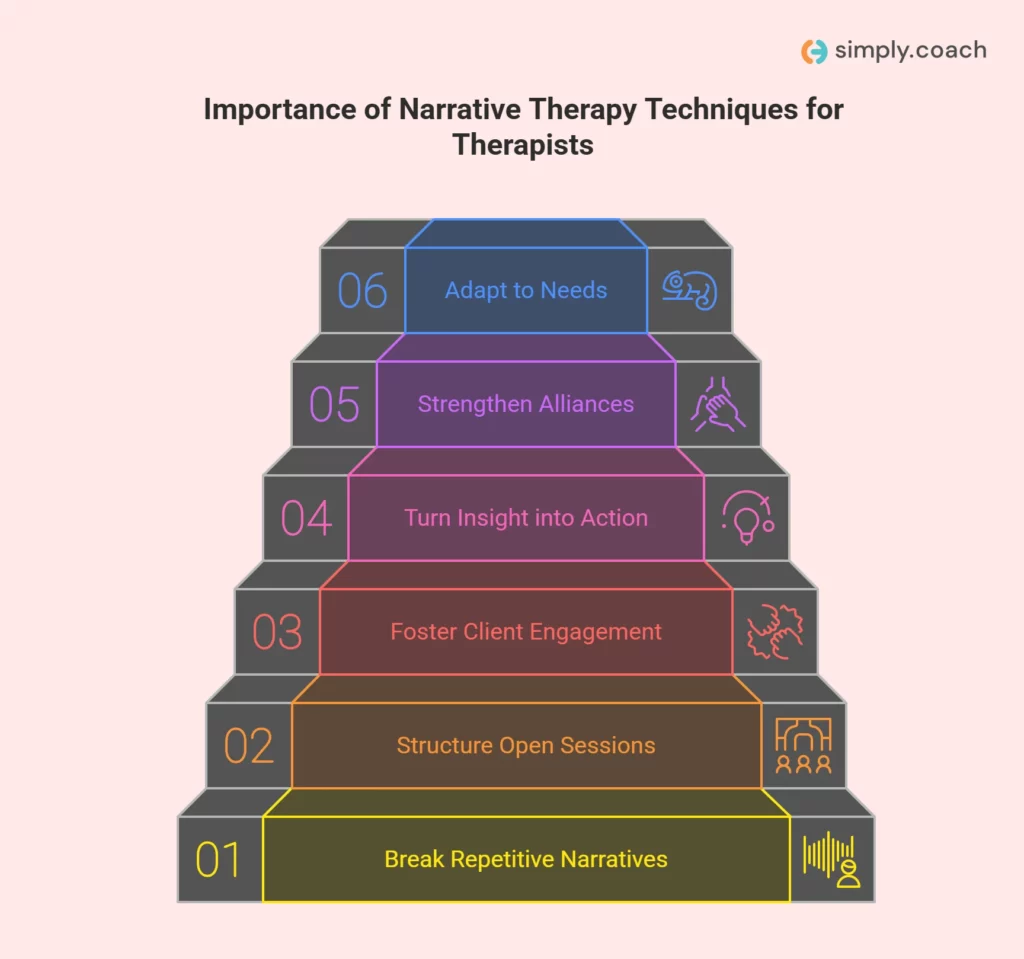
In your practice, you often need more than active listening to create meaningful change for your clients. Narrative therapy techniques give you structured ways to guide conversations and shift client perspectives effectively.
- Breaks repetitive client narratives: You often hear the same problem story repeated across sessions without meaningful change or progress. Narrative techniques help you interrupt these patterns and introduce new perspectives that shift how clients view their experiences.
- Brings structure to open-ended sessions: Some sessions can feel directionless when clients struggle to articulate thoughts or emotions clearly. These techniques give you a clear framework to guide conversations while still keeping the process flexible and client-centered.
- Supports deeper client engagement: Clients engage more actively when they feel heard beyond surface-level problems and symptoms. Narrative approaches help you involve them in reshaping their own stories, increasing participation and emotional investment.
- Moves beyond insight to actionable change: Insight alone does not always lead to behavioral or emotional change in therapy. These techniques help you translate awareness into practical shifts in thinking, identity, and decision-making patterns.
- Strengthens therapeutic alliance: You position yourself as a collaborator rather than an authority who provides solutions or fixes problems. This builds trust and encourages clients to take ownership of their growth and progress.
- Adapts across diverse client needs: You can apply narrative techniques across various concerns, including trauma, anxiety, and identity-related challenges. This flexibility makes them a valuable addition to your existing therapeutic toolkit.
When you apply these techniques consistently, you create sessions that are more focused, engaging, and outcome-driven for your clients.
Also read: Conflict Resolution Therapy: 6 Techniques, Benefits & Training Methods
12 Core Narrative Therapy Techniques and Interventions
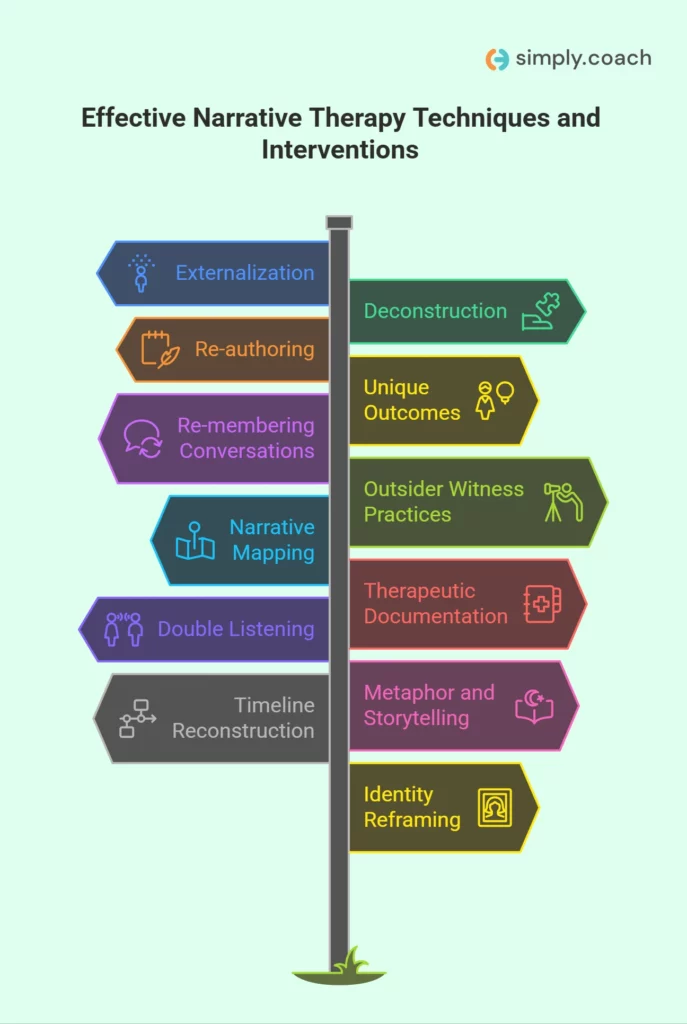
You may notice that some clients understand their problems clearly, yet their story does not shift in a meaningful way. Sessions start to feel repetitive, and your usual questions stop creating new insight. This is where having specific narrative therapy techniques helps you guide the conversation with more precision and intent.
1. Externalization (Separating the person from the problem)
Externalization helps you guide clients to see the problem as something affecting them, not defining them. This shift reduces shame and allows clearer reflection. You can use this technique to help clients gain control over issues rather than feeling overwhelmed.
- Encourage clients to describe the problem as an external force.
- Reflect statements back in a way that separates the person from the issue.
- Highlight how the problem influences thoughts, emotions, and actions.
- Maintain a supportive and non-judgmental tone throughout the session.
Example: A client says, “I am anxious all the time.” You might reframe it as, “It sounds like anxiety has been influencing your daily life lately.” This allows the client to step back and examine the problem objectively.
You can ask questions like:
- “When did anxiety start influencing your decisions?”
- “In what situations does this problem appear most strongly?”
- “How does this problem try to control your actions?”
Use this technique with clients dealing with anxiety, trauma, shame, or identity-related concerns. It works best when clients feel defined by their struggles.
2. Deconstruction
Deconstruction helps you break down rigid narratives that clients may accept as absolute truths. It allows clients to examine beliefs formed by past experiences, family influence, or cultural expectations. Applying this technique encourages exploration of alternative interpretations and flexibility in thinking.
- Guide clients to explore how their beliefs were formed and reinforced over time.
- Use reflective and layered questioning instead of direct confrontation.
- Highlight inconsistencies or gaps in the dominant narrative.
- Maintain a collaborative tone that promotes curiosity rather than defensiveness.
Example: A client says, “I always fail because I’m not capable.” You might explore, “What messages from your family or past experiences made you feel this way?” This opens the story to alternative perspectives.
You can ask questions like:
- “Who taught you to see yourself this way?”
- “What evidence supports this belief?”
- “Are there moments where this story does not fully apply?”
Use this technique with clients struggling with long-held limiting beliefs, family narratives, or socially reinforced assumptions. It helps clients gain perspective and create space for new interpretations.
3. Re-authoring (Rewriting the narrative)
Re-authoring allows you to help clients build alternative, empowering stories that reflect their strengths. This technique connects past achievements and coping experiences to their present identity. Using re-authoring, clients can shift from feeling stuck to seeing themselves as capable and resilient.
- Identify patterns in the client’s dominant story that limit their perspective.
- Highlight past successes or moments of resilience that contradict negative beliefs.
- Collaborate with clients to imagine a preferred or alternative story.
- Encourage integration of new perspectives into daily life and decision-making.
Example: A client says, “I always fail.” You can reframe it as, “You have handled difficult situations before and found ways to succeed.” This reframing helps them see evidence of capability.
You can ask questions like:
- “What does your preferred story look like?”
- “What strengths helped you in similar situations?”
- “How would this new story change how you respond to challenges?”
Use this technique with clients focused on identity work, building self-confidence, or recovering from setbacks. It works well when negative self-beliefs dominate their narrative.
4. Unique outcomes (Spark moments)
Unique outcomes focus on identifying exceptions to the client’s problem story. This technique helps clients recognize moments when the problem was less influential or absent, highlighting strengths and resilience they may overlook.
- Encourage clients to recall specific moments that contradict their dominant problem narrative.
- Emphasize patterns of success, calm, or control that show the problem does not define them.
- Integrate these exceptions into broader discussions about coping and personal agency.
- Reinforce client recognition of small but meaningful victories.
Example: A client who feels “always anxious” can be guided to explore times of calm or control, like completing a task without fear. These moments become building blocks for change.
You can ask questions like:
- “Can you recall a time when this problem was less present?”
- “What was different in that moment?”
- “How can you use this experience to approach similar situations?”
Use this technique with clients experiencing depression, anxiety, or self-doubt. It is particularly helpful when clients focus on persistent negative patterns and overlook successes.
5. Re-membering conversations
Re-membering conversations help you guide your clients to rebuild their sense of identity through the relationships that matter most. This technique allows you to explore the supportive figures in their life and how these connections shape their preferred story. You use this to highlight how relationships reinforce resilience and personal values.
- Invite clients to reflect on people who have witnessed their strengths or supported them in challenging moments.
- Help clients consider how these relationships contribute to their identity and sense of agency.
- Encourage discussion about what they value in these relationships and how it reinforces their preferred story.
- Integrate insights from these reflections into the client’s ongoing narrative and goals.
Example: A client struggling with self-doubt may describe a family member who always believed in them. You can help them say, “My aunt always noticed when I persevered, even when I didn’t see it myself,” reinforcing a positive identity.
You can ask questions like:
- “Who in your life has seen you at your strongest?”
- “What would they say about your strengths?”
- “How have these relationships influenced how you see yourself?”
Use this technique with clients rebuilding identity after trauma, navigating grief, or seeking to strengthen self-esteem through meaningful relationships.
6. Outsider witness practices
Outsider witness practices allow you to help clients gain perspective by hearing their story reflected through others. You use this in group sessions or role-play exercises to validate experiences and highlight strengths clients may overlook. This method helps clients see themselves from a supportive external viewpoint.
- Select individuals or groups who can listen empathetically and provide feedback without judgment.
- Encourage clients to share their story in a structured way, focusing on experiences and coping strategies.
- Reflect back key strengths and unique outcomes highlighted by the witnesses.
- Use the feedback to reinforce resilience and alternative narratives within the client’s story.
Example: During a group session, a client shares their struggle with anxiety, and peers note how the client manages challenges daily. This reflection can help the client recognize strengths they had overlooked.
You can ask questions like:
- “What stood out to you from what the witness said?”
- “How does hearing your story through someone else’s perspective feel?”
- “Which strengths were highlighted that you hadn’t noticed?”
Use this technique with clients in group therapy or coaching settings, especially when they benefit from validation, social support, or seeing strengths they cannot identify on their own.
7. Narrative mapping
Narrative mapping allows you to help clients visualize the influence of problems and their responses across different areas of life. You can guide clients in creating diagrams, timelines, or flowcharts that reveal patterns, triggers, and moments of agency. This makes abstract problems concrete and actionable.
- Work with clients to chart how the problem shows up in different contexts, such as work, relationships, or self-perception.
- Identify areas where the client successfully resisted or managed the problem.
- Highlight connections between events, thoughts, and behaviors to reveal patterns.
- Use the map as a visual tool to set goals and track progress over time.
Example: A client struggling with self-criticism may map how critical thoughts arise at work, during social interactions, and in private reflection. You can then identify moments where the client responded differently, reinforcing agency.
You can ask questions like:
- “Where does this problem affect your daily life the most?”
- “When have you successfully resisted or managed it?”
- “How does seeing this mapped pattern help you plan your next steps?”
Use this technique with clients facing complex or long-standing challenges, such as anxiety, trauma, or recurring self-critical thoughts. It works well when you want to make abstract patterns visible and actionable.
8. Therapeutic documentation (Letters & notes)
Therapeutic documentation allows you to extend the impact of your sessions beyond the room. You guide clients to write letters or notes, either to themselves or to significant others, reinforcing insights, strengths, and preferred narratives. This approach makes progress tangible and provides a tool for reflection between sessions.
- Encourage clients to write about their experiences, feelings, and the ways they are overcoming challenges.
- Use letters to summarize key insights from sessions or to highlight coping strategies.
- Help clients reflect on patterns and achievements they may have overlooked.
- Integrate written reflections into ongoing discussions to track growth over time.
Example: A client struggling with self-doubt might write a letter to their future self: “I recognize the small victories I’ve achieved this week, even when I doubted myself.” This reinforces their resilience and reframes the narrative.
You can ask questions like:
- “What would you like to remind yourself after this session?”
- “Which strengths do you want to acknowledge in writing?”
- “How can documenting your experience help you approach challenges differently?”
Use this technique with clients who benefit from reflection, reinforcement, or processing emotions outside of therapy sessions. It works well for self-esteem building, identity exploration, and anxiety management.
Read: How to Write Group Therapy Notes: Examples, Templates & Best Practices
9. Double listening
Double listening allows you to hear both the problem and the client’s strengths simultaneously. You can guide clients to recognize resilience, coping strategies, and moments of agency even while they describe difficulties. This helps you highlight strengths hidden within struggles.
- Listen carefully for moments that contradict the dominant problem story.
- Reflect both the challenges and the coping strategies the client demonstrates.
- Encourage clients to notice patterns of strength in situations they consider problematic.
- Use these observations to gradually reframe the client’s narrative in a balanced way.
Example: A client describing repeated anxiety episodes might also note times they managed a difficult situation calmly. You can highlight these moments: “Even in stressful moments, you found ways to manage your response.”
You can ask questions like:
- “What strengths do you notice when describing this situation?”
- “When has this problem been less controlling than usual?”
- “How did you handle similar challenges before?”
Use this technique with clients experiencing trauma, crisis, or recurring challenges. It works best when clients focus on problems but have hidden strengths that need to be acknowledged.
10. Metaphor & storytelling techniques
Metaphor and storytelling help you translate complex emotions or experiences into symbolic language. This allows clients to engage creatively, uncover insights, and see their problems from new perspectives. You can use metaphors to make abstract issues concrete and relatable.
- Encourage clients to describe their experiences using metaphors or stories.
- Explore the symbolic meaning behind the metaphor to reveal beliefs, feelings, or patterns.
- Help clients connect the story to their preferred identity or future goals.
- Reflect on metaphors to identify insights, exceptions, or strengths within the client’s narrative.
Example: A client feeling overwhelmed might describe their anxiety as “carrying a heavy backpack.” You can explore the metaphor: “What’s in the backpack, and how can we lighten it?” This helps them visualize control and change.
You can ask questions like:
- “If this problem were a character, what would it look like?”
- “What story represents how you handle this challenge?”
- “How does this metaphor help you see a different perspective?”
Use this technique with clients who struggle to articulate emotions directly, including children, emotionally blocked adults, or those exploring creative ways to process experiences.
11. Timeline reconstruction
Timeline reconstruction helps you guide clients in mapping life events, turning points, and patterns to understand how their story has evolved over time. This technique allows clients to see cause-and-effect relationships, recognize growth, and identify moments of resilience that might otherwise be overlooked.
- Work with clients to create a chronological map of significant life events and experiences.
- Highlight moments when they managed challenges successfully or made meaningful choices.
- Encourage reflection on how past experiences have shaped current beliefs and behaviors.
- Use the timeline to identify recurring patterns, triggers, and opportunities for change.
Example: A client struggling with trauma might map experiences of stress across childhood and adulthood. You can guide them to note moments where they overcame obstacles, helping them see continuity in resilience.
You can ask questions like:
- “Which past experiences shaped the way you respond to challenges today?”
- “Can you identify moments where you handled difficulties differently?”
- “How does seeing your story on a timeline help you understand your growth?”
Use this technique with clients experiencing trauma, life transitions, or long-standing behavioral patterns. It works best when you want to make abstract experiences concrete and highlight progress over time.
12. Identity reframing
Identity reframing allows you to help clients shift how they perceive themselves and their capabilities. You guide clients in exploring self-concepts that go beyond the problem, emphasizing strengths, values, and preferred ways of being. This technique fosters empowerment and supports lasting change in self-perception.
- Encourage clients to describe themselves without reference to the problem.
- Highlight qualities, achievements, and behaviors that contradict limiting beliefs.
- Collaborate on constructing a self-narrative that reflects strengths and preferred identity.
- Reinforce the new narrative consistently throughout sessions to strengthen internalization.
Example: A client who believes, “I am broken,” can reframe to, “I am someone who has overcome challenges and continues to grow.” This shift empowers them to act from strength rather than limitation.
You can ask questions like:
- “How would you describe yourself if this problem didn’t define you?”
- “Which personal strengths have helped you overcome challenges in the past?”
- “What would your preferred self-story look like?”
Use this technique with clients struggling with shame, low self-esteem, or rigid self-concepts. It works best when clients are ready to explore alternative ways of understanding themselves.
Best Practices for Applying Narrative Therapy Techniques
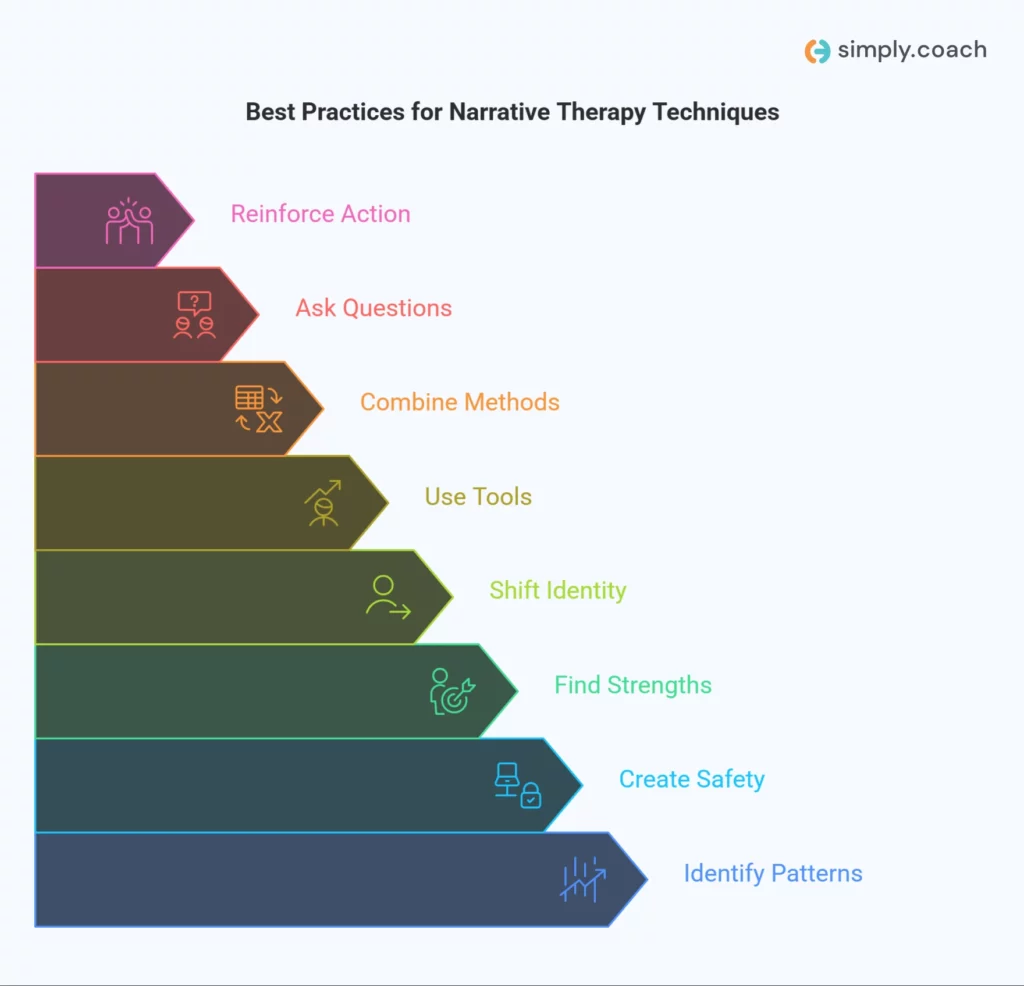
To make narrative therapy effective in your sessions, it’s essential to follow structured best practices. These strategies help you select the right technique, sequence interventions thoughtfully, and ensure clients experience meaningful change.
- Understand the client’s narrative patterns
Observe whether the client is stuck in rigid beliefs, overwhelmed by the problem, or struggling to recognize their strengths. This assessment guides you in selecting the most appropriate techniques. - Start with techniques that create safety and perspective
Begin sessions with externalization or deconstruction to separate the client from the problem and open space for reflection. Establishing emotional safety is key before deeper interventions. - Identify exceptions and hidden strengths
Use unique outcomes or double listening to uncover moments when the client has successfully managed challenges. Highlight these to reinforce resilience and show that the problem does not define their identity. - Focus on identity and preferred narratives
Apply re-authoring or identity reframing to help clients construct empowering stories. Connect past strengths to present growth and guide clients toward an internalized sense of agency. - Incorporate visual and reflective tools
Techniques like narrative mapping, timeline reconstruction, letters, or metaphors help clients visualize problem patterns, track progress, and engage creatively with their narrative. - Sequence and combine techniques strategically
Layer interventions to deepen impact. For example, start with externalization, highlight unique outcomes, and finish with identity reframing or storytelling. This ensures sessions remain structured, yet flexible. - Use guided questions to deepen insight
Ask reflective questions that prompt awareness and action, such as:- “Which experiences today feel most important to explore?”
- “What strengths have helped you navigate similar challenges?”
- “How might reframing this problem change your next steps?”
- Reinforce insights and encourage application
Summarize key learnings at the end of each session and encourage clients to apply their new perspectives in real-life situations. Reinforcement ensures that narrative shifts are internalized and actionable.
Common Mistakes to Avoid While Using Narrative Therapy Techniques
Even experienced therapists can inadvertently reduce the impact of narrative therapy if certain pitfalls are overlooked. Being aware of these mistakes ensures that your interventions remain effective, client-centered, and empowering.
- Over-identifying with the client’s problem: When you adopt the client’s problem perspective too closely, you risk reinforcing their sense of being defined by it. Maintain emotional distance while showing empathy to help clients observe the problem objectively.
- Using techniques mechanically or rigidly: Applying interventions as a checklist or formula can make sessions feel scripted. Techniques should be adapted to the client’s unique story, pacing, and emotional readiness. Flexibility is key.
- Ignoring the client’s preferred story: Forcing a “positive” narrative or reframing too quickly can feel artificial. Always explore the client’s own values, experiences, and goals before shaping their preferred story.
- Overloading the client with multiple techniques: Introducing too many techniques in one session can overwhelm clients and dilute the focus. Sequence interventions strategically and integrate them gradually based on client readiness.
- Failing to follow up on insights: Insights without reinforcement often fade. Ensure that reflections, letters, timelines, or metaphors are revisited and integrated into ongoing sessions to make the narrative shifts stick.
- Neglecting relational and cultural context: Dominant narratives often stem from family, cultural, or societal influences. Ignoring these factors can limit understanding and reduce relevance. Always consider context when deconstructing and reframing stories.
By being mindful of these common mistakes, you can apply narrative therapy techniques more effectively, strengthen client engagement, and promote lasting change.
Conclusion
Narrative therapy empowers clients to rewrite their stories, separate themselves from problems, and recognize hidden strengths. By applying techniques like externalization, re-authoring, and identity reframing, you can guide clients toward meaningful change. Structured interventions, combined with reflective exercises, help uncover new perspectives and build resilience. Using these strategies consistently ensures sessions are purposeful and client-focused.
Simply.Coach for Narrative Therapy
Simply.Coach is an all-in-one therapy practice management software that helps you focus on clients while managing your practice efficiently. It supports the structured application of narrative therapy techniques.
- Centralized client information: Store session notes, goals, and reflections in one secure place.
- Goal setting and planning: Link narrative interventions to client objectives and track progress.
- Digital tools and forms: Create worksheets and exercises clients can complete between sessions.
- Progress tracking and reporting: Generate insights on how techniques impact client growth.
- Automated scheduling and reminders: Reduce no-shows and maintain consistent engagement.
- Shared client workspaces: Let clients access resources, exercises, and session summaries securely.
- Secure and compliant environment:Protect client data with HIPAA, SOC2, and GDPR standards.
Simply.Coach helps you implement narrative therapy effectively while reducing administrative tasks and keeping sessions client-focused.
FAQs
1. What are narrative therapy techniques?
Narrative therapy techniques are methods therapists use to help clients separate themselves from problems and reshape life stories. They focus on externalizing issues and building preferred narratives that reflect clients’ strengths and values.
2. How does externalization work in narrative therapy?
Externalization helps clients view the problem as separate from themselves, reducing self‑blame and increasing choice. It makes the issue something the client can examine and respond to rather than internalize.
3. What is re‑authoring in narrative therapy?
Re‑authoring involves guiding clients to rewrite their dominant story into alternative narratives that highlight strengths, values, and agency. This supports identity change and more adaptive self‑perception.
4. When should a therapist use unique outcomes?
You use unique outcomes to help clients identify moments where the problem was less present or absent, revealing patterns of resilience. This reinforces strength and opens the door to new narratives.
5. Is narrative therapy effective for trauma?
Yes. Narrative therapy helps clients reframe trauma narratives by separating the person from the experience and exploring alternative meanings or exceptions. This can decrease distress and promote self‑agency.
6. What is deconstruction in narrative therapy?
Deconstruction involves breaking down complex stories into smaller parts to clarify underlying beliefs, assumptions, and social influences shaping the problem narrative. It enhances insight and expands perspective.
7. How do narrative therapists help clients find preferred stories?
Therapists guide clients to explore alternative experiences, values, and exceptions that contradict limiting narratives. Clients build preferred stories that support their goals, strengths, and future possibilities.