
As a coach, you know how challenging it can be to keep clients motivated throughout their coaching journey. Clients often start strong but can quickly lose momentum, which leads to missed sessions, lack of progress, and ultimately unmet goals. This isn’t just about willpower, it’s about understanding what drives sustained motivation and how to effectively apply those strategies in your coaching.
Motivation for coaches is crucial, but it’s equally important to understand how to use that motivation to engage your clients and keep them on track. When clients stay motivated, they take consistent action, set clear goals, and ultimately achieve success. Without it, your coaching efforts may go off course, affecting client satisfaction and the overall effectiveness of the coaching process.
In this blog, we’ll explore key motivational strategies that can help you boost client engagement, keep them focused on their goals, and help them achieve lasting success. You’ll discover actionable tips and avoidable pitfalls to ensure that your clients stay motivated and committed to their journey.
Key Takeaways
- Motivation for coaches is crucial but ensuring client motivation is vital for their success, helping them stay focused, engaged, and committed to their goals.
- Break down large goals into manageable steps, use visualization techniques, and implement frameworks like WOOP to boost motivation and overcome obstacles.
- A lack of motivation can lead to stalled progress, burnout, missed opportunities, and strain on client relationships.
- Simply.Coach tools help streamline goal-setting, track progress, automate reminders, and create personalized action plans, ensuring client motivation stays strong.
- To maintain motivation, encourage a growth mindset, reframe limiting beliefs, and use social support to help clients stay on track.
What is Motivation in Coaching?
Motivation in coaching refers to the internal and external factors that drive your clients to take action, pursue their goals, and stay committed throughout the coaching process. It’s the force that helps them to keep moving forward, even when faced with challenges, and ensures they stay focused on achieving meaningful and measurable outcomes. Motivation is essential for initiating action and maintaining progress, and as a coach, understanding how to cultivate it in your clients is crucial for driving success and long-term growth.
When clients are motivated, they’re more likely to set clear goals, tackle obstacles with persistence, and ultimately achieve the success they’re striving for. As a coach, your role is not just to guide them but to help ignite and sustain that motivation in a way that fuels continuous progress.
Know more: How to Become a Motivational Coach
Why motivation In coaching is important
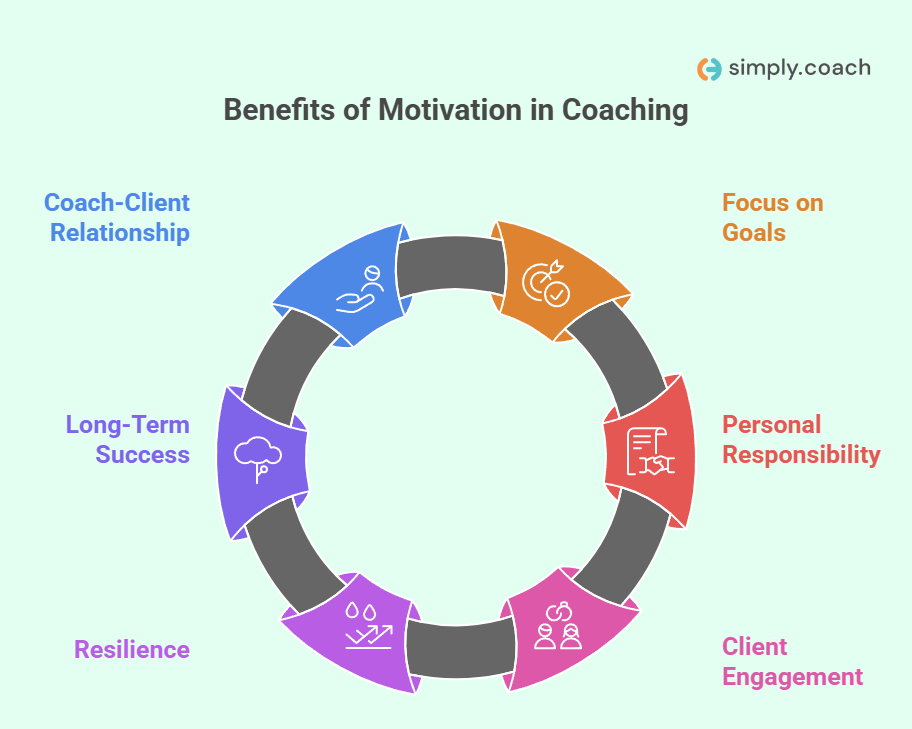
Motivation is the engine that drives both you and your clients to success. It shapes the entire coaching journey, influencing how clients set goals, engage with the process, and ultimately achieve lasting results. Without motivation, coaching efforts can stagnate, leaving clients feeling stuck and coaches feeling frustrated. Here’s why motivation is so crucial in coaching:
- Motivation helps clients stay focused on their goals: When your clients are motivated, they’re more likely to stay committed to their goals, even when faced with challenges or distractions.
- It fosters a sense of personal responsibility: Motivation encourages your clients to take ownership of their actions and decisions, making them more accountable for their success.
- It enhances client engagement: Motivated clients are more likely to show up for sessions, complete assignments, and actively engage in the coaching process, ensuring consistent progress.
- Motivation fuels resilience: A motivated client is better equipped to handle setbacks and obstacles. Motivation strengthens their ability to persevere and stay focused on their end goals.
- It supports long-term success: Motivation drives not only short-term action but also long-term commitment. When your clients are motivated, they are more likely to achieve lasting success and continue growing even after coaching ends.
- It improves the coach-client relationship: When clients are motivated, there’s better collaboration between you and your client. Motivation fosters trust, leading to a more productive and positive coaching dynamic.
Also read: Client Engagement in Coaching: Best Practices for Better Results
How Lack of Motivation Affects Clients
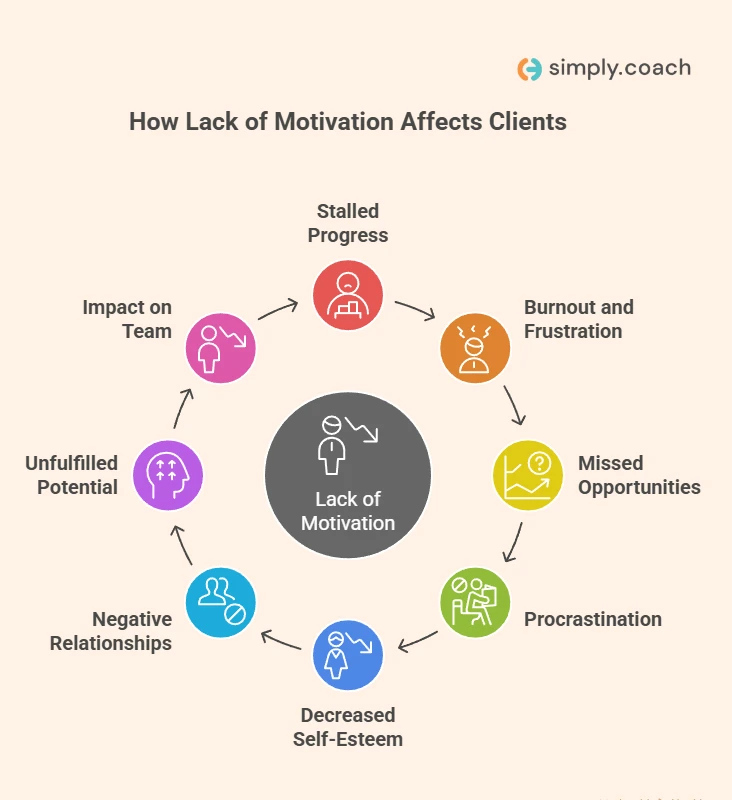
As a coach, you’re likely aware that when clients lose motivation, it can seriously impact their progress. Without consistent drive, they may face several setbacks. Here’s how a lack of motivation can affect your clients:
- Stalled progress: When motivation wanes, clients often fail to take consistent action, leaving their goals incomplete and progress stalled. This lack of forward movement can be discouraging and hinder their long-term success.
- Burnout and frustration: Disengagement can lead to feelings of burnout, stress, and frustration. Without motivation, clients can lose confidence in themselves and the process, which can significantly lower their drive to continue.
- Missed opportunities: Unmotivated clients are likely to avoid tasks, procrastinate, or even miss key opportunities for growth. This can prevent them from reaching their full potential and achieving the goals you’ve set together.
- Procrastination and task avoidance: Lack of motivation often results in procrastination, with clients avoiding critical tasks or pushing them aside. Over time, this avoidance can snowball, making it harder for them to get started and accomplish anything meaningful.
- Decreased self-esteem and confidence: As clients struggle with motivation, they may begin doubting their abilities. This can lead to a negative self-image and diminished confidence, which further affects their motivation levels.
- Negative impact on relationships: Clients lacking motivation may withdraw from social interactions, feeling disconnected or unworthy. This can strain relationships, both professionally and personally, as they may feel they have nothing valuable to contribute.
- Sense of unfulfilled potential: When clients aren’t motivated, they often feel like they aren’t living up to their potential. This can lead to frustration, regret, and a sense of being stuck, preventing them from pursuing their dreams and goals.
- Impact on team productivity and morale: For clients working within teams, lack of motivation can affect overall productivity and morale. Unmotivated clients may fail to meet deadlines, deliver subpar work, or avoid new challenges, which can drag down team performance.
Now that we’ve explored how a lack of motivation affects your clients, let’s dive into strategies you can implement to reignite their drive and help them achieve success.
12 Proven Strategies to Motivate Clients
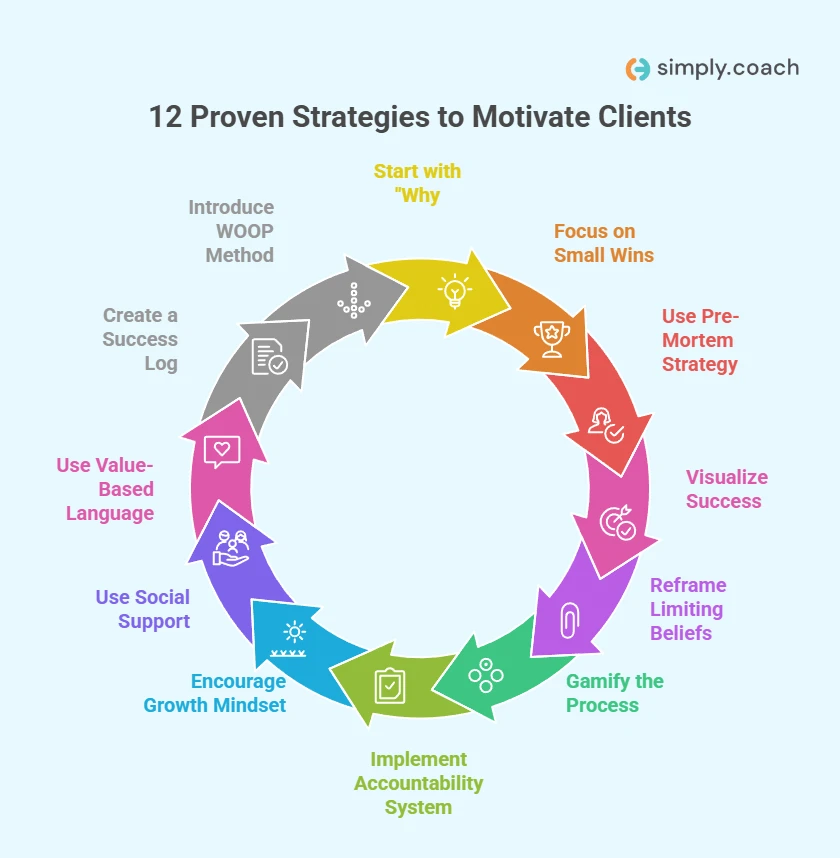
As a coach, your job is not just to guide clients but to keep them engaged and motivated throughout the process. You know that motivation is a crucial driving force for client success, but sometimes it takes more than just a nudge to keep them on track. Here are some proven strategies that will help you unlock deeper levels of motivation in your clients, ensuring they stay committed to their goals.
1. Start with the “Why”
You’ve probably heard the phrase “find your why” many times, but it’s more than just asking surface-level questions. Digging deeper into what drives your clients beyond the goal itself is key. When clients connect their goals to a deeper personal purpose, something that aligns with their values or long-term vision, it fuels their intrinsic motivation. This makes the goal more than just a task to check off; it becomes a meaningful journey they are committed to, no matter the challenges.
How to implement:
Instead of asking the generic “What do you want to achieve?”, try asking more thought-provoking questions like:
- What does achieving this goal mean to you beyond the surface?
- How will achieving this goal impact your life in the long term?
- How does this align with your core values?
Want more powerful questions to enhance your coaching sessions?
Download “The Ultimate Guide to Asking Powerful Life Coaching Questions” and take your coaching practice to the next level.

2. Focus on small wins
Breaking down large goals into smaller, manageable steps is a powerful strategy for maintaining client motivation. When clients can see progress in real-time, even in small doses, it reinforces their sense of achievement and keeps them engaged.
By celebrating these small wins, you help them build momentum, making the larger goal feel more attainable. This approach ensures clients don’t get overwhelmed and stay motivated throughout the process.
How to implement:
- Work with your clients to break down large goals into smaller, actionable steps.
- Celebrate each small success to reinforce their progress and build confidence.
- Encourage clients to reflect on their achievements after completing each step.
- Create a visible progress tracker (e.g., checklist or milestone chart) to help clients visualize their progress.
3. Use a pre-mortem strategy
The Pre-Mortem Strategy encourages clients to imagine their goal has failed and identify potential reasons for that failure. This proactive approach helps them anticipate obstacles and develop strategies to address them before they even arise. By confronting possible challenges upfront, clients can create more realistic plans and be better prepared to navigate setbacks, turning them into learning opportunities.
How to implement:
- Ask your clients to imagine that they’ve already failed to achieve their goal.
- Guide them to identify the specific reasons why the goal wasn’t achieved.
- Help them develop strategies to overcome each identified obstacle.
- Encourage clients to visualizehow they will address setbacks and stay on track when challenges arise.
4. Use visualization to strengthen client success
Visualization is a powerful tool that helps clients mentally rehearse their success. By guiding them to vividly imagine reaching their goals, you help build their confidence and prepare them for potential challenges. This process strengthens their belief in their ability to succeed, which leads to a more focused and resilient mindset. When clients can see themselves achieving their goals, they are more likely to take consistent action to make those visions a reality.
How to implement:
- Guide your clients to spend a few minutes daily visualizing their success, from start to finish.
- Encourage them to imagine the steps they need to take and how they’ll overcome obstacles along the way.
- Ask clients to focus on the emotions they’ll feel when they achieve their goal, making the visualization more impactful.
- Use specific scenarios to help them mentally prepare for challenges they might face and how they can overcome them.
Also read: A Guide to Using Vision Boards in Coaching to Help Clients
5. Reframe limiting beliefs
Limiting beliefs are one of the biggest barriers to a client’s progress. As a coach, it’s important to help clients recognize these negative thought patterns and challenge them. By reframing these beliefs, you can help clients replace self-doubt with positive, empowering affirmations. Shifting from a mindset of limitation to one of possibility opens the door to greater self-confidence and a willingness to take bold steps toward success.
How to implement:
- Encourage your clients to identify and write down their limiting beliefs about themselves or their goals.
- Ask clients to challenge these beliefs by providing evidence to the contrary (e.g., past successes or strengths).
- Help them replace negative thoughts with positive affirmations, such as, “I am capable of overcoming challenges,” or “I am worthy of success.”
- Remind clients to revisit these affirmations regularly, especially when they encounter obstacles.
6. Gamify the process
Gamification turns coaching into a fun, engaging experience that encourages consistent effort. By introducing elements of competition, rewards, or point systems, you make the process feel like a game. Clients enjoy the challenge and the sense of accomplishment that comes with completing tasks and earning rewards. This strategy can significantly boost motivation, particularly for clients who enjoy measurable progress and tangible milestones.
How to implement:
- Create a point system for tasks, where clients earn points for completing specific actions or hitting milestones.
- Set up rewards for achieving certain levels, such as treating themselves to something they value or a special activity.
- Incorporate friendly competition if clients are open to it, such as a challenge to complete tasks faster or more efficiently.
- Use a visual progress tracker (like a leaderboard or badge system) to help clients see how they’re advancing and celebrate their wins.
7. Implement an accountability system
An accountability system is essential to keep your clients on track, but it’s about more than just checking in. It’s about creating consistent, actionable touchpoints that ensure progress doesn’t stall. As an experienced coach, you understand that simply asking a client how they’re doing isn’t enough. Instead, use structured check-ins, automated reminders, or shared progress trackers to foster responsibility. When clients know they have a system in place, they’re more likely to stay committed.
How to implement:
- Set weekly or bi-weekly check-ins with your clients to track progress, share challenges, and adjust goals.
- Use task reminders and progress trackers to help clients visualize their journey and stay on target.
- Encourage clients to track their actions in a shared document or app for real-time accountability.
- Adjust the frequency or type of reminders based on your client’s engagement and needs.
8. Encourage a growth mindset
Shifting your clients from a fixed mindset to a growth mindset is one of the most powerful ways to drive long-term success. While you likely already understand this concept, the real value comes from consistently reinforcing it throughout the coaching journey. Teach clients to see challenges not as roadblocks but as opportunities for development. When clients embrace the idea that failure is a part of growth, they become more resilient and proactive in their approach to challenges.
How to implement:
- Reframe setbacks by guiding clients to ask, “What can I learn from this experience?”
- Use language that promotes growth, such as, “We can work through this together” instead of focusing on difficulty.
- Have your clients set both performance and learning goals, emphasizing effort over outcome.
- Share stories of resilience to inspire your clients and reinforce the growth mindset.
Also read: Coaching the Growth Mindset: A Mindful Approach to Unlocking Leadership Potential
9. Use social support
Clients’ success doesn’t only rely on the coach-client relationship. Social support is a game-changer in sustaining motivation and progress. Encourage your clients to surround themselves with people who understand their goals and can provide consistent feedback, encouragement, and even challenge them when necessary. Social support strengthens the commitment to their goals and creates a safety net when obstacles arise.
How to implement:
- Help your clients identify one or two people in their life who can act as accountability partners.
- Create shared milestones and progress trackers that your clients can share with their support network.
- Encourage clients to join peer groups or mastermind communities for shared learning and motivation.
- Check in regularly with your clients to ensure their support network is actively contributing to their progress.
10. Use value-based language
Aligning your clients’ goals with their core values is a powerful way to enhance their commitment. When goals resonate with what truly matters to them, they become more meaningful and motivating. As a coach, you can help your clients reframe their goals in a way that ties directly to their personal values, making the pursuit of those goals feel more impactful.
How to implement:
- Identify your client’s core values and ensure their goals reflect these values.
- Reframe goals by asking your client how achieving them would fulfill their deeper desires. For example, change “get a promotion” to “build a stable future for my family.”
- Regularly remind clients of how their goals connect to their personal values during check-ins, keeping them focused on the bigger picture.
- Encourage clients to visualize their success in terms of the emotional fulfillment that aligns with their core values.
11. Create a success log
Tracking progress is key to maintaining motivation, and a success log is a great tool to help clients reflect on their journey. This log not only tracks milestones but also reminds clients of the challenges they’ve overcome and the skills they’ve gained, reinforcing their belief in their ability to achieve their goals.
How to implement:
- Encourage clients to journal their achievements, big or small, after each session or milestone.
- Have them note down challenges they overcame, as well as any skills or insights gained during the process.
- Suggest clients reflect on their logs weekly to maintain a sense of progress and boost confidence.
- Use the success log as a tool during check-ins to highlight how far clients have come, reinforcing their commitment and belief in their ability to succeed.
12. Introduce the WOOP method
The WOOP method is a goal-setting framework that helps clients dream big while realistically anticipating obstacles and planning actionable steps. By guiding your clients through the four steps of Wish, Outcome, Obstacle, and Plan, you help them not only envision success but also prepare to handle setbacks.
How to implement:
- Ask your client to define their wish, a clear and meaningful goal.
- Help them visualize the outcome, the positive result they will experience once they achieve the goal.
- Have them identify potential obstacles, internal or external challenges that could get in the way of their success.
- Work with them to develop a clear Plan for overcoming those obstacles and achieving their goal.
- Encourage clients to revisit their WOOP regularly to stay focused on their goals and adjust their plans as needed.
How Simply.Coach Tools Enhance Client Motivation and Support your Coaching
Simply.Coach is a leading digital coaching platform designed to streamline your coaching process, keep clients motivated, and ensure they stay on track. With its all-in-one suite of tools, Simply.Coach provides you with the resources needed to improve client engagement, maintain accountability, and track progress efficiently.
Key tools to boost client motivation:
- Goal setting & tracking: Helps you set clear, actionable goals and track your clients’ progress, ensuring they remain motivated by visible milestones.
- Automated reminders: Sends timely reminders to clients about their tasks and goals, helping them stay on track without requiring constant follow-ups from you.
- Progress reports: Automatically generates detailed reports to highlight your clients’ achievements and areas for improvement, making it easier to celebrate their wins and adjust strategies.
- Client workspaces: Provides each client with a dedicated space to track their goals, interact with resources, and stay engaged in their coaching process.
- Action plans: Enables you to create personalized action plans for each client, ensuring they consistently take steps toward their goals.
- Video conferencing integration: Seamlessly integrates video tools like Zoom, Google Meet and Microsoft Teams so you can conduct sessions without switching platforms, keeping everything organized in one place.
Simply.Coach’s suite of tools ensures that you can deliver personalized, structured coaching while keeping your clients motivated and focused on achieving their goals.
Conclusion
Maintaining client motivation is essential for ensuring they stay focused on their goals and continue making meaningful progress. By implementing strategies like setting clear goals, breaking them down into manageable steps, and fostering a growth mindset, you can help your clients stay engaged and overcome any obstacles in their path. The right approach to motivation can transform your coaching practice and lead your clients to long-term success.
Simplify your coaching process with Simply.Coach, the all-in-one digital coaching management platform. With its powerful suite of tools, Simply.Coach helps you track client progress, automate reminders, and create personalized action plans, all while keeping clients motivated. Whether it’s goal setting or maintaining accountability, Simply.Coach streamlines your coaching so you can focus on what truly matters: your clients’ success.