
As a life coach, you know the hard parts. Training costs are high, funding rules are confusing, and it’s easy to waste time chasing programs that won’t actually cover the certification you want. Many aspiring and early-stage coaches also need real practice hours, recognized credentials, and support in turning training into paying client work — not just theory or long marketing pages.
At the same time, coaching is no longer a niche industry. According to the International Coaching Federation 2025 industry study, global coaching revenue has reached approximately $5.34 billion. Demand for professionally trained coaches continues to grow, which means there’s a stronger case than ever for structured, credentialed training.
Because coaching is increasingly recognized as a legitimate workforce pathway, federal and state workforce development funds may cover approved training programs. However, funding is only available when a program or provider appears on an official list. For example, you can use the CareerOneStop training search tool to check whether a course qualifies under the Workforce Innovation and Opportunity Act (WIOA).
In this blog, we’ll walk you step by step through where to look for legitimate government-funded training, how to verify whether a course will be paid for, and which documents and delivery formats matter most, so you spend less time guessing and more time training and serving clients.
Key Takeaways
- “Free” usually means funded, not open access. Most government-backed coaching options are delivered through scholarships, workforce grants, employer programs, or veterans’ benefits that pay approved providers, not random online courses.
- Eligibility depends on your situation. Funding is often tied to employment status, income level, age 55+, veteran status, state residency, or employer participation, so your background determines what you can access.
- Provider approval is critical. Many programs only pay if the school or course appears on an official approved list such as WIOA ETPL, VA-approved schools, or state scholarship lists. Always verify before enrolling.
- Community colleges and workforce agencies are the safest starting points. American Job Centers, state workforce boards, and community college workforce offices offer the most reliable paths to funded, job-focused credentials.
- Check the fine print before committing. Some programs include service obligations, income rules, reporting requirements, or limited funding windows. Written confirmation protects you from unexpected costs.
- Certification is only step one. After completing funded training, using a platform like Simply.Coach helps you manage clients, track outcomes, and turn your credential into structured, paid coaching work.
What Are “Free Government Funded Life Coaching Courses”?
These aren’t always single, open-to-all “free courses.” Most government programs are funding pathways that pay for approved training, cover tuition, or provide paid work-based training. That funding can sometimes cover coaching certificates or related credentials, but only when the course or provider meets the funder’s rules. Start by treating these programs as funding options, not automatic free access.
Who can get funding? (typical eligibility criteria)
Government funding focuses on public goals (job placement, workforce shortages, veteran support, or community service). That shapes who qualifies:
- Jobseekers/career changers: Often eligible under workforce programs if you’re unemployed or underemployed.
- Residents of a state with a targeted scholarship: Some scholarships are state-specific (you must live or work in that state).
- Veterans & family members: Many education benefits are reserved for those with qualifying military service.
- Older adults (55+): Special programs offer paid training and placements rather than tuition grants.
- Employees of sponsoring employers or participants in nonprofit cohorts: Some local grants and employer funds are limited to staff or referred participants.
Documents you’ll likely need: photo ID, proof of residency, income or unemployment paperwork, and the course acceptance or provider details. If you prepare those before you call an agency, you’ll move faster.
Where to find legitimate government-funded coaching training (and how to verify it)
Below are the best places to look and make exact checks so you don’t waste time on programs that won’t pay for your course.
1. Official government portals & workforce agencies
Start at your local American Job Center (find them via CareerOneStop). These centers manage WIOA services and local training funds that can pay tuition for approved programs. Use the WIOA/ETPL (Eligible Training Provider List) search to see whether a specific course or school is eligible in your state. If a provider is not on that list, WIOA usually won’t cover services from that provider.
How to verify:
- Search the WIOA-Eligible Training Program Finder for your state.
- Ask the American Job Center whether your chosen program appears on the state ETPL.
- If it does, ask what paperwork they need to approve funding.
2. Community colleges, registered training organizations, and adult ed
Community colleges and accredited continuing-education programs are often the easiest path to funded training. States and the DOL frequently fund community college certificate programs because they align with local job needs. Check your local college’s workforce page and ask about current workforce grants or short-term certificate scholarships. DOL grant programs (and community college grant announcements) also indicate which credentials are in demand, which helps you choose a useful program.
How to verify:
- Contact the college’s workforce development office.
- Ask whether the coaching certificate is covered by any active grants.
- Request written confirmation of coverage and any commitments (hours, internships, employer matches).
3. Employer programs, union training funds, and veterans’ benefits
- Employer tuition assistance: Ask HR if your company offers tuition reimbursement or a training budget. Many employers will fund credentialing if it benefits the role or team.
- Union or apprenticeship funds: Some unions or industry partnerships sponsor training cohorts. If you have a union or industry partner, check their training pipelines.
- Veterans’ education benefits (GI Bill, VA programs): If you served, the GI Bill can pay for approved schools and some certifications. Use the VA’s GI Bill comparison and school-approval tools to confirm whether a course accepts benefits before you enroll.
How to verify employer/VA coverage: Get the benefits contact for your employer or the VA certifying official for the school and request a clear yes/no in writing.
Finding legitimate free government-funded life coaching courses takes a little research, but once you know where to look – official workforce portals, community colleges, VA tools, and employer programs – the process becomes much clearer.
With the basics covered on where to search and how to verify programs, it helps to look at the most reliable funding routes currently available across the United States.
Also Read: 12 Best Accredited Life Coach Certification Programs 2026
Top 6 U.S. Funding Pathways & Programs
If you’re looking for free government-funded life coaching courses in the United States, the key is knowing where to look and what each program actually covers. Not every opportunity is a simple “free course.” Some are scholarships. Some are workforce training grants. Others are federal education benefits or paid training programs.
Below, you’ll find the most legitimate and reliable U.S.-based funding pathways available right now:
1. Wellness Coach Scholarship Program (California State Scholarship for Wellness/Coach Training)

This California scholarship funds training that leads to a Certified Wellness Coach credential. It’s aimed at people who will work in California communities or schools and want scholarship support to complete an approved associate or bachelor’s pathway.
What it can actually fund:
- Scholarship awards can cover tuition and approved program costs for qualifying degree or certificate pathways that lead to a Certified Wellness Coach credential.
- Some awards are large and may fund a full academic program when used as directed by the grant guide.
Eligibility requirements:
- Must be a California resident (check exact residency rules).
- Enrollment or conditional acceptance in an approved program that leads to Wellness Coach Certification.
- Willingness to meet any service or reporting commitment the scholarship requires.
How to apply (step-by-step):
- Read the WCSP grant guide to confirm program and residency rules.
- Confirm your chosen school/program appears on the scholarship’s approved list.
- Gather residency documents, program acceptance, and ID.
- Complete the state application during the open window and upload the required documents.
- If awarded, follow the scholarship’s onboarding steps and any service-commitment paperwork.
Important limitations to know:
- It’s a state program that only California residents or those studying in California qualify for.
- Funds are tied to approved programs; a private provider not listed will likely be ineligible.
- Some awards require service commitments (for example, a year of providing wellness services in California).
Scholarship/funding amount:
Up to $35,000 per recipient for approved pathways (this is the award level described in the program materials for the 2024–25 cycle).
Focus areas: Training that leads to a Certified Wellness Coach credential and allied fields (social work, addiction studies, human services) when taken as part of an approved associate or bachelor’s program. The scholarship is specifically designed to grow the wellness workforce serving California communities.
2. Careeronestop / WIOA – Federal & State Workforce Training Support (May Fund Approved Coach Training)

The Workforce Innovation and Opportunity Act (WIOA) is a federal framework that funds training and career services for eligible job seekers through local American Job Centers. CareerOneStop is the U.S. Department of Labor portal that helps you find WIOA services in your state. WIOA can fund training if the provider and program appear on the state’s approved list.
What it can actually fund:
- Tuition for WIOA-approved training programs.
- Career counseling, skills assessments, and sometimes certification exam fees.
- Short-term training that leads to employment is prioritized.
Eligibility requirements:
- Must meet local WIOA eligibility rules (commonly based on employment status, income, or barriers to employment).
- The training program must be listed as WIOA-eligible in your state (Eligible Training Provider List).
- You must complete WIOA intake and be approved by a case manager.
How to apply (step-by-step):
- Locate your local American Job Center via CareerOneStop.
- Schedule a WIOA intake/orientation; bring ID and any employment history.
- Ask whether the exact program/provider you want is WIOA-eligible.
- If it is the case, the case manager will create a training plan and submit paperwork for funding.
- Stay in contact with your case manager and follow any attendance or reporting rules.
Important limitations to know:
- WIOA funding varies by state and local workforce board priorities; not every training request is approved.
- The provider must be on the state’s approved list; private short courses often are not.
- Funds prioritize job outcomes; hobby or purely self-improvement courses are less likely to be approved.
Scholarship/funding amount:
There is no single national dollar cap; funding is administered locally. Typical Individual Training Account (ITA) limits typically range from about $5,000 to $10,000 per participant (some local boards set caps such as $5k/year or up to $10k over two years), while other local areas may allow higher ITA amounts for in-demand occupations. Always confirm the cap with your local American Job Center.
Focus areas: Job-focused training tied to local labor market needs, short-term certificate programs, career counseling, and training that leads directly to employment. WIOA prioritizes programs that are on a state’s approved provider list and that align with in-demand occupations.
3. State Workforce & Community College Workforce Grants (Local Retraining Funds and Continuing-ed Pathways)

Many states and community colleges run workforce grants and continuing education funds to upskill residents and meet local employer needs. These local grants can sometimes pay for short certificate programs, community-college certificates, or tuition for workforce-aligned training.
What it can actually fund:
- Partial or full tuition for community college certificate programs and continuing education.
- Short-term workforce training grants and employer-partner programs.
- Materials or exam fees when they’re part of the approved training.
Eligibility requirements:
- Rules vary by state and college; check residency and income tests.
- Often targeted to in-demand industries or employer partnerships.
- May require employer sponsorship or match funding for some grants.
How to apply (step-by-step):
- Search your state workforce board and local community college workforce pages for open grants.
- Contact the community college’s workforce development office and describe the course and credential.
- Ask whether the program is part of a funded pathway or whether short-course scholarships apply.
- Complete the college’s application and any grant forms they request.
Important limitations to know:
- Funding windows open and close; availability changes with new award cycles.
- Many grants require employer partnership or must meet local labor market needs.
- Not every certificate or private training provider qualifies; community college programs are most commonly funded.
Funding amount:
Amounts vary widely by state and program. Some state grants and community-college workforce funds provide tuition coverage or grants up to around $5,000 for noncredit or short-term programs; others may cover full tuition for approved certificate tracks or use larger institutional grants to subsidize many learners. Check your state’s program page for exact caps.
Focus areas: Short-term certificates, sector-based career pathways, continuing education, and employer-aligned training (health care, IT, skilled trades, and other regionally in-demand areas). Community college workforce grants typically aim to place people into local jobs.
4. Veterans Education Benefits – GI Bill & VA Training Programs (Funding for Eligible Veterans)

If you have a qualifying veteran status, the GI Bill, and VA education benefits, you can pay for approved schooling and training. The VA maintains lists of approved programs and a comparison tool so you can check whether a certificate or school accepts benefits from the U.S. Department of Veterans Affairs.
What it can actually fund:
- Tuition and fees, books, and housing (depending on the GI Bill tier).
- Certificate programs and short courses, if the school or provider is VA-approved.
- The Yellow Ribbon Program supports additional costs at participating institutions.
Eligibility requirements:
- Must meet VA eligibility rules (service history, discharge status, etc.).
- The training program or provider must be approved by the VA to accept GI Bill benefits.
- Benefit amounts and eligible items vary with the GI Bill program used.
How to apply (step-by-step):
- Check your eligibility on the VA education pages.
- Use the VA’s school comparison and GI Bill tools to find approved programs.
- Contact the school/provider to confirm they accept your VA benefits.
- Apply for benefits via the VA and enroll through the approved provider.
Important limitations to know:
- Not all private bootcamps or short courses are VA-approved.
- Benefits and covered items differ by GI Bill tier. Confirm what’s covered before you enroll.
- Always verify approval in the VA’s official comparison tool; don’t rely on marketing claims.
Funding amount:
Benefits depend on the GI Bill tier. For Post-9/11 GI Bill users, VA covers tuition and fees up to published caps (for private schools the net tuition/fee cap has been shown around $29,920.95 in recent published rates, housing and book stipends vary by entitlement and enrollment). Yellow Ribbon can add additional support at participating schools. Confirm exact current rates on VA tools before applying.
Focus areas: Tuition, fees, books/supplies, and housing (depending on benefit level). VA benefits can be used for approved certificate or non-degree training if the school/provider accepts VA benefits.
5. Senior Community Service Employment Program (SCSEP) (Paid Training & Placements for Older Adults)

SCSEP is a Federal DOL program that offers paid community service placements and on-the-job training for low-income adults aged 55+. It provides work experience, job-search help, and training tied to placements, not direct tuition grants.
What it can actually fund:
- Paid community service placements that build job skills and work history.
- Training and job readiness supports are connected to the placement.
- Connections to American Job Centers and local employers for next-step placement.
Eligibility requirements:
- Age 55 or older.
- Low income and unemployed (income thresholds apply).
- Able to work and complete community service tasks.
How to apply (step-by-step):
- Find your local SCSEP provider through the Department of Labor resources.
- Contact the provider for intake and eligibility screening.
- Complete the required application forms and provide income documentation.
- Participate in a placement and training plan designed with the provider.
Important limitations to know:
- SCSEP provides work experience and modest wages; it is not a tuition grant for private certification.
- Availability and services depend on local SCSEP providers and funding.
- Program goals focus on job placement and community service, not private credentialing.
Funding amount:
SCSEP is not a scholarship; it provides paid community service placements. Participants typically work about 20 hours per week and are paid the highest applicable federal, state, or local minimum wage (so the “amount” is hourly pay rather than a scholarship). SCSEP funds training tied to the placement, but does not usually pay private course tuition directly.
Focus areas: On-the-job training and community-service roles at public or nonprofit sites (schools, hospitals, senior centers). The program emphasizes job readiness and transitions to unsubsidized work.
6. Local Non-Profit Workforce Partnerships & Employer-Sponsored Training (Hyper-Local Funding Routes)

Local workforce boards, nonprofit partners, community foundations, and employers often fund training to address specific community needs or to support employees. These sources are decentralized but can be a fast route to funded training when a partnership is in place.
What it can actually fund:
- Employer tuition assistance for employees or referral-based training.
- Non-profit or foundation grants that pay tuition for target groups.
- Local apprenticeship or work-based learning programs with training components.
Eligibility requirements:
- Often limited to employees of a sponsoring employer or to participants in partner programs.
- May target specific populations (youth, displaced workers, low-income residents).
- Requirements are set by the sponsoring organization.
How to apply (step-by-step):
- Check the local workforce board and community foundation announcements.
- Ask your employer’s HR team about tuition assistance or professional development funds.
- Contact local non-profits that run workforce programs and ask about funded spots.
- If accepted, follow the sponsor’s application and reporting process.
Important limitations to know:
- These options are very local; availability varies widely by city and county.
- Funding is often tied to employer needs or nonprofit priorities rather than to open enrollment.
- Programs may require matching funds or commitments to remain with an employer for a period.
Funding amount:
Amounts vary widely. Employer tuition assistance commonly offers up to $5,250 per employee per year as a tax-free educational benefit under IRC Section 127 (check your employer’s plan). Non-profit or foundation grants may range from small stipends (a few hundred dollars) to full tuition support for targeted cohorts. For exact figures, contact the local sponsor.
Focus areas: Employer skills development, staff upskilling, apprenticeships and work-based learning, and community workforce initiatives targeting specific populations (youth, displaced workers, low-income residents). These opportunities are usually tied to employer needs or nonprofit priorities rather than open public enrollment.
As you can see, free government-funded life coaching courses in the U.S. usually come through structured programs, not random online offers. Some routes are state-specific. Others depend on income, veteran status, age, or employment situation. And a few require that your training provider be officially approved.
After exploring the main funding options, the next step is choosing a course that aligns with both the funding rules and your long-term goals.
Also Read: Top 14 Coaching Models Every Professional Coach Should Master
How to Choose the Right Free Government Funded Life Coaching Course
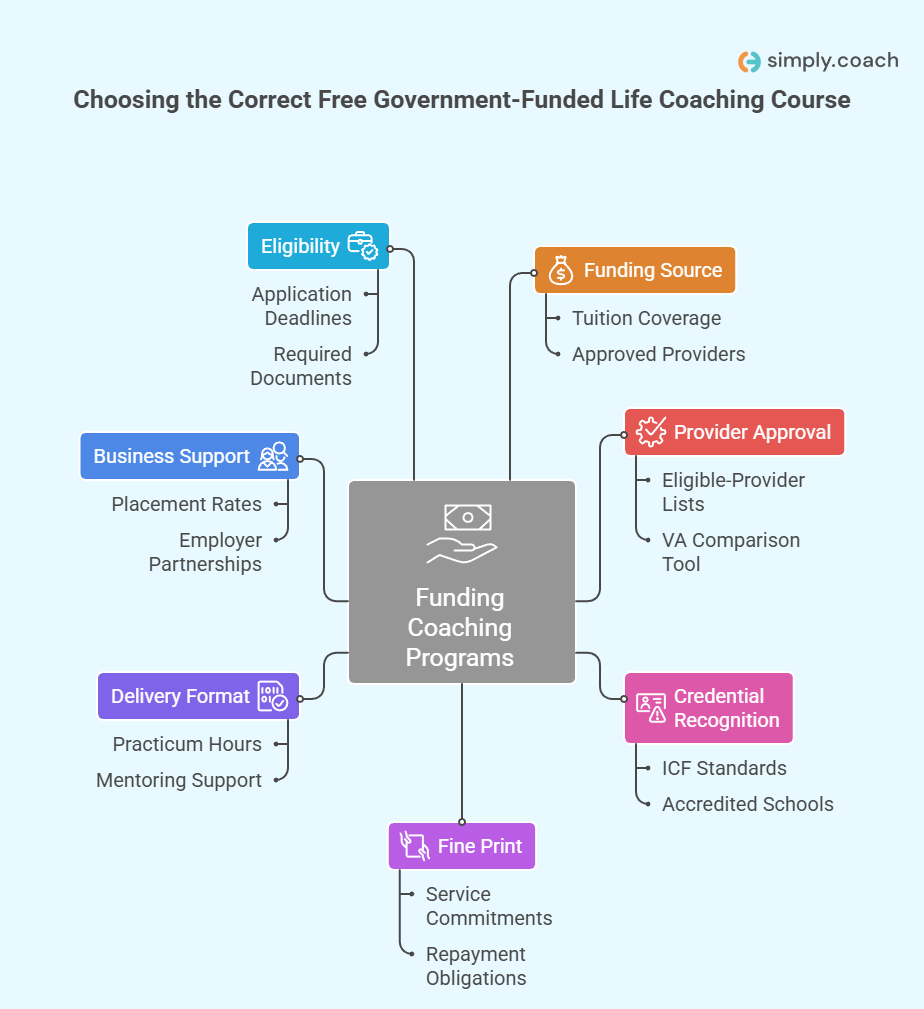
If you want to train without paying full tuition, government-funded paths can be a smart route, but not all “free” programs are the same. Below is a simple, step-by-step guide to help you pick the right funded option for your goals.
1. Start with the funding source (confirm what it actually pays for)
Not every program pays full tuition. Some pay for part of a certificate, some pay only for approved providers, and some offer paid work experience rather than classroom training. For example, WIOA funds require that the training provider be WIOA-approved in your state, and the VA only pays for programs approved for GI Bill benefits. Always check the funder’s official tool or local office to see what they will cover.
What to do: Call the funder or use their online tool to confirm whether your desired course or provider is eligible.
2. Check provider approval and eligible-provider lists
Many funding routes pay only to providers on an official list. State workforce boards and American Job Centers publish WIOA eligible-provider lists; the VA has a school/program comparison tool for GI Bill benefits. If the provider isn’t on the list, funding is unlikely. Use the official provider finder and ask your case manager or benefits officer.
What to do: Find the eligible-provider page for your state or the VA comparison tool and search for the exact course name.
3. Verify the credential’s recognition and quality
Even when training is funded, the credential needs to help your practice. Look for programs that follow recognized coaching standards or offer connections to respected certifications. The International Coaching Federation (ICF) is the most widely recognized standard; training aligned with ICF competencies or provided by ICF-accredited schools generally carries more weight with clients and certain employers.
What to do: Ask the provider whether the course maps to ICF core competencies or whether graduates can apply for ICF hours/credentialing.
4. Read the fine print (fees, hidden costs, and obligations)
Some programs require service commitments, reporting, or a short employment term after training (for example, certain state scholarships). Veterans should be wary of misleading claims and use the VA comparison tool. The FTC has warned about misleading school claims, so verify everything in writing. Also, confirm whether the funder pays the provider up front or reimburses you later.
What to do: Get funding terms in writing: what is paid, whether you may need to repay, and whether there’s a service obligation.
5. Check delivery format, practicum hours, and mentoring support
A good coaching program includes practical coaching practice, supervised hours, and feedback, not just video lessons. If you plan to work with clients, pick a funded course that offers live practice, mentor coaching, or a practical placement. That real practice increases skill and helps when you start working.
What to do: Request the course syllabus and ask how many supervised coaching hours or practicums are included.
6. Look for business and placement support after training
Some workforce programs (WIOA, community college workforce grants, employer-sponsored training) include job placement help, resume support, or employer connections. If you want to turn training into paying work quickly, these supports are valuable. Check whether the program offers career services or local employer partnerships.
What to do: Ask the program about placement rates, alumni outcomes, or employer partners.
7. Confirm eligibility, timelines, and application windows
Funding rounds open and close. WIOA and many state grants use rolling or seasonal intake. Some scholarships (e.g., state scholarship programs) have strict application windows. Start early and confirm deadlines with the program contact.
What to do: Mark deadlines in your calendar and prepare required documents (ID, proof of residency, income statements, or DD-214 for veterans).
With funding confirmed and the right program selected, you’ll be in a stronger position to begin training without unexpected financial setbacks.
Also Read: Best Free Health & Wellness Coach Certifications Online
Final Thoughts
When you evaluate free government-funded life coaching courses, think beyond tuition and focus on career traction. Choose funding that leads to recognized credentials, real coaching practice, and clear pathways to income. Compare approval rules, service commitments, and timelines so you avoid delays or hidden conditions. A smart choice is one that reduces your financial risk and helps you transition steadily from training to paid client work.
Once you complete funded training, you still need a structured way to run your practice. Simply.Coach supports this next step with client management tools such as goal and development tracking, session notes, contracts, and invoicing, along with integrations with Zoom, Google Calendar, and Stripe. With secure client workspaces and compliance standards such as SOC 2, HIPAA, and GDPR, you can operate professionally from day one and transition smoothly from certification to active coaching.
Suggested watch: Introduction to Simply.Coach– a quick tour of the platform features that coaches and providers use to deliver supervised practice and track outcomes.
FAQ’s
1. What are “free government-funded life coaching courses”?
These are training options paid for (fully or partly) by government programs or grants, which are not always open or free, and funding applies only when the course/provider meets the funder’s rules.
2. Who usually qualifies for government-funded coaching training?
Commonly eligible groups include job seekers, residents of state scholarship areas, veterans, older adults (55+), and employees in employer-sponsored programs. Specific rules vary by program.
3. Can veterans use the GI Bill for life coaching courses?
Yes, the GI Bill can cover approved certificates and short courses if the school or program is VA-approved. Always check the VA’s comparison tool before enrolling.
4. How do I check if a specific coaching course is eligible for funding?
Search your state’s WIOA/Eligible Training Provider list or the federal training-provider finder and ask your local American Job Center or case manager to confirm the exact course name.
5. What paperwork and steps should I prepare before applying?
Have photo ID, proof of residency, income/unemployment documents, and the course acceptance or provider details ready, then contact the listed funder (American Job Center, VA rep, or college workforce office) to start the application.