
Many experienced coaches hit a wall despite years of practice: sessions feel productive, yet lasting client change stalls. That’s often because the coach lacks a clearly defined coaching philosophy. This philosophy guides how you facilitate reflection, manage emotional regulation, decide when to challenge assumptions, and determine when it’s safer to pause. Without it, even sophisticated tools and exercises can produce inconsistent results.
A thoughtful coaching philosophy helps you deal with complex client interactions, prevent common pitfalls like scattered notes, inconsistent follow-ups, and high no-shows, and make in-session decisions with confidence. From running team coaching programs to supporting individual reflection, your philosophy influences the interventions you choose.
In this article, you’ll explore a practical decision framework, see a real example of coaching philosophy, and learn how experienced coaches operationalize these principles in daily practice.
Key Takeaways
- A well‑defined coaching philosophy acts as your clinical compass, guiding decisions during emotionally charged or high‑stakes sessions and reinforcing adherence to behavioral and relational goals.
- Coaching philosophy is distinct from coaching style; philosophy informs when and why to intervene, while style determines how you engage and respond in session.
- Developing your philosophy requires intentional reflection on purpose, values, objectives, and integration of practical in‑session behaviors that uphold emotional regulation and rupture repair.
- Digital tools augment your philosophy and practice by reducing no‑shows, supporting structured goal tracking, and automating routine work so you can focus on session quality and client outcomes.
- Simply.Coach combines client management, goal tracking, automated nudges, action plans, reducing administrative overhead, and supporting durable client progress.
What Is a Coaching Philosophy?
A coaching philosophy is more than a mission statement; it’s a set of principles that guide every decision in a session. It impacts how you intervene, structure dialogue, and respond to client resistance or escalation. Experienced coaches know that philosophy influences outcomes like emotional regulation, rupture repair, and clarity in communication patterns.
It also dictates how you track progress, run check-ins, and maintain consistency across clients. For example, a career coach using scattered spreadsheets may miss subtle behavior changes, while an organized system with automated reminders and structured goal tracking ensures timely interventions.
In-session, philosophy affects behavior: when a client exhibits avoidance, a coach’s approach, pause, challenge, or reflect, depends on predefined principles rather than improvisation. It’s the difference between reacting to client behavior and intentionally guiding it.
As Marshall Goldsmith says, “What gets measured gets coached,” highlighting that philosophy influences both observation and action in practice.
Before creating your own philosophy, it’s important to recognize why having one matters for your coaching practice.
Why Do You Need a Coaching Philosophy?
Without a coherent philosophy, even experienced coaches face pitfalls: inconsistent follow-ups, messy goal tracking, and higher no-shows. Here’s why having a philosophy matters:
- Guides in-session decisions: Determines when to pause, probe, or challenge clients’ assumptions.
- Reduces operational errors: Supports automated reminders, structured pre-session forms, and consistent goal tracking.
- Improves client outcomes: Enhances emotional regulation, conflict management, and adherence to behavioral goals.
- Supports multi-client management: Makes running team coaching programs smoother while maintaining individual progress visibility.
- Clarifies boundaries and ethics: Helps decide when techniques shouldn’t be used, e.g., trauma activation or severe emotional dysregulation.
A clear philosophy is not theoretical; it informs every micro-decision in a session, from intervention choice to managing emotional escalation. It’s what separates experienced coaches who maintain consistent client progress from those who rely on intuition alone.
Also read: Becoming an Agile Coach in the USA: A Step-by-Step Career Guide
Knowing its value leads naturally to understanding how philosophy differs from your coaching style.
The Difference Between a Coaching Philosophy and a Coaching Style
Many coaches confuse philosophy with style, but they serve distinct purposes in practice. Philosophy is your underlying framework for decision-making, guiding when, how, and why you intervene. Style is the observable expression of that philosophy, such as tone, pacing, or technique preferences.
Here’s a practical comparison:
| Aspect | Coaching philosophy | Coaching style |
| Definition | Guiding principles for decision-making in sessions | Observable behaviors, tone, and approach in client interaction |
| Purpose | Ensures consistency, ethical boundaries, and informed interventions | Adapts to client personality, session phase, and emotional state |
| Focus | Decision-making criteria: when to challenge, pause, or reinforce | Delivery: empathetic, directive, reflective, or motivational |
| Flexibility | Stable across clients and contexts | Flexible, changes based on client readiness or session conditions |
| Example | Only introduce confrontation after emotional regulation is stable | Use humor or metaphor to explain concepts during reflection exercises |
| Operationalization | Integrates with goal tracking, pre-session forms, automated reminders | In-session behaviors, tone, gestures, phrasing |
Many experienced coaches fail to differentiate these, resulting in inconsistent interventions. A coach might adopt a warm, empathetic style but violate their philosophy by pushing unresolved emotional content, triggering client escalation.
With that distinction in mind, let’s explore real-world examples to illustrate different coaching philosophies.
10 Examples Of Coaching Philosophies
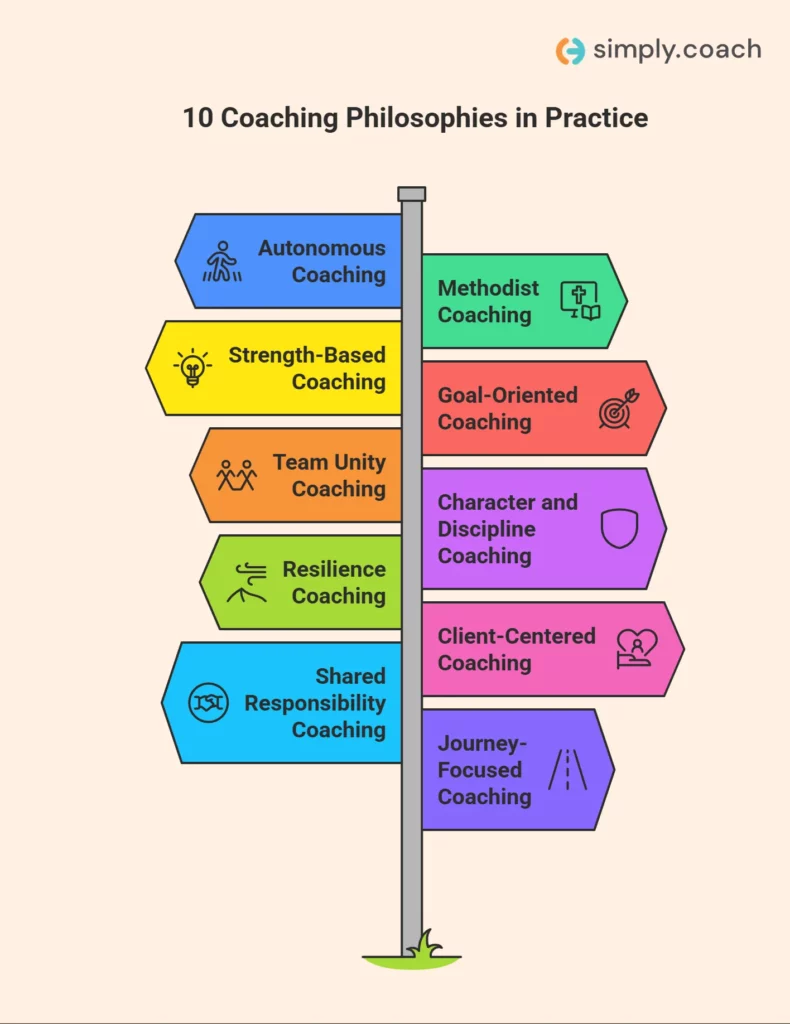
Every experienced coach develops a unique philosophy that guides session decisions, intervention timing, and client engagement. These philosophies are more than statements; they influence how change happens, how risks are managed, and how insights translate into action.
The following examples illustrate real-world principles used by seasoned coaches across life, executive, career, business, and relationship domains.
1. Autonomous coaching
Autonomous coaching emphasizes encouraging clients to generate insight and take action independently. Experienced practitioners use it to strengthen client agency, resilience, and sustained adherence to goals. In-session, it involves strategic questioning, pacing client reflection, and resisting the urge to direct outcomes.
Across life, career, executive, and relationship contexts, autonomy prevents dependency, supports rupture repair, and reinforces emotional regulation.
Underlying principle: Change is most durable when clients internalize ownership of decisions and actions rather than relying on the coach.
When to use
- Mid-to-late session phases when clients can tolerate self-reflection without immediate guidance
- With clients demonstrating baseline emotional regulation, able to process insight safely
- During post-rupture repair, when autonomy strengthens reengagement and agency
- In structured dialogue stages, where exploratory problem-solving supports goal adherence
When not to use
- Early sessions where clients require stabilization and scaffolding
- When trauma activation or coercive control limits reflective capacity
- Severe emotional dysregulation that requires explicit containment before autonomous exploration
- High-risk situations where client insight without support may backfire
How it applies in practice
- Use open-ended, exploratory questions that allow clients to articulate and prioritize goals
- Pause to let clients sit with difficult emotions before proposing interventions
- Reflect insights back without solving, prompting self-directed planning
- Observe non-verbal cues for overwhelm and redirect to containment or structured guidance if needed
Common pitfalls
- Forcing autonomy too early, risking disengagement or emotional overwhelm
- Overusing reflective questioning without clarifying actionable next steps
- Ignoring subtle signs of avoidance, avoidance masking as self-directed action
- Allowing dependency patterns to persist unaddressed under the guise of autonomy
Example
“The opponent within one’s own mind is more formidable than the one on the other side of the net.” – Tim Gallwey, The Inner Game of Tennis
Gallwey’s insight reinforces that autonomous coaching focuses on the client’s internal dialogue as the primary site of change. The coach creates a safe container for self-discovery, balancing autonomy with session safety and readiness.
2. Methodist coaching
Methodist coaching emphasizes structured, methodical session design and deliberate sequencing of interventions. Experienced coaches use this philosophy to reduce escalation, clarify communication patterns, and ensure consistent progress toward client goals.
In executive, career, and life coaching, it supports complex problem-solving and behavioral alignment. In relationship coaching, methodical pacing aids rupture repair and strengthens emotional regulation.
Underlying principle: Structured, deliberate intervention sequencing reduces risk, strengthens adherence, and supports durable client outcomes.
When to use
- Early engagement phases to establish session rhythm and predictability
- With clients struggling to organize goals or behaviors
- During multi-session programs (e.g., team or leadership coaching) requiring consistent scaffolding
- When emotional regulation is sufficient to tolerate methodical guidance
When not to use
- When client rigidity or trauma history makes structured pacing counterproductive
- During acute dysregulation or post-rupture repair, where empathy and flexibility take precedence
- If over-reliance on the method suppresses client autonomy
- In crisis situations requiring immediate responsive interventions
How it applies in practice
- Sequence dialogue and exercises: reflection → insight → action, adjusting pace based on real-time observation
- Use pre-session reflection prompts to clarify focus areas
- Anchor interventions in clear session milestones while monitoring the client’s affect
- Adjust method when escalation, avoidance, or power imbalances appear
Common pitfalls
- Over-focusing on procedure at the expense of client readiness
- Applying sequences mechanically without observing emotional cues
- Ignoring subtle resistance signals that indicate discomfort with the structure
- Failing to revisit and recalibrate the method after client setbacks
Example
“The coach really has to be flexible, but flexibility within a structure.” – John Wooden, Wooden: A Lifetime of Observations and Reflections on and off the Court
Wooden’s insight captures methodist coaching: the structure is a framework, not a script. Effective application balances methodical progression with responsive observation, ensuring client safety, engagement, and long-term adherence to behavioral and emotional goals.
3. Strength‑based coaching
Strength‑based coaching emphasizes amplifying a client’s existing capacities rather than focusing on deficits. Experienced coaches use it to improve emotional regulation, reinforce adaptive patterns, and support rupture repair.
In life and career coaching, it builds client confidence and self-efficacy. In executive and relationship contexts, it reinforces constructive behavior patterns while mitigating reactive cycles.
Underlying principle: Clients progress most effectively when coaching highlights and amplifies existing strengths, rather than overemphasizing weaknesses.
When to use
- When clients are stuck in self-criticism or negative patterns
- During phases requiring confidence-building or motivation
- Post-rupture repair to reinforce positive interaction patterns
- In structured dialogue or skill-building sessions to consolidate adaptive behaviors
When not to use
- If strengths are being misapplied or reinforcing maladaptive behaviors
- During acute emotional dysregulation requiring stabilization
- With trauma-activated clients who need containment before exploration
- When overemphasis on strengths ignores emerging risks or safety concerns
How it applies in practice
- Reflect back on behaviors that demonstrate mastery or adaptive choices
- Pair strengths with action experiments to expand capabilities
- Track patterns of success while monitoring for subtle escalation cues
- Use reflective prompts that help clients articulate the link between their actions and positive outcomes
Common pitfalls
- Overfocusing on strengths while avoiding necessary corrective interventions
- Reinforcing patterns that appear functional but are contextually maladaptive
- Failing to document and follow up consistently, weakening learning
- Assuming confidence equals readiness for high-risk tasks
Example
“What you focus on expands; what you think about grows.” – Esther Hicks
Hicks’ quote reflects strength‑based coaching by emphasizing that deliberate attention to what already works amplifies client progress. Coaches operationalize this by monitoring client responses, reinforcing adaptive behaviors, and guiding growth while mitigating escalation or maladaptive repetition.
4. Goal‑oriented coaching
Goal‑oriented coaching emphasizes defining clear, actionable objectives while maintaining client ownership. Experienced coaches use it to reduce escalation, improve adherence, and strengthen clarity in communication and decision-making.
In life and career contexts, it helps clients articulate meaningful steps. In executive and relationship coaching, it structures sessions around tangible behaviors while supporting emotional regulation and rupture repair.
Underlying principle: Progress is optimized when client goals are explicit, achievable, and connected to observable behaviors.
When to use
- When clients struggle with goal clarity or prioritization
- During mid- to late-session phases to sustain engagement and momentum
- Post-rupture or conflict repair to anchor action steps
- In structured programs (team or executive coaching) to coordinate behavior and reflection
When not to use
- Early sessions where clients need stabilization or containment
- When acute emotional dysregulation may compromise goal-setting
- Trauma-activated clients needing reflective processing before goal articulation
- Situations where goals are externally imposed, creating resistance
How it applies in practice
- Facilitate dialogue that clarifies and sequences client objectives
- Use reflective prompts to track progress and reinforce adherence
- Integrate milestones into session planning without overriding client choice
- Monitor for signs of overwhelm or avoidance during goal negotiation
Common pitfalls
- Defining goals too rigidly, which may escalate anxiety or avoidance
- Neglecting process and emotional readiness in favor of outcomes
- Inconsistent follow-up that breaks continuity and client trust
- Misinterpreting no-shows or disengagement as a lack of motivation
Example
“Setting goals is the first step in turning the invisible into the visible.” – Tony Robbins
Robbins’ quote reflects goal‑oriented coaching by highlighting the importance of clear, articulated goals as the foundation for observable change. Practitioners apply this by facilitating structured, client-led goal setting while attending to emotional readiness, regulation, and session safety.
5. Team unity & collective success coaching
Team unity & collective success coaching focuses on strengthening interdependent structures within groups, emphasizing mutual accountability, shared goals, and collaborative problem-solving.
Experienced executive, business, and leadership coaches use it to reduce conflict escalation, improve communication patterns, and reinforce team cohesion. Life and relationship coaches apply similar principles to couples, families, or small groups to repair ruptures and enhance emotional regulation.
Underlying principle: Sustainable outcomes emerge when team members advance collaboratively, with aligned accountability and shared reflection.
When to use
- During team formation or restructuring, to set norms and clarify roles
- With teams experiencing communication breakdowns, conflict escalation, or unclear responsibilities
- To facilitate the co-regulation of emotions and collective adherence to behavioral goals
- In relational coaching (couples/families), shared responsibility improves rupture repair and conflict resolution
When not to use
- With teams where coercive control or authority imbalance prevents safe participation
- In early individual-focused sessions, where team context may overwhelm or dilute focus
- During acute conflict or trauma activation that requires containment before group engagement
- If individual vulnerabilities require one-on-one scaffolding before group collaboration
How it applies in practice
- Facilitate pre-session alignment exercises to surface expectations, roles, and priorities
- Use structured reflection prompts and round-robin dialogue to ensure all voices are heard
- Apply real-time interventions for escalation, e.g., redirecting interruptive behaviors or coaching emotional regulation
- Track shared milestones in sessions while providing individual follow-up cues for accountability
Common pitfalls
- Ignoring subtle power imbalances or dominant voices that undermine collective learning
- Applying generic “team-building exercises” without linking to specific behavioral goals
- Failing to contain emotional escalation before facilitating shared reflection
- Allowing uneven participation to persist, weakening cohesion and progress
Example
“Alone we can do so little; together we can do so much.” – Helen Keller
Keller’s quote exemplifies the philosophy: collaborative progress amplifies individual contributions. Coaches operationalize this by structuring sessions that foreground mutual accountability, monitoring escalation cues, and reinforcing shared responsibility, ultimately supporting adherence to behavioral and relational goals across the team or group.
6. Character & discipline development coaching
Character & discipline development coaching emphasizes cultivating consistent behavior, accountability, and ethical decision-making. Experienced executive, business, and life coaches use it to strengthen adherence to session goals, improve emotional regulation, and reinforce rupture repair.
In relationship coaching, it supports clients in honoring commitments and managing conflict constructively. Sessions are designed to balance guidance with autonomy, scaffolding habits without triggering resistance.
Underlying principle: Durable change emerges when clients internalize disciplined, principled behaviors within a supportive coaching framework.
When to use
- When clients struggle with follow-through, consistency, or commitment to goals
- In early habit formation or re-establishing behavioral structure post-rupture
- With teams or couples needing norm reinforcement to reduce repeated conflict cycles
- During structured dialogue, where incremental behavioral shifts can be monitored
When not to use
- During acute emotional dysregulation or trauma activation
- If clients resist structure or experience coercive interactions
- When prioritizing process over safety might escalate distress
- In exploratory sessions, where flexibility and reflection are more appropriate
How it applies in practice
- Set explicit session commitments and review adherence in each follow-up
- Use reflective dialogue to highlight consistency and ethical alignment
- Scaffold challenging behaviors gradually, monitoring emotional regulation cues
- Pair behavioral reinforcement with in-session feedback and corrective guidance
Common pitfalls
- Overemphasizing discipline too early, risking client resistance
- Ignoring subtle power dynamics or emotional vulnerability
- Failing to link structured habits with session goals, weakening adherence
- Treating consistency as compliance rather than co-created accountability
Example
“Discipline yourself, and others won’t need to.” – John Wooden, Wooden: A Lifetime of Observations and Reflections on and off the Court
Wooden’s insight embodies the philosophy that disciplined behaviors reduce dependency and strengthen client agency. Coaches operationalize this by structuring sessions to reinforce principled habits, integrating reflective review, and monitoring readiness, emotional regulation, and relational safety.
7. Resilience through preparation coaching
Resilience through preparation coaching equips clients to anticipate challenges and respond adaptively under pressure. Experienced executive, business, and career coaches use it to reduce escalation, support emotional regulation, and strengthen adherence to difficult goals.
In life and relationship contexts, it helps clients manage conflict, repair ruptures, and cope with high-stress interactions. Sessions focus on preparatory exercises, scenario rehearsal, and reflective anticipation, while coaches monitor readiness, power dynamics, and emotional capacity.
Underlying principle: Clients withstand stress and maintain goal-directed behavior when they are intentionally prepared for foreseeable challenges.
When to use
- Prior to high-stakes conversations or presentations
- With clients who reactively escalate under pressure
- During transitions or complex problem-solving phases
- To integrate rehearsal and reflection for skill consolidation
When not to use
- When preparation becomes avoidance rather than readiness
- If trauma history or dysregulation makes anticipatory work unsafe
- During early stabilization sessions, requiring containment before rehearsal
- With clients resistant to structured anticipatory exercises
How it applies in practice
- Map potential scenarios and rehearse responses collaboratively
- Use reflective prompts to surface emotional triggers and regulation strategies
- Observe non-verbal cues for overwhelm and adjust rehearsal intensity
- Tie preparatory exercises to session goals, reinforcing adaptive behavior
Common pitfalls
- Overpreparing clients, creating rigidity or anxiety
- Ignoring emotional readiness, risking escalation during rehearsal
- Failing to revisit or adapt preparation after setbacks
- Neglecting subtle avoidance or disengagement cues, including no-shows
Example
“By failing to prepare, you are preparing to fail.” – Benjamin Franklin
Franklin’s quote reflects the core of resilience through preparation coaching: anticipation and rehearsal strengthen client agency and regulation. Coaches operationalize this by integrating scenario mapping, reflective prompts, and iterative rehearsal while balancing emotional safety and readiness.
8. Service & client-centered coaching
Service & client-centered coaching prioritizes the client’s lived experience, values, and goals as the foundation for all interventions. Experienced life, career, executive, and relationship coaches use it to reduce escalation, improve adherence, and support rupture repair.
Sessions are tailored to client priorities, balancing structured guidance with active listening and reflective inquiry. Coaches integrate observational judgment, emotional regulation cues, and readiness assessment to ensure interventions align with client context.
Underlying principle: Change is most effective when the client’s values, priorities, and lived context guide every coaching intervention.
When to use
- Early sessions to build trust and rapport
- During emotionally charged phases requiring safe exploration of priorities
- When clarifying goals, aligning interventions, or repairing relational ruptures
- In structured programs where client input drives the sequencing of actions
When not to use
- When acute stabilization or emotional containment is needed first
- If client narratives are dominated by denial or avoidance
- When safety concerns (trauma, coercive interactions) limit open dialogue
- In highly procedural interventions requiring immediate action
How it applies in practice
- Use pre-session reflection prompts to surface what matters most to the client
- Prioritize active listening and reflective summarization before proposing interventions
- Adjust session focus based on client feedback, non-verbal cues, and emotional readiness
- Document client priorities and progress for consistent follow-up and continuity
Common pitfalls
- Allowing sessions to drift without anchoring to client goals
- Overemphasizing feelings without linking to behavioral or relational outcomes
- Ignoring early warning signs of disengagement or no-shows
- Treating client input as descriptive rather than guiding intervention
Example
“People don’t care how much you know until they know how much you care.” – Theodore Roosevelt
Roosevelt’s quote reflects the philosophy that prioritizing the client’s experience builds trust and engagement, enabling safer, more effective interventions. Coaches operationalize this by centering session design on client priorities, continuously monitoring emotional and relational safety, and reinforcing behavioral adherence aligned with values.
9. Reflective shared responsibility coaching
Reflective shared responsibility coaching emphasizes mutual accountability between coach and client for insight, decisions, and follow-through. Experienced life, executive, and business coaches use it to reduce escalation, strengthen emotional regulation, and enhance rupture repair.
In relational or team coaching, it clarifies expectations, balances contributions, and ensures engagement across members. Sessions are designed to co-create commitments, while the coach monitors readiness, power dynamics, and emotional safety.
Underlying principle: Durable change occurs when coach and client jointly hold responsibility for both insight and action.
When to use
- Mid-session or post-rupture phases to evaluate commitment and insight
- With clients oscillating between reflection and action
- During team or couple sessions to clarify shared expectations and roles
- When integrating reflective learning with observable behavioral tasks
When not to use
- Acute emotional dysregulation or trauma-activated states
- When power imbalances make shared responsibility unsafe
- Early sessions where containment and rapport-building are needed
- If clients are resistant to accountability or reflective practice
How it applies in practice
- Co-create action steps and reflective summaries during sessions
- Use structured follow-up prompts to track both insight and behaviors
- Observe and correct avoidance or dominant participation patterns in real time
- Align reflective exercises with session goals for adaptive learning
Common pitfalls
- Leaving accountability vague, reducing engagement
- Overemphasizing reflection without tracking action
- Ignoring subtle disengagement cues, including no-shows
- Assuming responsibility rests solely with the client
Example
“Coaching is unlocking a person’s potential to maximize their own performance. It is helping them to learn rather than teaching them.” – Timothy Gallwey, The Inner Game of Work
Gallwey’s quote reflects the philosophy: the coach facilitates learning and shared responsibility, rather than imposing outcomes. Practitioners operationalize this by co-creating commitments, monitoring readiness and emotional regulation, and using structured reflection linked to actionable steps.
10. Journey‑over‑outcome mindset coaching
Journey‑over‑outcome mindset coaching emphasizes the process of growth, prioritizing engagement, reflection, and adaptive learning over fixation on final results. Experienced life, career, executive, and relationship coaches use it to strengthen emotional regulation, reduce escalation, and reinforce rupture repair.
In practice, sessions focus on incremental progress, iterative reflection, and adaptive problem-solving, balancing learning with actionable steps.
Underlying principle: Sustainable progress arises from engagement with the growth process, not merely achieving predetermined outcomes.
When to use
- During phases where clients overfocus on results, creating anxiety or avoidance
- Post-rupture or conflict repair sessions to reinforce adaptive engagement
- When building resilience, patience, and reflective capacity
- In coaching processes requiring incremental mastery before large-scale outcomes
When not to use
- Acute crises requiring immediate action or stabilization
- When clients resist reflective exploration and need concrete guidance
- If the process focus detaches from actionable steps, reducing accountability
- Situations where high-risk decisions require immediate resolution
How it applies in practice
- Frame sessions around reflective inquiry tied to observable behaviors
- Use progress markers and incremental milestones to anchor growth
- Encourage clients to articulate lessons learned from each session or challenge
- Monitor engagement, emotional regulation, and readiness to move to the next steps
Common pitfalls
- Overemphasizing reflection without linking to action, reducing momentum
- Allowing the process to become vague, leading to disengagement
- Ignoring subtle avoidance or no-show patterns signaling process fatigue
- Neglecting the balance between patience and accountability
Example
“Success is a journey, not a destination. The doing is often more important than the outcome.” – Arthur Ashe
As Ashe illustrates, this coaching prioritizes engagement and learning over fixation on final goals. Coaches operationalize this by guiding reflection, reinforcing incremental mastery, monitoring emotional regulation, and balancing process with actionable steps for durable change.
Also read: Writing a Compelling Health Coach Bio: A Guide with Examples
The next step is learning how to develop a philosophy that fits your practice.
How to Develop Your Coaching Philosophy
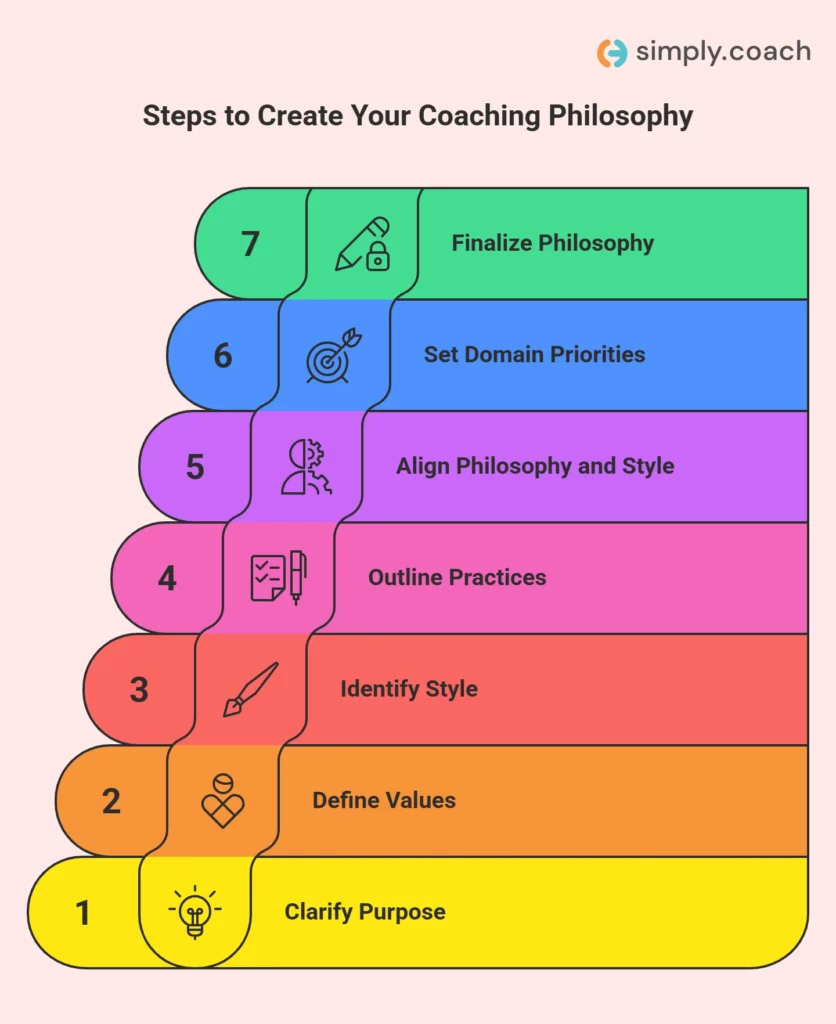
For experienced coaches, a well-defined philosophy strengthens judgment, supports emotional regulation, and maintains consistency across challenging or high-stakes interactions.
Each step below builds on the last, helping you translate values and objectives into practical, session-level behaviors.
1. Clarify your purpose and mission
Your purpose and mission define the foundational “why” of your coaching practice. They help you maintain clarity during high-stakes or emotionally charged sessions and anchor your interventions in long-term client growth. Establishing this foundation ensures every decision reflects both your values and your professional judgment.
Start by clarifying why you coach and what you aim to achieve. Your mission anchors decisions during critical or complex sessions. Ask yourself:
- Why do I coach this specific type of client?
- What outcomes matter most in my sessions?
- How do I define success beyond external metrics?
2. Define your core values
Core values act as guiding principles, determining how you interact with clients, manage rupture repair, and respond to escalation or resistance. Limiting yourself to 3–5 values keeps your focus clear, ensuring interventions remain consistent and ethically grounded.
Outline the values that guide your interventions and decisions. Examples include:
- What do I stand for as a coach?
- What are my non-negotiables in client interactions?
- Which behaviors or attitudes will I always model?
- Which values underpin my approach to emotional regulation and rupture repair?
3. Identify your coaching style
Your coaching style reflects how you translate values into session-level behaviors. Understanding your style helps you decide when to guide, when to observe, and how to balance structure with flexibility in complex client interactions. It also ensures your approach is consistent across different coaching domains.
Determine how your values translate into session behaviors. Consider:
- Am I more directive, facilitative, or reflective?
- How do I respond under pressure or during rupture repair?
- Which behaviors best reinforce client autonomy and agency?
- Which approaches naturally align with my values?
4. Outline your core practices
Core practices are the methods, strategies, and facilitation approaches you use consistently to implement your philosophy. They define session flow, feedback delivery, and client engagement, ensuring interventions remain purposeful and aligned with values.
Outline the methods, strategies, and facilitation approaches you consistently apply. Examples include:
- Structuring sessions to support emotional regulation and rupture repair
- Using reflective dialogue frameworks for insight and adaptive learning
- Scaffolding challenging behaviors while monitoring client readiness and affect
- Employing documentation, automated check-ins, and goal tracking to maintain consistency
5. Integrate philosophy with your style
Linking your philosophy to your coaching style ensures that values, objectives, and behaviors align, creating coherence across all sessions. This integration strengthens judgment, supports adaptive responses, and maintains client safety in emotionally charged or high-risk scenarios.
Ensure your style reflects your philosophy in practice. Ask yourself:
- How does my style reflect my core values in session?
- Which behaviors operationalize my philosophy consistently?
- How do I adjust style without compromising principles?
- How do I ensure interventions support both process and outcome?
6. Explore priorities across coaching domains
Breaking coaching into categories helps you operationalize your philosophy across different domains (life, executive, career, and relationship). It clarifies where to emphasize structure, reflection, skill-building, or containment, and where flexibility is critical.
Explore key coaching areas and define priorities. Ask yourself:
- Teaching and skill-building: what is my priority approach?
- Leadership and people management: how do I model behaviors?
- Character and discipline: which practices are non-negotiable?
- Planning, preparation, strategy, and tactics: how structured should sessions be?
- Feedback and communication: what frameworks do I rely on?
- Innovation and adaptation: when do I allow creative exploration versus containment?
7. Finalize your philosophy statement
Synthesizing insights into a cohesive, actionable statement creates a reference for session-level decisions. A well-articulated statement changes with experience and serves as a guide for maintaining consistency and judgment.
Create a concise statement that guides your practice. Consider:
- How can I summarize my philosophy in one or two paragraphs?
- Which session behaviors reflect my values and style?
- How do I ensure my statement is actionable, not theoretical?
- How will I revisit and refine my philosophy as I gain experience?
After developing your philosophy, these practical tips help you translate it into clear statements for your clients and team.
5 Tips to Write Your Coaching Philosophy Statements
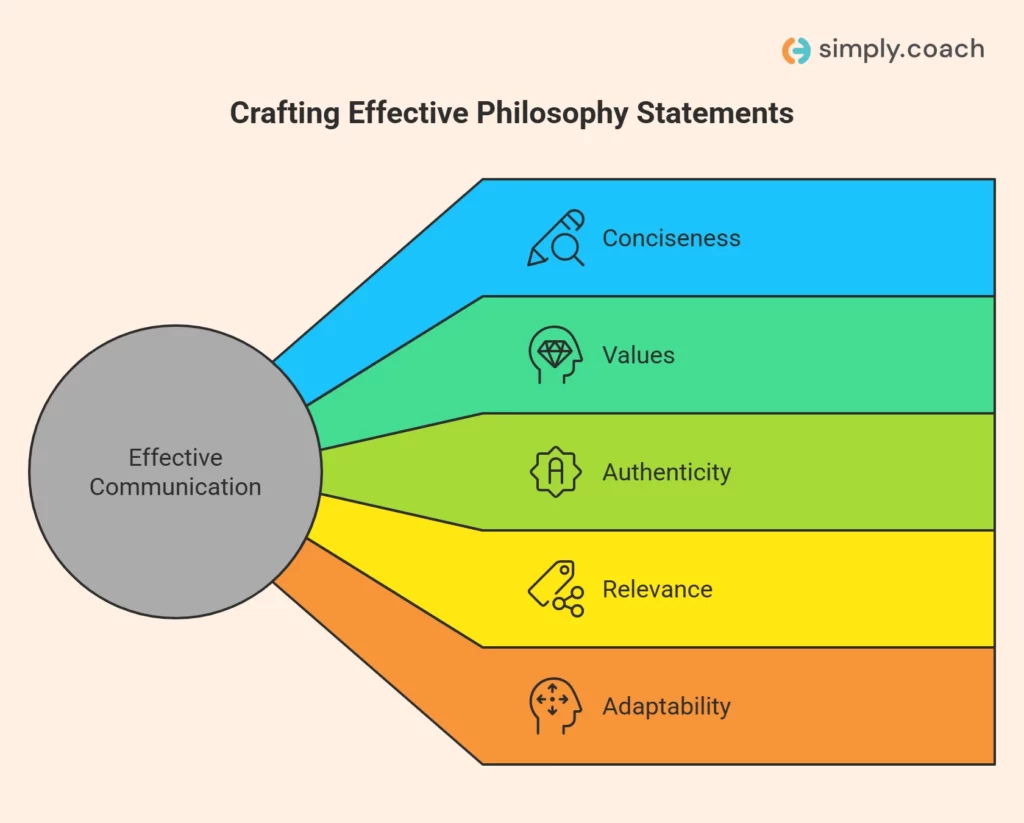
For experienced coaches, a coaching philosophy statement serves as a north star for decisions during emotionally charged sessions, rupture repair, or high-stakes client interventions.
1. Keep it concise and actionable
Your statement should be clear, specific, and operational, not abstract or generic. It acts as a reference for real-time session decisions, helping you balance guidance with client autonomy. A concise, actionable statement allows you to quickly align interventions with your principles, ensuring each session reflects your priorities and core values.
2. Ground it in your purpose and values
Link your statement directly to your mission, core values, and the reasons you coach. This ensures your philosophy is both aspirational and clinically anchored, reinforcing consistency during high-risk or emotionally charged sessions. A values-grounded statement reminds you of what matters most in client outcomes and guides interventions while maintaining ethical and relational boundaries.
3. Reflect your coaching style and approach
Your philosophy should describe how you operate in sessions, including the balance between facilitation, guidance, and reflective inquiry. For experienced coaches, this clarity allows adaptation without compromising core principles. It communicates how you manage power dynamics, support emotional regulation, and structure sessions while maintaining client autonomy and engagement.
4. Make it relevant across contexts
Ensure your statement applies to the types of clients and coaching domains you work in, be it life, career, executive, business, or relationship coaching. A context-aware statement allows you to translate principles into practice consistently, adjusting your interventions to client readiness, emotional states, or session goals while preserving fidelity to your philosophy.
5. Keep it flexible and adaptable
A coaching philosophy is a living document, not a fixed mantra. As your practice grows and you encounter new challenges, your statement should improve to reflect new insights, session learnings, and refined judgment. Flexibility ensures that your philosophy remains actionable, grounded, and relevant, guiding you through complex client interactions while supporting sustainable growth.
Also read: What Is Your Coaching Philosophy? [How to Develop a Strong & Effective One]
With your philosophy documented, the next step is choosing digital tools that help implement it in your day-to-day practice.
3 Best Digital Software for Your Practice
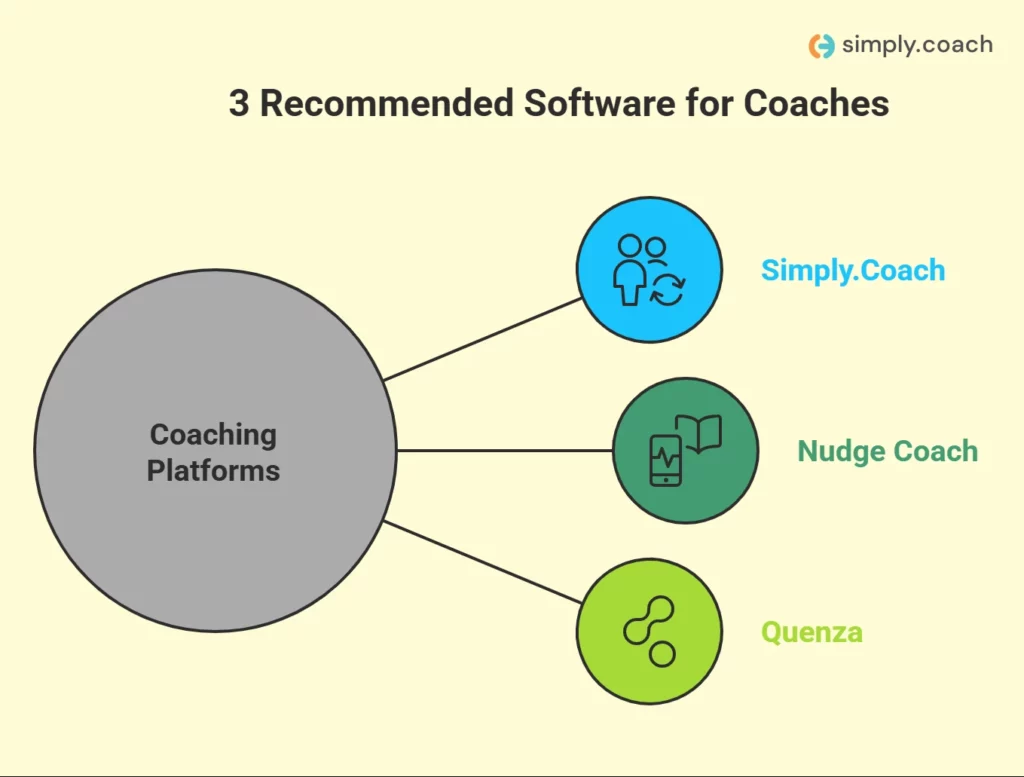
Selecting the right digital platform can change your coaching practice. For experienced coaches managing multiple clients, programs, and session data, a comprehensive tool helps automate administrative tasks, reduce no-shows, and maintain consistency across interventions.
1. Simply.Coach
Simply.Coach is a leading digital coaching platform designed for professionals such as coaches, therapists, consultants, and trainers. It simplifies client management, automates session workflows, and enhances engagement through tools like goal tracking, action plans, and nudges. By combining administrative automation with a focus on client outcomes, Simply.Coach helps coaches to maximize their impact while maintaining session-level control and supporting emotional and behavioral growth.
Key features
- Reports: Generate automated insights on client progress, impact, and coaching outcomes, with easy sharing for sponsors or stakeholders.
- Stakeholder integration: Collect feedback from managers, peers, or team members and track behavioral changes for holistic assessments.
- Action plans and nudges: Keep clients accountable with task tracking and automated reminders to reinforce behavioral change and consistency.
- Goal & development planning: Set SMART goals for clients, track progress, assign actions, and automate periodic check-ins to maintain accountability.
- Scheduling and notes: Integrate calendars, allow self-booking, manage session notes, and convert notes into actionable steps with reminders.
- Forms: Create custom forms, exercises, and templates; automate collection, and nudge clients to complete them on time.
- Client workspaces and shared resources: Enhance collaboration through centralized dashboards, shared materials, and discussion tools for engagement and learning.
- Team engagements: Manage multi-client or corporate coaching programs with automated logistics, communications, and centralized program management.
- Business management tools: Journey builder templates, subscriptions, contracts, invoicing, and facilitating payments, all integrated for efficiency.
Pricing
Plans begin at $9 per month and scale with additional features and users:
- Starter: $9/month
- Essentials: $29/month
- Growth: $49/month
- Leap: $69/month
(Prices may vary based on billing frequency and annual discounts.)
Reviews
- G2: 4.8/5 (45+ reviews)
- Capterra: 4.6/5 (40+ reviews)
2. Nudge Coach
Nudge Coach is a digital platform designed to help coaches engage clients consistently, track progress, and reinforce behavioral change. It focuses on delivering automated nudges and actionable insights that keep clients on track between sessions. The platform is ideal for life, career, executive, and wellness coaches seeking tools to improve client adherence and outcomes.
Key features
- Automated nudges: Send clients friendly reminders about actions, goals, or exercises to maintain consistency between sessions.
- Progress tracking: Dashboards provide an overview of client engagement and behavioral changes over time.
- Action assignments: Easily assign tasks aligned with client goals and track completion.
- Client engagement analytics: Insights on response rates, activity completion, and session readiness.
- Calendar and communication integration: Sync sessions, reminders, and follow-ups to reduce administrative burden and no-shows.
Pricing: Plans start at $19/month, scaling with users and features.
Reviews
- G2: 4.5/5
- Capterra: 4.4/5
Quenza
Quenza is a lightweight platform designed to digitize coaching programs and client interactions, making it easy for coaches to share exercises, monitor progress, and maintain engagement. Perfect for solo practitioners or small teams who want structured program delivery without a heavy administrative load.
Key features
- Activity creation: Build exercises and programs tailored to client needs.
- Automated program delivery: Schedule activities, reminders, and follow-ups for consistent engagement.
- Progress tracking: Monitor client completion rates and program adherence easily.
- Client workspace: Centralized hub for clients to access exercises, notes, and resources.
- Integration with tools: Connect Zoom, email, and other platforms for seamless session management.
Pricing: Starts at $25/month for solo coaches; team plans available.
Reviews:
- G2: 4.6/5
- Capterra: 4.5/5
Conclusion
A clearly defined coaching philosophy is the guiding framework for every session, intervention, and client interaction. From understanding your purpose and core values to articulating your style and objectives, a solid philosophy ensures consistency, supports emotional regulation, strengthens rupture repair, and improves adherence to client goals.
When combined with actionable tips and real-life examples, it provides experienced coaches with a reliable reference for handling complex client dynamics.
For coaches ready to streamline their practice without sacrificing quality or client outcomes, Simply.Coach offers an all-in-one platform that combines client management, goal tracking, automated nudges, action plans, and integrated video conferencing. With SOC2, HIPAA, and GDPR compliance, it ensures both operational efficiency and client data security, enabling experienced coaches to maintain focus on what matters most: facilitating lasting change and meaningful client results.
FAQs
1. What is a coaching philosophy, and why does it matter?
A coaching philosophy is your guiding framework for decisions, interventions, and in‑session judgment. It matters because it influences how you manage emotional regulation, conflict, rupture repair, and long‑term adherence to goals.
2. How do I develop a coaching philosophy as an experienced coach?
Start with your purpose and core values, clarify your objectives, identify your coaching style, and integrate these into consistent session practices. Reflection on experience and client outcomes deepens clinical judgment.
3. What should a coaching philosophy statement include?
It should include your mission, core values, coaching style, session priorities (e.g., escalation containment, emotional regulation cues), and how you support sustainable client change.
4. How is coaching philosophy different from coaching style?
Philosophy is your decision framework for why and when you intervene. Style is how you express that in session (facilitative, reflective, directive) while considering power dynamics and emotional safety.
5. Can a coaching philosophy change over time?
Yes. As your experience grows and client complexity deepens, your philosophy should change while remaining grounded in core values, session safety, and consistent outcomes.