
If you know testimonials matter but still hesitate to ask for them, you are not alone. For many coaches, the hard part is not delivering results. It is knowing how to ask for a testimonial in a way that feels natural, respectful, and easy for the client to respond to.
The truth is, most clients are happy to share their experience. They just need the right prompt, the right timing, and the right format. If you ask too vaguely, too late, or with too much effort required, you usually get no response or a weak one-line quote.
In this article, you will learn 8 effective ways to ask clients for testimonials, when to ask, how to make it feel friction-free, and how to turn client wins into credible social proof for your coaching business.
Key Takeaways
- Ask at the right time: Request testimonials shortly after client breakthroughs or milestone achievements to capture authentic, detailed feedback.
- Focus on transformations: Highlight measurable results, mindset shifts, or skill improvements to make testimonials credible and persuasive.
- Personalize and simplify: Tailor requests to each client’s journey and offer flexible formats like text, audio, or video to increase participation.
- Integrate testimonials into workflow: Include requests naturally in sessions, progress reviews, or milestone celebrations for consistent collection.
- Use strategically to build trust: Display testimonials on sales pages, program pages, and emails, matching them to objections and keeping them current.
- Learn from real examples: Platforms like Simply.Coach demonstrate that specific, outcome-driven reviews establish credibility and influence decisions.
Why Coaches Need Client Testimonials
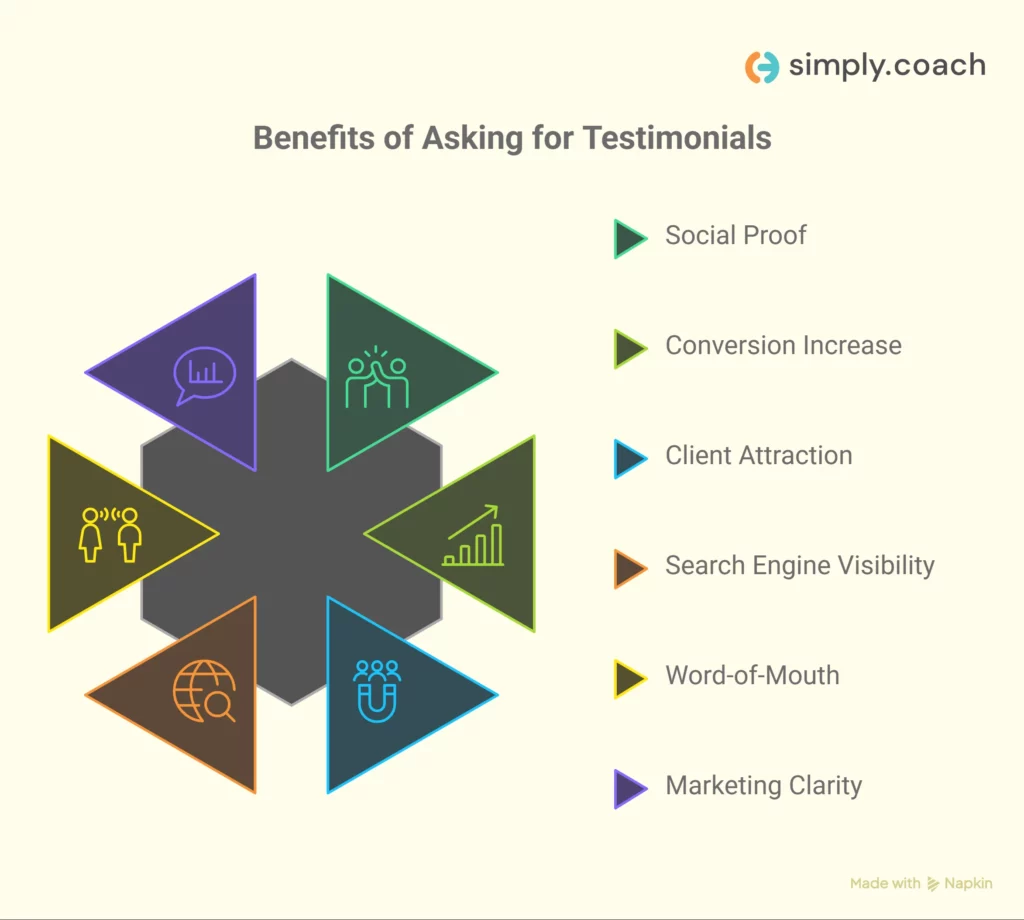
Client testimonials do far more than validate your work. Coaches often struggle to stand out among competitors. Well‑crafted testimonials help you establish credibility and show outcome‑based proof of your coaching impact. Potential clients look for evidence of real results before they make a decision.
Here are the benefits of asking for testimonials:
- Build social proof with real results: Testimonials show concrete outcomes, making your coaching claims more believable.
- Increase conversion on sales pages: Prospects are more likely to engage when they see relatable success stories.
- Attract more ideal clients: Testimonials help people, such as your existing clients, recognize themselves in those stories.
- Strengthen your coaching authority: When others speak about your impact, your expertise stands out in search and referrals.
- Support word‑of‑mouth referrals: Happy clients who provide testimonials are more likely to recommend your services.
- Improve marketing message clarity: Testimonials show what results clients actually value, refining your positioning.
Collecting strong testimonials lets you highlight specific outcomes and patterns that matter most to your coaching audience.
8 Proven Strategies to Ask for Client Testimonials
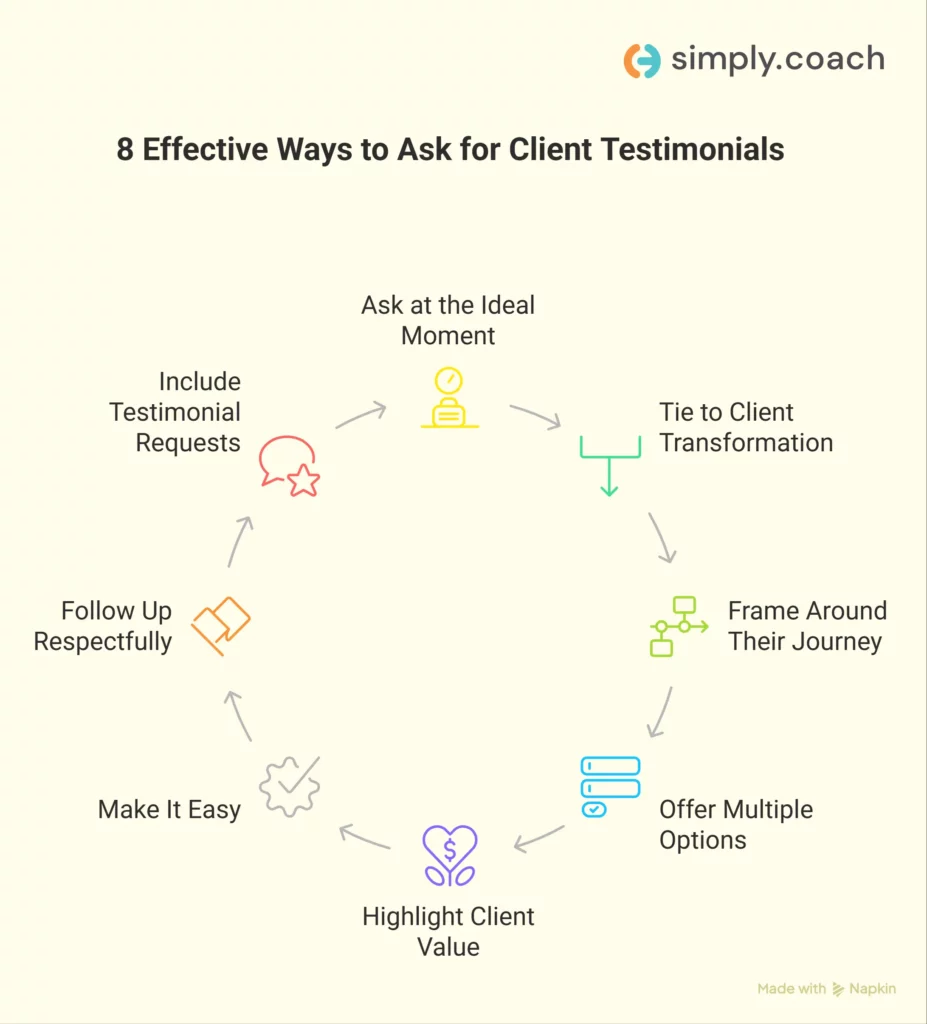
The success of your coaching business depends on how well you build trust with future clients. Testimonials show others what transformation looks like in real terms. The best strategy isn’t guessing; it’s being intentional, respectful, and thoughtful about the way you request those testimonials. Here are eight strategies that get results for coaches.
1. Ask at the ideal moment
To get the most thoughtful testimonials, timing matters. Ask when the experience is still fresh and the client is proud of their progress. As a coach, this might be right after a breakthrough session, the completion of a program, or after a major milestone. Clients are most willing to share when they are feeling grateful and clear about what changed for them.
Actionable tips:
- Identify peak moments: Note sessions where clients achieve tangible results or breakthroughs. These moments naturally inspire enthusiasm to share.
- Send requests promptly: Reach out within 48–72 hours after a milestone while the experience is fresh in their mind.
- Tie requests to specific outcomes: Reference changes like improved mindset, completed goals, or breakthrough habits to make the testimonial concrete.
- Personalize your timing: Consider individual client journeys and choose the moment when their progress is most evident.
- Frame the request positively: Highlight their success as the reason for the testimonial, making it feel celebratory instead of obligatory.
2. Make your request specific to the result
Generic testimonial requests produce generic responses. If you want powerful social proof, your request must be anchored to a clear result.
Instead of asking, “Can you write a testimonial?” guide the client toward the transformation they experienced. Specific prompts help clients articulate meaningful outcomes rather than vague praise.
Practical approaches:
- Reference the exact result: Mention the goal they achieved, the obstacle they overcame, or the milestone they reached.
- Highlight the before-and-after contrast: Prompt them to describe where they were before coaching and what changed.
- Focus on measurable outcomes: Ask about promotions, revenue growth, confidence shifts, clarity, productivity, or habit consistency.
- Use outcome-driven language: Frame the request around impact, not satisfaction. For example, “What tangible difference has this coaching made?”
- Guide, don’t script: Offer 2–3 prompts that encourage depth while allowing clients to respond naturally.
When your request is specific to the result, you make it easier for clients to recall concrete changes. That clarity leads to testimonials that feel credible, detailed, and persuasive.
3. Personalize the request to the individual client
Even when you make your request specific to a result, it can still feel generic if it sounds like a template sent to everyone.
Personalization is what turns a testimonial request into a meaningful conversation. When clients feel seen and acknowledged, they are far more likely to respond thoughtfully.
Instead of copying and pasting the same message, reference details unique to that client’s experience.
Ways to personalize your request:
- Mention their original goal: Reconnect them with their primary objective; the reason they started this coaching journey.
- Acknowledge their effort: Recognize the work they put in, not just the outcome.
- Use language they used: Repeat phrases they said during sessions to make the request feel familiar.
- Reference a specific moment: Mention a breakthrough session, tough decision, or turning point.
- Adapt tone to the relationship: Some clients prefer formal language, others respond better to conversational wording.
What this sounds like in practice
“When we first started, you were feeling stuck about stepping into leadership conversations. Watching you confidently lead that team meeting last week was a big shift. If you’re open to it, I’d love a short testimonial about what changed for you and what helped most during this process.”
This kind of request feels thoughtful, not automated. It shows that you were paying attention to their journey, which naturally encourages a more genuine response.
4. Offer multiple response options
Clients are more likely to respond when they can share feedback in the format they find easiest. Offering options removes barriers and respects individual preferences.
Response options to offer:
- Brief text quotes: 2–3 sentence statements that are quick to write but impactful.
- Voice notes: Allow clients to speak their experience, capturing natural tone and emotion.
- Short video clips: Mobile-friendly videos of 30–60 seconds highlight authenticity.
- Anonymous submissions: Some clients may prefer sharing feedback without their name attached.
- Guided prompts: Offer questions or topics to guide the response without limiting storytelling.
5. Highlight the value for the client
When clients understand how their testimonial can help others, they are more willing to share. Testimonials framed as inspiration or guidance create meaningful contributions.
Tips to show value:
- Explain the impact on others: Show that sharing their story may help peers make informed decisions.
- Connect to community growth: Present their feedback as a way to support the coaching community.
- Focus on legacy: Emphasize that their success story can influence positive change in others’ lives.
- Acknowledge their achievements: Recognizing their progress motivates participation.
- Invite reflection: Encourage clients to describe what made their transformation meaningful.
6. Make it easy and friction-free
Simplifying the process increases testimonial completion. Long, complicated forms discourage participation and reduce response rates.
Pro tips for simplicity:
- Use short forms or links: One-click links with prefilled prompts reduce effort.
- Include examples: Provide sample answers or suggested sentence structures to guide your clients.
- Specify time commitment: Mention that sharing will take only a few minutes.
- Offer step-by-step instructions: Break the process into clear, manageable actions.
- Minimize tools: Avoid requiring multiple logins or software downloads that can frustrate clients.
7. Follow up respectfully
Not every client responds to the first request. Gentle, considerate follow-ups increase response rates without straining relationships.
Respectful follow-up practices:
- Wait an appropriate period: Typically one week after the initial request.
- Keep it brief: A short note reminding them of the request is sufficient.
- Reiterate purpose: Remind your clients how their testimonial helps others without pressuring them.
- Show gratitude: Thank them for considering contributing regardless of their decision.
- Offer flexible options: Remind your clients they can choose any format or level of detail they prefer.
8. Include testimonial requests naturally in your coaching workflow
The most effective coaches treat testimonials as part of the coaching journey. Integrating requests into your existing processes increases response rates and authenticity.
Workflow examples:
- Request after key sessions: Ask following program completion or major breakthroughs.
- Mention early in the program: Let clients know you may ask for feedback during milestones.
- Incorporate into progress reviews: Add a question during quarterly check-ins or evaluation sessions.
- Keep requests consistent: Standardize the timing across clients while adapting to individual experiences.
- Link to action outcomes: Highlight specific transformations or results in your request for context.
Applying these eight strategies thoughtfully ensures your testimonial requests are client-centered, actionable, and generate authentic stories that strengthen your credibility as a coach.
Must read: How to Get Coaching Testimonials: A Complete Guide with Questions & Templates
Quick Testimonial Request Examples for Coaches
Understanding the strategy behind how to ask for a testimonial is important. But sometimes, what you really need is the exact language to use.
Below are three simple, natural examples you can adapt depending on the situation.
1. After a breakthrough session
When a client experiences a visible mindset shift or solves a long-standing challenge, keep the request immediate and specific.
“You’ve made a big shift in how you’re approaching this challenge. If you’re open to it, I’d love a short testimonial about where you were before, what changed, and what’s feeling different now.”
This works because it anchors the request to a clear transformation rather than a vague compliment.
2. After the program completion
When wrapping up a coaching engagement, position the testimonial as a reflection on their journey.
“Now that we’ve wrapped up the program, would you be open to sharing a few lines about your experience? A short note on what changed for you and what you found most valuable would be incredibly helpful.”
This frames the request as appreciation and reflection, not obligation.
3. As a follow-up email
If you prefer email, or in case the moment has passed, keep it light and offer support.
“Thanks again for the work you put into this. If you’d be happy to share a short testimonial, I can send a few simple prompts to make it easy.”
Offering prompts reduces friction and increases the likelihood of a response.
These examples demonstrate that knowing how to ask for a testimonial is less about perfect wording and more about clarity, timing, and making it easy for the client to say yes.
How to Use Client Testimonials Effectively to Increase Conversions

Once you have strong testimonials, use them intentionally. A well-placed testimonial can influence decisions more than a long explanation about your services.
Here are focused ways to maximize their impact:
- Place them where decisions happen: Add relevant testimonials directly on sales pages, program pages, and booking pages. Position them near pricing details, outcomes, or call-to-action sections.
- Match them to specific objections: If your clients worry about time, show a testimonial from a busy professional. If they question results, highlight a measurable outcome.
- Organize them by theme: Categorize testimonials by outcomes such as confidence, promotion, revenue growth, clarity, or leadership development. This makes them easier to use in proposals and marketing materials.
- Use strong excerpts strategically: Pull one clear, results-focused sentence and place it in emails, pitch decks, or discovery call follow-ups.
- Keep them current: Review testimonials every 6 to 12 months and replace outdated ones that no longer reflect your positioning or ideal client.
- Retain authenticity: Avoid over-editing client language. Natural wording builds more trust than perfectly polished statements.
When used intentionally, testimonials serve as visible proof of your results at every stage of the client journey.
Also read: How to Build Compelling Case Studies and Life Coaching Testimonials
How Simply.Coach Uses Testimonials to Build Trust With Coaches
Everything discussed in this guide about how to ask for a testimonial also applies to platforms that serve coaches. Clear, specific, outcome-driven reviews build far more trust than generic praise.
Simply.Coach demonstrates this well. Instead of broad statements, their reviews highlight practical results coaches care about, such as saving time on admin, simplifying client management, and reducing manual follow-ups.
The testimonials are effective because they:
- Focus on operational improvements, not vague compliments.
- Reference real workflows like onboarding, session tracking, and payments.
- Reflect common coaching challenges such as time pressure and organization.
- Use straightforward language from actual users.
This mirrors the same principle you should apply when learning how to ask for a testimonial: specificity builds credibility.
Review how coaches describe their results with Simply.Coach
If you want to see how detailed, experience-based testimonials influence buying decisions, review how coaches describe their results with Simply.Coach and observe how social proof works in action.

Conclusion
Knowing how to ask for a testimonial is not about collecting compliments. It is about capturing transformation. When you ask at the right moment, guide clients with thoughtful prompts, and make the process simple, you turn real outcomes into powerful proof. Those stories do more than fill space on a website. They reduce hesitation, answer objections, and help future clients see what is possible for them.
When testimonial requests become a natural part of your coaching workflow, you create a consistent system for documenting progress and celebrating wins. Over time, this builds a library of credible, specific success stories that strengthen your positioning and increase conversions without sounding promotional.
Simply.Coach helps you manage your coaching practice efficiently so you can focus on delivering results that generate strong testimonials. Using an all in one coaching platform, Simply.Coach helps save time on scheduling, tracking client progress, and managing session notes. With everything organized in one platform, it is easier to document client achievements and highlight real outcomes.
FAQs
1. When is the best time to ask a client for a testimonial?
Ask for a testimonial soon after a client’s success or breakthrough. The sweetest spot is within 24 – 72 hours after they achieve a milestone or complete your program. During this time, the experience is fresh and clients can describe their results in detail, which leads to better testimonials.
2. How do I ask a client for a testimonial without sounding pushy?
Be specific and respectful in your request. Reference the result they achieved, thank them for the work you did together, and explain how their testimonial will help others make confident decisions. Avoid broad phrases like “write something nice.”
3. What should I include in a testimonial request message to clients?
A clear request should: mention the client’s name, highlight a specific result or milestone, explain why their story matters, and offer simple response options. You can also provide helpful prompts to guide their response if needed.
4. How many questions should I ask in a testimonial form?
Keep it short and focused. Ask only the essential questions that help illustrate transformation, such as what challenge they faced before coaching, what changed after working with you, and how the change impacted their life or work. Too many questions can overwhelm clients.
5. Can I ask for a testimonial in person or should I use email?
Both methods work well, but timing matters. If you meet clients in person during a session or celebration of success, ask for a short quote then. If not, send a well‑timed email within a day or two of their milestone. Offering both options increases response rates.
6. Should I offer clients multiple ways to give a testimonial?
Yes. Clients are more likely to respond when they can choose a format that suits them. Options include short written quotes, audio recordings, or brief video clips. This flexibility increases participation and variety in your testimonial library.
7. Can I edit a client’s testimonial before publishing it?
Yes, but with permission. Ask clients how they would like their name to appear and whether minor edits for clarity are okay. Always respect their comfort level and maintain the original meaning of their words.