
ADHD coaching is one of the fastest-growing niches in the U.S., but what does it really pay? In the United States, about 10.2% of boys and 5.6% of girls have an ADHD (Attention-Deficit/Hyperactivity Disorder) diagnosis. These numbers have climbed steadily over the last two decades, which means more families and adults are actively looking for coaching support. That rise in demand directly affects income potential in this field.
As an ADHD coach, you work with clients who want structure, focus, and better ways to manage their daily responsibilities. Coaching is different from therapy because it emphasizes practical strategies and accountability, not diagnosis or treatment. This distinction makes your role unique and results-driven.
This guide takes you through what an ADHD coach salary looks like in the U.S., the factors that shape those earnings, and how you can grow your practice to reach higher salary brackets.
Key Takeaways
- ADHD coach salaries in the U.S. range widely, from $40K/year for entry-level roles to $128K/year for experienced coaches with specialized programs and corporate contracts.
- States play a major role, Washington, D.C., New York, and Massachusetts offer the highest salaries, while Florida and the Southeast tend to have lower rates.
- Experience, certifications, and business models (hourly vs. packages vs. corporate) directly influence income potential.
- Certifications like ICF or ADDCA can increase your earning capacity and attract higher-paying clients.
- Offering group programs, workshops, and digital products can expand your reach and create additional revenue streams.
- Simply.Coach helps ADHD coaches automate admin tasks, making it easier to scale your business and increase earnings without additional time commitment.
Average ADHD Coach Salary in the U.S. (2026 Data)
When you search for ADHD coach salary figures in the U.S., you’ll notice wide differences across sources.
ZipRecruiter reports an average annual salary of about $40,970, which comes to $19.70 per hour. These numbers reflect entry-level and mid-level positions, often tied to hourly sessions or part-time coaching.
Glassdoor shows a very different picture, with a median salary closer to $128,000 per year. This range reflects more established ADHD coaches who offer structured programs, work with executives, or secure corporate coaching contracts.
The gap between these numbers exists because salary data comes from different reporting pools. Job boards often track hourly postings, while self-reported platforms reflect established coaches running independent practices.
For you, the key takeaway is this: the ADHD coach salary spectrum in the U.S. stretches from entry-level hourly rates to six-figure incomes. Where you land depends on experience, certifications, and the type of clients you work with.
ADHD Coach Salary by State (U.S. Breakdown)
ADHD coach salary in the U.S. differs widely depending on where you practice. States with higher living costs and stronger demand for coaching, like Washington, D.C. and New York, pay more. States in the Southeast and parts of the Midwest generally show lower averages.
| State | Annual salary | Hourly rate |
| Washington | $46,403 | $22.31 |
| District of Columbia | $46,297 | $22.26 |
| New York | $44,823 | $21.55 |
| Massachusetts | $44,745 | $21.51 |
| Colorado | $43,978 | $21.14 |
| Oregon | $43,184 | $20.76 |
| Vermont | $42,672 | $20.51 |
| Hawaii | $42,350 | $20.36 |
| Alaska | $41,985 | $20.18 |
| California | $40,434 | $19.44 |
| Pennsylvania | $39,375 | $18.93 |
| Ohio | $38,950 | $18.73 |
| Texas | $38,170 | $18.35 |
| Missouri | $38,430 | $18.48 |
| Michigan | $35,709 | $17.17 |
| North Carolina | $35,409 | $17.02 |
| Georgia | $34,517 | $16.59 |
| Florida | $30,617 | $14.72 |
The spread is clear: Washington, D.C., New York, and Massachusetts lead the charts, while Florida and the Southeast sit at the lower end. For ADHD coaches, this means your earning potential can shift significantly depending on your client base and region.
Also read: Life Coach Pay Rate: How Much Can You Make in 2025
Factors That Influence ADHD Coach Income
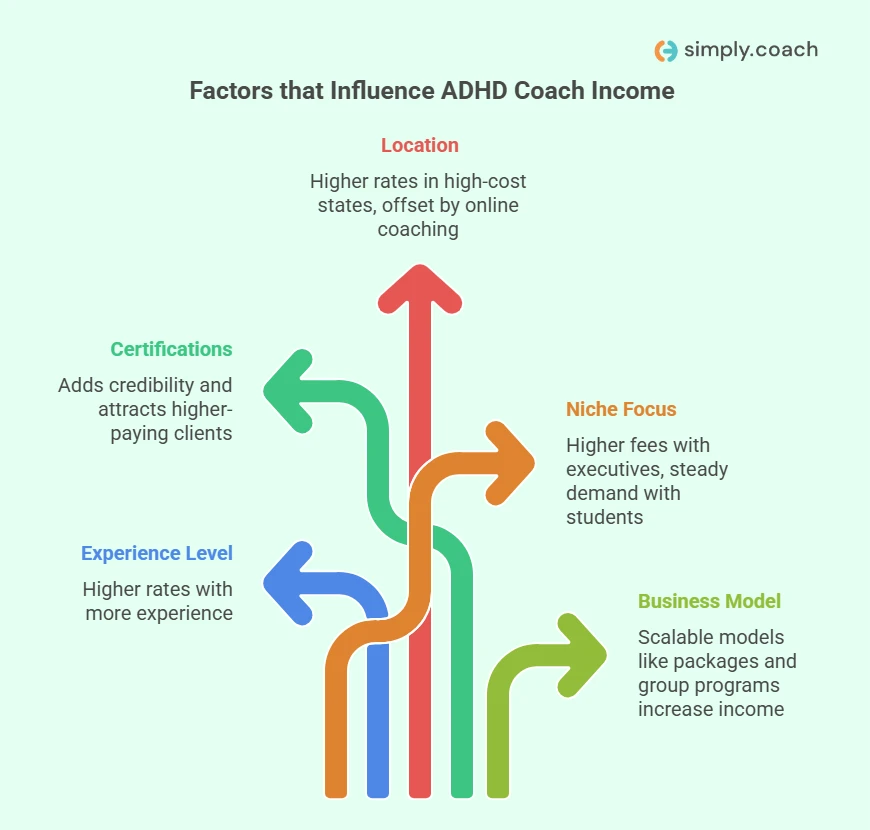
Your ADHD coach salary in the U.S. is shaped by a mix of professional choices and market realities. Each factor interacts with the others, so the more strategically you approach them, the more your income grows.
1. Experience level
- Starting out: If you are new to ADHD coaching, you may begin with rates between $50 and $75 per session. At this stage, your focus is often on building testimonials and gaining trust rather than maximizing income.
- Growing practice: Coaches with a few years of experience and steady clients usually shift to structured packages priced at $100 to $150 per session. This transition not only raises earnings but also provides more stability.
- Established coaches: Once you have proven outcomes and a strong client base, your income potential expands. Many experienced ADHD coaches charge $200 or more per session, and some secure monthly retainers or corporate contracts that pay several thousand dollars.
2. Certifications
- Why it matters: Certifications like ICF or ADDCA don’t just add a title after your name, they act as proof of credibility. Clients, especially parents and executives, view these as signals of professionalism.
- Impact on income: Coaches with certifications often find it easier to charge premium rates because clients associate credentials with reliability and quality results. This credibility can also help you win corporate opportunities that may not be available to non-certified coaches.
3. Location
- High-cost states: Living in states like New York, Massachusetts, or Washington, D.C., typically allows you to set higher fees because local markets expect them.
- Lower-cost states: Coaches in regions like the Midwest or Southeast often face lower average rates, but this gap can be closed by offering online coaching programs that attract clients nationwide.
- Regional influence: Your earning potential reflects not just where you live but also where your clients are located and how much they are able to invest.
4. Niche focus
- Students and families: Working with children and teenagers brings steady demand, but budgets in this segment are often limited.
- Executives and professionals: Corporate clients and entrepreneurs value results that tie to performance and career growth. This niche supports higher fees and often leads to long-term contracts.
- Choosing a niche: By defining your focus clearly, you attract clients who not only need your help but are also prepared to pay the rates that reflect your expertise.
5. Business model
- Hourly sessions: Sticking to single-session pricing limits your income because you are directly trading time for money.
- Packages and subscriptions: Offering multi-session packages or monthly subscriptions creates predictable revenue and reduces “no-shows.”
- Group programs and corporate contracts: These models scale your reach. Instead of working only one-on-one, you can serve multiple clients at once or manage long-term organizational programs, which often pushes annual income into the six-figure range.
For ADHD coaches like you, each of these factors is a lever. The way you combine experience, certifications, location strategy, niche, and business model directly determines where your income falls on the salary spectrum.
ADHD Coaching Business Models & Their Income Potential
How you structure your coaching practice plays the biggest role in determining your ADHD coach salary. Each model creates different opportunities for income, client commitment, and business stability. Understanding these models helps you decide which combination will work best for your goals.
1. Hourly sessions
Charging by the hour is often where ADHD coaches begin. Typical rates range from $75 to $200 per session depending on your location, experience, and credentials. This model is straightforward and allows new clients to try your services without a long-term commitment.
The challenge with hourly billing is that your income rises only when you increase your number of sessions. If you average three sessions per day at $100 each, your monthly income would sit around $6,000 before expenses. This is sustainable for some, but it limits growth once your calendar fills. Many ADHD coaches eventually transition away from this model as they look for stability and scale.
2. Monthly packages and subscriptions
Packages and subscriptions create structure for both you and your clients. A common setup is four sessions per month for $600–$800, often bundled with check-ins or resources between sessions. Subscriptions might run on a rolling monthly basis, allowing you to build a steady pipeline of recurring income.
This model significantly improves client outcomes because it encourages consistency. For you, it removes the uncertainty of waiting for one-off bookings and reduces the impact of no-shows. For example, maintaining ten clients on a $700 monthly package generates $7,000 in predictable monthly revenue, giving you a clear financial baseline.
Tools like Simply.CoachSubscriptions & Packages make it easier to manage billing, renewals, and scheduling without manual work.
3. Corporate contracts
Executive and corporate ADHD coaching offers the highest earning potential. Organizations often budget for professional development and view coaching as a measurable way to improve performance. Rates here can reach $150 to $300 per session, but many contracts are structured as retainers, bringing in $2,000 to $5,000 per month per client.
A single corporate agreement with a leadership team can generate more income than several individual clients combined. Beyond the financial benefit, corporate contracts usually extend over several months or even years, offering both stability and prestige. Coaches in this space often highlight progress through reports, which reinforces value for the organization and strengthens long-term relationships.
4. Digital programs and group coaching
Digital and group models expand your reach and income without increasing your working hours. For example, you might create a six-week group program priced at $600 per participant. With ten participants, the program generates $6,000, often with less overall time than one-on-one sessions.
Digital courses or hybrid programs go even further. Once built, these can be sold repeatedly at $300 to $1,500 per client, creating passive or semi-passive income. Many ADHD coaches combine digital offerings with live group sessions, providing both interaction and scalability. This model requires upfront effort in design and marketing, but the long-term return often surpasses hourly or package-based coaching.
The most successful ADHD coaches rarely rely on just one model. Instead, they combine packages for steady income, corporate contracts for higher-paying work, and group or digital programs for scale. This mix not only raises overall earnings but also provides security by spreading income across multiple sources.
Want step-by-step strategies on how to set prices for your coaching services?
Download “The Complete Guide to Pricing Strategies for Your Coaching Business” and learn how to build pricing models that support both stability and growth.

How ADHD Coaches Can Increase Their Salary
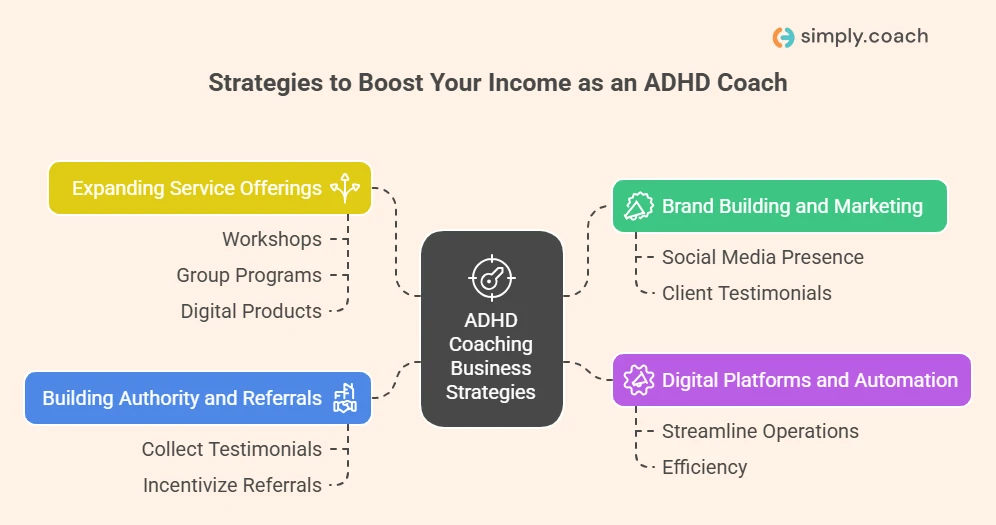
Boosting your income as an ADHD coach involves more than just raising session fees, it’s about building visibility, offering diverse services, and strengthening client trust. Here’s how you can do it:
1. Brand building and marketing
Creating a strong presence online helps you reach more of the clients who need ADHD coaching. LinkedIn is a powerful platform for connecting with professionals and parents searching for support. Sharing insights, progress stories, and tools positions you as an expert in managing ADHD challenges. Instagram allows you to share client testimonials, motivational content, and behind-the-scenes moments, which makes your coaching brand feel more approachable and personal. These platforms can help you grow a loyal audience and convert followers into paying clients.
2. Digital platforms and automation
Handling scheduling, payments, and reminders manually takes valuable time away from coaching. Using an all in one digital platform like Simply.Coach allows you to automate these tasks, giving you more space to work directly with clients. Features such as automated reminders, invoicing and payments, and progress tracking reduce no-shows and make your business run smoothly. By removing repetitive admin work, you increase your capacity to serve more clients and boost your income without adding extra hours.
3. Expanding service offerings
Diversifying your services lets you serve more clients and unlock new income streams:
- Workshops: Hosting focused sessions on time management, study skills, or workplace productivity can attract larger groups. Charging $100 to $300 per participant quickly adds up when several people attend.
- Group programs: A six-week ADHD coaching program priced at $500 per participant with ten participants generates $5,000, often requiring fewer hours than one-on-one sessions.
- Digital products or courses: Create practical guides, checklists, or online courses that clients can purchase at their convenience. Priced between $100 and $1,000, these resources provide ongoing revenue and introduce more people to your coaching style.
4. Building authority and referrals
Establishing yourself as a trusted ADHD coach makes it easier to justify higher rates and attract new clients through word-of-mouth. Start by collecting testimonials from satisfied clients and displaying them on your website or social profiles. Share success stories that highlight measurable results, such as improved academic performance or workplace productivity.
Finally, encourage referrals by offering small incentives, like discounted sessions or bonus resources, to clients who recommend your services. Referrals often come with built-in trust, making them easier to convert into long-term coaching relationships.
Conclusion
The ADHD coach salary in the U.S. ranges from modest hourly earnings to six-figure incomes, depending on how you structure your practice. Certifications, niche focus, and business models all play a role in determining where you land on that spectrum. With demand for ADHD coaching on the rise, now is the time to align your strategy with income goals. By making smart choices, you can build both financial security and lasting impact for your clients.
Managing packages, automating reminders, and tracking client progress doesn’t have to feel overwhelming. Simply.Coach, the leading digital coaching platform, gives ADHD coaches the tools to simplify operations and focus on clients. From subscriptions to reports, it’s designed to help you scale without the admin burden.
FAQs
1. What is the demand for ADHD coaches in 2026?
ADHD coaching demand is increasing as more individuals, parents, and corporate teams seek support. The rise in ADHD diagnoses and workplace awareness has led to more opportunities in coaching.
2. Can ADHD coaches work remotely or online?
Yes, ADHD coaches can easily work remotely, offering virtual sessions through video calls, which expands their reach beyond local clients and increases income potential.
3. What is the salary range for ADHD coaches working with children vs adults?
Coaches working with children generally charge less, with rates ranging between $50–$100 per session, while coaching adults or corporate clients can bring in higher rates of $150–$250 per session.
4. How much do ADHD coaches make in the first year?
In the first year, ADHD coaches typically earn between $30,000 to $50,000, depending on client base, business model, and marketing strategies.
5. What additional services can ADHD coaches offer to increase their salary?
ADHD coaches can expand their services by offering workshops, online courses, productivity consulting, or corporate packages to increase their overall income.
6. Do ADHD coaches need a specific degree to get started?
While a degree isn’t required, having training in psychology, counseling, or coaching, as well as certifications, can enhance credibility and earning potential.